Evolution of Production &
Operation Management
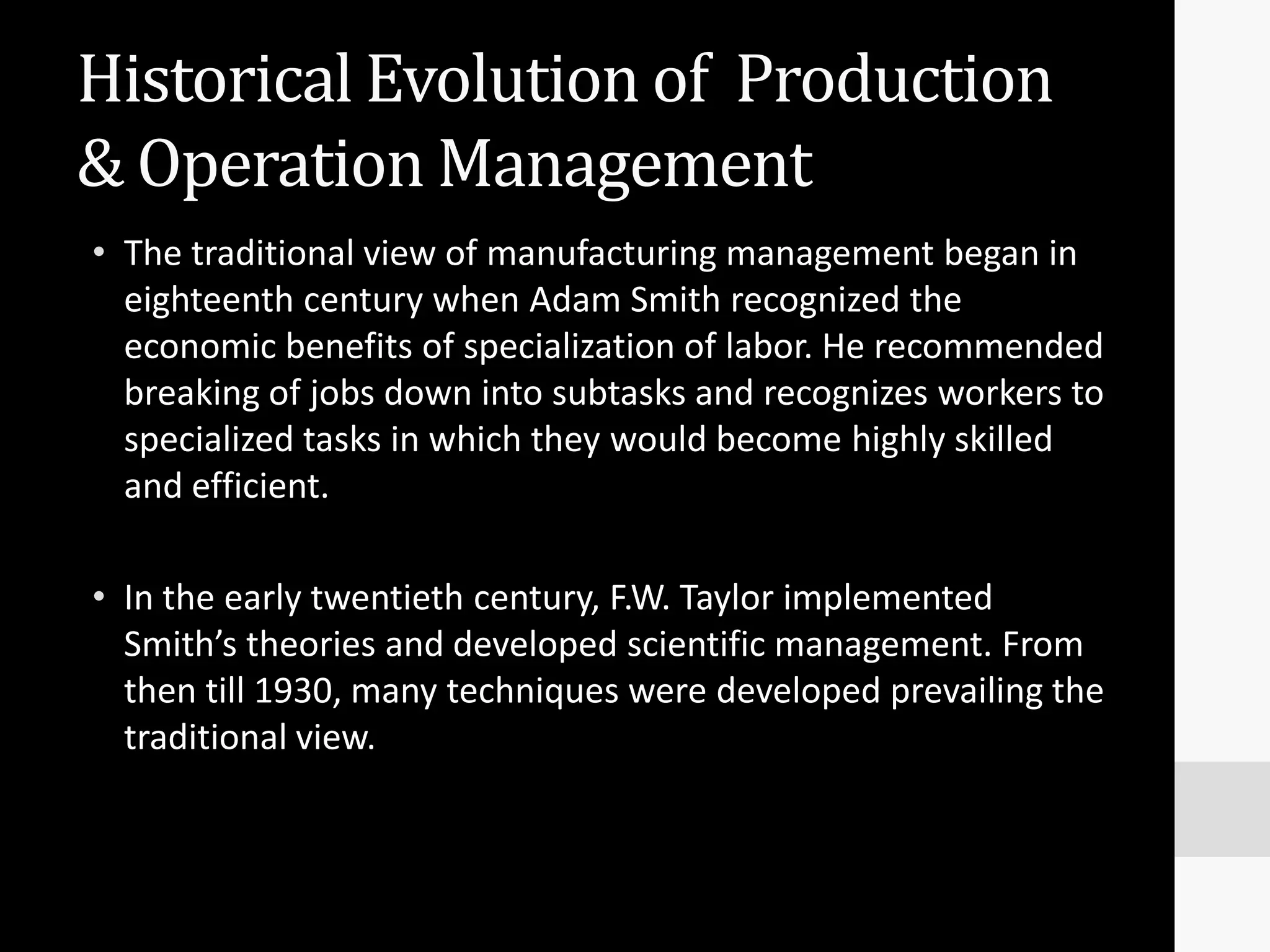
Historical Evolution of Production
& Operation Management
• The traditional view of manufacturing management began in
  eighteenth century when Adam Smith recognized the
  economic benefits of specialization of labor. He recommended
  breaking of jobs down into subtasks and recognizes workers to
  specialized tasks in which they would become highly skilled
  and efficient.

• In the early twentieth century, F.W. Taylor implemented
  Smith’s theories and developed scientific management. From
  then till 1930, many techniques were developed prevailing the
  traditional view.
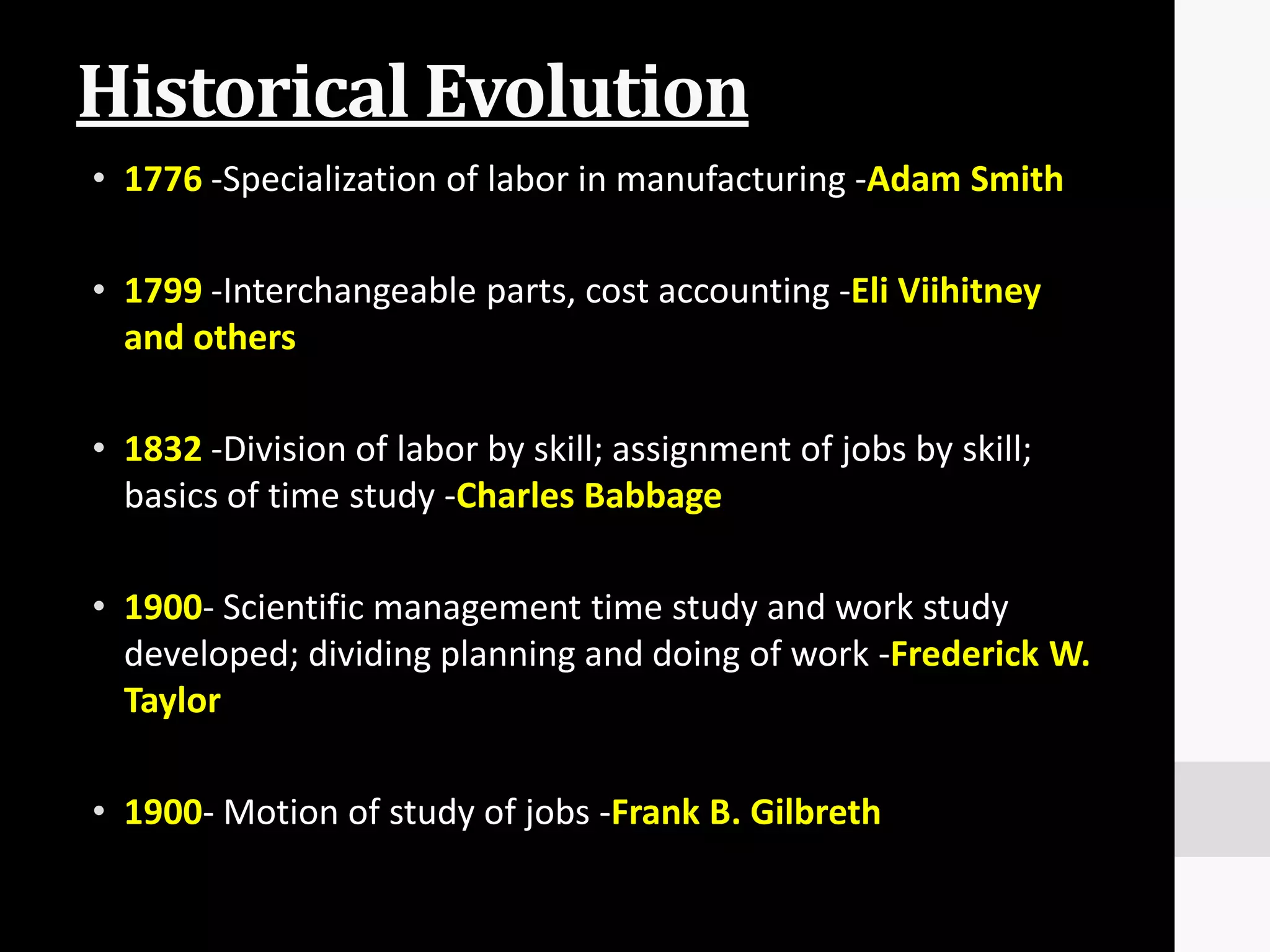
Historical Evolution
• 1776 -Specialization of labor in manufacturing -Adam Smith

• 1799 -Interchangeable parts, cost accounting -Eli Viihitney
  and others

• 1832 -Division of labor by skill; assignment of jobs by skill;
  basics of time study -Charles Babbage

• 1900- Scientific management time study and work study
  developed; dividing planning and doing of work -Frederick W.
  Taylor

• 1900- Motion of study of jobs -Frank B. Gilbreth
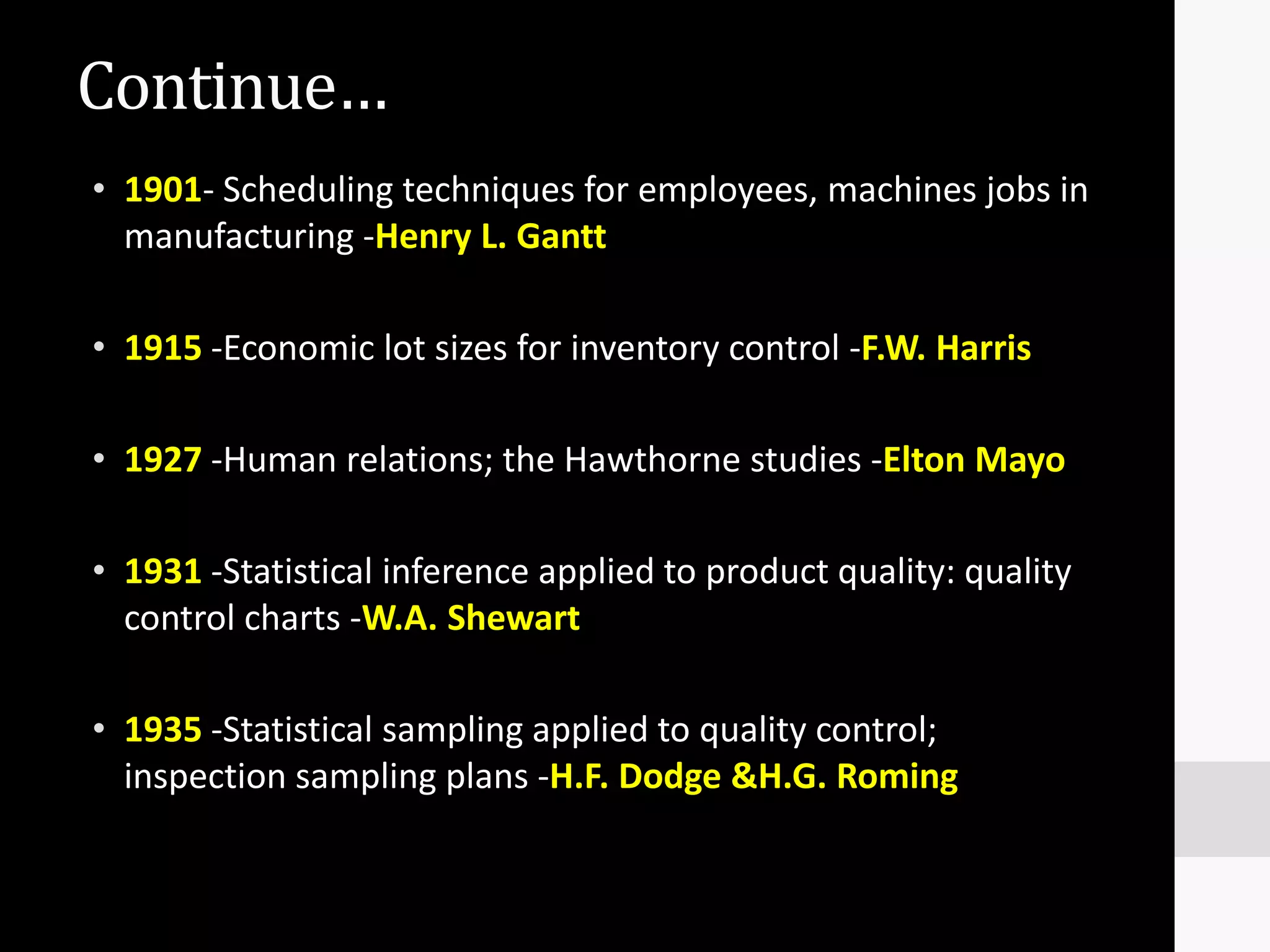
Continue…
• 1901- Scheduling techniques for employees, machines jobs in
  manufacturing -Henry L. Gantt

• 1915 -Economic lot sizes for inventory control -F.W. Harris

• 1927 -Human relations; the Hawthorne studies -Elton Mayo

• 1931 -Statistical inference applied to product quality: quality
  control charts -W.A. Shewart

• 1935 -Statistical sampling applied to quality control;
  inspection sampling plans -H.F. Dodge &H.G. Roming
Cont….
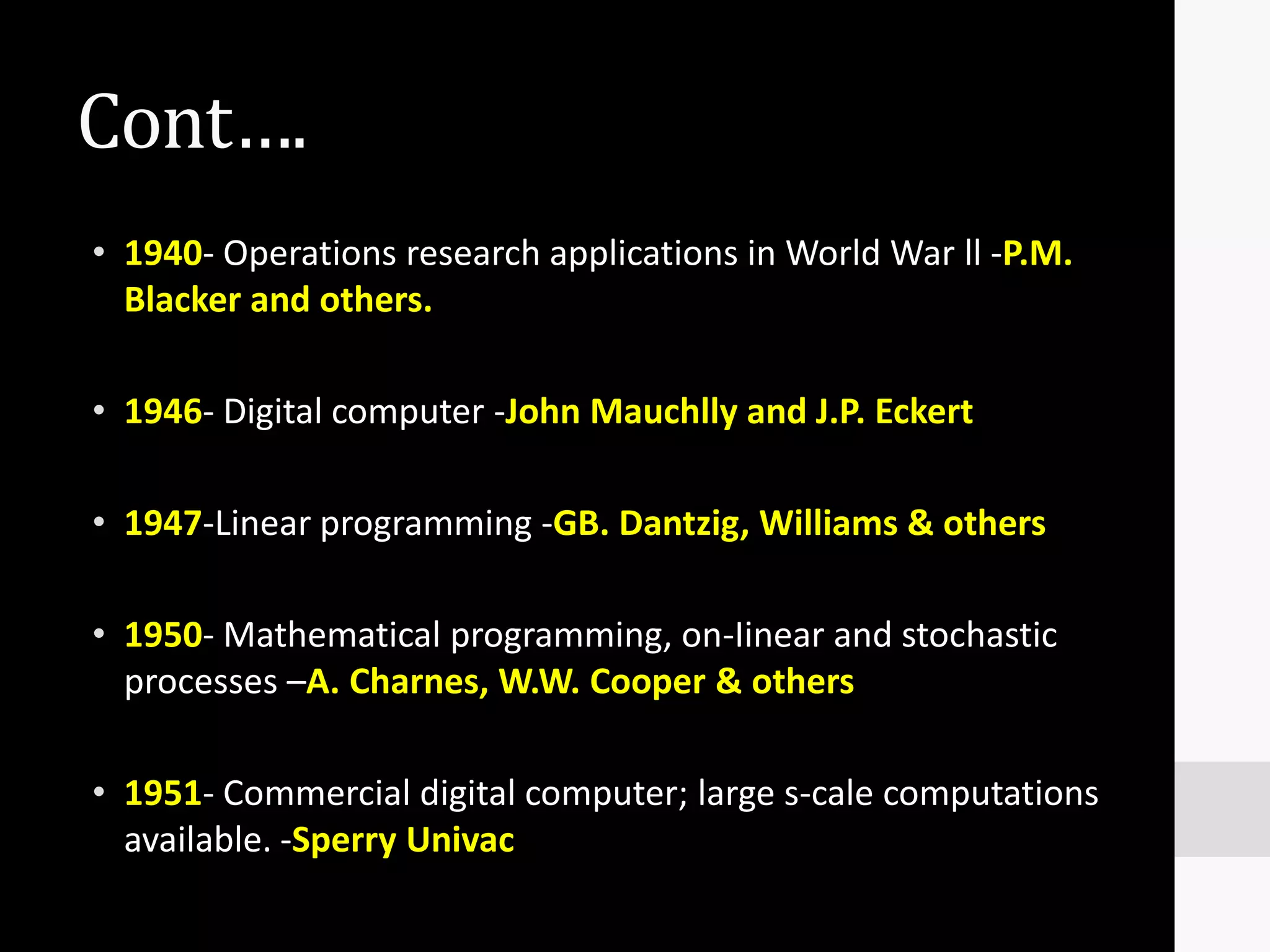
• 1940- Operations research applications in World War ll -P.M.
  Blacker and others.

• 1946- Digital computer -John Mauchlly and J.P. Eckert

• 1947-Linear programming -GB. Dantzig, Williams & others

• 1950- Mathematical programming, on-Iinear and stochastic
  processes –A. Charnes, W.W. Cooper & others

• 1951- Commercial digital computer; large s-cale computations
  available. -Sperry Univac
Cont….
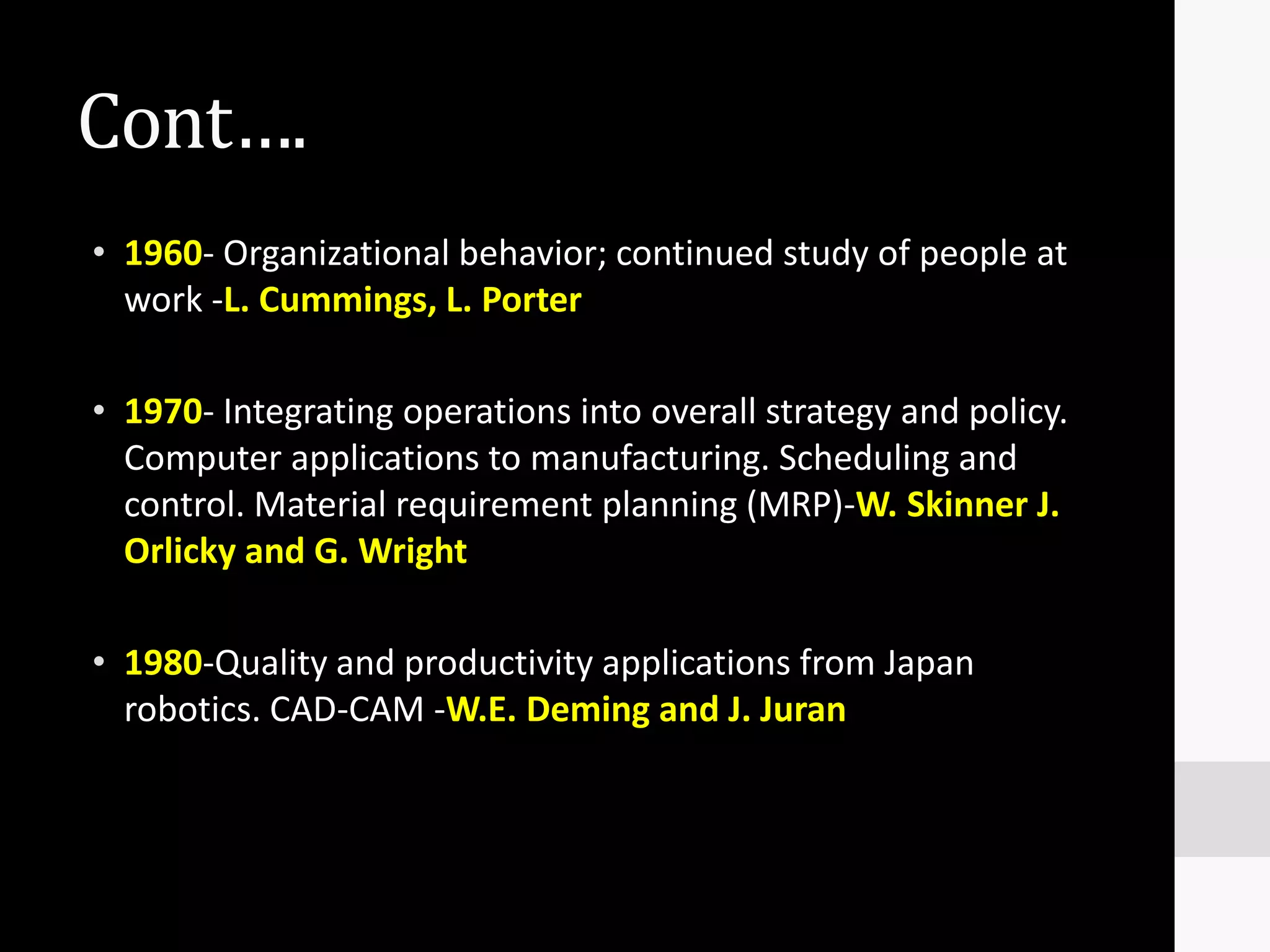
• 1960- Organizational behavior; continued study of people at
  work -L. Cummings, L. Porter

• 1970- Integrating operations into overall strategy and policy.
  Computer applications to manufacturing. Scheduling and
  control. Material requirement planning (MRP)-W. Skinner J.
  Orlicky and G. Wright

• 1980-Quality and productivity applications from Japan
  robotics. CAD-CAM -W.E. Deming and J. Juran
Evolution of production & operation management

Evolution of production & operation management

  • 1.
    Evolution of Production& Operation Management
  • 2.
    Historical Evolution ofProduction & Operation Management • The traditional view of manufacturing management began in eighteenth century when Adam Smith recognized the economic benefits of specialization of labor. He recommended breaking of jobs down into subtasks and recognizes workers to specialized tasks in which they would become highly skilled and efficient. • In the early twentieth century, F.W. Taylor implemented Smith’s theories and developed scientific management. From then till 1930, many techniques were developed prevailing the traditional view.
  • 3.
    Historical Evolution • 1776-Specialization of labor in manufacturing -Adam Smith • 1799 -Interchangeable parts, cost accounting -Eli Viihitney and others • 1832 -Division of labor by skill; assignment of jobs by skill; basics of time study -Charles Babbage • 1900- Scientific management time study and work study developed; dividing planning and doing of work -Frederick W. Taylor • 1900- Motion of study of jobs -Frank B. Gilbreth
  • 4.
    Continue… • 1901- Schedulingtechniques for employees, machines jobs in manufacturing -Henry L. Gantt • 1915 -Economic lot sizes for inventory control -F.W. Harris • 1927 -Human relations; the Hawthorne studies -Elton Mayo • 1931 -Statistical inference applied to product quality: quality control charts -W.A. Shewart • 1935 -Statistical sampling applied to quality control; inspection sampling plans -H.F. Dodge &H.G. Roming
  • 5.
    Cont…. • 1940- Operationsresearch applications in World War ll -P.M. Blacker and others. • 1946- Digital computer -John Mauchlly and J.P. Eckert • 1947-Linear programming -GB. Dantzig, Williams & others • 1950- Mathematical programming, on-Iinear and stochastic processes –A. Charnes, W.W. Cooper & others • 1951- Commercial digital computer; large s-cale computations available. -Sperry Univac
  • 6.
    Cont…. • 1960- Organizationalbehavior; continued study of people at work -L. Cummings, L. Porter • 1970- Integrating operations into overall strategy and policy. Computer applications to manufacturing. Scheduling and control. Material requirement planning (MRP)-W. Skinner J. Orlicky and G. Wright • 1980-Quality and productivity applications from Japan robotics. CAD-CAM -W.E. Deming and J. Juran