1-1
CHAPTER 1
Introduction to Production
and Operations Management
1-2
Definition
• Production
– Step by step conversion of one form of material to
other through chemical or mechanical process.
• Production Management
– Planning, organizing, directing and controlling the
activities of the production function.
• Operation Management
– Service oriented industry is broadly known as
operations management.
1-3
Why study Operations Management?
• find tools and information to become the best
manager possible.
• many of the management tools learned in operations
management may be applied to personal life and
other disciplines.
• learn basic business ideas and their
implementations.
• Study will give you information on why some things
work and some things do not work.
1-4
Historical Development
• Adam Smith is the first person who introduced
Production Management in 1776.
–Emphasized the division of labour
–This effected in turn for improving the quality
& quantity of goods.
• Charles Babbage in 1883 introduced the
principle of limiting skills as a basis for pay
fixation.
• Also agreeing on Adam Smith’s theory.
1-5
Historical Development
• Management techniques by F M Taylor.
– The workers should not be allowed to evolve their own
operations.
– Proper selection, training and development programmers
given to workers to get the best result.
– Close cooperation and understanding between workers
and management.
– Importance of specialization & expertise to carry different
operations.
• Short Comings on Taylor technique
– Production Management was very slow.
– Study materials were unavailable.
– Output depended on man, job and job conditions.
1-6
Production and Operations Management
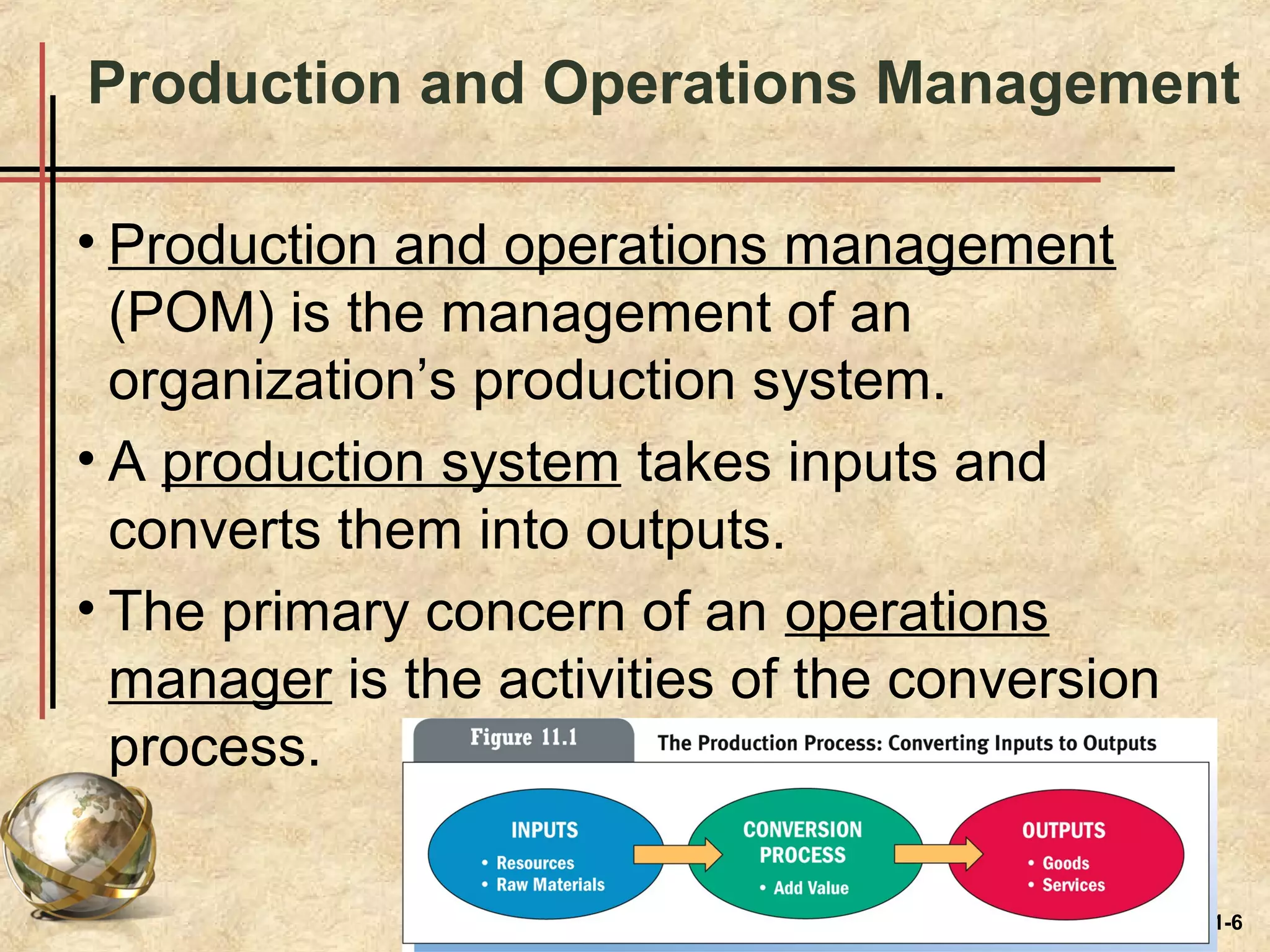
• Production and operations management
(POM) is the management of an
organization’s production system.
• A production system takes inputs and
converts them into outputs.
• The primary concern of an operations
manager is the activities of the conversion
process.
1-7
Organising chart for a bank
1-8
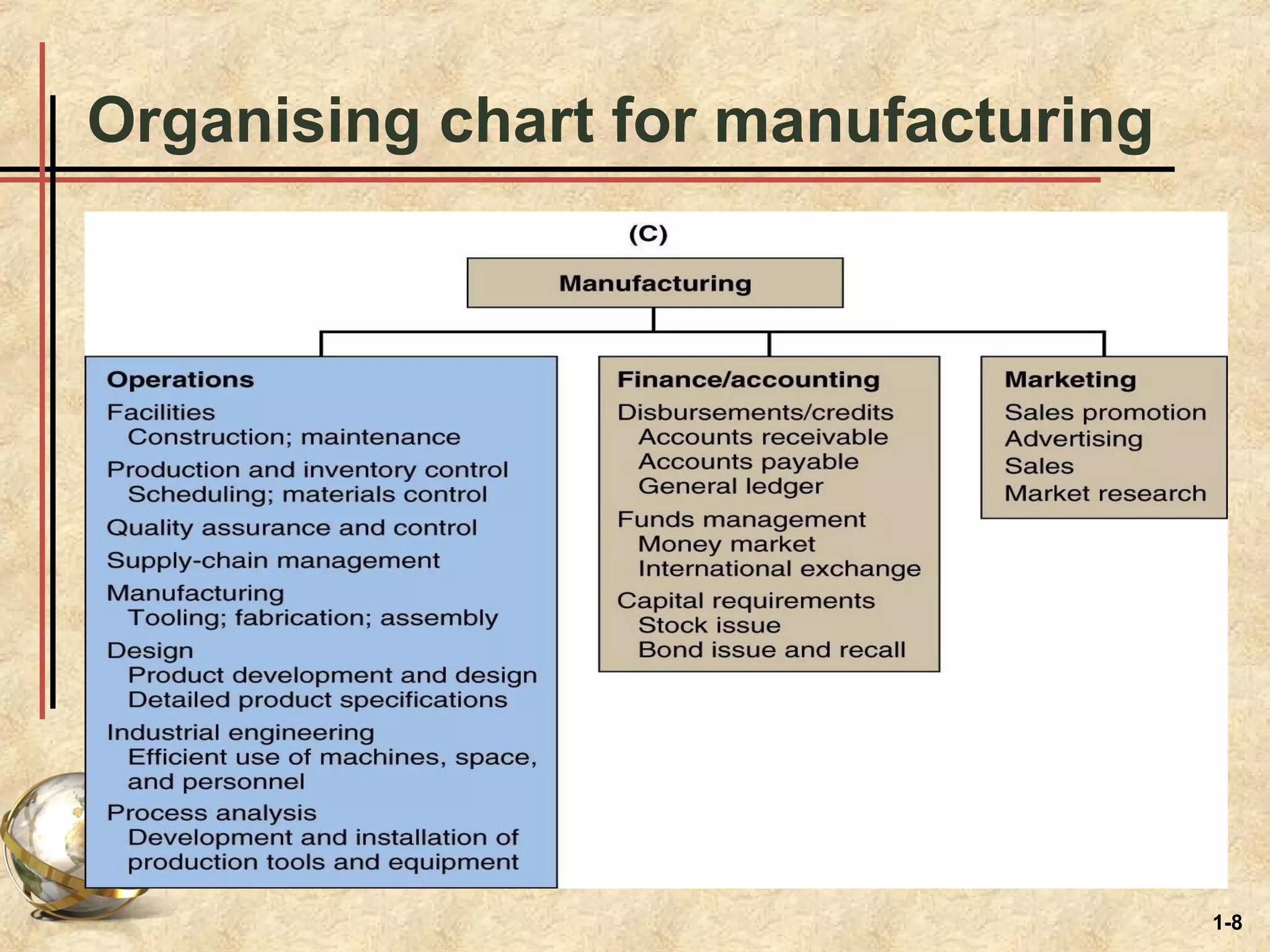
Organising chart for manufacturing
1-9
Page 9
Simplified Organizational Chart
1-10
Page 10
Information Flows
1-11
Page 11
Functional relationship with other
departments
1-12
Types of Production Systems
1. Flow Process1. Flow Process 2.Intermittent
Production
2.Intermittent
Production
A. Mass ProductionA. Mass Production
B. Assembly productionB. Assembly production
A. Job ProductionA. Job Production
B. Batch ProductionB. Batch Production
1-13
A production process, such as those used by chemical
plants or refineries, that runs for very long periods without
the start-and-stop behavior associated with intermittent
production.
Enormous capital investments are required for highly
automated facilities that use special-purpose equipment
designed for high volumes of production and little or no
variation in the type of outputs
Continuous/Flow Production Processes
Intermittent Production System
Production is performed on a start-and-stop basis, such as
for the manufacture of made-to-order products. Done to
produce small volume and high diversity products.
1-14
Mass Production
A special type of flow production process using
standardized methods and single-use machines to
produce long runs of standardized items. Usually used to
produce large volume and low diversity products.
Assembly Production
It is a type of Production system in which the assembly of
different equipment takes place to produce the final
product. Exp- Manufacturing of car.
Flow/Continuous System
1-15
Intermittent System
Job - With Job production, the complete task is handled by
a single worker or group of workers. Jobs can be small-
scale/low technology as well as complex/high technology.
Low technology jobs: hairdressers; tailoring
High technology jobs: film production; large construction
projects (e.g. the Millennium Dome)
•In Batch production batches are produced in different time
by same machineries. Exp- tablet production in
pharmaceutical industries.
1-16
1-17
Role of Operations Strategy
Provide a plan that makes best use of resources
which; Specifies the policies and plans for using
organizational resources and Supports Business
Strategy .
1-18
Importance of Operations Strategy
• Companies often do not understand the differences between
operational efficiency and strategy
– Operational efficiency is performing tasks well, even
better than competitors
– Strategy is a plan for competing in the marketplace
• Operations strategy is to ensure all tasks performed are the
right tasks
• A business strategy is developed after taking into many
factors and following some strategic decisions such as;
– What business is the company in (mission)
– Analyzing and understanding the market (environmental
scanning)
– Identifying the companies strengths (core competencies)
1-19
© Wiley 2010 19
Three Inputs to a Business Strategy
1-20
Developing an Operations Strategy
• Operations Strategy is a plan for the design and
management of operations functions
• Operation Strategy developed after the business
strategy
• Operations Strategy focuses on specific capabilities
which give it a competitive edge. Common priorities
include:
– Cost: low production costs enables the company to price its
product below competitors
– Quality: higher performance or a more consistent product can
support a price premium
– Time: faster delivery or consistent on-time delivery can support a
price premium
– Flexibility: highly customized products or volume flexibility can
support a price premium
1-21
SWOT Analysis
1-22
Porter’s Five Forces Model
1-23
Criteria of performance for production
and operations management system
• Customer Satisfaction
• Efficiency (Doing the thing right)
• Effectiveness (Doing the right thing)
1-24
Jobs/ Decisions of production and
operation management
Long Term Intermediate Short Term
Product Design
Quality Policy
Process selection
Technology selection
Site selection
Machinery selection
Plant selection
Manpower training
Warehouses
arrangements
Effluent and waste
disposal systems
Safety and maintenance
systems
Supply chain and
outsourcing
Forecasting
Quality implementation,
inspection and control
methods
Machinery and plant
facility loading decisions
Deployment of
manpower
Overtime decisions
Shift working decisions
Temporary hiring or lay
off
Purchasing policy
Make or buy decision
Transport and delivery
arrangements
Production/operation
scheduling
Materials allocation and
handling
Scheduling of manpower
Breakdown maintenance
Temporary manpower
Progress check
Supervision
Immediate attention to
problem areas in labour,
materials, machines, etc
1-25
Classification of decision areas
• Technology selection and management
• Capacity management
• Scheduling/Timing/Time allocation
• System maintenance
1-26
New ways of looking at decision areas
• Movement from traditional to modern
classification
• Traditional orientation was on product and
processes i.e. focus was internal or on the
operations of the company
• Product centric approach/ self centric
• Transition from product to people centric
1-27
Transition from product to people centric
Target
people
Decision type Affected aspect
Employees Hr Decisions Quality, productivity, safety and
security
Business
associates
Supply
decisions
Supplies and capacities
Customers Timing
decisions
Production/ operation planning and
scheduling; Technology/ process
All the above Spatial
decisions
Location of plants/facilities, location of
business associates; layoffs
1-28
Thank you

Production and Operations Mangement

  • 1.
    1-1 CHAPTER 1 Introduction toProduction and Operations Management
  • 2.
    1-2 Definition • Production – Stepby step conversion of one form of material to other through chemical or mechanical process. • Production Management – Planning, organizing, directing and controlling the activities of the production function. • Operation Management – Service oriented industry is broadly known as operations management.
  • 3.
    1-3 Why study OperationsManagement? • find tools and information to become the best manager possible. • many of the management tools learned in operations management may be applied to personal life and other disciplines. • learn basic business ideas and their implementations. • Study will give you information on why some things work and some things do not work.
  • 4.
    1-4 Historical Development • AdamSmith is the first person who introduced Production Management in 1776. –Emphasized the division of labour –This effected in turn for improving the quality & quantity of goods. • Charles Babbage in 1883 introduced the principle of limiting skills as a basis for pay fixation. • Also agreeing on Adam Smith’s theory.
  • 5.
    1-5 Historical Development • Managementtechniques by F M Taylor. – The workers should not be allowed to evolve their own operations. – Proper selection, training and development programmers given to workers to get the best result. – Close cooperation and understanding between workers and management. – Importance of specialization & expertise to carry different operations. • Short Comings on Taylor technique – Production Management was very slow. – Study materials were unavailable. – Output depended on man, job and job conditions.
  • 6.
    1-6 Production and OperationsManagement • Production and operations management (POM) is the management of an organization’s production system. • A production system takes inputs and converts them into outputs. • The primary concern of an operations manager is the activities of the conversion process.
  • 7.
  • 8.
  • 9.
  • 10.
  • 11.
  • 12.
    1-12 Types of ProductionSystems 1. Flow Process1. Flow Process 2.Intermittent Production 2.Intermittent Production A. Mass ProductionA. Mass Production B. Assembly productionB. Assembly production A. Job ProductionA. Job Production B. Batch ProductionB. Batch Production
  • 13.
    1-13 A production process,such as those used by chemical plants or refineries, that runs for very long periods without the start-and-stop behavior associated with intermittent production. Enormous capital investments are required for highly automated facilities that use special-purpose equipment designed for high volumes of production and little or no variation in the type of outputs Continuous/Flow Production Processes Intermittent Production System Production is performed on a start-and-stop basis, such as for the manufacture of made-to-order products. Done to produce small volume and high diversity products.
  • 14.
    1-14 Mass Production A specialtype of flow production process using standardized methods and single-use machines to produce long runs of standardized items. Usually used to produce large volume and low diversity products. Assembly Production It is a type of Production system in which the assembly of different equipment takes place to produce the final product. Exp- Manufacturing of car. Flow/Continuous System
  • 15.
    1-15 Intermittent System Job -With Job production, the complete task is handled by a single worker or group of workers. Jobs can be small- scale/low technology as well as complex/high technology. Low technology jobs: hairdressers; tailoring High technology jobs: film production; large construction projects (e.g. the Millennium Dome) •In Batch production batches are produced in different time by same machineries. Exp- tablet production in pharmaceutical industries.
  • 16.
  • 17.
    1-17 Role of OperationsStrategy Provide a plan that makes best use of resources which; Specifies the policies and plans for using organizational resources and Supports Business Strategy .
  • 18.
    1-18 Importance of OperationsStrategy • Companies often do not understand the differences between operational efficiency and strategy – Operational efficiency is performing tasks well, even better than competitors – Strategy is a plan for competing in the marketplace • Operations strategy is to ensure all tasks performed are the right tasks • A business strategy is developed after taking into many factors and following some strategic decisions such as; – What business is the company in (mission) – Analyzing and understanding the market (environmental scanning) – Identifying the companies strengths (core competencies)
  • 19.
    1-19 © Wiley 201019 Three Inputs to a Business Strategy
  • 20.
    1-20 Developing an OperationsStrategy • Operations Strategy is a plan for the design and management of operations functions • Operation Strategy developed after the business strategy • Operations Strategy focuses on specific capabilities which give it a competitive edge. Common priorities include: – Cost: low production costs enables the company to price its product below competitors – Quality: higher performance or a more consistent product can support a price premium – Time: faster delivery or consistent on-time delivery can support a price premium – Flexibility: highly customized products or volume flexibility can support a price premium
  • 21.
  • 22.
  • 23.
    1-23 Criteria of performancefor production and operations management system • Customer Satisfaction • Efficiency (Doing the thing right) • Effectiveness (Doing the right thing)
  • 24.
    1-24 Jobs/ Decisions ofproduction and operation management Long Term Intermediate Short Term Product Design Quality Policy Process selection Technology selection Site selection Machinery selection Plant selection Manpower training Warehouses arrangements Effluent and waste disposal systems Safety and maintenance systems Supply chain and outsourcing Forecasting Quality implementation, inspection and control methods Machinery and plant facility loading decisions Deployment of manpower Overtime decisions Shift working decisions Temporary hiring or lay off Purchasing policy Make or buy decision Transport and delivery arrangements Production/operation scheduling Materials allocation and handling Scheduling of manpower Breakdown maintenance Temporary manpower Progress check Supervision Immediate attention to problem areas in labour, materials, machines, etc
  • 25.
    1-25 Classification of decisionareas • Technology selection and management • Capacity management • Scheduling/Timing/Time allocation • System maintenance
  • 26.
    1-26 New ways oflooking at decision areas • Movement from traditional to modern classification • Traditional orientation was on product and processes i.e. focus was internal or on the operations of the company • Product centric approach/ self centric • Transition from product to people centric
  • 27.
    1-27 Transition from productto people centric Target people Decision type Affected aspect Employees Hr Decisions Quality, productivity, safety and security Business associates Supply decisions Supplies and capacities Customers Timing decisions Production/ operation planning and scheduling; Technology/ process All the above Spatial decisions Location of plants/facilities, location of business associates; layoffs
  • 28.