Production planning and
control
Presented By
Manu Alias
What do you mean by production planning & control??
Production planning and control can be viewed as the nervous system of the
production operation. This function aims at efficient utilization of material,
resources, people and facilities in any undertaking through planning, coordination
and controlling the production activities that transform the raw materials into
finished products or components as a most optimal manner. All the activities in the
manufacturing or production cycle must be planned, coordinated, organized and
controlled to its objectives.
Definition
• According to Charles A. Koepke, “Production planning and control may
be defined as the coordination of a series of functions according to a
plan which will, economically utilize the plant facilities and regulate the
orderly movement of goods through their entire manufacturing cycle,
from the procurement of all materials to the shipping of finished goods
at a predetermined rate”
objectives
1. Nature of the inputs
To manufacture a product, different types of inputs are used. The quality of the product
depends upon the nature of the inputs used.
2. Quantity of inputs
A product can be prepared only when there is an estimate of the required composition of inputs.
3. Proper coordination
It ensures the proper coordination among the work force, machine and equipment. This leads
to avoidance of wastages and smooth flow of production.
4. Better Control
Production planning is a method of control. For a better control, planning is a precondition.
Only then one can compare the performance and calculate the deviations which lead control of
the production.
5. Ensures uninterrupted production
The planning of materials ensures the regular supply of raw materials and other
components. The regular flow of materials and supplies are helpful in the
uninterrupted production.
6. Capacity Utilization
There is a need to use the available resources effectively. It is helpful in bringing down
various costs of production.
7. Timely Delivery
If there is good production planning and control, there will be timely production and
the finished product will be rushed to the market in time. This also ensures the better
relationship with the customers.
Objectives continues…
Stages/Phases of production planning & control
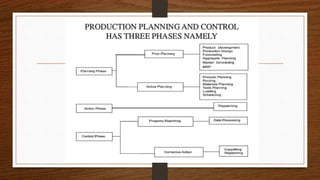
 There are 3 stages or phases of production planning and control
1. Planning phase
A) Pre planning phase :- It involves product planning and development, facilities
planning, plant planning, and plant location, etc.
B) Active planning phase:- It involves planning for quantity, determination of product
mix, scheduling, materials, capacity planning, etc.
Stages continues…
2. Action Phase
Action phase has the major step of dispatching. Dispatching is the
transition from planning phase to action phase. Here the worker is
ordered to start manufacturing the product. The tasks included in
dispatching are job order, tool order, inspection order, etc.
3. Control Phase
A) Progress Reporting :- In progress reporting, the data regarding what is
happening with the job is collected. It also helps to make comparison
with present level of performance.
B) Corrective Action :- The tasks under corrective action primarily make
provisions for an unexpected event. For Example; make or buy decision,
Schedule modifications, etc.
Stages continues…
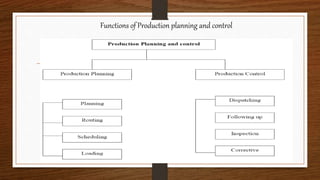
Functions of Production planning and control
Production planning
It is the planning of production and manufacturing modules in a
company or industry. It utilizes the resource allocation of activities of
employees, materials and production capacity, in order to serve
different customers.
Production planning functions
1. Estimating
Involves deciding the quantity of products to be produced and cost involved
in it on the basis of sales forecast. Estimating man power, machine capacity
and materials required to meet the planned production targets are key
activities before budgeting for resources.
2. Routing
Routing means, determination of route on which manufacturing operations
will travel, establishing the sequence of operations to be followed in
manufacturing a product.
Functions Continues…
3. Scheduling
It involves fixing priorities for each job and determining the starting time and
finishing time for each operation, the starting dates and finishing dates for each
part, Sub-assembly and final assembly. For Example; Total time required for the
manufacture of a product, time table for production, etc.
4. Loading
Facility loading means loading of work center and deciding which jobs to be
assigned to which work center or machine.
Production Control
Production control is the activity of monitoring and controlling any
particular production or operation. Production control is often run
from a specific control room or operations room.
Production control functions
1. Dispatching
The actual production starts with dispatching. It is a part of
production control that translates the paper work into actual
production in accordance with the details worked out under routing
and scheduling functions.
2. Follow up
Follow up ensures that, the work is carried out as per the plan and delivery
schedules are met. For example; Status reporting, controlling variations,
monitoring progress of work through all stages of production, etc.
3. Inspection
Inspection is the process of examining an object for identification or checking
it for verification of quality and quantity in any of its characteristics. It is an
important tool for ascertaining and controlling the quality of a product.
Inspection can occur before production, during production, and after
production.
Control functions continues…
Factors affecting production planning and control
 Use of computers
 Seasonal variations
 Variation in fashion and style
 Test marketing
 Vertical Vs Horizontal integration
 After sales service
 Losses due to predictable and
unpredictable factors
 Production of order
 Design changes
 Rejection and replacement
Importance of production planning and control
 Higher productivity
 Removal of hurdles
 Better quality
 Consumer satisfaction
 saving in cost
 increase in production
 optimum utilization of
capabilities
 Minimum over time
Better industrial relations
Better profitability
Limitations of production planning and control
1. Assumptions
It is based on certain assumptions or forecasts of consumer demand, plant capacity,
availability of materials, tec.
2. Rigidity of employees behavior
Employees may resist changes in production levels set as per production plans if such
plans are rigid.
3. Costly process
The implementation of production planning and control is costly
Limitations continues…
4. Time consuming process
The production planning process is time consuming when it is necessary to
carry out routing and scheduling functions for large and complex products
consisting of a large number of parts going into the product.
5. External environmental factors
It become extremely difficult when the environmental factors change very
rapidly such as technology, customers taste and preferences, government
policies, etc.
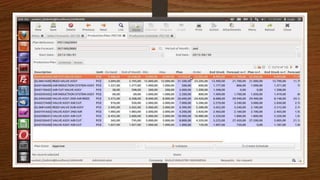
Master Production Schedule (MPS)
 Meaning of MPS
A master production schedule is a statement of what will be made, how many
units will be made, and when they will be made. It is a production plan, not a
sales plan. The MPS considers total demand on a plant’s resources, including
finished product sale, spare parts needs, and interplant needs. The MPS must
also consider the capacity of the plant and the requirements imposed on
vendors. Provisions are made in the overall plan for each manufacturing
facility’s operation. All planning for materials, manpower, plant, equipment,
and financing for the facility is driven by the master production schedule.
Objectives of MPS
1. To provide top management with a means to authorize, and control
manpower levels, inventory investment, and cash flow.
2. To coordinate marketing, manufacturing, engineering, and finance
activities by a common performance objective.
3. To reconcile marketing and manufacturing needs.
4. To provide an overall measure of performance.
5. To provide data for material and capacity planning.
Functions of MPS
1. Translating aggregate plans
The aggregate plans sets the level of operations that roughly balances market demands with the
material, labor and equipment capabilities of the firm. The aggregate is translated into specific
number of end products to be produced in specific time period.
2. Evaluating alternative master schedules
Master scheduling is done on a trial and error basis. Trial fitting of alternative MPS can be done by
simulation using computers. Detailed material and capacity required are then derived from the
firm’s MPS.
3. Effectively utilizing the capacity
By specifying the end item requirements over a time period, the MPS establishes the load and
utilization parameters for labor and equipment.
Functions continues…
4. Generating material requirements
The MPS is the prime input to the MRP-1 system. The MRP-1 system provides for purchasing
or manufacturing the necessary items in sufficient time to meet the final assembly dates
specified, based on the MPS for end products.
5. Generating capacity requirements
Capacity needs, arise for manufacturing the components in the required time schedule to
meet the requirements of end products as per the MPS. Capacity requirement planning is
based on the MPS which should reflect an economic products as per the MPS. Capacity
requirement planning is based on the MPS
Functions continues…
6. Facilitating information processing
By controlling the workload on work centres, the MPS determines the delivery schedules for
end products for make-to-stock and make to order items. It coordinates other management
information such as marketing capabilities, financial resources and personnel policies.
7. Maintaining valid priorities
The absolute or relative priorities for various jobs to be completed should reflect the true
needs. This means that, the due date and the ranking of jobs should correspond with the time
the order is actually needed. when customers change their orders or materials get scrapped
sometimes, either the components are not actually needed or the end items cannot be
produced because of shortage of some materials and then it is necessary that the MPS should
be modified to reflect this change.
Production Planning and Control (Operations Management)

Production Planning and Control (Operations Management)

  • 1.
  • 2.
    What do youmean by production planning & control?? Production planning and control can be viewed as the nervous system of the production operation. This function aims at efficient utilization of material, resources, people and facilities in any undertaking through planning, coordination and controlling the production activities that transform the raw materials into finished products or components as a most optimal manner. All the activities in the manufacturing or production cycle must be planned, coordinated, organized and controlled to its objectives.
  • 3.
    Definition • According toCharles A. Koepke, “Production planning and control may be defined as the coordination of a series of functions according to a plan which will, economically utilize the plant facilities and regulate the orderly movement of goods through their entire manufacturing cycle, from the procurement of all materials to the shipping of finished goods at a predetermined rate”
  • 4.
    objectives 1. Nature ofthe inputs To manufacture a product, different types of inputs are used. The quality of the product depends upon the nature of the inputs used. 2. Quantity of inputs A product can be prepared only when there is an estimate of the required composition of inputs. 3. Proper coordination It ensures the proper coordination among the work force, machine and equipment. This leads to avoidance of wastages and smooth flow of production. 4. Better Control Production planning is a method of control. For a better control, planning is a precondition. Only then one can compare the performance and calculate the deviations which lead control of the production.
  • 5.
    5. Ensures uninterruptedproduction The planning of materials ensures the regular supply of raw materials and other components. The regular flow of materials and supplies are helpful in the uninterrupted production. 6. Capacity Utilization There is a need to use the available resources effectively. It is helpful in bringing down various costs of production. 7. Timely Delivery If there is good production planning and control, there will be timely production and the finished product will be rushed to the market in time. This also ensures the better relationship with the customers. Objectives continues…
  • 7.
    Stages/Phases of productionplanning & control  There are 3 stages or phases of production planning and control 1. Planning phase A) Pre planning phase :- It involves product planning and development, facilities planning, plant planning, and plant location, etc. B) Active planning phase:- It involves planning for quantity, determination of product mix, scheduling, materials, capacity planning, etc.
  • 8.
    Stages continues… 2. ActionPhase Action phase has the major step of dispatching. Dispatching is the transition from planning phase to action phase. Here the worker is ordered to start manufacturing the product. The tasks included in dispatching are job order, tool order, inspection order, etc.
  • 9.
    3. Control Phase A)Progress Reporting :- In progress reporting, the data regarding what is happening with the job is collected. It also helps to make comparison with present level of performance. B) Corrective Action :- The tasks under corrective action primarily make provisions for an unexpected event. For Example; make or buy decision, Schedule modifications, etc. Stages continues…
  • 10.
    Functions of Productionplanning and control
  • 11.
    Production planning It isthe planning of production and manufacturing modules in a company or industry. It utilizes the resource allocation of activities of employees, materials and production capacity, in order to serve different customers.
  • 12.
    Production planning functions 1.Estimating Involves deciding the quantity of products to be produced and cost involved in it on the basis of sales forecast. Estimating man power, machine capacity and materials required to meet the planned production targets are key activities before budgeting for resources. 2. Routing Routing means, determination of route on which manufacturing operations will travel, establishing the sequence of operations to be followed in manufacturing a product.
  • 13.
    Functions Continues… 3. Scheduling Itinvolves fixing priorities for each job and determining the starting time and finishing time for each operation, the starting dates and finishing dates for each part, Sub-assembly and final assembly. For Example; Total time required for the manufacture of a product, time table for production, etc. 4. Loading Facility loading means loading of work center and deciding which jobs to be assigned to which work center or machine.
  • 14.
    Production Control Production controlis the activity of monitoring and controlling any particular production or operation. Production control is often run from a specific control room or operations room.
  • 15.
    Production control functions 1.Dispatching The actual production starts with dispatching. It is a part of production control that translates the paper work into actual production in accordance with the details worked out under routing and scheduling functions. 2. Follow up Follow up ensures that, the work is carried out as per the plan and delivery schedules are met. For example; Status reporting, controlling variations, monitoring progress of work through all stages of production, etc.
  • 16.
    3. Inspection Inspection isthe process of examining an object for identification or checking it for verification of quality and quantity in any of its characteristics. It is an important tool for ascertaining and controlling the quality of a product. Inspection can occur before production, during production, and after production. Control functions continues…
  • 17.
    Factors affecting productionplanning and control  Use of computers  Seasonal variations  Variation in fashion and style  Test marketing  Vertical Vs Horizontal integration  After sales service  Losses due to predictable and unpredictable factors  Production of order  Design changes  Rejection and replacement
  • 18.
    Importance of productionplanning and control  Higher productivity  Removal of hurdles  Better quality  Consumer satisfaction  saving in cost  increase in production  optimum utilization of capabilities  Minimum over time Better industrial relations Better profitability
  • 19.
    Limitations of productionplanning and control 1. Assumptions It is based on certain assumptions or forecasts of consumer demand, plant capacity, availability of materials, tec. 2. Rigidity of employees behavior Employees may resist changes in production levels set as per production plans if such plans are rigid. 3. Costly process The implementation of production planning and control is costly
  • 20.
    Limitations continues… 4. Timeconsuming process The production planning process is time consuming when it is necessary to carry out routing and scheduling functions for large and complex products consisting of a large number of parts going into the product. 5. External environmental factors It become extremely difficult when the environmental factors change very rapidly such as technology, customers taste and preferences, government policies, etc.
  • 21.
    Master Production Schedule(MPS)  Meaning of MPS A master production schedule is a statement of what will be made, how many units will be made, and when they will be made. It is a production plan, not a sales plan. The MPS considers total demand on a plant’s resources, including finished product sale, spare parts needs, and interplant needs. The MPS must also consider the capacity of the plant and the requirements imposed on vendors. Provisions are made in the overall plan for each manufacturing facility’s operation. All planning for materials, manpower, plant, equipment, and financing for the facility is driven by the master production schedule.
  • 22.
    Objectives of MPS 1.To provide top management with a means to authorize, and control manpower levels, inventory investment, and cash flow. 2. To coordinate marketing, manufacturing, engineering, and finance activities by a common performance objective. 3. To reconcile marketing and manufacturing needs. 4. To provide an overall measure of performance. 5. To provide data for material and capacity planning.
  • 23.
    Functions of MPS 1.Translating aggregate plans The aggregate plans sets the level of operations that roughly balances market demands with the material, labor and equipment capabilities of the firm. The aggregate is translated into specific number of end products to be produced in specific time period. 2. Evaluating alternative master schedules Master scheduling is done on a trial and error basis. Trial fitting of alternative MPS can be done by simulation using computers. Detailed material and capacity required are then derived from the firm’s MPS. 3. Effectively utilizing the capacity By specifying the end item requirements over a time period, the MPS establishes the load and utilization parameters for labor and equipment.
  • 24.
    Functions continues… 4. Generatingmaterial requirements The MPS is the prime input to the MRP-1 system. The MRP-1 system provides for purchasing or manufacturing the necessary items in sufficient time to meet the final assembly dates specified, based on the MPS for end products. 5. Generating capacity requirements Capacity needs, arise for manufacturing the components in the required time schedule to meet the requirements of end products as per the MPS. Capacity requirement planning is based on the MPS which should reflect an economic products as per the MPS. Capacity requirement planning is based on the MPS
  • 25.
    Functions continues… 6. Facilitatinginformation processing By controlling the workload on work centres, the MPS determines the delivery schedules for end products for make-to-stock and make to order items. It coordinates other management information such as marketing capabilities, financial resources and personnel policies. 7. Maintaining valid priorities The absolute or relative priorities for various jobs to be completed should reflect the true needs. This means that, the due date and the ranking of jobs should correspond with the time the order is actually needed. when customers change their orders or materials get scrapped sometimes, either the components are not actually needed or the end items cannot be produced because of shortage of some materials and then it is necessary that the MPS should be modified to reflect this change.