571210 – OPERATIONS MANAGEMENTFACILITAOR- T.PRAVEEN KUMAR
REFERENCEPannerselvam R, Production and operations management, Prentice Hall of India,Norman Gaither and Gregory Fraizer, Operations Management, south western cengage learning 2002.Business line Journals of production management.
EXPECTATIONYOUR SIDE
INTERNAL MARKSINTERNAL / MODEL EXAMS-    10 MARKSATTENDANCE 	/ CLASS PARTICIPATION	     -	5 MARKSASSIGNMENTS		     -	5 MARKSDON’T BEG FOR MARKS
OPERATIONS MANAGEMENT = SQUARE OF TQM
PRODUCTION AND OPERATIONSMANAGEMENT (POM)AN INTRODUCTION
OVERVIEWIntroductionHistorical Milestones in POMFactors Affecting POM TodayDifferent Ways of Studying POMWrap-Up: What World-Class Producers Do
INTRODUCTIONIn the growing global competition the productivity is the key for the survival of business organization.Among the different functions in a organization POM is a vital function which does the job of value addition to products /services respectively.Maximize value automatically results in productivity improvement.
…contdThis should be done from starting stage of product development.Implementation of proper quality control system, maintenance of equipments and concentrating on various other inter mediate tasks leads to improvement in productivity.
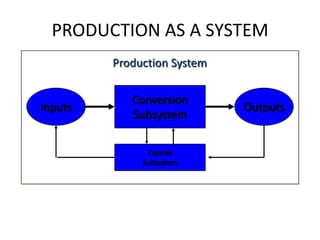
INTRODUCTIONProduction and operations management (POM) is the management of an organization’s production system.A production system takes inputs and converts them into outputs.The conversion process is the predominant activity of a production system.The primary concern of an operations manager is the activities of the conversion process.
HISTORICAL MILESTONES IN POMThe Industrial RevolutionPost-Civil War PeriodScientific ManagementHuman Relations and BehaviorismOperations ResearchThe Service Revolution
THE INDUSTRIAL REVOLUTIONThe industrial revolution developed in England in the 1700s.The steam engine, invented by James Watt in 1764, largely replaced human and water power for factories.Adam Smith’s The Wealth of Nations in 1776 touted the economic benefits of the specialization of labor.Thus the late-1700s factories had not only machine power but also ways of planning and controlling the tasks of workers.
THE INDUSTRIAL REVOLUTIONThe industrial revolution spread from England to other European countries and to the United Sates.In 1790 an American, Eli Whitney, developed the concept of interchangeable parts.The first great industry in the U.S. was the textile industry.In the 1800s the development of the gasoline engine and electricity further advanced the revolution.By the mid-1800s, the old cottage system of production had been replaced by the factory system.
POST-CIVIL WAR PERIODDuring the post-Civil War period great expansion of production capacity occurred.By post-Civil War the following developments set the stage for the great production explosion of the 20th century:increased capital and production capacitythe expanded urban workforceNew  marketsan effective national transportation system
SCIENTIFIC MANAGEMENTFrederick Taylor is known as the father of scientific management.  His shop system employed these steps:Each worker’s skill, strength, and learning ability were determined.Stopwatch studies were conducted to precisely set standard output per worker on each task.Material specifications, work methods, and routing sequences were used to organize the shop.Supervisors were carefully selected and trained.Incentive pay systems were initiated.
SCIENTIFIC MANAGEMENTIn the 1920s, Ford Motor Company’s operation embodied the key elements of scientific management:standardized product designsmass productionlow manufacturing costsmechanized assembly linesspecialization of laborinterchangeable parts
HUMAN RELATIONSAND BEHAVIORALISMIn the 1927-1932 period, researchers in the Hawthorne Studies realized that human factors were affecting production.Researchers and managers were recognizing that psychological and sociological factors affected production.From the work of behavior lists came a gradual change in the way managers thought about and treated workers.
OPERATIONS RESEARCHDuring World War II, enormous quantities of resources (personnel, supplies, equipment, …) had to be deployed.Military operations research (OR) teams were formed to deal with the complexity of the deployment.After the war, operations researchers found their way back to universities, industry, government, and consulting firms.OR helps operations managers make decisions when problems are complex and wrong decisions are costly.
THE SERVICE REVOLUTIONThe creation of services organizations accelerated sharply after World War II.Today, more than two-thirds of the workforce is employed in services.About two-thirds of world GDP is from services.There is a huge trade surplus in services.Investment per office worker now exceeds the investment per factory worker.Thus there is a growing need for service operations management.
Next 3 months you are going to see aboutPRODUCTION/OPERATION MANAGEMENTTYPES OF PRODUCTION SYSTEMDIFFERENT PRODUCTIVITY IMPROVEMENT STRATEGIESNEW PRODUCT DEVELOPMENTPROCESS PLANNINGCAPACITY PLANNINGMRPTQM TOOLS etc………………………………
DIFFERENT WAYS TO STUDY POMProduction as a SystemProduction as an Organization FunctionDecision Making in POM
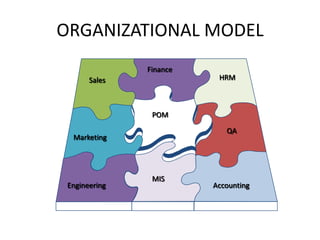
ORGANIZATIONAL MODELFinanceHRMSalesPOMQA  MarketingMISEngineering Accounting
PRODUCTION SYSTEMAn organization consists of mainly four functional subsystemMarketingProductionFinance Personnel
MARKETING FUNCTIONAims to promote its products among customers which helps it to obtain substantial sales order.PRODUCTION FUNCTIONThis function will managing the physical resources for the production of an item/ provision of services.The available facilities need to be managed effectively in order to meet the current market requirements.
…..contThe resources are raw material, equipment, labor, working capital.The production function needs to organize its resources according to the predetermined production plans.
FINANCE FUNCTIONThis function provides authorization and control to all other subsystems to utilize the money in more effectively through a well designed mechanism.PERSONNEL FUNCTION/HRThis is a supporting function which plans and provides manpower to all other function of the organization.It involves in recruitment, training and development, performance measures of the manpower.All functions of the organization are interwoven by many linkages for their effective functioning.
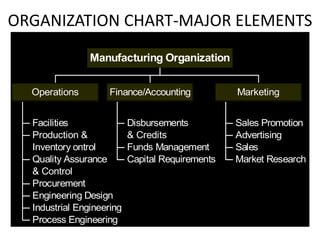
ORGANIZATION CHART-MAJOR ELEMENTS
PRODUCTION AS AN ORGANIZATION FUNCTION companies cannot compete using marketing, finance, accounting, and engineering alone.We focus on POM as we think of global competitiveness, because that is where the vast majority of a firm’s workers, capital assets, and expenses reside.To succeed, a firm must have a strong operations function teaming with the other organization functions.
PRODUCTION MANAGEMENT	Production /operations management is the process which combines and transforms various resources used in the production/operation sub system of the organization into value added products/ services in a controlled manner as per the policies of the organization
ANOTHER VIEW	Production/operation management function is the part of the organization which is concerned with the transformation of a range of inputs into the required output(product/service) having the requisite quality level.
IN GENERALThe set of interrelated management activities which are involved in manufacturing certain products is called as production management.If the above concept is extended to services management then the corresponding set of management activities is called as operations management.So in general the concept of manufacturing products/providing services is called production/operations management
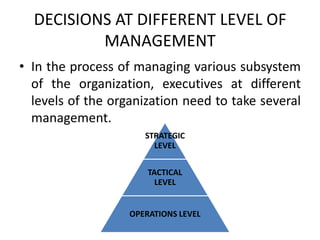
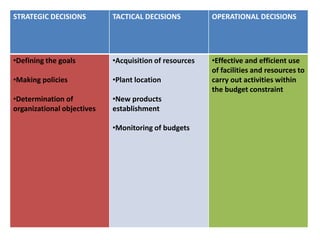
DECISIONS AT DIFFERENT LEVEL OF MANAGEMENTIn the process of managing various subsystem of the organization, executives at different levels of the organization need to take several management.
STRATEGIC DECISIONSThese decisions are of strategic importance and have long-term significance for the organization.Examples include deciding:the design for a new product’s production processwhere to locate a new factorywhether to launch a new-product development plan
OPERATING DECISIONSThese decisions are necessary if the ongoing production of goods and services is to satisfy market  demands and provide profits.Examples include deciding:how much finished-goods inventory to carrythe amount of overtime to use next weekthe details for purchasing raw material next month
CONTROL DECISIONSThese decisions concern the day-to-day activities of workers, quality of products and services, production and overhead costs, and machine maintenance.Examples include deciding:labor cost standards for a new productfrequency of preventive maintenancenew quality control acceptance criteria
MARKETING - FUNCTIONStrategic DecisionsConsideration of new markets and marketing strategiesThe information requirements for strategic planningInclude customer analysisCompetitor analysisConsumer surveyIncome projectionDemographic projectionTechnology projection
…contdTactical DecisionsComparison of overall performance against a marketing plan.Concerns data on customers, competitors and its products and sales force requirements.Operational decisionsHiring and firing of sales forceDay to day scheduling of sales and promotions efforts and periodic analysis of sales.
PRODUCTION FUNCTIONStrategic DecisionAlternative manufacturing approaches and alternative approaches to automation.Tactical DecisionReports which compare overall planned/standard performanceOperational DecisionReports comparing actual performance to production schedule
FINANCE FUNCTIONStrategic DecisionLong run strategy to ensure adequate financing .Long run tax accounting policy to minimize the impact of taxes.Planning of systems for budgetingTactical DecisionInformation on budgeted versus actual cost of financial resources.Cost of processing accounting data. Operational DecisionDaily error and exception reports.Records of processing delays reports of unprocessed transaction etc.
PERSONNEL /HR FUNCTIONStrategic DecisionStrategies  for recruitment, salary, training and benefits.Analysis of shift pattern of employment, education and wage rate etc.Tactical DecisionVariance analysis on hiring and firing.Cost of recruitmentCost of training, salary paid, distribution of wage rates.Operational decisionDecision on hiring, training, termination changing pay rates and issuing benefits.
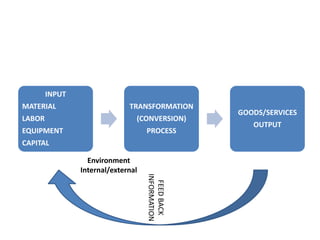
SYSTEM CONCEPT OF PRODUCTIONSystemIt is a collection of interrelated  entities.	Operations management is the management of transformation systems which convert input into goods/servicesInput materials, labors, equipments, capitalThe types of inputs used vary from one industry to another
PRODUCTION AS A SYSTEMProduction SystemConversionSubsystemInputsOutputsControlSubsystem
FEED BACK INFORMATIONEnvironmentInternal/external
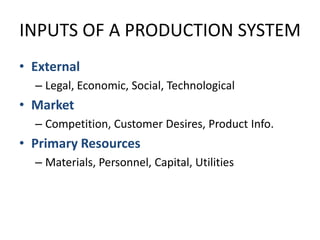
INPUTS OF A PRODUCTION SYSTEMExternalLegal, Economic, Social, TechnologicalMarketCompetition, Customer Desires, Product Info.Primary ResourcesMaterials, Personnel, Capital, Utilities
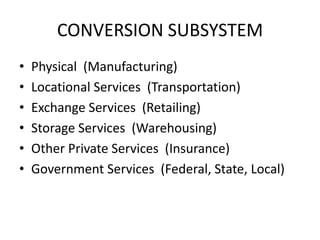
CONVERSION SUBSYSTEMPhysical  (Manufacturing)Locational Services  (Transportation)Exchange Services  (Retailing)Storage Services  (Warehousing)Other Private Services  (Insurance)Government Services  (Federal, State, Local)
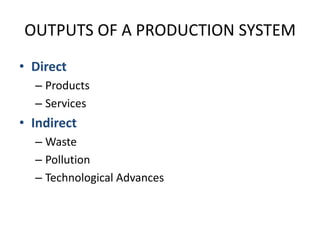
OUTPUTS OF A PRODUCTION SYSTEMDirectProductsServicesIndirectWastePollutionTechnological Advances
WHAT CONTROLS THE OPERATIONS SYSTEM?Information about the outputs, the conversions, and the inputs is feed back to management.This information is matched with management’s expectationsWhen there is a difference, management must take corrective action to  maintain control of the system
TYPES OF PRODUCTION SYSTEMProduction systemThe production system of a company mainly  uses facilities, equipments and operating methods (production system) to produce goods.The requirement of production system depend on the type of product that company offers and strategy that the company follows
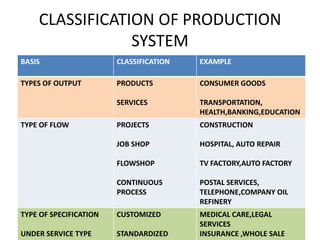
CLASSIFICATION OF PRODUCTION SYSTEM
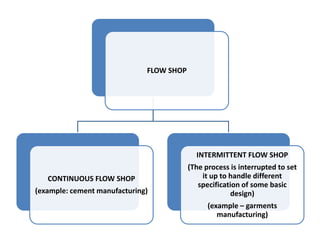
FLOW SHOPFLOW SHOPIt is a conversion process in which successive units of output undergo the same sequence of operations using specialized equipments  usually positioned along a production line.ExampleAuto assemblyassembly of electronic goods.Extreme form of flow shop is sometimes treated as a continuous process
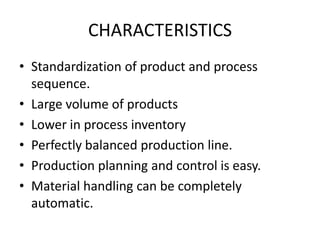
CHARACTERISTICSStandardization of product and process sequence.Large volume of productsLower in process inventoryPerfectly balanced production line.Production planning and control is easy.Material handling can be completely automatic.
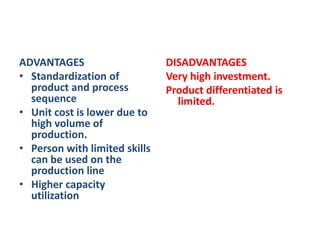
ADVANTAGESStandardization of product and process sequenceUnit cost is lower due to high volume of production.Person with limited skills can be used on the production lineHigher capacity utilizationDISADVANTAGESVery high investment.Product differentiated is limited.
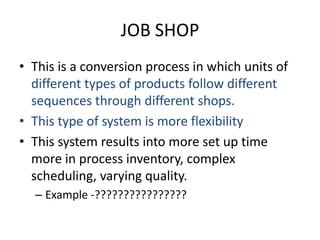
JOB SHOP This is a conversion process in which units of different types of products follow different sequences through different shops.This type of system is more flexibilityThis system results into more set up time more in process inventory, complex scheduling, varying quality.Example -????????????????
CHARACTERISTICSHigh variety of products and low volume.Use of general purpose machines and facilities.Large inventory of materials, tools, parts.Detailed planning is essential for sequencing the requirements of each product, capacities for each work centre.
ADVANTAGESVariety of products can be produced.Operators will become more skilled and competent.DISADVANTAGESHigher cost due to frequent set up changes.Production planning is complicated.Large space requirements
BATCH MANUFACTURINGA batch manufacturing facility produces some intermediate varieties of products with intermediate volumes.The volume of any single product may not be sufficient to justify the use of dedicated set of equipments for its production.
CHARACTERISTICSShorter production runPlant and machinery are flexible.Manufacturing lead time and cost are lower as compared to job order production.
ADVANTAGESBetter utilization of plant and machineryPromotes functional specializationLower investment in plant and machineryDISADVANTAGESMaterial handling is complex because of irregular and longer flowsProduction planning and control is complexHigher set up costs due to frequent changes in set up
PROJECTA project refers to the process of creating a complex kind of product or service with set of well defined tasks in terms of resources required and time phasing.
PRODUCTIVITYProductivity = output/input   always p>1Several strategies for improving the productivityIncreased output for the same inputDecreased input for the same outputProportionate increase in the output is more than the proportionate increase in the input.Proportionate decrease in the input is more than the proportionate decrease in the output.Increase in the output with decrease in the input
OPERATION STRATEGYThe process of making decisions about their future in this complex and changing environment is called strategic management.Changing environment  Environment of organization is becoming more complex because of the increased rate of PESTELStrategic management involves making decision with regard to organizations mission and objectives, it also determine the organizations most effective utilization of its resources.
STRATEGIC MANAGEMENT PHASESStrategy management has two phasesStrategy formulationDefining the organization philosophy and mission.Establish long and short range objectives.And choosing the strategy in order achieve the objective.Strategy implementationIt concerned with aligning the organizational structure , system and processes.
HIERARCHY OF STRATEGYMissionObjectiveCorporate strategiesBusiness unit strategiesFunctional strategies
CORPORATE STRATEGIESStable growth strategyGrowth strategyConcentration on a single product/serviceConcentric diversificationVertical diversificationHorizontal diversificationConglomerate diversificationEnd game strategy
…contdRetrenchment strategiesTurnaround.Disinvestment strategy.Liquidation strategy.Combination strategiesSimultaneous strategy.Sequential strategy.
GENERIC COMPETITIVE (BUSINESS) STARETGIESOver all leadership strategyDifferentiation strategyFocus strategy
FUNCTIONAL STRATEGIESMarketing strategyFinancial strategyPersonnel/HR strategyProduction/manufacturing strategies
PRODUCTION/MANUFACTURING STRATEGIESProduction /operation function of an organization aims to provide product/service to its customer by using a combination of following  strategies.By timely deliveryFlexibility (in meeting customer demands)QualityCost effectiveness.
…contdThe selected strategies alternatives are translated into operations objectives. Some of the objectives areAchieving high efficiencyFlexibility in meeting customer demand (in term of product features)Flexibility in production volume to meet changing customers demand.Satisfy customers demand with good quality.Effective in labor relation  and manpower cost control.Efficient material utilization and its cost control. Efficient facility utilization and its cost
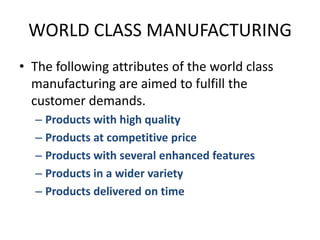
WORLD CLASS MANUFACTURINGThe following attributes of the world class manufacturing are aimed to fulfill the customer demands.Products with high qualityProducts at competitive priceProducts with several enhanced featuresProducts in a wider varietyProducts delivered on time
ENTRY-LEVEL JOBS IN POMPurchasing planner/buyerProduction (or operations) supervisorProduction (or operations) scheduler/controllerProduction (or operations) analystInventory analystQuality specialist
TODAY'S FACTORS AFFECTING POMGlobal Competition Quality, Customer Service, and Cost ChallengesComputers and Advanced Production TechnologyGrowth of  Service SectorScarcity of Production ResourcesIssues of Social Responsibility
SCOPE OF POM
Adding value by improving Operations  Management.It can help improve its competitiveness and long term profitability.Intel, FORD, Hewlett Packard.Cost effectiveness?Understanding the fundamental concepts of operations management and being able to use a variety of common decision-making tools and problem solving approaches is key to making better operations decisions.
SCOPE OF POMProduction of goods is the fabrication of the physical object through the judicious use of the resources available to the manager.These resources include men, materials, money, methods and machines.Operations management is substituted for Production Management, as many individuals and organizations continue to use the term Production solely to manufacturing activity.Operations management has wider scope, it begins with the idea stage, goes through research and development, manufacturing, purchasing, inspection, quality control and warehousing and ends with customer.
Production is a subset of operations management. It’s scope is a part of operations management. It focuses on:Product DesignForecastingFacility LocationCapacity PlanningProcess PlanningPlant Layout
Scope cont….Resource ManagementPPCJob DesignMaintenanceQuality ManagementWork MeasurementPurchasingStore KeepingWarehouse ManagementInventory controlMaterials ManagementProject Management
Functions of POMProduction is a process or a set of procedures to be executed in order to convert or transform a set of inputs into pre-determined set of outputs in accordance with the objectives assigned to the production system.PlanningOrganizingStaffingDirectingControlling
Relationship between POM and other FunctionsMarketingCustomer satisfactionDeveloping and maintaining marketAggregate Production PlanningSales forecastProduction SchedulingASPProduct improvement etc.FinanceEconomic analysis of investment proposalsProduction pricingBudgeting and timing of fundsWorking capital calculationsProvision and release of fundsCapital Budgeting
R&DIdea generationProduct formulationTest facilitiesPrototype DevelopmentFacilities for development activitiesTest marketingProduct DesignMaintenanceIndustrial EngineeringMaterialsPersonnelAccounting and Costing
OPERATIONS STRATEGIESIN A GLOBAL ECONOMY
OVERVIEWIntroductionToday’s Global Business ConditionsOperations StrategyForming Operations Strategies
INTRODUCTIONOperational effectiveness is the ability to perform similar operations activities better than competitors.It is very difficult for a company to compete successfully in the long run based just on operational effectiveness.A firm must also determine how operational effectiveness can be used to achieve a sustainable competitive advantage.An effective competitive strategy is critical.
FACTORS AFFECTING TODAY’S GLOBAL BUSINESS CONDITIONS?????????????????????????????????????????
REALITY OF GLOBAL COMPETITIONChanging nature of world businessInternational companiesStrategic alliances and production sharingFluctuation of international financial conditions
changing nature of world businessThe Indian gross domestic product (GDP) growing at 8% making significant presence in the world.Companies all over the globe are aggressively exporting their products/services to the different countriesMany Foreign companies are targeting Indian markets to shore up profits.The global economy that interconnects the economies of all nations has been termed the global village.One of the most important new markets are BRIC.
International companiesInternational companies are those whose scope of operations spans the globe as they buy, produce, and sell.International firms search out opportunities for profits relatively unencumbered by national boundaries.Operations managers must coordinate geographically dispersed operations.
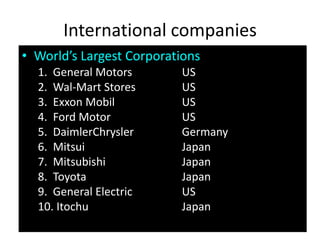
International companiesWorld’s Largest Corporations1.  General Motors		US2.  Wal-Mart Stores		US3.  Exxon Mobil			US4.  Ford Motor			US5.  DaimlerChrysler		Germany6.  Mitsui				Japan7.  Mitsubishi			Japan8.  Toyota			Japan9.  General Electric		US10. Itochu			Japan
Strategic AlliancesStrategic alliances are joint ventures among international companies to exploit global business opportunities.Alliances are often motivated byProduct or production technologyMarket accessProduction capabilityPooling of capital
Strategic AlliancesJapanese companies have long practiced keiretsu, the linking of companies into industrial groups.A financial keiretsu links companies together with cross-holding of shares, sales and purchases within the group, and consultation.A production keiretsu is a web of interlocking relationships between a big manufacturer (Toyota) and its suppliers.
Production SharingProduction sharing means that a product might be designed and financed in one country, its materials produced in other countries, assembled in another country, and sold in yet other countries.The country that is the highest-quality, lowest-cost producer for a particular activity would perform that portion of the production of the product.
Pros and Cons of GlobalizationPros (Pluses)Productivity grows more quickly (living standards can go up faster)Global competition and cheap imports keep a lid on prices (inflation less likely to derail economic growth)Open economy spurs innovation (with fresh ideas from abroad)Export jobs often pay more than other jobsIndia has more access to foreign investment (keeps interest rates low)
Pros and Cons of GlobalizationCons (Minuses)Most displaced workers find new jobs that pay lessWorkers face pay-cuts demands from employersService and white-collar jobs are increasingly vulnerableemployees lose their comparative advantage when companies build advanced factories abroad
International Financial ConditionsInternational financial conditions are complex due to:inflationfluctuating currency exchange ratesturbulent interest ratesvolatility of international stock marketshuge national debts of some countriesenormous trade imbalances between countries
International Financial ConditionsCompanies must be ready to move quickly to shift strategies as world financial conditions change.Opportunities are usually available to reduce riskBuilding smaller, more flexible factoriesUsing foreign suppliers for materials, parts, or productsCarefully planning and forecasting so that changing conditions can be anticipated
QUALITY SERVICE  AND COST CHALLENGESQualityThe goal of adequate quality must be replaced with the objective of perfect product and service quality.The entire corporate culture must be redirected and committed to the ideal of perfect quality.All employees must be empowered to act.A commitment to continuous improvement has to be organization-wide.
QUALITY SERVICE  AND COST CHALLENGESCustomer ServiceCompanies must quickly develop innovative products and respond quicklyOrganizational structures must be made more horizontal to quickly accommodate change.Multidiscipline teams must have decision-making authority, responding better to the marketplace.Large, unwieldy companies are spinning off whole business units making them autonomous businesses that can compete with small, aggressive competitors.
QUALITY  SERVICE  AND COST CHALLENGESCostThere is continuing pressure to reduce direct costs (of producing and selling) and overhead costs.It cost the US automakers $1,500 more per auto for labor in 1980 than it cost the Japanese auto-makers. By the 1990s the difference was almost zero.Giant retailers (like Wal-Mart) squeezed weaker competitors out of the market, giving the retailers the leverage to force their suppliers to streamline operations and reduce costs/prices.
QUALITY SERVICE  AND COST CHALLENGESCostCost-cutting measures being used include:Moving production to low-labor-cost countriesNegotiating lower labor rates with unions and workersAutomating processes to reduce the amount of labor needed, particularly processes that are labor intensive.
ADVANCED TECHNOLOGIESThe use of automation is one of the most far-reaching developments to affect manufacturing and services in the past century.The initial cost of these assets is high.The benefits go far beyond a reduction in labor costs.Increased product/service qualityReduced scrap and material costsFaster responses to customer needsFaster introduction of new products and services
CONTINUED GROWTH OF SERVICE SECTOR A robust service sector helps support the manufacturing sector.There is much opportunity for quality improvement in service firms all round the globe.Many operations managers are being employed in services.Planning, analyzing, and controlling approaches from manufacturing are being adapted to service systems.The service sector, like the manufacturing sector, must streamline and improve operations if it is to survive.
SCARCITY OF OPERATIONS RESOURCESRaw materials like titanium, nickel, coal, natural gas, water, and petroleum products are periodically unavailable or in short supply.A shortage of any necessary input to a conversion subsystem, including skilled personnel, can be a challenge for an operations manager.An important issue in the formation of business strategy is how to allocate scarce resources among business opportunities.
SOCIAL-RESPONSIBILITY ISSUESCorporate attitudes are evolving from doing what companies have a legal right to do, to doing what is right.Factors influencing this evolution include:Consumer attitude -- Consumers are expressing their likes/dislikes by such means as  stockholder meetings, liability suits, and buying preferences.Regulation – The EPA, OSHA (Occupational Safety and Health Administration Act), Clean Air Act, and Family Leave Act place constraints on businesses.Self-interests -- Companies realize that profits will be greater if they act responsibly.
SOCIAL-RESPONSIBILITY ISSUESEnvironmental ImpactProduct-Safety ImpactEmployee Impact
Social-Responsibility IssuesEnvironmental Impact	Concerns about the global environment include:Landfill waste reductionRecyclingEnergy conservationChemical spillsAcid rainRadioactive waste disposal… and more
Social-Responsibility IssuesEnvironmental ImpactThere is a need for standardizing government regulations of the environment.Otherwise, companies will gravitate to the less-regulated countries.The International Organization for Standardization has developed a set of environmental guidelines called ISO 14000.
Social-Responsibility IssuesProduct-Safety Impact	Harm to people or animals that results from poor product design can:Damage a company’s reputationRequire a large expense to remedyCause governments to impose more regulations
Social-Responsibility IssuesEmployee Impact	Employee benefits and policies include:Safety and health programsFair hiring and promotion practicesDay-careFamily leaveHealth careRetirement benefitsEducational assistance… and more
Social-Responsibility IssuesEmployee Impact	Employee benefits and policies impact long-term profitability due to their effect on:Employee morale and productivityRecruitment and retention of employeesDemand for a company’s productsCost of defending against lawsuits and boycotts
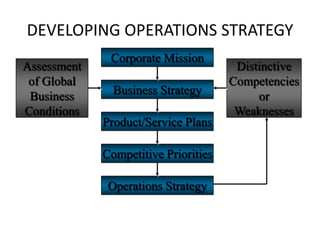
DEVELOPING OPERATIONS STRATEGYCorporate MissionAssessmentof GlobalBusinessConditionsDistinctiveCompetenciesorWeaknessesBusiness StrategyProduct/Service PlansCompetitive PrioritiesOperations Strategy
Corporate MissionA corporate mission is a set of long-range goals and including statements about:the kind of business the company wants to be inwho its customers areits basic beliefs about businessits goals of survival, growth, and profitability
Business StrategyBusiness strategy is a long-range game plan of an organization and provides a road map of how to achieve the corporate mission.Inputs to the business strategy areAssessment of global business conditions - social, economic, political, technological, competitiveDistinctive competencies or weaknesses - workers, sales force, R&D, technology, management
Competitive PrioritiesLow Production CostsDefinition		Unit cost (labor, material, and overhead) of each product/serviceSome Ways of CreatingRedesign of product/serviceNew technologyIncrease in production ratesReduction of scrap/wasteReduction of inventory
Competitive PrioritiesDelivery PerformanceDefinitiona) Fast delivery	b) On-time deliverySome Ways of Creating	a) larger finished-goods inventory	a) faster production rates	a) quicker shipping methods		b) more-realistic promises	b) better control of production of orders	b) better information systems
Competitive PrioritiesHigh-Quality Products/Services Definition		Customers’ perception of degree of excellence exhibited by products/servicesSome Ways of CreatingImprove product/service’sAppearancePerformance and functionWear, endurance abilityAfter-sales service
Competitive PrioritiesCustomer Service and Flexibility Definition		Ability to quickly change production to other products/services.  Customer responsiveness.Some Ways of CreatingChange in type of processes usedUse of advanced technologiesReduction in WIP through lean manufacturingIncrease in capacity
OPERATIONS STRATEGYOperations strategy is a long-range game plan for the production of a company’s products/services, and provides a road map for the production function in helping to achieve the business strategy.
ELEMENTS OF OPERATIONS STRATEGYPositioning the production systemProduct/service plans  Outsourcing plans Process and technology plansStrategic allocation of resourcesFacility plans: capacity, location, and layout
POSITIONING THE PRODUCTION SYSTEMSelect the type of product designStandardCustomSelect the type of production processing systemProduct focusedProcess focusedSelect the type of finished-goods inventory policyProduce-to-stockProduce-to-order
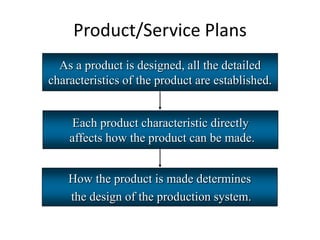
Product/Service PlansAs a product is designed, all the detailedcharacteristics of the product are established.Each product characteristic directly affects how the product can be made.How the product is made determines the design of the production system.
Stages in a Product’s Life CycleIntroduction- Sales begin, production and marketing are developing, profits are negative.Growth - sales grow dramatically, marketing efforts intensify, capacity is expanded, profits begin.Maturity - production focuses on high-volume, efficiency, low costs; marketing focuses on competitive sales promotion; profits are at peak.Decline - declining sales and profit; product might be dropped or replaced.
Outsourcing PlansOutsourcing refers to hiring out or subcontracting some of the work that a company needs to do.This strategy is being used more and more as companies strive to operate more efficiently.Outsourcing has many advantages and disadvantages. Companies try to determine the best level of out-sourcing to achieve their operations & business goals.More outsourcing requires a company to have less equipment, fewer employees, and a smaller facility.
Outsourcing PlansA company might outsource any of the following manufacturing related functions:Designing the productPurchasing the basic raw materialsProcessing the subcomponents, subassemblies, major assemblies, and finished productDistributing the product
Outsourcing PlansMany companies even outsource some service functions such as:PayrollBillingOrder processingDeveloping/maintaining a websiteEmployee recruitmentFacility maintenance
Process and Technology PlansAn essential part of operations strategy is the determination of how products/services will be produced.The range of technologies available to produce products/services is great and is continually changing.
Strategic Allocation of ResourcesFor most companies, the vast majority of the firm’s resources are used in production/operations.Some or all of these resources are limited.The resources must be allocated to products, services, projects, or profit opportunities in ways that maximize the achievement of the operations objectives.
Facility PlansHow to provide the long-range capacity to produce the firm’s products/services is a critical strategic decision.The location of a new facility may need to be decided.The internal arrangement (layout) of workers, equipment, and functional areas within a facility affects the ability to provide the desired volume, quality, and cost of products/services.
Competitive Priorities for ServicesThe competitive priorities listed earlier for manufacturers apply to service firms as wellLow production costsFast and on-time deliveryHigh-quality products/servicesCustomer service and flexibilityProviding all the priorities simultaneously to customers is seldom possible.
Positioning Strategies for ServicesType of Service DesignStandard or custom products  Amount of customer contactMix of physical goods and intangible servicesType of Production ProcessQuasi manufacturingCustomer-as-participantCustomer-as-product
Positioning Strategies for ServicesEXAMPLE:  MCDONALD’SHighly standardized service designLow amount of customer contactPhysical goods dominating intangible servicesQuasi-manufacturing approach to back-room production process
Forming Operations StrategiesSupport the product plans and competitive priorities defined in the business strategy.Adjust to the evolving positioning strategies.Link to the marketing strategies.Look at alternative operations strategies.
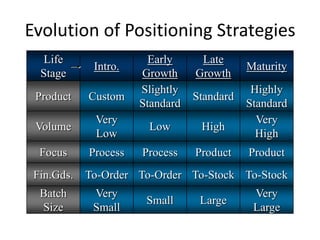
Evolution of Positioning StrategiesThe characteristics of production systems tend to evolve as products move through their product life cycles.Operations strategies must include plan for modifying production systems to a changing set of competitive priorities as products mature.The capital and production technology required to support these changes must be provided.
Evolution of Positioning StrategiesLifeStageIntro.EarlyGrowthLateGrowthMaturityProductCustomSlightlyStandardStandardHighlyStandardVolumeVeryLowLowHighVeryHighFocusProcessProcessProductProductFin.Gds.To-OrderTo-OrderTo-StockTo-StockBatchSizeVerySmallSmallLargeVeryLarge
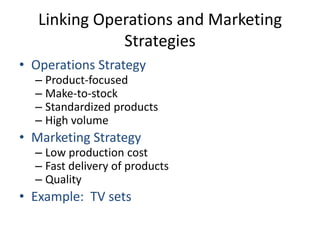
Linking Operations and Marketing StrategiesOperations StrategyProduct-focusedMake-to-stockStandardized productsHigh volumeMarketing StrategyLow production costFast delivery of productsQualityExample:  TV sets
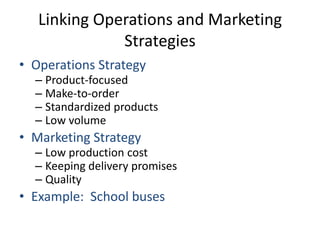
Linking Operations and Marketing StrategiesOperations StrategyProduct-focusedMake-to-orderStandardized productsLow volumeMarketing StrategyLow production costKeeping delivery promisesQualityExample:  School buses
Linking Operations and Marketing StrategiesOperations StrategyProcess-focusedMake-to-stockCustom productsHigh volumeMarketing StrategyFlexibilityQualityFast delivery of productsExample:  Medical instruments
Linking Operations and Marketing StrategiesOperations StrategyProcess-focusedMake-to-orderCustom productsLow volumeMarketing StrategyKeeping delivery promisesQualityFlexibilityExample:  Large supercomputers
No Single Best StrategyStart-up and Small ManufacturersUsually prefer positioning strategies with:Custom productsProcess-focused productionProduce-to-order policiesThese systems are more flexible and require lesscapital.
No Single Best StrategyStart-up and Small ServicesSuccessfully compete with large corporations by:Carving out a specialty nicheEmphasizing close, personal customer serviceDeveloping a loyal customer base
No Single Best StrategyTechnology-Intensive BusinessProduction systems must be capable of producing new products and services in high volume soon after introductionSuch companies must have two key strengths:Highly capable technical peopleSufficient capital
Wrap-Up: World-Class PracticePut customers firstGet new products/services to market fasterAre high quality producersHave high labor productivity & low production costsCarry little excess inventory. . . more
World-Class PracticeThink more globally in purchasing and sellingQuickly adopt and develop new technologiesTrim organizations to be lean and flexibleAre less resistant to strategic alliances/joint venturesConsider relevant social issues when setting strategies

Unit 1

  • 1.
    571210 – OPERATIONSMANAGEMENTFACILITAOR- T.PRAVEEN KUMAR
  • 2.
    REFERENCEPannerselvam R, Productionand operations management, Prentice Hall of India,Norman Gaither and Gregory Fraizer, Operations Management, south western cengage learning 2002.Business line Journals of production management.
  • 3.
  • 4.
    INTERNAL MARKSINTERNAL /MODEL EXAMS- 10 MARKSATTENDANCE / CLASS PARTICIPATION - 5 MARKSASSIGNMENTS - 5 MARKSDON’T BEG FOR MARKS
  • 5.
  • 6.
  • 7.
    OVERVIEWIntroductionHistorical Milestones inPOMFactors Affecting POM TodayDifferent Ways of Studying POMWrap-Up: What World-Class Producers Do
  • 8.
    INTRODUCTIONIn the growingglobal competition the productivity is the key for the survival of business organization.Among the different functions in a organization POM is a vital function which does the job of value addition to products /services respectively.Maximize value automatically results in productivity improvement.
  • 9.
    …contdThis should bedone from starting stage of product development.Implementation of proper quality control system, maintenance of equipments and concentrating on various other inter mediate tasks leads to improvement in productivity.
  • 10.
    INTRODUCTIONProduction and operationsmanagement (POM) is the management of an organization’s production system.A production system takes inputs and converts them into outputs.The conversion process is the predominant activity of a production system.The primary concern of an operations manager is the activities of the conversion process.
  • 11.
    HISTORICAL MILESTONES INPOMThe Industrial RevolutionPost-Civil War PeriodScientific ManagementHuman Relations and BehaviorismOperations ResearchThe Service Revolution
  • 12.
    THE INDUSTRIAL REVOLUTIONTheindustrial revolution developed in England in the 1700s.The steam engine, invented by James Watt in 1764, largely replaced human and water power for factories.Adam Smith’s The Wealth of Nations in 1776 touted the economic benefits of the specialization of labor.Thus the late-1700s factories had not only machine power but also ways of planning and controlling the tasks of workers.
  • 13.
    THE INDUSTRIAL REVOLUTIONTheindustrial revolution spread from England to other European countries and to the United Sates.In 1790 an American, Eli Whitney, developed the concept of interchangeable parts.The first great industry in the U.S. was the textile industry.In the 1800s the development of the gasoline engine and electricity further advanced the revolution.By the mid-1800s, the old cottage system of production had been replaced by the factory system.
  • 14.
    POST-CIVIL WAR PERIODDuringthe post-Civil War period great expansion of production capacity occurred.By post-Civil War the following developments set the stage for the great production explosion of the 20th century:increased capital and production capacitythe expanded urban workforceNew marketsan effective national transportation system
  • 15.
    SCIENTIFIC MANAGEMENTFrederick Tayloris known as the father of scientific management. His shop system employed these steps:Each worker’s skill, strength, and learning ability were determined.Stopwatch studies were conducted to precisely set standard output per worker on each task.Material specifications, work methods, and routing sequences were used to organize the shop.Supervisors were carefully selected and trained.Incentive pay systems were initiated.
  • 16.
    SCIENTIFIC MANAGEMENTIn the1920s, Ford Motor Company’s operation embodied the key elements of scientific management:standardized product designsmass productionlow manufacturing costsmechanized assembly linesspecialization of laborinterchangeable parts
  • 17.
    HUMAN RELATIONSAND BEHAVIORALISMInthe 1927-1932 period, researchers in the Hawthorne Studies realized that human factors were affecting production.Researchers and managers were recognizing that psychological and sociological factors affected production.From the work of behavior lists came a gradual change in the way managers thought about and treated workers.
  • 18.
    OPERATIONS RESEARCHDuring WorldWar II, enormous quantities of resources (personnel, supplies, equipment, …) had to be deployed.Military operations research (OR) teams were formed to deal with the complexity of the deployment.After the war, operations researchers found their way back to universities, industry, government, and consulting firms.OR helps operations managers make decisions when problems are complex and wrong decisions are costly.
  • 19.
    THE SERVICE REVOLUTIONThecreation of services organizations accelerated sharply after World War II.Today, more than two-thirds of the workforce is employed in services.About two-thirds of world GDP is from services.There is a huge trade surplus in services.Investment per office worker now exceeds the investment per factory worker.Thus there is a growing need for service operations management.
  • 20.
    Next 3 monthsyou are going to see aboutPRODUCTION/OPERATION MANAGEMENTTYPES OF PRODUCTION SYSTEMDIFFERENT PRODUCTIVITY IMPROVEMENT STRATEGIESNEW PRODUCT DEVELOPMENTPROCESS PLANNINGCAPACITY PLANNINGMRPTQM TOOLS etc………………………………
  • 21.
    DIFFERENT WAYS TOSTUDY POMProduction as a SystemProduction as an Organization FunctionDecision Making in POM
  • 22.
    ORGANIZATIONAL MODELFinanceHRMSalesPOMQA MarketingMISEngineering Accounting
  • 23.
    PRODUCTION SYSTEMAn organizationconsists of mainly four functional subsystemMarketingProductionFinance Personnel
  • 24.
    MARKETING FUNCTIONAims topromote its products among customers which helps it to obtain substantial sales order.PRODUCTION FUNCTIONThis function will managing the physical resources for the production of an item/ provision of services.The available facilities need to be managed effectively in order to meet the current market requirements.
  • 25.
    …..contThe resources areraw material, equipment, labor, working capital.The production function needs to organize its resources according to the predetermined production plans.
  • 26.
    FINANCE FUNCTIONThis functionprovides authorization and control to all other subsystems to utilize the money in more effectively through a well designed mechanism.PERSONNEL FUNCTION/HRThis is a supporting function which plans and provides manpower to all other function of the organization.It involves in recruitment, training and development, performance measures of the manpower.All functions of the organization are interwoven by many linkages for their effective functioning.
  • 27.
  • 28.
    PRODUCTION AS ANORGANIZATION FUNCTION companies cannot compete using marketing, finance, accounting, and engineering alone.We focus on POM as we think of global competitiveness, because that is where the vast majority of a firm’s workers, capital assets, and expenses reside.To succeed, a firm must have a strong operations function teaming with the other organization functions.
  • 29.
    PRODUCTION MANAGEMENT Production /operationsmanagement is the process which combines and transforms various resources used in the production/operation sub system of the organization into value added products/ services in a controlled manner as per the policies of the organization
  • 30.
    ANOTHER VIEW Production/operation managementfunction is the part of the organization which is concerned with the transformation of a range of inputs into the required output(product/service) having the requisite quality level.
  • 31.
    IN GENERALThe setof interrelated management activities which are involved in manufacturing certain products is called as production management.If the above concept is extended to services management then the corresponding set of management activities is called as operations management.So in general the concept of manufacturing products/providing services is called production/operations management
  • 32.
    DECISIONS AT DIFFERENTLEVEL OF MANAGEMENTIn the process of managing various subsystem of the organization, executives at different levels of the organization need to take several management.
  • 33.
    STRATEGIC DECISIONSThese decisionsare of strategic importance and have long-term significance for the organization.Examples include deciding:the design for a new product’s production processwhere to locate a new factorywhether to launch a new-product development plan
  • 34.
    OPERATING DECISIONSThese decisionsare necessary if the ongoing production of goods and services is to satisfy market demands and provide profits.Examples include deciding:how much finished-goods inventory to carrythe amount of overtime to use next weekthe details for purchasing raw material next month
  • 35.
    CONTROL DECISIONSThese decisionsconcern the day-to-day activities of workers, quality of products and services, production and overhead costs, and machine maintenance.Examples include deciding:labor cost standards for a new productfrequency of preventive maintenancenew quality control acceptance criteria
  • 37.
    MARKETING - FUNCTIONStrategicDecisionsConsideration of new markets and marketing strategiesThe information requirements for strategic planningInclude customer analysisCompetitor analysisConsumer surveyIncome projectionDemographic projectionTechnology projection
  • 38.
    …contdTactical DecisionsComparison ofoverall performance against a marketing plan.Concerns data on customers, competitors and its products and sales force requirements.Operational decisionsHiring and firing of sales forceDay to day scheduling of sales and promotions efforts and periodic analysis of sales.
  • 39.
    PRODUCTION FUNCTIONStrategic DecisionAlternativemanufacturing approaches and alternative approaches to automation.Tactical DecisionReports which compare overall planned/standard performanceOperational DecisionReports comparing actual performance to production schedule
  • 40.
    FINANCE FUNCTIONStrategic DecisionLongrun strategy to ensure adequate financing .Long run tax accounting policy to minimize the impact of taxes.Planning of systems for budgetingTactical DecisionInformation on budgeted versus actual cost of financial resources.Cost of processing accounting data. Operational DecisionDaily error and exception reports.Records of processing delays reports of unprocessed transaction etc.
  • 41.
    PERSONNEL /HR FUNCTIONStrategicDecisionStrategies for recruitment, salary, training and benefits.Analysis of shift pattern of employment, education and wage rate etc.Tactical DecisionVariance analysis on hiring and firing.Cost of recruitmentCost of training, salary paid, distribution of wage rates.Operational decisionDecision on hiring, training, termination changing pay rates and issuing benefits.
  • 42.
    SYSTEM CONCEPT OFPRODUCTIONSystemIt is a collection of interrelated entities. Operations management is the management of transformation systems which convert input into goods/servicesInput materials, labors, equipments, capitalThe types of inputs used vary from one industry to another
  • 43.
    PRODUCTION AS ASYSTEMProduction SystemConversionSubsystemInputsOutputsControlSubsystem
  • 44.
  • 45.
    INPUTS OF APRODUCTION SYSTEMExternalLegal, Economic, Social, TechnologicalMarketCompetition, Customer Desires, Product Info.Primary ResourcesMaterials, Personnel, Capital, Utilities
  • 46.
    CONVERSION SUBSYSTEMPhysical (Manufacturing)Locational Services (Transportation)Exchange Services (Retailing)Storage Services (Warehousing)Other Private Services (Insurance)Government Services (Federal, State, Local)
  • 47.
    OUTPUTS OF APRODUCTION SYSTEMDirectProductsServicesIndirectWastePollutionTechnological Advances
  • 49.
    WHAT CONTROLS THEOPERATIONS SYSTEM?Information about the outputs, the conversions, and the inputs is feed back to management.This information is matched with management’s expectationsWhen there is a difference, management must take corrective action to maintain control of the system
  • 50.
    TYPES OF PRODUCTIONSYSTEMProduction systemThe production system of a company mainly uses facilities, equipments and operating methods (production system) to produce goods.The requirement of production system depend on the type of product that company offers and strategy that the company follows
  • 51.
  • 52.
    FLOW SHOPFLOW SHOPItis a conversion process in which successive units of output undergo the same sequence of operations using specialized equipments usually positioned along a production line.ExampleAuto assemblyassembly of electronic goods.Extreme form of flow shop is sometimes treated as a continuous process
  • 54.
    CHARACTERISTICSStandardization of productand process sequence.Large volume of productsLower in process inventoryPerfectly balanced production line.Production planning and control is easy.Material handling can be completely automatic.
  • 55.
    ADVANTAGESStandardization of productand process sequenceUnit cost is lower due to high volume of production.Person with limited skills can be used on the production lineHigher capacity utilizationDISADVANTAGESVery high investment.Product differentiated is limited.
  • 56.
    JOB SHOP Thisis a conversion process in which units of different types of products follow different sequences through different shops.This type of system is more flexibilityThis system results into more set up time more in process inventory, complex scheduling, varying quality.Example -????????????????
  • 57.
    CHARACTERISTICSHigh variety ofproducts and low volume.Use of general purpose machines and facilities.Large inventory of materials, tools, parts.Detailed planning is essential for sequencing the requirements of each product, capacities for each work centre.
  • 58.
    ADVANTAGESVariety of productscan be produced.Operators will become more skilled and competent.DISADVANTAGESHigher cost due to frequent set up changes.Production planning is complicated.Large space requirements
  • 59.
    BATCH MANUFACTURINGA batchmanufacturing facility produces some intermediate varieties of products with intermediate volumes.The volume of any single product may not be sufficient to justify the use of dedicated set of equipments for its production.
  • 60.
    CHARACTERISTICSShorter production runPlantand machinery are flexible.Manufacturing lead time and cost are lower as compared to job order production.
  • 61.
    ADVANTAGESBetter utilization ofplant and machineryPromotes functional specializationLower investment in plant and machineryDISADVANTAGESMaterial handling is complex because of irregular and longer flowsProduction planning and control is complexHigher set up costs due to frequent changes in set up
  • 62.
    PROJECTA project refersto the process of creating a complex kind of product or service with set of well defined tasks in terms of resources required and time phasing.
  • 63.
    PRODUCTIVITYProductivity = output/input always p>1Several strategies for improving the productivityIncreased output for the same inputDecreased input for the same outputProportionate increase in the output is more than the proportionate increase in the input.Proportionate decrease in the input is more than the proportionate decrease in the output.Increase in the output with decrease in the input
  • 64.
    OPERATION STRATEGYThe processof making decisions about their future in this complex and changing environment is called strategic management.Changing environment  Environment of organization is becoming more complex because of the increased rate of PESTELStrategic management involves making decision with regard to organizations mission and objectives, it also determine the organizations most effective utilization of its resources.
  • 65.
    STRATEGIC MANAGEMENT PHASESStrategymanagement has two phasesStrategy formulationDefining the organization philosophy and mission.Establish long and short range objectives.And choosing the strategy in order achieve the objective.Strategy implementationIt concerned with aligning the organizational structure , system and processes.
  • 66.
    HIERARCHY OF STRATEGYMissionObjectiveCorporatestrategiesBusiness unit strategiesFunctional strategies
  • 67.
    CORPORATE STRATEGIESStable growthstrategyGrowth strategyConcentration on a single product/serviceConcentric diversificationVertical diversificationHorizontal diversificationConglomerate diversificationEnd game strategy
  • 68.
    …contdRetrenchment strategiesTurnaround.Disinvestment strategy.Liquidationstrategy.Combination strategiesSimultaneous strategy.Sequential strategy.
  • 69.
    GENERIC COMPETITIVE (BUSINESS)STARETGIESOver all leadership strategyDifferentiation strategyFocus strategy
  • 70.
    FUNCTIONAL STRATEGIESMarketing strategyFinancialstrategyPersonnel/HR strategyProduction/manufacturing strategies
  • 71.
    PRODUCTION/MANUFACTURING STRATEGIESProduction /operationfunction of an organization aims to provide product/service to its customer by using a combination of following strategies.By timely deliveryFlexibility (in meeting customer demands)QualityCost effectiveness.
  • 72.
    …contdThe selected strategiesalternatives are translated into operations objectives. Some of the objectives areAchieving high efficiencyFlexibility in meeting customer demand (in term of product features)Flexibility in production volume to meet changing customers demand.Satisfy customers demand with good quality.Effective in labor relation and manpower cost control.Efficient material utilization and its cost control. Efficient facility utilization and its cost
  • 73.
    WORLD CLASS MANUFACTURINGThefollowing attributes of the world class manufacturing are aimed to fulfill the customer demands.Products with high qualityProducts at competitive priceProducts with several enhanced featuresProducts in a wider varietyProducts delivered on time
  • 74.
    ENTRY-LEVEL JOBS INPOMPurchasing planner/buyerProduction (or operations) supervisorProduction (or operations) scheduler/controllerProduction (or operations) analystInventory analystQuality specialist
  • 75.
    TODAY'S FACTORS AFFECTINGPOMGlobal Competition Quality, Customer Service, and Cost ChallengesComputers and Advanced Production TechnologyGrowth of Service SectorScarcity of Production ResourcesIssues of Social Responsibility
  • 76.
  • 77.
    Adding value byimproving Operations Management.It can help improve its competitiveness and long term profitability.Intel, FORD, Hewlett Packard.Cost effectiveness?Understanding the fundamental concepts of operations management and being able to use a variety of common decision-making tools and problem solving approaches is key to making better operations decisions.
  • 78.
    SCOPE OF POMProductionof goods is the fabrication of the physical object through the judicious use of the resources available to the manager.These resources include men, materials, money, methods and machines.Operations management is substituted for Production Management, as many individuals and organizations continue to use the term Production solely to manufacturing activity.Operations management has wider scope, it begins with the idea stage, goes through research and development, manufacturing, purchasing, inspection, quality control and warehousing and ends with customer.
  • 79.
    Production is asubset of operations management. It’s scope is a part of operations management. It focuses on:Product DesignForecastingFacility LocationCapacity PlanningProcess PlanningPlant Layout
  • 80.
    Scope cont….Resource ManagementPPCJobDesignMaintenanceQuality ManagementWork MeasurementPurchasingStore KeepingWarehouse ManagementInventory controlMaterials ManagementProject Management
  • 81.
    Functions of POMProductionis a process or a set of procedures to be executed in order to convert or transform a set of inputs into pre-determined set of outputs in accordance with the objectives assigned to the production system.PlanningOrganizingStaffingDirectingControlling
  • 82.
    Relationship between POMand other FunctionsMarketingCustomer satisfactionDeveloping and maintaining marketAggregate Production PlanningSales forecastProduction SchedulingASPProduct improvement etc.FinanceEconomic analysis of investment proposalsProduction pricingBudgeting and timing of fundsWorking capital calculationsProvision and release of fundsCapital Budgeting
  • 83.
    R&DIdea generationProduct formulationTestfacilitiesPrototype DevelopmentFacilities for development activitiesTest marketingProduct DesignMaintenanceIndustrial EngineeringMaterialsPersonnelAccounting and Costing
  • 84.
  • 85.
    OVERVIEWIntroductionToday’s Global BusinessConditionsOperations StrategyForming Operations Strategies
  • 86.
    INTRODUCTIONOperational effectiveness isthe ability to perform similar operations activities better than competitors.It is very difficult for a company to compete successfully in the long run based just on operational effectiveness.A firm must also determine how operational effectiveness can be used to achieve a sustainable competitive advantage.An effective competitive strategy is critical.
  • 87.
    FACTORS AFFECTING TODAY’SGLOBAL BUSINESS CONDITIONS?????????????????????????????????????????
  • 88.
    REALITY OF GLOBALCOMPETITIONChanging nature of world businessInternational companiesStrategic alliances and production sharingFluctuation of international financial conditions
  • 89.
    changing nature ofworld businessThe Indian gross domestic product (GDP) growing at 8% making significant presence in the world.Companies all over the globe are aggressively exporting their products/services to the different countriesMany Foreign companies are targeting Indian markets to shore up profits.The global economy that interconnects the economies of all nations has been termed the global village.One of the most important new markets are BRIC.
  • 90.
    International companiesInternational companiesare those whose scope of operations spans the globe as they buy, produce, and sell.International firms search out opportunities for profits relatively unencumbered by national boundaries.Operations managers must coordinate geographically dispersed operations.
  • 91.
    International companiesWorld’s LargestCorporations1. General Motors US2. Wal-Mart Stores US3. Exxon Mobil US4. Ford Motor US5. DaimlerChrysler Germany6. Mitsui Japan7. Mitsubishi Japan8. Toyota Japan9. General Electric US10. Itochu Japan
  • 92.
    Strategic AlliancesStrategic alliancesare joint ventures among international companies to exploit global business opportunities.Alliances are often motivated byProduct or production technologyMarket accessProduction capabilityPooling of capital
  • 93.
    Strategic AlliancesJapanese companieshave long practiced keiretsu, the linking of companies into industrial groups.A financial keiretsu links companies together with cross-holding of shares, sales and purchases within the group, and consultation.A production keiretsu is a web of interlocking relationships between a big manufacturer (Toyota) and its suppliers.
  • 94.
    Production SharingProduction sharingmeans that a product might be designed and financed in one country, its materials produced in other countries, assembled in another country, and sold in yet other countries.The country that is the highest-quality, lowest-cost producer for a particular activity would perform that portion of the production of the product.
  • 95.
    Pros and Consof GlobalizationPros (Pluses)Productivity grows more quickly (living standards can go up faster)Global competition and cheap imports keep a lid on prices (inflation less likely to derail economic growth)Open economy spurs innovation (with fresh ideas from abroad)Export jobs often pay more than other jobsIndia has more access to foreign investment (keeps interest rates low)
  • 96.
    Pros and Consof GlobalizationCons (Minuses)Most displaced workers find new jobs that pay lessWorkers face pay-cuts demands from employersService and white-collar jobs are increasingly vulnerableemployees lose their comparative advantage when companies build advanced factories abroad
  • 97.
    International Financial ConditionsInternationalfinancial conditions are complex due to:inflationfluctuating currency exchange ratesturbulent interest ratesvolatility of international stock marketshuge national debts of some countriesenormous trade imbalances between countries
  • 98.
    International Financial ConditionsCompaniesmust be ready to move quickly to shift strategies as world financial conditions change.Opportunities are usually available to reduce riskBuilding smaller, more flexible factoriesUsing foreign suppliers for materials, parts, or productsCarefully planning and forecasting so that changing conditions can be anticipated
  • 99.
    QUALITY SERVICE AND COST CHALLENGESQualityThe goal of adequate quality must be replaced with the objective of perfect product and service quality.The entire corporate culture must be redirected and committed to the ideal of perfect quality.All employees must be empowered to act.A commitment to continuous improvement has to be organization-wide.
  • 100.
    QUALITY SERVICE AND COST CHALLENGESCustomer ServiceCompanies must quickly develop innovative products and respond quicklyOrganizational structures must be made more horizontal to quickly accommodate change.Multidiscipline teams must have decision-making authority, responding better to the marketplace.Large, unwieldy companies are spinning off whole business units making them autonomous businesses that can compete with small, aggressive competitors.
  • 101.
    QUALITY SERVICE AND COST CHALLENGESCostThere is continuing pressure to reduce direct costs (of producing and selling) and overhead costs.It cost the US automakers $1,500 more per auto for labor in 1980 than it cost the Japanese auto-makers. By the 1990s the difference was almost zero.Giant retailers (like Wal-Mart) squeezed weaker competitors out of the market, giving the retailers the leverage to force their suppliers to streamline operations and reduce costs/prices.
  • 102.
    QUALITY SERVICE AND COST CHALLENGESCostCost-cutting measures being used include:Moving production to low-labor-cost countriesNegotiating lower labor rates with unions and workersAutomating processes to reduce the amount of labor needed, particularly processes that are labor intensive.
  • 103.
    ADVANCED TECHNOLOGIESThe useof automation is one of the most far-reaching developments to affect manufacturing and services in the past century.The initial cost of these assets is high.The benefits go far beyond a reduction in labor costs.Increased product/service qualityReduced scrap and material costsFaster responses to customer needsFaster introduction of new products and services
  • 104.
    CONTINUED GROWTH OFSERVICE SECTOR A robust service sector helps support the manufacturing sector.There is much opportunity for quality improvement in service firms all round the globe.Many operations managers are being employed in services.Planning, analyzing, and controlling approaches from manufacturing are being adapted to service systems.The service sector, like the manufacturing sector, must streamline and improve operations if it is to survive.
  • 105.
    SCARCITY OF OPERATIONSRESOURCESRaw materials like titanium, nickel, coal, natural gas, water, and petroleum products are periodically unavailable or in short supply.A shortage of any necessary input to a conversion subsystem, including skilled personnel, can be a challenge for an operations manager.An important issue in the formation of business strategy is how to allocate scarce resources among business opportunities.
  • 106.
    SOCIAL-RESPONSIBILITY ISSUESCorporate attitudesare evolving from doing what companies have a legal right to do, to doing what is right.Factors influencing this evolution include:Consumer attitude -- Consumers are expressing their likes/dislikes by such means as stockholder meetings, liability suits, and buying preferences.Regulation – The EPA, OSHA (Occupational Safety and Health Administration Act), Clean Air Act, and Family Leave Act place constraints on businesses.Self-interests -- Companies realize that profits will be greater if they act responsibly.
  • 107.
  • 108.
    Social-Responsibility IssuesEnvironmental Impact Concernsabout the global environment include:Landfill waste reductionRecyclingEnergy conservationChemical spillsAcid rainRadioactive waste disposal… and more
  • 109.
    Social-Responsibility IssuesEnvironmental ImpactThereis a need for standardizing government regulations of the environment.Otherwise, companies will gravitate to the less-regulated countries.The International Organization for Standardization has developed a set of environmental guidelines called ISO 14000.
  • 110.
    Social-Responsibility IssuesProduct-Safety Impact Harmto people or animals that results from poor product design can:Damage a company’s reputationRequire a large expense to remedyCause governments to impose more regulations
  • 111.
    Social-Responsibility IssuesEmployee Impact Employeebenefits and policies include:Safety and health programsFair hiring and promotion practicesDay-careFamily leaveHealth careRetirement benefitsEducational assistance… and more
  • 112.
    Social-Responsibility IssuesEmployee Impact Employeebenefits and policies impact long-term profitability due to their effect on:Employee morale and productivityRecruitment and retention of employeesDemand for a company’s productsCost of defending against lawsuits and boycotts
  • 113.
    DEVELOPING OPERATIONS STRATEGYCorporateMissionAssessmentof GlobalBusinessConditionsDistinctiveCompetenciesorWeaknessesBusiness StrategyProduct/Service PlansCompetitive PrioritiesOperations Strategy
  • 114.
    Corporate MissionA corporatemission is a set of long-range goals and including statements about:the kind of business the company wants to be inwho its customers areits basic beliefs about businessits goals of survival, growth, and profitability
  • 115.
    Business StrategyBusiness strategyis a long-range game plan of an organization and provides a road map of how to achieve the corporate mission.Inputs to the business strategy areAssessment of global business conditions - social, economic, political, technological, competitiveDistinctive competencies or weaknesses - workers, sales force, R&D, technology, management
  • 116.
    Competitive PrioritiesLow ProductionCostsDefinition Unit cost (labor, material, and overhead) of each product/serviceSome Ways of CreatingRedesign of product/serviceNew technologyIncrease in production ratesReduction of scrap/wasteReduction of inventory
  • 117.
    Competitive PrioritiesDelivery PerformanceDefinitiona)Fast delivery b) On-time deliverySome Ways of Creating a) larger finished-goods inventory a) faster production rates a) quicker shipping methods b) more-realistic promises b) better control of production of orders b) better information systems
  • 118.
    Competitive PrioritiesHigh-Quality Products/ServicesDefinition Customers’ perception of degree of excellence exhibited by products/servicesSome Ways of CreatingImprove product/service’sAppearancePerformance and functionWear, endurance abilityAfter-sales service
  • 119.
    Competitive PrioritiesCustomer Serviceand Flexibility Definition Ability to quickly change production to other products/services. Customer responsiveness.Some Ways of CreatingChange in type of processes usedUse of advanced technologiesReduction in WIP through lean manufacturingIncrease in capacity
  • 120.
    OPERATIONS STRATEGYOperations strategyis a long-range game plan for the production of a company’s products/services, and provides a road map for the production function in helping to achieve the business strategy.
  • 121.
    ELEMENTS OF OPERATIONSSTRATEGYPositioning the production systemProduct/service plans Outsourcing plans Process and technology plansStrategic allocation of resourcesFacility plans: capacity, location, and layout
  • 122.
    POSITIONING THE PRODUCTIONSYSTEMSelect the type of product designStandardCustomSelect the type of production processing systemProduct focusedProcess focusedSelect the type of finished-goods inventory policyProduce-to-stockProduce-to-order
  • 123.
    Product/Service PlansAs aproduct is designed, all the detailedcharacteristics of the product are established.Each product characteristic directly affects how the product can be made.How the product is made determines the design of the production system.
  • 124.
    Stages in aProduct’s Life CycleIntroduction- Sales begin, production and marketing are developing, profits are negative.Growth - sales grow dramatically, marketing efforts intensify, capacity is expanded, profits begin.Maturity - production focuses on high-volume, efficiency, low costs; marketing focuses on competitive sales promotion; profits are at peak.Decline - declining sales and profit; product might be dropped or replaced.
  • 125.
    Outsourcing PlansOutsourcing refersto hiring out or subcontracting some of the work that a company needs to do.This strategy is being used more and more as companies strive to operate more efficiently.Outsourcing has many advantages and disadvantages. Companies try to determine the best level of out-sourcing to achieve their operations & business goals.More outsourcing requires a company to have less equipment, fewer employees, and a smaller facility.
  • 126.
    Outsourcing PlansA companymight outsource any of the following manufacturing related functions:Designing the productPurchasing the basic raw materialsProcessing the subcomponents, subassemblies, major assemblies, and finished productDistributing the product
  • 127.
    Outsourcing PlansMany companieseven outsource some service functions such as:PayrollBillingOrder processingDeveloping/maintaining a websiteEmployee recruitmentFacility maintenance
  • 128.
    Process and TechnologyPlansAn essential part of operations strategy is the determination of how products/services will be produced.The range of technologies available to produce products/services is great and is continually changing.
  • 129.
    Strategic Allocation ofResourcesFor most companies, the vast majority of the firm’s resources are used in production/operations.Some or all of these resources are limited.The resources must be allocated to products, services, projects, or profit opportunities in ways that maximize the achievement of the operations objectives.
  • 130.
    Facility PlansHow toprovide the long-range capacity to produce the firm’s products/services is a critical strategic decision.The location of a new facility may need to be decided.The internal arrangement (layout) of workers, equipment, and functional areas within a facility affects the ability to provide the desired volume, quality, and cost of products/services.
  • 131.
    Competitive Priorities forServicesThe competitive priorities listed earlier for manufacturers apply to service firms as wellLow production costsFast and on-time deliveryHigh-quality products/servicesCustomer service and flexibilityProviding all the priorities simultaneously to customers is seldom possible.
  • 132.
    Positioning Strategies forServicesType of Service DesignStandard or custom products Amount of customer contactMix of physical goods and intangible servicesType of Production ProcessQuasi manufacturingCustomer-as-participantCustomer-as-product
  • 133.
    Positioning Strategies forServicesEXAMPLE: MCDONALD’SHighly standardized service designLow amount of customer contactPhysical goods dominating intangible servicesQuasi-manufacturing approach to back-room production process
  • 134.
    Forming Operations StrategiesSupportthe product plans and competitive priorities defined in the business strategy.Adjust to the evolving positioning strategies.Link to the marketing strategies.Look at alternative operations strategies.
  • 135.
    Evolution of PositioningStrategiesThe characteristics of production systems tend to evolve as products move through their product life cycles.Operations strategies must include plan for modifying production systems to a changing set of competitive priorities as products mature.The capital and production technology required to support these changes must be provided.
  • 136.
    Evolution of PositioningStrategiesLifeStageIntro.EarlyGrowthLateGrowthMaturityProductCustomSlightlyStandardStandardHighlyStandardVolumeVeryLowLowHighVeryHighFocusProcessProcessProductProductFin.Gds.To-OrderTo-OrderTo-StockTo-StockBatchSizeVerySmallSmallLargeVeryLarge
  • 137.
    Linking Operations andMarketing StrategiesOperations StrategyProduct-focusedMake-to-stockStandardized productsHigh volumeMarketing StrategyLow production costFast delivery of productsQualityExample: TV sets
  • 138.
    Linking Operations andMarketing StrategiesOperations StrategyProduct-focusedMake-to-orderStandardized productsLow volumeMarketing StrategyLow production costKeeping delivery promisesQualityExample: School buses
  • 139.
    Linking Operations andMarketing StrategiesOperations StrategyProcess-focusedMake-to-stockCustom productsHigh volumeMarketing StrategyFlexibilityQualityFast delivery of productsExample: Medical instruments
  • 140.
    Linking Operations andMarketing StrategiesOperations StrategyProcess-focusedMake-to-orderCustom productsLow volumeMarketing StrategyKeeping delivery promisesQualityFlexibilityExample: Large supercomputers
  • 141.
    No Single BestStrategyStart-up and Small ManufacturersUsually prefer positioning strategies with:Custom productsProcess-focused productionProduce-to-order policiesThese systems are more flexible and require lesscapital.
  • 142.
    No Single BestStrategyStart-up and Small ServicesSuccessfully compete with large corporations by:Carving out a specialty nicheEmphasizing close, personal customer serviceDeveloping a loyal customer base
  • 143.
    No Single BestStrategyTechnology-Intensive BusinessProduction systems must be capable of producing new products and services in high volume soon after introductionSuch companies must have two key strengths:Highly capable technical peopleSufficient capital
  • 144.
    Wrap-Up: World-Class PracticePutcustomers firstGet new products/services to market fasterAre high quality producersHave high labor productivity & low production costsCarry little excess inventory. . . more
  • 145.
    World-Class PracticeThink moreglobally in purchasing and sellingQuickly adopt and develop new technologiesTrim organizations to be lean and flexibleAre less resistant to strategic alliances/joint venturesConsider relevant social issues when setting strategies