Production and Operation Management

                                           Unit-1

1. Production management and Production System
2. Production and operations in the organization
3. Scope of Production Management
4. Function and jobs of POM
5. Decision Making in POM
6. The emergence of production and operation management
7. Plant Location and Layout

1. Production Management
  Production management is a process of planning, organizing, directing and controlling the
  activities of the production function. It combines and transforms various resources used in
  the production subsystem of the organization into value added product in a controlled
  manner as per the policies of the organization.
  E.S. Buffa defines production management as, “Production management deals with
  decision making related to production processes so that the resulting goods or services are
  produced according to specifications, in the amount and by the schedule demanded and
  out of minimum cost.”

1.1 Objectives of Production Management
The objective of the production management is ‘to produce goods services of right quality
and quantity at the right time and right manufacturing cost’.
1. RIGHT QUALITY
The quality of product is established based upon the customers’ needs. The right quality is not
necessarily best quality. It is determined by the cost of the product and the technical
characteristics as suited to the specific requirements.

2. RIGHT QUANTITY
The manufacturing organization should produce the products in right number. If they are
produced in excess of demand the capital will block up in the form of inventory and if the
quantity is produced in short of demand, leads to shortage of products.

3. RIGHT TIME
Timeliness of delivery is one of the important parameter to judge the effectiveness of
production department. So, the production department has to make the optimal utilization of
input resources to achieve its objective.

4. RIGHT MANUFACTURING COST
Manufacturing costs are established before the product is actually manufactured. Hence, all
attempts should be made to produce the products at pre-established cost, so as to reduce the
variation between actual and the standard (pre-established) cost.
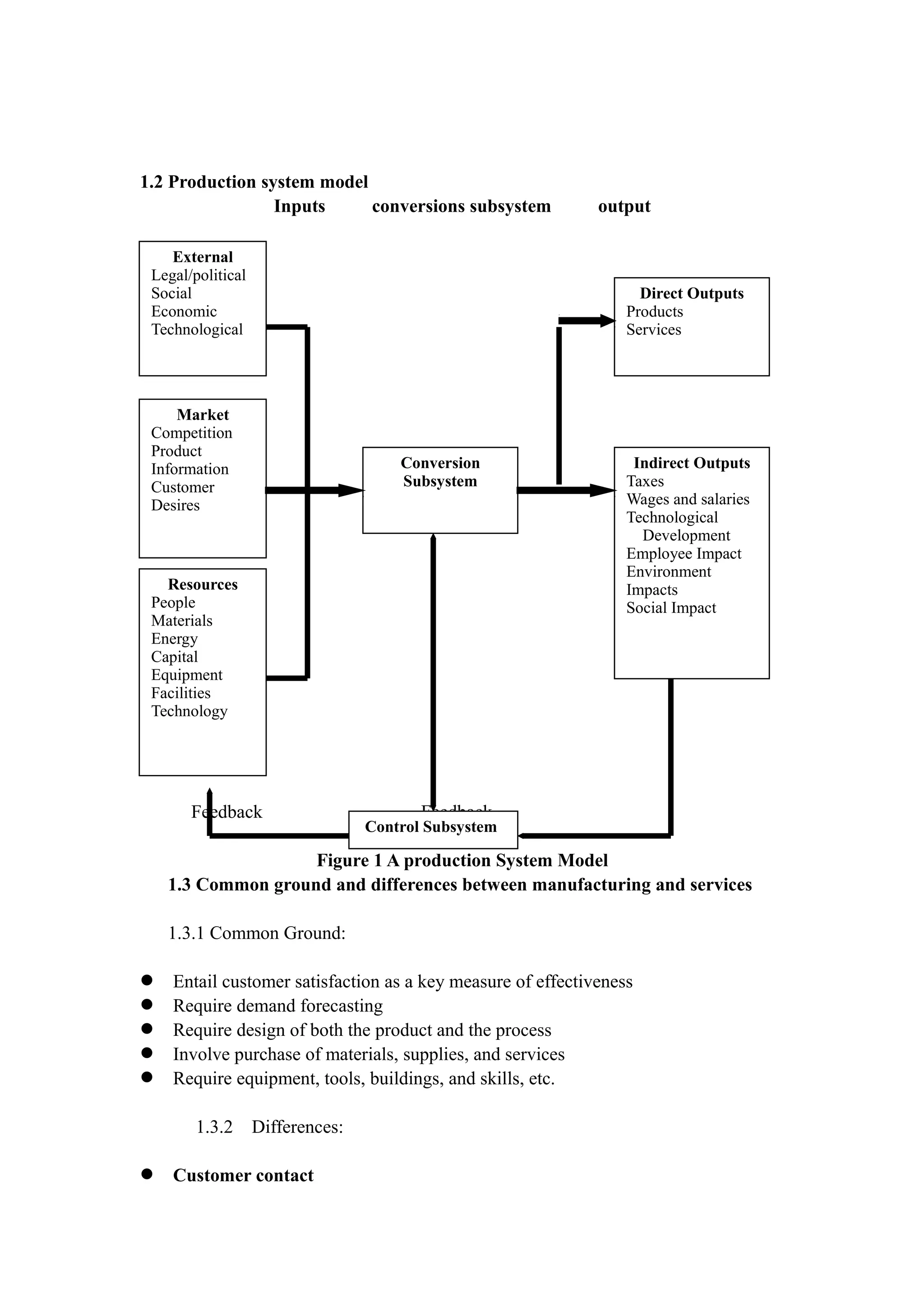
1.2 Production system model
                 Inputs     conversions subsystem            output

    External
 Legal/political
 Social                                                            Direct Outputs
 Economic                                                        Products
 Technological                                                   Services


     Market
 Competition
 Product
 Information                          Conversion                  Indirect Outputs
 Customer                             Subsystem                  Taxes
 Desires                                                         Wages and salaries
                                                                 Technological
                                                                   Development
                                                                 Employee Impact
                                                                 Environment
   Resources                                                     Impacts
 People                                                          Social Impact
 Materials
 Energy
 Capital
 Equipment
 Facilities
 Technology


       Feedback                          Feedback
                                  Control Subsystem

                    Figure 1 A production System Model
    1.3 Common ground and differences between manufacturing and services

    1.3.1 Common Ground:

   Entail customer satisfaction as a key measure of effectiveness
   Require demand forecasting
   Require design of both the product and the process
   Involve purchase of materials, supplies, and services
   Require equipment, tools, buildings, and skills, etc.

        1.3.2      Differences:

 Customer contact
Service involves a much higher degree of customer contact than manufacturing does.
The performance of a service typically occurs at the point of consumption.
Manufacturing allows a separation between production and consumption.

 Uniformity of input
Service operations are subject to more variability of inputs than manufacturing
operations are. Each patient, each lawn, each TV presents a specific problem.

 Labor content of jobs
Manufacturing ---capital -intensive
Service ---a higher labor content.

 Uniformity of output
Products--standardization, low variability, smooth, efficient
Service--customization, variable, slow.

 Store
Goods may be stored
Services are consumed during delivery, cannot be stored.

 Measurement of productivity
In manufacturing, measurement is more straightforward
In service operation, measurement is more difficult due to variations in demand
intensity.

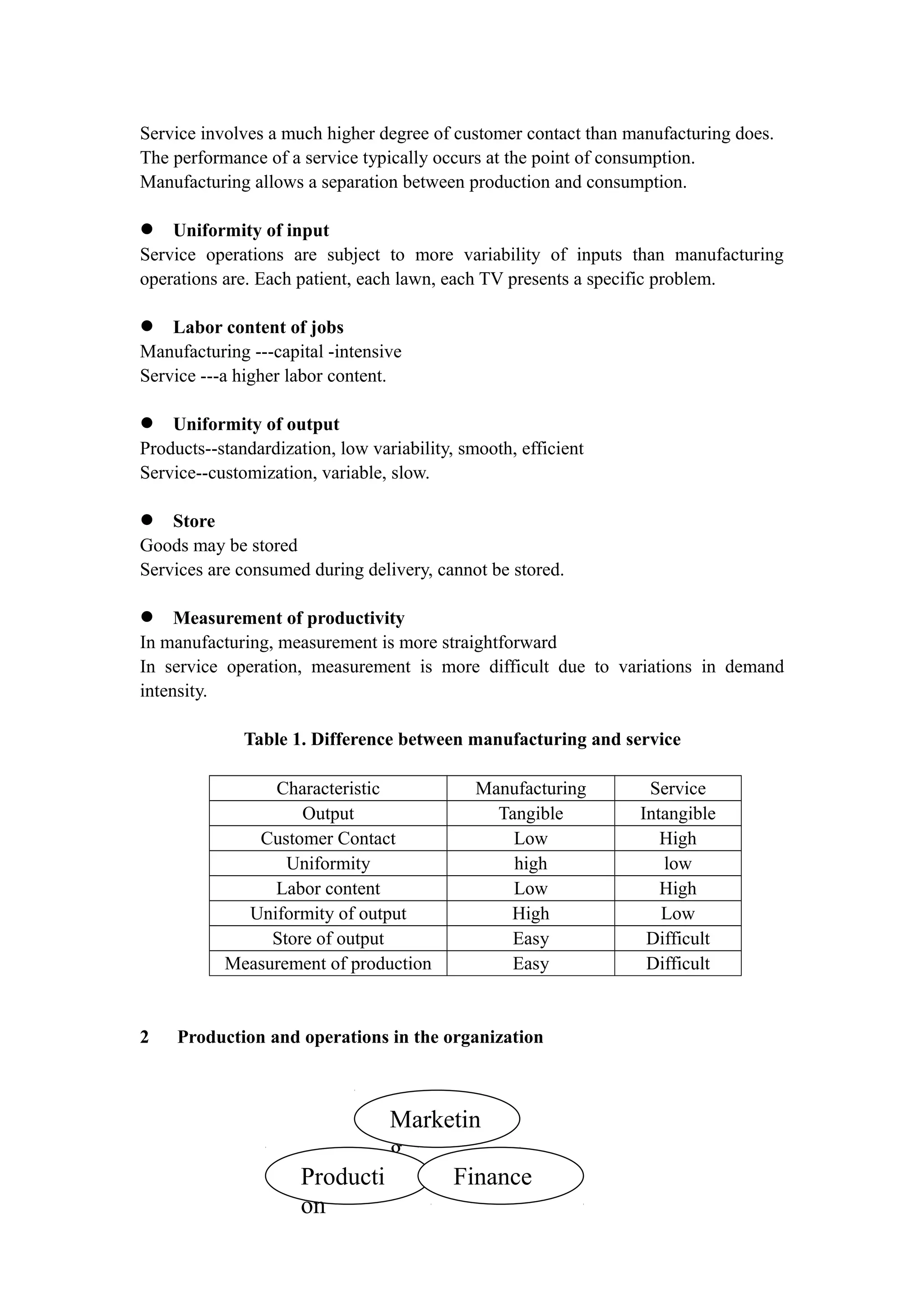
              Table 1. Difference between manufacturing and service

                Characteristic                Manufacturing      Service
                    Output                      Tangible        Intangible
              Customer Contact                    Low              High
                  Uniformity                      high             low
                Labor content                     Low              High
             Uniformity of output                High              Low
                Store of output                   Easy           Difficult
           Measurement of production              Easy           Difficult


2    Production and operations in the organization


                               Marketin
                               g
                      Producti      Finance
                      on
Figure 2 Basic management responsibilities


3    Scope of Production and Operations Management

Production and operations management concern with the conversion of inputs into outputs,
using physical resources, so as to provide the desired utilities to the customer while meeting
the other organizational objectives of effectiveness, efficiency and adaptability. It
distinguishes itself from other functions such as personnel, marketing, finance, etc., by its
primary concern for ‘conversion by using physical resources.’
Following are the activities which are listed under production and operations management
functions:

1. Location of facilities
2. Plant layouts and material handling
3. Product design
4. Process design
5. Production and planning control
6. Quality control
7. Materials management
8. Maintenance management.

LOCATION OF FACILITIES
Location of facilities for operations is a long-term capacity decision which involves a long
term commitment about the geographically static factors that affect a business organization. It
is an important strategic level decision-making for an organization. It deals with the questions
such as ‘where our main operations should be based?’
The selection of location is a key-decision as large investment is made in building plant and
machinery. An improper location of plant may lead to waste of all the investments made in
plant and machinery equipments. Hence, location of plant should be based on the company’s
expansion plan and policy, diversification plan for the products, changing sources of raw
materials and many other factors. The purpose of the location study is to find the optimal
location that will results in the greatest advantage to the organization.

PLANT LAYOUT AND MATERIAL HANDLING
Plant layout refers to the physical arrangement of facilities. It is the configuration of
departments, work centers and equipment in the conversion process. The overall objective of
the plant layout is to design a physical arrangement that meets the required output quality and
quantity most economically.

According to James Moore, “Plant layout is a plan of an optimum arrangement of facilities
including personnel, operating equipment, storage space, material handling equipments and
all other supporting services along with the design of best structure to contain all these
facilities”.

‘Material Handling’ refers to the ‘moving of materials from the store room to the machine and
from one machine to the next during the process of manufacturing’. It is also defined as the
‘art and science of moving, packing and storing of products in any form’. It is a specialized
activity for a modern manufacturing concern, with 50 to 75% of the cost of production. This
cost can be reduced by proper selection, operation and maintenance of material handling
devices.
Material handling devices increases the output, improves quality, speeds up the deliveries and
decreases the cost of production. Hence, material handling is a prime consideration in the
designing new plant and several existing plants.

PRODUCT DESIGN
Product design deals with conversion of ideas into reality. Every business organization has to
design, develop and introduce new products as a survival and growth strategy. Developing the
new products and launching them in the market is the biggest challenge faced by the
organizations.
The entire process of need identification to physical manufactures of product involves three
functions: marketing, product development, and manufacturing. Product development
translates the needs of customers given by marketing into technical specifications and
designing the various features into the product to these specifications. Manufacturing has the
responsibility of selecting the processes by which the product can be manufactured. Product
design and development provides link between marketing, customer needs and expectations
and the activities required to manufacture the product.


PROCESS DESIGN
Process design is a macroscopic decision-making of an overall process route for converting
the raw material into finished goods. These decisions encompass the selection of a process,
choice of technology, process flow analysis and layout of the facilities. Hence, the important
decisions in process design are to analyze the workflow for converting raw material into
finished product and to select the workstation for each included in the workflow.

PRODUCTION PLANNING AND CONTROL
Production planning and control can be defined as the process of planning the production in
advance, setting the exact route of each item, fixing the starting and finishing dates for each
item, to give production orders to shops and to follow up the progress of products according
to orders.
The principle of production planning and control lies in the statement ‘First Plan Your Work
and then Work on Your Plan’. Main functions of production planning and control includes
planning, routing, scheduling, dispatching and follow-up.
QUALITY CONTROL
Quality Control (QC) may be defined as ‘a system that is used to maintain a desired level of
quality in a product or service’. It is a systematic control of various factors that affect the
quality of the product. Quality control aims at prevention of defects at the source, relies on
effective feedback system and corrective action procedure.
Quality control can also be defined as ‘that industrial management technique by means of
which product of uniform acceptable quality is manufactured’. It is the entire collection of
activities which ensures that the operation will produce the optimum quality products at
minimum cost.
The main objectives of quality control are:
_ To improve the companies income by making the production more acceptable to the

customers i.e., by providing long life, greater usefulness, maintainability, etc.
_ To reduce companies cost through reduction of losses due to defects.

_ To achieve interchangeability of manufacture in large scale production.

_ To produce optimal quality at reduced price.

_ To ensure satisfaction of customers with productions or services or high quality level, to

build customer goodwill, confidence and reputation of manufacturer.
_ To make inspection prompt to ensure quality control.

_ To check the variation during manufacturing.


MATERIALS MANAGEMENT
Materials management is that aspect of management function which is primarily concerned
with the acquisition, control and use of materials needed and flow of goods and services
connected with the production process having some predetermined objectives in view.
The main objectives of materials management are:
_ To minimise material cost.

_ To purchase, receive, transport and store materials efficiently and to reduce the related cost.

_ To cut down costs through simplification, standardization, value analysis, import

substitution, etc.
_ To trace new sources of supply and to develop cordial relations with them in order to ensure

continuous supply at reasonable rates.
_ To reduce investment tied in the inventories for use in other productive purposes and to

develop high inventory turnover ratios.

MAINTENANCE MANAGEMENT
In modern industry, equipment and machinery are a very important part of the total productive
effort. Therefore, their idleness or downtime becomes are very expensive. Hence, it is very
important that the plant machinery should be properly maintained.

The main objectives of maintenance management are:
1. To achieve minimum breakdown and to keep the plant in good working condition at the
lowest possible cost.
2. To keep the machines and other facilities in such a condition that permits them to be used at
their optimal capacity without interruption.
3. To ensure the availability of the machines, buildings and services required by other sections
of the factory for the performance of their functions at optimal return on investment.

4    Function and jobs of POM

4.1 Functions

 Manufacturing--cutting, drilling, milling, etc. Or Teaching, farming, packing,
  consulting, mixing, etc.
 Transporting
 Storing
 Plant maintenance and management
 Material management
 Quality control, etc.

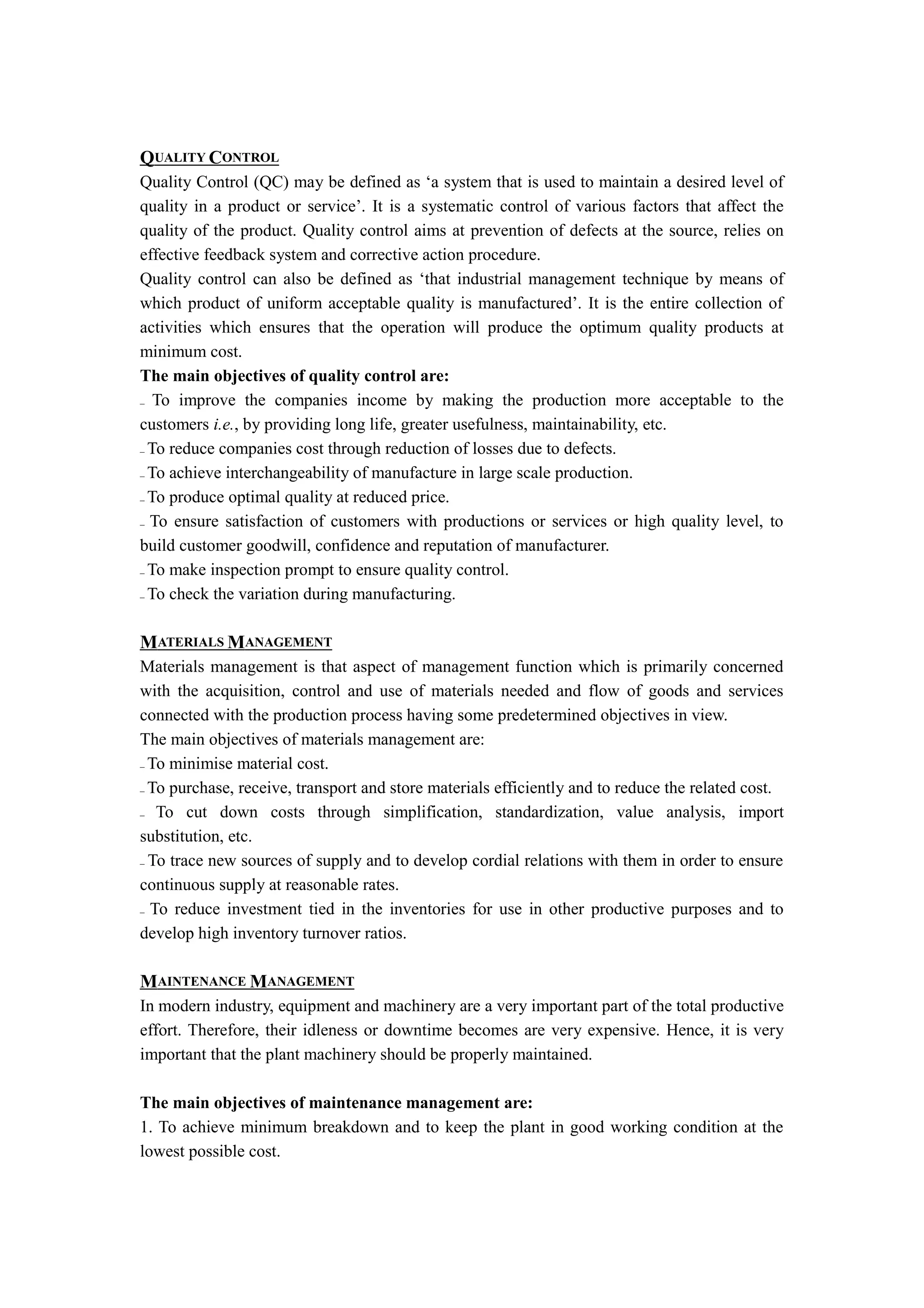
                             Table 2 functions of POM
                 Planing         Capacity
                                 Location
                                 Layout
                                 Projects
                                 Products and services
                                 Make or buy
                                 Scheduling
                 Organizing      Degree of centralization
                                 Subcontracting
                 Staffing        Hiring/laying off
                                 Use of overtime
                 Directing       Incentive plans
                                 Issuance of work orders
                                 Job assignments
                 Controlling     Inventory control
                                 Quality control
                                 Work-in process control
                                 Process control


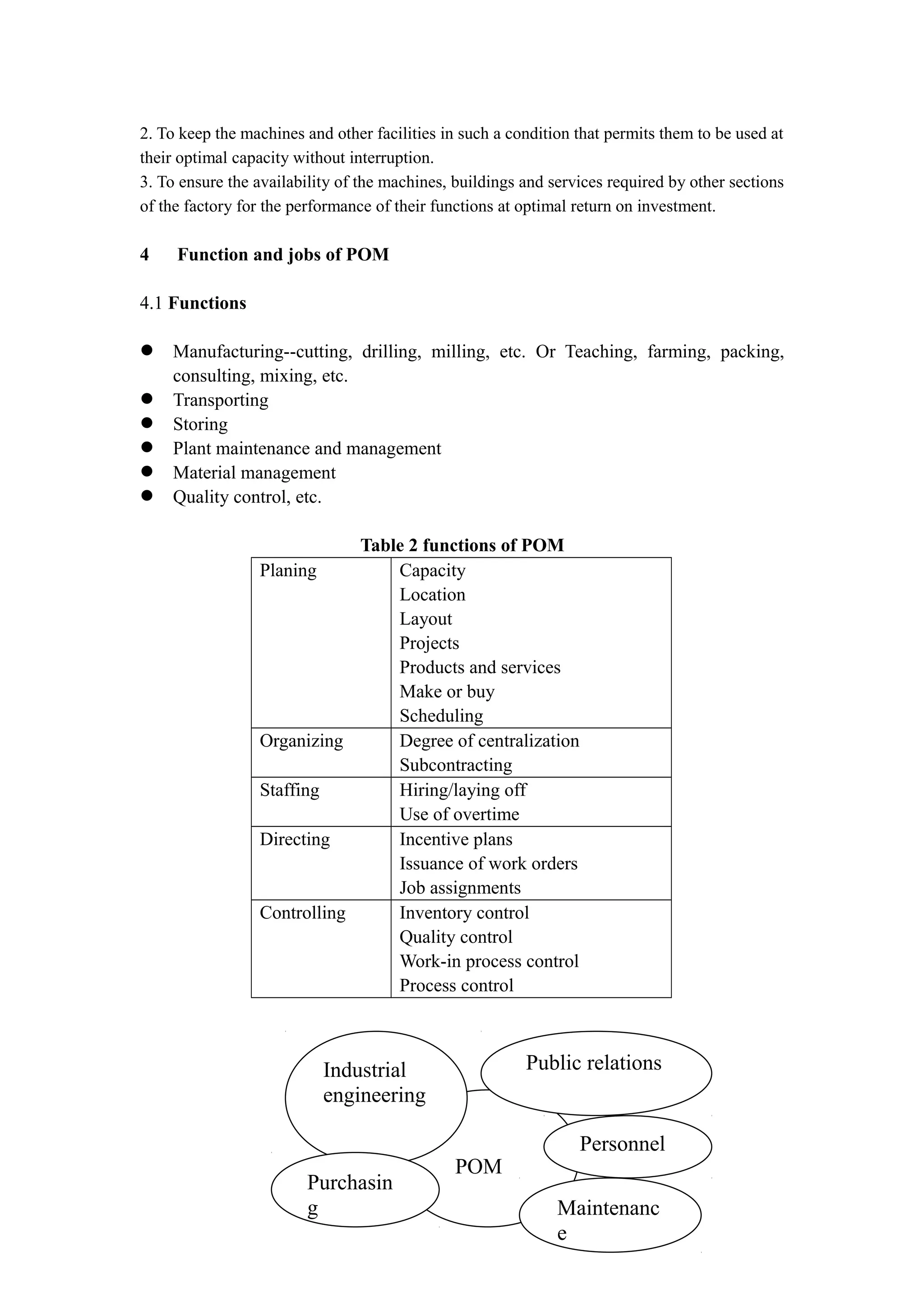
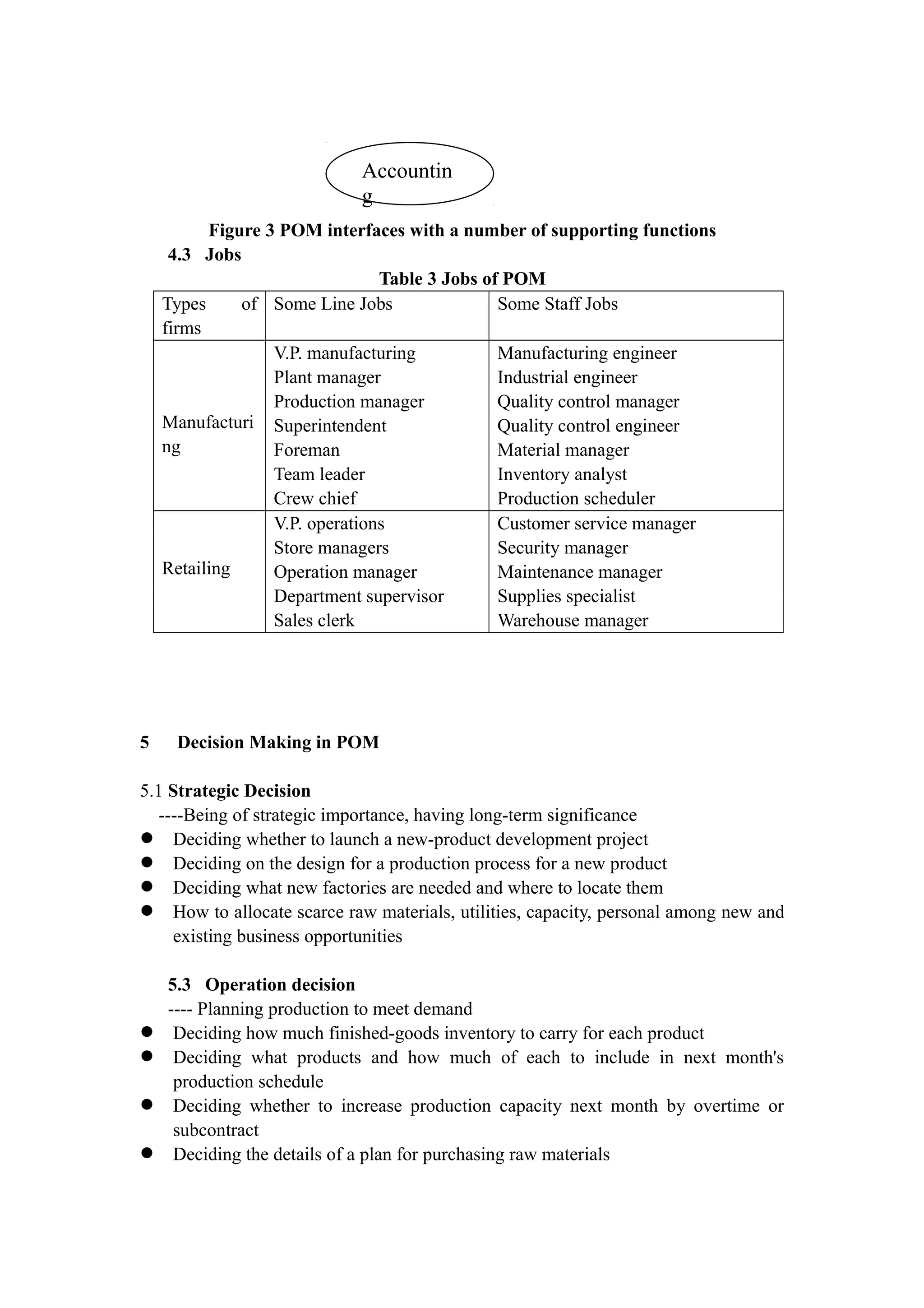
                           Industrial                    Public relations
                           engineering

                                                                 Personnel
                                              POM
                        Purchasin
                        g                                     Maintenanc
                                                              e
Accountin
                            g
          Figure 3 POM interfaces with a number of supporting functions
     4.3 Jobs
                                Table 3 Jobs of POM
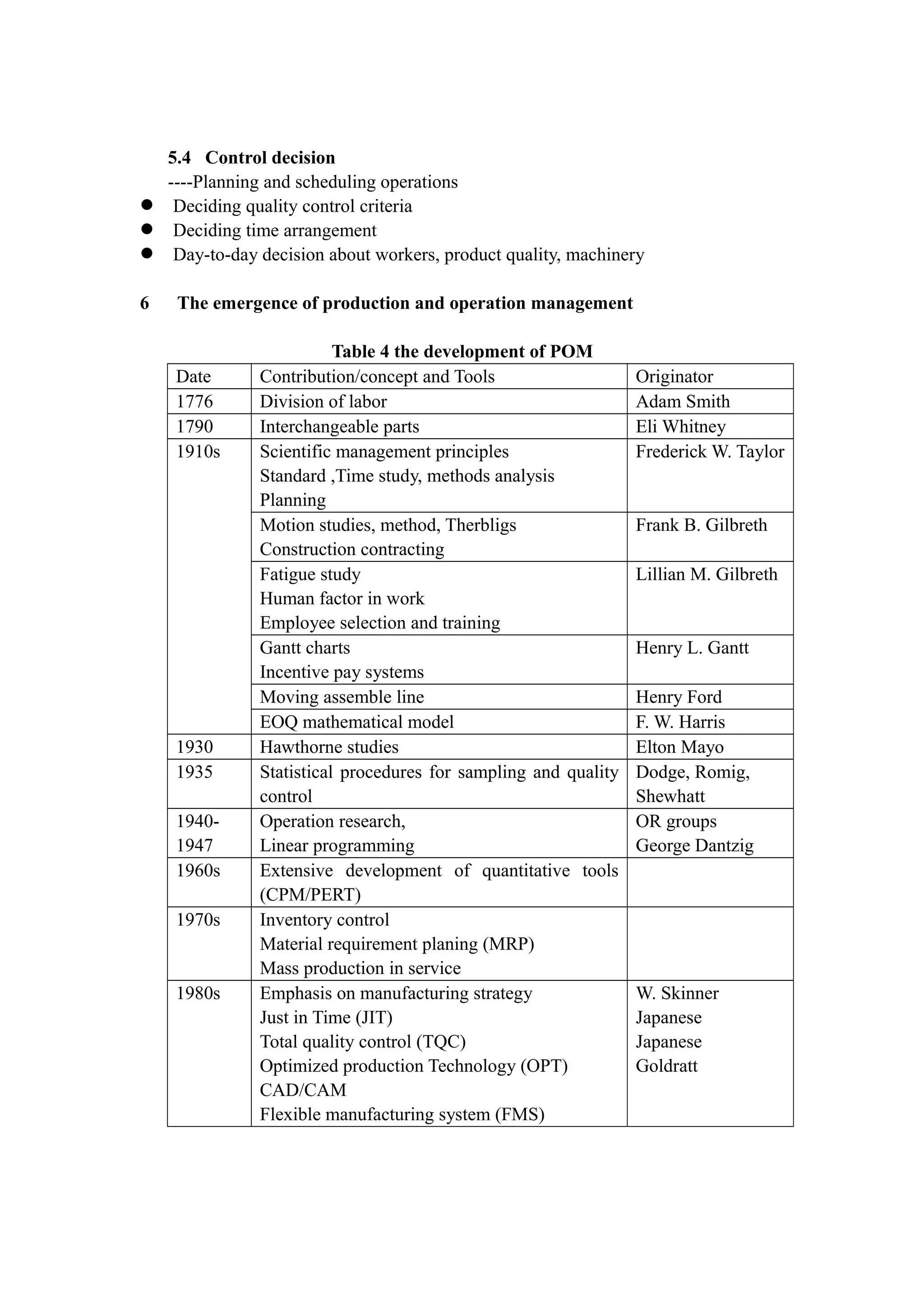
    Types     of Some Line Jobs                Some Staff Jobs
    firms
                  V.P. manufacturing           Manufacturing engineer
                  Plant manager                Industrial engineer
                  Production manager           Quality control manager
    Manufacturi Superintendent                 Quality control engineer
    ng            Foreman                      Material manager
                  Team leader                  Inventory analyst
                  Crew chief                   Production scheduler
                  V.P. operations              Customer service manager
                  Store managers               Security manager
    Retailing     Operation manager            Maintenance manager
                  Department supervisor        Supplies specialist
                  Sales clerk                  Warehouse manager


5    Decision Making in POM

5.1 Strategic Decision
   ----Being of strategic importance, having long-term significance
 Deciding whether to launch a new-product development project
 Deciding on the design for a production process for a new product
 Deciding what new factories are needed and where to locate them
 How to allocate scarce raw materials, utilities, capacity, personal among new and
     existing business opportunities

    5.3 Operation decision
    ---- Planning production to meet demand
    Deciding how much finished-goods inventory to carry for each product
    Deciding what products and how much of each to include in next month's
     production schedule
    Deciding whether to increase production capacity next month by overtime or
     subcontract
    Deciding the details of a plan for purchasing raw materials
5.4 Control decision
  ----Planning and scheduling operations
 Deciding quality control criteria
 Deciding time arrangement
 Day-to-day decision about workers, product quality, machinery

6   The emergence of production and operation management

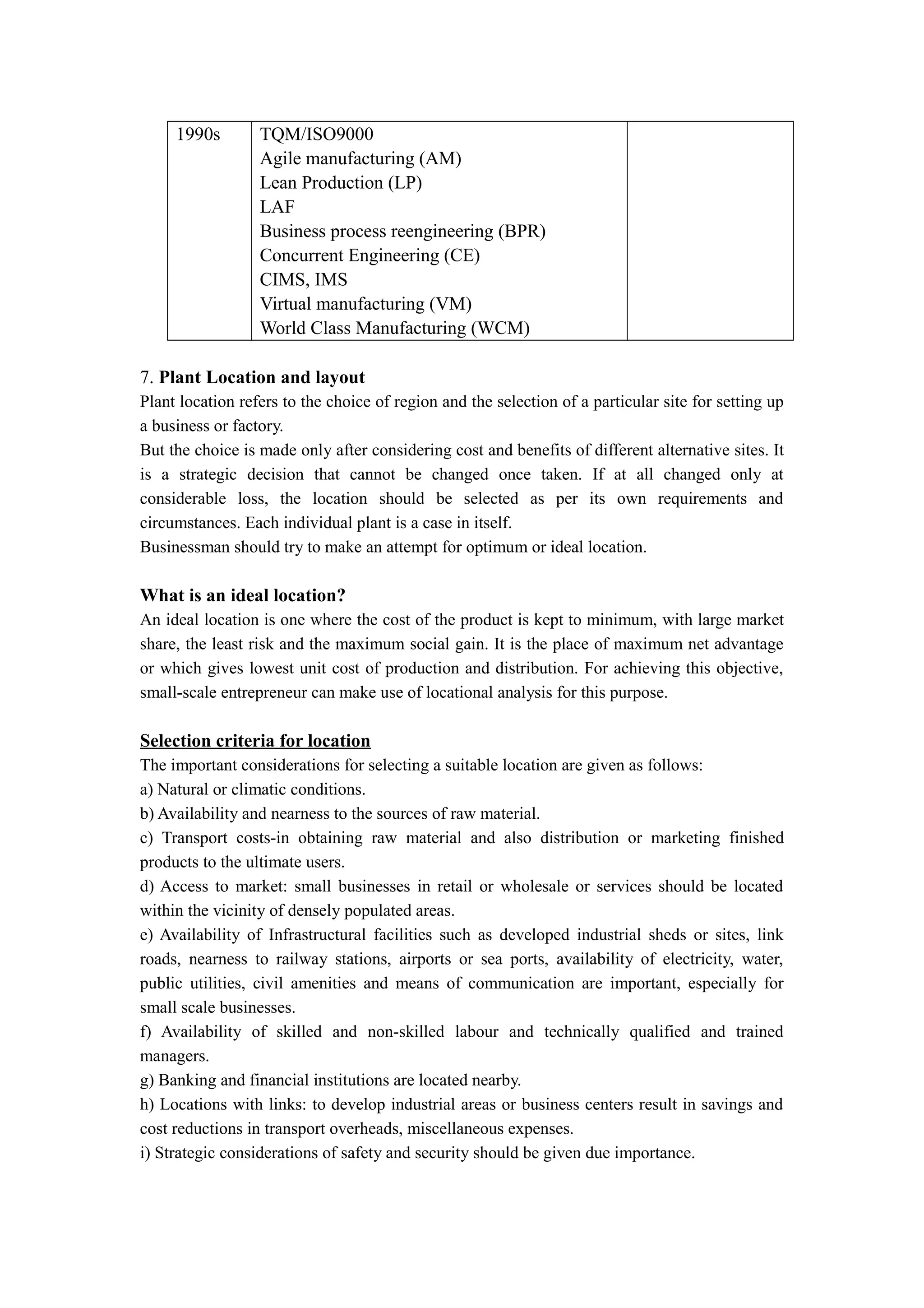
                         Table 4 the development of POM
    Date      Contribution/concept and Tools                    Originator
    1776      Division of labor                                 Adam Smith
    1790      Interchangeable parts                             Eli Whitney
    1910s     Scientific management principles                  Frederick W. Taylor
              Standard ,Time study, methods analysis
              Planning
              Motion studies, method, Therbligs                 Frank B. Gilbreth
              Construction contracting
              Fatigue study                                     Lillian M. Gilbreth
              Human factor in work
              Employee selection and training
              Gantt charts                                      Henry L. Gantt
              Incentive pay systems
              Moving assemble line                              Henry Ford
              EOQ mathematical model                            F. W. Harris
    1930      Hawthorne studies                                 Elton Mayo
    1935      Statistical procedures for sampling and quality   Dodge, Romig,
              control                                           Shewhatt
    1940-     Operation research,                               OR groups
    1947      Linear programming                                George Dantzig
    1960s     Extensive development of quantitative tools
              (CPM/PERT)
    1970s     Inventory control
              Material requirement planing (MRP)
              Mass production in service
    1980s     Emphasis on manufacturing strategy                W. Skinner
              Just in Time (JIT)                                Japanese
              Total quality control (TQC)                       Japanese
              Optimized production Technology (OPT)             Goldratt
              CAD/CAM
              Flexible manufacturing system (FMS)
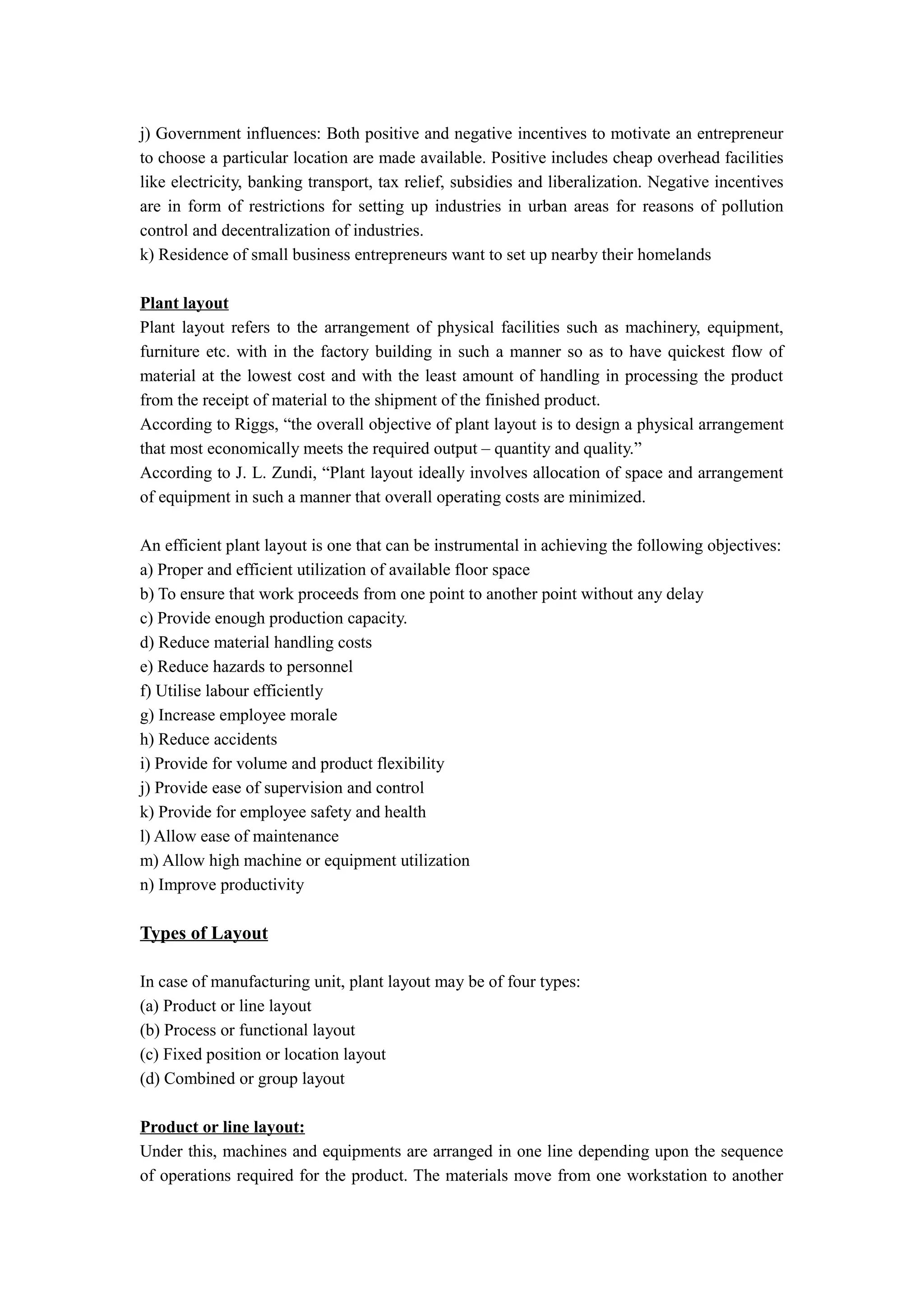
1990s        TQM/ISO9000
                  Agile manufacturing (AM)
                  Lean Production (LP)
                  LAF
                  Business process reengineering (BPR)
                  Concurrent Engineering (CE)
                  CIMS, IMS
                  Virtual manufacturing (VM)
                  World Class Manufacturing (WCM)

7. Plant Location and layout
Plant location refers to the choice of region and the selection of a particular site for setting up
a business or factory.
But the choice is made only after considering cost and benefits of different alternative sites. It
is a strategic decision that cannot be changed once taken. If at all changed only at
considerable loss, the location should be selected as per its own requirements and
circumstances. Each individual plant is a case in itself.
Businessman should try to make an attempt for optimum or ideal location.

What is an ideal location?
An ideal location is one where the cost of the product is kept to minimum, with large market
share, the least risk and the maximum social gain. It is the place of maximum net advantage
or which gives lowest unit cost of production and distribution. For achieving this objective,
small-scale entrepreneur can make use of locational analysis for this purpose.

Selection criteria for location
The important considerations for selecting a suitable location are given as follows:
a) Natural or climatic conditions.
b) Availability and nearness to the sources of raw material.
c) Transport costs-in obtaining raw material and also distribution or marketing finished
products to the ultimate users.
d) Access to market: small businesses in retail or wholesale or services should be located
within the vicinity of densely populated areas.
e) Availability of Infrastructural facilities such as developed industrial sheds or sites, link
roads, nearness to railway stations, airports or sea ports, availability of electricity, water,
public utilities, civil amenities and means of communication are important, especially for
small scale businesses.
f) Availability of skilled and non-skilled labour and technically qualified and trained
managers.
g) Banking and financial institutions are located nearby.
h) Locations with links: to develop industrial areas or business centers result in savings and
cost reductions in transport overheads, miscellaneous expenses.
i) Strategic considerations of safety and security should be given due importance.
j) Government influences: Both positive and negative incentives to motivate an entrepreneur
to choose a particular location are made available. Positive includes cheap overhead facilities
like electricity, banking transport, tax relief, subsidies and liberalization. Negative incentives
are in form of restrictions for setting up industries in urban areas for reasons of pollution
control and decentralization of industries.
k) Residence of small business entrepreneurs want to set up nearby their homelands

Plant layout
Plant layout refers to the arrangement of physical facilities such as machinery, equipment,
furniture etc. with in the factory building in such a manner so as to have quickest flow of
material at the lowest cost and with the least amount of handling in processing the product
from the receipt of material to the shipment of the finished product.
According to Riggs, “the overall objective of plant layout is to design a physical arrangement
that most economically meets the required output – quantity and quality.”
According to J. L. Zundi, “Plant layout ideally involves allocation of space and arrangement
of equipment in such a manner that overall operating costs are minimized.

An efficient plant layout is one that can be instrumental in achieving the following objectives:
a) Proper and efficient utilization of available floor space
b) To ensure that work proceeds from one point to another point without any delay
c) Provide enough production capacity.
d) Reduce material handling costs
e) Reduce hazards to personnel
f) Utilise labour efficiently
g) Increase employee morale
h) Reduce accidents
i) Provide for volume and product flexibility
j) Provide ease of supervision and control
k) Provide for employee safety and health
l) Allow ease of maintenance
m) Allow high machine or equipment utilization
n) Improve productivity

Types of Layout

In case of manufacturing unit, plant layout may be of four types:
(a) Product or line layout
(b) Process or functional layout
(c) Fixed position or location layout
(d) Combined or group layout

Product or line layout:
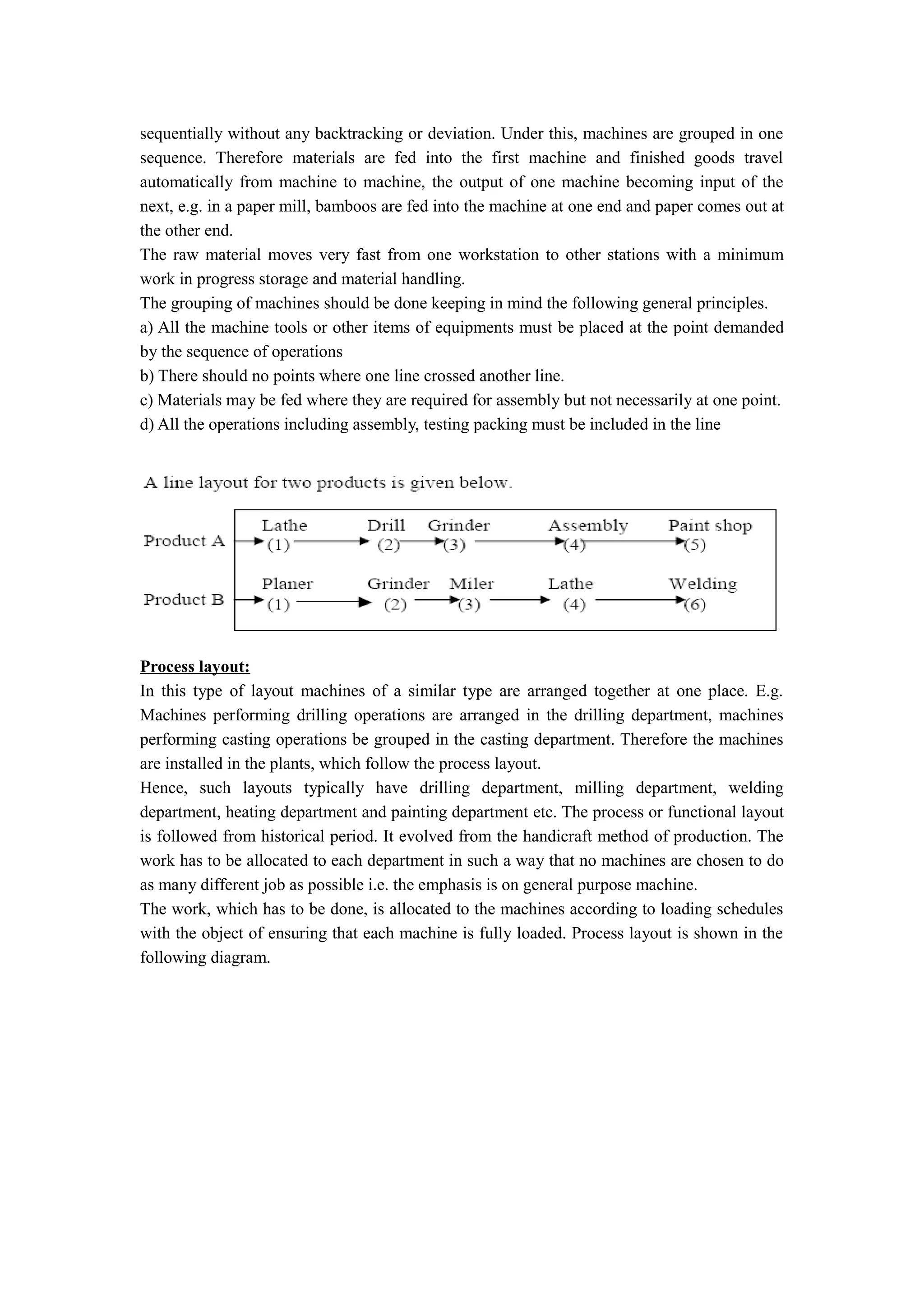
Under this, machines and equipments are arranged in one line depending upon the sequence
of operations required for the product. The materials move from one workstation to another
sequentially without any backtracking or deviation. Under this, machines are grouped in one
sequence. Therefore materials are fed into the first machine and finished goods travel
automatically from machine to machine, the output of one machine becoming input of the
next, e.g. in a paper mill, bamboos are fed into the machine at one end and paper comes out at
the other end.
The raw material moves very fast from one workstation to other stations with a minimum
work in progress storage and material handling.
The grouping of machines should be done keeping in mind the following general principles.
a) All the machine tools or other items of equipments must be placed at the point demanded
by the sequence of operations
b) There should no points where one line crossed another line.
c) Materials may be fed where they are required for assembly but not necessarily at one point.
d) All the operations including assembly, testing packing must be included in the line


Process layout:
In this type of layout machines of a similar type are arranged together at one place. E.g.
Machines performing drilling operations are arranged in the drilling department, machines
performing casting operations be grouped in the casting department. Therefore the machines
are installed in the plants, which follow the process layout.
Hence, such layouts typically have drilling department, milling department, welding
department, heating department and painting department etc. The process or functional layout
is followed from historical period. It evolved from the handicraft method of production. The
work has to be allocated to each department in such a way that no machines are chosen to do
as many different job as possible i.e. the emphasis is on general purpose machine.
The work, which has to be done, is allocated to the machines according to loading schedules
with the object of ensuring that each machine is fully loaded. Process layout is shown in the
following diagram.
Fixed Position or Location Layout
In this type of layout, the major product being produced is fixed at one location. Equipment
labour and components are moved to that location. All facilities are brought and arranged
around one work center. This type of layout is not relevant for small scale entrepreneur. The
following figure shows a fixed position layout regarding shipbuilding.


Combined layout
Certain manufacturing units may require all three processes namely intermittent process (job
shops), the continuous process (mass production shops) and the representative process
combined process [i.e. miscellaneous shops].
In most of industries, only a product layout or process layout or fixed location layout does not
exist. Thus, in manufacturing concerns where several products are produced in repeated
numbers with no likelihood of continuous production, combined layout is followed.
Generally, a combination of the product and process layout or other combination are found, in
practice, e.g. for industries involving the fabrication of parts and assembly, fabrication tends
to employ the process layout, while the assembly areas often employ the product layout. In
soap, manufacturing plant, the machinery manufacturing soap is arranged on the product line
principle, but ancillary services such as heating, the manufacturing of glycerin, the power
house, the water treatment plant etc. are arranged on a functional basis.
Factors influencing layout
While deciding his factory or unit or establishment or store, a small-scale businessman should
keep the following factors in mind:
a) Factory building: The nature and size of the building determines the floor space available
for layout. While designing the special requirements, e.g. air conditioning, dust control,
humidity control etc. must be kept in mind.
b) Nature of product: product layout is suitable for uniform products whereas process layout
is more appropriate for custom-made products.
c) Production process: In assembly line industries, product layout is better. In job order or
intermittent manufacturing on the other hand, process layout is desirable.
d) Type of machinery: General purpose machines are often arranged as per process layout
while special purpose machines are arranged according to product layout
e) Repairs and maintenance: machines should be so arranged that adequate space is available
between them for movement of equipment and people required for repairing the machines.
f) Human needs: Adequate arrangement should be made for cloakroom, washroom, lockers,
drinking water, toilets and other employee facilities, proper provision should be made for
disposal of effluents, if any.
g) Plant environment: Heat, light, noise, ventilation and other aspects should be duly
considered, e.g. paint shops and plating section should be located in another hall so that
dangerous fumes can be removed through proper ventilation etc. Adequate safety arrangement
should also be made.

Thus, the layout should be conducive to health and safety of employees. It should ensure free
and efficient flow of men and materials. Future expansion and diversification may also be
considered while planning factory layout.

Unit 1 production and operation management

  • 1.
    Production and OperationManagement Unit-1 1. Production management and Production System 2. Production and operations in the organization 3. Scope of Production Management 4. Function and jobs of POM 5. Decision Making in POM 6. The emergence of production and operation management 7. Plant Location and Layout 1. Production Management Production management is a process of planning, organizing, directing and controlling the activities of the production function. It combines and transforms various resources used in the production subsystem of the organization into value added product in a controlled manner as per the policies of the organization. E.S. Buffa defines production management as, “Production management deals with decision making related to production processes so that the resulting goods or services are produced according to specifications, in the amount and by the schedule demanded and out of minimum cost.” 1.1 Objectives of Production Management The objective of the production management is ‘to produce goods services of right quality and quantity at the right time and right manufacturing cost’. 1. RIGHT QUALITY The quality of product is established based upon the customers’ needs. The right quality is not necessarily best quality. It is determined by the cost of the product and the technical characteristics as suited to the specific requirements. 2. RIGHT QUANTITY The manufacturing organization should produce the products in right number. If they are produced in excess of demand the capital will block up in the form of inventory and if the quantity is produced in short of demand, leads to shortage of products. 3. RIGHT TIME Timeliness of delivery is one of the important parameter to judge the effectiveness of production department. So, the production department has to make the optimal utilization of input resources to achieve its objective. 4. RIGHT MANUFACTURING COST Manufacturing costs are established before the product is actually manufactured. Hence, all attempts should be made to produce the products at pre-established cost, so as to reduce the variation between actual and the standard (pre-established) cost.
  • 2.
    1.2 Production systemmodel Inputs conversions subsystem output External Legal/political Social Direct Outputs Economic Products Technological Services Market Competition Product Information Conversion Indirect Outputs Customer Subsystem Taxes Desires Wages and salaries Technological Development Employee Impact Environment Resources Impacts People Social Impact Materials Energy Capital Equipment Facilities Technology Feedback Feedback Control Subsystem Figure 1 A production System Model 1.3 Common ground and differences between manufacturing and services 1.3.1 Common Ground:  Entail customer satisfaction as a key measure of effectiveness  Require demand forecasting  Require design of both the product and the process  Involve purchase of materials, supplies, and services  Require equipment, tools, buildings, and skills, etc. 1.3.2 Differences:  Customer contact
  • 3.
    Service involves amuch higher degree of customer contact than manufacturing does. The performance of a service typically occurs at the point of consumption. Manufacturing allows a separation between production and consumption.  Uniformity of input Service operations are subject to more variability of inputs than manufacturing operations are. Each patient, each lawn, each TV presents a specific problem.  Labor content of jobs Manufacturing ---capital -intensive Service ---a higher labor content.  Uniformity of output Products--standardization, low variability, smooth, efficient Service--customization, variable, slow.  Store Goods may be stored Services are consumed during delivery, cannot be stored.  Measurement of productivity In manufacturing, measurement is more straightforward In service operation, measurement is more difficult due to variations in demand intensity. Table 1. Difference between manufacturing and service Characteristic Manufacturing Service Output Tangible Intangible Customer Contact Low High Uniformity high low Labor content Low High Uniformity of output High Low Store of output Easy Difficult Measurement of production Easy Difficult 2 Production and operations in the organization Marketin g Producti Finance on
  • 4.
    Figure 2 Basicmanagement responsibilities 3 Scope of Production and Operations Management Production and operations management concern with the conversion of inputs into outputs, using physical resources, so as to provide the desired utilities to the customer while meeting the other organizational objectives of effectiveness, efficiency and adaptability. It distinguishes itself from other functions such as personnel, marketing, finance, etc., by its primary concern for ‘conversion by using physical resources.’ Following are the activities which are listed under production and operations management functions: 1. Location of facilities 2. Plant layouts and material handling 3. Product design 4. Process design 5. Production and planning control 6. Quality control 7. Materials management 8. Maintenance management. LOCATION OF FACILITIES Location of facilities for operations is a long-term capacity decision which involves a long term commitment about the geographically static factors that affect a business organization. It is an important strategic level decision-making for an organization. It deals with the questions such as ‘where our main operations should be based?’ The selection of location is a key-decision as large investment is made in building plant and machinery. An improper location of plant may lead to waste of all the investments made in plant and machinery equipments. Hence, location of plant should be based on the company’s expansion plan and policy, diversification plan for the products, changing sources of raw materials and many other factors. The purpose of the location study is to find the optimal location that will results in the greatest advantage to the organization. PLANT LAYOUT AND MATERIAL HANDLING Plant layout refers to the physical arrangement of facilities. It is the configuration of departments, work centers and equipment in the conversion process. The overall objective of the plant layout is to design a physical arrangement that meets the required output quality and quantity most economically. According to James Moore, “Plant layout is a plan of an optimum arrangement of facilities including personnel, operating equipment, storage space, material handling equipments and
  • 5.
    all other supportingservices along with the design of best structure to contain all these facilities”. ‘Material Handling’ refers to the ‘moving of materials from the store room to the machine and from one machine to the next during the process of manufacturing’. It is also defined as the ‘art and science of moving, packing and storing of products in any form’. It is a specialized activity for a modern manufacturing concern, with 50 to 75% of the cost of production. This cost can be reduced by proper selection, operation and maintenance of material handling devices. Material handling devices increases the output, improves quality, speeds up the deliveries and decreases the cost of production. Hence, material handling is a prime consideration in the designing new plant and several existing plants. PRODUCT DESIGN Product design deals with conversion of ideas into reality. Every business organization has to design, develop and introduce new products as a survival and growth strategy. Developing the new products and launching them in the market is the biggest challenge faced by the organizations. The entire process of need identification to physical manufactures of product involves three functions: marketing, product development, and manufacturing. Product development translates the needs of customers given by marketing into technical specifications and designing the various features into the product to these specifications. Manufacturing has the responsibility of selecting the processes by which the product can be manufactured. Product design and development provides link between marketing, customer needs and expectations and the activities required to manufacture the product. PROCESS DESIGN Process design is a macroscopic decision-making of an overall process route for converting the raw material into finished goods. These decisions encompass the selection of a process, choice of technology, process flow analysis and layout of the facilities. Hence, the important decisions in process design are to analyze the workflow for converting raw material into finished product and to select the workstation for each included in the workflow. PRODUCTION PLANNING AND CONTROL Production planning and control can be defined as the process of planning the production in advance, setting the exact route of each item, fixing the starting and finishing dates for each item, to give production orders to shops and to follow up the progress of products according to orders. The principle of production planning and control lies in the statement ‘First Plan Your Work and then Work on Your Plan’. Main functions of production planning and control includes planning, routing, scheduling, dispatching and follow-up.
  • 6.
    QUALITY CONTROL Quality Control(QC) may be defined as ‘a system that is used to maintain a desired level of quality in a product or service’. It is a systematic control of various factors that affect the quality of the product. Quality control aims at prevention of defects at the source, relies on effective feedback system and corrective action procedure. Quality control can also be defined as ‘that industrial management technique by means of which product of uniform acceptable quality is manufactured’. It is the entire collection of activities which ensures that the operation will produce the optimum quality products at minimum cost. The main objectives of quality control are: _ To improve the companies income by making the production more acceptable to the customers i.e., by providing long life, greater usefulness, maintainability, etc. _ To reduce companies cost through reduction of losses due to defects. _ To achieve interchangeability of manufacture in large scale production. _ To produce optimal quality at reduced price. _ To ensure satisfaction of customers with productions or services or high quality level, to build customer goodwill, confidence and reputation of manufacturer. _ To make inspection prompt to ensure quality control. _ To check the variation during manufacturing. MATERIALS MANAGEMENT Materials management is that aspect of management function which is primarily concerned with the acquisition, control and use of materials needed and flow of goods and services connected with the production process having some predetermined objectives in view. The main objectives of materials management are: _ To minimise material cost. _ To purchase, receive, transport and store materials efficiently and to reduce the related cost. _ To cut down costs through simplification, standardization, value analysis, import substitution, etc. _ To trace new sources of supply and to develop cordial relations with them in order to ensure continuous supply at reasonable rates. _ To reduce investment tied in the inventories for use in other productive purposes and to develop high inventory turnover ratios. MAINTENANCE MANAGEMENT In modern industry, equipment and machinery are a very important part of the total productive effort. Therefore, their idleness or downtime becomes are very expensive. Hence, it is very important that the plant machinery should be properly maintained. The main objectives of maintenance management are: 1. To achieve minimum breakdown and to keep the plant in good working condition at the lowest possible cost.
  • 7.
    2. To keepthe machines and other facilities in such a condition that permits them to be used at their optimal capacity without interruption. 3. To ensure the availability of the machines, buildings and services required by other sections of the factory for the performance of their functions at optimal return on investment. 4 Function and jobs of POM 4.1 Functions  Manufacturing--cutting, drilling, milling, etc. Or Teaching, farming, packing, consulting, mixing, etc.  Transporting  Storing  Plant maintenance and management  Material management  Quality control, etc. Table 2 functions of POM Planing Capacity Location Layout Projects Products and services Make or buy Scheduling Organizing Degree of centralization Subcontracting Staffing Hiring/laying off Use of overtime Directing Incentive plans Issuance of work orders Job assignments Controlling Inventory control Quality control Work-in process control Process control Industrial Public relations engineering Personnel POM Purchasin g Maintenanc e
  • 8.
    Accountin g Figure 3 POM interfaces with a number of supporting functions 4.3 Jobs Table 3 Jobs of POM Types of Some Line Jobs Some Staff Jobs firms V.P. manufacturing Manufacturing engineer Plant manager Industrial engineer Production manager Quality control manager Manufacturi Superintendent Quality control engineer ng Foreman Material manager Team leader Inventory analyst Crew chief Production scheduler V.P. operations Customer service manager Store managers Security manager Retailing Operation manager Maintenance manager Department supervisor Supplies specialist Sales clerk Warehouse manager 5 Decision Making in POM 5.1 Strategic Decision ----Being of strategic importance, having long-term significance  Deciding whether to launch a new-product development project  Deciding on the design for a production process for a new product  Deciding what new factories are needed and where to locate them  How to allocate scarce raw materials, utilities, capacity, personal among new and existing business opportunities 5.3 Operation decision ---- Planning production to meet demand  Deciding how much finished-goods inventory to carry for each product  Deciding what products and how much of each to include in next month's production schedule  Deciding whether to increase production capacity next month by overtime or subcontract  Deciding the details of a plan for purchasing raw materials
  • 9.
    5.4 Control decision ----Planning and scheduling operations  Deciding quality control criteria  Deciding time arrangement  Day-to-day decision about workers, product quality, machinery 6 The emergence of production and operation management Table 4 the development of POM Date Contribution/concept and Tools Originator 1776 Division of labor Adam Smith 1790 Interchangeable parts Eli Whitney 1910s Scientific management principles Frederick W. Taylor Standard ,Time study, methods analysis Planning Motion studies, method, Therbligs Frank B. Gilbreth Construction contracting Fatigue study Lillian M. Gilbreth Human factor in work Employee selection and training Gantt charts Henry L. Gantt Incentive pay systems Moving assemble line Henry Ford EOQ mathematical model F. W. Harris 1930 Hawthorne studies Elton Mayo 1935 Statistical procedures for sampling and quality Dodge, Romig, control Shewhatt 1940- Operation research, OR groups 1947 Linear programming George Dantzig 1960s Extensive development of quantitative tools (CPM/PERT) 1970s Inventory control Material requirement planing (MRP) Mass production in service 1980s Emphasis on manufacturing strategy W. Skinner Just in Time (JIT) Japanese Total quality control (TQC) Japanese Optimized production Technology (OPT) Goldratt CAD/CAM Flexible manufacturing system (FMS)
  • 10.
    1990s TQM/ISO9000 Agile manufacturing (AM) Lean Production (LP) LAF Business process reengineering (BPR) Concurrent Engineering (CE) CIMS, IMS Virtual manufacturing (VM) World Class Manufacturing (WCM) 7. Plant Location and layout Plant location refers to the choice of region and the selection of a particular site for setting up a business or factory. But the choice is made only after considering cost and benefits of different alternative sites. It is a strategic decision that cannot be changed once taken. If at all changed only at considerable loss, the location should be selected as per its own requirements and circumstances. Each individual plant is a case in itself. Businessman should try to make an attempt for optimum or ideal location. What is an ideal location? An ideal location is one where the cost of the product is kept to minimum, with large market share, the least risk and the maximum social gain. It is the place of maximum net advantage or which gives lowest unit cost of production and distribution. For achieving this objective, small-scale entrepreneur can make use of locational analysis for this purpose. Selection criteria for location The important considerations for selecting a suitable location are given as follows: a) Natural or climatic conditions. b) Availability and nearness to the sources of raw material. c) Transport costs-in obtaining raw material and also distribution or marketing finished products to the ultimate users. d) Access to market: small businesses in retail or wholesale or services should be located within the vicinity of densely populated areas. e) Availability of Infrastructural facilities such as developed industrial sheds or sites, link roads, nearness to railway stations, airports or sea ports, availability of electricity, water, public utilities, civil amenities and means of communication are important, especially for small scale businesses. f) Availability of skilled and non-skilled labour and technically qualified and trained managers. g) Banking and financial institutions are located nearby. h) Locations with links: to develop industrial areas or business centers result in savings and cost reductions in transport overheads, miscellaneous expenses. i) Strategic considerations of safety and security should be given due importance.
  • 11.
    j) Government influences:Both positive and negative incentives to motivate an entrepreneur to choose a particular location are made available. Positive includes cheap overhead facilities like electricity, banking transport, tax relief, subsidies and liberalization. Negative incentives are in form of restrictions for setting up industries in urban areas for reasons of pollution control and decentralization of industries. k) Residence of small business entrepreneurs want to set up nearby their homelands Plant layout Plant layout refers to the arrangement of physical facilities such as machinery, equipment, furniture etc. with in the factory building in such a manner so as to have quickest flow of material at the lowest cost and with the least amount of handling in processing the product from the receipt of material to the shipment of the finished product. According to Riggs, “the overall objective of plant layout is to design a physical arrangement that most economically meets the required output – quantity and quality.” According to J. L. Zundi, “Plant layout ideally involves allocation of space and arrangement of equipment in such a manner that overall operating costs are minimized. An efficient plant layout is one that can be instrumental in achieving the following objectives: a) Proper and efficient utilization of available floor space b) To ensure that work proceeds from one point to another point without any delay c) Provide enough production capacity. d) Reduce material handling costs e) Reduce hazards to personnel f) Utilise labour efficiently g) Increase employee morale h) Reduce accidents i) Provide for volume and product flexibility j) Provide ease of supervision and control k) Provide for employee safety and health l) Allow ease of maintenance m) Allow high machine or equipment utilization n) Improve productivity Types of Layout In case of manufacturing unit, plant layout may be of four types: (a) Product or line layout (b) Process or functional layout (c) Fixed position or location layout (d) Combined or group layout Product or line layout: Under this, machines and equipments are arranged in one line depending upon the sequence of operations required for the product. The materials move from one workstation to another
  • 12.
    sequentially without anybacktracking or deviation. Under this, machines are grouped in one sequence. Therefore materials are fed into the first machine and finished goods travel automatically from machine to machine, the output of one machine becoming input of the next, e.g. in a paper mill, bamboos are fed into the machine at one end and paper comes out at the other end. The raw material moves very fast from one workstation to other stations with a minimum work in progress storage and material handling. The grouping of machines should be done keeping in mind the following general principles. a) All the machine tools or other items of equipments must be placed at the point demanded by the sequence of operations b) There should no points where one line crossed another line. c) Materials may be fed where they are required for assembly but not necessarily at one point. d) All the operations including assembly, testing packing must be included in the line Process layout: In this type of layout machines of a similar type are arranged together at one place. E.g. Machines performing drilling operations are arranged in the drilling department, machines performing casting operations be grouped in the casting department. Therefore the machines are installed in the plants, which follow the process layout. Hence, such layouts typically have drilling department, milling department, welding department, heating department and painting department etc. The process or functional layout is followed from historical period. It evolved from the handicraft method of production. The work has to be allocated to each department in such a way that no machines are chosen to do as many different job as possible i.e. the emphasis is on general purpose machine. The work, which has to be done, is allocated to the machines according to loading schedules with the object of ensuring that each machine is fully loaded. Process layout is shown in the following diagram.
  • 13.
    Fixed Position orLocation Layout In this type of layout, the major product being produced is fixed at one location. Equipment labour and components are moved to that location. All facilities are brought and arranged around one work center. This type of layout is not relevant for small scale entrepreneur. The following figure shows a fixed position layout regarding shipbuilding. Combined layout Certain manufacturing units may require all three processes namely intermittent process (job shops), the continuous process (mass production shops) and the representative process combined process [i.e. miscellaneous shops]. In most of industries, only a product layout or process layout or fixed location layout does not exist. Thus, in manufacturing concerns where several products are produced in repeated numbers with no likelihood of continuous production, combined layout is followed. Generally, a combination of the product and process layout or other combination are found, in practice, e.g. for industries involving the fabrication of parts and assembly, fabrication tends to employ the process layout, while the assembly areas often employ the product layout. In soap, manufacturing plant, the machinery manufacturing soap is arranged on the product line principle, but ancillary services such as heating, the manufacturing of glycerin, the power house, the water treatment plant etc. are arranged on a functional basis.
  • 14.
    Factors influencing layout Whiledeciding his factory or unit or establishment or store, a small-scale businessman should keep the following factors in mind: a) Factory building: The nature and size of the building determines the floor space available for layout. While designing the special requirements, e.g. air conditioning, dust control, humidity control etc. must be kept in mind. b) Nature of product: product layout is suitable for uniform products whereas process layout is more appropriate for custom-made products. c) Production process: In assembly line industries, product layout is better. In job order or intermittent manufacturing on the other hand, process layout is desirable. d) Type of machinery: General purpose machines are often arranged as per process layout while special purpose machines are arranged according to product layout e) Repairs and maintenance: machines should be so arranged that adequate space is available between them for movement of equipment and people required for repairing the machines. f) Human needs: Adequate arrangement should be made for cloakroom, washroom, lockers, drinking water, toilets and other employee facilities, proper provision should be made for disposal of effluents, if any. g) Plant environment: Heat, light, noise, ventilation and other aspects should be duly considered, e.g. paint shops and plating section should be located in another hall so that dangerous fumes can be removed through proper ventilation etc. Adequate safety arrangement should also be made. Thus, the layout should be conducive to health and safety of employees. It should ensure free and efficient flow of men and materials. Future expansion and diversification may also be considered while planning factory layout.