Operation Management
Definition of 'Operations
              Management'
• Operations management refers to the
  administration of business practices to create the
  highest level of efficiency possible within an
  organization. Operations management is
  concerned with converting materials and labor
  into goods and services as efficiently as possible
  to maximize the profit of an organization.
Production and Operations
Operations Management
• Operation system is either manufacturing sector
  or service sector. The input requirements and the
  transformation process, in which part of the
  value addition takes place to get the required
  quantity of the product or services with the
  targeted quality within the specified time
  period, is carried out in a most economical way.
  Operation Management Plan coordinates and
  controls all the activities in the operation system
  to achieve the stated objectives.
• The operation system includes both
  manufacturing sector as well as service
  sector, but when you use the word PM, you
  should be careful to note that it refers to the
  manufacturing sector but not the service
  sector. Suppose, you are designing a layout for
  the hospital you should say that you are
  applying Operations Management Technique
  not the Production Management Technique.
Nature / Scope / Introduction :


• Know the production & operation function as process
  of value addition.
• Recognize the distinction between product & services.
• Understand all organizations as conversion system whe
  ther in manufacturing or service sectors.
• Identify problems of decision making in operations
  management.
• Distinguish functions & requirements of different
  departments.
• Facilities required for production & operation.
Production and operation function
• Creation
• Customer Service
• Profit(produce a product or service that creates profit and revenue
  for the company)
• Evaluation(self-evaluating entity that monitors the
  quality, quantity, and cost of goods produced)
• Tasks(include
  forecasting, scheduling, purchasing, design, maintenance, people
  management, flow analysis, reporting, assembly and testing)
• Fulfilment
Specifying the production function
• A production function can be expressed in a
  functional form as the right side of
 Q= f (X1,X2,X3,…..Xn)
 where:
 Q=quantity of output
 X1,X2,X3,…..Xn=quantities of factor inputs (such
  as capital, labour, land or raw materials).
STRATEGIC IMPORTANCE OF THE
      PRODUCTION FUNCTION

• Effective production and operations
  management can:
  • Lower a firm’s costs of production.
  • Boost the quality of its goods and services.
  • Allow it to respond dependably to customer
  demands.
  • Enable it to renew itself by providing new
  products.
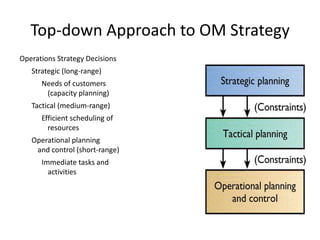
Top-down Approach to OM Strategy
Operations Strategy Decisions
   Strategic (long-range)
      Needs of customers
       (capacity planning)
   Tactical (medium-range)
      Efficient scheduling of
        resources
   Operational planning
    and control (short-range)
      Immediate tasks and
        activities
Mass Production

•   A system for manufacturing products in large amounts through
   effective combinations of employees with specialized
   skills, mechanization, and standardization.
• Assembly line Manufacturing technique that carries the product on a
   conveyor system past several workstations where workers perform
   specialized tasks.
• Applied by Henry Ford to improve the efficiency of automobile
   manufacturing.
• Before assembly line, produced one car per worker per 12-hour
   workday.
• After assembly line, produced eight cars per worker per 12-hour
   workday.
• Efficient method for making mass quantities of similar items.
• Not flexible.
• Flexible Production
• Produces smaller batches of goods cost-effectively with
    information technology.
• Information technology to share the details of customer orders.
• Programmable equipment to fulfill the orders.
• Skilled people to carry out whatever tasks are needed to fill a
    particular order.
• Customer-Driven Production
• Evaluates customer demands to link what a manufacturer
   makes with what customers want to buy.
• Link computers in factories to retail scanners to create short-
   term forecasts and design production schedules.
• Make product only after customer orders it.
• Example: Dell
PRODUCTION PROCESSES

• Synthetic production system Combines a number of
   raw materials or parts or transforms raw materials to
   produce finished products.
• Example: Dell’s assembly line
• Continuous production process Generates finished
   products over a lengthy period of time.
• Example: Steel industry
• Intermittent production process Generates products in
   short production runs, shutting down machines
   frequently or changing their configurations to produce
   different products.
   • Example: Most services
THE JOB OF PRODUCTION MANAGERS
• Oversee the work of people and machinery to convert
inputs (materials and resources) into finished goods and
                        services.
                   • Four main tasks:
Planning the Production Process

• Begins by choosing what goods or services
  to offer customers.
• Convert original product ideas into final
  specifications.
• Design the most efficient facilities to
  produce those products.
Implementing the Production
              Plan
• Make, Buy, or Lease Decision
• Choosing whether to manufacture a needed
   product or component in house, purchase it from
   an outside supplier, or lease it.
• Factors in the decision include cost, availability of
   reliable outside suppliers, and the need for
   confidentiality.
• Selection of Suppliers
• Based on comparison of
  quality, prices, dependability of delivery, and
  services offered by competing companies.
• Inventory Control
• • Perpetual inventory Systems continuously monitor
  the amounts and locations of stocks.
• Just-in-Time Systems
• • Management philosophy aimed at improving profits
  and return on investment by minimizing costs and
  eliminating waste through cut- ting inventory on hand.
• Materials Requirement Planning
• • Computer-based production planning system by
  which a firm can ensure that it has needed parts and
  materials available at the right time and place in the
  correct amounts.
Controlling the Production
               Process
• • Production control Creates a well-defined set
  of procedures for coordinating
  people, materials, and machinery to provide
  maximum production efficiency.
• Production Planning
• • Determining the amount of resources (including
  raw materials and other components) an
  organization needs to produce a certain output.
• Routing
• • Determining the sequence of work throughout
  the facility and specifying who will perform each
  aspect of the work at what location.
OM’s Contributions to Society
• Higher Standard of Living
  –Ability to increase productivity
  –Lower cost of goods and services
• Better Quality Goods and Services
  –Competition increases quality
• Improved Working Conditions
  –Better job design and employee participation
Application of OM to Service
             Operations

–Batch cooking operations at McDonald’s
–Just-in-Time (JIT) at Northern Telecomm, Inc.
–Automatic inventory replenishment at Wal-Mart
An Expanded Definition of Quality
• Quality is important in all functional areas of
  an organization.
• Quality is now much more than the technical
  requirements for manufactured goods.
• Service quality (customer relationships)
  is equally important.
                                             Quality
Linking OM to Customers and
                Suppliers
• Benefits of Buffering the Transformation Process
   – The process was often more efficient than input and
     distribution processes.
   – Productivity was maximized when processes operated at
     continuous rates.
   – Process management skills were different from those of
     other functional activities.
• Disadvantages of Buffering the Transformation Process
   – Information lag in interaction with other functional
     activities.
   – Lack of communication between customers and the shop
     floor for problem solving.
Operation management

Operation management

  • 1.
  • 2.
    Definition of 'Operations Management' • Operations management refers to the administration of business practices to create the highest level of efficiency possible within an organization. Operations management is concerned with converting materials and labor into goods and services as efficiently as possible to maximize the profit of an organization.
  • 3.
  • 4.
    Operations Management • Operationsystem is either manufacturing sector or service sector. The input requirements and the transformation process, in which part of the value addition takes place to get the required quantity of the product or services with the targeted quality within the specified time period, is carried out in a most economical way. Operation Management Plan coordinates and controls all the activities in the operation system to achieve the stated objectives.
  • 5.
    • The operationsystem includes both manufacturing sector as well as service sector, but when you use the word PM, you should be careful to note that it refers to the manufacturing sector but not the service sector. Suppose, you are designing a layout for the hospital you should say that you are applying Operations Management Technique not the Production Management Technique.
  • 6.
    Nature / Scope/ Introduction : • Know the production & operation function as process of value addition. • Recognize the distinction between product & services. • Understand all organizations as conversion system whe ther in manufacturing or service sectors. • Identify problems of decision making in operations management. • Distinguish functions & requirements of different departments. • Facilities required for production & operation.
  • 7.
    Production and operationfunction • Creation • Customer Service • Profit(produce a product or service that creates profit and revenue for the company) • Evaluation(self-evaluating entity that monitors the quality, quantity, and cost of goods produced) • Tasks(include forecasting, scheduling, purchasing, design, maintenance, people management, flow analysis, reporting, assembly and testing) • Fulfilment
  • 8.
    Specifying the productionfunction • A production function can be expressed in a functional form as the right side of Q= f (X1,X2,X3,…..Xn) where: Q=quantity of output X1,X2,X3,…..Xn=quantities of factor inputs (such as capital, labour, land or raw materials).
  • 9.
    STRATEGIC IMPORTANCE OFTHE PRODUCTION FUNCTION • Effective production and operations management can: • Lower a firm’s costs of production. • Boost the quality of its goods and services. • Allow it to respond dependably to customer demands. • Enable it to renew itself by providing new products.
  • 10.
    Top-down Approach toOM Strategy Operations Strategy Decisions Strategic (long-range) Needs of customers (capacity planning) Tactical (medium-range) Efficient scheduling of resources Operational planning and control (short-range) Immediate tasks and activities
  • 11.
    Mass Production • A system for manufacturing products in large amounts through effective combinations of employees with specialized skills, mechanization, and standardization. • Assembly line Manufacturing technique that carries the product on a conveyor system past several workstations where workers perform specialized tasks. • Applied by Henry Ford to improve the efficiency of automobile manufacturing. • Before assembly line, produced one car per worker per 12-hour workday. • After assembly line, produced eight cars per worker per 12-hour workday. • Efficient method for making mass quantities of similar items. • Not flexible.
  • 12.
    • Flexible Production •Produces smaller batches of goods cost-effectively with information technology. • Information technology to share the details of customer orders. • Programmable equipment to fulfill the orders. • Skilled people to carry out whatever tasks are needed to fill a particular order. • Customer-Driven Production • Evaluates customer demands to link what a manufacturer makes with what customers want to buy. • Link computers in factories to retail scanners to create short- term forecasts and design production schedules. • Make product only after customer orders it. • Example: Dell
  • 13.
    PRODUCTION PROCESSES • Syntheticproduction system Combines a number of raw materials or parts or transforms raw materials to produce finished products. • Example: Dell’s assembly line • Continuous production process Generates finished products over a lengthy period of time. • Example: Steel industry • Intermittent production process Generates products in short production runs, shutting down machines frequently or changing their configurations to produce different products. • Example: Most services
  • 14.
    THE JOB OFPRODUCTION MANAGERS • Oversee the work of people and machinery to convert inputs (materials and resources) into finished goods and services. • Four main tasks:
  • 15.
    Planning the ProductionProcess • Begins by choosing what goods or services to offer customers. • Convert original product ideas into final specifications. • Design the most efficient facilities to produce those products.
  • 16.
    Implementing the Production Plan • Make, Buy, or Lease Decision • Choosing whether to manufacture a needed product or component in house, purchase it from an outside supplier, or lease it. • Factors in the decision include cost, availability of reliable outside suppliers, and the need for confidentiality. • Selection of Suppliers • Based on comparison of quality, prices, dependability of delivery, and services offered by competing companies.
  • 17.
    • Inventory Control •• Perpetual inventory Systems continuously monitor the amounts and locations of stocks. • Just-in-Time Systems • • Management philosophy aimed at improving profits and return on investment by minimizing costs and eliminating waste through cut- ting inventory on hand. • Materials Requirement Planning • • Computer-based production planning system by which a firm can ensure that it has needed parts and materials available at the right time and place in the correct amounts.
  • 18.
    Controlling the Production Process • • Production control Creates a well-defined set of procedures for coordinating people, materials, and machinery to provide maximum production efficiency. • Production Planning • • Determining the amount of resources (including raw materials and other components) an organization needs to produce a certain output. • Routing • • Determining the sequence of work throughout the facility and specifying who will perform each aspect of the work at what location.
  • 19.
    OM’s Contributions toSociety • Higher Standard of Living –Ability to increase productivity –Lower cost of goods and services • Better Quality Goods and Services –Competition increases quality • Improved Working Conditions –Better job design and employee participation
  • 20.
    Application of OMto Service Operations –Batch cooking operations at McDonald’s –Just-in-Time (JIT) at Northern Telecomm, Inc. –Automatic inventory replenishment at Wal-Mart
  • 21.
    An Expanded Definitionof Quality • Quality is important in all functional areas of an organization. • Quality is now much more than the technical requirements for manufactured goods. • Service quality (customer relationships) is equally important. Quality
  • 22.
    Linking OM toCustomers and Suppliers • Benefits of Buffering the Transformation Process – The process was often more efficient than input and distribution processes. – Productivity was maximized when processes operated at continuous rates. – Process management skills were different from those of other functional activities. • Disadvantages of Buffering the Transformation Process – Information lag in interaction with other functional activities. – Lack of communication between customers and the shop floor for problem solving.