PRODUCTION SYSTEMS
By
Naeem Akram
Noor College of Business & Sciences
What is production?
Production can be explained as an act
of either manufacturing or mining or
growing of goods (commodities)
generally in bulk for trade.
Production is a method employed for
making or providing essential goods
and services for consumers.
What is production?
It is a process that puts intangible
inputs like ideas, creativity, research,
knowledge, wisdom, etc. in use or
action. It is a way that transforms
(convert) tangible inputs like raw-
materials, semi-finished goods and
unassembled goods into finished goods
or commodities.
What is production system?
Production system may be defined as,
"The methods, procedure or
arrangement which includes all
functions required to accumulate
(gather) the inputs, process or
reprocess the inputs, and deliver the
marketable output (goods)."
Meaning of production system
Production system consists of three
main components viz.,
Inputs
Conversion Process and
Output.
Meaning of production system
Inputs include raw-materials, machines, man-hours,
components or parts, drawing, instructions and other
paper works.
Conversion process includes operations (actual
production process). Operations may be either manual or
mechanical or chemical. Operations convert inputs into
output. Conversion process also includes supporting
activities, which help the process of conversion. The
supporting activities include; production planning and
control, purchase of raw-materials, receipt, storage and
issue of materials, inspection of parts and work-in-
progress, testing of products, quality control,
warehousing of finished products, etc.
Meaning of production system
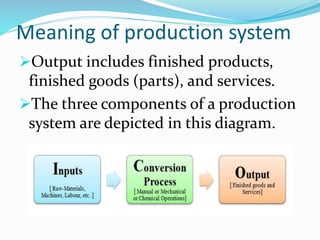
Output includes finished products,
finished goods (parts), and services.
The three components of a production
system are depicted in this diagram.
Examples
The examples of a production system are as
follows:
Tangible goods : Consider an example of a
manufacturing industry like a Sugar
Industry. Here, sugarcane is first used as an
input, then the juice of sugarcane is
processed through a conversion process,
finally to get an output known as a refined
sugar (used for mass consumption).
Examples
Intangible goods : Consider an example
from a service industry that of a software-
development firm or company. Here,
initially, written program codes are used as
an inputs. These codes are then integrated
in some database and are provided with a
user-friendly interface through a conversion
process. Finally, an output is made available
in form of an executable application
program.
Types of Production System
The normal way of classifying
production systems is under four broad
headings as follows.
1) Job production
2) Batch production
3) Mass production
4) Process production
Job production
This type of production system is concerned with
making a (usually) high-priced product to an order
which is not likely to be repeated –i.e. a one-off job.
This calls for skilled workers, who can be flexible in
adapting their skills to producing just what the
customer requires.
A crucial consideration in job production is the fact
that nearly all the production costs fall to the one
job.
Since they cannot be spread over a long run of
production, the fixing of a correct selling price is
very important.
Example of Job production
 Designing and implementing an advertising
campaign
 Auditing the accounts of a large public
limited company
 Building a new factory
 Installing machinery in a factory
Advantages of Job production
The main advantages of using job production
include:
Advantages
Product usually high quality
Producer meets individual customer needs
Greater job satisfaction – involved in all
stages of production
Disadvantages of Job production
The main disadvantages of using job
production include:
Disadvantages
Cost of producing one unit or job is higher
Labour –intensive
Requires investment in skills and training
Batch production
This is the production of a given quantity of goods
–i.e. a number of units of a similar specification.
There may be repeat orders for these goods, but
there is no continuous flow of production.
Batch production resembles job production in that
these are specialist goods made to fit customers'
requirements, but differs in that the costs of
production can be spread over a number of units,
so allowing firms more scope to invest in new
machinery.
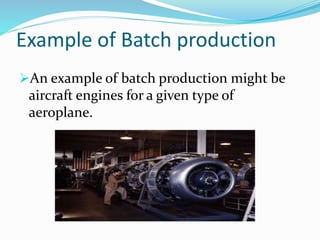
Example of Batch production
An example of batch production might be
aircraft engines for a given type of
aeroplane.
Advantages of Batch production
The benefits of batch production include:
Making in batches reduces unit costs
Can still address specific customer needs
(e.g. size, weight, style)
Use of specialist machinery & skills can
increase output and productivity
Disadvantages of Batch production
The drawbacks of batch production include:
Time lost switching between batches –
machinery may need to be reset
Need to keep stocks of raw materials. Cash
also investment in work-in-progress
Potentially de-motivating for staff
Mass production
This is the continuous output of uniform,
standardised products for a mass market
which offers a regular, continuous demand.
The goods are relatively low priced and are
produced by the use of machines and semi-
skilled and unskilled labour.
A sub-type of mass production is flow
production.
Mass production
This makes use of machines and labour in a
sequence called a production line. Cars for the
mass market are produced by materials and
parts moving along an assembly line until
eventually a finished car rolls off at the end.
Flow production can take many of the features
of mass production and apply them to the
manufacture of relatively high-cost goods like
cars, washing machines and TV sets.
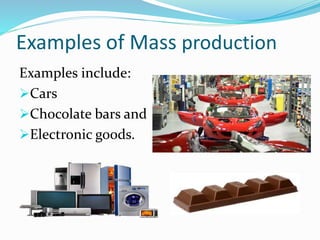
Examples of Mass production
Examples include:
Cars
Chocolate bars and
Electronic goods.
Advantages of Mass production
The benefits of mass production include:
Labour costs are usually lower.
Materials can be purchased in large
quantities, so they are often cheaper.
Large number of goods are produced.
Disadvantages of Mass production
The main disadvantages of using mass production
include:
Machinery is very expensive to buy, so production
lines are very expensive to set up.
Workers are not very motivated, since their work is
very repetitive.
Not very flexible, as a production line is difficult to
adapt.
If one part of the line breaks, the whole production
process will have to stop until it is repaired.
Process production
This refers to the process used to extract products
such as oil and gas. It makes possible a continuous
flow of production, using expensive machinery,
highly automated methods and a mass marketing
technique.
In mass production, flow production and process
production, a small range of products is produced
in very large quantities.
Process production
Large capital investment is involved and a mass
market is needed to absorb the goods
produced.
The type of production system will have
implications for the way in which a production
department is structured, and certain theorists
see the type of production system as an
important influence on the way in which the
whole organisation is structured.
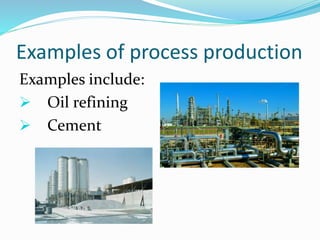
Examples of process production
Examples include:
 Oil refining
 Cement
The advantages of process production
The advantages of using process production
include:
Processes can normally be automated which
reduces unit costs
Large quantities can be produced
Ideal for products which have to be of a
consistent quality
The disadvantages of process production
The disadvantages of using process production
include:
Heavy investment required in process design
and production equipment / facilities
Difficult and disruptive if the production
process has to be stopped
Little opportunity to make different versions
of the product
PRODUCTION SYSTEMS

PRODUCTION SYSTEMS

  • 1.
    PRODUCTION SYSTEMS By Naeem Akram NoorCollege of Business & Sciences
  • 2.
    What is production? Productioncan be explained as an act of either manufacturing or mining or growing of goods (commodities) generally in bulk for trade. Production is a method employed for making or providing essential goods and services for consumers.
  • 3.
    What is production? Itis a process that puts intangible inputs like ideas, creativity, research, knowledge, wisdom, etc. in use or action. It is a way that transforms (convert) tangible inputs like raw- materials, semi-finished goods and unassembled goods into finished goods or commodities.
  • 4.
    What is productionsystem? Production system may be defined as, "The methods, procedure or arrangement which includes all functions required to accumulate (gather) the inputs, process or reprocess the inputs, and deliver the marketable output (goods)."
  • 5.
    Meaning of productionsystem Production system consists of three main components viz., Inputs Conversion Process and Output.
  • 6.
    Meaning of productionsystem Inputs include raw-materials, machines, man-hours, components or parts, drawing, instructions and other paper works. Conversion process includes operations (actual production process). Operations may be either manual or mechanical or chemical. Operations convert inputs into output. Conversion process also includes supporting activities, which help the process of conversion. The supporting activities include; production planning and control, purchase of raw-materials, receipt, storage and issue of materials, inspection of parts and work-in- progress, testing of products, quality control, warehousing of finished products, etc.
  • 7.
    Meaning of productionsystem Output includes finished products, finished goods (parts), and services. The three components of a production system are depicted in this diagram.
  • 8.
    Examples The examples ofa production system are as follows: Tangible goods : Consider an example of a manufacturing industry like a Sugar Industry. Here, sugarcane is first used as an input, then the juice of sugarcane is processed through a conversion process, finally to get an output known as a refined sugar (used for mass consumption).
  • 9.
    Examples Intangible goods :Consider an example from a service industry that of a software- development firm or company. Here, initially, written program codes are used as an inputs. These codes are then integrated in some database and are provided with a user-friendly interface through a conversion process. Finally, an output is made available in form of an executable application program.
  • 10.
    Types of ProductionSystem The normal way of classifying production systems is under four broad headings as follows. 1) Job production 2) Batch production 3) Mass production 4) Process production
  • 11.
    Job production This typeof production system is concerned with making a (usually) high-priced product to an order which is not likely to be repeated –i.e. a one-off job. This calls for skilled workers, who can be flexible in adapting their skills to producing just what the customer requires. A crucial consideration in job production is the fact that nearly all the production costs fall to the one job. Since they cannot be spread over a long run of production, the fixing of a correct selling price is very important.
  • 12.
    Example of Jobproduction  Designing and implementing an advertising campaign  Auditing the accounts of a large public limited company  Building a new factory  Installing machinery in a factory
  • 13.
    Advantages of Jobproduction The main advantages of using job production include: Advantages Product usually high quality Producer meets individual customer needs Greater job satisfaction – involved in all stages of production
  • 14.
    Disadvantages of Jobproduction The main disadvantages of using job production include: Disadvantages Cost of producing one unit or job is higher Labour –intensive Requires investment in skills and training
  • 15.
    Batch production This isthe production of a given quantity of goods –i.e. a number of units of a similar specification. There may be repeat orders for these goods, but there is no continuous flow of production. Batch production resembles job production in that these are specialist goods made to fit customers' requirements, but differs in that the costs of production can be spread over a number of units, so allowing firms more scope to invest in new machinery.
  • 16.
    Example of Batchproduction An example of batch production might be aircraft engines for a given type of aeroplane.
  • 17.
    Advantages of Batchproduction The benefits of batch production include: Making in batches reduces unit costs Can still address specific customer needs (e.g. size, weight, style) Use of specialist machinery & skills can increase output and productivity
  • 18.
    Disadvantages of Batchproduction The drawbacks of batch production include: Time lost switching between batches – machinery may need to be reset Need to keep stocks of raw materials. Cash also investment in work-in-progress Potentially de-motivating for staff
  • 19.
    Mass production This isthe continuous output of uniform, standardised products for a mass market which offers a regular, continuous demand. The goods are relatively low priced and are produced by the use of machines and semi- skilled and unskilled labour. A sub-type of mass production is flow production.
  • 20.
    Mass production This makesuse of machines and labour in a sequence called a production line. Cars for the mass market are produced by materials and parts moving along an assembly line until eventually a finished car rolls off at the end. Flow production can take many of the features of mass production and apply them to the manufacture of relatively high-cost goods like cars, washing machines and TV sets.
  • 21.
    Examples of Massproduction Examples include: Cars Chocolate bars and Electronic goods.
  • 22.
    Advantages of Massproduction The benefits of mass production include: Labour costs are usually lower. Materials can be purchased in large quantities, so they are often cheaper. Large number of goods are produced.
  • 23.
    Disadvantages of Massproduction The main disadvantages of using mass production include: Machinery is very expensive to buy, so production lines are very expensive to set up. Workers are not very motivated, since their work is very repetitive. Not very flexible, as a production line is difficult to adapt. If one part of the line breaks, the whole production process will have to stop until it is repaired.
  • 24.
    Process production This refersto the process used to extract products such as oil and gas. It makes possible a continuous flow of production, using expensive machinery, highly automated methods and a mass marketing technique. In mass production, flow production and process production, a small range of products is produced in very large quantities.
  • 25.
    Process production Large capitalinvestment is involved and a mass market is needed to absorb the goods produced. The type of production system will have implications for the way in which a production department is structured, and certain theorists see the type of production system as an important influence on the way in which the whole organisation is structured.
  • 26.
    Examples of processproduction Examples include:  Oil refining  Cement
  • 27.
    The advantages ofprocess production The advantages of using process production include: Processes can normally be automated which reduces unit costs Large quantities can be produced Ideal for products which have to be of a consistent quality
  • 28.
    The disadvantages ofprocess production The disadvantages of using process production include: Heavy investment required in process design and production equipment / facilities Difficult and disruptive if the production process has to be stopped Little opportunity to make different versions of the product