Probability Distributions
Anthony J. Evans
Professor of Economics, ESCP Europe
www.anthonyjevans.com
(cc) Anthony J. Evans 2019 | http://creativecommons.org/licenses/by-nc-sa/3.0/
Objectives
After attending this lecture, students will be able to:
• Develop an intuitive grasp of probability distributions and
be able to read tables
• Distinguish between the Normal, Binomial and Poisson
distributions
• Understand the Central Limit Theorem, and the conditions
under which it holds
2
Outline
• The Normal Distribution
– The Standard Normal Distribution
– The Central Limit Theorem
• The Binomial Distribution
• The Poisson Distribution
3
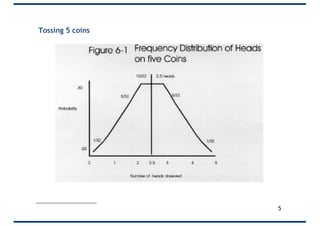
A coin tossing distribution
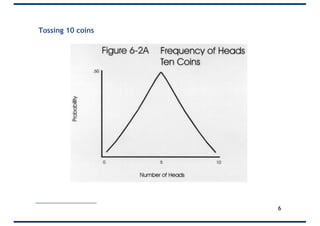
• Let’s assume we toss a coin 5 times and note how many
heads we observe
• We know the distribution – it will range from 0 to 5, and we
can calculate the probabilities
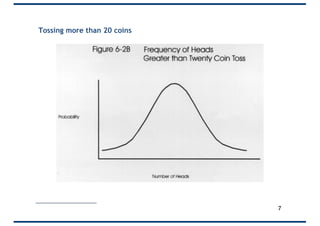
• If we toss the coin more than 20 times there is more
uncertainty about how many heads we’ll see, but we still
have a fully specified probability distribution
4
Tossing 5 coins
5
Tossing 10 coins
6
Tossing more than 20 coins
7
A quiz on distributions
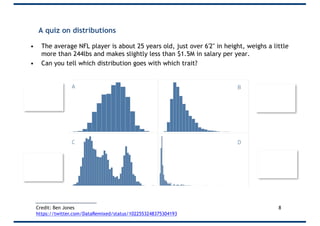
• The average NFL player is about 25 years old, just over 6'2" in height, weighs a little
more than 244lbs and makes slightly less than $1.5M in salary per year.
• Can you tell which distribution goes with which trait?
8Credit: Ben Jones
https://twitter.com/DataRemixed/status/1022553248375304193
Height
Weight
Age
Salary
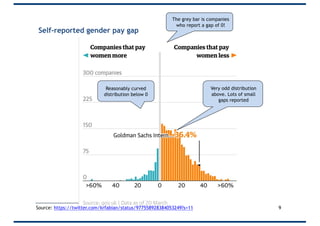
Self-reported gender pay gap
9Source: https://twitter.com/krfabian/status/977558928384053249?s=11
The grey bar is companies
who report a gap of 0!
Reasonably curved
distribution below 0
Very odd distribution
above. Lots of small
gaps reported
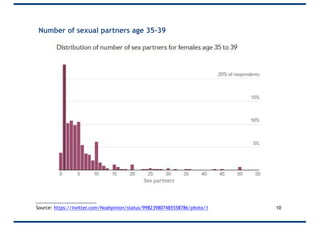
Number of sexual partners age 35-39
10Source: https://twitter.com/Noahpinion/status/998239807485558786/photo/1
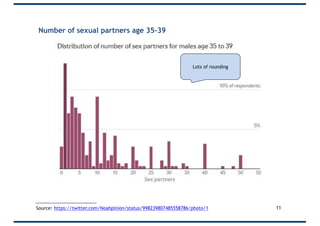
Number of sexual partners age 35-39
11Source: https://twitter.com/Noahpinion/status/998239807485558786/photo/1
Lots of rounding
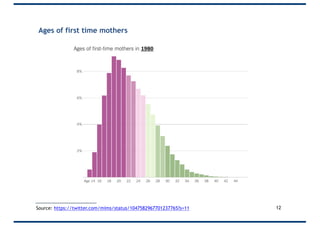
Ages of first time mothers
12Source: https://twitter.com/mims/status/1047582967701237765?s=11
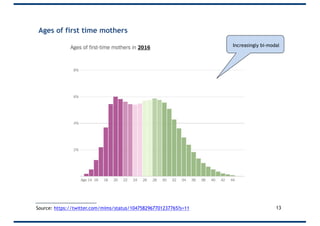
Ages of first time mothers
13Source: https://twitter.com/mims/status/1047582967701237765?s=11
Increasingly bi-modal
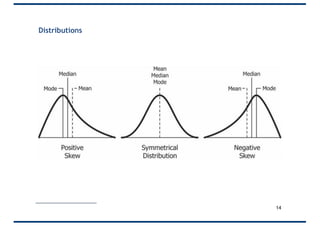
Distributions
14
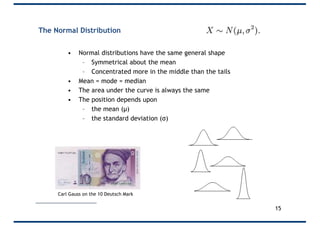
The Normal Distribution
• Normal distributions have the same general shape
– Symmetrical about the mean
– Concentrated more in the middle than the tails
• Mean = mode = median
• The area under the curve is always the same
• The position depends upon
– the mean (µ)
– the standard deviation (σ)
Carl Gauss on the 10 Deutsch Mark
15
Outline
• The Normal Distribution
– The Standard Normal Distribution
– The Central Limit Theorem
• The Binomial Distribution
• The Poisson Distribution
16
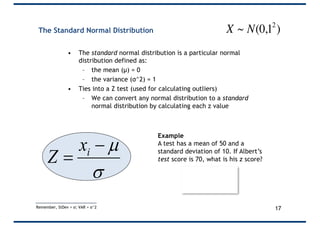
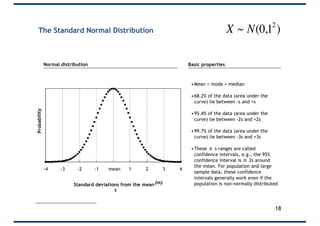
The Standard Normal Distribution
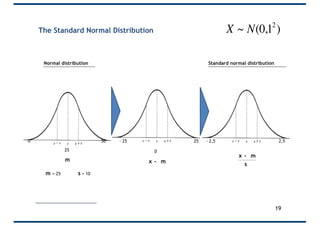
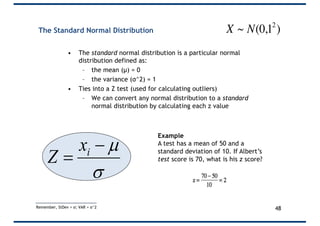
• The standard normal distribution is a particular normal
distribution defined as:
– the mean (µ) = 0
– the variance (σ^2) = 1
• Ties into a Z test (used for calculating outliers)
– We can convert any normal distribution to a standard
normal distribution by calculating each z value
s
µ-
= ix
Z
Example
A test has a mean of 50 and a
standard deviation of 10. If Albert’s
test score is 70, what is his z score?
17
€
X ~ N(0,12
)
Remember, StDev = σ; VAR = σ^2
Normal distribution
Standard deviations from the mean
s
-4 -3 -2 -1 mean 1 2 3 4
Basic properties
•Mean = mode = median
•68.2% of the data (area under the
curve) lie between -s and +s
•95.4% of the data (area under the
curve) lie between -2s and +2s
•99.7% of the data (area under the
curve) lie between -3s and +3s
•These ± s ranges are called
confidence intervals, e.g., the 95%
confidence interval is ± 2s around
the mean. For population and large
sample data, these confidence
intervals generally work even if the
population is non-normally distributed(m)
The Standard Normal Distribution
18
€
X ~ N(0,12
)
0
Normal distribution Standard normal distribution
x - m
sx - mm
- 25 25 - 2,5 2,5
25
0 50
m = 25 s = 10
19
The Standard Normal Distribution
€
X ~ N(0,12
)
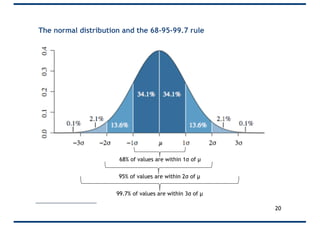
68% of values are within 1σ of µ
99.7% of values are within 3σ of µ
95% of values are within 2σ of µ
The normal distribution and the 68-95-99.7 rule
20
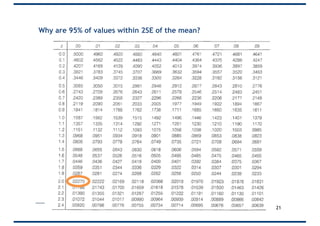
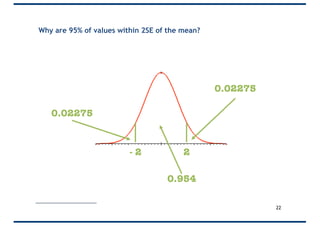
Why are 95% of values within 2SE of the mean?
21
Why are 95% of values within 2SE of the mean?
22
2
0.02275
0.02275
- 2
0.954
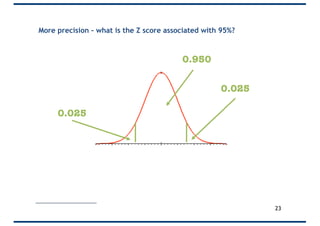
More precision – what is the Z score associated with 95%?
23
0.025
0.025
0.950
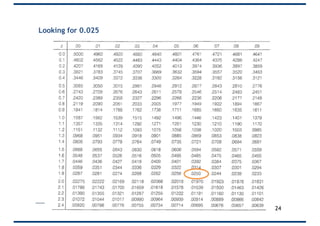
Looking for 0.025
24
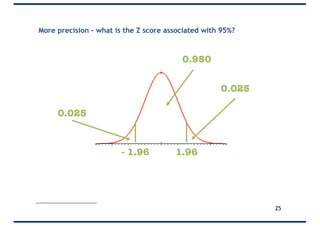
More precision – what is the Z score associated with 95%?
25
0.025
0.025
0.950
- 1.96 1.96
Outline
• The Normal Distribution
– The Standard Normal Distribution
– The Central Limit Theorem
• The Binomial Distribution
• The Poisson Distribution
26
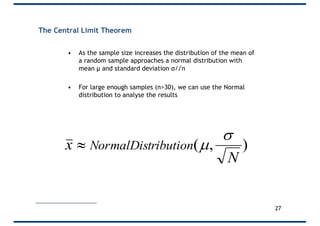
The Central Limit Theorem
• As the sample size increases the distribution of the mean of
a random sample approaches a normal distribution with
mean µ and standard deviation σ/√n
• For large enough samples (n>30), we can use the Normal
distribution to analyse the results
),(
N
x ributionNormalDist
s
µ»
27
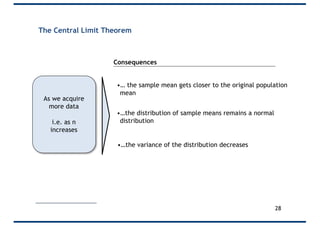
As we acquire
more data
i.e. as n
increases
•… the sample mean gets closer to the original population
mean
•…the distribution of sample means remains a normal
distribution
•…the variance of the distribution decreases
Consequences
The Central Limit Theorem
28
Outline
• The Normal Distribution
– The Standard Normal Distribution
– The Central Limit Theorem
• The Binomial Distribution
• The Poisson Distribution
29
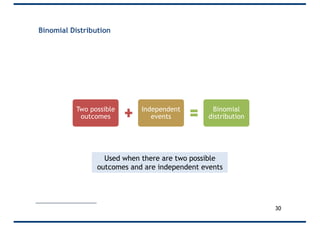
Binomial Distribution
Two possible
outcomes
Independent
events
Binomial
distribution
30
Used when there are two possible
outcomes and are independent events
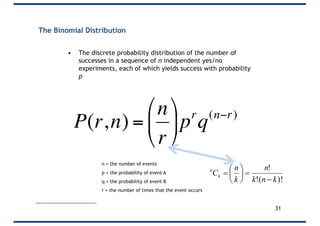
The Binomial Distribution
• The discrete probability distribution of the number of
successes in a sequence of n independent yes/no
experiments, each of which yields success with probability
p
P(r,n) =
n
r
"
#
$
%
&
'pr
q(n−r)
n = the number of events
p = the probability of event A
q = the probability of event B
r = the number of times that the event occurs
31
)!(!
!
knk
n
k
n
Ck
n
-
=÷
ø
ö
ç
è
æ
=
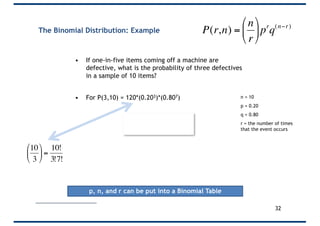
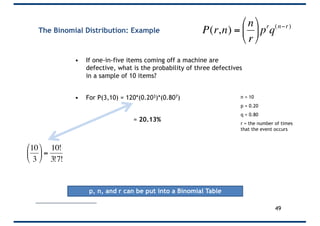
The Binomial Distribution: Example
• If one-in-five items coming off a machine are
defective, what is the probability of three defectives
in a sample of 10 items?
• For P(3,10) = 120*(0.203)*(0.807)
= 20.13%
n = 10
p = 0.20
q = 0.80
r = the number of times
that the event occurs
p, n, and r can be put into a Binomial Table
32
€
P(r,n) =
n
r
"
#
$
%
&
'pr
q(n−r)
10
3
"
#
$
%
&
' =
10!
3!7!
33
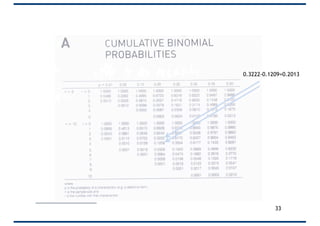
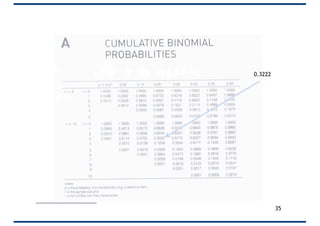
0.3222-0.1209=0.2013
The Binomial Distribution: Example
• If one-in-five items coming off a machine are
defective, what is the probability of three or more
defectives in a sample of 10 items?
• For P(0,10) = 1*(0.200)*(0.8010) = 0.1073
• For P(1,10) = 10*(0.201)*(0.809)
• For P(2,10) = 45*(0.202)*(0.808)
• P(>=3) = 1 – [P(2)+P(1)+P(0)]
= 1 – 0.678
= 32.2%
n = 10
p = 0.20
q = 0.80
r = the number of times
that the event occurs
p, n, and r can be put into a Binomial Table
34
€
P(r,n) =
n
r
"
#
$
%
&
'pr
q(n−r)
35
0.3222
Outline
• The Normal Distribution
– The Standard Normal Distribution
– The Central Limit Theorem
• The Binomial Distribution
• The Poisson Distribution
36
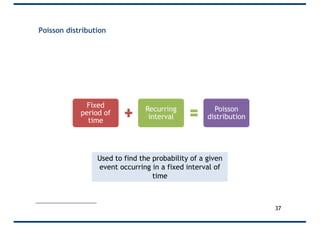
Poisson distribution
Fixed
period of
time
Recurring
interval
Poisson
distribution
37
Used to find the probability of a given
event occurring in a fixed interval of
time
The Poisson Distribution
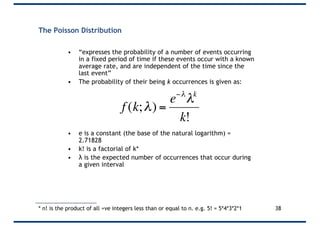
• “expresses the probability of a number of events occurring
in a fixed period of time if these events occur with a known
average rate, and are independent of the time since the
last event”
• The probability of their being k occurrences is given as:
• e is a constant (the base of the natural logarithm) =
2.71828
• k! is a factorial of k*
• λ is the expected number of occurrences that occur during
a given interval
* n! is the product of all +ve integers less than or equal to n. e.g. 5! = 5*4*3*2*1 38
€
f (k;λ) =
e−λ
λk
k!
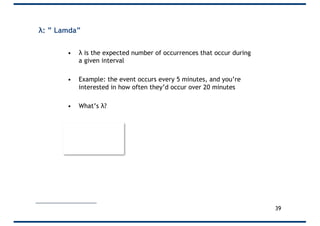
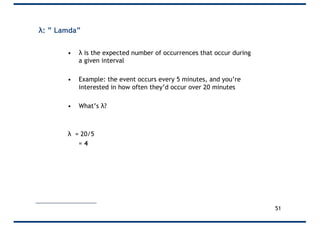
λ: ” Lamda”
• λ is the expected number of occurrences that occur during
a given interval
• Example: the event occurs every 5 minutes, and you’re
interested in how often they’d occur over 20 minutes
• What’s λ?
λ = 20/5
= 4
39
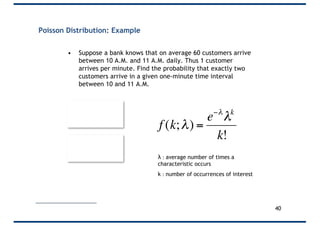
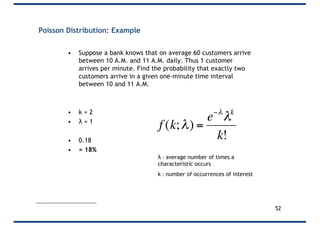
Poisson Distribution: Example
• Suppose a bank knows that on average 60 customers arrive
between 10 A.M. and 11 A.M. daily. Thus 1 customer
arrives per minute. Find the probability that exactly two
customers arrive in a given one-minute time interval
between 10 and 11 A.M.
• k = 2
• λ = 1
• 0.18
• = 18%
λ : average number of times a
characteristic occurs
k : number of occurrences of interest
40
€
f (k;λ) =
e−λ
λk
k!
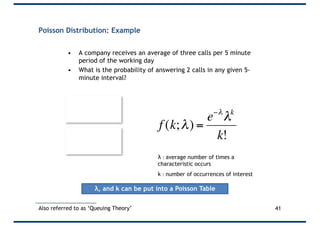
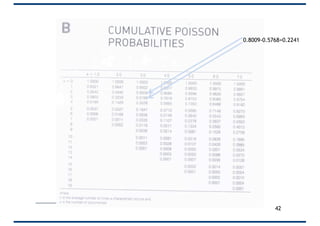
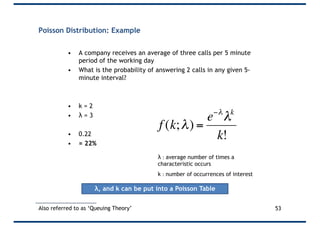
Poisson Distribution: Example
• A company receives an average of three calls per 5 minute
period of the working day
• What is the probability of answering 2 calls in any given 5-
minute interval?
• k = 2
• λ = 3
• 0.22
• = 22%
λ : average number of times a
characteristic occurs
k : number of occurrences of interest
λ, and k can be put into a Poisson Table
41Also referred to as ‘Queuing Theory’
€
f (k;λ) =
e−λ
λk
k!
42
0.8009-0.5768=0.2241
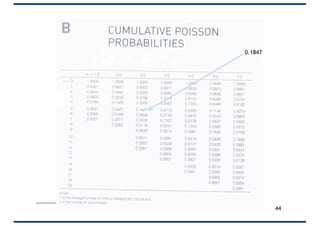
Poisson Distribution: Example
• A company receives an average of three calls per 5 minute
period of the working day
• What is the probability of answering 5 calls or more in any
given 5-minute interval?
43
44
0.1847
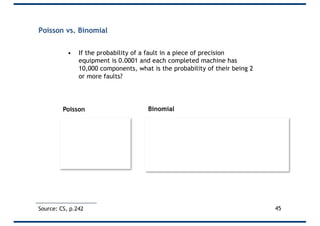
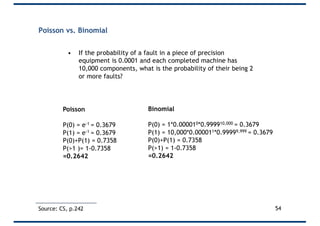
Poisson vs. Binomial
• If the probability of a fault in a piece of precision
equipment is 0.0001 and each completed machine has
10,000 components, what is the probability of their being 2
or more faults?
45
Poisson
P(0) = e-1 = 0.3679
P(1) = e-1 = 0.3679
P(0)+P(1) = 0.7358
P(>1 )= 1-0.7358
=0.2642
Binomial
P(0) = 1*0.000010*0.999910,000 = 0.3679
P(1) = 10,000*0.000011*0.99999,999 = 0.3679
P(0)+P(1) = 0.7358
P(>1) = 1-0.7358
=0.2642
Source: CS, p.242
Summary
• Probability distributions are the basis for inferential
statistics since they demonstrate the characteristics of a
dataset
• It’s easy to practice textbook examples (which is highly
recommended) but also important to put into a practical
setting
46
Solutions
47
The Standard Normal Distribution
• The standard normal distribution is a particular normal
distribution defined as:
– the mean (µ) = 0
– the variance (σ^2) = 1
• Ties into a Z test (used for calculating outliers)
– We can convert any normal distribution to a standard
normal distribution by calculating each z value
s
µ-
= ix
Z
Example
A test has a mean of 50 and a
standard deviation of 10. If Albert’s
test score is 70, what is his z score?
48
€
X ~ N(0,12
)
Remember, StDev = σ; VAR = σ^2
The Binomial Distribution: Example
• If one-in-five items coming off a machine are
defective, what is the probability of three defectives
in a sample of 10 items?
• For P(3,10) = 120*(0.203)*(0.807)
= 20.13%
n = 10
p = 0.20
q = 0.80
r = the number of times
that the event occurs
p, n, and r can be put into a Binomial Table
49
€
P(r,n) =
n
r
"
#
$
%
&
'pr
q(n−r)
10
3
"
#
$
%
&
' =
10!
3!7!
The Binomial Distribution: Example
• If one-in-five items coming off a machine are
defective, what is the probability of three or more
defectives in a sample of 10 items?
• For P(0,10) = 1*(0.200)*(0.8010) = 0.1073
• For P(1,10) = 10*(0.201)*(0.809)
• For P(2,10) = 45*(0.202)*(0.808)
• P(>=3) = 1 – [P(2)+P(1)+P(0)]
= 1 – 0.678
= 32.2%
n = 10
p = 0.20
q = 0.80
r = the number of times
that the event occurs
p, n, and r can be put into a Binomial Table
50
€
P(r,n) =
n
r
"
#
$
%
&
'pr
q(n−r)
λ: ” Lamda”
• λ is the expected number of occurrences that occur during
a given interval
• Example: the event occurs every 5 minutes, and you’re
interested in how often they’d occur over 20 minutes
• What’s λ?
λ = 20/5
= 4
51
Poisson Distribution: Example
• Suppose a bank knows that on average 60 customers arrive
between 10 A.M. and 11 A.M. daily. Thus 1 customer
arrives per minute. Find the probability that exactly two
customers arrive in a given one-minute time interval
between 10 and 11 A.M.
• k = 2
• λ = 1
• 0.18
• = 18%
λ : average number of times a
characteristic occurs
k : number of occurrences of interest
52
€
f (k;λ) =
e−λ
λk
k!
Poisson Distribution: Example
• A company receives an average of three calls per 5 minute
period of the working day
• What is the probability of answering 2 calls in any given 5-
minute interval?
• k = 2
• λ = 3
• 0.22
• = 22%
λ : average number of times a
characteristic occurs
k : number of occurrences of interest
λ, and k can be put into a Poisson Table
53Also referred to as ‘Queuing Theory’
€
f (k;λ) =
e−λ
λk
k!
Poisson vs. Binomial
• If the probability of a fault in a piece of precision
equipment is 0.0001 and each completed machine has
10,000 components, what is the probability of their being 2
or more faults?
54Source: CS, p.242
Poisson
P(0) = e-1 = 0.3679
P(1) = e-1 = 0.3679
P(0)+P(1) = 0.7358
P(>1 )= 1-0.7358
=0.2642
Binomial
P(0) = 1*0.000010*0.999910,000 = 0.3679
P(1) = 10,000*0.000011*0.99999,999 = 0.3679
P(0)+P(1) = 0.7358
P(>1) = 1-0.7358
=0.2642
Appendix
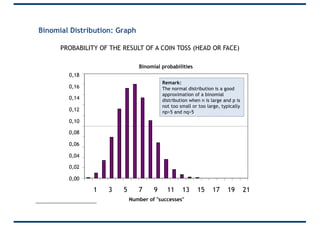
Binomial probabilities
1 3 5 7 9 11 13 15 17 19 21
Number of "successes"
0,00
0,02
0,04
0,06
0,08
0,10
0,12
0,14
0,16
0,18
Remark:
The normal distribution is a good
approximation of a binomial
distribution when n is large and p is
not too small or too large, typically
np>5 and nq>5
PROBABILITY OF THE RESULT OF A COIN TOSS (HEAD OR FACE)
Binomial Distribution: Graph
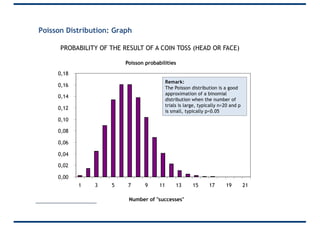
Poisson probabilities
0,00
0,02
0,04
0,06
0,08
0,10
0,12
0,14
0,16
0,18
1 3 5 7 9 11 13 15 17 19 21
Number of "successes"
Remark:
The Poisson distribution is a good
approximation of a binomial
distribution when the number of
trials is large, typically n>20 and p
is small, typically p<0.05
Poisson Distribution: Graph
PROBABILITY OF THE RESULT OF A COIN TOSS (HEAD OR FACE)
• This presentation forms part of a free, online course
on analytics
• http://econ.anthonyjevans.com/courses/analytics/
58

Probability Distributions

  • 1.
    Probability Distributions Anthony J.Evans Professor of Economics, ESCP Europe www.anthonyjevans.com (cc) Anthony J. Evans 2019 | http://creativecommons.org/licenses/by-nc-sa/3.0/
  • 2.
    Objectives After attending thislecture, students will be able to: • Develop an intuitive grasp of probability distributions and be able to read tables • Distinguish between the Normal, Binomial and Poisson distributions • Understand the Central Limit Theorem, and the conditions under which it holds 2
  • 3.
    Outline • The NormalDistribution – The Standard Normal Distribution – The Central Limit Theorem • The Binomial Distribution • The Poisson Distribution 3
  • 4.
    A coin tossingdistribution • Let’s assume we toss a coin 5 times and note how many heads we observe • We know the distribution – it will range from 0 to 5, and we can calculate the probabilities • If we toss the coin more than 20 times there is more uncertainty about how many heads we’ll see, but we still have a fully specified probability distribution 4
  • 5.
  • 6.
  • 7.
  • 8.
    A quiz ondistributions • The average NFL player is about 25 years old, just over 6'2" in height, weighs a little more than 244lbs and makes slightly less than $1.5M in salary per year. • Can you tell which distribution goes with which trait? 8Credit: Ben Jones https://twitter.com/DataRemixed/status/1022553248375304193 Height Weight Age Salary
  • 9.
    Self-reported gender paygap 9Source: https://twitter.com/krfabian/status/977558928384053249?s=11 The grey bar is companies who report a gap of 0! Reasonably curved distribution below 0 Very odd distribution above. Lots of small gaps reported
  • 10.
    Number of sexualpartners age 35-39 10Source: https://twitter.com/Noahpinion/status/998239807485558786/photo/1
  • 11.
    Number of sexualpartners age 35-39 11Source: https://twitter.com/Noahpinion/status/998239807485558786/photo/1 Lots of rounding
  • 12.
    Ages of firsttime mothers 12Source: https://twitter.com/mims/status/1047582967701237765?s=11
  • 13.
    Ages of firsttime mothers 13Source: https://twitter.com/mims/status/1047582967701237765?s=11 Increasingly bi-modal
  • 14.
  • 15.
    The Normal Distribution •Normal distributions have the same general shape – Symmetrical about the mean – Concentrated more in the middle than the tails • Mean = mode = median • The area under the curve is always the same • The position depends upon – the mean (µ) – the standard deviation (σ) Carl Gauss on the 10 Deutsch Mark 15
  • 16.
    Outline • The NormalDistribution – The Standard Normal Distribution – The Central Limit Theorem • The Binomial Distribution • The Poisson Distribution 16
  • 17.
    The Standard NormalDistribution • The standard normal distribution is a particular normal distribution defined as: – the mean (µ) = 0 – the variance (σ^2) = 1 • Ties into a Z test (used for calculating outliers) – We can convert any normal distribution to a standard normal distribution by calculating each z value s µ- = ix Z Example A test has a mean of 50 and a standard deviation of 10. If Albert’s test score is 70, what is his z score? 17 € X ~ N(0,12 ) Remember, StDev = σ; VAR = σ^2
  • 18.
    Normal distribution Standard deviationsfrom the mean s -4 -3 -2 -1 mean 1 2 3 4 Basic properties •Mean = mode = median •68.2% of the data (area under the curve) lie between -s and +s •95.4% of the data (area under the curve) lie between -2s and +2s •99.7% of the data (area under the curve) lie between -3s and +3s •These ± s ranges are called confidence intervals, e.g., the 95% confidence interval is ± 2s around the mean. For population and large sample data, these confidence intervals generally work even if the population is non-normally distributed(m) The Standard Normal Distribution 18 € X ~ N(0,12 )
  • 19.
    0 Normal distribution Standardnormal distribution x - m sx - mm - 25 25 - 2,5 2,5 25 0 50 m = 25 s = 10 19 The Standard Normal Distribution € X ~ N(0,12 )
  • 20.
    68% of valuesare within 1σ of µ 99.7% of values are within 3σ of µ 95% of values are within 2σ of µ The normal distribution and the 68-95-99.7 rule 20
  • 21.
    Why are 95%of values within 2SE of the mean? 21
  • 22.
    Why are 95%of values within 2SE of the mean? 22 2 0.02275 0.02275 - 2 0.954
  • 23.
    More precision –what is the Z score associated with 95%? 23 0.025 0.025 0.950
  • 24.
  • 25.
    More precision –what is the Z score associated with 95%? 25 0.025 0.025 0.950 - 1.96 1.96
  • 26.
    Outline • The NormalDistribution – The Standard Normal Distribution – The Central Limit Theorem • The Binomial Distribution • The Poisson Distribution 26
  • 27.
    The Central LimitTheorem • As the sample size increases the distribution of the mean of a random sample approaches a normal distribution with mean µ and standard deviation σ/√n • For large enough samples (n>30), we can use the Normal distribution to analyse the results ),( N x ributionNormalDist s µ» 27
  • 28.
    As we acquire moredata i.e. as n increases •… the sample mean gets closer to the original population mean •…the distribution of sample means remains a normal distribution •…the variance of the distribution decreases Consequences The Central Limit Theorem 28
  • 29.
    Outline • The NormalDistribution – The Standard Normal Distribution – The Central Limit Theorem • The Binomial Distribution • The Poisson Distribution 29
  • 30.
    Binomial Distribution Two possible outcomes Independent events Binomial distribution 30 Usedwhen there are two possible outcomes and are independent events
  • 31.
    The Binomial Distribution •The discrete probability distribution of the number of successes in a sequence of n independent yes/no experiments, each of which yields success with probability p P(r,n) = n r " # $ % & 'pr q(n−r) n = the number of events p = the probability of event A q = the probability of event B r = the number of times that the event occurs 31 )!(! ! knk n k n Ck n - =÷ ø ö ç è æ =
  • 32.
    The Binomial Distribution:Example • If one-in-five items coming off a machine are defective, what is the probability of three defectives in a sample of 10 items? • For P(3,10) = 120*(0.203)*(0.807) = 20.13% n = 10 p = 0.20 q = 0.80 r = the number of times that the event occurs p, n, and r can be put into a Binomial Table 32 € P(r,n) = n r " # $ % & 'pr q(n−r) 10 3 " # $ % & ' = 10! 3!7!
  • 33.
  • 34.
    The Binomial Distribution:Example • If one-in-five items coming off a machine are defective, what is the probability of three or more defectives in a sample of 10 items? • For P(0,10) = 1*(0.200)*(0.8010) = 0.1073 • For P(1,10) = 10*(0.201)*(0.809) • For P(2,10) = 45*(0.202)*(0.808) • P(>=3) = 1 – [P(2)+P(1)+P(0)] = 1 – 0.678 = 32.2% n = 10 p = 0.20 q = 0.80 r = the number of times that the event occurs p, n, and r can be put into a Binomial Table 34 € P(r,n) = n r " # $ % & 'pr q(n−r)
  • 35.
  • 36.
    Outline • The NormalDistribution – The Standard Normal Distribution – The Central Limit Theorem • The Binomial Distribution • The Poisson Distribution 36
  • 37.
    Poisson distribution Fixed period of time Recurring interval Poisson distribution 37 Usedto find the probability of a given event occurring in a fixed interval of time
  • 38.
    The Poisson Distribution •“expresses the probability of a number of events occurring in a fixed period of time if these events occur with a known average rate, and are independent of the time since the last event” • The probability of their being k occurrences is given as: • e is a constant (the base of the natural logarithm) = 2.71828 • k! is a factorial of k* • λ is the expected number of occurrences that occur during a given interval * n! is the product of all +ve integers less than or equal to n. e.g. 5! = 5*4*3*2*1 38 € f (k;λ) = e−λ λk k!
  • 39.
    λ: ” Lamda” •λ is the expected number of occurrences that occur during a given interval • Example: the event occurs every 5 minutes, and you’re interested in how often they’d occur over 20 minutes • What’s λ? λ = 20/5 = 4 39
  • 40.
    Poisson Distribution: Example •Suppose a bank knows that on average 60 customers arrive between 10 A.M. and 11 A.M. daily. Thus 1 customer arrives per minute. Find the probability that exactly two customers arrive in a given one-minute time interval between 10 and 11 A.M. • k = 2 • λ = 1 • 0.18 • = 18% λ : average number of times a characteristic occurs k : number of occurrences of interest 40 € f (k;λ) = e−λ λk k!
  • 41.
    Poisson Distribution: Example •A company receives an average of three calls per 5 minute period of the working day • What is the probability of answering 2 calls in any given 5- minute interval? • k = 2 • λ = 3 • 0.22 • = 22% λ : average number of times a characteristic occurs k : number of occurrences of interest λ, and k can be put into a Poisson Table 41Also referred to as ‘Queuing Theory’ € f (k;λ) = e−λ λk k!
  • 42.
  • 43.
    Poisson Distribution: Example •A company receives an average of three calls per 5 minute period of the working day • What is the probability of answering 5 calls or more in any given 5-minute interval? 43
  • 44.
  • 45.
    Poisson vs. Binomial •If the probability of a fault in a piece of precision equipment is 0.0001 and each completed machine has 10,000 components, what is the probability of their being 2 or more faults? 45 Poisson P(0) = e-1 = 0.3679 P(1) = e-1 = 0.3679 P(0)+P(1) = 0.7358 P(>1 )= 1-0.7358 =0.2642 Binomial P(0) = 1*0.000010*0.999910,000 = 0.3679 P(1) = 10,000*0.000011*0.99999,999 = 0.3679 P(0)+P(1) = 0.7358 P(>1) = 1-0.7358 =0.2642 Source: CS, p.242
  • 46.
    Summary • Probability distributionsare the basis for inferential statistics since they demonstrate the characteristics of a dataset • It’s easy to practice textbook examples (which is highly recommended) but also important to put into a practical setting 46
  • 47.
  • 48.
    The Standard NormalDistribution • The standard normal distribution is a particular normal distribution defined as: – the mean (µ) = 0 – the variance (σ^2) = 1 • Ties into a Z test (used for calculating outliers) – We can convert any normal distribution to a standard normal distribution by calculating each z value s µ- = ix Z Example A test has a mean of 50 and a standard deviation of 10. If Albert’s test score is 70, what is his z score? 48 € X ~ N(0,12 ) Remember, StDev = σ; VAR = σ^2
  • 49.
    The Binomial Distribution:Example • If one-in-five items coming off a machine are defective, what is the probability of three defectives in a sample of 10 items? • For P(3,10) = 120*(0.203)*(0.807) = 20.13% n = 10 p = 0.20 q = 0.80 r = the number of times that the event occurs p, n, and r can be put into a Binomial Table 49 € P(r,n) = n r " # $ % & 'pr q(n−r) 10 3 " # $ % & ' = 10! 3!7!
  • 50.
    The Binomial Distribution:Example • If one-in-five items coming off a machine are defective, what is the probability of three or more defectives in a sample of 10 items? • For P(0,10) = 1*(0.200)*(0.8010) = 0.1073 • For P(1,10) = 10*(0.201)*(0.809) • For P(2,10) = 45*(0.202)*(0.808) • P(>=3) = 1 – [P(2)+P(1)+P(0)] = 1 – 0.678 = 32.2% n = 10 p = 0.20 q = 0.80 r = the number of times that the event occurs p, n, and r can be put into a Binomial Table 50 € P(r,n) = n r " # $ % & 'pr q(n−r)
  • 51.
    λ: ” Lamda” •λ is the expected number of occurrences that occur during a given interval • Example: the event occurs every 5 minutes, and you’re interested in how often they’d occur over 20 minutes • What’s λ? λ = 20/5 = 4 51
  • 52.
    Poisson Distribution: Example •Suppose a bank knows that on average 60 customers arrive between 10 A.M. and 11 A.M. daily. Thus 1 customer arrives per minute. Find the probability that exactly two customers arrive in a given one-minute time interval between 10 and 11 A.M. • k = 2 • λ = 1 • 0.18 • = 18% λ : average number of times a characteristic occurs k : number of occurrences of interest 52 € f (k;λ) = e−λ λk k!
  • 53.
    Poisson Distribution: Example •A company receives an average of three calls per 5 minute period of the working day • What is the probability of answering 2 calls in any given 5- minute interval? • k = 2 • λ = 3 • 0.22 • = 22% λ : average number of times a characteristic occurs k : number of occurrences of interest λ, and k can be put into a Poisson Table 53Also referred to as ‘Queuing Theory’ € f (k;λ) = e−λ λk k!
  • 54.
    Poisson vs. Binomial •If the probability of a fault in a piece of precision equipment is 0.0001 and each completed machine has 10,000 components, what is the probability of their being 2 or more faults? 54Source: CS, p.242 Poisson P(0) = e-1 = 0.3679 P(1) = e-1 = 0.3679 P(0)+P(1) = 0.7358 P(>1 )= 1-0.7358 =0.2642 Binomial P(0) = 1*0.000010*0.999910,000 = 0.3679 P(1) = 10,000*0.000011*0.99999,999 = 0.3679 P(0)+P(1) = 0.7358 P(>1) = 1-0.7358 =0.2642
  • 55.
  • 56.
    Binomial probabilities 1 35 7 9 11 13 15 17 19 21 Number of "successes" 0,00 0,02 0,04 0,06 0,08 0,10 0,12 0,14 0,16 0,18 Remark: The normal distribution is a good approximation of a binomial distribution when n is large and p is not too small or too large, typically np>5 and nq>5 PROBABILITY OF THE RESULT OF A COIN TOSS (HEAD OR FACE) Binomial Distribution: Graph
  • 57.
    Poisson probabilities 0,00 0,02 0,04 0,06 0,08 0,10 0,12 0,14 0,16 0,18 1 35 7 9 11 13 15 17 19 21 Number of "successes" Remark: The Poisson distribution is a good approximation of a binomial distribution when the number of trials is large, typically n>20 and p is small, typically p<0.05 Poisson Distribution: Graph PROBABILITY OF THE RESULT OF A COIN TOSS (HEAD OR FACE)
  • 58.
    • This presentationforms part of a free, online course on analytics • http://econ.anthonyjevans.com/courses/analytics/ 58