Distribution
- Binomial distribution
- Poisson distribution
- Geometric distribution
- Normal distribution
Binomial distribution
• Binomial distribution is a discrete probability distribution which is obtained when the probability P
of the happening of an event is same in all the trials, and there are only two events in each trial.
Eg:
The probability of getting a head when a coin is tossed a number of times, must remain same in each
toss
i.e. p= 1/2
Characteristics of binomial distribution
• It is a discrete distribution which gives the theoretical probabilities.
• For each trial there are only two possible outcomes on each trial, success (p) or a failure (r).
• Each trial is independent and therefore the probability of success and the probability of failure is
the same for each trial.
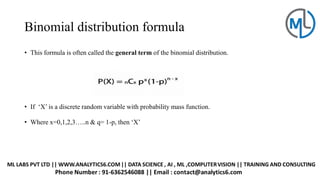
Binomial distribution formula
• This formula is often called the general term of the binomial distribution.
• If ‘X’ is a discrete random variable with probability mass function.
• Where x=0,1,2,3…..n & q= 1-p, then ‘X’
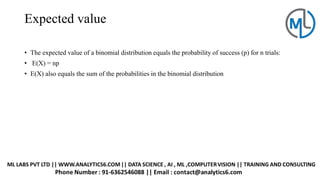
Expected value
• The expected value of a binomial distribution equals the probability of success (p) for n trials:
• E(X) = np
• E(X) also equals the sum of the probabilities in the binomial distribution
Assumptions for binomial distribution
• The number of trials ‘n’ is finite.
• For each trial, the two outcomes are mutually exclusive.
• P(S) =p is constant. P(F) = q = 1- p.
• The trials are independent, the outcome of a trial is not affected by the outcome of any other trial.
• The probability of success, p, is constant from trial to trial.
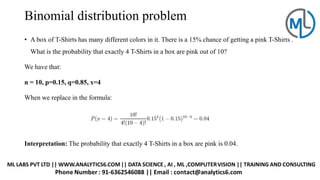
Binomial distribution problem
• A box of T-Shirts has many different colors in it. There is a 15% chance of getting a pink T-Shirts .
What is the probability that exactly 4 T-Shirts in a box are pink out of 10?
We have that:
n = 10, p=0.15, q=0.85, x=4
When we replace in the formula:
Interpretation: The probability that exactly 4 T-Shirts in a box are pink is 0.04.
What is Poisson distribution ?
• Poisson distribution is a limiting form of the binomial distribution in which n, the number of trials,
becomes very large and p, the probability of success of the event is very very small.
• The Poisson distribution is a discrete probability distribution for the counts of events that occur
randomly in a given interval of time (or space).
• The Poisson distribution is used in those situations where the probability of happening of an event
is small i.e. the event rarely occurs.
Characteristics of Poisson distribution
• Poisson distribution is a discrete distribution.
• It depends mainly on the value of the mean m.
• This distribution is positively skewed to the left. With the increase in the value of the mean m, the
distribution shift to the right and the skewness diminished.
• If n is large & p is small , this distribution gives a close approximation to binomial distribution.
Since the arithmetic mean of poisson is same as the binomial.
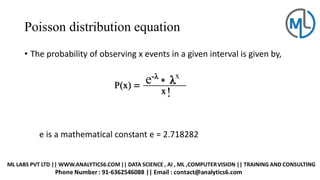
Poisson distribution equation
• The probability of observing x events in a given interval is given by,
e is a mathematical constant e = 2.718282
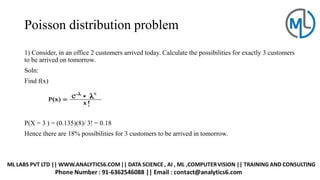
Poisson distribution problem
1) Consider, in an office 2 customers arrived today. Calculate the possibilities for exactly 3 customers
to be arrived on tomorrow.
Soln:
Find f(x)
P(X = 3 ) = (0.135)(8)/ 3! = 0.18
Hence there are 18% possibilities for 3 customers to be arrived in tomorrow.
Geometric distribution
A geometric distribution is defined as a discrete probability distribution of a random variable “x”
which satisfies some of the conditions. The geometric distribution conditions are. A phenomenon that
has a series of trials, Each trial has only two possible outcomes either success or failure, The
probability of success is the same for each trial.
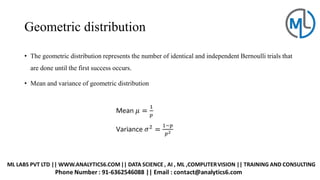
Geometric distribution
• The geometric distribution represents the number of identical and independent Bernoulli trials that
are done until the first success occurs.
• Mean and variance of geometric distribution
4 parts of a Geometric distribution
• Each trial have only two possible mutually exclusive outcomes: success or failure
• Probability of success is fixed
• Trials are independent
• No fixed number of trials – try until you suceed
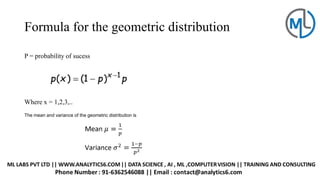
Formula for the geometric distribution
P = probability of sucess
Where x = 1,2,3,..
The mean and variance of the geometric distribution is
Geometric distribution problem
Example:
A fair coin is tossed.
a) What is the probability of getting a tail at the 5th toss?
b) Find the mean μ and standard deviation σ of the distribution?
Solution:
a) Let "getting a tail" be a "success". For a fair coin, the probability of getting a tail is p=1/2 and
not getting a tail (failure) is 1- p = 1- ½ = ½
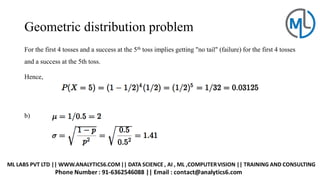
Geometric distribution problem
For the first 4 tosses and a success at the 5th toss implies getting "no tail" (failure) for the first 4 tosses
and a success at the 5th toss.
Hence,
b)
Normal distribution
• Normal distribution sometimes called the “bell curve". It has the shape of a bell.
• A symmetrical probability distribution where most results are located in the middle and few are
spread on both sides
• Normal distribution are symmetric around their mean.
• The area under the normal curve is equal to 1.0.
• Normal distributions are defined by two parameters, the mean and the standard deviation
Normal distribution
Many things closely follow a normal distribution:
• Heights and weights of adults
• Size of things produced by machines
• Marks on a test
• Errors in measurements
• Blood pressure
• Quality control test results.
Everyday data sets follow approximately the normal distribution.
Normal distribution
➢ Used to illustrate the shape and variability of the data.
➢ Used to estimate future process performance.
➢ Normality is an important assumption when conducting statistical analysis.
Normal distribution
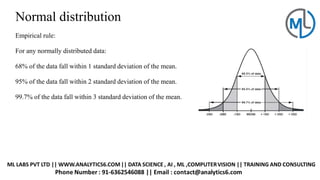
Empirical rule:
For any normally distributed data:
68% of the data fall within 1 standard deviation of the mean.
95% of the data fall within 2 standard deviation of the mean.
99.7% of the data fall within 3 standard deviation of the mean.
Normal distribution
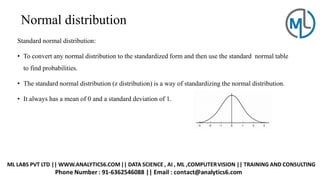
Standard normal distribution:
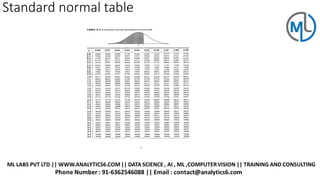
• To convert any normal distribution to the standardized form and then use the standard normal table
to find probabilities.
• The standard normal distribution (z distribution) is a way of standardizing the normal distribution.
• It always has a mean of 0 and a standard deviation of 1.
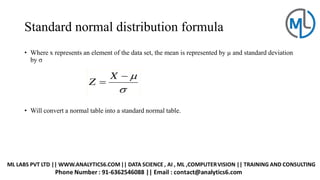
Standard normal distribution formula
• Where x represents an element of the data set, the mean is represented by µ and standard deviation
by σ
• Will convert a normal table into a standard normal table.
Standard normal table
Normal distribution problem
1) X is a normally distributed variable with mean μ = 30 and standard deviation σ = 4. Find
a) P(x < 40)
b) P(x > 21)
c) P(30 < x < 35)
Soln:
For x = 40, the z-value z = (40 - 30) / 4 = 2.5
Hence P(x < 40) = P(z < 2.5) = [area to the left of 2.5] = 0.9938
b) For x = 21, z = (21 - 30) / 4 = -2.25
Hence P(x > 21) = P(z > -2.25) = [total area] - [area to the left of -2.25]
= 1 - 0.0122 = 0.9878
c) For x = 30 , z = (30 - 30) / 4 = 0 and for x = 35, z = (35 - 30) / 4 = 1.25
Hence P(30 < x < 35) = P(0 < z < 1.25) = [area to the left of z = 1.25] - [area to the left of 0]
= 0.8944 - 0.5 = 0.3944

Binomial,Poisson,Geometric,Normal distribution

  • 1.
    Distribution - Binomial distribution -Poisson distribution - Geometric distribution - Normal distribution
  • 2.
    Binomial distribution • Binomialdistribution is a discrete probability distribution which is obtained when the probability P of the happening of an event is same in all the trials, and there are only two events in each trial. Eg: The probability of getting a head when a coin is tossed a number of times, must remain same in each toss i.e. p= 1/2
  • 3.
    Characteristics of binomialdistribution • It is a discrete distribution which gives the theoretical probabilities. • For each trial there are only two possible outcomes on each trial, success (p) or a failure (r). • Each trial is independent and therefore the probability of success and the probability of failure is the same for each trial.
  • 4.
    Binomial distribution formula •This formula is often called the general term of the binomial distribution. • If ‘X’ is a discrete random variable with probability mass function. • Where x=0,1,2,3…..n & q= 1-p, then ‘X’
  • 5.
    Expected value • Theexpected value of a binomial distribution equals the probability of success (p) for n trials: • E(X) = np • E(X) also equals the sum of the probabilities in the binomial distribution
  • 6.
    Assumptions for binomialdistribution • The number of trials ‘n’ is finite. • For each trial, the two outcomes are mutually exclusive. • P(S) =p is constant. P(F) = q = 1- p. • The trials are independent, the outcome of a trial is not affected by the outcome of any other trial. • The probability of success, p, is constant from trial to trial.
  • 7.
    Binomial distribution problem •A box of T-Shirts has many different colors in it. There is a 15% chance of getting a pink T-Shirts . What is the probability that exactly 4 T-Shirts in a box are pink out of 10? We have that: n = 10, p=0.15, q=0.85, x=4 When we replace in the formula: Interpretation: The probability that exactly 4 T-Shirts in a box are pink is 0.04.
  • 8.
    What is Poissondistribution ? • Poisson distribution is a limiting form of the binomial distribution in which n, the number of trials, becomes very large and p, the probability of success of the event is very very small. • The Poisson distribution is a discrete probability distribution for the counts of events that occur randomly in a given interval of time (or space). • The Poisson distribution is used in those situations where the probability of happening of an event is small i.e. the event rarely occurs.
  • 9.
    Characteristics of Poissondistribution • Poisson distribution is a discrete distribution. • It depends mainly on the value of the mean m. • This distribution is positively skewed to the left. With the increase in the value of the mean m, the distribution shift to the right and the skewness diminished. • If n is large & p is small , this distribution gives a close approximation to binomial distribution. Since the arithmetic mean of poisson is same as the binomial.
  • 10.
    Poisson distribution equation •The probability of observing x events in a given interval is given by, e is a mathematical constant e = 2.718282
  • 11.
    Poisson distribution problem 1)Consider, in an office 2 customers arrived today. Calculate the possibilities for exactly 3 customers to be arrived on tomorrow. Soln: Find f(x) P(X = 3 ) = (0.135)(8)/ 3! = 0.18 Hence there are 18% possibilities for 3 customers to be arrived in tomorrow.
  • 12.
    Geometric distribution A geometricdistribution is defined as a discrete probability distribution of a random variable “x” which satisfies some of the conditions. The geometric distribution conditions are. A phenomenon that has a series of trials, Each trial has only two possible outcomes either success or failure, The probability of success is the same for each trial.
  • 13.
    Geometric distribution • Thegeometric distribution represents the number of identical and independent Bernoulli trials that are done until the first success occurs. • Mean and variance of geometric distribution
  • 14.
    4 parts ofa Geometric distribution • Each trial have only two possible mutually exclusive outcomes: success or failure • Probability of success is fixed • Trials are independent • No fixed number of trials – try until you suceed
  • 15.
    Formula for thegeometric distribution P = probability of sucess Where x = 1,2,3,.. The mean and variance of the geometric distribution is
  • 16.
    Geometric distribution problem Example: Afair coin is tossed. a) What is the probability of getting a tail at the 5th toss? b) Find the mean μ and standard deviation σ of the distribution? Solution: a) Let "getting a tail" be a "success". For a fair coin, the probability of getting a tail is p=1/2 and not getting a tail (failure) is 1- p = 1- ½ = ½
  • 17.
    Geometric distribution problem Forthe first 4 tosses and a success at the 5th toss implies getting "no tail" (failure) for the first 4 tosses and a success at the 5th toss. Hence, b)
  • 18.
    Normal distribution • Normaldistribution sometimes called the “bell curve". It has the shape of a bell. • A symmetrical probability distribution where most results are located in the middle and few are spread on both sides • Normal distribution are symmetric around their mean. • The area under the normal curve is equal to 1.0. • Normal distributions are defined by two parameters, the mean and the standard deviation
  • 19.
    Normal distribution Many thingsclosely follow a normal distribution: • Heights and weights of adults • Size of things produced by machines • Marks on a test • Errors in measurements • Blood pressure • Quality control test results. Everyday data sets follow approximately the normal distribution.
  • 20.
    Normal distribution ➢ Usedto illustrate the shape and variability of the data. ➢ Used to estimate future process performance. ➢ Normality is an important assumption when conducting statistical analysis.
  • 21.
    Normal distribution Empirical rule: Forany normally distributed data: 68% of the data fall within 1 standard deviation of the mean. 95% of the data fall within 2 standard deviation of the mean. 99.7% of the data fall within 3 standard deviation of the mean.
  • 22.
    Normal distribution Standard normaldistribution: • To convert any normal distribution to the standardized form and then use the standard normal table to find probabilities. • The standard normal distribution (z distribution) is a way of standardizing the normal distribution. • It always has a mean of 0 and a standard deviation of 1.
  • 23.
    Standard normal distributionformula • Where x represents an element of the data set, the mean is represented by µ and standard deviation by σ • Will convert a normal table into a standard normal table.
  • 24.
  • 25.
    Normal distribution problem 1)X is a normally distributed variable with mean μ = 30 and standard deviation σ = 4. Find a) P(x < 40) b) P(x > 21) c) P(30 < x < 35) Soln: For x = 40, the z-value z = (40 - 30) / 4 = 2.5 Hence P(x < 40) = P(z < 2.5) = [area to the left of 2.5] = 0.9938
  • 26.
    b) For x= 21, z = (21 - 30) / 4 = -2.25 Hence P(x > 21) = P(z > -2.25) = [total area] - [area to the left of -2.25] = 1 - 0.0122 = 0.9878 c) For x = 30 , z = (30 - 30) / 4 = 0 and for x = 35, z = (35 - 30) / 4 = 1.25 Hence P(30 < x < 35) = P(0 < z < 1.25) = [area to the left of z = 1.25] - [area to the left of 0] = 0.8944 - 0.5 = 0.3944