Binomial
Distribution and
Applications
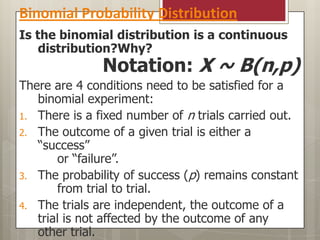
Binomial Probability Distribution
Is the binomial distribution is a continuous
distribution?Why?
Notation: X ~ B(n,p)
There are 4 conditions need to be satisfied for a
binomial experiment:
1. There is a fixed number of n trials carried out.
2. The outcome of a given trial is either a
“success”
or “failure”.
3. The probability of success (p) remains constant
from trial to trial.
4. The trials are independent, the outcome of a
trial is not affected by the outcome of any
other trial.
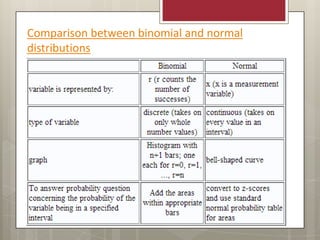
Comparison between binomial and normal
distributions
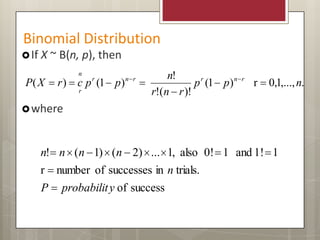
Binomial Distribution
If X ~ B(n, p), then
where
successof
trials.insuccessesofnumberr
11!and10!also,1...)2()1(!
yprobabilitP
n
nnnn
.,...,1,0r)1(
)!(!
!
)1()( npp
rnr
n
ppcrXP rnrrnr
n
r
Exam Question
 Ten percent of computer parts produced by a
certain supplier are defective. What is the
probability that a sample of 10 parts contains
more than 3 defective ones?
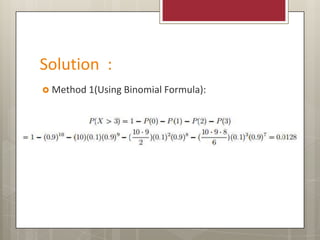
Solution :
 Method 1(Using Binomial Formula):
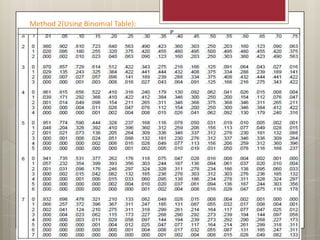
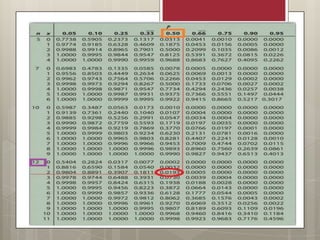
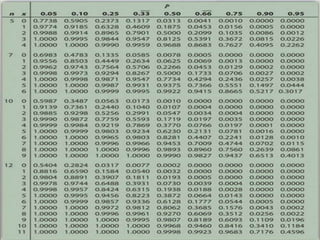
Method 2(Using Binomial Table):
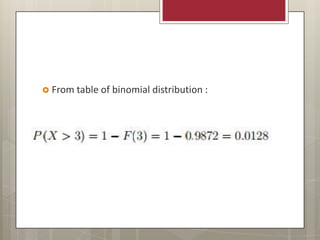
 From table of binomial distribution :
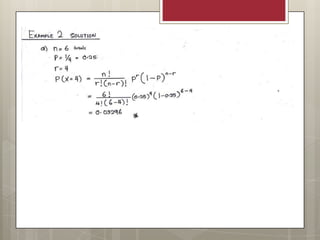
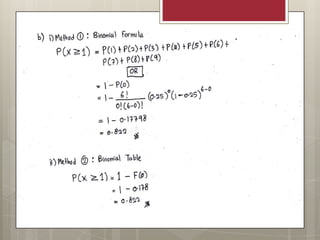
Example 2
If X is binomially distributed with 6 trials and a
probability of success equal to ¼ at each attempt.
What is the probability of
a)exactly 4 succes.
b)at least one success.
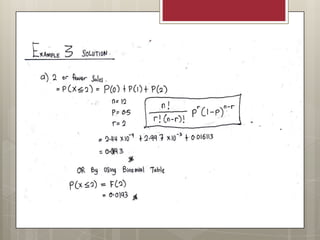
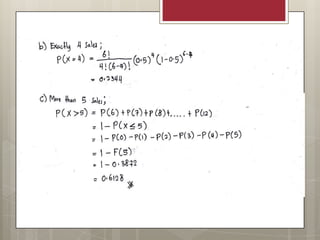
Example 3
Jeremy sells a magazine which is produced in order
to raise money for homeless people. The probability
of making a sale is, independently, 0.50 for each
person he approaches. Given that he approaches 12
people, find the probability that he will make:
(a)2 or fewer sales;
(b)exactly 4 sales;
(c)more than 5 sales.
Normal
Distribution
Normal Distribution
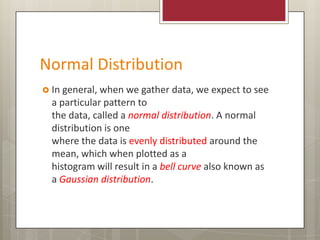
 In general, when we gather data, we expect to see
a particular pattern to
the data, called a normal distribution. A normal
distribution is one
where the data is evenly distributed around the
mean, which when plotted as a
histogram will result in a bell curve also known as
a Gaussian distribution.
 thus, things tend towards the mean – the closer a
value is to the mean, the more you’ll see it; and
the number of values on
either side of the mean at any particular distance
are equal or in symmetry.

Z-score
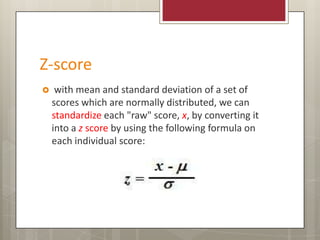
 with mean and standard deviation of a set of
scores which are normally distributed, we can
standardize each "raw" score, x, by converting it
into a z score by using the following formula on
each individual score:
Example 1
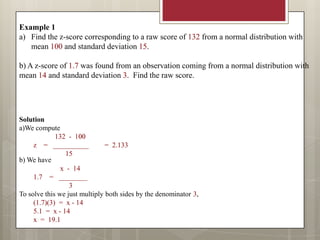
a) Find the z-score corresponding to a raw score of 132 from a normal distribution with
mean 100 and standard deviation 15.
b) A z-score of 1.7 was found from an observation coming from a normal distribution with
mean 14 and standard deviation 3. Find the raw score.
Solution
a)We compute
132 -
z = __________ = 2.133
15
b) We have
x -
1.7 = ________
3
To solve this we just multiply both sides by the denominator 3,
(1.7)(3) = x - 14
5.1 = x - 14
x = 19.1
Example 2
Find
a) P(z < 2.37)
b) P(z > 1.82)
Solution
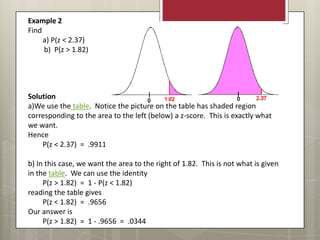
a)We use the table. Notice the picture on the table has shaded region
corresponding to the area to the left (below) a z-score. This is exactly what
we want.
Hence
P(z < 2.37) = .9911
b) In this case, we want the area to the right of 1.82. This is not what is given
in the table. We can use the identity
P(z > 1.82) = 1 - P(z < 1.82)
reading the table gives
P(z < 1.82) = .9656
Our answer is
P(z > 1.82) = 1 - .9656 = .0344
Example 3
Find
P(-1.18 < z < 2.1)
Solution
Once again, the table does not exactly handle this type of area. However, the area
between -1.18 and 2.1 is equal to the area to the left of 2.1 minus the area to the left
of -1.18. That is
P(-1.18 < z < 2.1) = P(z < 2.1) - P(z < -1.18)
To find P(z < 2.1) we rewrite it as P(z < 2.10) and use the table to get
P(z < 2.10) = .9821.
The table also tells us that
P(z < -1.18) = .1190
Now subtract to get
P(-1.18 < z < 2.1) = .9821 - .1190 = .8631
Poisson
distribution
Definitions
 a discrete probability distribution for the count of
events that occur randomly in a given time.
 a discrete frequency distribution which gives the
probability of a number of independent events
occurring in a fixed time.
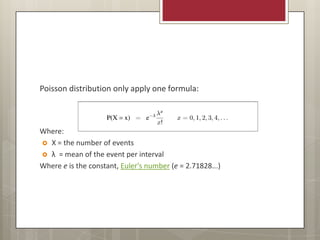
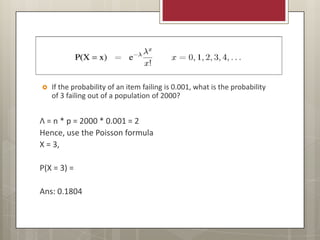
Poisson distribution only apply one formula:
Where:
 X = the number of events
 λ = mean of the event per interval
Where e is the constant, Euler's number (e = 2.71828...)
Example:
Births rate in a hospital occur randomly at an average rate of 1.8 births
per hour.
What is the probability of observing 4 births in a given hour at the
hospital?
Assuming
X = No. of births in a given hour
i) Events occur randomly
ii) Mean rate λ = 1.8
Using the poisson formula, we cam simply calculate the distribution.
P(X = 4) =( e^-1.8)(1.8^4)/(4!)
Ans: 0.0723
 If the probability of an item failing is 0.001, what is the probability
of 3 failing out of a population of 2000?
Λ = n * p = 2000 * 0.001 = 2
Hence, use the Poisson formula
X = 3,
P(X = 3) =
Ans: 0.1804
Example:
A small life insurance company has determined that on the
average it receives 6 death claims per day. Find the probability
that the company receives at least seven death claims on a
randomly selected day.
Analysis method
 1st: analyse the given data.
 2nd: label the value of x, λ
 At least 7 days, means the probability must be ≥ 7. but
the value will be to the infinity. Hence, must apply the
probability rule which is
 P(X ≥ 7) = 1 – P(X ≤ 6)
 P(X ≤ 6) means that the value of x must be from 0, 1, 2,
3, 4, 5, 6.
 Total them up using Poisson, then 1 subtract the
answer.
 Ans = 0.3938
Example:
The number of traffic accidents that occurs on a particular
stretch of road during a month follows a Poisson distribution
with a mean of 9.4. Find the probability that less than two
accidents will occur on this stretch of road during a randomly
selected month.
P(x < 2) = P(x = 0) + P(x = 1)
Ans: 0.000860

Normal Distribution, Binomial Distribution, Poisson Distribution

  • 1.
  • 2.
    Binomial Probability Distribution Isthe binomial distribution is a continuous distribution?Why? Notation: X ~ B(n,p) There are 4 conditions need to be satisfied for a binomial experiment: 1. There is a fixed number of n trials carried out. 2. The outcome of a given trial is either a “success” or “failure”. 3. The probability of success (p) remains constant from trial to trial. 4. The trials are independent, the outcome of a trial is not affected by the outcome of any other trial.
  • 3.
    Comparison between binomialand normal distributions
  • 4.
    Binomial Distribution If X~ B(n, p), then where successof trials.insuccessesofnumberr 11!and10!also,1...)2()1(! yprobabilitP n nnnn .,...,1,0r)1( )!(! ! )1()( npp rnr n ppcrXP rnrrnr n r
  • 5.
    Exam Question  Tenpercent of computer parts produced by a certain supplier are defective. What is the probability that a sample of 10 parts contains more than 3 defective ones?
  • 6.
    Solution :  Method1(Using Binomial Formula):
  • 7.
  • 9.
     From tableof binomial distribution :
  • 10.
    Example 2 If Xis binomially distributed with 6 trials and a probability of success equal to ¼ at each attempt. What is the probability of a)exactly 4 succes. b)at least one success.
  • 14.
    Example 3 Jeremy sellsa magazine which is produced in order to raise money for homeless people. The probability of making a sale is, independently, 0.50 for each person he approaches. Given that he approaches 12 people, find the probability that he will make: (a)2 or fewer sales; (b)exactly 4 sales; (c)more than 5 sales.
  • 19.
  • 20.
    Normal Distribution  Ingeneral, when we gather data, we expect to see a particular pattern to the data, called a normal distribution. A normal distribution is one where the data is evenly distributed around the mean, which when plotted as a histogram will result in a bell curve also known as a Gaussian distribution.
  • 21.
     thus, thingstend towards the mean – the closer a value is to the mean, the more you’ll see it; and the number of values on either side of the mean at any particular distance are equal or in symmetry.
  • 22.
  • 23.
    Z-score  with meanand standard deviation of a set of scores which are normally distributed, we can standardize each "raw" score, x, by converting it into a z score by using the following formula on each individual score:
  • 24.
    Example 1 a) Findthe z-score corresponding to a raw score of 132 from a normal distribution with mean 100 and standard deviation 15. b) A z-score of 1.7 was found from an observation coming from a normal distribution with mean 14 and standard deviation 3. Find the raw score. Solution a)We compute 132 - z = __________ = 2.133 15 b) We have x - 1.7 = ________ 3 To solve this we just multiply both sides by the denominator 3, (1.7)(3) = x - 14 5.1 = x - 14 x = 19.1
  • 25.
    Example 2 Find a) P(z< 2.37) b) P(z > 1.82) Solution a)We use the table. Notice the picture on the table has shaded region corresponding to the area to the left (below) a z-score. This is exactly what we want. Hence P(z < 2.37) = .9911 b) In this case, we want the area to the right of 1.82. This is not what is given in the table. We can use the identity P(z > 1.82) = 1 - P(z < 1.82) reading the table gives P(z < 1.82) = .9656 Our answer is P(z > 1.82) = 1 - .9656 = .0344
  • 26.
    Example 3 Find P(-1.18 <z < 2.1) Solution Once again, the table does not exactly handle this type of area. However, the area between -1.18 and 2.1 is equal to the area to the left of 2.1 minus the area to the left of -1.18. That is P(-1.18 < z < 2.1) = P(z < 2.1) - P(z < -1.18) To find P(z < 2.1) we rewrite it as P(z < 2.10) and use the table to get P(z < 2.10) = .9821. The table also tells us that P(z < -1.18) = .1190 Now subtract to get P(-1.18 < z < 2.1) = .9821 - .1190 = .8631
  • 27.
  • 28.
    Definitions  a discreteprobability distribution for the count of events that occur randomly in a given time.  a discrete frequency distribution which gives the probability of a number of independent events occurring in a fixed time.
  • 29.
    Poisson distribution onlyapply one formula: Where:  X = the number of events  λ = mean of the event per interval Where e is the constant, Euler's number (e = 2.71828...)
  • 30.
    Example: Births rate ina hospital occur randomly at an average rate of 1.8 births per hour. What is the probability of observing 4 births in a given hour at the hospital? Assuming X = No. of births in a given hour i) Events occur randomly ii) Mean rate λ = 1.8 Using the poisson formula, we cam simply calculate the distribution. P(X = 4) =( e^-1.8)(1.8^4)/(4!) Ans: 0.0723
  • 31.
     If theprobability of an item failing is 0.001, what is the probability of 3 failing out of a population of 2000? Λ = n * p = 2000 * 0.001 = 2 Hence, use the Poisson formula X = 3, P(X = 3) = Ans: 0.1804
  • 32.
    Example: A small lifeinsurance company has determined that on the average it receives 6 death claims per day. Find the probability that the company receives at least seven death claims on a randomly selected day.
  • 33.
    Analysis method  1st:analyse the given data.  2nd: label the value of x, λ  At least 7 days, means the probability must be ≥ 7. but the value will be to the infinity. Hence, must apply the probability rule which is  P(X ≥ 7) = 1 – P(X ≤ 6)  P(X ≤ 6) means that the value of x must be from 0, 1, 2, 3, 4, 5, 6.  Total them up using Poisson, then 1 subtract the answer.  Ans = 0.3938
  • 34.
    Example: The number oftraffic accidents that occurs on a particular stretch of road during a month follows a Poisson distribution with a mean of 9.4. Find the probability that less than two accidents will occur on this stretch of road during a randomly selected month. P(x < 2) = P(x = 0) + P(x = 1) Ans: 0.000860