



Probability Distribution
Agenda
01
02
03
04
Meaning and Types of Distribution
Classification of Distribution
Distribution & Modelling explained
Conclusion
01. Meaning and Type
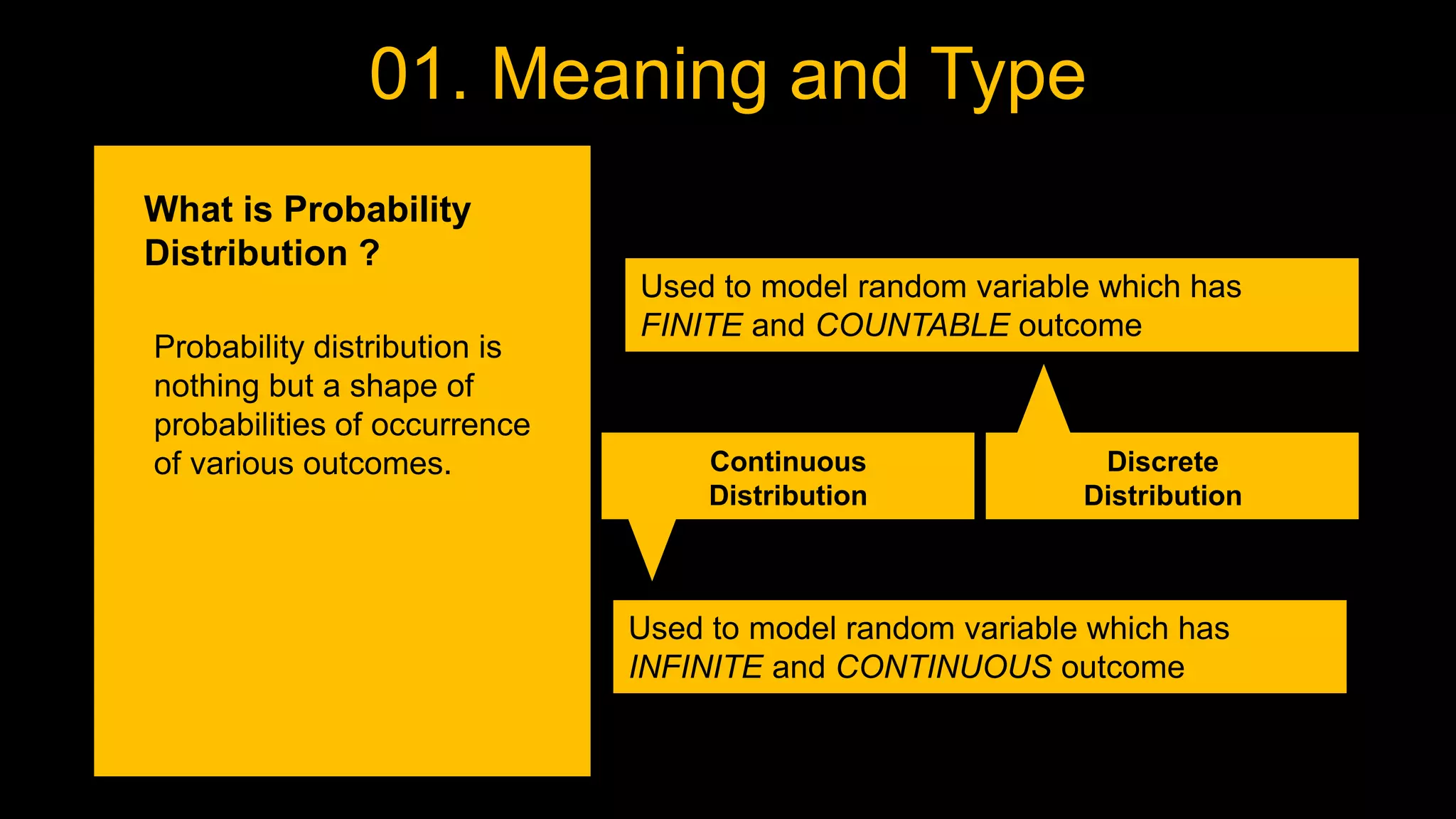
Probability distribution is
nothing but a shape of
probabilities of occurrence
of various outcomes.
What is Probability
Distribution ?
Continuous
Distribution
Discrete
Distribution
Used to model random variable which has
FINITE and COUNTABLE outcome
Used to model random variable which has
INFINITE and CONTINUOUS outcome
02. Classification
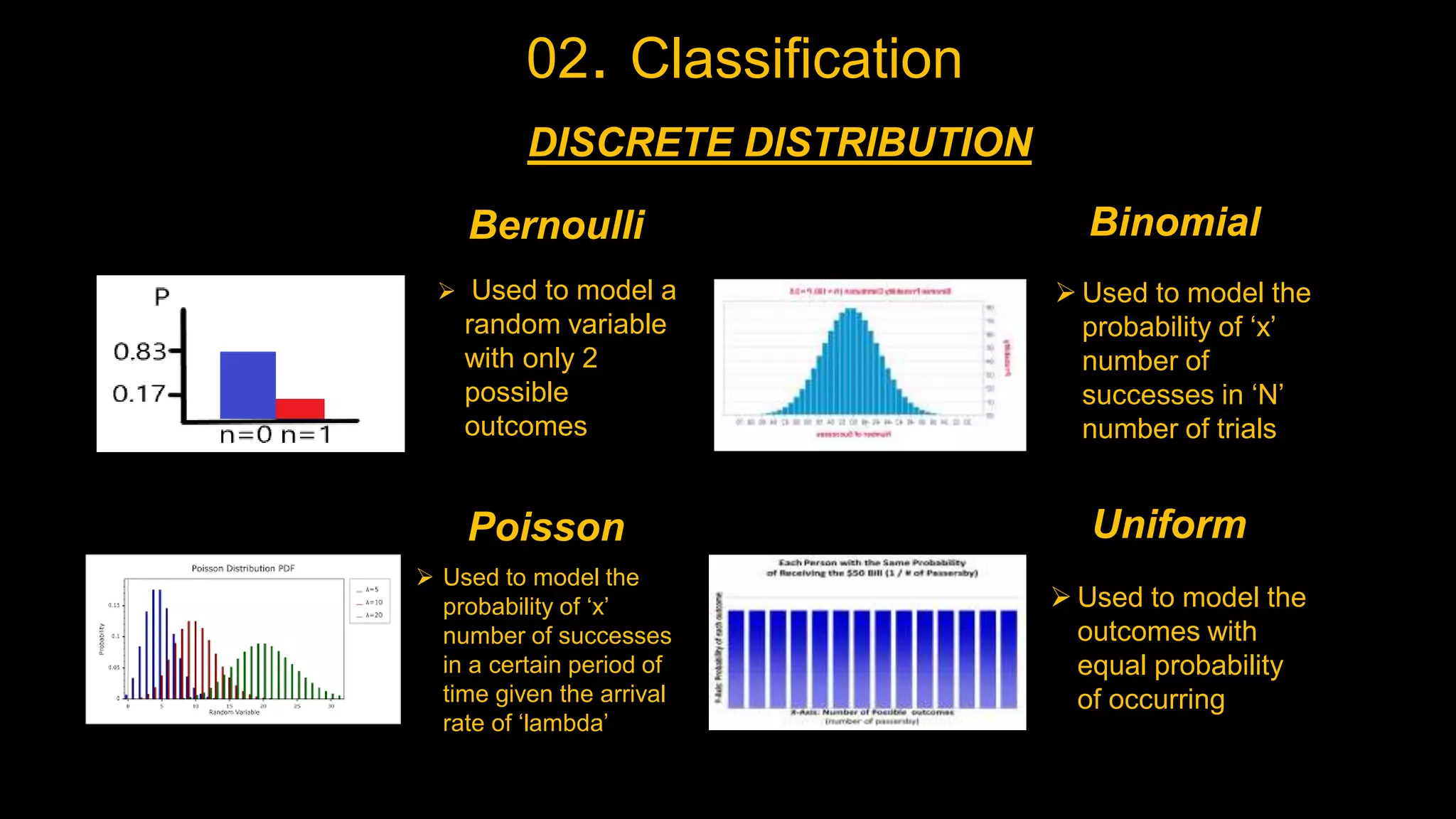
DISCRETE DISTRIBUTION
UniformPoisson
Bernoulli Binomial
 Used to model a
random variable
with only 2
possible
outcomes
 Used to model the
probability of ‘x’
number of
successes in ‘N’
number of trials
 Used to model the
probability of ‘x’
number of successes
in a certain period of
time given the arrival
rate of ‘lambda’
 Used to model the
outcomes with
equal probability
of occurring
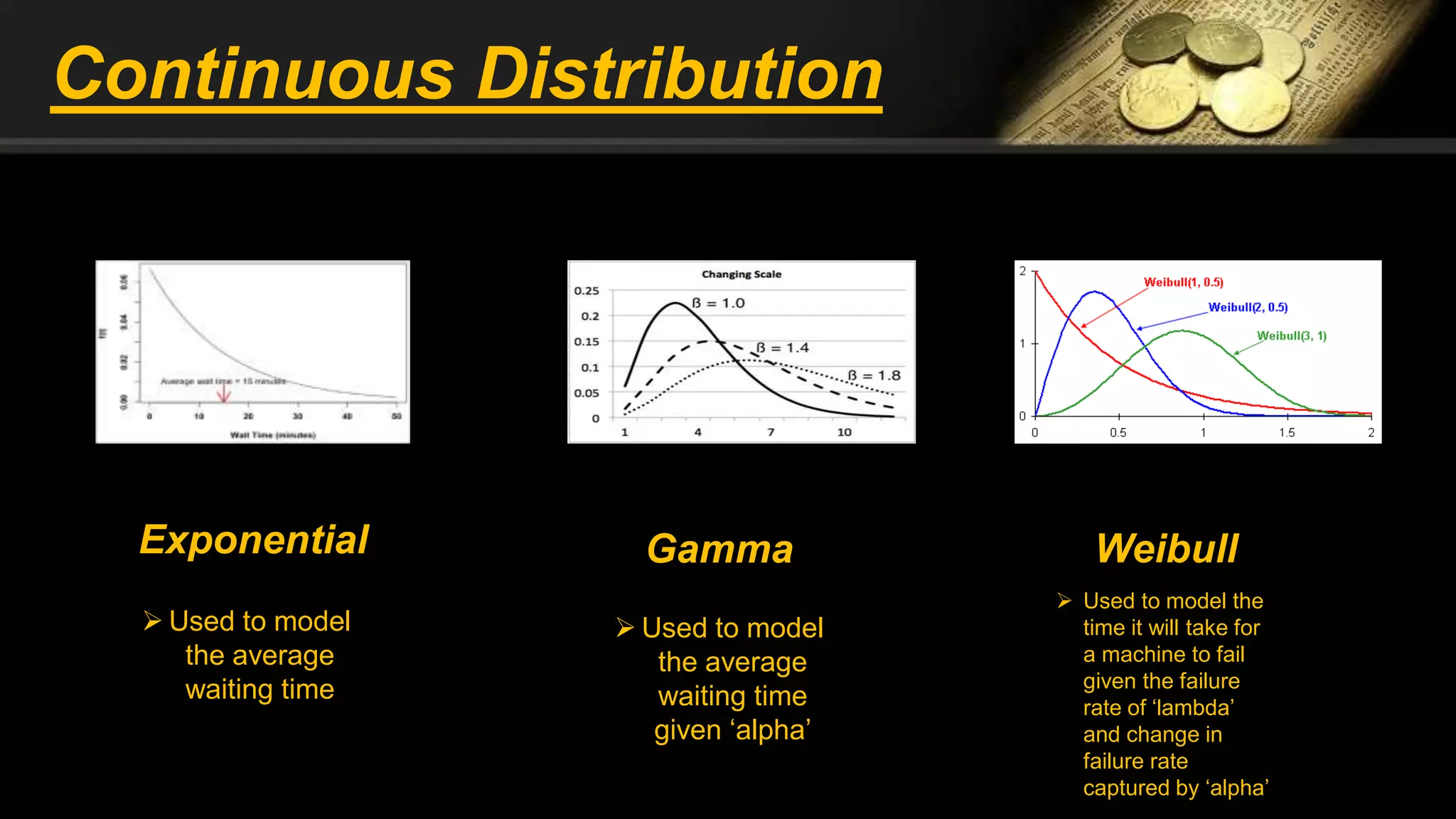
Exponential
 Used to model
the average
waiting time
Gamma
 Used to model
the average
waiting time
given ‘alpha’
Weibull
 Used to model the
time it will take for
a machine to fail
given the failure
rate of ‘lambda’
and change in
failure rate
captured by ‘alpha’
Continuous Distribution
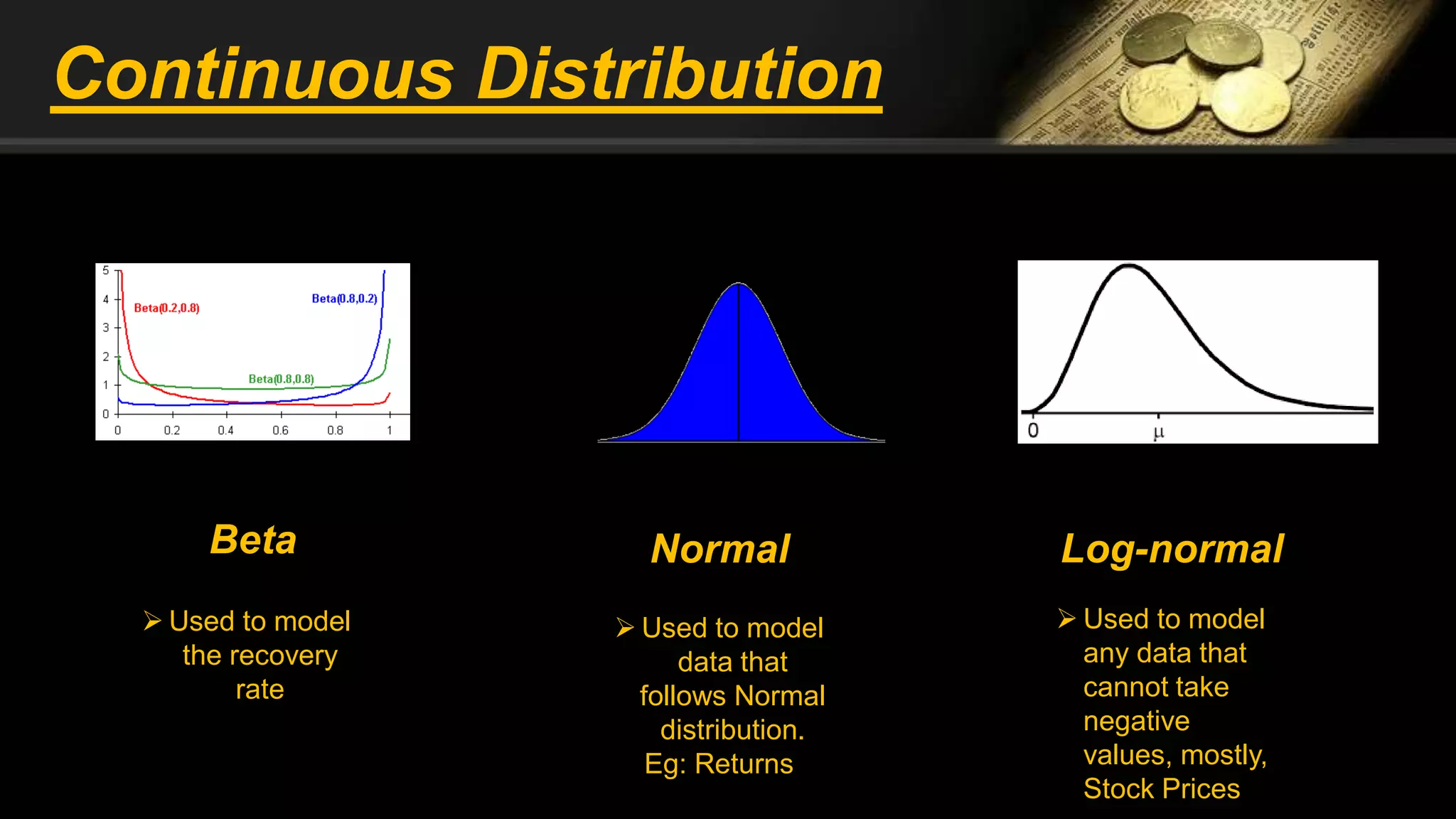
Beta
 Used to model
the recovery
rate
Normal
 Used to model
data that
follows Normal
distribution.
Eg: Returns
Log-normal
 Used to model
any data that
cannot take
negative
values, mostly,
Stock Prices
Continuous Distribution
03. Distribution and Modelling
Bernoulli
Used to model a random variable with only 2
possible outcomes – Success or Failure
Parameter is ‘P’ – Probability of Success. (Success doesn’t
mean success here, it means the event defined by the
variable)
Mean = ‘P’ (Probability of success)
Variance = P * Q (Q is probability of failure i.e. 1-p)
Used in Credit Risk as a default Indicator.
Expected Loss = D.I. * LGD * EAD
Credit Risk – Bernoulli
EL = DI * LGD * EAD
 Bernoulli Distribution is used to find out the
Default Indicator i.e. the probability a customer will
default, while modeling the Credit Risk in Bank
 Please refer to the data given in the excel sheet.
We are using ‘P’ = 0.05 i.e. 5% of total customers
will default.
Total customers = 100
LGD = 0.60, EAD = 100
 Now, exactly which customer will default i.e. ‘DI’
can be found using Bernoulli distribution.
Here, we generate Random numbers as DI.
Function used = IF (Rand()<0.05,1,0). This means
that, if the random number generated is less than
5%, then the default will occur, which is indicated by
‘1’ and if it’s more than 5%, then default will not
occur, which is indicated by ‘0’. Now EL can be
calculated and a distribution can be plotted of the same
Binomial Distribution
It is a distribution of ‘N’ number of Independent and
Identically distributed Bernoulli trials
Used to find the probability of ‘x’ number of
successes in ‘N’ number of trials
Parameters of Binomial distribution are ‘N’ and ‘P’
(Probability of success)
Mean = N * P
Variance = N * P * Q ; Q = (1-p)
Probability : P(X) = N (N-1) / X! * P^X * Q^(N-X)
Binomial Application
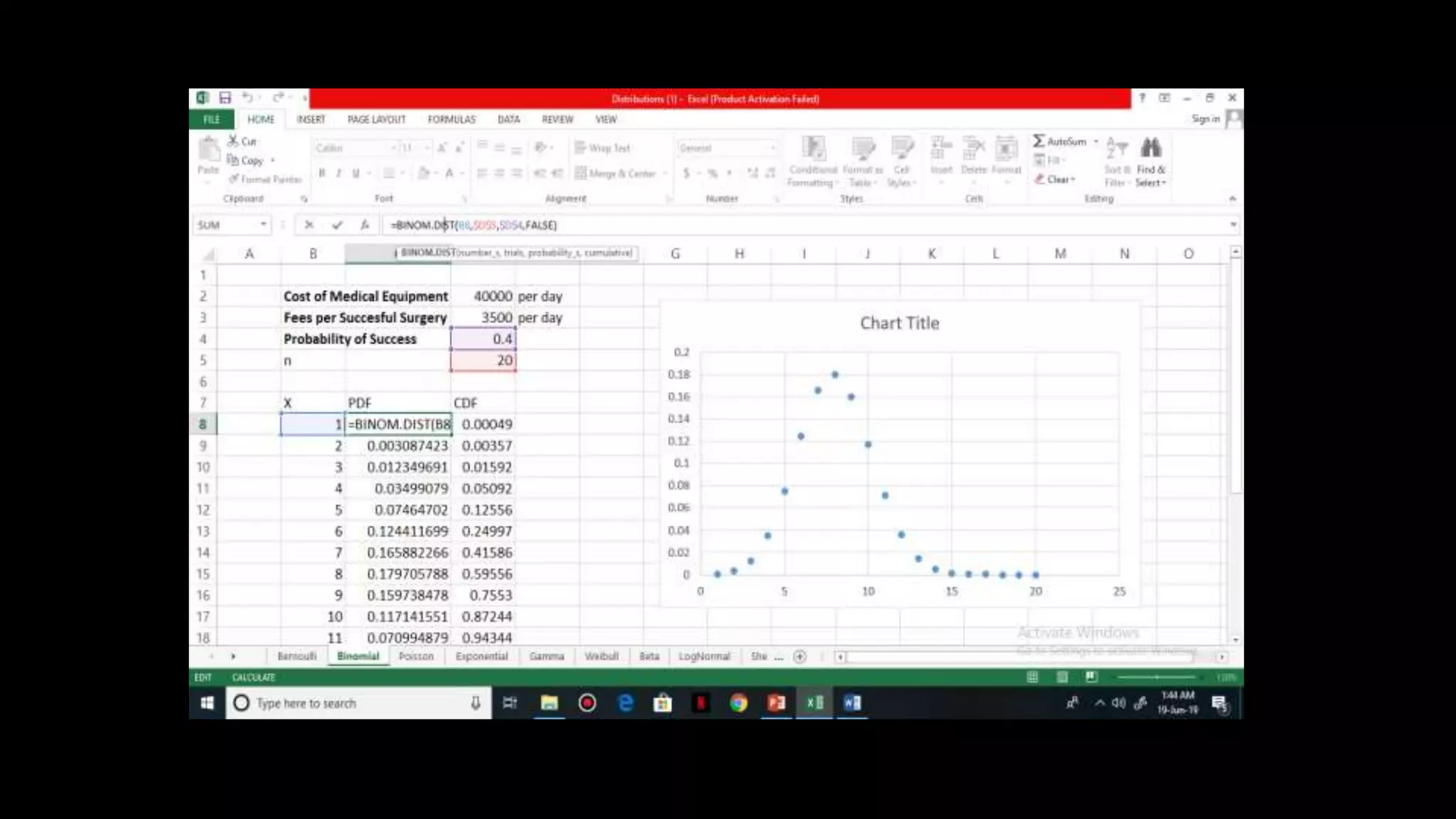
 The medical equipment costs 40,000/- per day.
Charge/successful surgery = 3500/- . To cover the
cost of 40,000/- per day, we need at least 12
successful surgeries
 Probability of success in past = 0.40 i.e. ‘P’ = 0.40
We need to find out P(x> or = 12)
 We need to define 2 terms, namely, PDF and
CDF of Binomial distribution
 PDF: =Binom.dist(x,n,p,false)
 CDF =Binom.dist(x,n,p,true)
 PDF gives discrete probability at certain point
and CDF gives cumulative probability up to
certain point
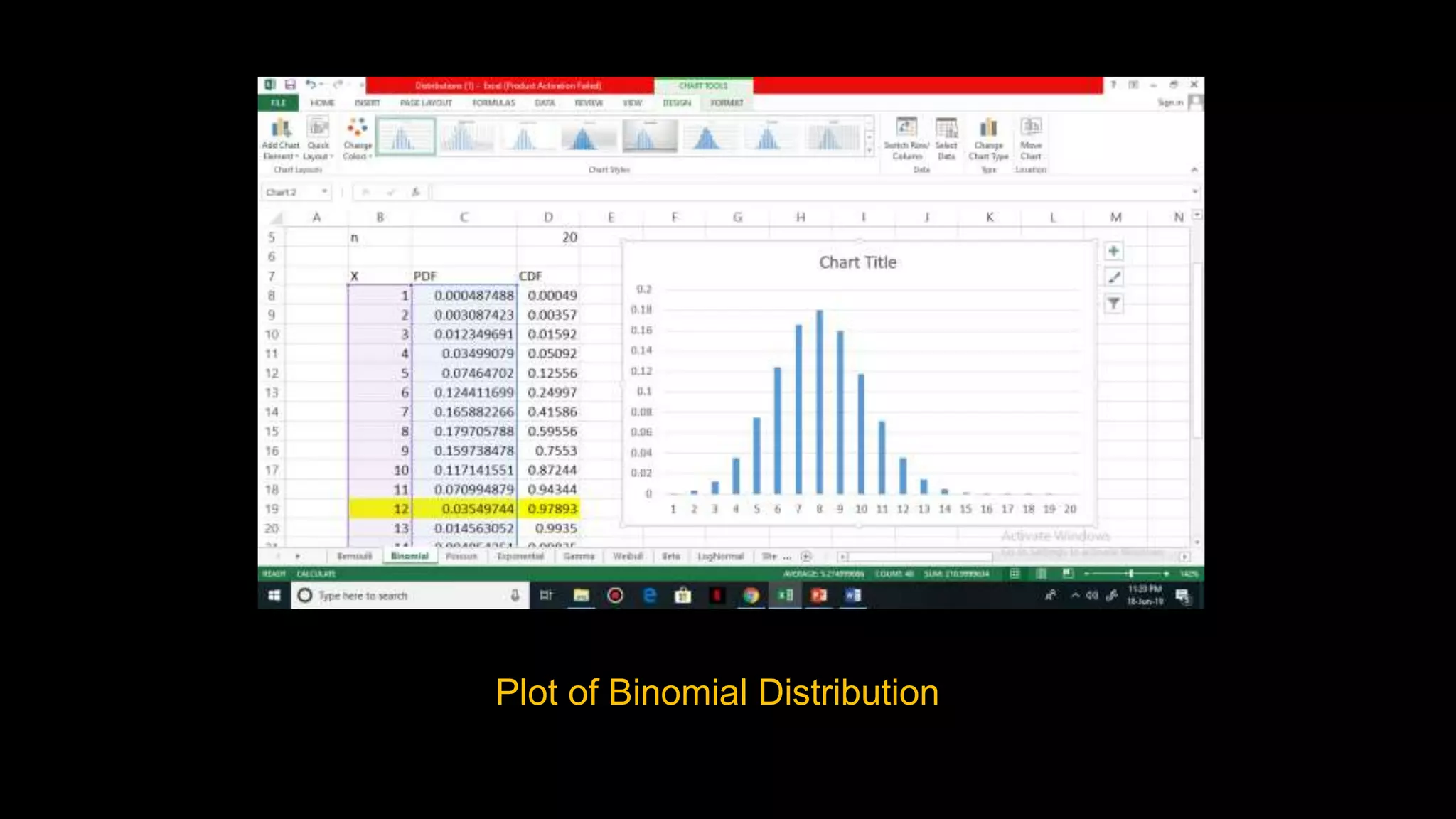
 Thereafter, check the total probability of PDF
from 12 to 20 (since we need X>or = 12)
 It comes out to be 0.056 which is very low and
thus this venture should not be carried out
Plot of Binomial Distribution
Poisson Distribution
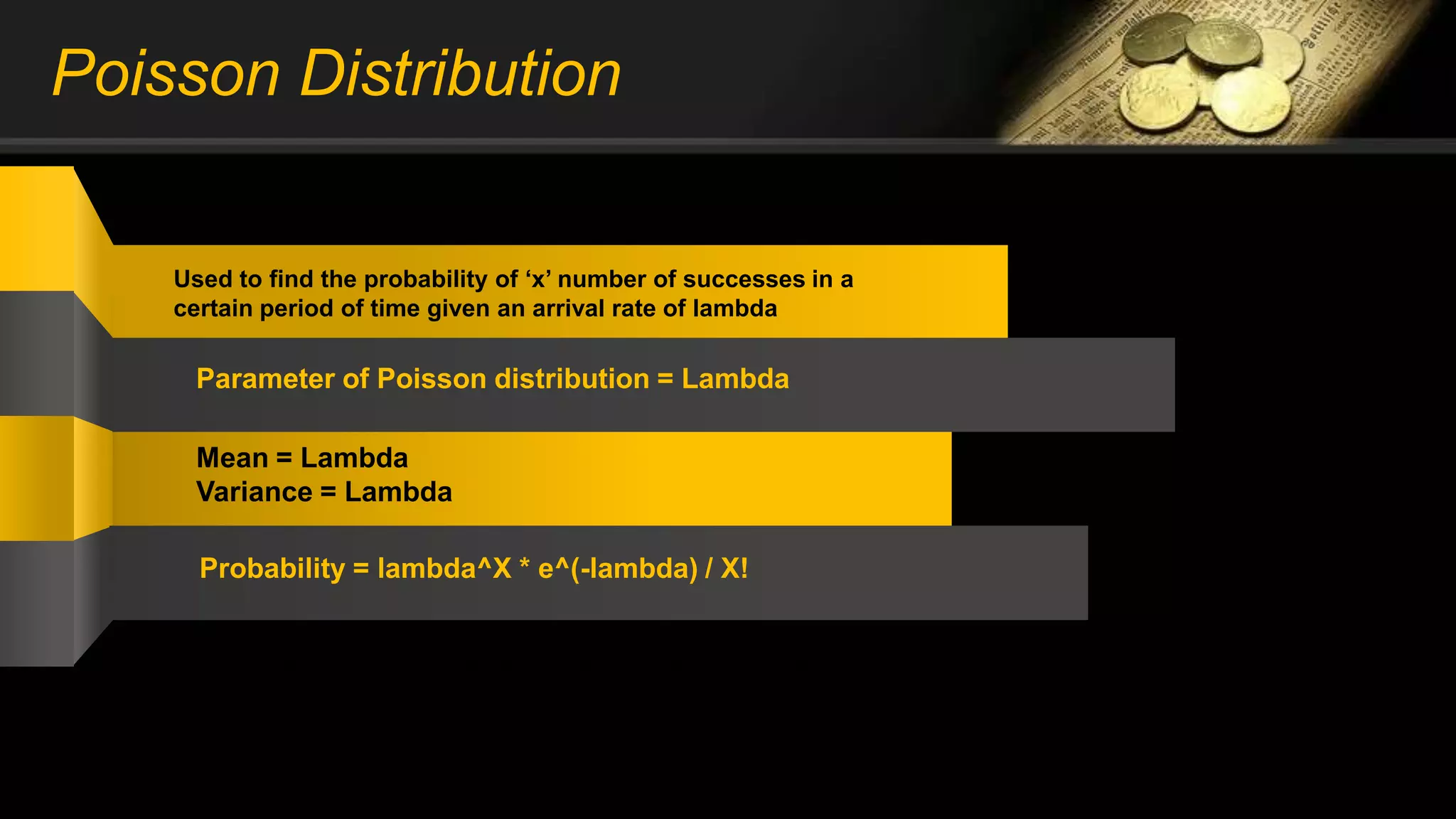
Used to find the probability of ‘x’ number of successes in a
certain period of time given an arrival rate of lambda
Parameter of Poisson distribution = Lambda
Mean = Lambda
Variance = Lambda
Probability = lambda^X * e^(-lambda) / X!
Probability : P(X) = N (N-1) / X! * P^X * Q^(N-X)
Poisson Application
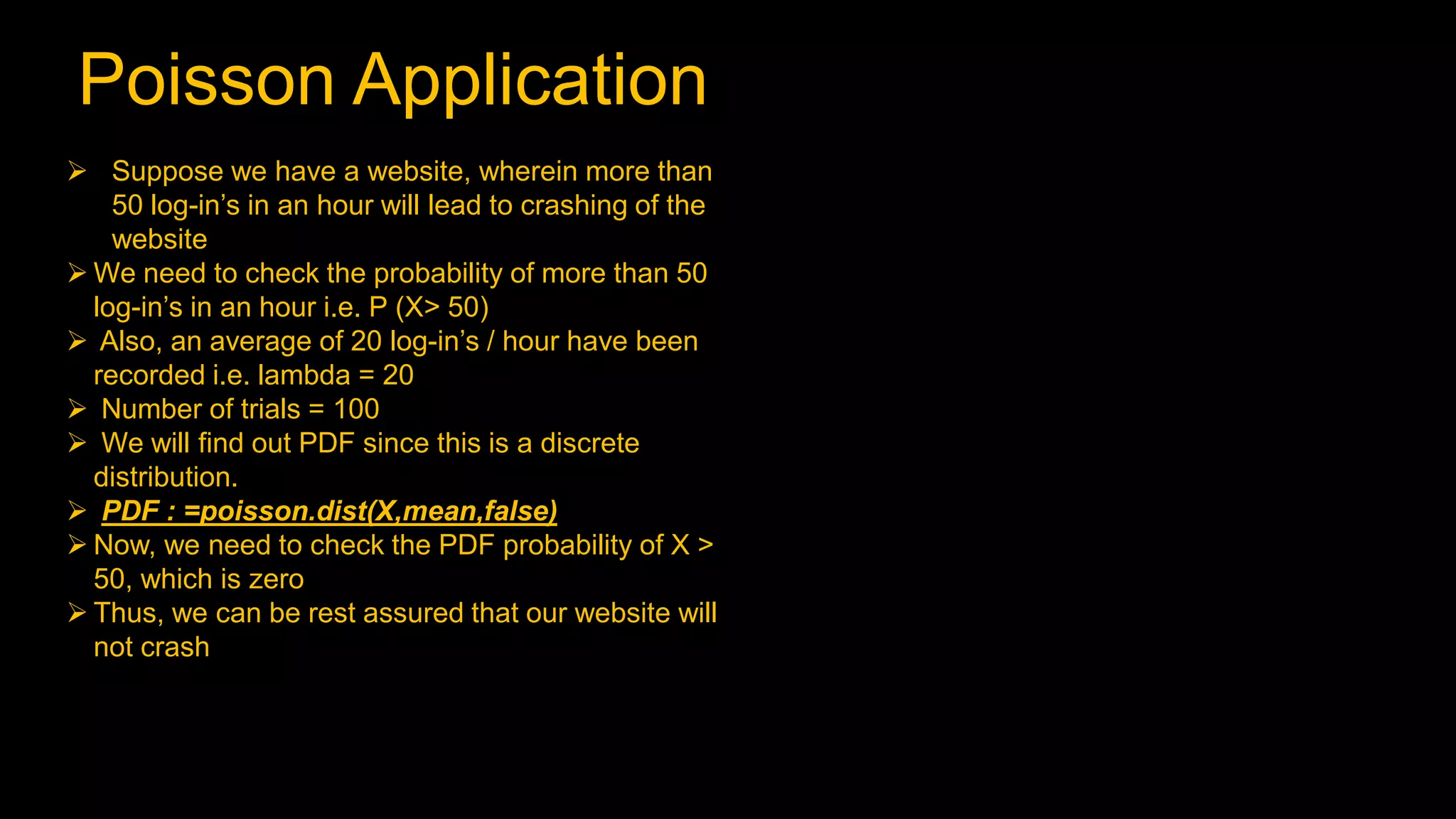
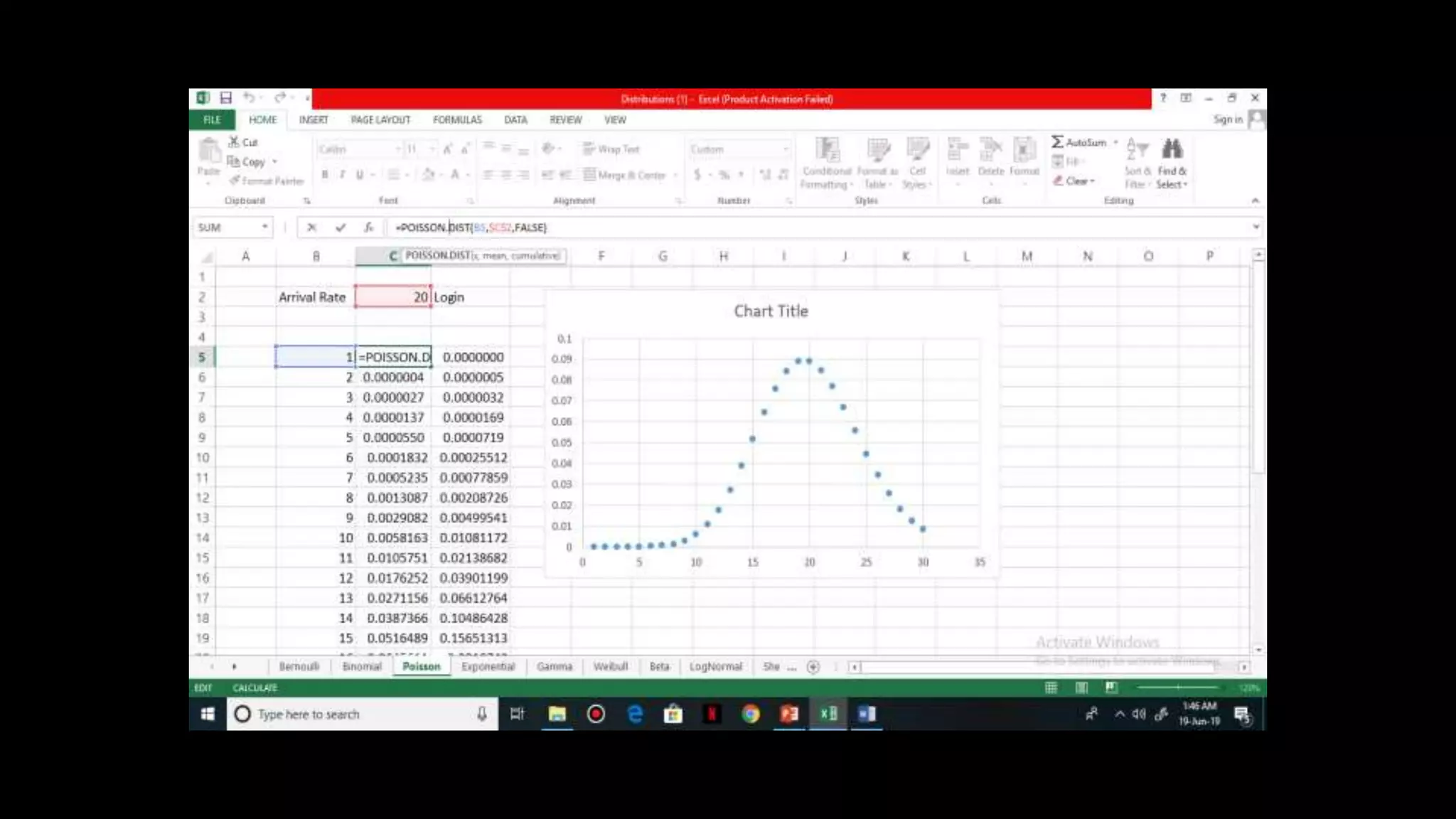
 Suppose we have a website, wherein more than
50 log-in’s in an hour will lead to crashing of the
website
 We need to check the probability of more than 50
log-in’s in an hour i.e. P (X> 50)
 Also, an average of 20 log-in’s / hour have been
recorded i.e. lambda = 20
 Number of trials = 100
 We will find out PDF since this is a discrete
distribution.
 PDF : =poisson.dist(X,mean,false)
 Now, we need to check the PDF probability of X >
50, which is zero
 Thus, we can be rest assured that our website will
not crash
Exponential Distribution
It is a continuous distribution and is used to model
average waiting time
Parameter of Exponential distribution = lambda
Mean = 1 / lambda
Variance = 1 / lambda^2
CDF , F(X) = 1 – e^ [(-lambda) * X]
PDF, f (X) = lambda * e^ [(-lambda) * X]
Survival probability = e^ [(-lambda) * X]
Exponential Application
 Exponential distribution gives us average waiting
time for alpha = 1
 Suppose lambda i.e. arrival rate = 0.05
 We apply exponential distribution as follows:
 Find out PDF : =expon.dist(x,lambda,false) ;
x = waiting time, lambda = arrival rate
 Find CDF:=expon.dist(x,lambda,true) . Here
we cannot simply add PDF’s because this is a
continuous distribution
Gamma Distribution
It is a continuous distribution and is used to model
average waiting time for alpha = >1
Parameter of Gamma distribution = alpha & lambda
Mean = alpha / lambda
Variance = alpha / lambda^2
CDF , F(X) = 1 – e^ [(-lambda) * X]
PDF, f (X) = lambda * e^ [(-lambda) * X]
Practically used in Credit Default Swaps to model the
time it will take for triggering event to occur
Gamma Application – CDS
 Exponential distribution gives us average waiting
time for alpha = >1
 Suppose triggering event is 3rd default that occurs
 We need to model the probabilities of time it will
take for the 3rd default to occur
 Alpha = 3 , Default intensity i.e. lambda = 0.05,
beta = 1 / alpha
 PDF: =gamma.dist(x,alpha,beta,false)
 CDF: =gamma.dist(x,alpha,beta,true)
Weibull Distribution
Used to model the time it will take for the machine to
fail given the failure rate of lambda
Change in failure rate (Constant/Increase/Decrease)
is captured by Alpha
If failure rate is constant, alpha = 0  exponential
If failure rate increases, alpha>1  Ageing problem
If failure rate decreases, alpha<1  Teething problem
CDF, F(X) = 1 – e^{[(-lambda) * x]^alpha}
Beta = 1 / alpha
Weibull Application
 Suppose, X i.e. time = 0.5 years, Beta (failure rate)
= 1, Alpha = 0.7 and probability of that period =
0.45
 We can interpret that, the probability of machine
failing in next 0.5 years is with a failure rate of 1
and failure decreasing with age ( alpha < 1) is
0.45 or 45%
 Function to be used:
PDF: =Weibull.dist(x,alpha,beta,false)
CDF: =Weibull.dist(x,alpha,beta,true)
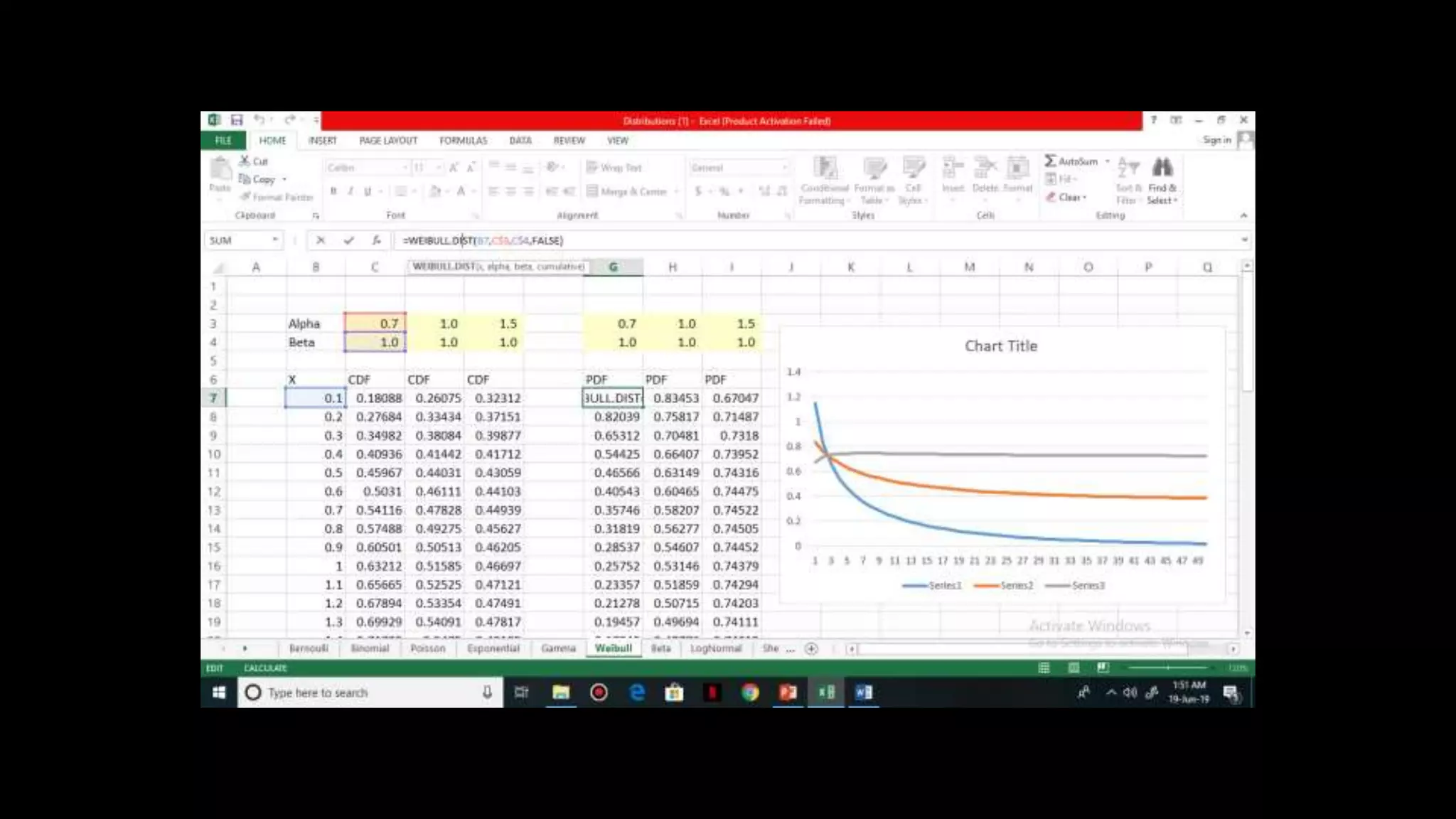
 Weibull distribution is used for 3 different alpha’s
here. Please refer the excel sheet snapshot
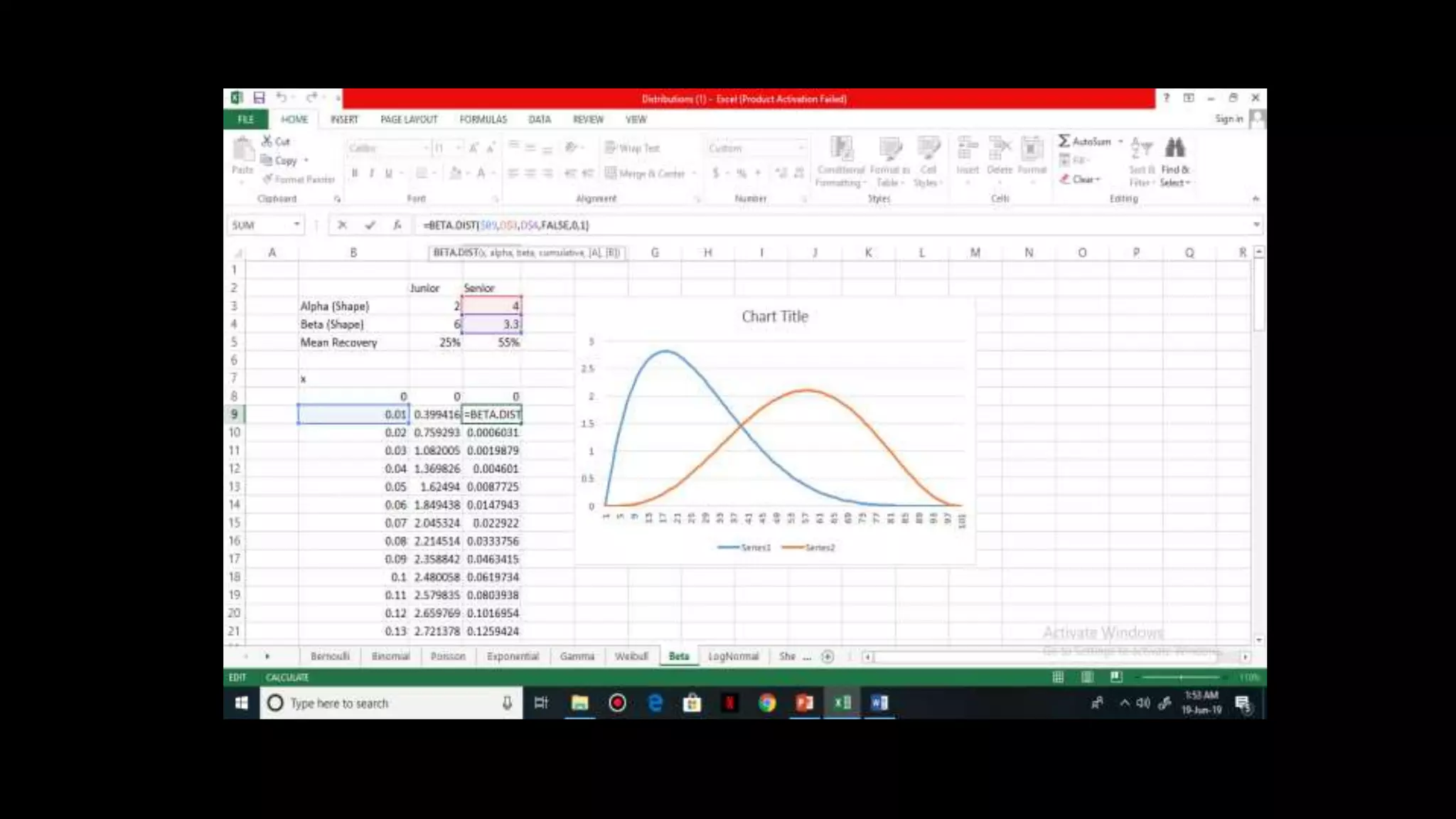
Beta Distribution
It is a continuous distribution and is used to model
recovery rate
Parameters of beta distribution = alpha & beta
Mean = alpha / alpha + beta
CDF, F(X) = 1 – e^{[(-lambda) * x]^alpha}
Beta = 1 / alpha
Log-normal Distribution
Generally used to model the stock prices (since
stock prices range from zero to infinity)
If something follows normal distribution, Ln of
something follows log-normal distribution
Parameters = Mean and Sigma from normal
distribution
Mean = e^mu + ½ * sigma^2
Product of two or more log-normally distributed
random number is log-normal
Log-normal Application
 Modelling the probabilities of possible stock prices
 Current price = 100, Rate of return on the stock =
8%, Volatility = 30%, Time = 3 years
 CDF: =NormSdist((LN(ST)-LN(S0) – (return – ½
* sigma^2 ) * T / Sigma * Sqrt.(T)))
 For example, the probability of stock price going
up to 140/- is 67.2% and exactly being 140 is
0.50% (Refer the excel snapshot)
Thank you

Probability Distribution & Modelling

  • 1.
  • 2.
    Agenda 01 02 03 04 Meaning and Typesof Distribution Classification of Distribution Distribution & Modelling explained Conclusion
  • 3.
    01. Meaning andType Probability distribution is nothing but a shape of probabilities of occurrence of various outcomes. What is Probability Distribution ? Continuous Distribution Discrete Distribution Used to model random variable which has FINITE and COUNTABLE outcome Used to model random variable which has INFINITE and CONTINUOUS outcome
  • 4.
    02. Classification DISCRETE DISTRIBUTION UniformPoisson BernoulliBinomial  Used to model a random variable with only 2 possible outcomes  Used to model the probability of ‘x’ number of successes in ‘N’ number of trials  Used to model the probability of ‘x’ number of successes in a certain period of time given the arrival rate of ‘lambda’  Used to model the outcomes with equal probability of occurring
  • 5.
    Exponential  Used tomodel the average waiting time Gamma  Used to model the average waiting time given ‘alpha’ Weibull  Used to model the time it will take for a machine to fail given the failure rate of ‘lambda’ and change in failure rate captured by ‘alpha’ Continuous Distribution
  • 6.
    Beta  Used tomodel the recovery rate Normal  Used to model data that follows Normal distribution. Eg: Returns Log-normal  Used to model any data that cannot take negative values, mostly, Stock Prices Continuous Distribution
  • 7.
    03. Distribution andModelling Bernoulli Used to model a random variable with only 2 possible outcomes – Success or Failure Parameter is ‘P’ – Probability of Success. (Success doesn’t mean success here, it means the event defined by the variable) Mean = ‘P’ (Probability of success) Variance = P * Q (Q is probability of failure i.e. 1-p) Used in Credit Risk as a default Indicator. Expected Loss = D.I. * LGD * EAD
  • 8.
    Credit Risk –Bernoulli EL = DI * LGD * EAD  Bernoulli Distribution is used to find out the Default Indicator i.e. the probability a customer will default, while modeling the Credit Risk in Bank  Please refer to the data given in the excel sheet. We are using ‘P’ = 0.05 i.e. 5% of total customers will default. Total customers = 100 LGD = 0.60, EAD = 100  Now, exactly which customer will default i.e. ‘DI’ can be found using Bernoulli distribution. Here, we generate Random numbers as DI. Function used = IF (Rand()<0.05,1,0). This means that, if the random number generated is less than 5%, then the default will occur, which is indicated by ‘1’ and if it’s more than 5%, then default will not occur, which is indicated by ‘0’. Now EL can be calculated and a distribution can be plotted of the same
  • 10.
    Binomial Distribution It isa distribution of ‘N’ number of Independent and Identically distributed Bernoulli trials Used to find the probability of ‘x’ number of successes in ‘N’ number of trials Parameters of Binomial distribution are ‘N’ and ‘P’ (Probability of success) Mean = N * P Variance = N * P * Q ; Q = (1-p) Probability : P(X) = N (N-1) / X! * P^X * Q^(N-X)
  • 11.
    Binomial Application  Themedical equipment costs 40,000/- per day. Charge/successful surgery = 3500/- . To cover the cost of 40,000/- per day, we need at least 12 successful surgeries  Probability of success in past = 0.40 i.e. ‘P’ = 0.40 We need to find out P(x> or = 12)  We need to define 2 terms, namely, PDF and CDF of Binomial distribution  PDF: =Binom.dist(x,n,p,false)  CDF =Binom.dist(x,n,p,true)  PDF gives discrete probability at certain point and CDF gives cumulative probability up to certain point  Thereafter, check the total probability of PDF from 12 to 20 (since we need X>or = 12)  It comes out to be 0.056 which is very low and thus this venture should not be carried out
  • 14.
    Plot of BinomialDistribution
  • 15.
    Poisson Distribution Used tofind the probability of ‘x’ number of successes in a certain period of time given an arrival rate of lambda Parameter of Poisson distribution = Lambda Mean = Lambda Variance = Lambda Probability = lambda^X * e^(-lambda) / X! Probability : P(X) = N (N-1) / X! * P^X * Q^(N-X)
  • 16.
    Poisson Application  Supposewe have a website, wherein more than 50 log-in’s in an hour will lead to crashing of the website  We need to check the probability of more than 50 log-in’s in an hour i.e. P (X> 50)  Also, an average of 20 log-in’s / hour have been recorded i.e. lambda = 20  Number of trials = 100  We will find out PDF since this is a discrete distribution.  PDF : =poisson.dist(X,mean,false)  Now, we need to check the PDF probability of X > 50, which is zero  Thus, we can be rest assured that our website will not crash
  • 19.
    Exponential Distribution It isa continuous distribution and is used to model average waiting time Parameter of Exponential distribution = lambda Mean = 1 / lambda Variance = 1 / lambda^2 CDF , F(X) = 1 – e^ [(-lambda) * X] PDF, f (X) = lambda * e^ [(-lambda) * X] Survival probability = e^ [(-lambda) * X]
  • 20.
    Exponential Application  Exponentialdistribution gives us average waiting time for alpha = 1  Suppose lambda i.e. arrival rate = 0.05  We apply exponential distribution as follows:  Find out PDF : =expon.dist(x,lambda,false) ; x = waiting time, lambda = arrival rate  Find CDF:=expon.dist(x,lambda,true) . Here we cannot simply add PDF’s because this is a continuous distribution
  • 22.
    Gamma Distribution It isa continuous distribution and is used to model average waiting time for alpha = >1 Parameter of Gamma distribution = alpha & lambda Mean = alpha / lambda Variance = alpha / lambda^2 CDF , F(X) = 1 – e^ [(-lambda) * X] PDF, f (X) = lambda * e^ [(-lambda) * X] Practically used in Credit Default Swaps to model the time it will take for triggering event to occur
  • 23.
    Gamma Application –CDS  Exponential distribution gives us average waiting time for alpha = >1  Suppose triggering event is 3rd default that occurs  We need to model the probabilities of time it will take for the 3rd default to occur  Alpha = 3 , Default intensity i.e. lambda = 0.05, beta = 1 / alpha  PDF: =gamma.dist(x,alpha,beta,false)  CDF: =gamma.dist(x,alpha,beta,true)
  • 25.
    Weibull Distribution Used tomodel the time it will take for the machine to fail given the failure rate of lambda Change in failure rate (Constant/Increase/Decrease) is captured by Alpha If failure rate is constant, alpha = 0  exponential If failure rate increases, alpha>1  Ageing problem If failure rate decreases, alpha<1  Teething problem CDF, F(X) = 1 – e^{[(-lambda) * x]^alpha} Beta = 1 / alpha
  • 26.
    Weibull Application  Suppose,X i.e. time = 0.5 years, Beta (failure rate) = 1, Alpha = 0.7 and probability of that period = 0.45  We can interpret that, the probability of machine failing in next 0.5 years is with a failure rate of 1 and failure decreasing with age ( alpha < 1) is 0.45 or 45%  Function to be used: PDF: =Weibull.dist(x,alpha,beta,false) CDF: =Weibull.dist(x,alpha,beta,true)  Weibull distribution is used for 3 different alpha’s here. Please refer the excel sheet snapshot
  • 28.
    Beta Distribution It isa continuous distribution and is used to model recovery rate Parameters of beta distribution = alpha & beta Mean = alpha / alpha + beta CDF, F(X) = 1 – e^{[(-lambda) * x]^alpha} Beta = 1 / alpha
  • 31.
    Log-normal Distribution Generally usedto model the stock prices (since stock prices range from zero to infinity) If something follows normal distribution, Ln of something follows log-normal distribution Parameters = Mean and Sigma from normal distribution Mean = e^mu + ½ * sigma^2 Product of two or more log-normally distributed random number is log-normal
  • 32.
    Log-normal Application  Modellingthe probabilities of possible stock prices  Current price = 100, Rate of return on the stock = 8%, Volatility = 30%, Time = 3 years  CDF: =NormSdist((LN(ST)-LN(S0) – (return – ½ * sigma^2 ) * T / Sigma * Sqrt.(T)))  For example, the probability of stock price going up to 140/- is 67.2% and exactly being 140 is 0.50% (Refer the excel snapshot)
  • 35.