
A 5 Step Significance Test
Anthony J. Evans
Professor of Economics, ESCP Europe
www.anthonyjevans.com
(cc) Anthony J. Evans 2019 | http://creativecommons.org/licenses/by-nc-sa/3.0/
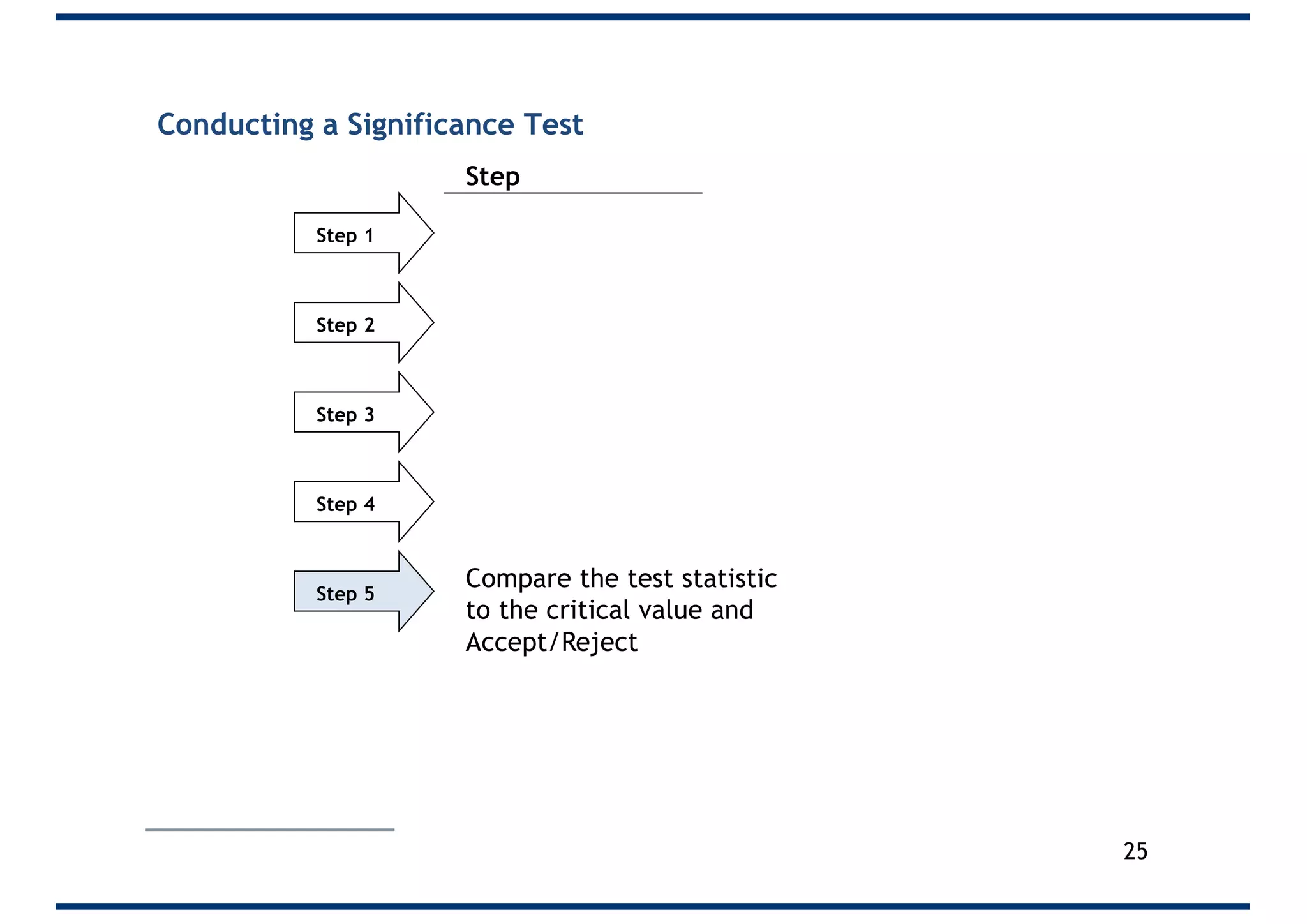
Conducting a Significance Test
Step 1
Step 2
Step 3
Step 4
Step 5
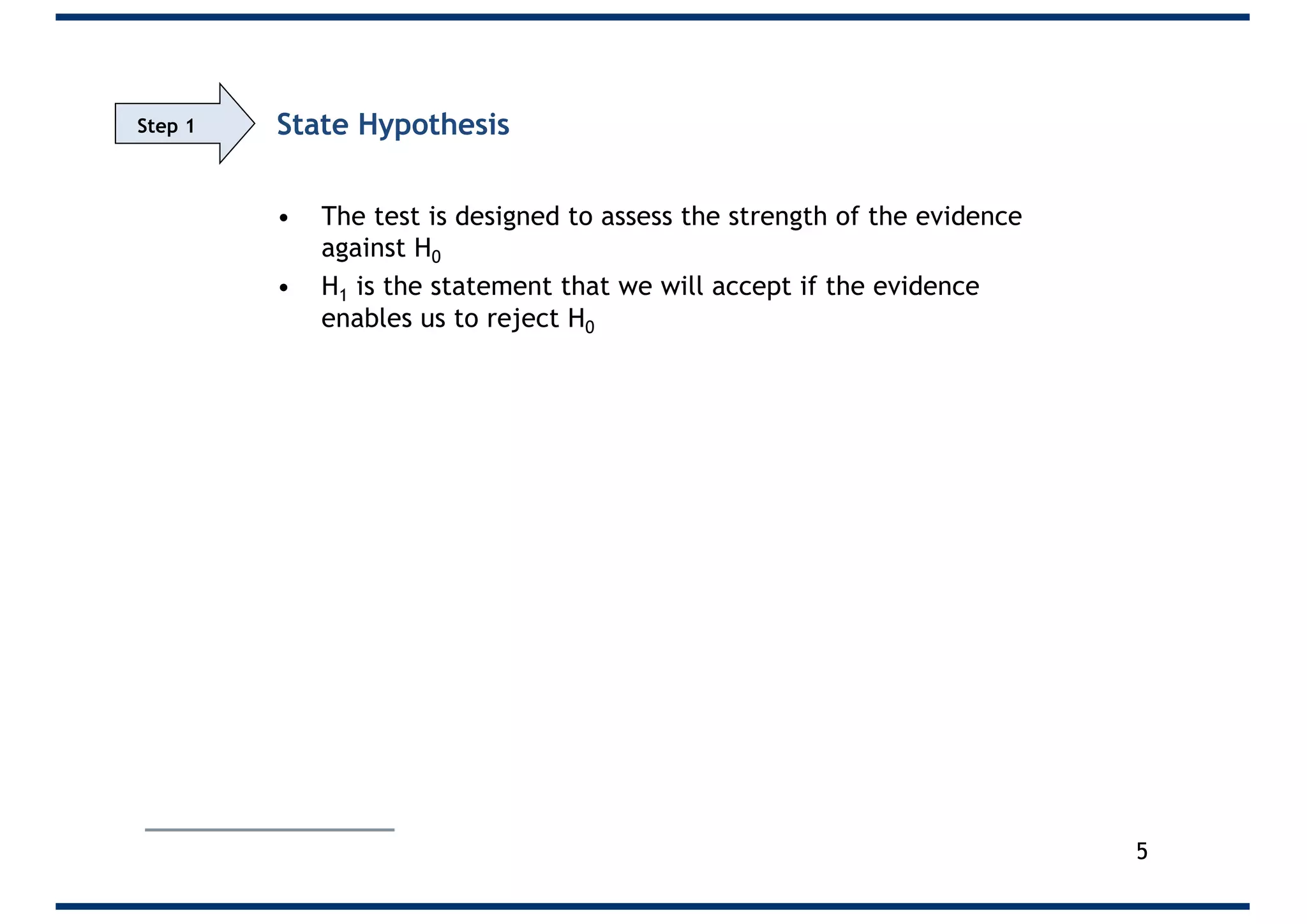
State Hypothesis
Step
2
Null and Alternative Hypothesis
Definition
Status quo hypothesis,
starting assumption
Null hypothesis
Alternative
hypothesis
Other assumption, strong
belief, gut feeling
Examples
In the US system of justice, the guiding
principle is supposed to be that the
defendant is “presumed innocent until
proven guilty”. This claim of innocence
is a null hypothesis
The prosecution offers a competing
claim: the defendant is guilty. This is an
alternative to the null hypothesis of
innocence and we call the claim of guilt
an alternative hypothesis
H0
H1
3
Step 1
Null and Alternative Hypotheses
• H0: b=0; H1: b>0 One tailed
• H0: b=0; H1: b<0 One tailed
• H0: b=0; H1: b¹0 Two tailed
Remark:
Accepting the null hypothesis does not necessarily mean that we literally
believe that it is true. Sometimes it means that we do not have enough
evidence to reject it or that we are reserving judgement
4
Step 1
State Hypothesis
• The test is designed to assess the strength of the evidence
against H0
• H1 is the statement that we will accept if the evidence
enables us to reject H0
5
Step 1
State Hypothesis: Examples
What is the null hypothesis (H0) and what is the
alternative hypothesis (H1)?
Also, is it a one or two-sided test?
1. The mean area of the several thousand apartments in a
new development is advertised to be 1250 square feet. A
tenant group thinks that the apartments are smaller than
advertised. They hire an engineer to measure a sample of
the apartments to test their suspicion
2. Larry’s car averages 32 miles per gallon on the highway. He
now switches to a new motor oil that is advertised as
increasing gas mileage. After driving 3000 highway miles
with the new oil, he wants to determine if his gas mileage
has actually increased
6
Step 1
State Hypothesis: Examples (2)
1. The mean area of the several thousand apartments
in a new development is advertised to be 1250
square feet. A tenant group thinks that the
apartments are smaller than advertised. They hire
an engineer to measure a sample of the apartments
to test their suspicion
H0: µ = 1250
H1: µ < 1250 One sided
2. Larry’s car averages 32 miles per gallon on the
highway. He now switches to a new motor oil that is
advertised as increasing gas mileage. After driving
3000 highway miles with the new oil, he wants to
determine if his gas mileage has actually increased
H0: µ =32
H1: µ > 32 One Sided
7
Step 1
Conducting a Significance Test
Step 1
Step 2
Step 3
Step 4
Step 5
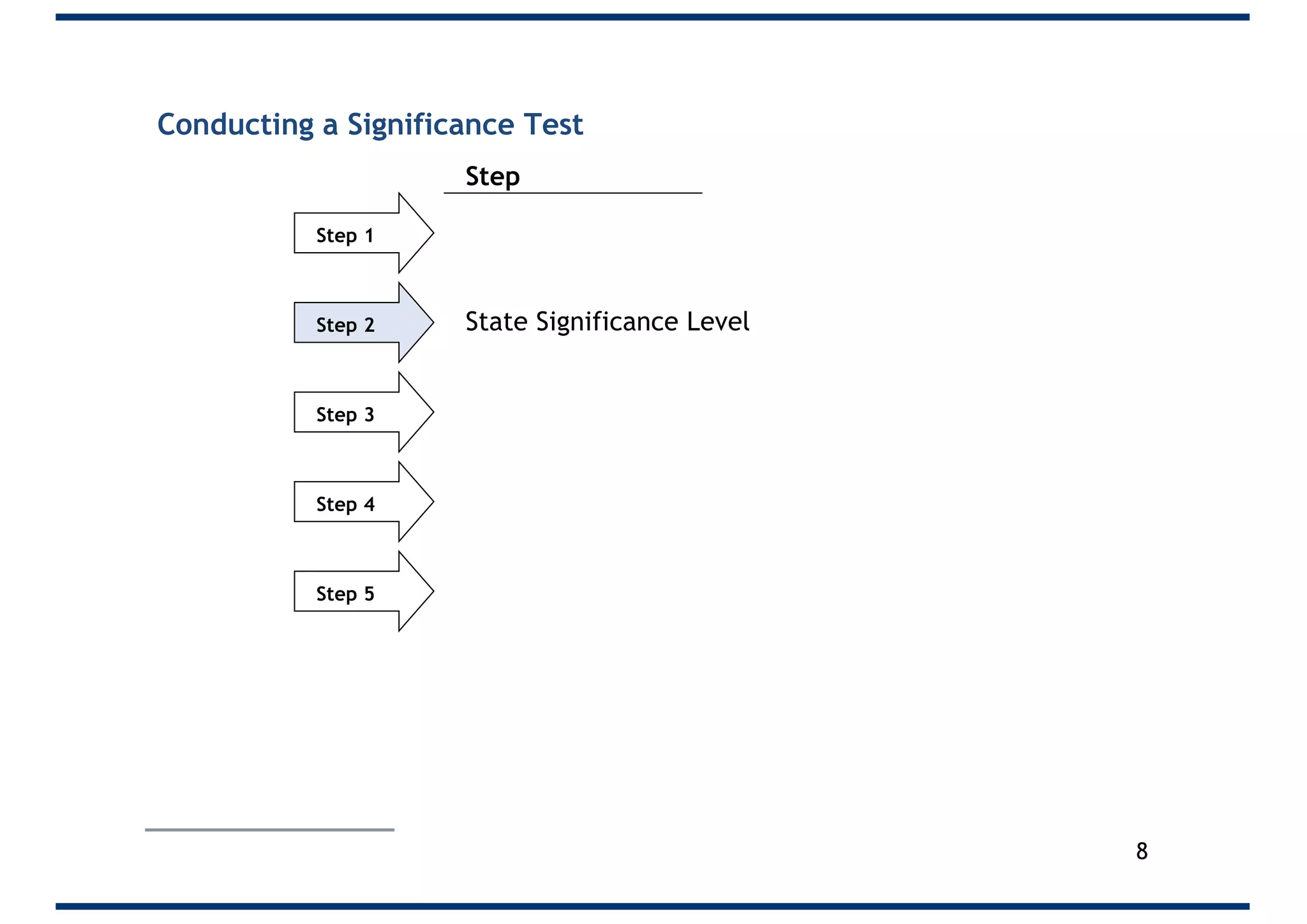
State Significance Level
Step
8
Significance Level
• Significance level has other names
– Probability value
– P-Value
– Alpha level
• We expect observations to have a random element, but
how confident can we be that the null hypothesis is wrong
because our theory is correct, instead of it just being
random error?
• There is a slight chance that an observation might come
from an extreme part of the distribution, but the chances
are very small
• So small, in fact, that we can conclude that it’s not a
random error, but the predicted result of your theory
• If there’s a large difference between the sample evidence
and the null hypothesis, we conclude that the alternative
hypothesis is more likely to be correct
9
Step 2
Significance Level
• To make this judgement we decide on critical values,
which define the points at which the probability of the
null hypothesis being true is at a small, predetermined
level
• Typical significance levels are 0.1 (10%), 0.05 (5%), and
0.01 (1%)
– These values correspond to the probability of observing
such an extreme value by chance
• We can divide up the Normal distribution diagram into
sections, see whether the z-value falls into a particular
section, and thus reject or accept the null hypothesis
• Generally, the smaller the significance level, the more
people there are who would be willing to say that the
alternative hypothesis beats the null hypothesis
• The p-value is the lowest level of significance at which
we can reject the null hypothesis
10
Step 2
Conducting a Significance Test
Step 1
Step 2
Step 3
Step 4
Step 5
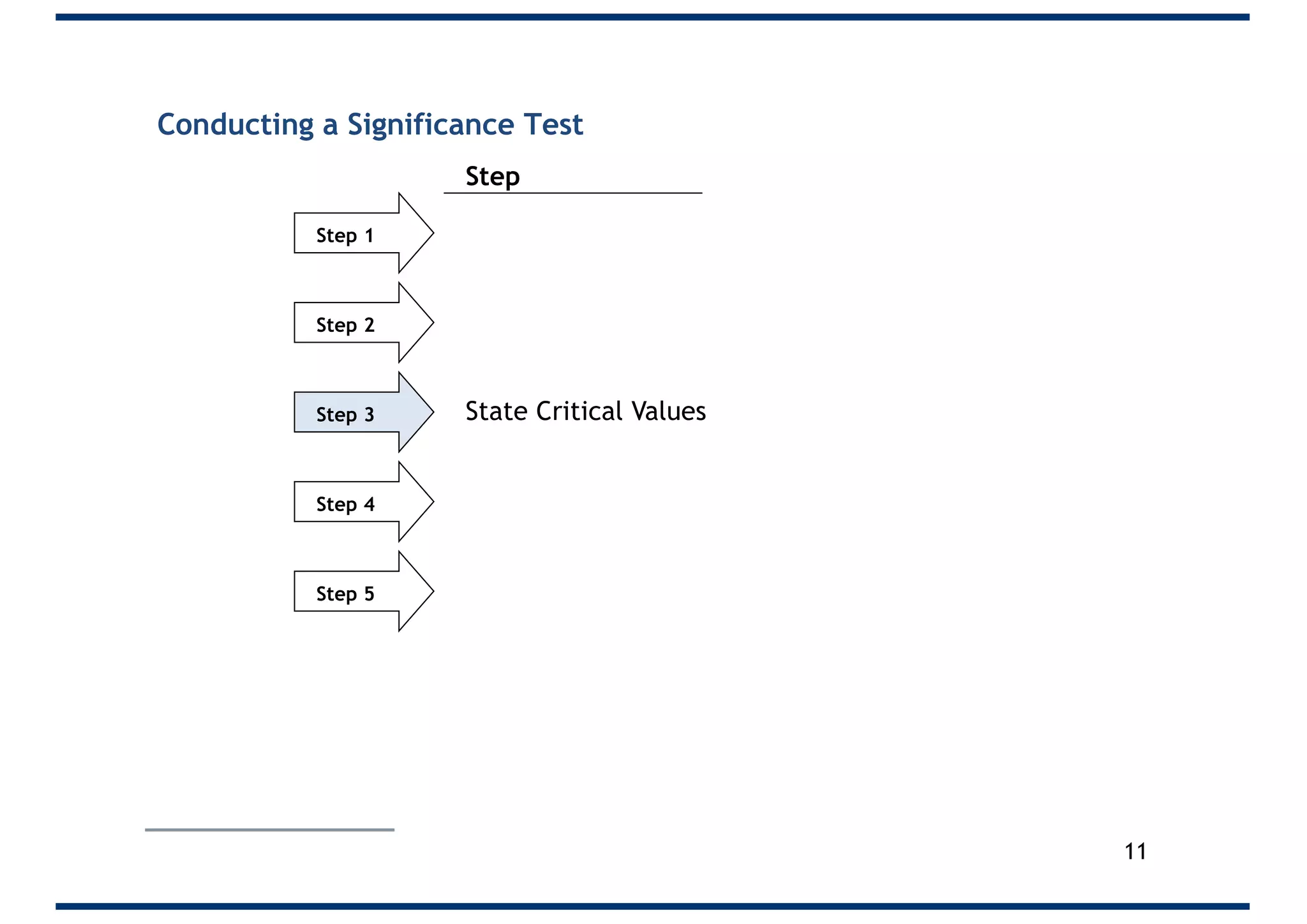
State Critical Values
Step
11
Two sided test
One sided tests
a / 2 a / 21 - a
– z + z
Do Not Reject H0
Reject H0Reject H0
a
1 - a
– z
Do Not Reject H0Reject H0
a1 - a
+ z
Do Not Reject H0
0
Reject H0
One vs. Two Sided TestsStep 3
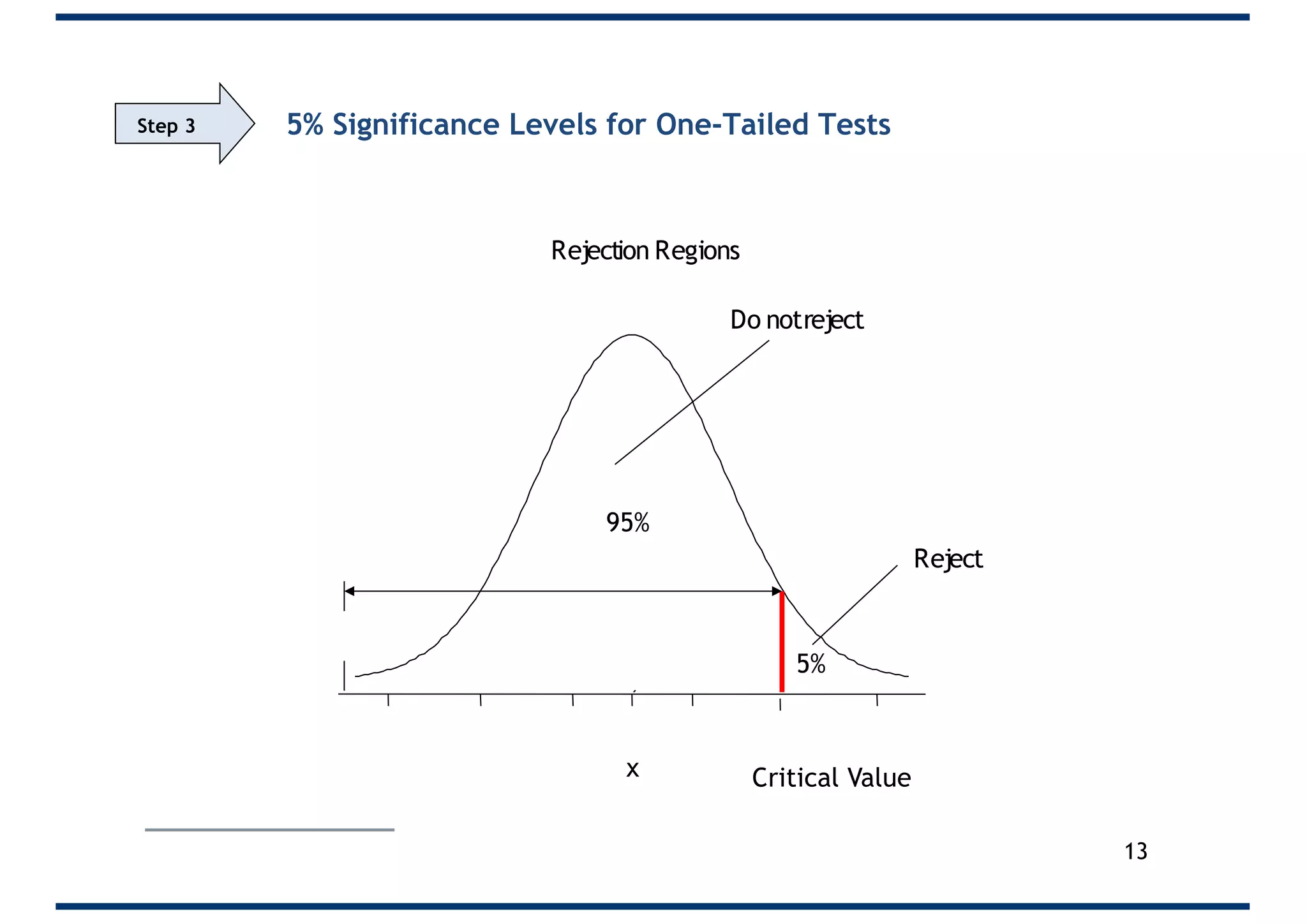
5% Significance Levels for One-Tailed Tests
x
Reject
Do notreject
Rejection Regions
Critical Value
5%
95%
13
Step 3
1% Significance Levels for One-Tailed Tests
x
Reject
Do notreject
Rejection Regions
Critical Value
1%
99%
14
Step 3
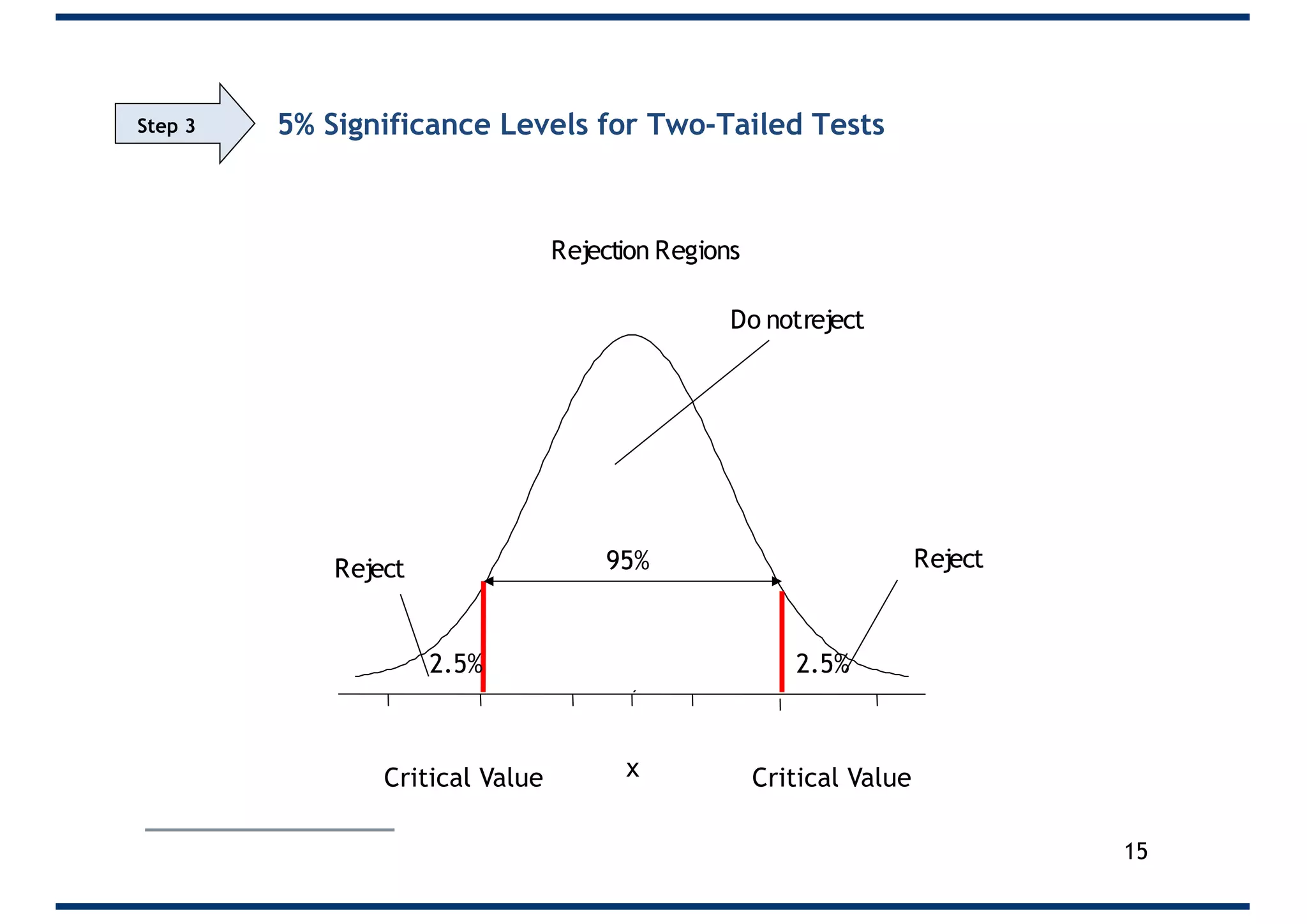
5% Significance Levels for Two-Tailed Tests
x
RejectReject
Do notreject
Rejection Regions
Critical ValueCritical Value
2.5%2.5%
95%
15
Step 3
1% Significance Levels for Two-Tailed Tests
x
RejectReject
Do notreject
Rejection Regions
Critical ValueCritical Value
0.5%0.5%
99%
16
Step 3
Significance Level à Critical Value
• For each significance level (e.g. 5%), we can use a Normal
probability table to ascertain the relevant critical value
(given as Z)
• Note: I’m showing you how to go from significance level to
critical value but we could do it in both directions
17
Step 3
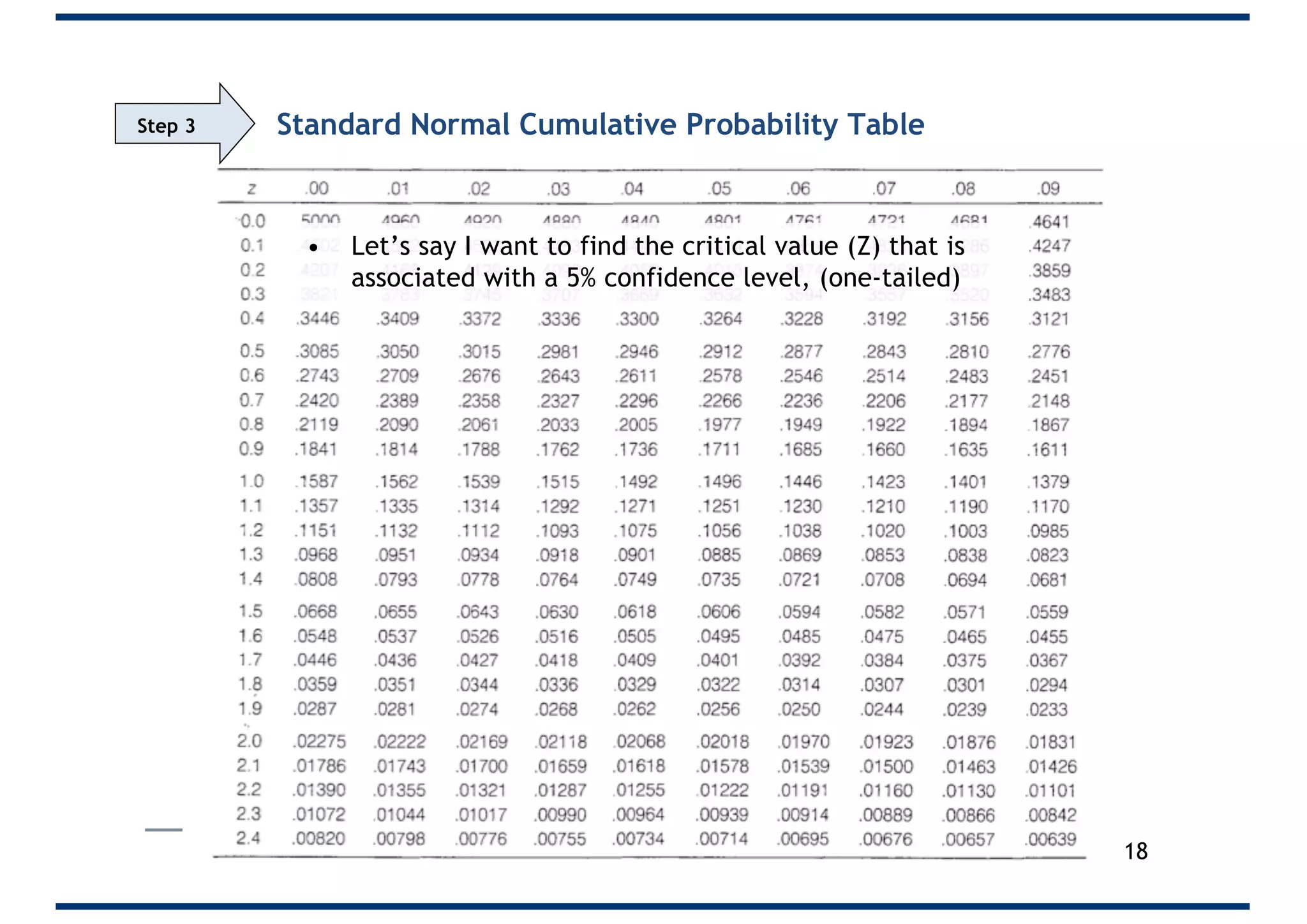
Standard Normal Cumulative Probability Table
• Let’s say I want to find the critical value (Z) that is
associated with a 5% confidence level, (one-tailed)
18
Step 3
Standard Normal Cumulative Probability Table
• Let’s say I want to find the critical value (Z) that is
associated with a 5% confidence level, (one-tailed)
• 95% of the population will be below the critical
value
z =
1.645
Looking
for 0.05
19
Step 3
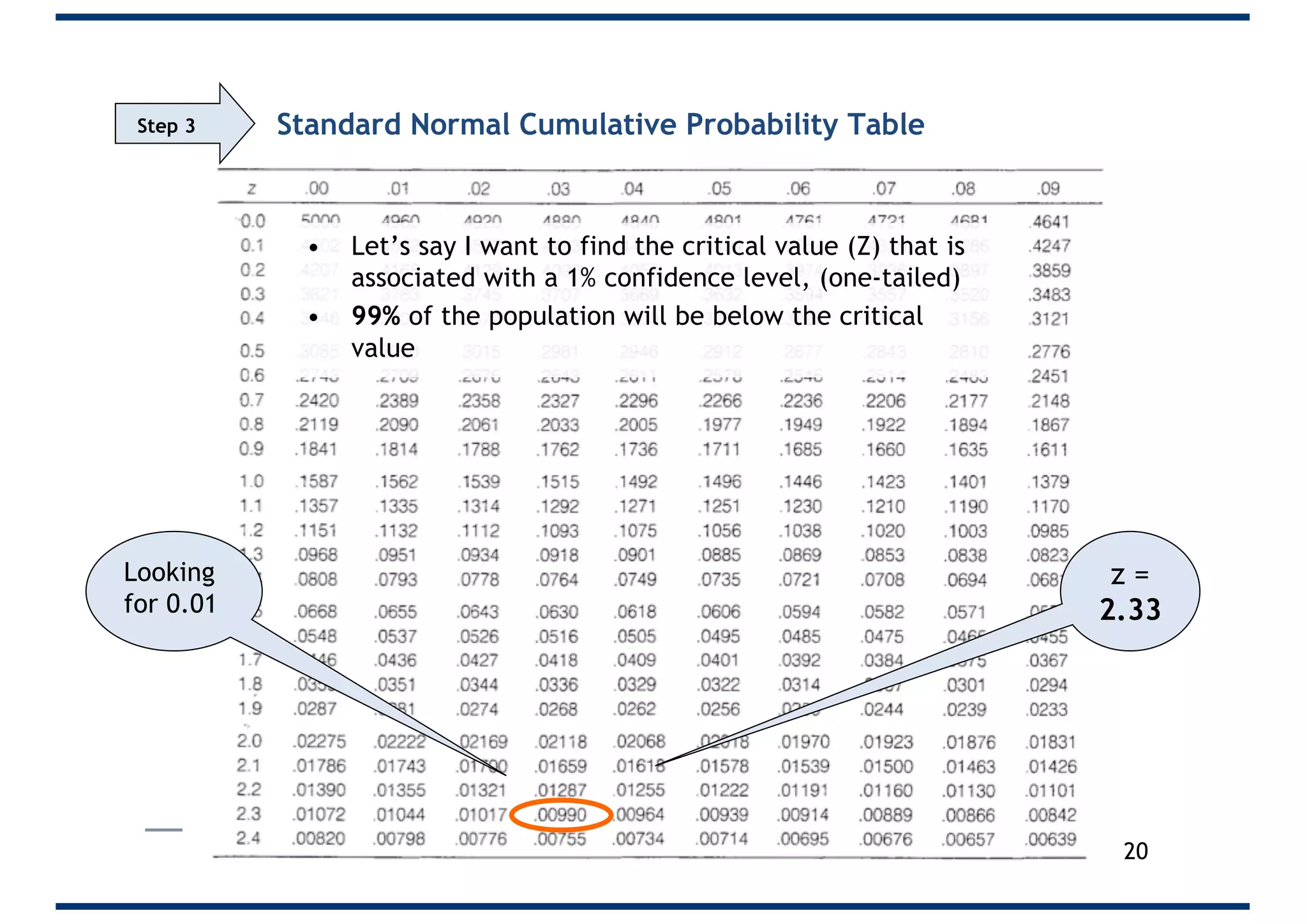
Standard Normal Cumulative Probability Table
z =
2.33
Looking
for 0.01
• Let’s say I want to find the critical value (Z) that is
associated with a 1% confidence level, (one-tailed)
• 99% of the population will be below the critical
value
20
Step 3
Standard Normal Cumulative Probability Table
• Let’s say I want to find the critical value (Z) that is
associated with a 5% confidence level, (two-tailed)
• 97.5% of the population will be below the critical
value
z =
1.96
Looking
for 0.025
21
Step 3
The relationship between confidence level (C), p value (P)
and Z for 1 and 2 tailed tests
At the 95% level, there is a 2.5% chance that we would see this result (or something even more extreme), if the
sample mean really is the population mean. Therefore a small p value tells us one of two things:
• Our observation is so extreme we can reject the hypothesis that the sample belongs to the overall population
• The hypothetical event is very unlikely to come given from the sample we have
Level of
confidence
C P2 Z2 Z1
A little 68% 0.16 1 -
Fairly 90% 0.05 1.645 1.282
Very 95% 0.025 1.96 1.645
Very 95.4% 0.023 2 -
Highly 99% 0.005 2.576 2.33
Extremely 99.7% 0.0015 3 -
22
Step 3
Conducting a Significance Test
Step 1
Step 2
Step 3
Step 4
Step 5
Calculate the Test
Statistic (z)
Step
23
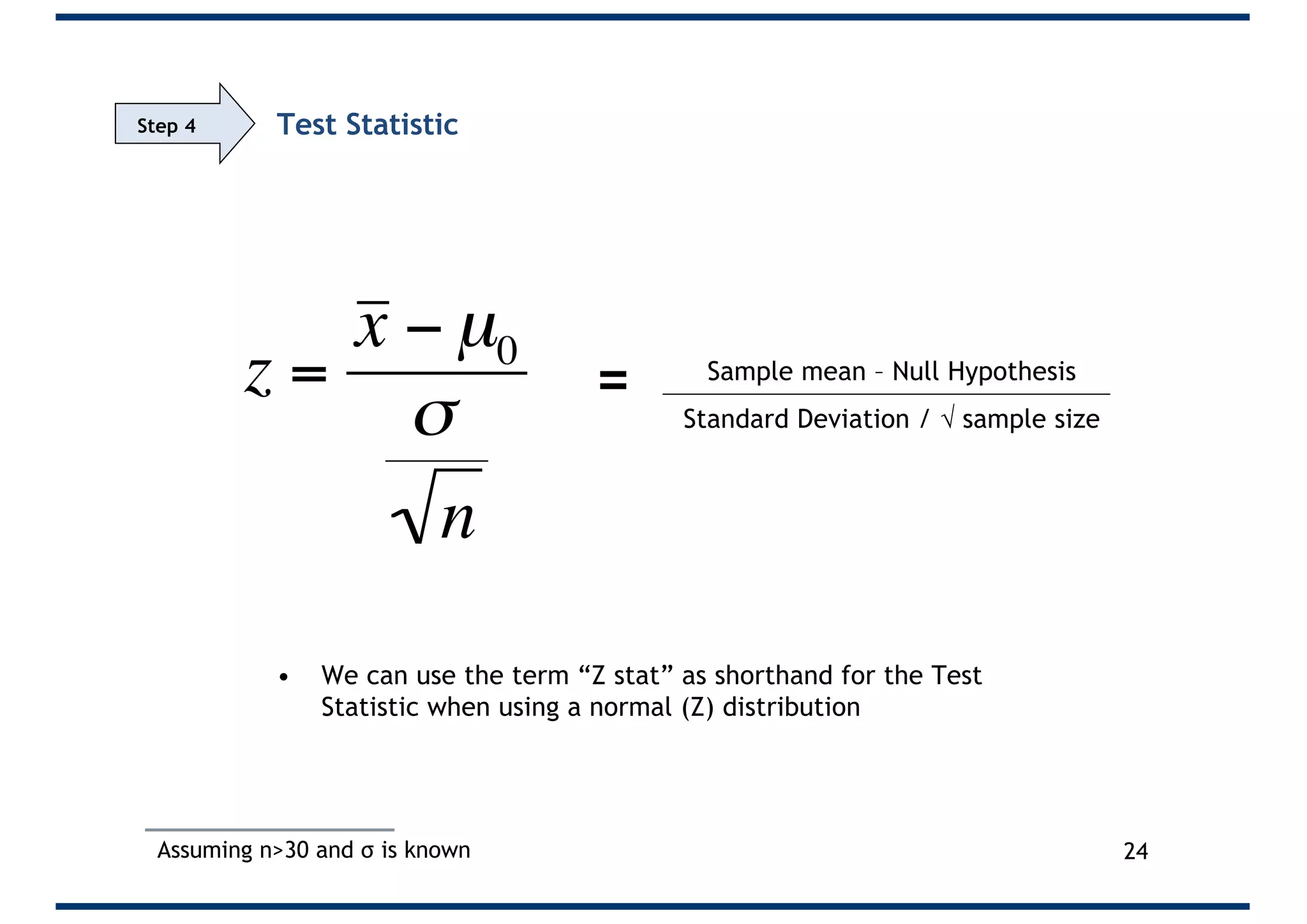
Test Statistic
• We can use the term “Z stat” as shorthand for the Test
Statistic when using a normal (Z) distribution
24
Sample mean – Null Hypothesis
Standard Deviation / Ö sample size
Assuming n>30 and σ is known
=
Step 4
z =
x − µ0
σ
n
Conducting a Significance Test
Step 1
Step 2
Step 3
Step 4
Step 5
Compare the test statistic
to the critical value and
Accept/Reject
Step
25
Critical Value (i.e. Probability Value) and Test Statistic
• A critical value is the value that a test statistic
must exceed in order for the null hypothesis to be
rejected.
• It should be noted that the all-or-none rejection of a
null hypothesis is not recommended
26
Step 5
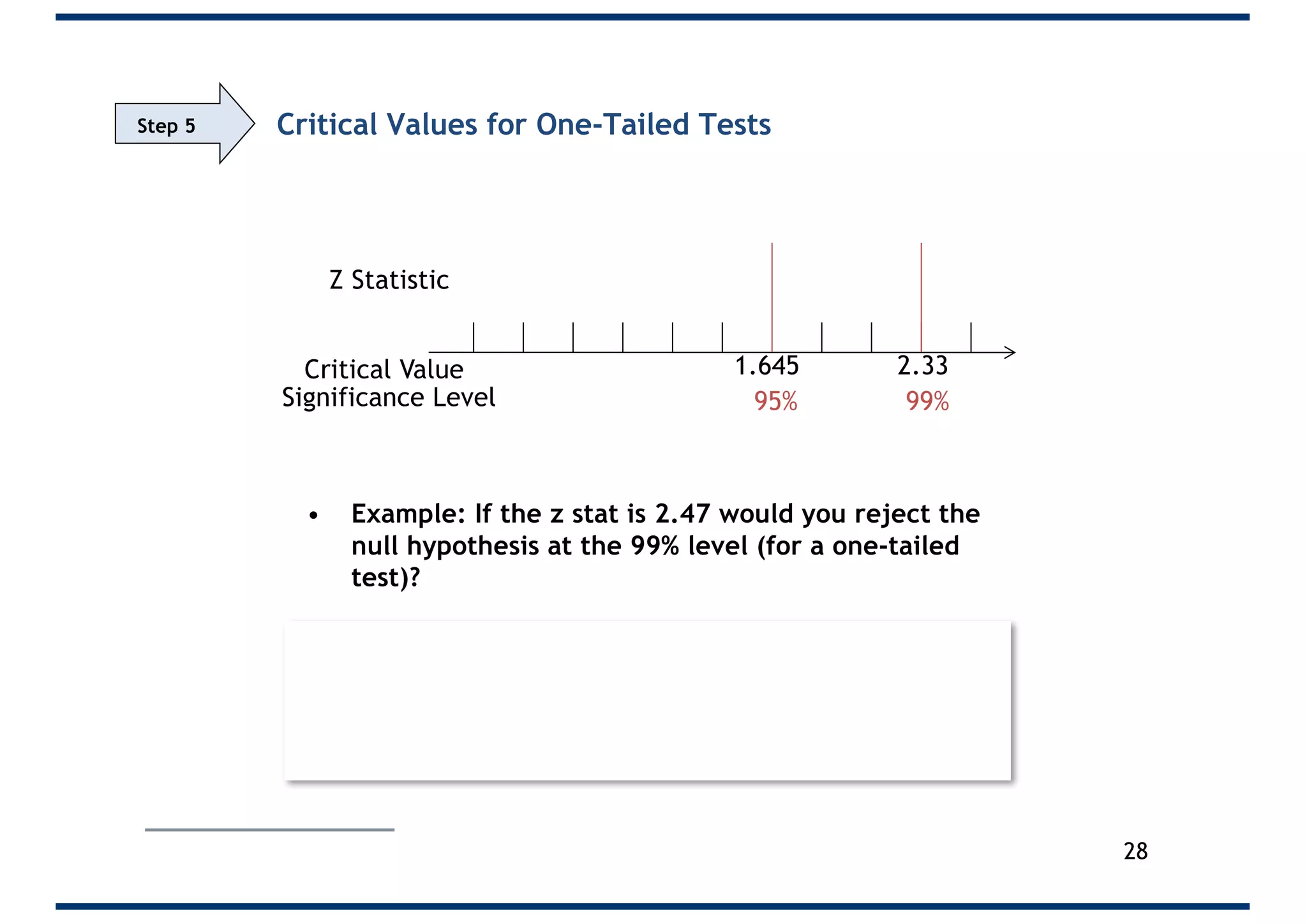
Critical Values for One-Tailed Tests
Critical Value 1.645 2.33
Significance Level 95% 99%
Z Statistic
• Example: If the z stat is 1.83 would you reject the
null hypothesis at the 95% level (for a one-tailed
test)?
• Yes, since
1.83 > 1.645
z > critical value
So REJECT at the 95% level
1.83
27
Step 5
Critical Values for One-Tailed Tests
Critical Value 1.645 2.33
Significance Level 95% 99%
Z Statistic
• Example: If the z stat is 2.47 would you reject the
null hypothesis at the 99% level (for a one-tailed
test)?
• Yes, since
2.47 > 2.33
z > critical value
So REJECT at the 99% level
2.47
28
Step 5
Conducting a Significance Test
Step 1
Step 2
Step 3
Step 4
Step 5
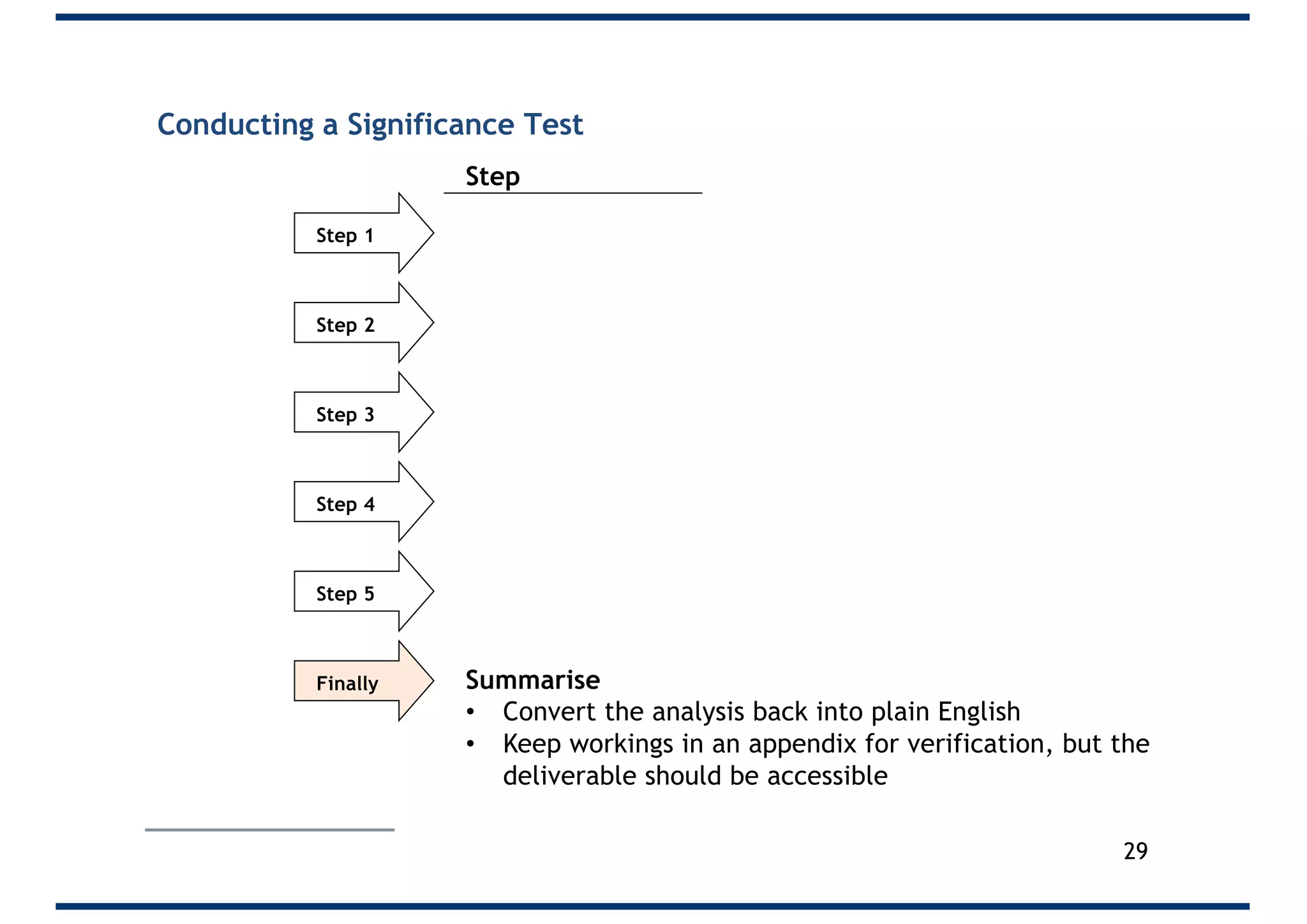
Finally Summarise
• Convert the analysis back into plain English
• Keep workings in an appendix for verification, but the
deliverable should be accessible
Step
29
Conducting a Significance Test: Recap
Step 1
Step 2
Step 3
Step 4
Step 5
Step
State Hypothesis
State Significance Level
State Critical Values
Calculate the Test
Statistic (z)
30
Compare the test statistic
to the critical value and
Accept/Reject
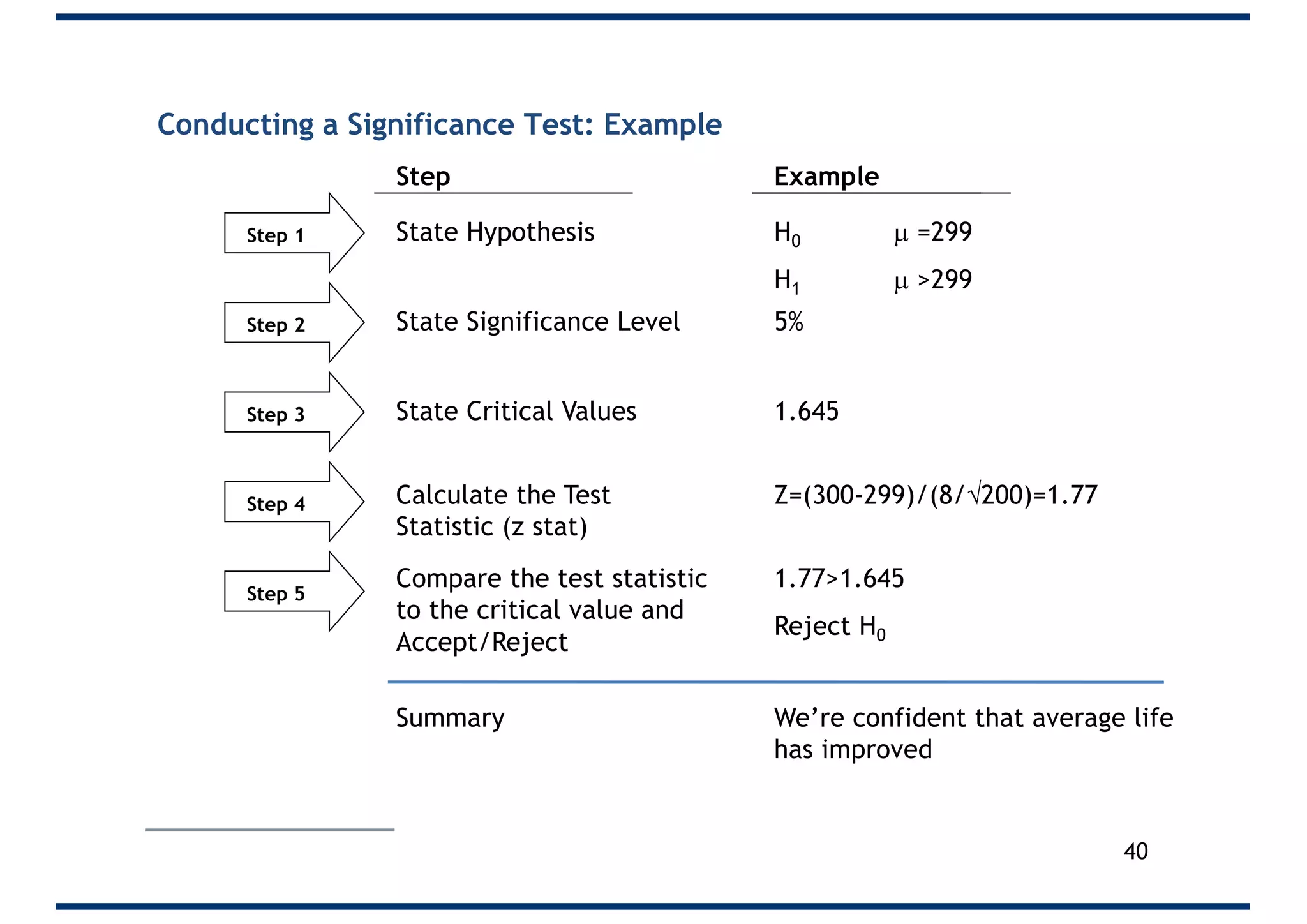
Conducting a Significance Test: Example
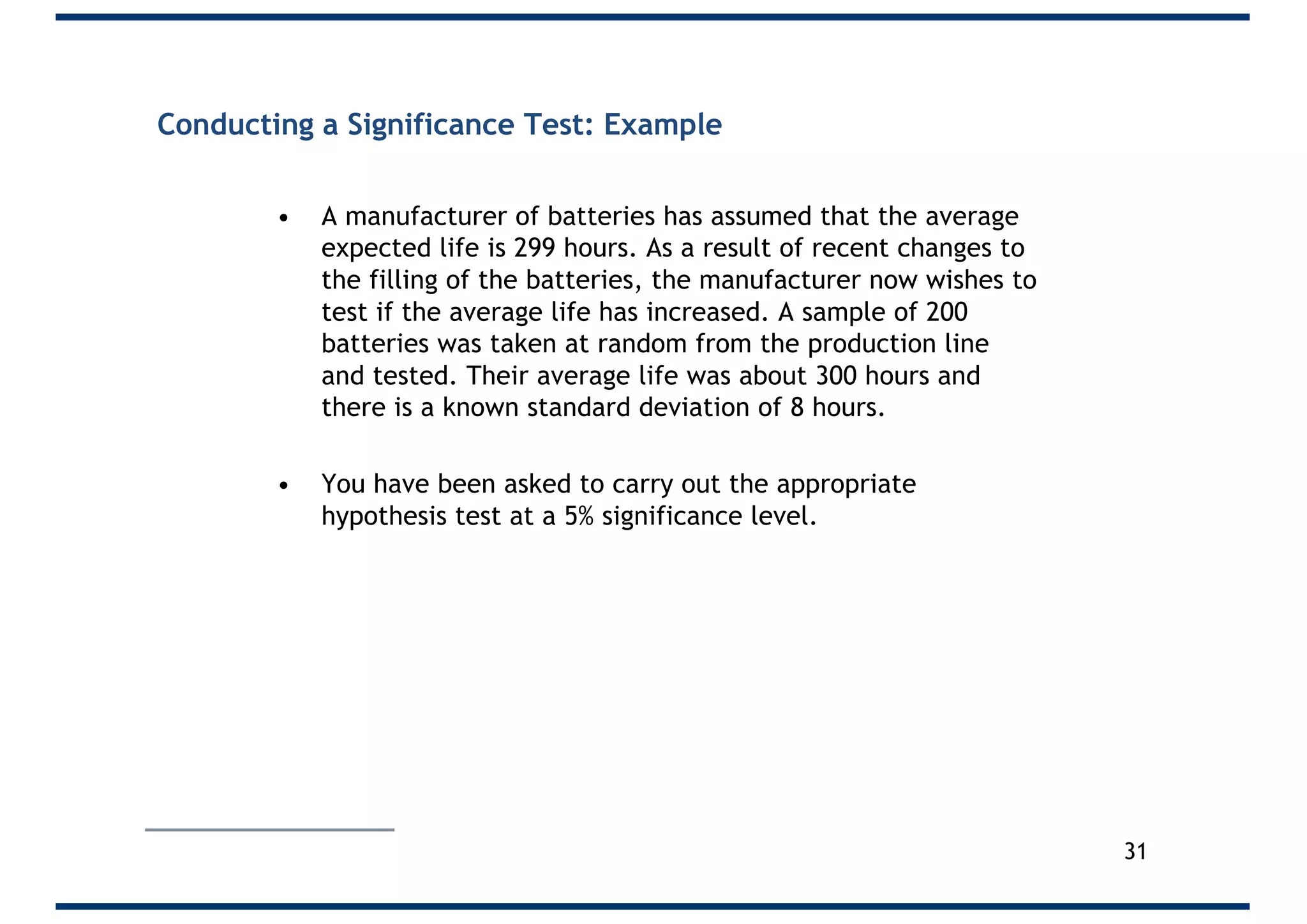
• A manufacturer of batteries has assumed that the average
expected life is 299 hours. As a result of recent changes to
the filling of the batteries, the manufacturer now wishes to
test if the average life has increased. A sample of 200
batteries was taken at random from the production line
and tested. Their average life was about 300 hours and
there is a known standard deviation of 8 hours.
• You have been asked to carry out the appropriate
hypothesis test at a 5% significance level.
31
Conducting a Significance Test: Example
Step 1
Step 2
Step 3
Step 4
Step 5
Summary
Step Example
State Hypothesis
State Significance Level
State Critical Values
Calculate the Test
Statistic (z stat)
Compare the test statistic
to the critical value and
Accept/Reject
We’re confident that average life
has improved
H0 µ =299
H1 µ >299
5%
1.645
Z=(300-299)/(8/Ö200)=1.77
1.77>1.645
Reject H0
32
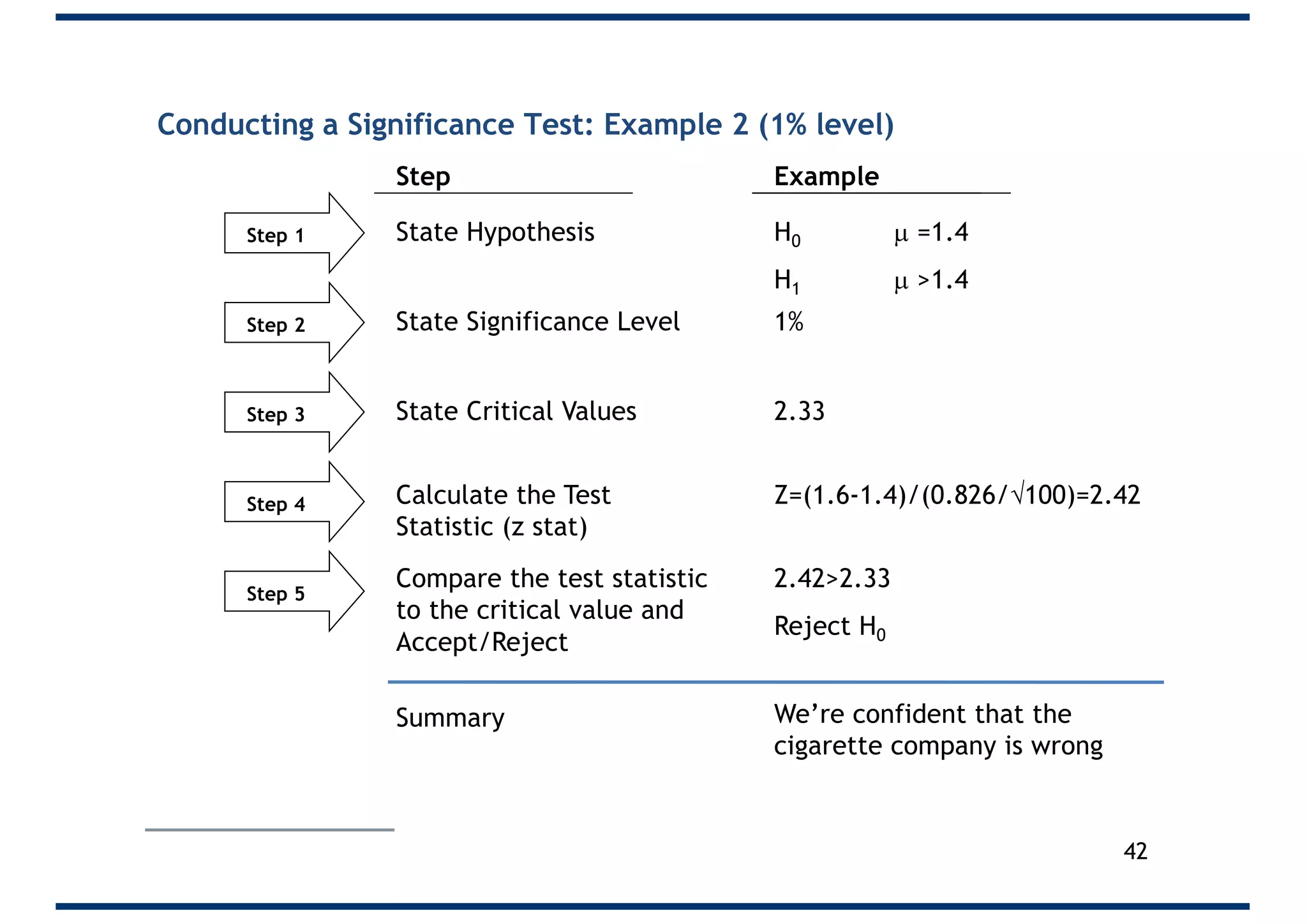
Conducting a Significance Test: Example 2
• A particular brand of cigarettes advertises that their
cigarettes contain 1.4 milligrams of nicotine.
• An anti-smoking group perform a survey of 100 cigarettes,
and find a sample mean of 1.6 milligrams
• Assume that the standard deviation is 0.826
• The group want to claim that there’s more nicotine in their
cigarettes than the company admit
• Is the result significant at the 5% level?
• Is the results significant at the 1% level?
33
Conducting a Significance Test: Example 2 (5% level)
Step 1
Step 2
Step 3
Step 4
Step 5
Step Example
State Hypothesis
State Significance Level
State Critical Values
Calculate the Test
Statistic (z stat)
Compare the test statistic
to the critical value and
Accept/Reject
We’re confident that the
cigarette company is wrong
H0 µ =1.4
H1 µ >1.4
5%
1.645
Z=(1.6-1.4)/(0.826/Ö100)=2.42
2.42>1.645
Reject H0
Summary
34
Conducting a Significance Test: Example 2 (1% level)
Step 1
Step 2
Step 3
Step 4
Step 5
Step Example
State Hypothesis
State Significance Level
State Critical Values
Calculate the Test
Statistic (z stat)
H0 µ =1.4
H1 µ >1.4
1%
2.33
Z=(1.6-1.4)/(0.826/Ö100)=2.42
2.42>2.33
Reject H0
We’re confident that the
cigarette company is wrong
Summary
35
Compare the test statistic
to the critical value and
Accept/Reject
Solutions
36
State Hypothesis: Examples (2)
1. The mean area of the several thousand apartments
in a new development is advertised to be 1250
square feet. A tenant group thinks that the
apartments are smaller than advertised. They hire
an engineer to measure a sample of the apartments
to test their suspicion
H0: µ = 1250
H1: µ < 1250 One sided
2. Larry’s car averages 32 miles per gallon on the
highway. He now switches to a new motor oil that is
advertised as increasing gas mileage. After driving
3000 highway miles with the new oil, he wants to
determine if his gas mileage has actually increased
H0: µ =32
H1: µ > 32 One Sided
37
Step 1
Critical Values for One-Tailed Tests
Critical Value 1.645 2.33
Significance Level 95% 99%
Z Statistic
• Example: If the z stat is 1.83 would you reject the
null hypothesis at the 95% level (for a one-tailed
test)?
• Yes, since
1.83 > 1.645
z > critical value
So REJECT at the 95% level
1.83
38
Step 5
Critical Values for One-Tailed Tests
Critical Value 1.645 2.33
Significance Level 95% 99%
Z Statistic
• Example: If the z stat is 2.47 would you reject the
null hypothesis at the 99% level (for a one-tailed
test)?
• Yes, since
2.47 > 2.33
z > critical value
So REJECT at the 99% level
2.47
39
Step 5
Conducting a Significance Test: Example
Step 1
Step 2
Step 3
Step 4
Step 5
Summary
Step Example
State Hypothesis
State Significance Level
State Critical Values
Calculate the Test
Statistic (z stat)
Compare the test statistic
to the critical value and
Accept/Reject
We’re confident that average life
has improved
H0 µ =299
H1 µ >299
5%
1.645
Z=(300-299)/(8/Ö200)=1.77
1.77>1.645
Reject H0
40
Conducting a Significance Test: Example 2 (5% level)
Step 1
Step 2
Step 3
Step 4
Step 5
Step Example
State Hypothesis
State Significance Level
State Critical Values
Calculate the Test
Statistic (z stat)
Compare the test statistic
to the critical value and
Accept/Reject
We’re confident that the
cigarette company is wrong
H0 µ =1.4
H1 µ >1.4
5%
1.645
Z=(1.6-1.4)/(0.826/Ö100)=2.42
2.42>1.645
Reject H0
Summary
41
Conducting a Significance Test: Example 2 (1% level)
Step 1
Step 2
Step 3
Step 4
Step 5
Step Example
State Hypothesis
State Significance Level
State Critical Values
Calculate the Test
Statistic (z stat)
H0 µ =1.4
H1 µ >1.4
1%
2.33
Z=(1.6-1.4)/(0.826/Ö100)=2.42
2.42>2.33
Reject H0
We’re confident that the
cigarette company is wrong
Summary
42
Compare the test statistic
to the critical value and
Accept/Reject
• This presentation forms part of a free, online course
on analytics
• http://econ.anthonyjevans.com/courses/analytics/
43

Significance Tests

  • 1.
    A 5 StepSignificance Test Anthony J. Evans Professor of Economics, ESCP Europe www.anthonyjevans.com (cc) Anthony J. Evans 2019 | http://creativecommons.org/licenses/by-nc-sa/3.0/
  • 2.
    Conducting a SignificanceTest Step 1 Step 2 Step 3 Step 4 Step 5 State Hypothesis Step 2
  • 3.
    Null and AlternativeHypothesis Definition Status quo hypothesis, starting assumption Null hypothesis Alternative hypothesis Other assumption, strong belief, gut feeling Examples In the US system of justice, the guiding principle is supposed to be that the defendant is “presumed innocent until proven guilty”. This claim of innocence is a null hypothesis The prosecution offers a competing claim: the defendant is guilty. This is an alternative to the null hypothesis of innocence and we call the claim of guilt an alternative hypothesis H0 H1 3 Step 1
  • 4.
    Null and AlternativeHypotheses • H0: b=0; H1: b>0 One tailed • H0: b=0; H1: b<0 One tailed • H0: b=0; H1: b¹0 Two tailed Remark: Accepting the null hypothesis does not necessarily mean that we literally believe that it is true. Sometimes it means that we do not have enough evidence to reject it or that we are reserving judgement 4 Step 1
  • 5.
    State Hypothesis • Thetest is designed to assess the strength of the evidence against H0 • H1 is the statement that we will accept if the evidence enables us to reject H0 5 Step 1
  • 6.
    State Hypothesis: Examples Whatis the null hypothesis (H0) and what is the alternative hypothesis (H1)? Also, is it a one or two-sided test? 1. The mean area of the several thousand apartments in a new development is advertised to be 1250 square feet. A tenant group thinks that the apartments are smaller than advertised. They hire an engineer to measure a sample of the apartments to test their suspicion 2. Larry’s car averages 32 miles per gallon on the highway. He now switches to a new motor oil that is advertised as increasing gas mileage. After driving 3000 highway miles with the new oil, he wants to determine if his gas mileage has actually increased 6 Step 1
  • 7.
    State Hypothesis: Examples(2) 1. The mean area of the several thousand apartments in a new development is advertised to be 1250 square feet. A tenant group thinks that the apartments are smaller than advertised. They hire an engineer to measure a sample of the apartments to test their suspicion H0: µ = 1250 H1: µ < 1250 One sided 2. Larry’s car averages 32 miles per gallon on the highway. He now switches to a new motor oil that is advertised as increasing gas mileage. After driving 3000 highway miles with the new oil, he wants to determine if his gas mileage has actually increased H0: µ =32 H1: µ > 32 One Sided 7 Step 1
  • 8.
    Conducting a SignificanceTest Step 1 Step 2 Step 3 Step 4 Step 5 State Significance Level Step 8
  • 9.
    Significance Level • Significancelevel has other names – Probability value – P-Value – Alpha level • We expect observations to have a random element, but how confident can we be that the null hypothesis is wrong because our theory is correct, instead of it just being random error? • There is a slight chance that an observation might come from an extreme part of the distribution, but the chances are very small • So small, in fact, that we can conclude that it’s not a random error, but the predicted result of your theory • If there’s a large difference between the sample evidence and the null hypothesis, we conclude that the alternative hypothesis is more likely to be correct 9 Step 2
  • 10.
    Significance Level • Tomake this judgement we decide on critical values, which define the points at which the probability of the null hypothesis being true is at a small, predetermined level • Typical significance levels are 0.1 (10%), 0.05 (5%), and 0.01 (1%) – These values correspond to the probability of observing such an extreme value by chance • We can divide up the Normal distribution diagram into sections, see whether the z-value falls into a particular section, and thus reject or accept the null hypothesis • Generally, the smaller the significance level, the more people there are who would be willing to say that the alternative hypothesis beats the null hypothesis • The p-value is the lowest level of significance at which we can reject the null hypothesis 10 Step 2
  • 11.
    Conducting a SignificanceTest Step 1 Step 2 Step 3 Step 4 Step 5 State Critical Values Step 11
  • 12.
    Two sided test Onesided tests a / 2 a / 21 - a – z + z Do Not Reject H0 Reject H0Reject H0 a 1 - a – z Do Not Reject H0Reject H0 a1 - a + z Do Not Reject H0 0 Reject H0 One vs. Two Sided TestsStep 3
  • 13.
    5% Significance Levelsfor One-Tailed Tests x Reject Do notreject Rejection Regions Critical Value 5% 95% 13 Step 3
  • 14.
    1% Significance Levelsfor One-Tailed Tests x Reject Do notreject Rejection Regions Critical Value 1% 99% 14 Step 3
  • 15.
    5% Significance Levelsfor Two-Tailed Tests x RejectReject Do notreject Rejection Regions Critical ValueCritical Value 2.5%2.5% 95% 15 Step 3
  • 16.
    1% Significance Levelsfor Two-Tailed Tests x RejectReject Do notreject Rejection Regions Critical ValueCritical Value 0.5%0.5% 99% 16 Step 3
  • 17.
    Significance Level àCritical Value • For each significance level (e.g. 5%), we can use a Normal probability table to ascertain the relevant critical value (given as Z) • Note: I’m showing you how to go from significance level to critical value but we could do it in both directions 17 Step 3
  • 18.
    Standard Normal CumulativeProbability Table • Let’s say I want to find the critical value (Z) that is associated with a 5% confidence level, (one-tailed) 18 Step 3
  • 19.
    Standard Normal CumulativeProbability Table • Let’s say I want to find the critical value (Z) that is associated with a 5% confidence level, (one-tailed) • 95% of the population will be below the critical value z = 1.645 Looking for 0.05 19 Step 3
  • 20.
    Standard Normal CumulativeProbability Table z = 2.33 Looking for 0.01 • Let’s say I want to find the critical value (Z) that is associated with a 1% confidence level, (one-tailed) • 99% of the population will be below the critical value 20 Step 3
  • 21.
    Standard Normal CumulativeProbability Table • Let’s say I want to find the critical value (Z) that is associated with a 5% confidence level, (two-tailed) • 97.5% of the population will be below the critical value z = 1.96 Looking for 0.025 21 Step 3
  • 22.
    The relationship betweenconfidence level (C), p value (P) and Z for 1 and 2 tailed tests At the 95% level, there is a 2.5% chance that we would see this result (or something even more extreme), if the sample mean really is the population mean. Therefore a small p value tells us one of two things: • Our observation is so extreme we can reject the hypothesis that the sample belongs to the overall population • The hypothetical event is very unlikely to come given from the sample we have Level of confidence C P2 Z2 Z1 A little 68% 0.16 1 - Fairly 90% 0.05 1.645 1.282 Very 95% 0.025 1.96 1.645 Very 95.4% 0.023 2 - Highly 99% 0.005 2.576 2.33 Extremely 99.7% 0.0015 3 - 22 Step 3
  • 23.
    Conducting a SignificanceTest Step 1 Step 2 Step 3 Step 4 Step 5 Calculate the Test Statistic (z) Step 23
  • 24.
    Test Statistic • Wecan use the term “Z stat” as shorthand for the Test Statistic when using a normal (Z) distribution 24 Sample mean – Null Hypothesis Standard Deviation / Ö sample size Assuming n>30 and σ is known = Step 4 z = x − µ0 σ n
  • 25.
    Conducting a SignificanceTest Step 1 Step 2 Step 3 Step 4 Step 5 Compare the test statistic to the critical value and Accept/Reject Step 25
  • 26.
    Critical Value (i.e.Probability Value) and Test Statistic • A critical value is the value that a test statistic must exceed in order for the null hypothesis to be rejected. • It should be noted that the all-or-none rejection of a null hypothesis is not recommended 26 Step 5
  • 27.
    Critical Values forOne-Tailed Tests Critical Value 1.645 2.33 Significance Level 95% 99% Z Statistic • Example: If the z stat is 1.83 would you reject the null hypothesis at the 95% level (for a one-tailed test)? • Yes, since 1.83 > 1.645 z > critical value So REJECT at the 95% level 1.83 27 Step 5
  • 28.
    Critical Values forOne-Tailed Tests Critical Value 1.645 2.33 Significance Level 95% 99% Z Statistic • Example: If the z stat is 2.47 would you reject the null hypothesis at the 99% level (for a one-tailed test)? • Yes, since 2.47 > 2.33 z > critical value So REJECT at the 99% level 2.47 28 Step 5
  • 29.
    Conducting a SignificanceTest Step 1 Step 2 Step 3 Step 4 Step 5 Finally Summarise • Convert the analysis back into plain English • Keep workings in an appendix for verification, but the deliverable should be accessible Step 29
  • 30.
    Conducting a SignificanceTest: Recap Step 1 Step 2 Step 3 Step 4 Step 5 Step State Hypothesis State Significance Level State Critical Values Calculate the Test Statistic (z) 30 Compare the test statistic to the critical value and Accept/Reject
  • 31.
    Conducting a SignificanceTest: Example • A manufacturer of batteries has assumed that the average expected life is 299 hours. As a result of recent changes to the filling of the batteries, the manufacturer now wishes to test if the average life has increased. A sample of 200 batteries was taken at random from the production line and tested. Their average life was about 300 hours and there is a known standard deviation of 8 hours. • You have been asked to carry out the appropriate hypothesis test at a 5% significance level. 31
  • 32.
    Conducting a SignificanceTest: Example Step 1 Step 2 Step 3 Step 4 Step 5 Summary Step Example State Hypothesis State Significance Level State Critical Values Calculate the Test Statistic (z stat) Compare the test statistic to the critical value and Accept/Reject We’re confident that average life has improved H0 µ =299 H1 µ >299 5% 1.645 Z=(300-299)/(8/Ö200)=1.77 1.77>1.645 Reject H0 32
  • 33.
    Conducting a SignificanceTest: Example 2 • A particular brand of cigarettes advertises that their cigarettes contain 1.4 milligrams of nicotine. • An anti-smoking group perform a survey of 100 cigarettes, and find a sample mean of 1.6 milligrams • Assume that the standard deviation is 0.826 • The group want to claim that there’s more nicotine in their cigarettes than the company admit • Is the result significant at the 5% level? • Is the results significant at the 1% level? 33
  • 34.
    Conducting a SignificanceTest: Example 2 (5% level) Step 1 Step 2 Step 3 Step 4 Step 5 Step Example State Hypothesis State Significance Level State Critical Values Calculate the Test Statistic (z stat) Compare the test statistic to the critical value and Accept/Reject We’re confident that the cigarette company is wrong H0 µ =1.4 H1 µ >1.4 5% 1.645 Z=(1.6-1.4)/(0.826/Ö100)=2.42 2.42>1.645 Reject H0 Summary 34
  • 35.
    Conducting a SignificanceTest: Example 2 (1% level) Step 1 Step 2 Step 3 Step 4 Step 5 Step Example State Hypothesis State Significance Level State Critical Values Calculate the Test Statistic (z stat) H0 µ =1.4 H1 µ >1.4 1% 2.33 Z=(1.6-1.4)/(0.826/Ö100)=2.42 2.42>2.33 Reject H0 We’re confident that the cigarette company is wrong Summary 35 Compare the test statistic to the critical value and Accept/Reject
  • 36.
  • 37.
    State Hypothesis: Examples(2) 1. The mean area of the several thousand apartments in a new development is advertised to be 1250 square feet. A tenant group thinks that the apartments are smaller than advertised. They hire an engineer to measure a sample of the apartments to test their suspicion H0: µ = 1250 H1: µ < 1250 One sided 2. Larry’s car averages 32 miles per gallon on the highway. He now switches to a new motor oil that is advertised as increasing gas mileage. After driving 3000 highway miles with the new oil, he wants to determine if his gas mileage has actually increased H0: µ =32 H1: µ > 32 One Sided 37 Step 1
  • 38.
    Critical Values forOne-Tailed Tests Critical Value 1.645 2.33 Significance Level 95% 99% Z Statistic • Example: If the z stat is 1.83 would you reject the null hypothesis at the 95% level (for a one-tailed test)? • Yes, since 1.83 > 1.645 z > critical value So REJECT at the 95% level 1.83 38 Step 5
  • 39.
    Critical Values forOne-Tailed Tests Critical Value 1.645 2.33 Significance Level 95% 99% Z Statistic • Example: If the z stat is 2.47 would you reject the null hypothesis at the 99% level (for a one-tailed test)? • Yes, since 2.47 > 2.33 z > critical value So REJECT at the 99% level 2.47 39 Step 5
  • 40.
    Conducting a SignificanceTest: Example Step 1 Step 2 Step 3 Step 4 Step 5 Summary Step Example State Hypothesis State Significance Level State Critical Values Calculate the Test Statistic (z stat) Compare the test statistic to the critical value and Accept/Reject We’re confident that average life has improved H0 µ =299 H1 µ >299 5% 1.645 Z=(300-299)/(8/Ö200)=1.77 1.77>1.645 Reject H0 40
  • 41.
    Conducting a SignificanceTest: Example 2 (5% level) Step 1 Step 2 Step 3 Step 4 Step 5 Step Example State Hypothesis State Significance Level State Critical Values Calculate the Test Statistic (z stat) Compare the test statistic to the critical value and Accept/Reject We’re confident that the cigarette company is wrong H0 µ =1.4 H1 µ >1.4 5% 1.645 Z=(1.6-1.4)/(0.826/Ö100)=2.42 2.42>1.645 Reject H0 Summary 41
  • 42.
    Conducting a SignificanceTest: Example 2 (1% level) Step 1 Step 2 Step 3 Step 4 Step 5 Step Example State Hypothesis State Significance Level State Critical Values Calculate the Test Statistic (z stat) H0 µ =1.4 H1 µ >1.4 1% 2.33 Z=(1.6-1.4)/(0.826/Ö100)=2.42 2.42>2.33 Reject H0 We’re confident that the cigarette company is wrong Summary 42 Compare the test statistic to the critical value and Accept/Reject
  • 43.
    • This presentationforms part of a free, online course on analytics • http://econ.anthonyjevans.com/courses/analytics/ 43