Quantitative Methods
Anthony J. Evans
Professor of Economics, ESCP Europe
www.anthonyjevans.com
(cc) Anthony J. Evans 2019 | http://creativecommons.org/licenses/by-nc-sa/3.0/
What are methods?
• Def. “Methods”: The techniques used for inquiry
• Def. “Methodology”: Discussion over methods
TITLE
1. Introduction
2. Literature Review
3. Methodology
4. Results
5. Conclusion
6. References
TITLE
1. Introduction
2. Literature Review
3. Methods
4. Results
5. Conclusion
6. References
2
The role of methodology in empirical research
Epistemology
Study of
knowledge
How we see things
Ontology
Categories of being
Underlying reality
Methodology
Procedures
employed
How we analyse
things
3
A methodological framework
Natural language
English
Formal language
Mathematics
Universal theory
Valid across
time/space
Particular theory
Depends on context
Case StudiesGame Theory
Econometrics Parable
4
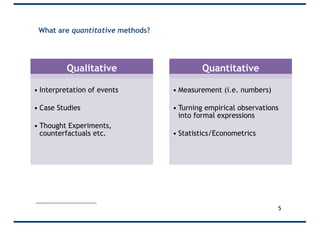
What are quantitative methods?
5
Qualitative
• Interpretation of events
• Case Studies
• Thought Experiments,
counterfactuals etc.
Quantitative
• Measurement (i.e. numbers)
• Turning empirical observations
into formal expressions
• Statistics/Econometrics
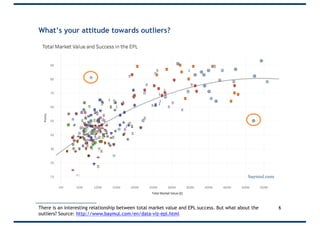
What’s your attitude towards outliers?
6There is an interesting relationship between total market value and EPL success. But what about the
outliers? Source: http://www.baymul.com/en/data-viz-epl.html
What is this?
7
4. Penicillin
Scottish scientist Alexander Fleming
was researching the flu in 1928 when
he noticed that a blue-green mold had
infected one of his petri dishes - and
killed the staphylococcus bacteria
growing in it. All hail sloppy lab work!
“The Best: Accidental Discoveries”
Wired, Issue 14.03 - March 2006
However faulty methods shouldn’t be the goal
Creative discovery Waste of time
8Source: ESCP Europe team analysis
Procedures matter
• What constitutes compelling evidence is a function
of how it is gathered
• OJ Simpson trial
– Nicole Brown Simpson and Ron Goldman were
murdered on June 12th 1994
– Blood stains matching OJ Simpson (her ex
husband) were found inside the house, at the
crime scene, and inside Simpson’s Ford Bronco
– The day after the murders Simpson provided a
blood sample to Police Detective Philip
Vannatter
– Before booking the evidence Vannatter
returned to the crime scene
– Simpson’s defence were able to argue that
LAPD had an opportunity to plant the evidence
9See https://www.pasadenastarnews.com/2014/06/08/oj-simpson-case-taught-police-what-not-to-do-at-a-
crime-scene/ and “O.J.: Made in America” (2016) https://www.youtube.com/watch?v=HrB3rOcrJxg
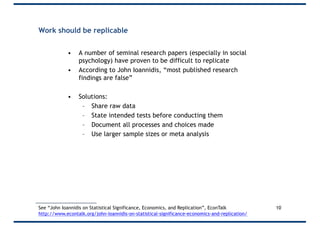
Work should be replicable
• A number of seminal research papers (especially in social
psychology) have proven to be difficult to replicate
• According to John Ioannidis, “most published research
findings are false”
• Solutions:
– Share raw data
– State intended tests before conducting them
– Document all processes and choices made
– Use larger sample sizes or meta analysis
10See “John Ioannidis on Statistical Significance, Economics, and Replication”, EconTalk
http://www.econtalk.org/john-ioannidis-on-statistical-significance-economics-and-replication/
Statistical analysis has historical context
11
High theory
• Blackboard
reasoning, a priori
logic
History
• Data, econometrics,
“facts”
Applied Theory
• The law is true, but
does it apply to this
institutional and
cultural context?
How many sheep?
12
How many sheep?
These are intact
males (rams)
This one is heavily pregnant
This is a baby (lamb)
13
Quantitative methods can illuminate but also confuse
• Statistics have the potential to reduce conflict through
hard evidence to support judgment
• When analysing a large number of cases it becomes too
complex and the use of abstract models and symbols are
necessary
• In some situations decision-making process has to be made
explicit for legal reasons
However
• Statistical techniques are only as good as the quality of raw
data
• Classification is a human construct, and a cultural
phenomena
• Never lose sight of the importance of theory to illuminate
what we deem to be “evidence”
14
Some key terms
• Population: the complete set of objects under study
• Sample: a subset of the objects under study
• Census: gathering data from the population
• Survey: gathering data from the sample
15
• This presentation forms part of a free, online course
on analytics
• http://econ.anthonyjevans.com/courses/analytics/
16

Quantitative Methods

  • 1.
    Quantitative Methods Anthony J.Evans Professor of Economics, ESCP Europe www.anthonyjevans.com (cc) Anthony J. Evans 2019 | http://creativecommons.org/licenses/by-nc-sa/3.0/
  • 2.
    What are methods? •Def. “Methods”: The techniques used for inquiry • Def. “Methodology”: Discussion over methods TITLE 1. Introduction 2. Literature Review 3. Methodology 4. Results 5. Conclusion 6. References TITLE 1. Introduction 2. Literature Review 3. Methods 4. Results 5. Conclusion 6. References 2
  • 3.
    The role ofmethodology in empirical research Epistemology Study of knowledge How we see things Ontology Categories of being Underlying reality Methodology Procedures employed How we analyse things 3
  • 4.
    A methodological framework Naturallanguage English Formal language Mathematics Universal theory Valid across time/space Particular theory Depends on context Case StudiesGame Theory Econometrics Parable 4
  • 5.
    What are quantitativemethods? 5 Qualitative • Interpretation of events • Case Studies • Thought Experiments, counterfactuals etc. Quantitative • Measurement (i.e. numbers) • Turning empirical observations into formal expressions • Statistics/Econometrics
  • 6.
    What’s your attitudetowards outliers? 6There is an interesting relationship between total market value and EPL success. But what about the outliers? Source: http://www.baymul.com/en/data-viz-epl.html
  • 7.
    What is this? 7 4.Penicillin Scottish scientist Alexander Fleming was researching the flu in 1928 when he noticed that a blue-green mold had infected one of his petri dishes - and killed the staphylococcus bacteria growing in it. All hail sloppy lab work! “The Best: Accidental Discoveries” Wired, Issue 14.03 - March 2006
  • 8.
    However faulty methodsshouldn’t be the goal Creative discovery Waste of time 8Source: ESCP Europe team analysis
  • 9.
    Procedures matter • Whatconstitutes compelling evidence is a function of how it is gathered • OJ Simpson trial – Nicole Brown Simpson and Ron Goldman were murdered on June 12th 1994 – Blood stains matching OJ Simpson (her ex husband) were found inside the house, at the crime scene, and inside Simpson’s Ford Bronco – The day after the murders Simpson provided a blood sample to Police Detective Philip Vannatter – Before booking the evidence Vannatter returned to the crime scene – Simpson’s defence were able to argue that LAPD had an opportunity to plant the evidence 9See https://www.pasadenastarnews.com/2014/06/08/oj-simpson-case-taught-police-what-not-to-do-at-a- crime-scene/ and “O.J.: Made in America” (2016) https://www.youtube.com/watch?v=HrB3rOcrJxg
  • 10.
    Work should bereplicable • A number of seminal research papers (especially in social psychology) have proven to be difficult to replicate • According to John Ioannidis, “most published research findings are false” • Solutions: – Share raw data – State intended tests before conducting them – Document all processes and choices made – Use larger sample sizes or meta analysis 10See “John Ioannidis on Statistical Significance, Economics, and Replication”, EconTalk http://www.econtalk.org/john-ioannidis-on-statistical-significance-economics-and-replication/
  • 11.
    Statistical analysis hashistorical context 11 High theory • Blackboard reasoning, a priori logic History • Data, econometrics, “facts” Applied Theory • The law is true, but does it apply to this institutional and cultural context?
  • 12.
  • 13.
    How many sheep? Theseare intact males (rams) This one is heavily pregnant This is a baby (lamb) 13
  • 14.
    Quantitative methods canilluminate but also confuse • Statistics have the potential to reduce conflict through hard evidence to support judgment • When analysing a large number of cases it becomes too complex and the use of abstract models and symbols are necessary • In some situations decision-making process has to be made explicit for legal reasons However • Statistical techniques are only as good as the quality of raw data • Classification is a human construct, and a cultural phenomena • Never lose sight of the importance of theory to illuminate what we deem to be “evidence” 14
  • 15.
    Some key terms •Population: the complete set of objects under study • Sample: a subset of the objects under study • Census: gathering data from the population • Survey: gathering data from the sample 15
  • 16.
    • This presentationforms part of a free, online course on analytics • http://econ.anthonyjevans.com/courses/analytics/ 16