Probability Distributions Chapter 6
GOALS Define the terms probability distribution and random variable. Distinguish between discrete and continuous probability distributions. Calculate the mean, variance, and standard deviation of a discrete probability distribution. Describe the characteristics  of and compute probabilities using the binomial probability distribution. Describe the characteristics of and compute probabilities using the hypergeometric probability distribution. Describe the characteristics of and compute probabilities using the Poisson
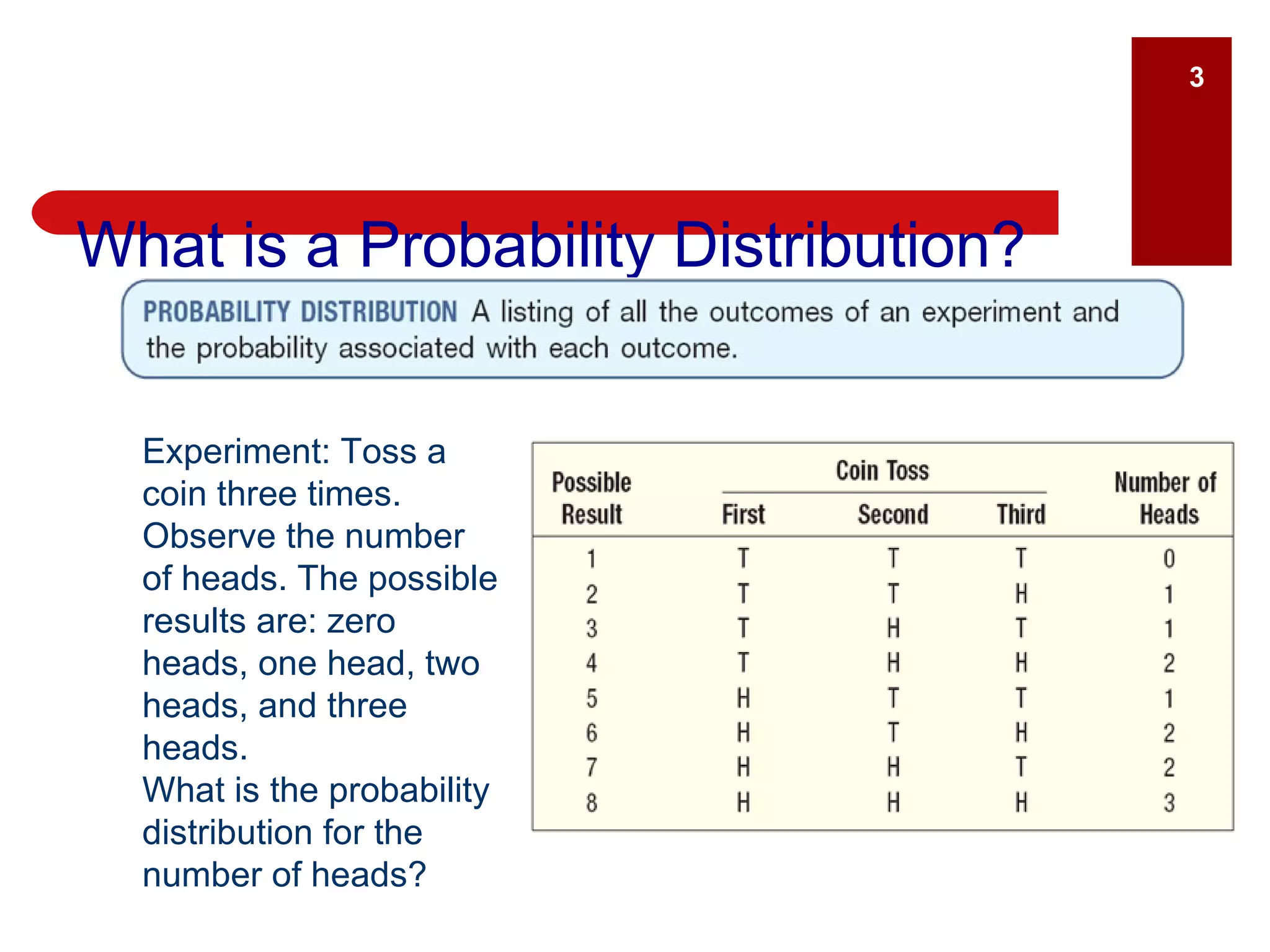
What is a Probability Distribution? Experiment: Toss a coin three times. Observe the number of heads. The possible results are: zero heads, one head, two heads, and three heads.  What is the probability distribution for the number of heads?
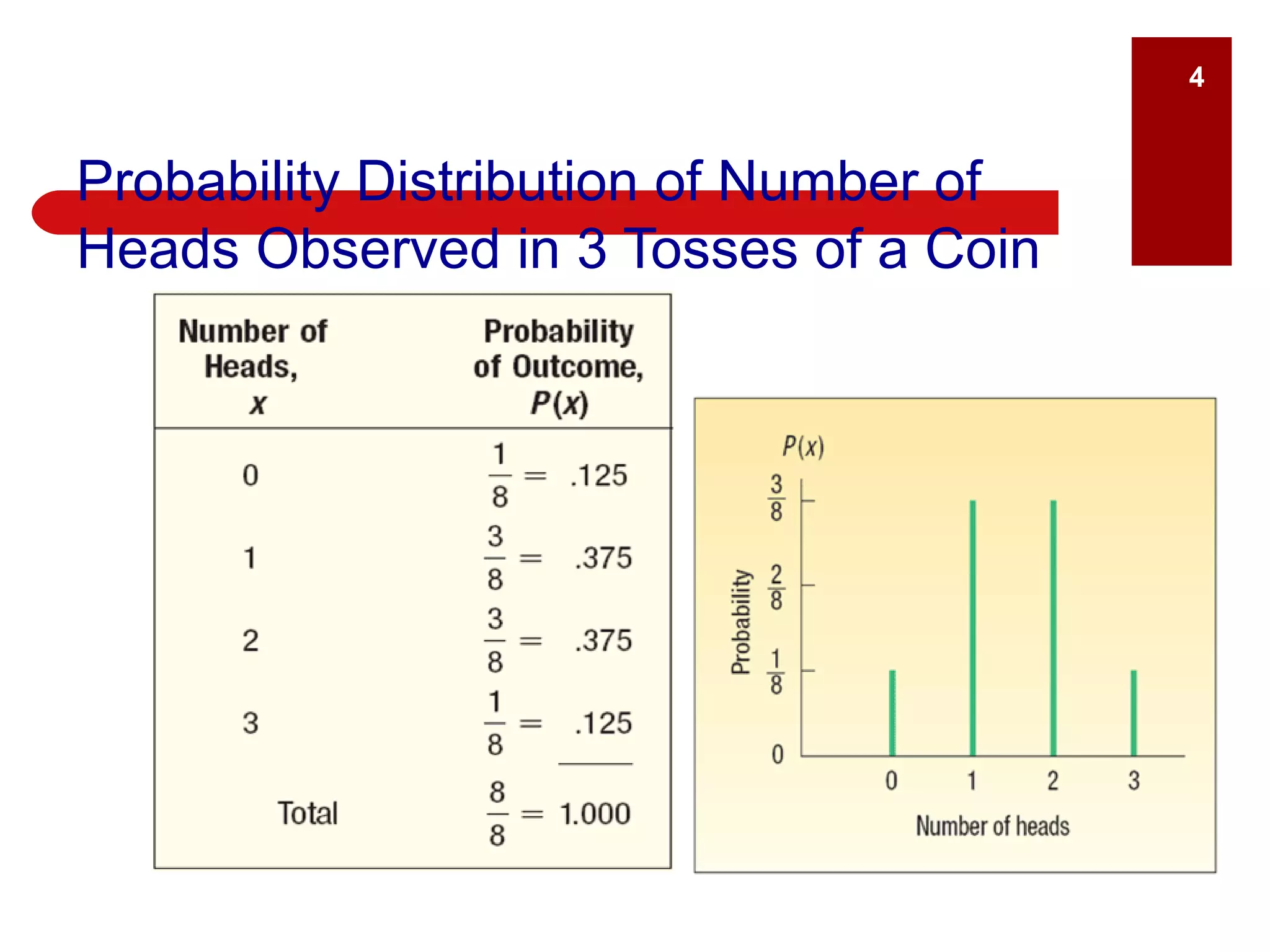
Probability Distribution of Number of Heads Observed in 3 Tosses of a Coin
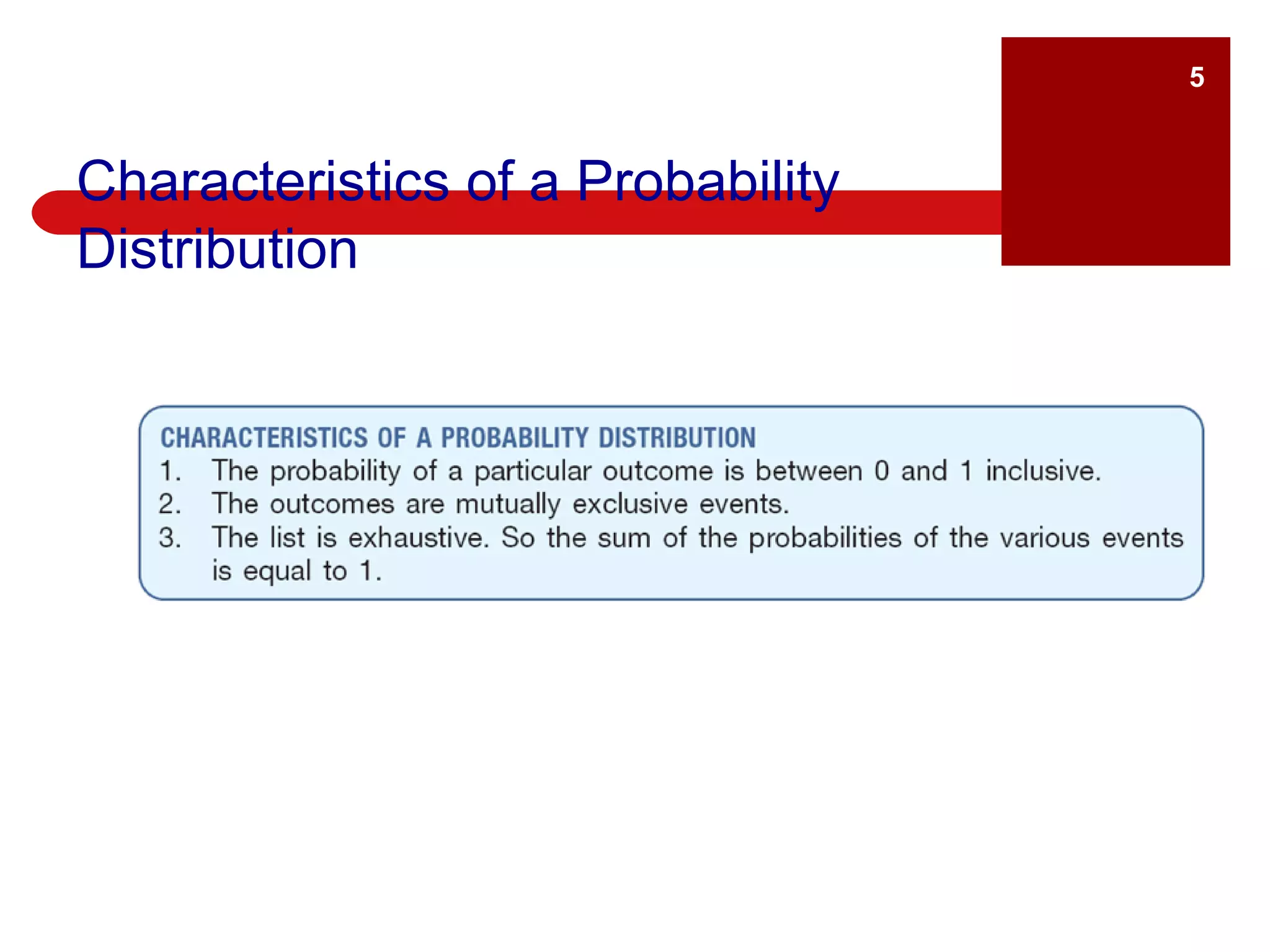
Characteristics of a Probability Distribution
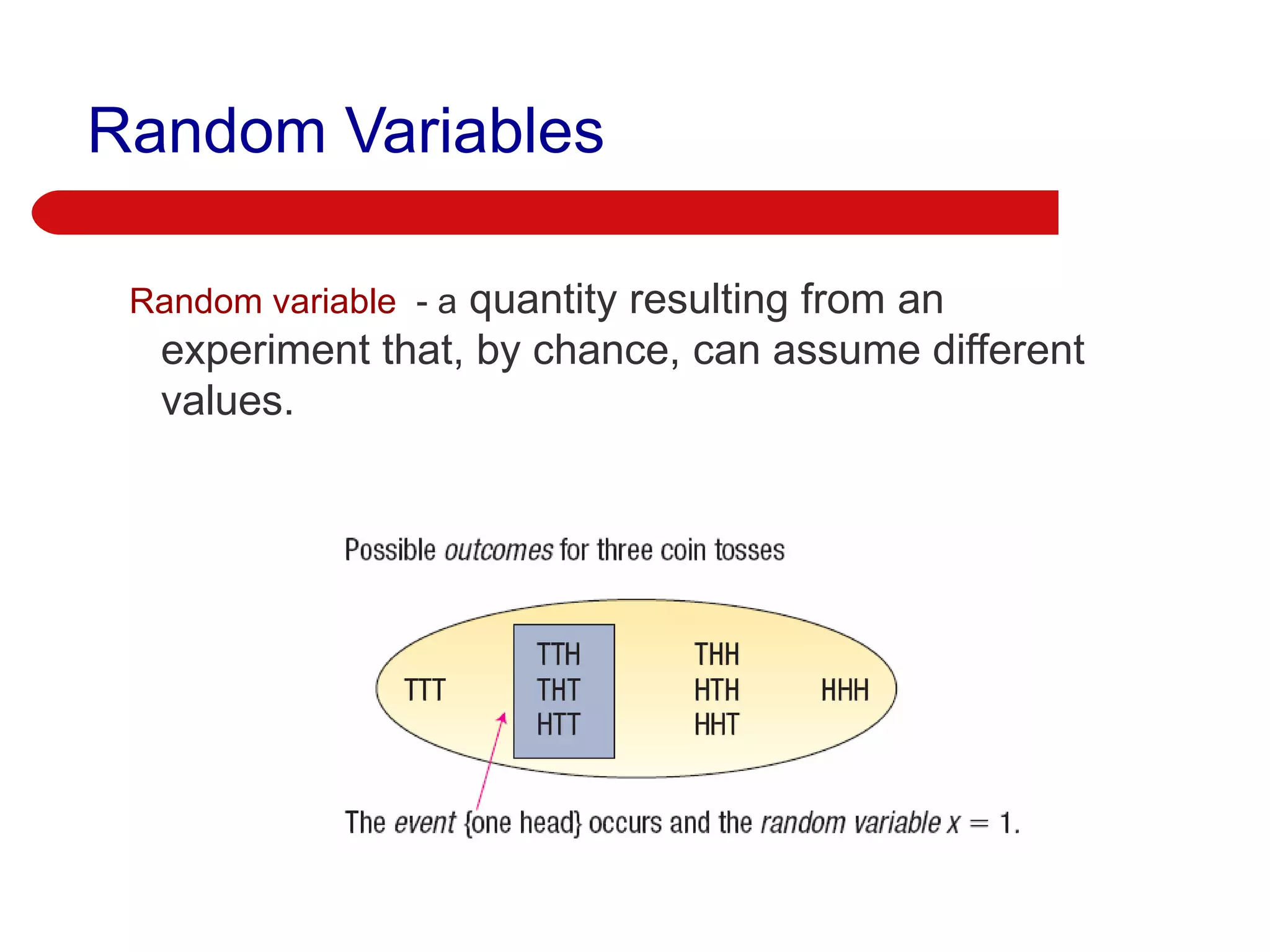
Random Variables Random variable   - a  quantity resulting from an experiment that, by chance, can assume different values.
EXAMPLE EXPERIMENT Rolling a die Monitoring daily absences per week Tossing 2 coins and recording number or heads RANDOM VARIABLE Number of dots Number of absentees per day Number of heads
Types of Random Variables Discrete Random Variable  can assume only certain clearly separated values. It is usually the result of  counting  something Continuous Random Variable   can assume an infinite number of values within a given range. It is usually the result of some type of  measurement
Discrete Random Variables - Examples The number of students in a class. The number of children in a family. The number of cars entering a carwash in a hour. Number of home mortgages approved by Coastal Federal Bank last week.
Continuous Random Variables - Examples The distance students travel to class. The time it takes an executive to drive to work. The length of an afternoon nap. The length of time of a particular phone call.
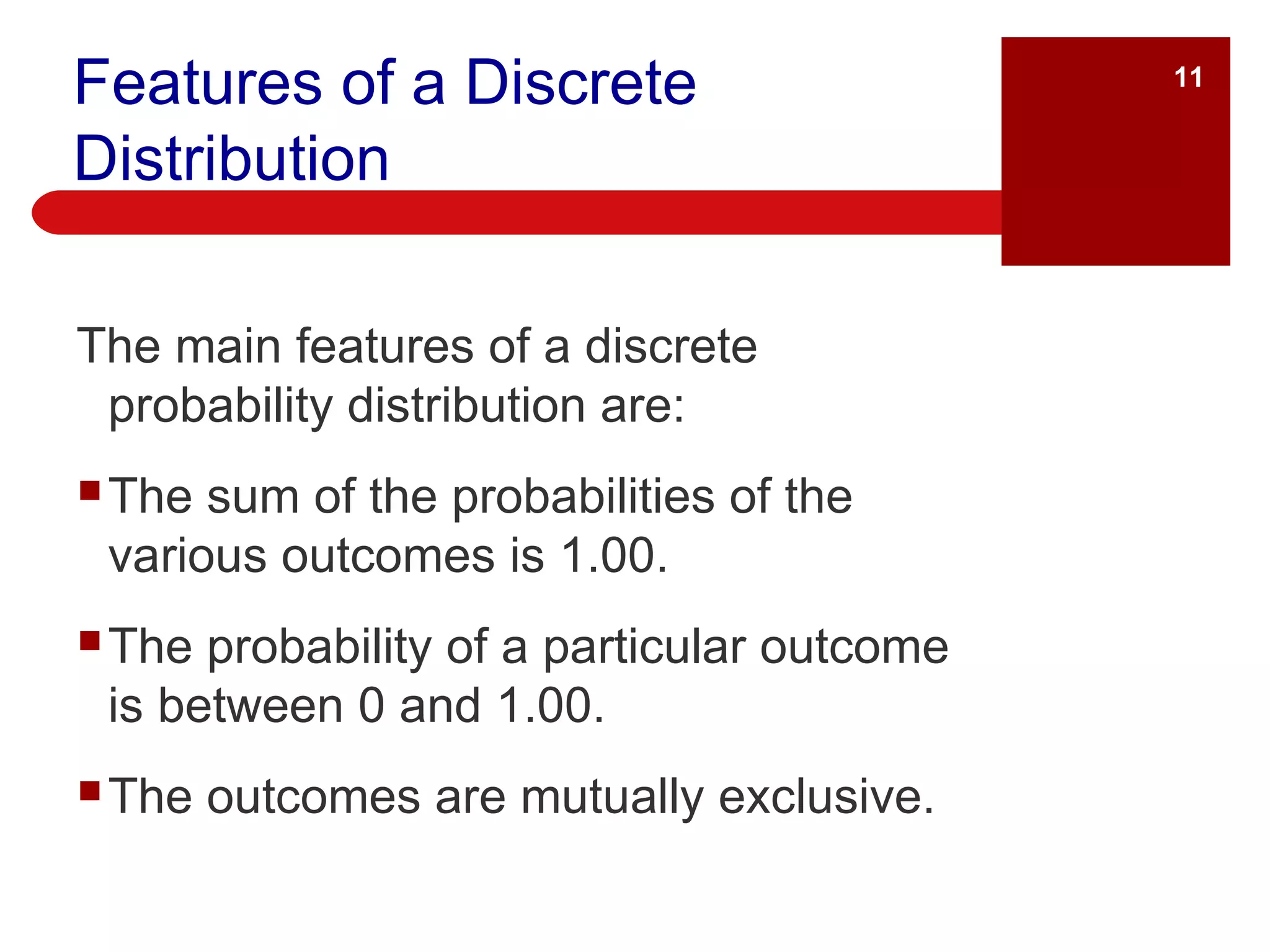
Features of a Discrete Distribution The main features of a discrete probability distribution are: The sum of the probabilities of the various outcomes is 1.00. The probability of a particular outcome is between 0 and 1.00. The outcomes are mutually exclusive.
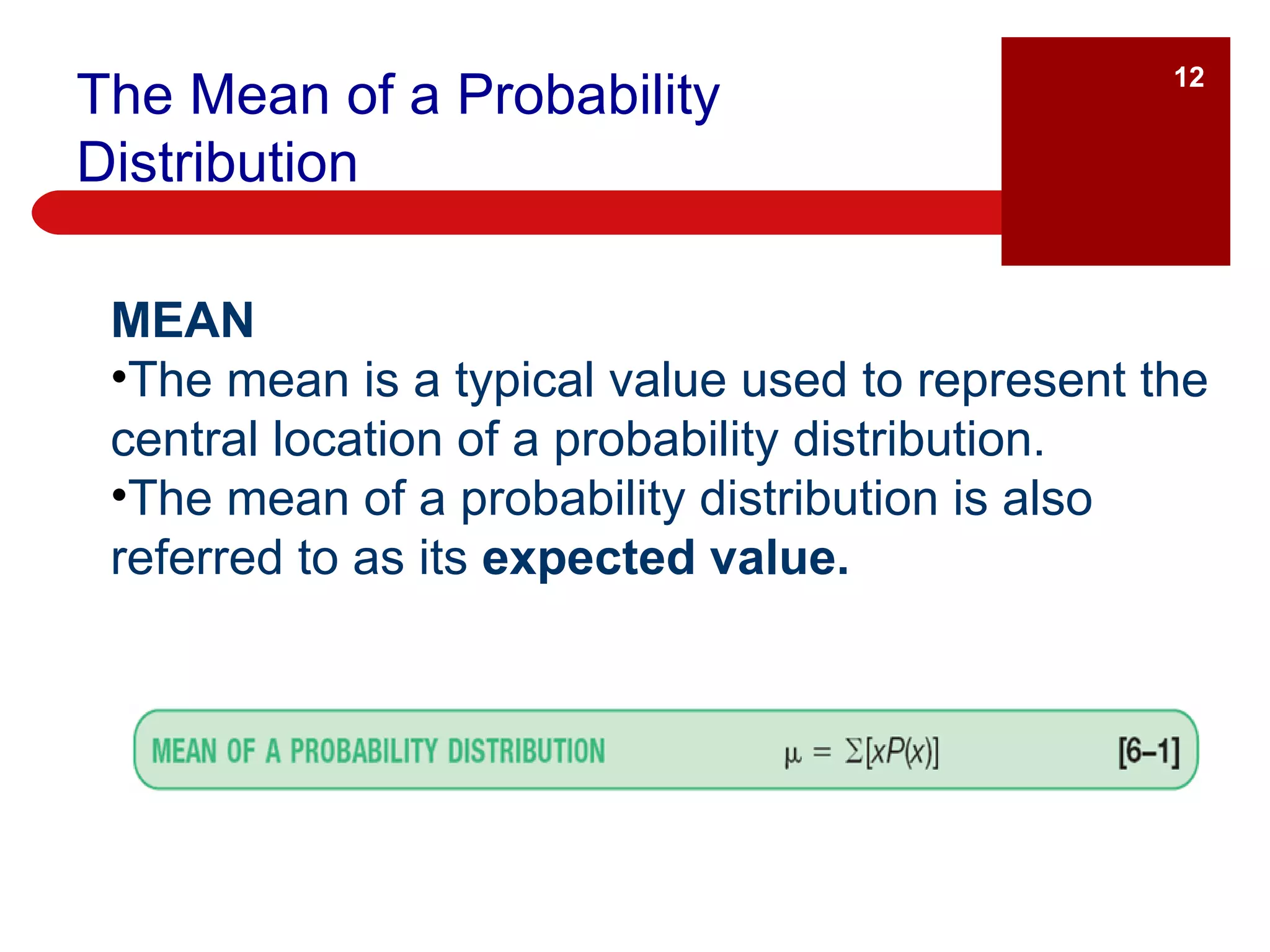
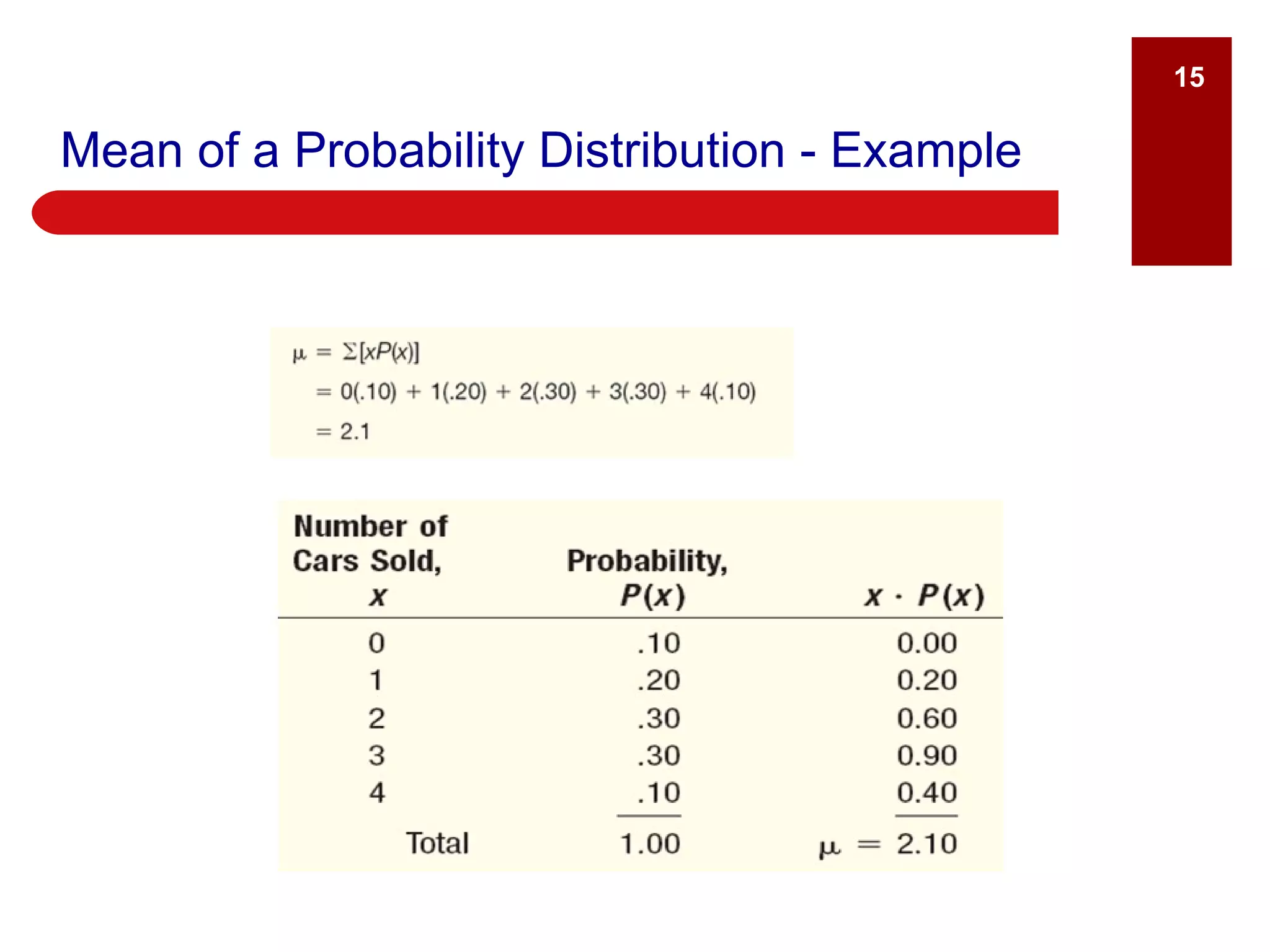
The Mean of a Probability Distribution MEAN The mean is a typical value used to represent the central location of a probability distribution. The mean of a probability distribution is also referred to as its  expected value.
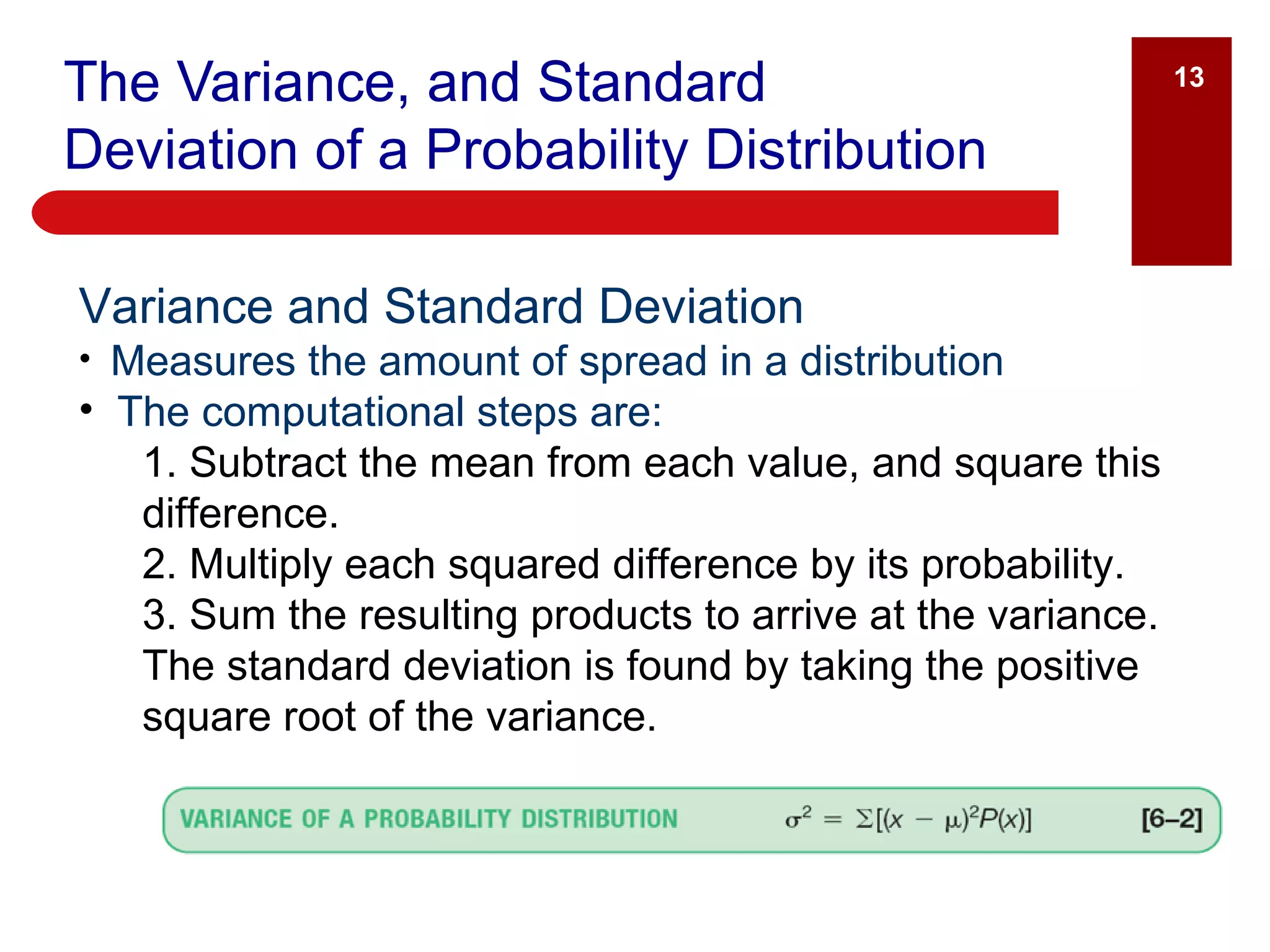
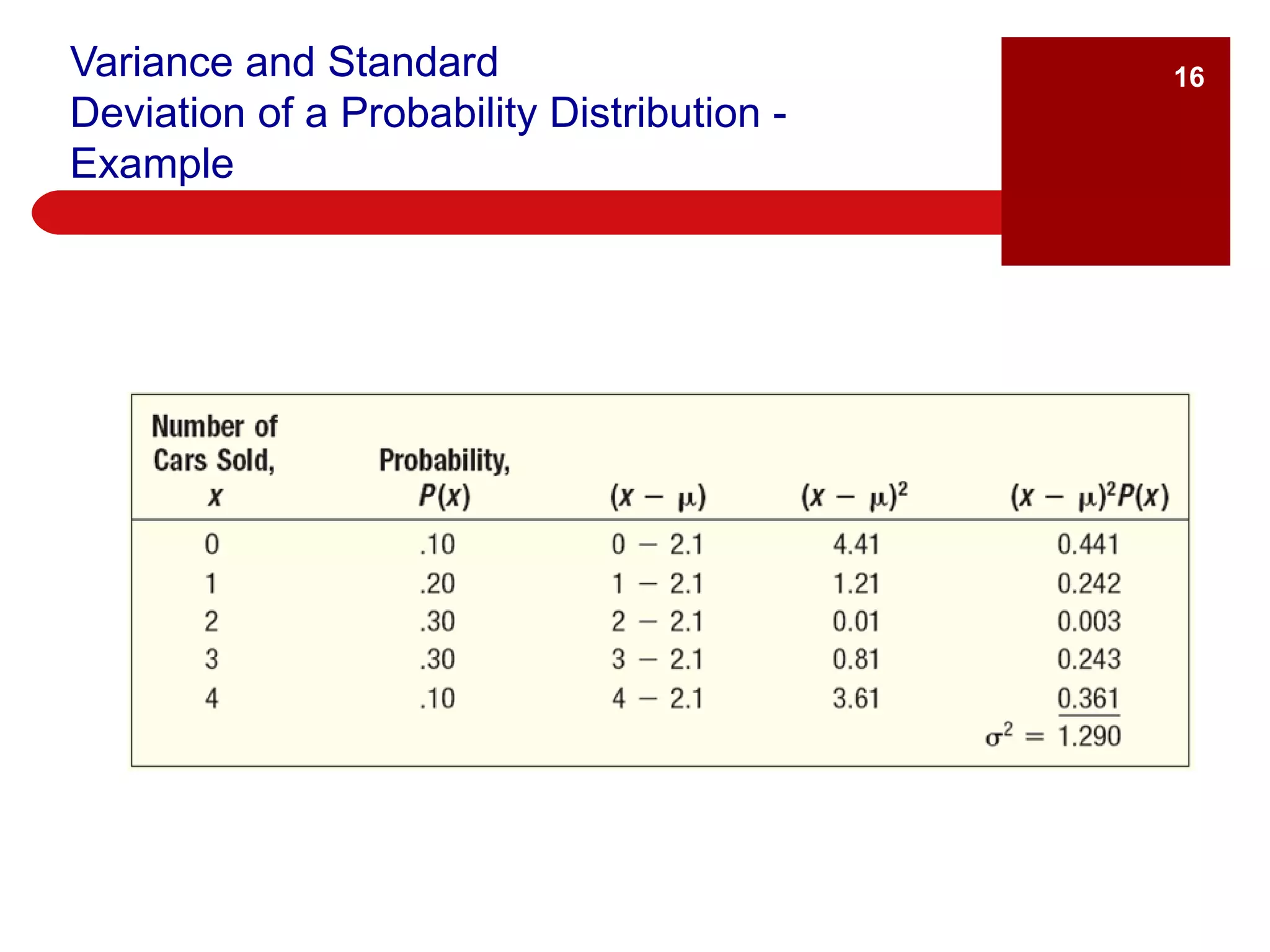
The Variance, and Standard Deviation of a Probability Distribution Variance and Standard Deviation Measures the amount of spread in a distribution The computational steps are: 1. Subtract the mean from each value, and square this difference. 2. Multiply each squared difference by its probability. 3. Sum the resulting products to arrive at the variance. The standard deviation is found by taking the positive square root of the variance.
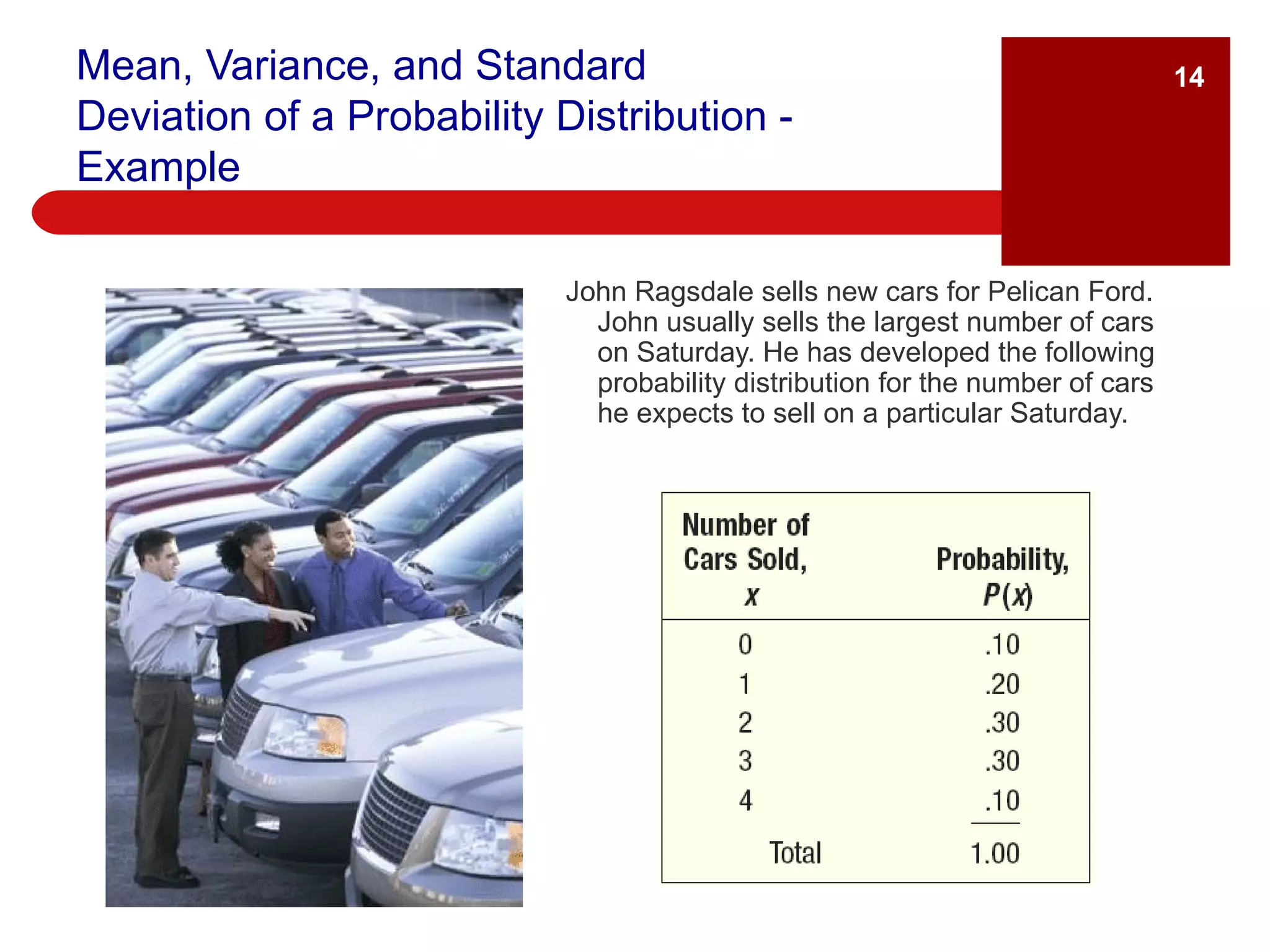
Mean, Variance, and Standard Deviation of a Probability Distribution - Example John Ragsdale sells new cars for Pelican Ford. John usually sells the largest number of cars on Saturday. He has developed the following probability distribution for the number of cars he expects to sell on a particular Saturday.
Mean of a Probability Distribution - Example
Variance and Standard Deviation of a Probability Distribution - Example
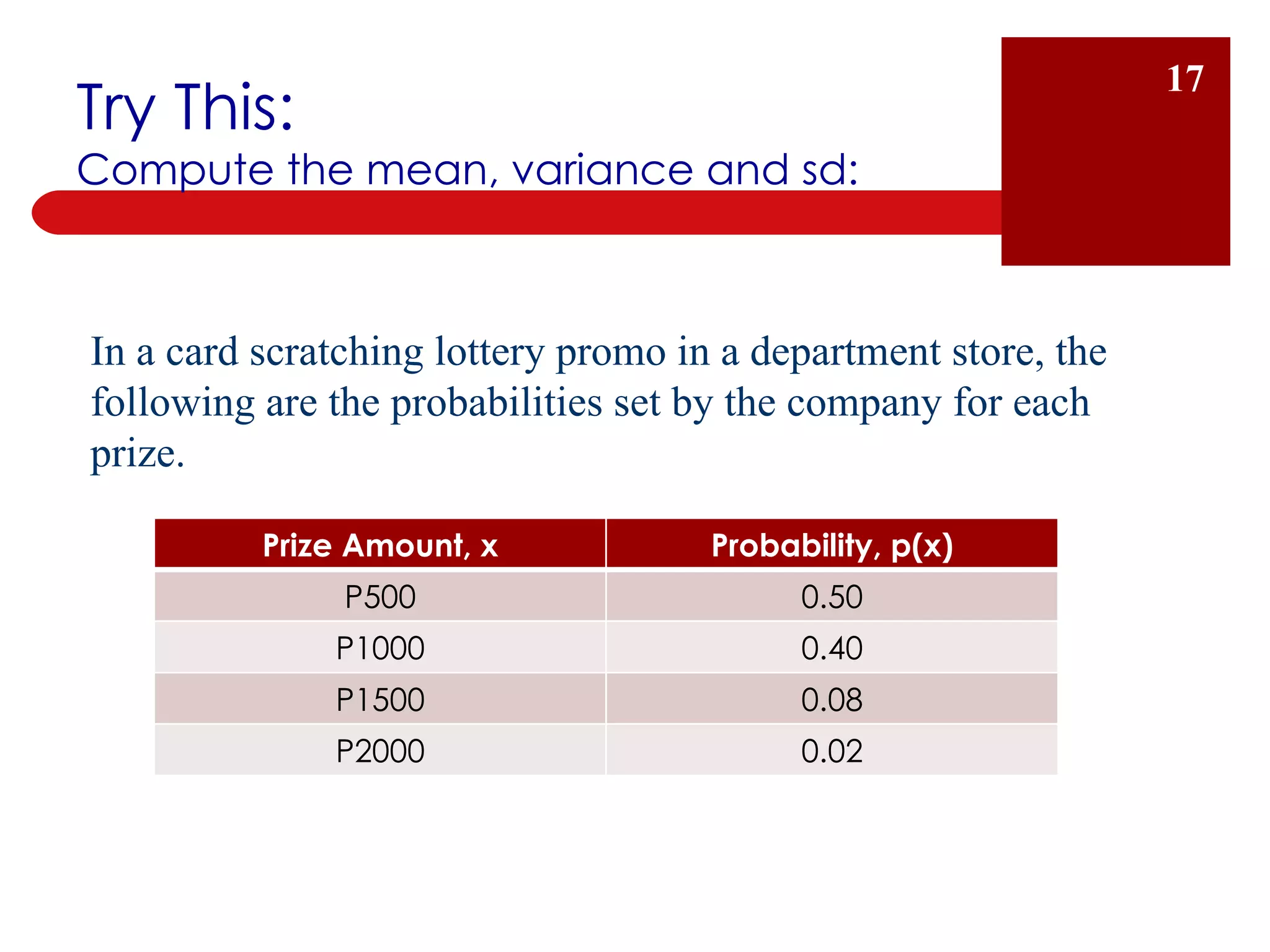
Try This: Compute the mean, variance and sd: In a card scratching lottery promo in a department store, the following are the probabilities set by the company for each prize. Prize Amount, x Probability, p(x) P500 0.50 P1000 0.40 P1500 0.08 P2000 0.02

Stat lesson 5.1 probability distributions

  • 1.
  • 2.
    GOALS Define theterms probability distribution and random variable. Distinguish between discrete and continuous probability distributions. Calculate the mean, variance, and standard deviation of a discrete probability distribution. Describe the characteristics of and compute probabilities using the binomial probability distribution. Describe the characteristics of and compute probabilities using the hypergeometric probability distribution. Describe the characteristics of and compute probabilities using the Poisson
  • 3.
    What is aProbability Distribution? Experiment: Toss a coin three times. Observe the number of heads. The possible results are: zero heads, one head, two heads, and three heads. What is the probability distribution for the number of heads?
  • 4.
    Probability Distribution ofNumber of Heads Observed in 3 Tosses of a Coin
  • 5.
    Characteristics of aProbability Distribution
  • 6.
    Random Variables Randomvariable - a quantity resulting from an experiment that, by chance, can assume different values.
  • 7.
    EXAMPLE EXPERIMENT Rollinga die Monitoring daily absences per week Tossing 2 coins and recording number or heads RANDOM VARIABLE Number of dots Number of absentees per day Number of heads
  • 8.
    Types of RandomVariables Discrete Random Variable can assume only certain clearly separated values. It is usually the result of counting something Continuous Random Variable can assume an infinite number of values within a given range. It is usually the result of some type of measurement
  • 9.
    Discrete Random Variables- Examples The number of students in a class. The number of children in a family. The number of cars entering a carwash in a hour. Number of home mortgages approved by Coastal Federal Bank last week.
  • 10.
    Continuous Random Variables- Examples The distance students travel to class. The time it takes an executive to drive to work. The length of an afternoon nap. The length of time of a particular phone call.
  • 11.
    Features of aDiscrete Distribution The main features of a discrete probability distribution are: The sum of the probabilities of the various outcomes is 1.00. The probability of a particular outcome is between 0 and 1.00. The outcomes are mutually exclusive.
  • 12.
    The Mean ofa Probability Distribution MEAN The mean is a typical value used to represent the central location of a probability distribution. The mean of a probability distribution is also referred to as its expected value.
  • 13.
    The Variance, andStandard Deviation of a Probability Distribution Variance and Standard Deviation Measures the amount of spread in a distribution The computational steps are: 1. Subtract the mean from each value, and square this difference. 2. Multiply each squared difference by its probability. 3. Sum the resulting products to arrive at the variance. The standard deviation is found by taking the positive square root of the variance.
  • 14.
    Mean, Variance, andStandard Deviation of a Probability Distribution - Example John Ragsdale sells new cars for Pelican Ford. John usually sells the largest number of cars on Saturday. He has developed the following probability distribution for the number of cars he expects to sell on a particular Saturday.
  • 15.
    Mean of aProbability Distribution - Example
  • 16.
    Variance and StandardDeviation of a Probability Distribution - Example
  • 17.
    Try This: Computethe mean, variance and sd: In a card scratching lottery promo in a department store, the following are the probabilities set by the company for each prize. Prize Amount, x Probability, p(x) P500 0.50 P1000 0.40 P1500 0.08 P2000 0.02