Raising your profile in a
      digital world


          PRISM 2011: Postgraduate Researchers In Science Medicine conference
                                                                 04 July 2011
your thoughts...
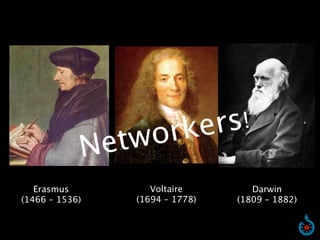
going back in time
before we went digital
using the technology
    of their times
o rker s!
            Ne tw
   Erasmus         Voltaire        Darwin
(1466 – 1536)   (1694 – 1778)   (1809 – 1882)
fast forward >>
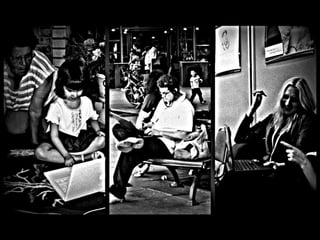
21st century
Digital Scholarship
           why?
      your thoughts...
4 dimensions
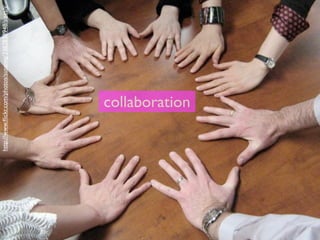
http://www.flickr.com/photos/susanvg/3382838948/sizes/l/


               collaboration
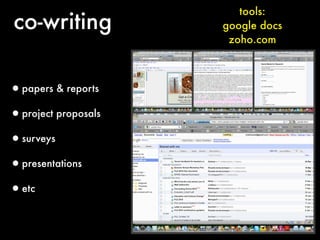
tools:
co-writing           google docs
                      zoho.com


•papers & reports
•project proposals
•surveys
•presentations
•etc
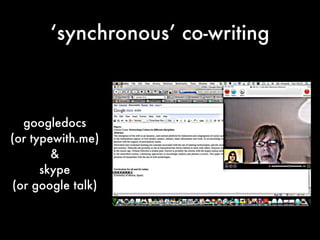
‘synchronous’ co-writing


  googledocs
(or typewith.me)
        &
      skype
(or google talk)
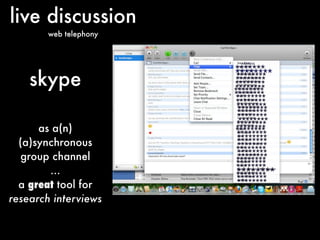
live discussion
        web telephony


    skype

      as a(n)
  (a)synchronous
   group channel
        ...
  a great tool for
research interviews
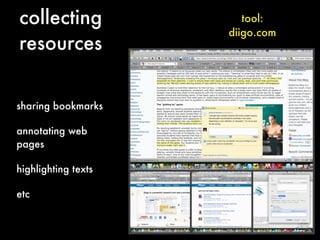
collecting              tool:
                     diigo.com
resources


sharing bookmarks

annotating web
pages

highlighting texts

etc
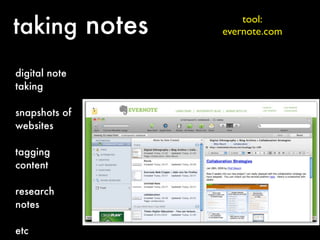
taking notes       tool:
               evernote.com


digital note
taking

snapshots of
websites

tagging
content

research
notes

etc
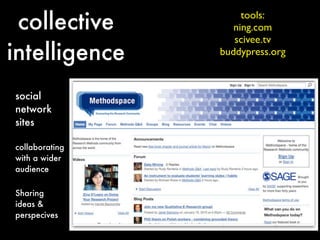
collective          tools:
                   ning.com
                   scivee.tv
intelligence    buddypress.org


social
network
sites

collaborating
with a wider
audience

Sharing
ideas &
perspecives
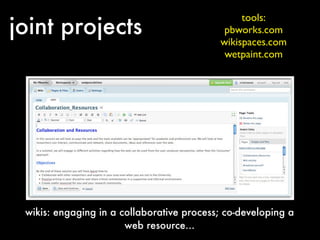
joint projects
                                                tools:
                                            pbworks.com
                                           wikispaces.com
                                            wetpaint.com


 wikis: engaging in a collaborative process; co-developing a
                       web resource...
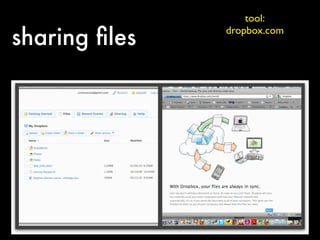
tool:

sharing files   dropbox.com
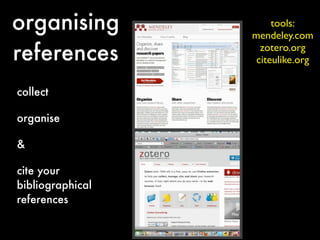
organising             tools:
                  mendeley.com

references          zotero.org
                   citeulike.org


collect

organise

&

cite your
bibliographical
references
communication
 dissemination
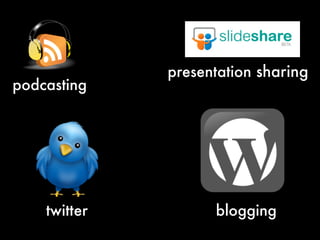
presentation sharing
podcasting


    twitter         blogging
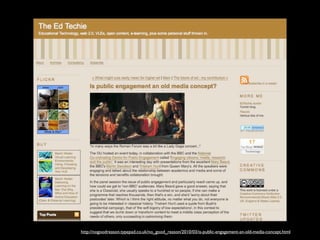
http://tinyurl.com/5c5eck   public engagement
http://nogoodreason.typepad.co.uk/no_good_reason/2010/03/is-public-engagement-an-old-media-concept.html
Academics to 'embrace Wikipedia'
http://www.bbc.co.uk/news/education-12809944
Don’t only push or pull


  Communicate
It’s about dialog!
http://www.flickr.com/photos/56695083@N00/4464828517/sizes/l/


                                Identity & Reputation
Presence
personal level
but not necessarily on your
          own!
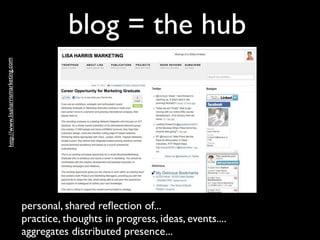
blog = the hub
http://www.lisaharrismarketing.com


                                     personal, shared reflection of...
                                     practice, thoughts in progress, ideas, events....
                                     aggregates distributed presence...
a story


from twitter and beyond about
    Open Thinking
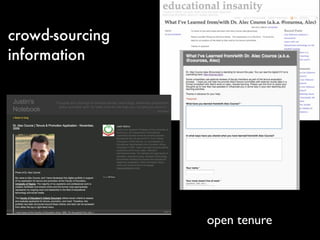
crowd-sourcing
information


                 open tenure
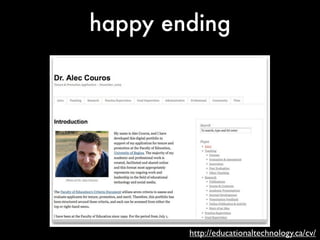
happy ending


        http://educationaltechnology.ca/cv/
open discussion
final thoughts
Cultivating a network
       where to start?
If we were to start designing a strategy for communication
and dissemination  of research from scratch, based on what
is available today, without any constraints of internal
structures or external regulating bodies, what would it look
like?

     Cameron Neylon, RIN Event (London, November 2010)


                                                          See discussion here:
                                  http://knowmansland.com/learningpath/?p=772
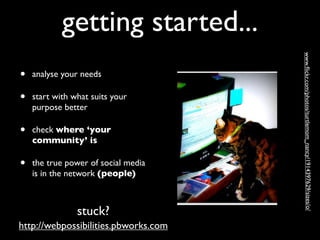
getting started...


                                      www.flickr.com/photos/turtlemom_nancy/1914397629/sizes/o/ 
•   analyse your needs

•   start with what suits your
    purpose better

•   check where ‘your
    community’ is

•   the true power of social media
    is in the network (people)


                stuck?
http://webpossibilities.pbworks.com
Prism 2011

Prism 2011

Editor's Notes

  • #2 \n
  • #3 \n
  • #4 \n
  • #5 \n
  • #6 \nVoltaire as an example of the statement above. The Philosopher was probably one of the most networked scholars of his time, with more than a thousand European correspondents\nNetworks of correspondence was quite useful during the Classic Age as a form of establishing and maintaining connections with the outside world in a rather informal, yet meaningful way. Other thinkers of that time also made use of the Epistolary genre to establish their networks beyond their local whereabouts: Erasmus and more recently Darwin \nCheck Republic of Letters: http://www.youtube.com/watch?v=nw0oS-AOIPE \nCharles Darwin corresponded with over 2000 individuals worldwide, exchanging his views on scientific matters, his health and family life... in http://great-scientists.suite101.com/article.cfm/charles_darwins_letters \n\nRead more at Suite101: Charles Darwin's Letters: Darwin Correspondence Project Expands his World Wide Web http://great-scientists.suite101.com/article.cfm/charles_darwins_letters#ixzz0p5hMEPG6\n\nDarwin corresponded widely, asking for information and opinions, checking facts. He was very scrupulous in giving credit, just look at the footnotes in his books. But actually the flow was not one-way. Yes, Darwin was a phenomenal networker. He would probably have had a blog. in http://agro.biodiver.se/2009/02/blogging-the-big-birthday-darwin-the-seed-networker/ \n
  • #7 \n
  • #8 \n
  • #9 \n
  • #10 \n
  • #11 \n
  • #12 \n
  • #13 \n
  • #14 \n
  • #15 \n
  • #16 \n
  • #17 \n
  • #18 \n
  • #19 \n
  • #20 \n
  • #21 \n
  • #22 \n
  • #23 \n
  • #24 \n
  • #25 \n
  • #26 \n
  • #27 \n
  • #28 \n
  • #29 \n
  • #30 \n
  • #31 \n
  • #32 \n
  • #33 \n
  • #34 \n
  • #35 \n
  • #36 \n
  • #37 \n
  • #38 \n
  • #39 \n
  • #40 \n
  • #41 \n
  • #42 \n
  • #43 \n
  • #44 \n