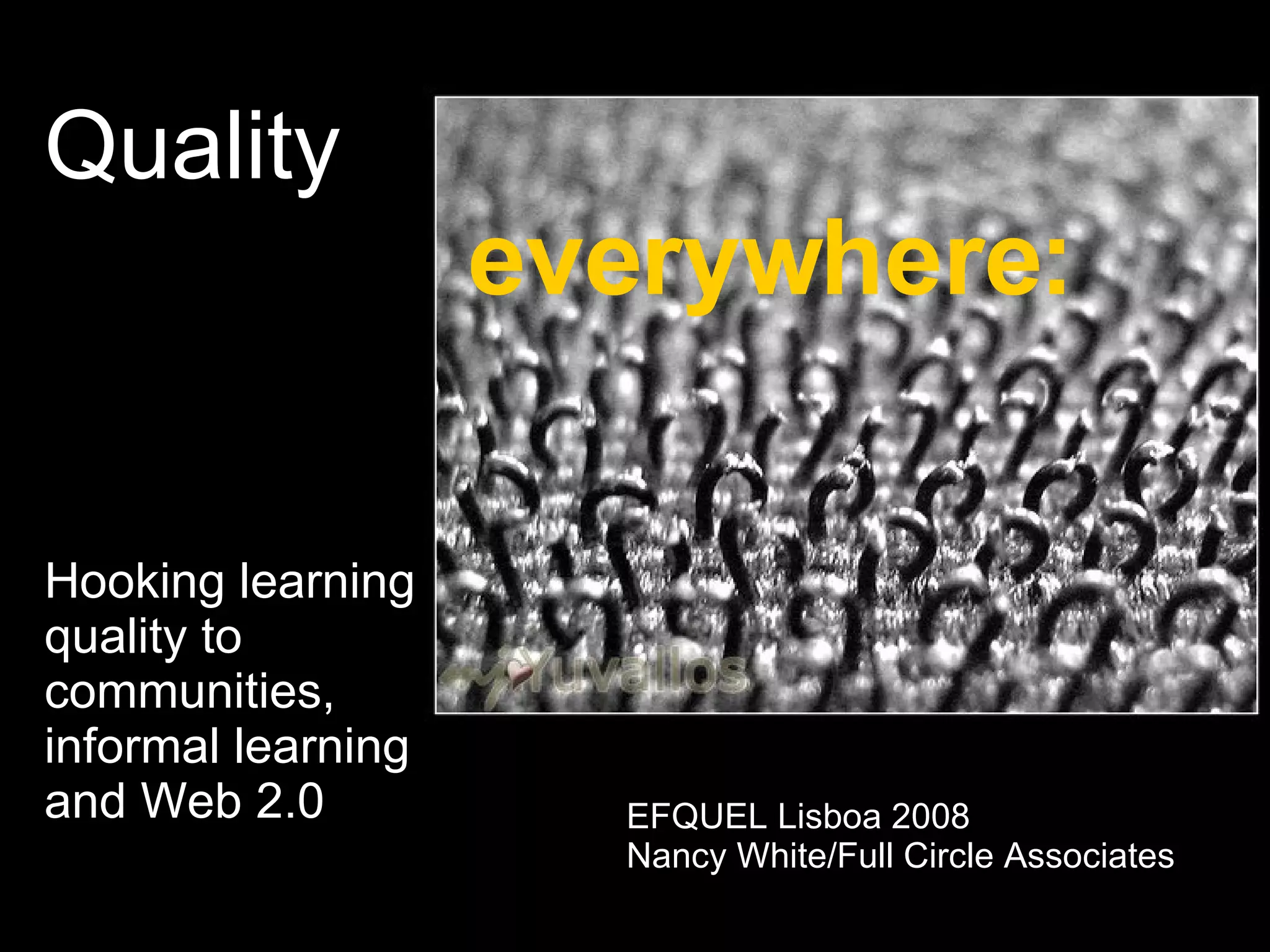
Quality    everywhere: Hooking learning  quality to  communities,  informal learning  and Web 2.0 EFQUEL Lisboa 2008 Nancy White/Full Circle Associates
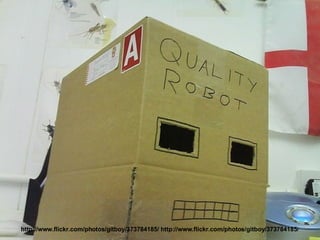
http://www.flickr.com/photos/gitboy/373784185/ http://www.flickr.com/photos/gitboy/373784185 /
1. Some  context 2. Some  strategies 3.  Many   questions
http://www.plexusinstitute.org/complexity/index.cfm?id=3
 
What needs to grow beyond the  boundaries of formal learning? http://www.flickr.com/photos/dsevilla/189528500/in/set-1368427/
Beyond our curriculum and courses… http://www.flickr.com/photos/stevewall/206426067 /
Beyond  our “classrooms” http://www.flickr.com/photos/stevewall/206426067 /
Beyond our institutions… http://www.flickr.com/photos/stevewall/206426067 /
What is emerging?
The  buzz part 1  social learning  in a  networked world
 
http://www.flickr.com/photos/lynetter/653541864/in/set-72057594139269787/ Photo via Flickr CC  www.flickr.com/photos/azlijamil01/231592469/  
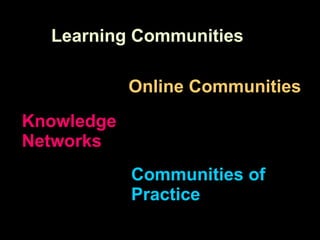
Learning Communities Knowledge Networks Communities of Practice Online Communities
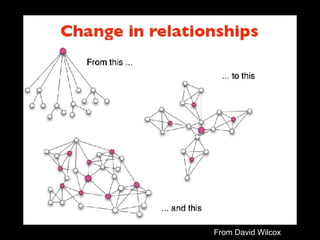
From David Wilcox
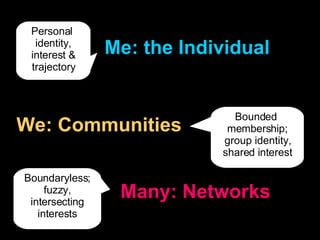
Many: Networks We:   Communities Me: the Individual Personal  identity, interest & trajectory Bounded  membership; group identity, shared interest Boundaryless; fuzzy, intersecting interests
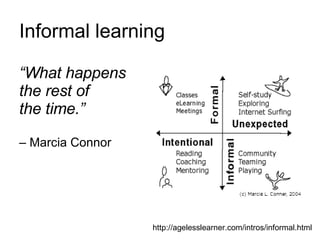
Informal learning “What happens  the rest of  the time.”   – Marcia Connor http://agelesslearner.com/intros/informal.html
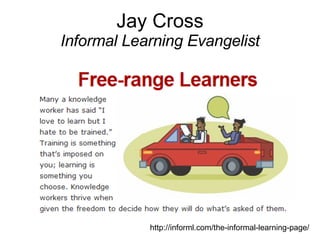
Jay Cross Informal Learning Evangelist http://informl.com/the-informal-learning-page/
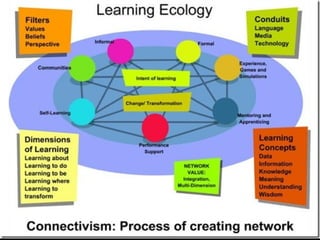
Connectivism – George Siemens Connectivism : A Learning Theory for the Digital Age   http://www.elearnspace.org/Articles/connectivism.htm
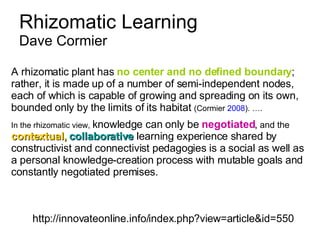
Rhizomatic Learning  Dave Cormier http://innovateonline.info/index.php?view=article&id=550 A rhizomatic plant has  no center and no defined boundary ; rather, it is made up of a number of semi-independent nodes, each of which is capable of growing and spreading on its own, bounded only by the limits of its habitat  (Cormier  2008 ). …. In the rhizomatic view,  knowledge can only be  negotiated ,  and the  contextual,   collaborative  learning experience shared by constructivist and connectivist pedagogies is a social as well as a personal knowledge-creation process with mutable goals and constantly negotiated premises.
The rhizome metaphor, which represents a critical leap in coping with the  loss of a canon against which to compare, judge, and value knowledge,  may be particularly apt as a model for disciplines on the  bleeding edge  where the canon is fluid and  knowledge is a  moving target . Thank you, Dave!
 
http://www.flickr.com/photos/aphrodite/66231929/ The  buzz  part 2  “Web 2.0”
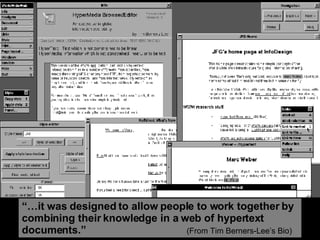
“… it was designed to allow people to work together by combining their knowledge in a web of hypertext documents.”   (From Tim Berners-Lee’s Bio)
The simplest thing that  could possibly work… Ward Cunningham, inventor of the wiki
http://www.flickr.com/photos/lynetter/483849193/in/set-72057594139269787/
 
Stephen Downes, August 13 th   One Laptop Per Child, Reviewed by 12-Year-Old   Pretty good review. The author, a 12-year old with previous computer experience, puts the computers through its paces before writing. While satisfied with the programs and the usability, he complains that the computer is too slow and the battery doesn't last long enough. Don't skip the comments, as the (adult) readers alternate between being impressed by the review and not believing that a 12-year old wrote it. It's worth remarking (again) that children today spend their days reading and writing on the internet. So a literate review from a 12-year old should not be a surprise. SG, Freedom to Tinker August 13, 2007 [ Link ] [Tags:  Usability ,  Experi   ence ] [ Comment ] http://www.downes.ca/cgi-bin/page.cgi?post=41279
Tech + Social: Technology has  fundamentally  changed how we can  be together
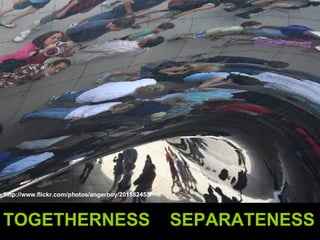
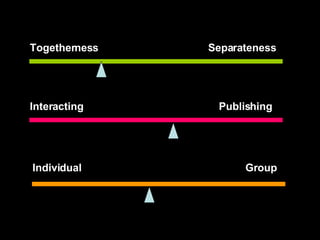
TOGETHERNESS  SEPARATENESS http://www.flickr.com/photos/angerboy/201582453/
Community time Community space Shifting engagement….
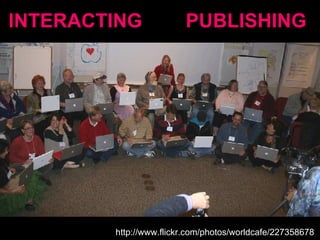
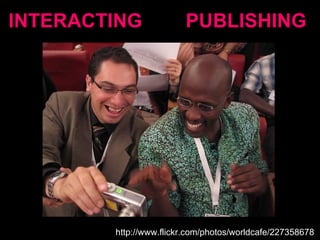
http://www.flickr.com/photos/worldcafe/227358678 / INTERACTING  PUBLISHING
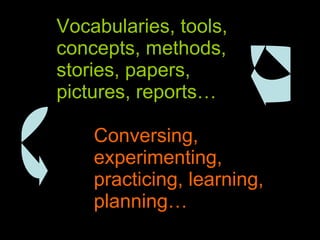
Vocabularies, tools, concepts, methods, stories, papers, pictures, reports… Conversing, experimenting, practicing, learning, planning…
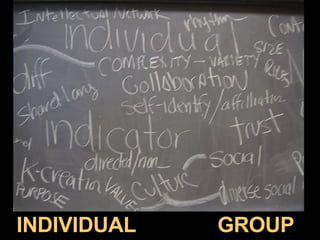
INDIVIDUAL  GROUP
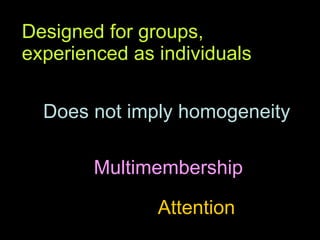
Designed for groups, experienced as individuals Does not imply homogeneity Multimembership Attention
http://www.flickr.com/photos/philwalter/348238734/ Strategies and Tips
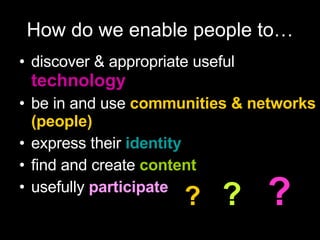
How do we enable people to… discover & appropriate useful  technology be in and use  communities & networks (people) express their   identity   find and create  content usefully  participate ?   ?   ?
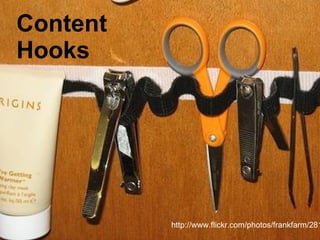
Build in  HOOKS! (think  velcro !)
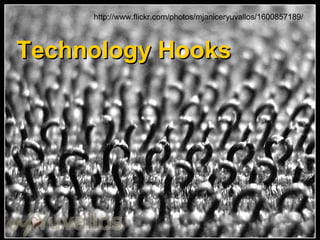
http://www.flickr.com/photos/mjaniceryuvallos/1600857189/ Technology Hooks
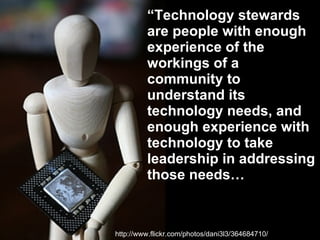
http://www.flickr.com/photos/dani3l3/364684710/ “ Technology stewards are people with enough experience of the workings of a community to understand its technology needs, and enough experience with technology to take leadership in addressing those needs…
Stewardship typically includes selecting and configuring technology, as well as supporting its use in the practice of the community.” Wenger, White and Smith, 2007
Togetherness  Separateness Interacting  Publishing Individual  Group
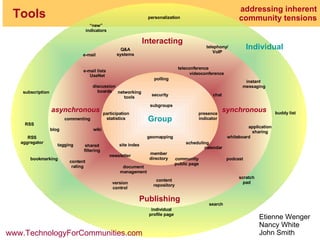
addressing inherent community tensions Tools Group asynchronous discussion  boards teleconference chat instant  messaging member directory wiki blog telephony/ VoIP individual profile page e-mail e-mail lists scratch pad RSS “ new” indicators subscription podcast content repository presence indicator buddy list security Q&A systems RSS aggregator newsletter calendar videoconference application sharing whiteboard site index participation statistics search subgroups personalization community public page version control document management UseNet content rating scheduling polling commenting networking tools tagging bookmarking shared filtering geomapping www.TechnologyForCommunities.com Etienne Wenger Nancy White John Smith Individual Interacting Publishing synchronous Group asynchronous
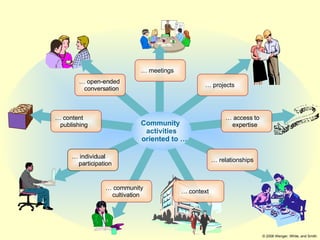
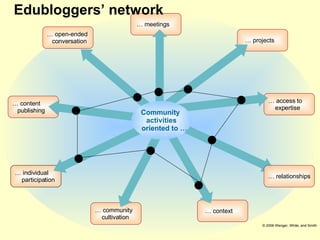
Community  activities   oriented to … …  meetings …  context …  community cultivation …  access to expertise …  projects …  open-ended   conversation …  content   publishing …  individual participation …  relationships © 2006 Wenger, White, and Smith
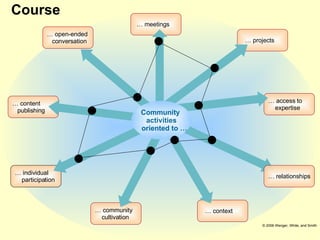
…  meetings …  access to expertise …  context …  community cultivation …  projects …  open-ended   conversation …  content   publishing …  individual participation …  relationships © 2006 Wenger, White, and Smith Community  activities   oriented to … Course
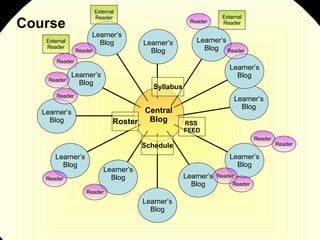
Learner’s Blog Learner’s Blog Learner’s Blog Learner’s Blog Learner’s Blog Learner’s Blog Learner’s Blog Learner’s Blog Learner’s Blog Learner’s Blog Learner’s Blog Learner’s Blog Central Blog External Reader External Reader RSS  FEED Reader Reader Reader Reader Reader Reader Reader Reader Reader Reader Reader Reader External Reader Roster Syllabus Schedule Course
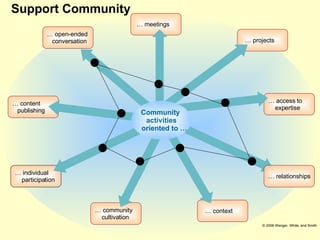
Support Community …  meetings …  access to expertise …  context …  community cultivation …  projects …  open-ended   conversation …  content   publishing …  individual participation …  relationships © 2006 Wenger, White, and Smith Community  activities   oriented to …
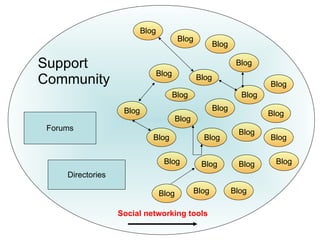
Forums Directories Blog Blog Blog Blog Blog Blog Blog Blog Blog Blog Blog Blog Blog Blog Blog Blog Blog Blog Blog Blog Blog Blog Blog Blog Social networking tools Support Community
…  meetings …  access to expertise …  context …  community cultivation …  projects …  open-ended   conversation …  content   publishing …  individual participation …  relationships © 2006 Wenger, White, and Smith Community  activities   oriented to … Edubloggers’ network
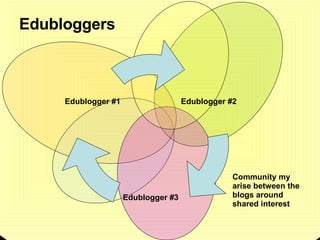
Edubloggers Community my arise between the blogs around shared interest Edublogger #2 Edublogger #3 Edublogger #1
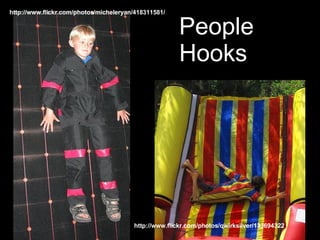
People Hooks http://www.flickr.com/photos/micheleryan/418311581/ http://www.flickr.com/photos/qwirksilver/133694322 /
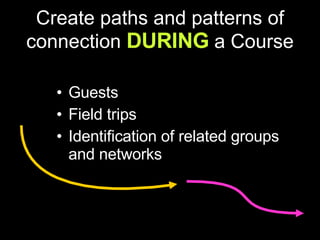
Create paths and patterns of connection  DURING  a Course Guests Field trips Identification of related groups and networks
 
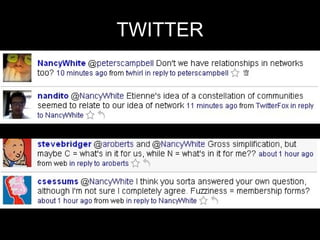
TWITTER
 
 
Identity hooks???
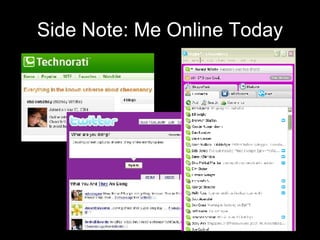
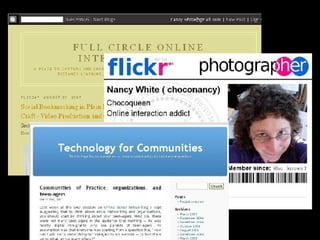
Side Note: Me Online Today


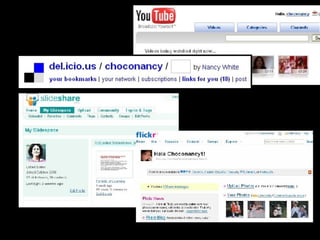
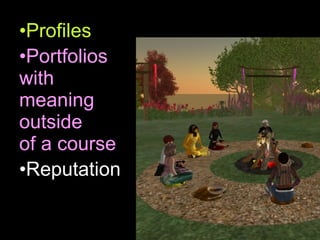
Profiles Portfolios  with  meaning  outside  of a course  Reputation
Content  Hooks http://www.flickr.com/photos/frankfarm/281433729 /
http://www.flickr.com/photos/assbach/253218488/ SEARCH
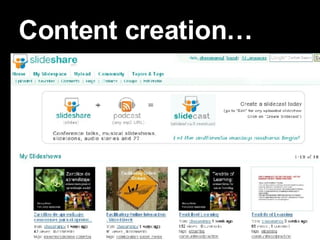
Content creation…
 
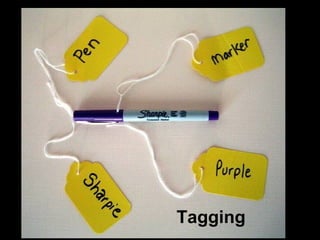
Tagging
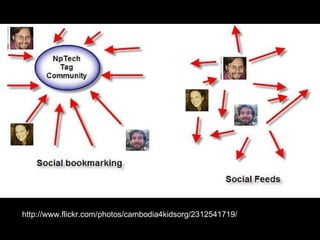
http://www.flickr.com/photos/cambodia4kidsorg/2312541719/
Participation hooks (I was tempted to say practice…)
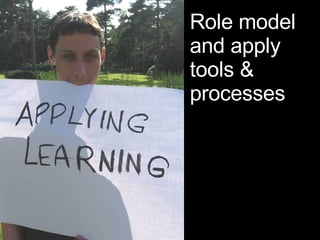
Role model and apply  tools & processes
Adoption takes time:  Wiki Wednesday & FAQ Project
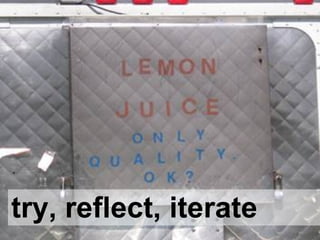
try, reflect, iterate
http://www.flickr.com/photos/nicmcphee/418922552/in/set-72157600218310366 / PLAY!
http://www.flickr.com/photos/mjaniceryuvallos/1600857189/ The velcro of bridging to informal learning… Technology People  Content Identity   Practice
 
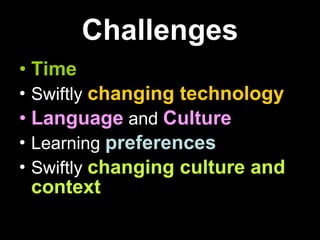
Challenges Time Swiftly  changing technology Language  and  Culture Learning  preferences Swiftly  changing culture and context
 
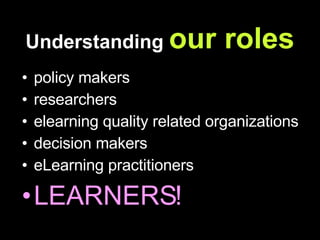
Understanding  our roles policy makers researchers elearning quality related organizations decision makers eLearning practitioners LEARNERS!
Evolving a “Quality Literacy” What does the quality  co-construction  of learning mean? … solo learning? What are the tensions between  quantity and quality ? What constitutes  quality communities and networks ? Is it  worth it ?
Tackling the barriers? Tickling the edge of  organizational change Can we take a  whole systems  approach? Leadership  walking the talk
 
Epilogue Resources http://onlinefacilitation.wikispaces.com/Quality+in+Informal+and+Community+Learning Or  http://tinyurl.com/4sff2k  Contact Nancy White nancyw at fullcirc dot com http://www.fullcirc.com http://www.flickr.com/photos/poagao/527259905/

Quality Everywhere in ELearning or Why Velcro Matters