





Digital
Literacies
&
Learning
Design
What are
Digital Literacies?
Your thoughts

http://www.flickr.com/photos/91903883@N00/2385264019
Digital literacies defines those who exhibit a
critical understanding and capability for
living, learning, and working in the digital
society. JISC, 2013
Critical understanding of …
Your thoughts

http://www.flickr.com/photos/91903883@N00/2385264019
Different, competing definitions of
digital literacies
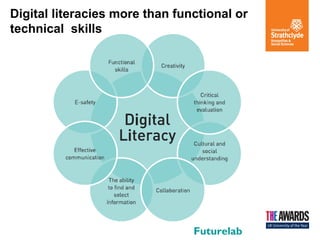
Digital literacies more than functional or
technical skills

Futurelab
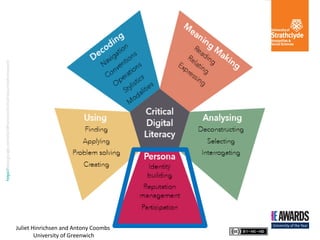
Juliet Hinrichsen and Antony Coombs
University of Greenwich

https://sites.google.com/site/dlframework/the5resourcesframework
Your thoughts

http://www.flickr.com/photos/91903883@N00/2385264019
How does this connect to
Curriculum for Excellence?
Within Curriculum for Excellence
literacy is defined as:

the set of skills which allows an individual to engage
fully in society and in learning, through the different
forms of language, and the range of texts, which
society values and finds useful.

Literacy across learning: principles and practice
http://www.scotland.gov.uk/Publications/2009/10/16155220/13
Current society; current perceptions
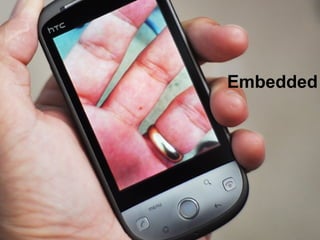
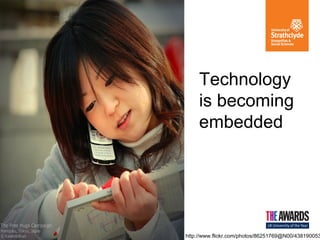
Technology
is becoming
embedded

http://www.flickr.com/photos/86251769@N00/438190053
It’s a way of life!

http://www.flickr.com/photos/40645538@N00/2796862756
Debatable?

http://www.flickr.com/photos/91903883@N00/2385264019
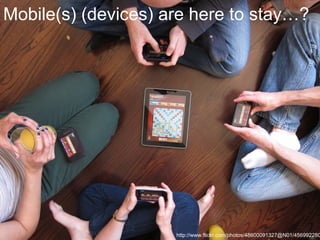
Mobile(s) (devices) are here to stay…?

http://www.flickr.com/photos/48600091327@N01/456992280
But...
Are we welcoming technology in
the Classroom?
How can we prepare the digital
literate learner?
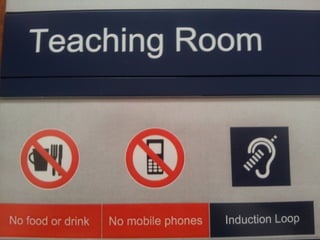
Digital dissonance
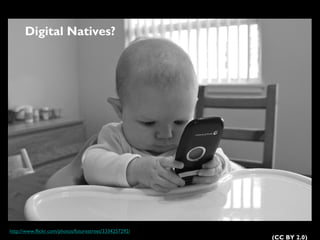
Digital Natives?

http://www.flickr.com/photos/futurestreet/3334257292/

(CC BY 2.0)
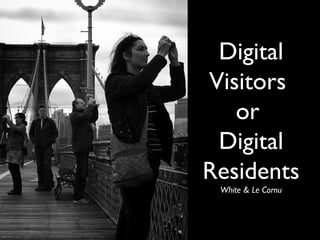
Digital
Visitors
or
Digital
Residents
White & Le Cornu
“Learners do not appear ‘to see beyond’
the immediately obvious functionality of
the technology and there is little evidence
of transfer”
Clark et al, 2008, p.68
“To

Pierre Bourdieu
1986

possess the machines,
[they] only need economic
capital; to appropriate them
and use them in accordance
with their specific purpose
[they] must have access to
embodied cultural capital,
either in person or by proxy”
Learning Design to drive
technology

http://www.flickr.com/photos/sovietuk/5861614/sizes/l/
*Not* technology to drive the
curriculum
Where to begin?
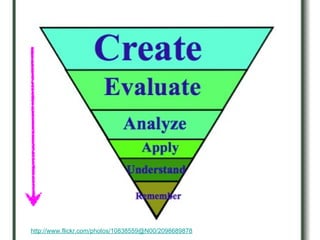
... with the end!
What are learners to achieve?
How are learners to engage with
their learning?
http://www.flickr.com/photos/10838559@N00/2098689730

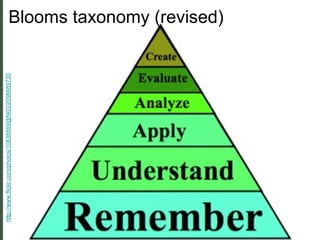
Blooms taxonomy (revised)
http://www.flickr.com/photos/10838559@N00/2098689878
http://www.flickr.com/photos/smallritual/505772429
Authentic learning requires
authentic assessment
Changing assessment
changing the way learners communicate their learning
Technology can support that
process...
... but cannot replace it!
as a book?
~Michael Coghlan

http://www.flickr.com/photos/tearsandrain/3526002850/in/faves-cristinacosta/
beyond the pdf...

http://www.flickr.com/photos/00015/5172592913/
Embedded
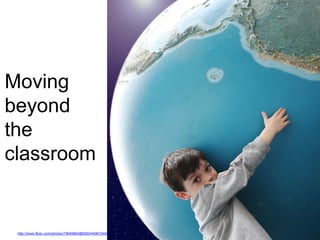
Moving
beyond
the
classroom

http://www.flickr.com/photos/73645804@N00/440672445
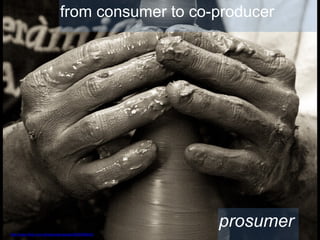
from consumer to co-producer

prosumer
http://www.flickr.com/photos/danisarda/3939008630/
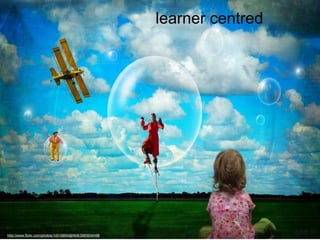
learner centred

http://www.flickr.com/photos/14516894@N08/3983934498
social

http://www.flickr.com/photos/vegas/814428452
The role of the teacher?

48
creating contexts

for learning

http://www.flickr.com/photos/44315708@N00/109795806
The digital classroom is a mind-set!

50
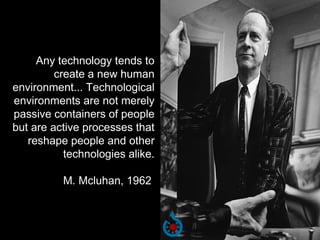
Any technology tends to
create a new human
environment... Technological
environments are not merely
passive containers of people
but are active processes that
reshape people and other
technologies alike.
M. Mcluhan, 1962
Creating new challenges

http://www.flickr.com/photos/21314760@N00/1583345201
Project based
learning

http://www.flickr.com/photos/71477195@N00/204879104
Promoting forms of inquiry

http://www.flickr.com/photos/72211347@N00/327122302#
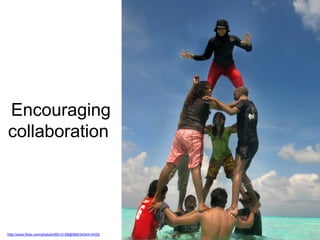
Encouraging
collaboration

http://www.flickr.com/photos/49512158@N00/3434414425
Unlocking potential

Digital Literacies & Learning Design

Editor's Notes

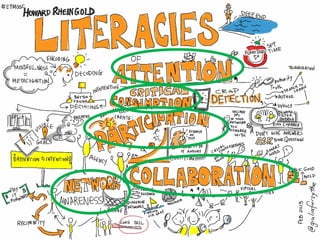
  • #10 Rheingold – 5 Web Literacies Metacognition (aware of our activity online) Attention  Awareness of attention curve and how you distribute this to diff media Participation  gives individuals a sense of belonging, of having an active and tangible input  practising active citizenship online. From consumer to producer Collaboration  working and learning with other people . Closely related to participation  leveraging collective intelligence Network Awareness  closely related to Global dimension of networks via digital technology “The technical networks amplify and extend the fundamental human capability of forming social networks” (Rheingold, 2010). Also about reputation management and networked individuality Critical Consumption  Knowing how to evaluate a source and making a educated guess about its origins and if it’s trustworthy
  • #11 In recognising the need to promote literacies for a world in transition, Hinrichsen and Coombs (2013) have developed a critical literacy framework mapping curriculum design into learner attributes. In doing so, they built on Luke and Freebody’s (2003) “Four Resource Model” that encapsulates a multi-literate requirement for reading through the use of the following roles: (1) Code breaker, (2) Meaning maker, (3) Text user and (4) Text critic by “adding a fifth resource, Persona, to accommodate the social and identity relations of the contemporary digital environment” (ibid, n/d) This resulted in the “Five Resource Framework”
  • #45 the glue of the learning
  • #46 from consumers to producers from content buyers to content creators / enhancing content
  • #47 boots motivation appeals to new initiatives
  • #48 personal as in private