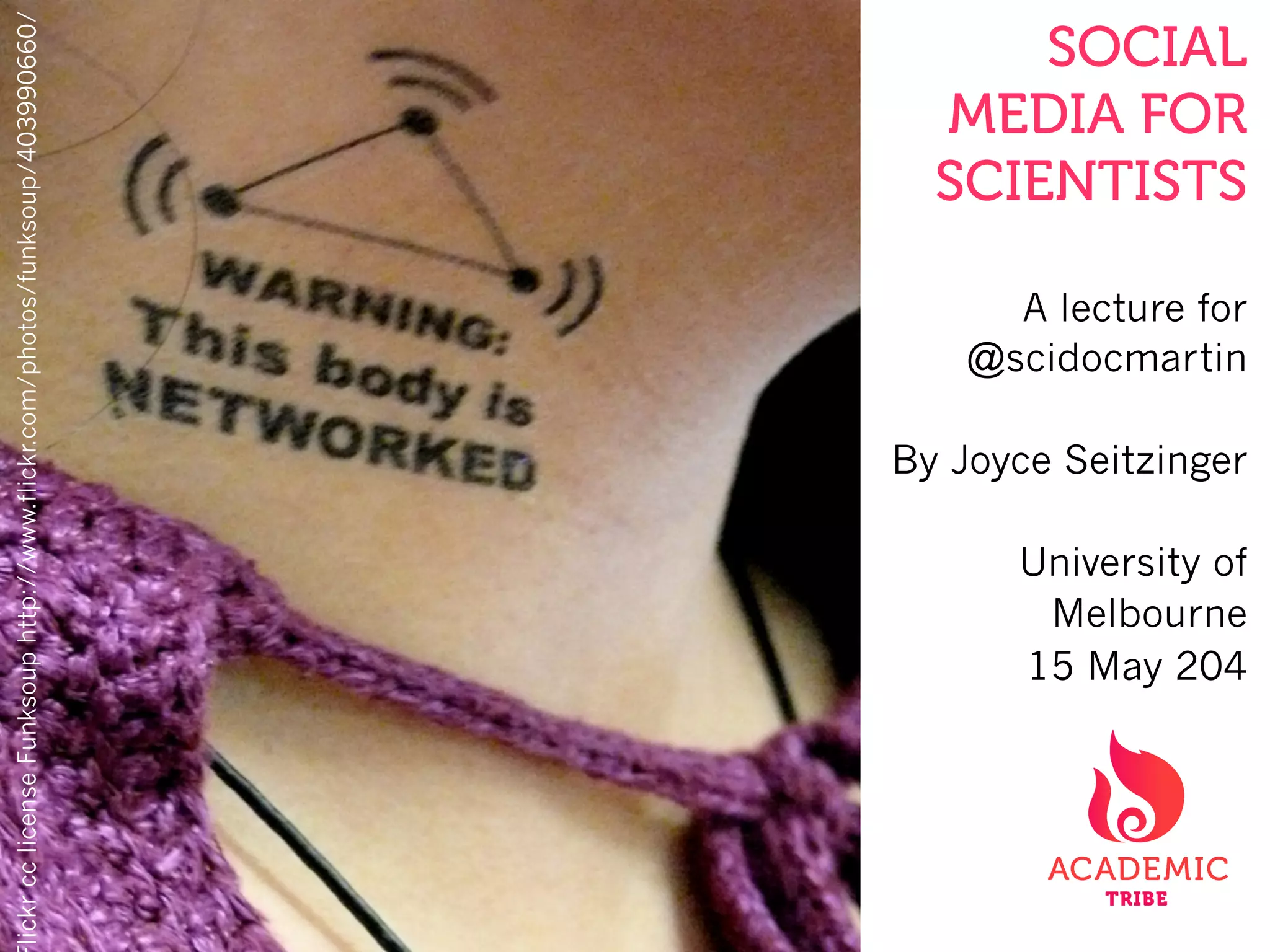
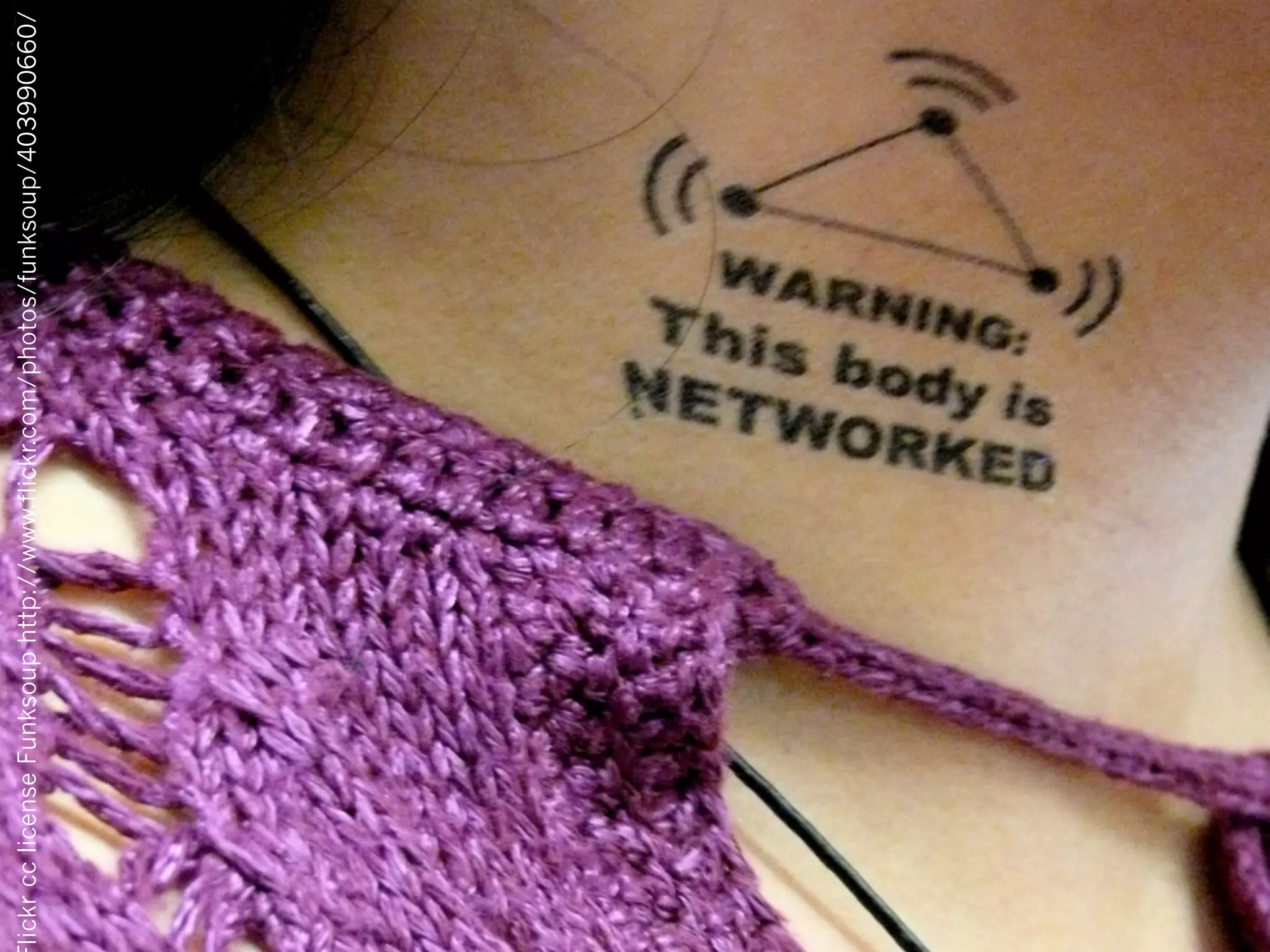
SOCIAL
MEDIA FOR
SCIENTISTS
A lecture for
@scidocmartin
By Joyce Seitzinger
University of
Melbourne
15 May 204
lickrcclicenseFunksouphttp://www.flickr.com/photos/funksoup/403990660/
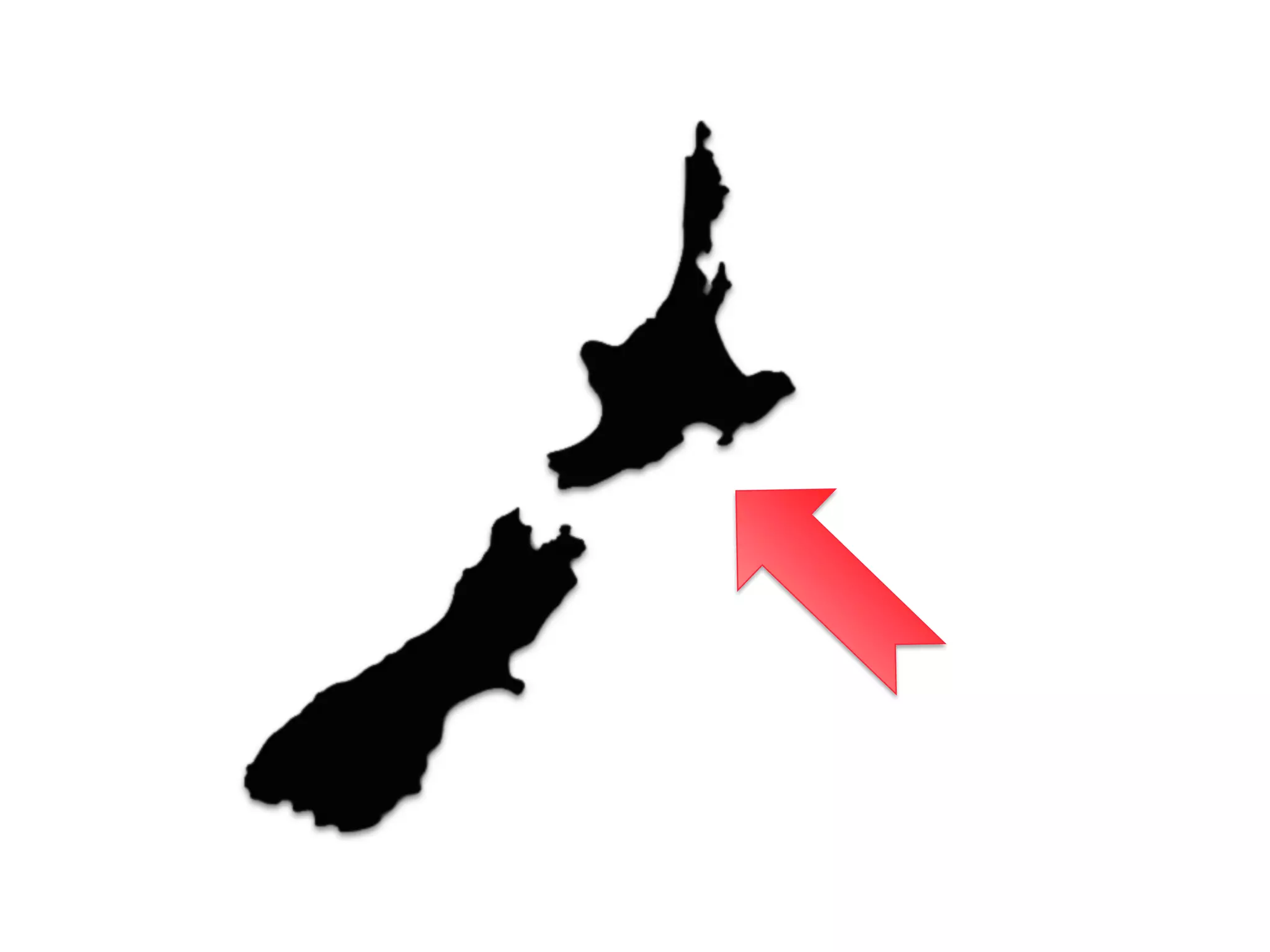
Kia Ora!
Goedemorgen!
Gidday!
Joyce Seitzinger
@catspyjamasnz
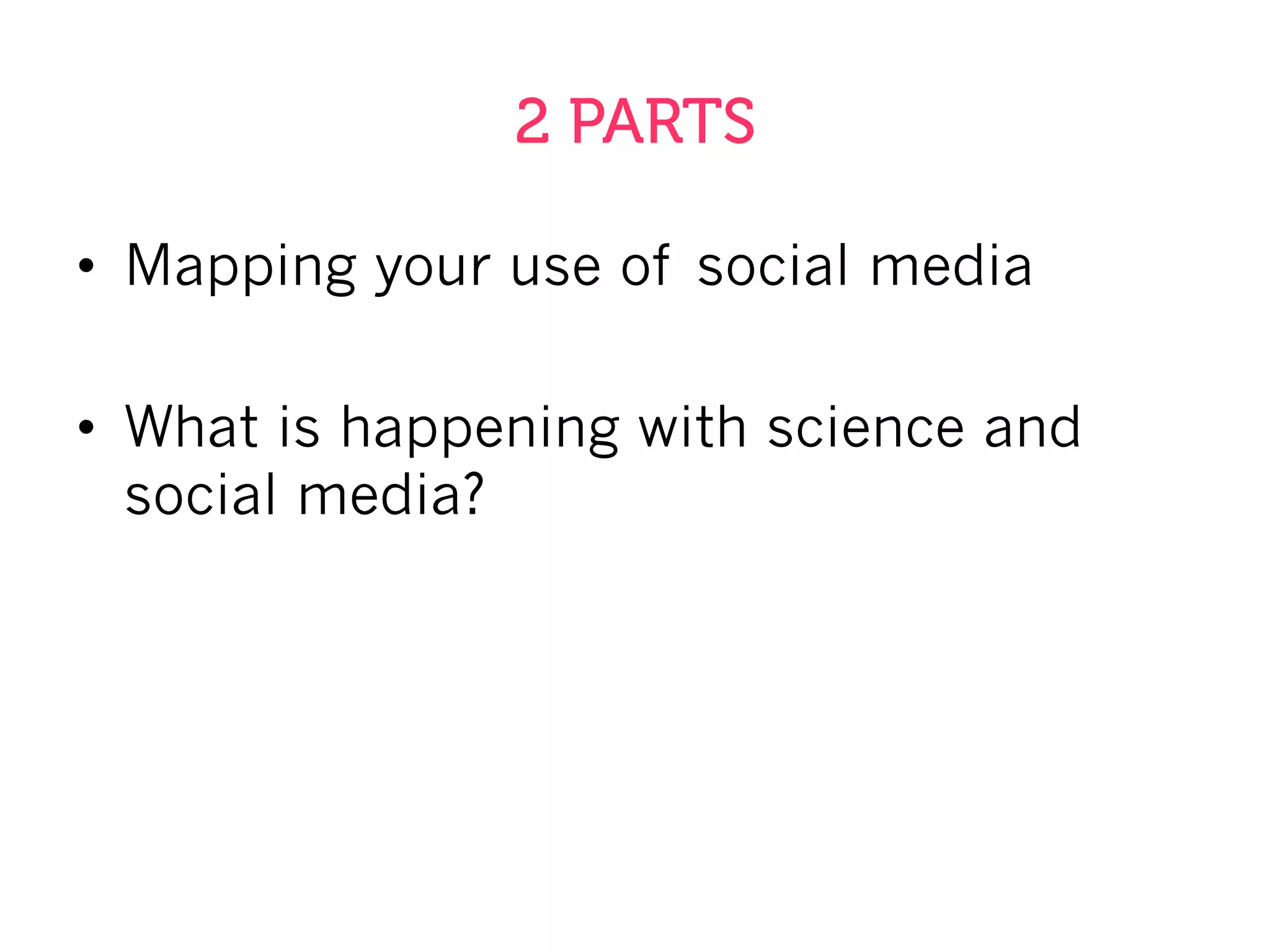
2 PARTS
•  Mapping your use of social media
•  What is happening with science and
social media?
LINK TO DIGITAL HANDOUT
http://tiny.cc/scidocmartin
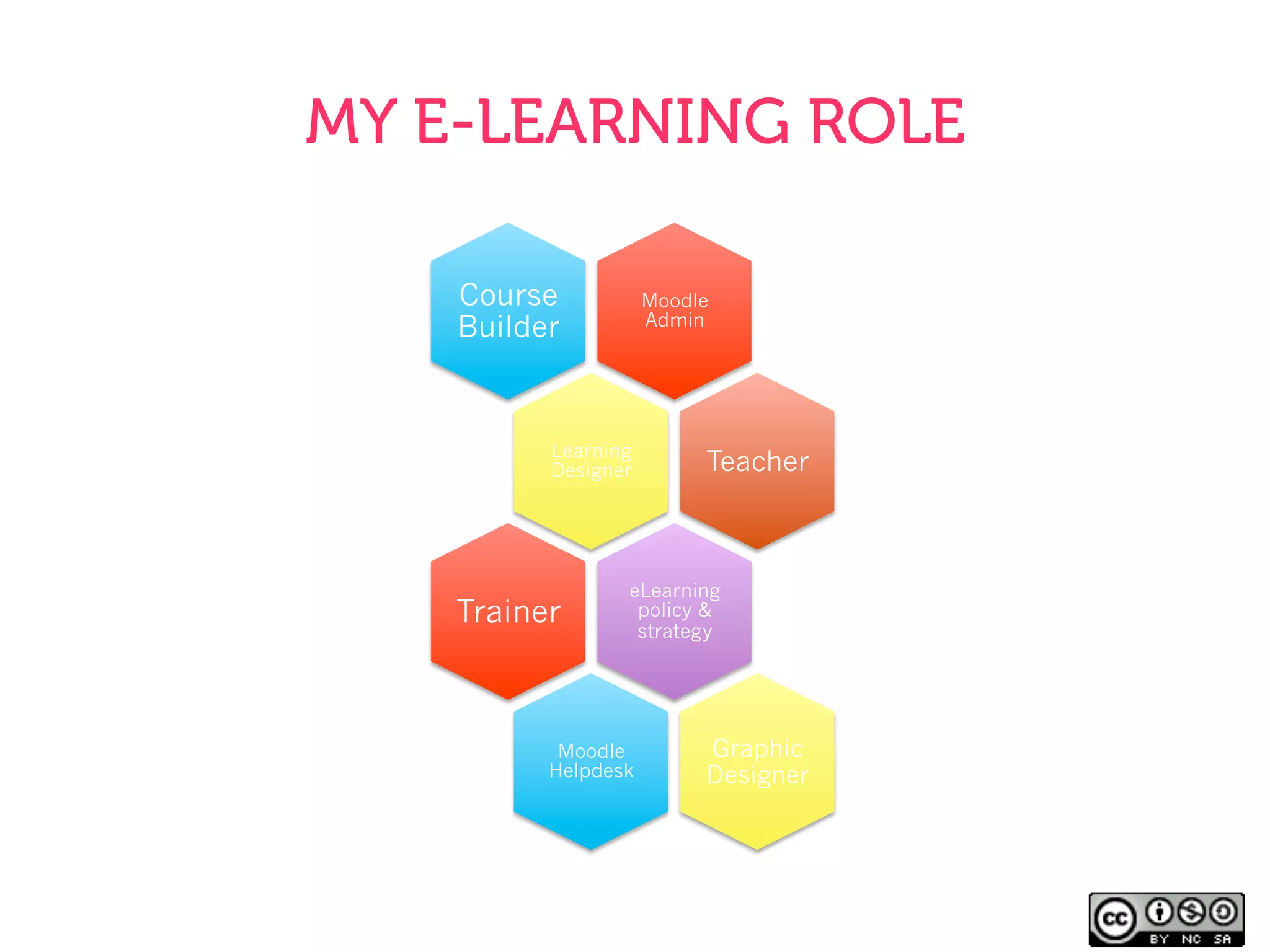
MY E-LEARNING ROLE
Moodle
Admin
Course
Builder
Learning
Designer Teacher
eLearning
policy &
strategy
Trainer
Moodle
Helpdesk
Graphic
Designer
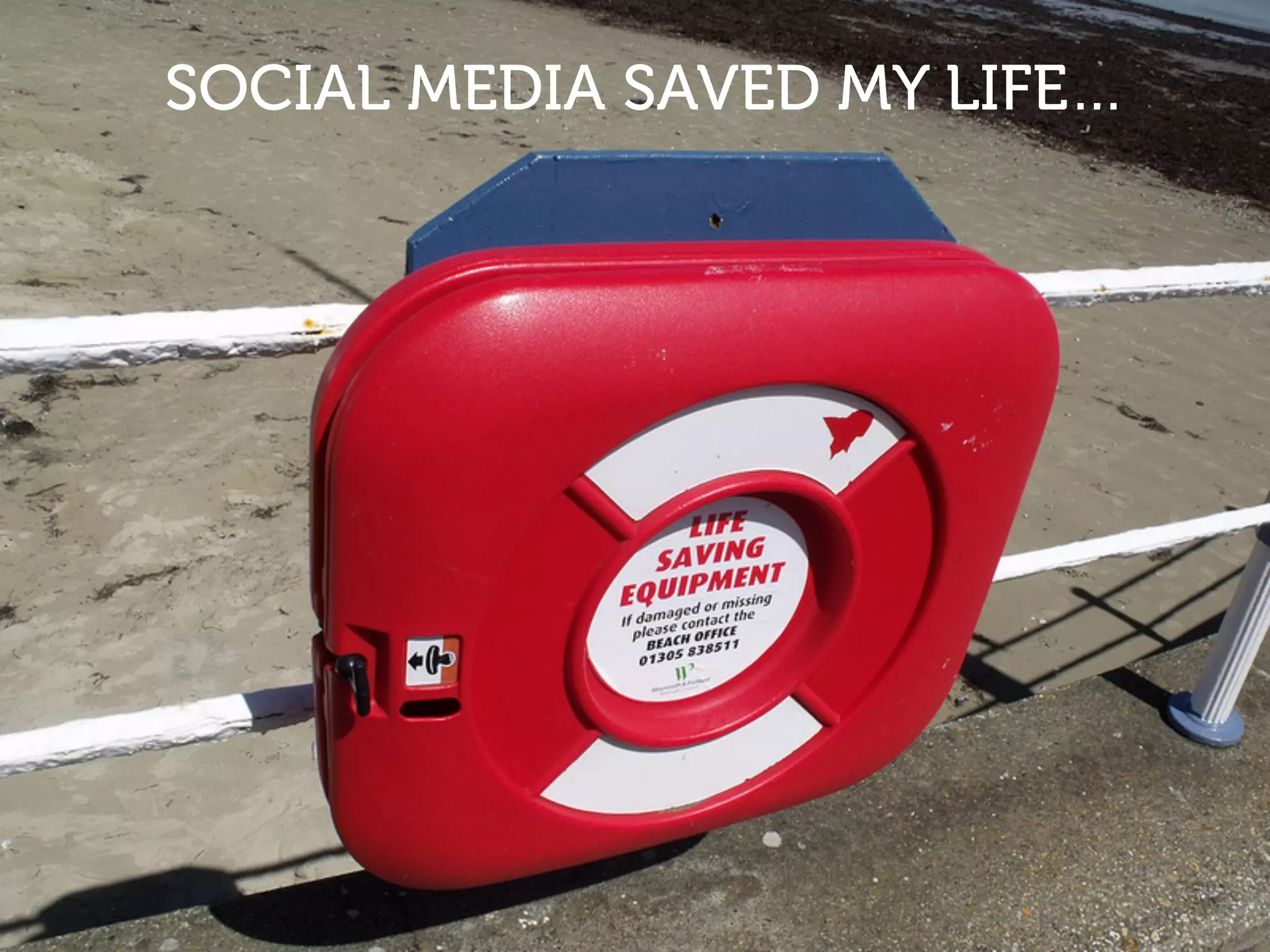
SOCIAL MEDIA SAVED MY LIFE…
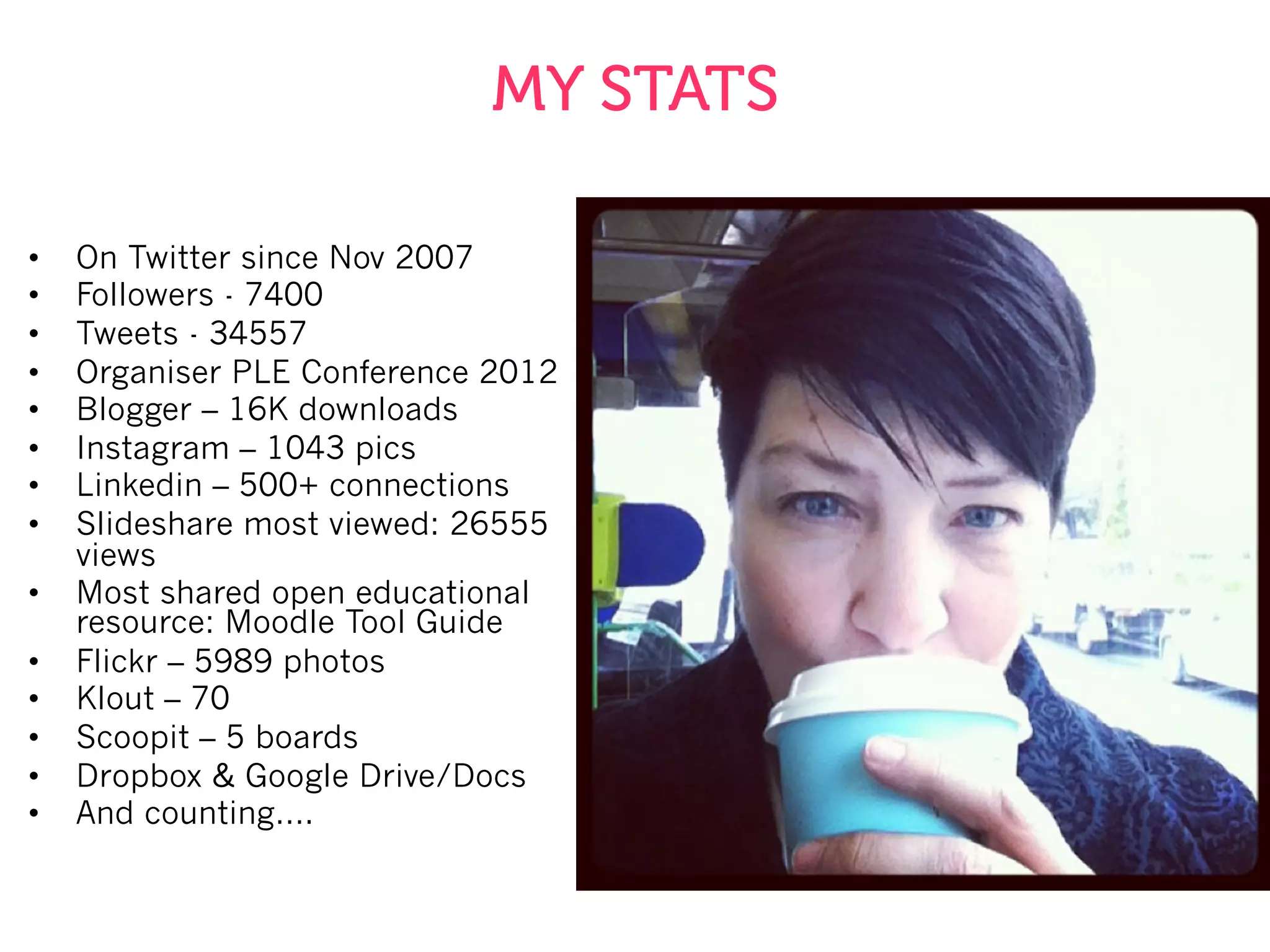
MY STATS
•  On Twitter since Nov 2007
•  Followers - 7400
•  Tweets - 34557
•  Organiser PLE Conference 2012
•  Blogger – 16K downloads
•  Instagram – 1043 pics
•  Linkedin – 500+ connections
•  Slideshare most viewed: 26555
views
•  Most shared open educational
resource: Moodle Tool Guide
•  Flickr – 5989 photos
•  Klout – 70
•  Scoopit – 5 boards
•  Dropbox & Google Drive/Docs
•  And counting….
NETPRAX
Deakin University, Faculty of Health
March 2013 - Jun 2014
100 participants
Embedding networked practice for
personal learning, teaching practice
and research practice
iPad based
Mozilla Open Badges
Yammer/Facebook/Blog
Twitter.com/netprax
lickrcclicenseFunksouphttp://www.flickr.com/photos/funksoup/403990660/
People live their lives and learn across multiple
settings, and this holds true not only across the
span of our lives but also across and within the
institutions and communities they inhabit – even
classrooms, for example. I take an approach that
urges me to consider the significant overlap
across these boundaries as people, tools, and
practices travel through different and even
contradictory contexts and activities.
KRIS GUTIERREZ
JOI ITO
“I don’t think education is about
centralized instruction anymore; rather, it
is the process [of] establishing oneself as
a node in a broad network of distributed
creativity.”
@joi
16
CRICOS	
  Provider	
  Code:	
  00113B	
  
17
CRICOS	
  Provider	
  Code:	
  00113B	
  
cc license http://www.flickr.com/photos/shareski/2655113202/
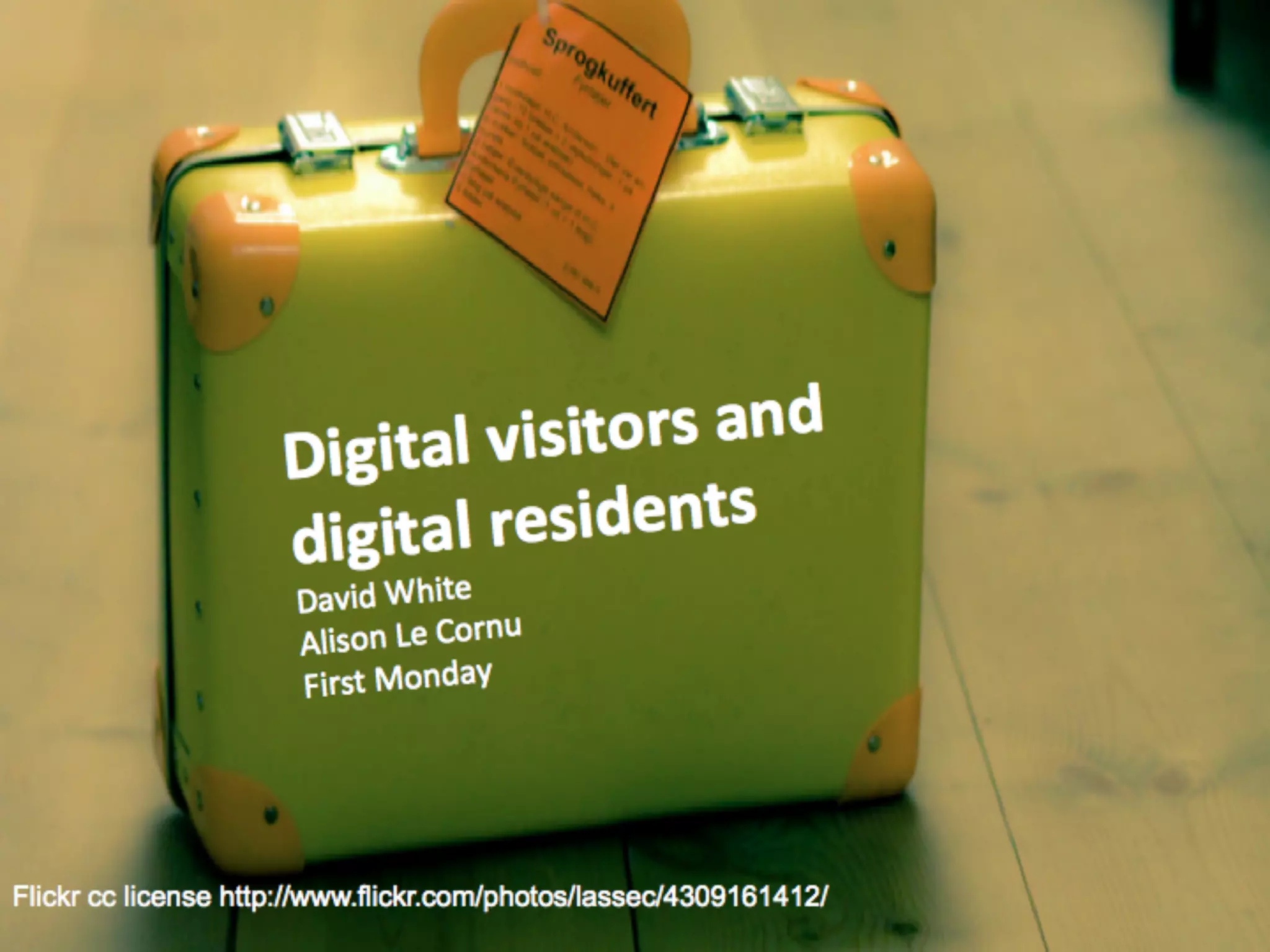
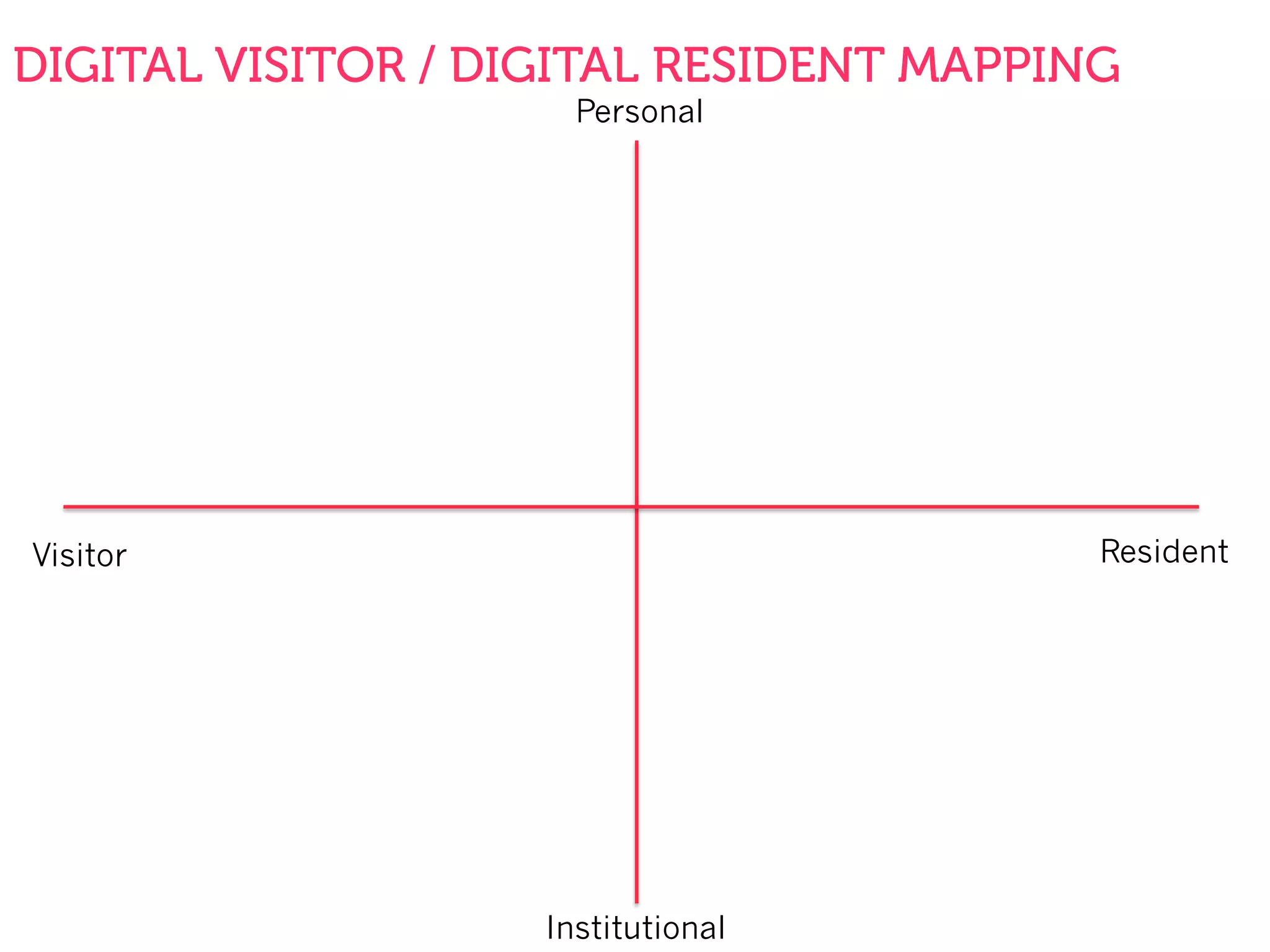
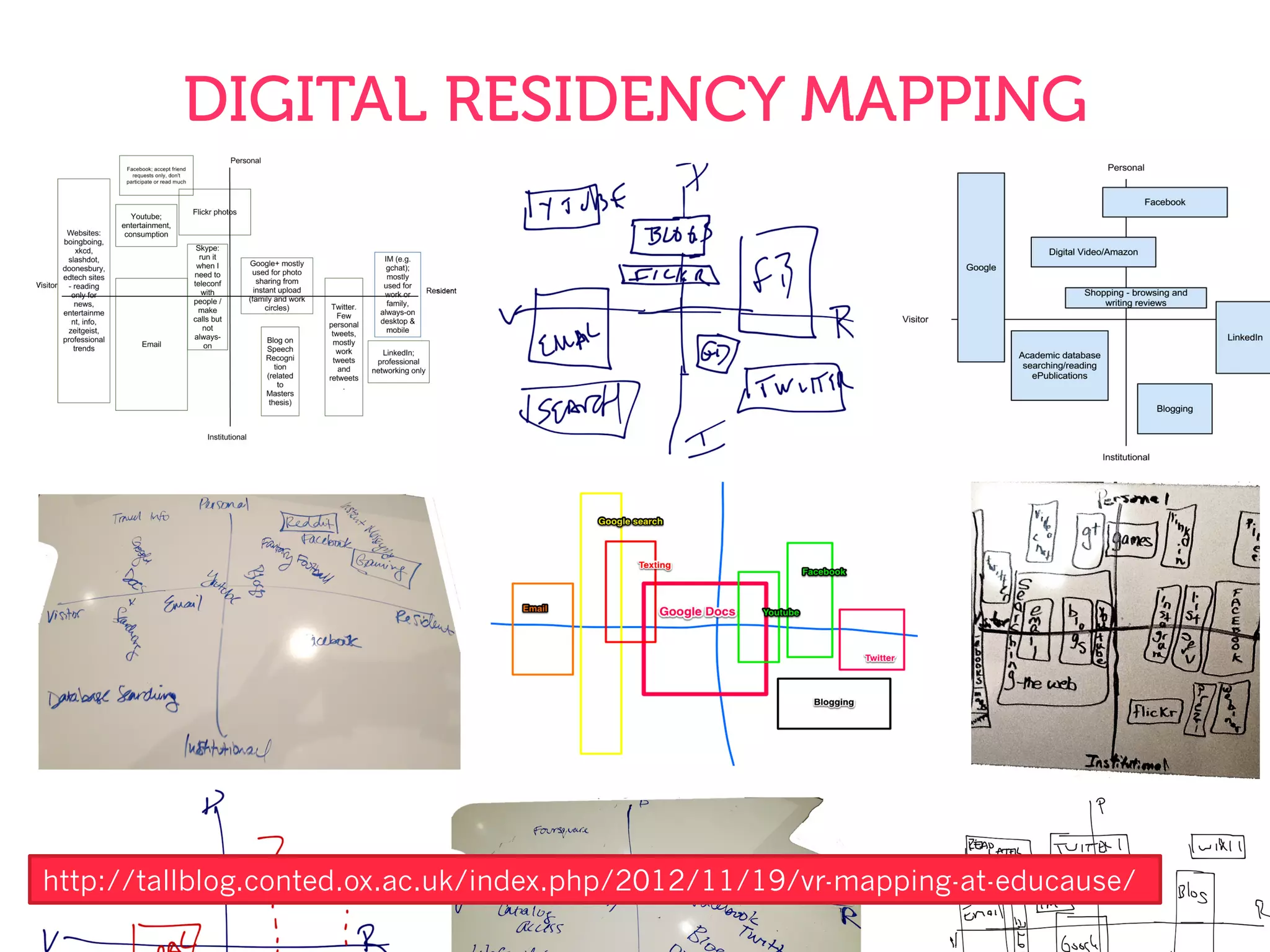
DIGITAL VISITOR / DIGITAL RESIDENT MAPPING
Personal
Institutional
ResidentVisitor
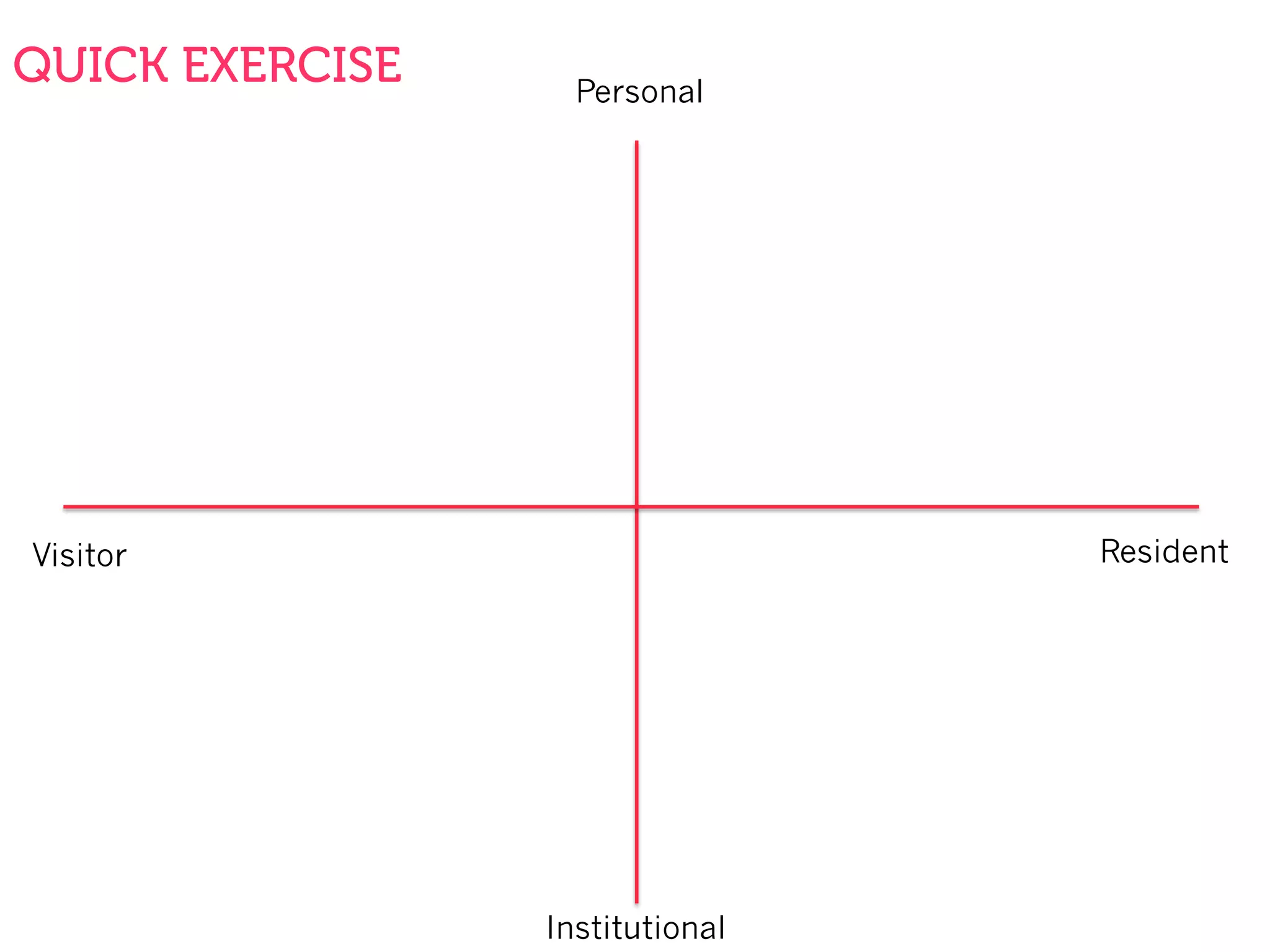
QUICK EXERCISE Personal
Institutional
ResidentVisitor
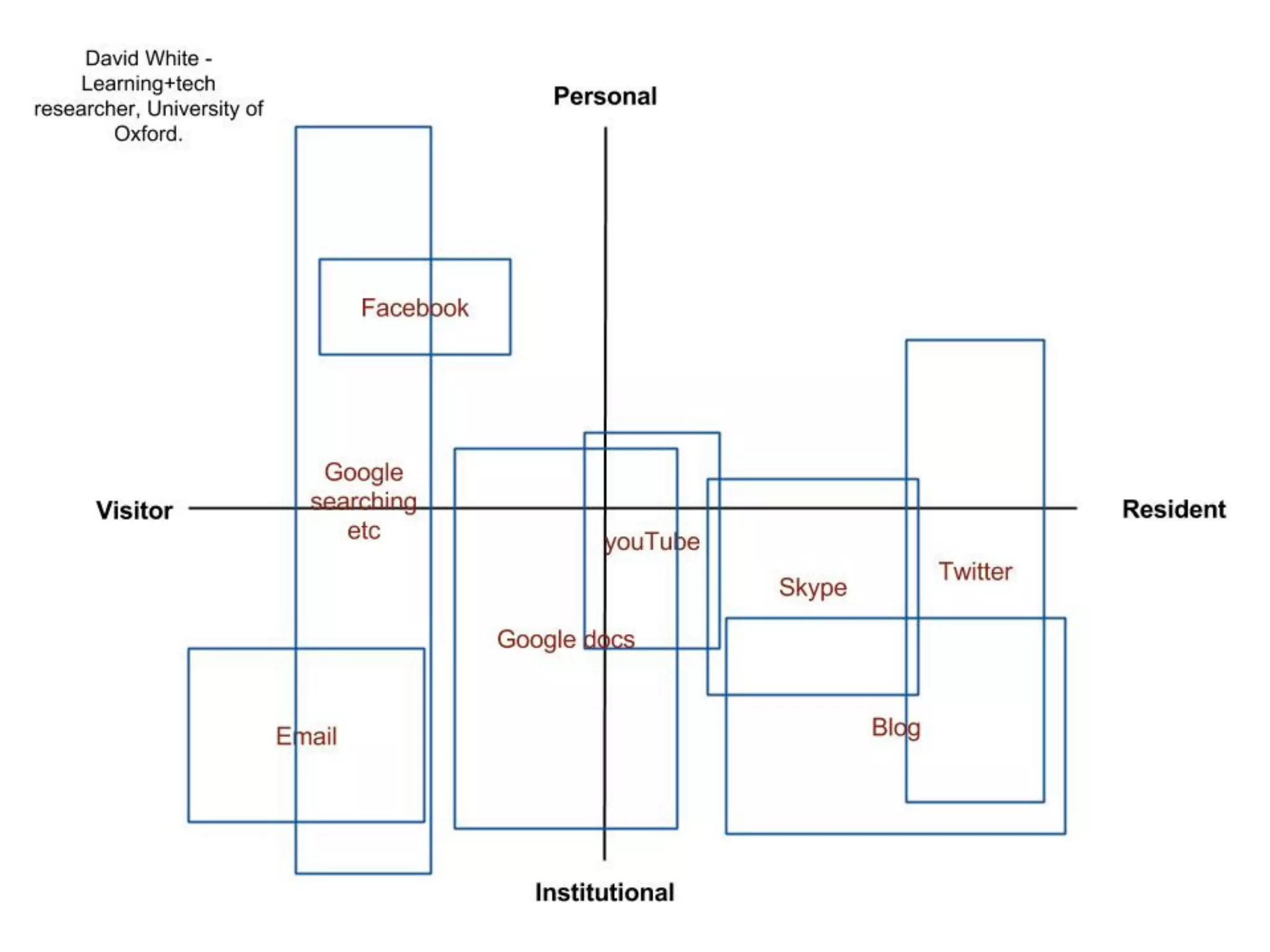
DIGITAL RESIDENCY MAPPING
http://tallblog.conted.ox.ac.uk/index.php/2012/11/19/vr-mapping-at-educause/
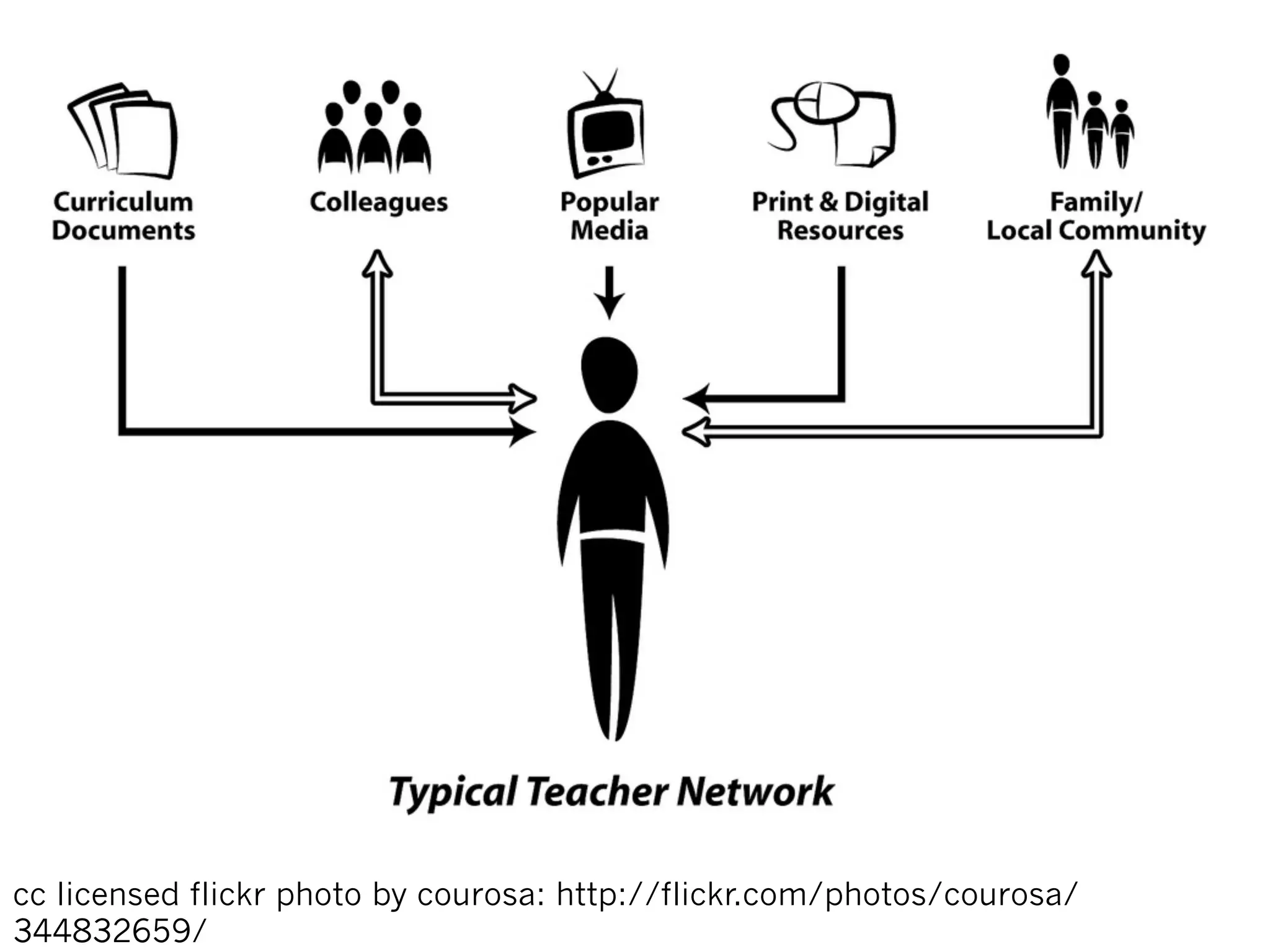
cc licensed flickr photo by courosa: http://flickr.com/photos/courosa/
344832659/
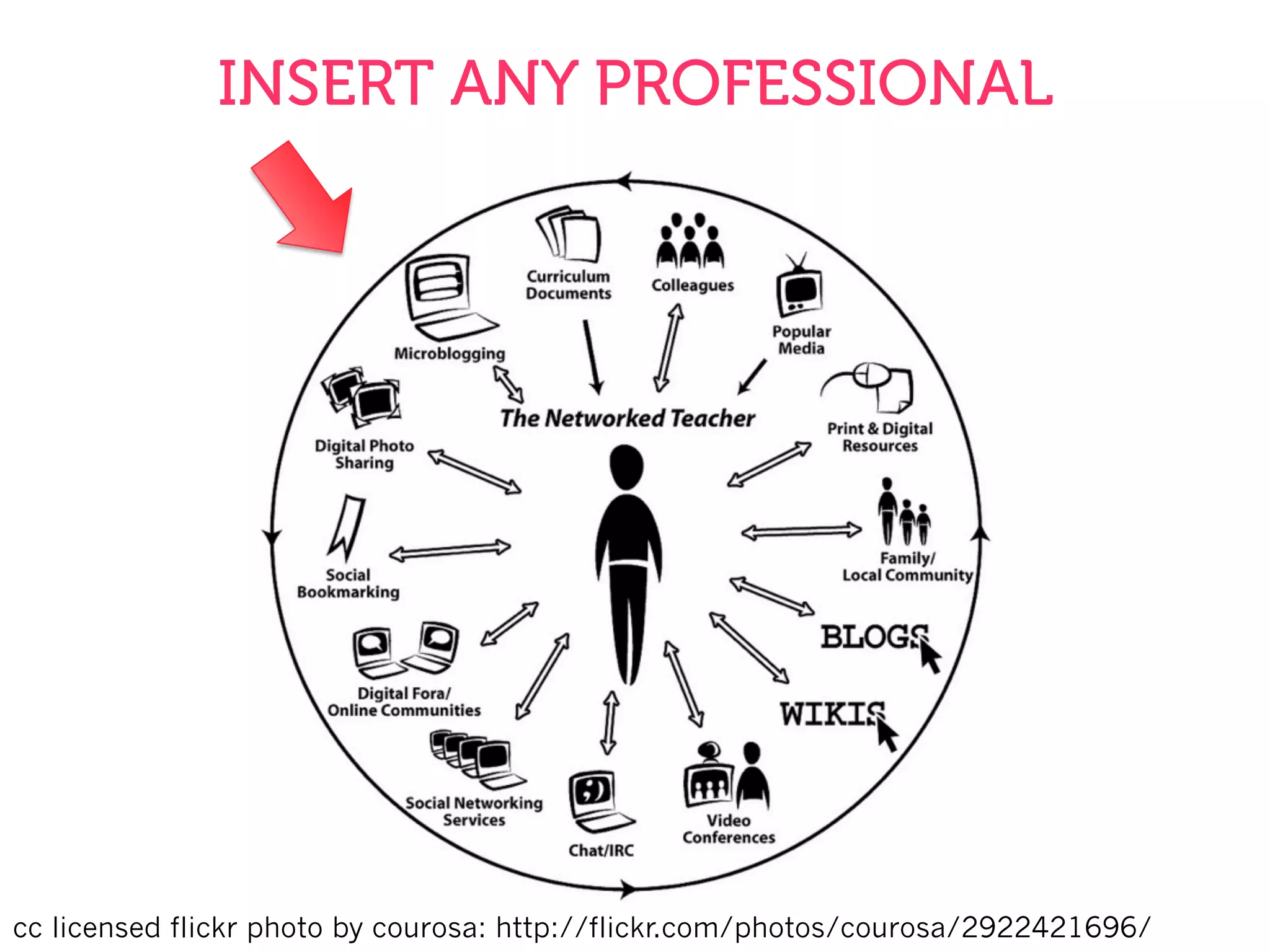
cc licensed flickr photo by courosa: http://flickr.com/photos/courosa/2922421696/
INSERT ANY PROFESSIONAL
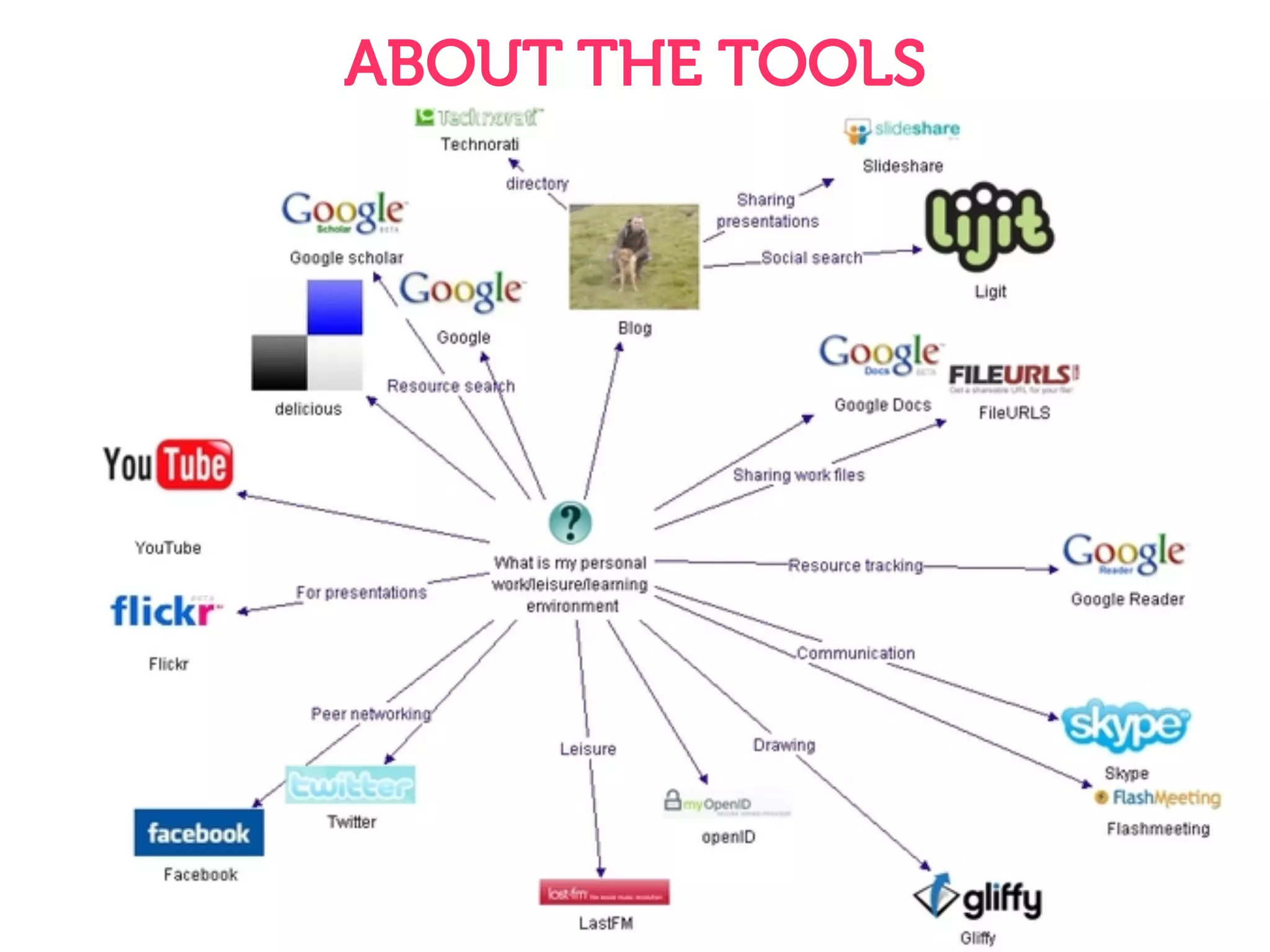
ABOUT THE TOOLS
ABOUT THE PEOPLE
cc licensed flickr photo by shareski: http://flickr.com/photos/shareski/
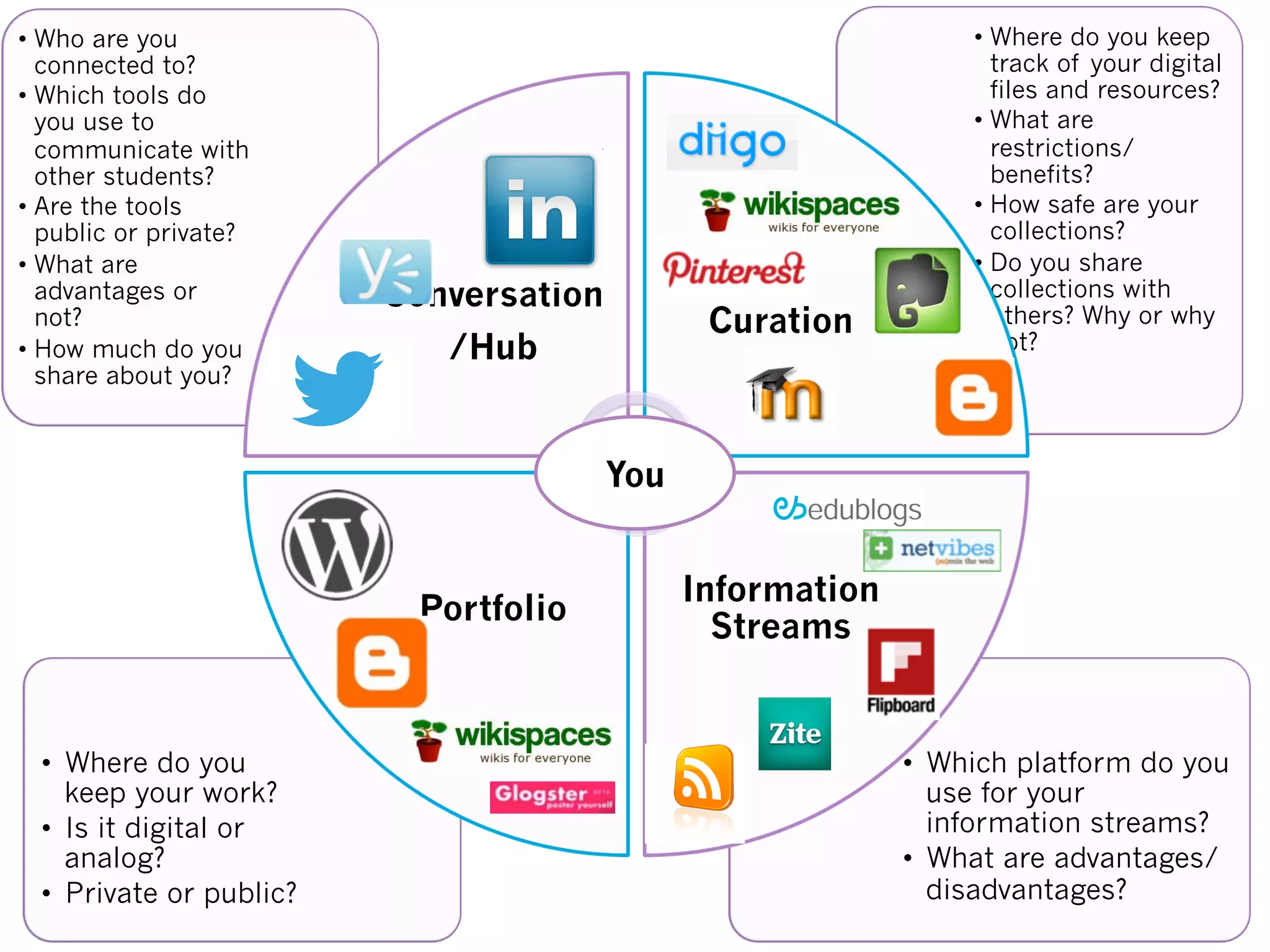
Everyone has the same building blocks…
…but how do you put them together?
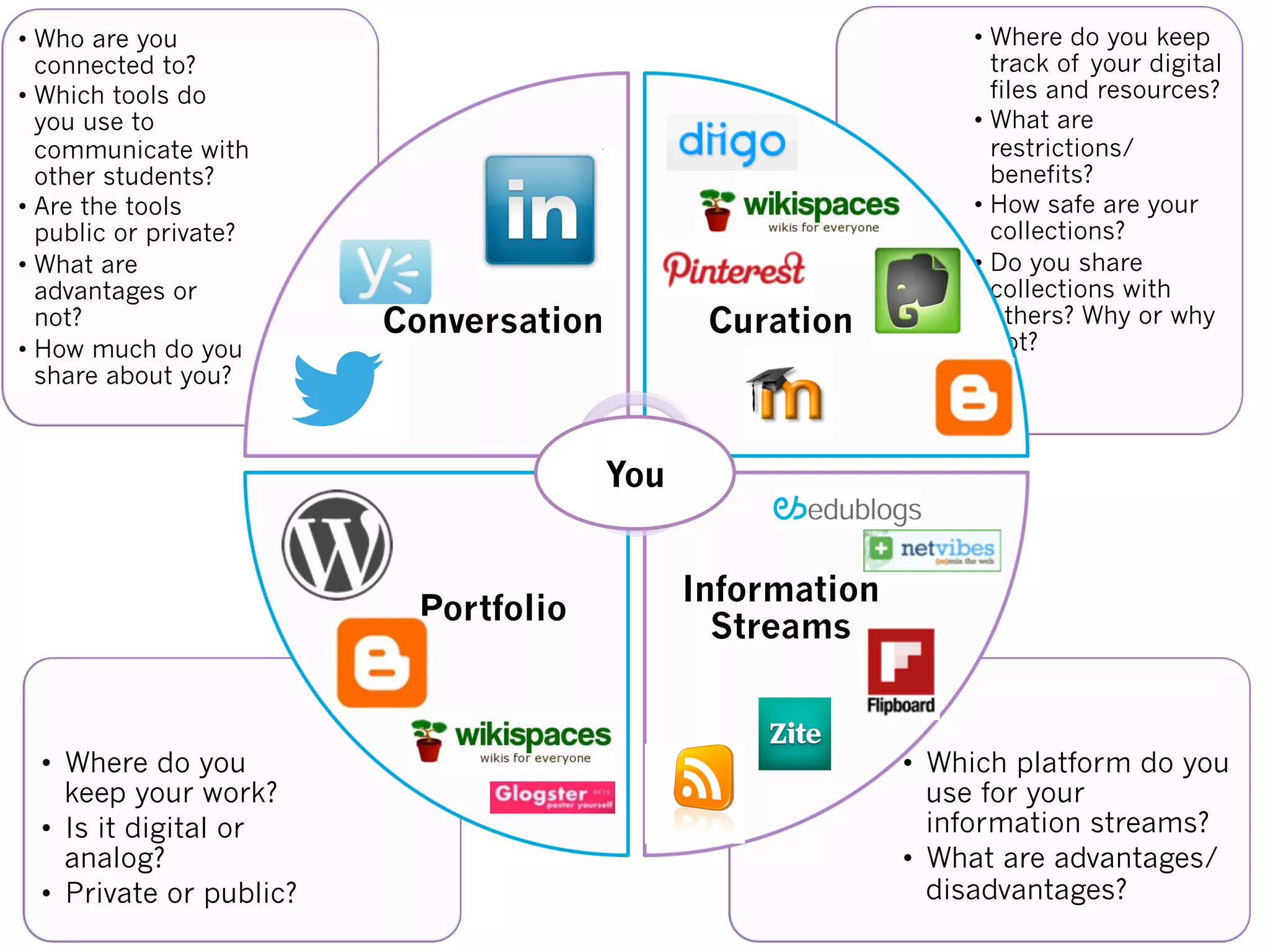
•  Which platform do you
use for your
information streams?
•  What are advantages/
disadvantages?
•  Where do you
keep your work?
•  Is it digital or
analog?
•  Private or public?
• Where do you keep
track of your digital
files and resources?
• What are
restrictions/
benefits?
• How safe are your
collections?
• Do you share
collections with
others? Why or why
not?
• Who are you
connected to?
• Which tools do
you use to
communicate with
other students?
• Are the tools
public or private?
• What are
advantages or
not?
• How much do you
share about you?
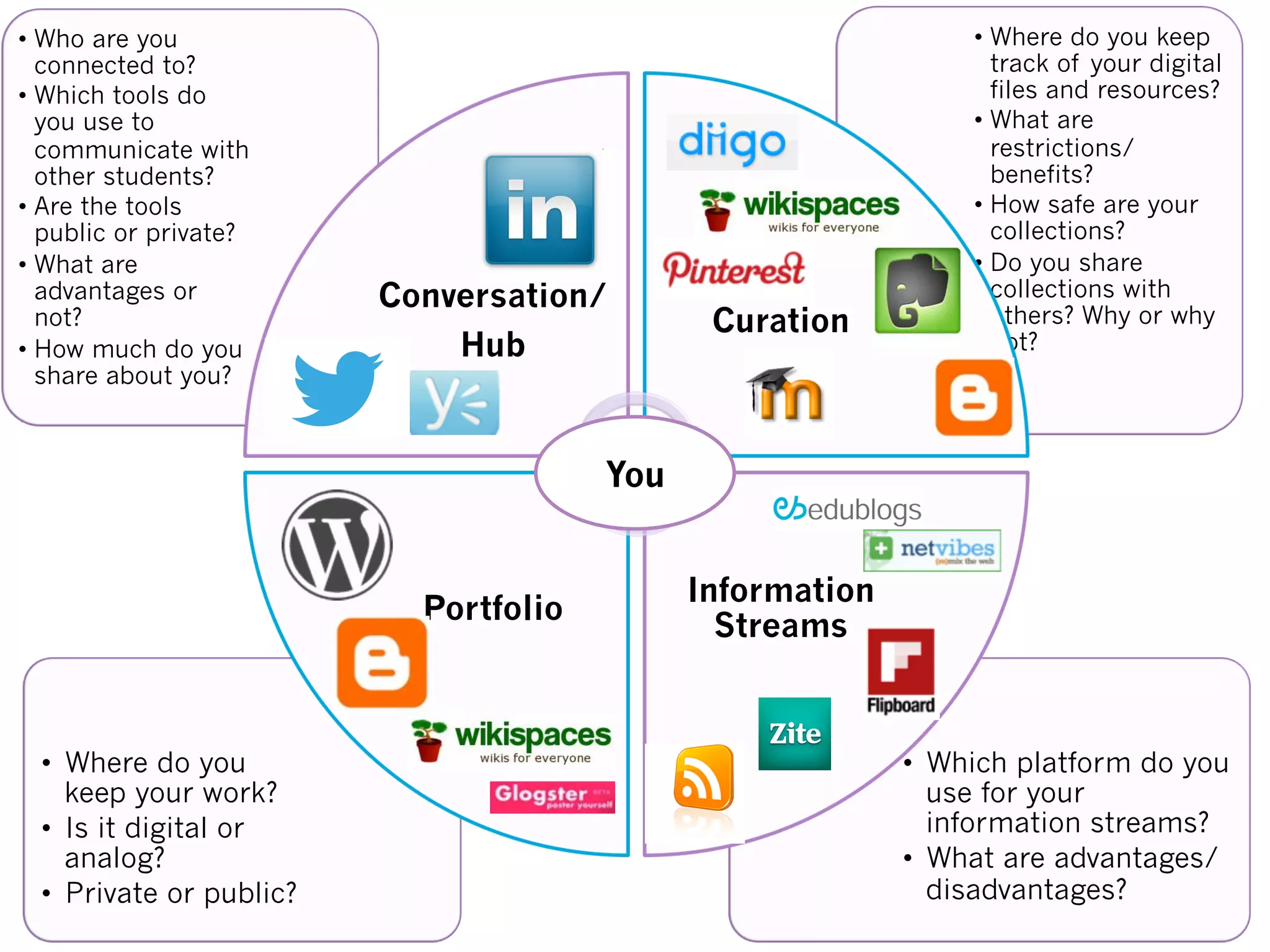
Conversation/
Hub
Curation
Information
Streams
Portfolio
You
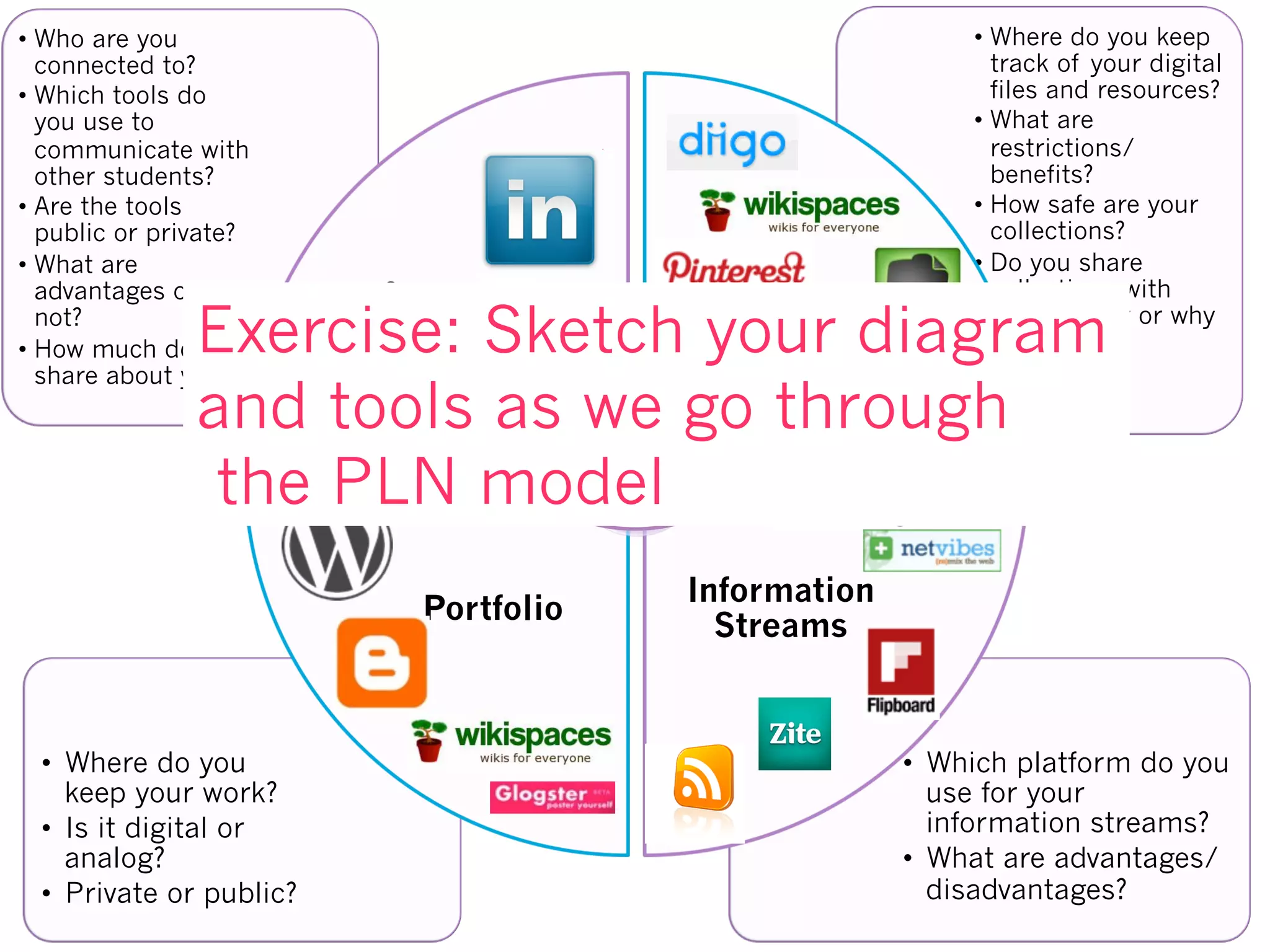
Exercise: Sketch your diagram
and tools as we go through
the PLN model
•  Which platform do you
use for your
information streams?
•  What are advantages/
disadvantages?
•  Where do you
keep your work?
•  Is it digital or
analog?
•  Private or public?
• Where do you keep
track of your digital
files and resources?
• What are
restrictions/
benefits?
• How safe are your
collections?
• Do you share
collections with
others? Why or why
not?
• Who are you
connected to?
• Which tools do
you use to
communicate with
other students?
• Are the tools
public or private?
• What are
advantages or
not?
• How much do you
share about you?
Conversation/
Hub
Curation
Information
Streams
Portfolio
You
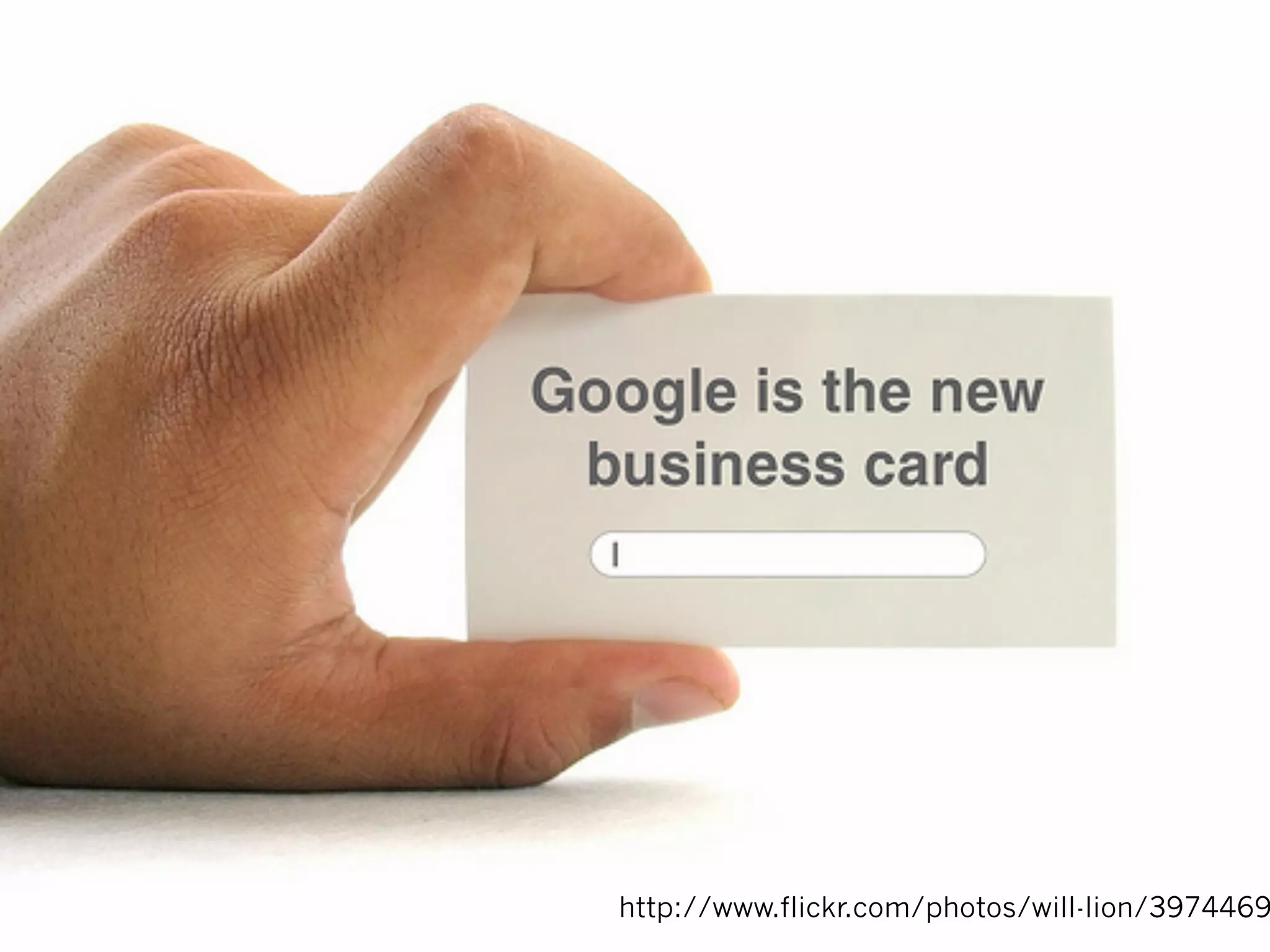
http://www.flickr.com/photos/will-lion/3974469
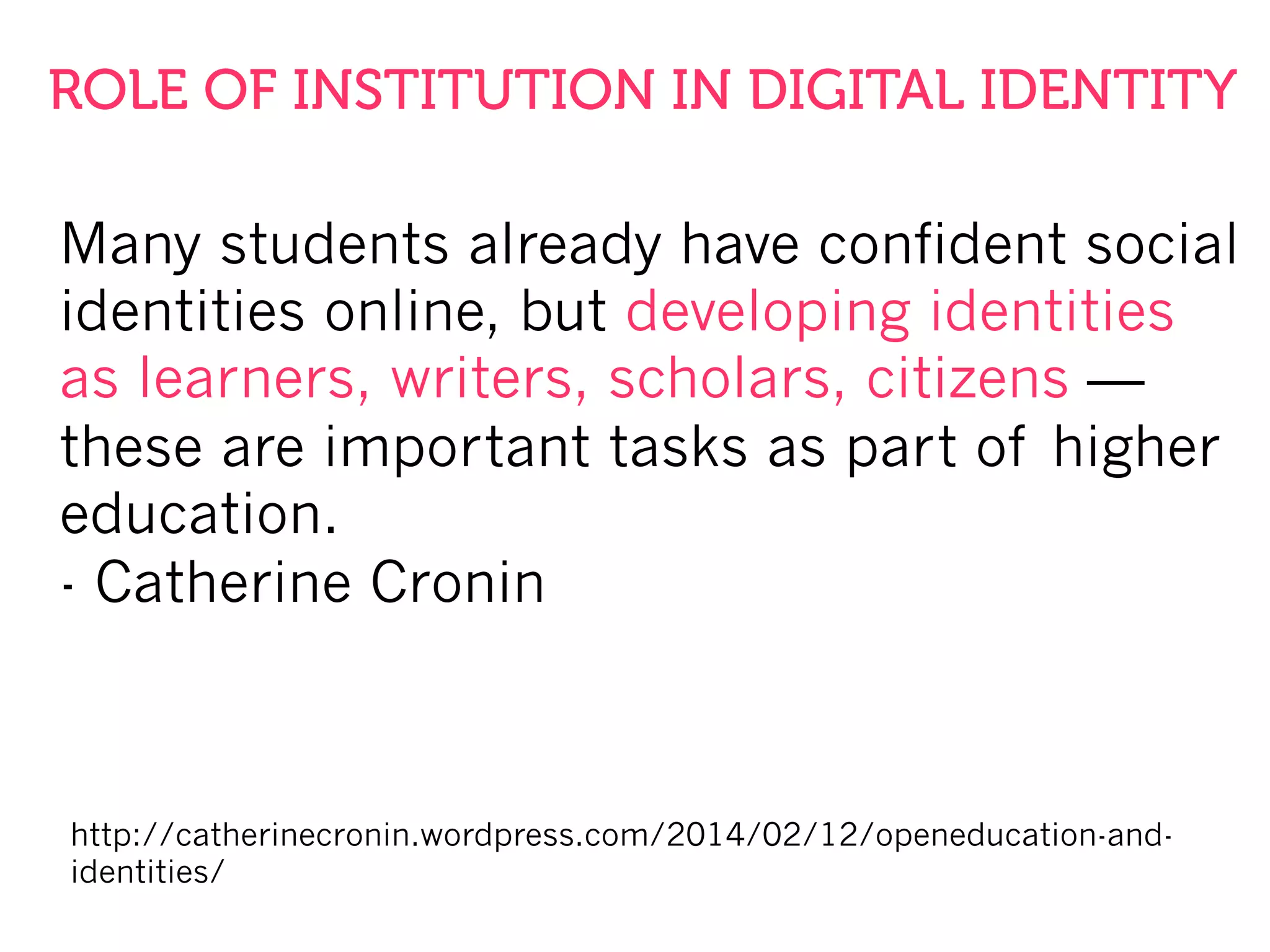
Many students already have confident social
identities online, but developing identities
as learners, writers, scholars, citizens —
these are important tasks as part of higher
education.
- Catherine Cronin
http://catherinecronin.wordpress.com/2014/02/12/openeducation-and-
identities/
ROLE OF INSTITUTION IN DIGITAL IDENTITY
If institutions of learning are going to help
learners with the real challenges they face…
[they] will have to shift their focus from
imparting curriculum to supporting the
negotiation of productive identities through
landscapes of practice.”
- Etienne Wenger (Digital Habitats, 2010)
ROLE OF INSTITUTION IN DIGITAL IDENTITY
•  Which platform do you
use for your
information streams?
•  What are advantages/
disadvantages?
•  Where do you
keep your work?
•  Is it digital or
analog?
•  Private or public?
• Where do you keep
track of your digital
files and resources?
• What are
restrictions/
benefits?
• How safe are your
collections?
• Do you share
collections with
others? Why or why
not?
• Who are you
connected to?
• Which tools do
you use to
communicate with
other students?
• Are the tools
public or private?
• What are
advantages or
not?
• How much do you
share about you?
Conversation
/Hub
Curation
Information
Streams
Portfolio
You
cc licensed flickr photo by Will Lion: http://flickr.com/photos/will-lion/
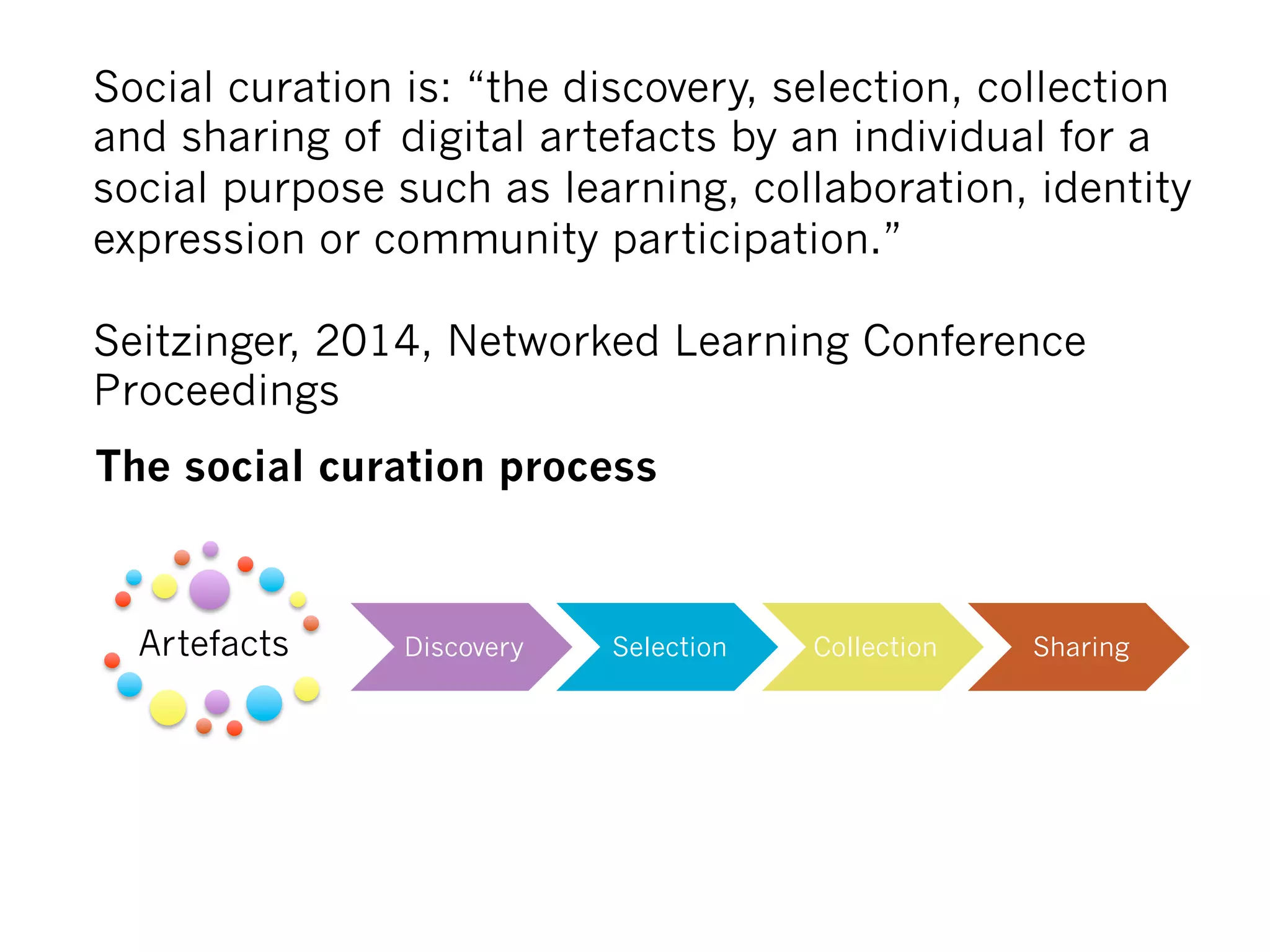
Artefacts Discovery Selection Collection Sharing
The social curation process
Social curation is: “the discovery, selection, collection
and sharing of digital artefacts by an individual for a
social purpose such as learning, collaboration, identity
expression or community participation.”
Seitzinger, 2014, Networked Learning Conference
Proceedings
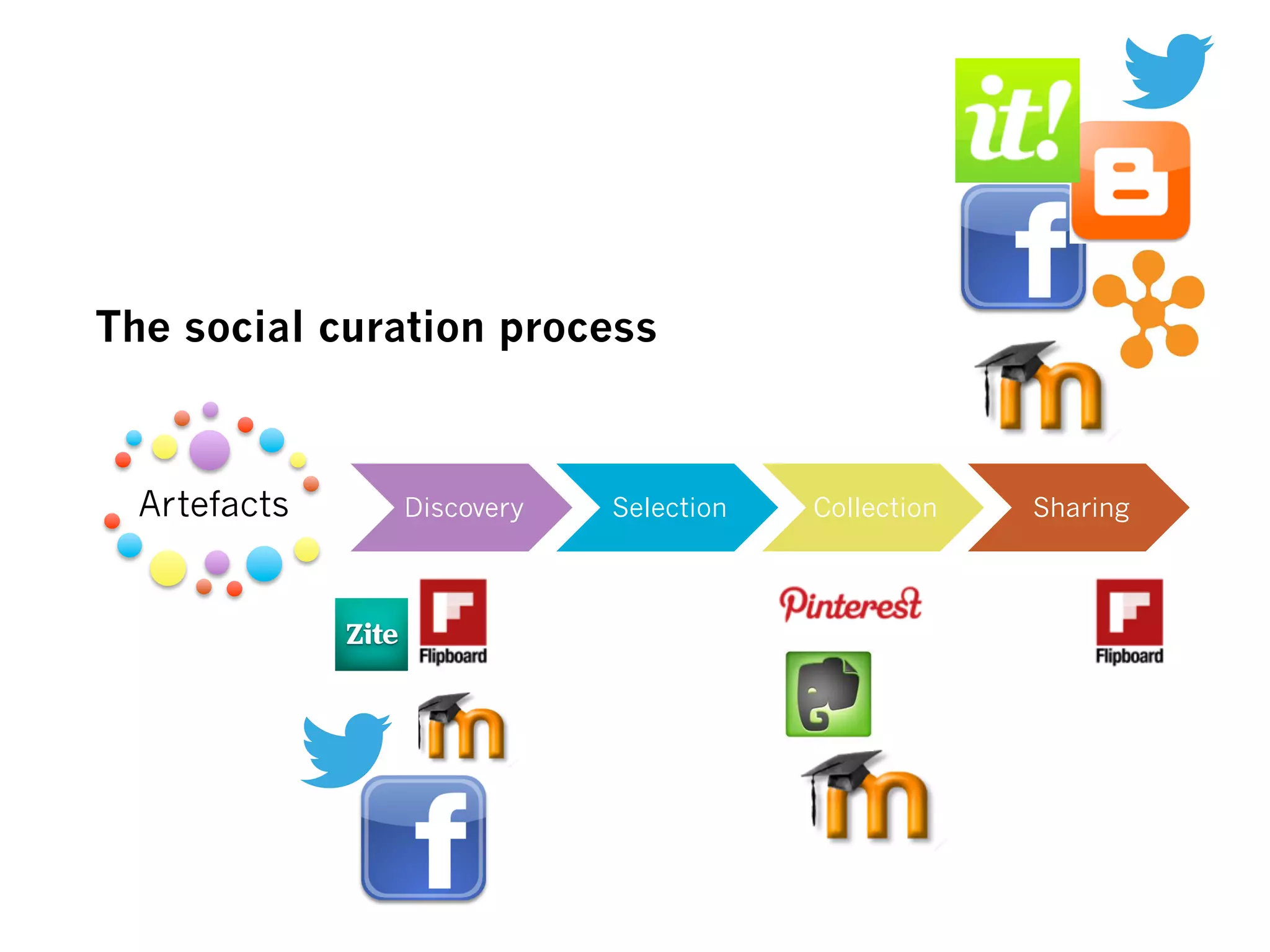
Artefacts Discovery Selection Collection Sharing
The social curation process
•  Which platform do you
use for your
information streams?
•  What are advantages/
disadvantages?
•  Where do you
keep your work?
•  Is it digital or
analog?
•  Private or public?
• Where do you keep
track of your digital
files and resources?
• What are
restrictions/
benefits?
• How safe are your
collections?
• Do you share
collections with
others? Why or why
not?
• Who are you
connected to?
• Which tools do
you use to
communicate with
other students?
• Are the tools
public or private?
• What are
advantages or
not?
• How much do you
share about you?
Conversation Curation
Information
Streams
Portfolio
You
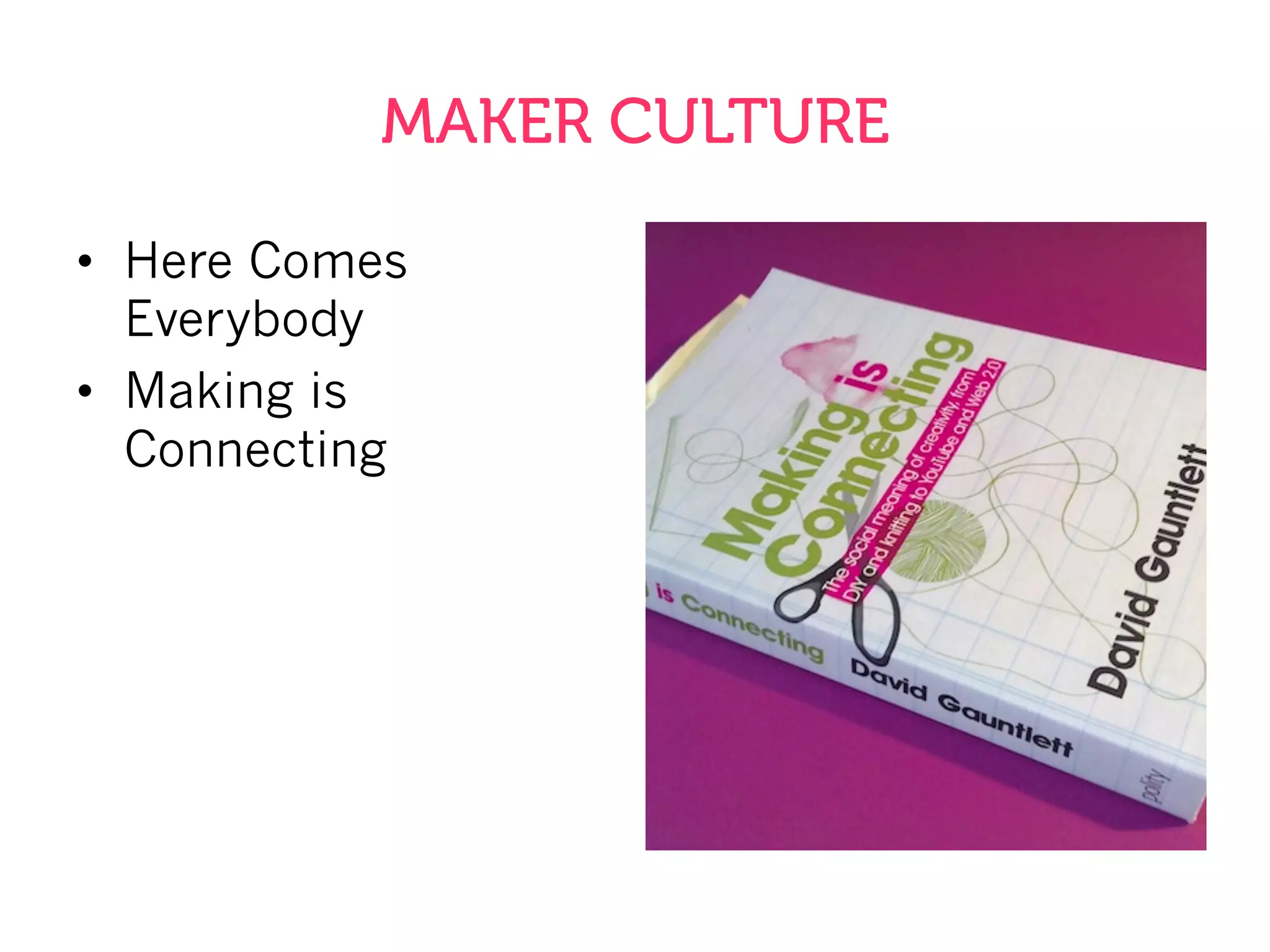
MAKER CULTURE
•  Here Comes
Everybody
•  Making is
Connecting
START EASY - SLIDES
•  www.slideshare.net/timbuckteeth
•  www.slideshare.net/gconole
•  www.slideshare.net/courosa
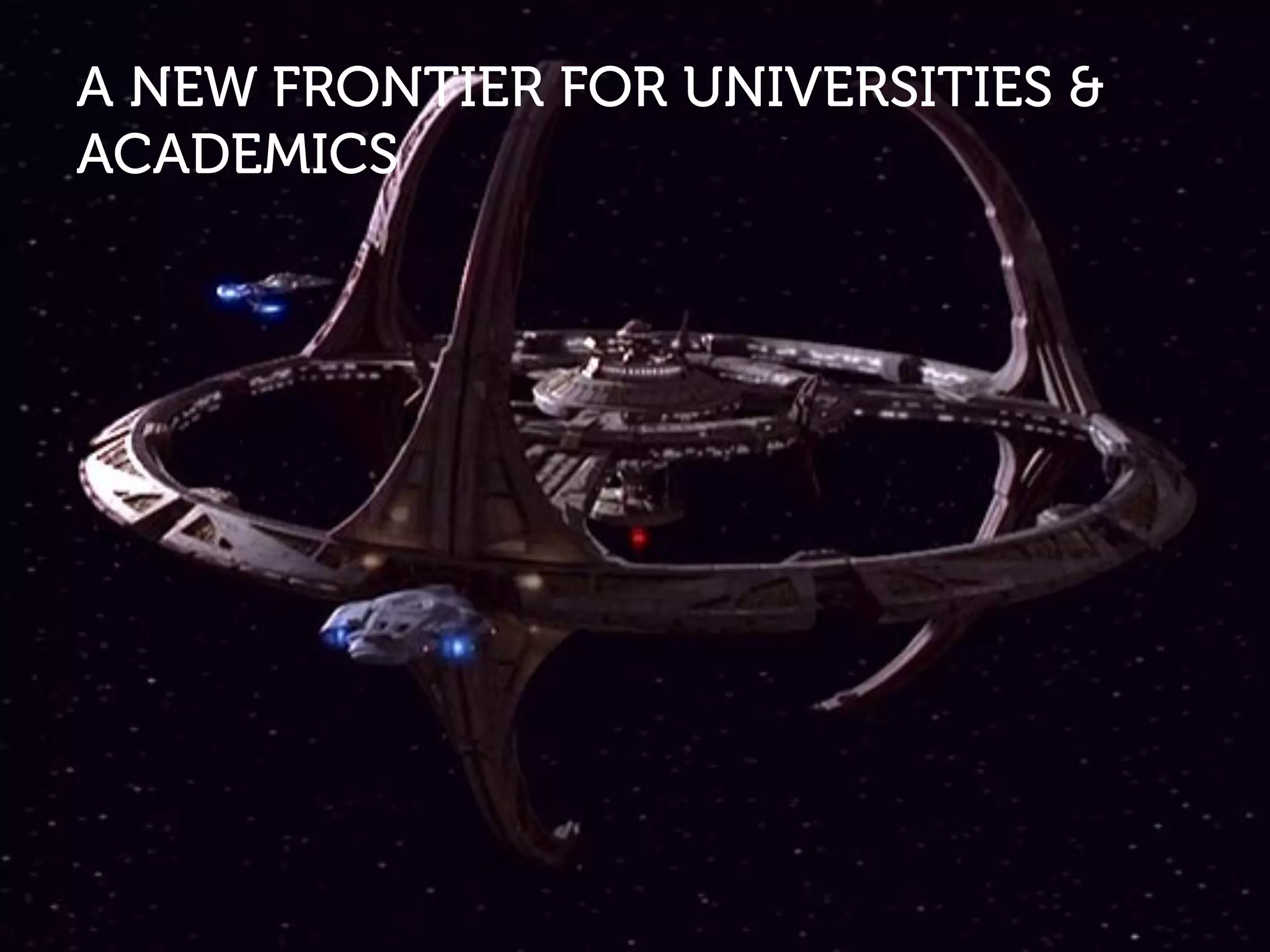
A NEW FRONTIER FOR UNIVERSITIES &
ACADEMICS
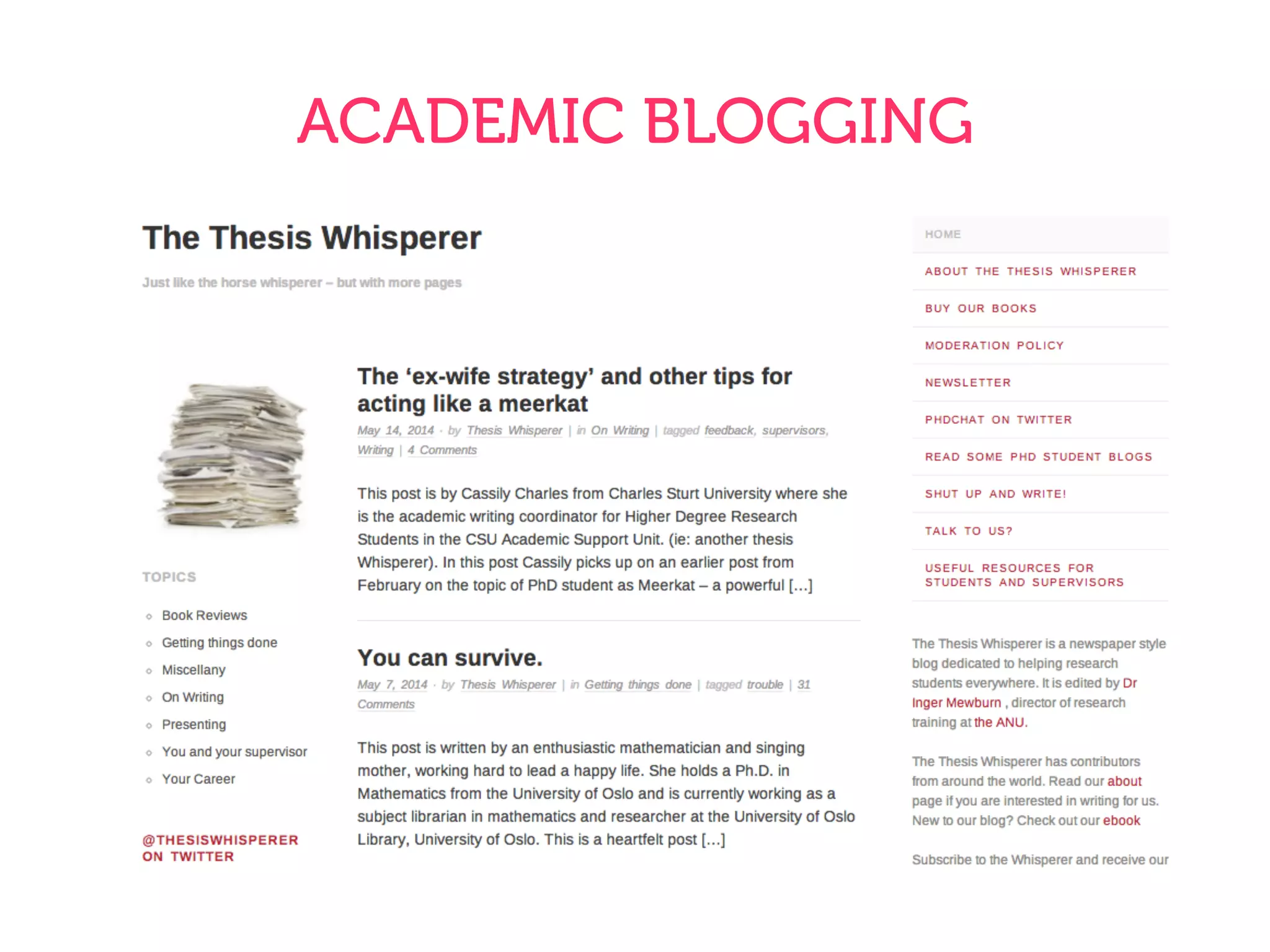
ACADEMIC BLOGGING
ACADEMIC BLOGGING
Using social media has helped give my research a media
profile which otherwise would have been impossible,
particularly at this stage of my career. It’s made me easy to
discover for journalists and it’s helped me forged a rich
array of connections with the broader community who have
been the subject of my research. I’ve also found that,
increasingly, journalists have read my blog posts or listened
to my podcasts before they contact me and it hugely aids
the subsequent dialogue.
Mark Carrigan
http://blogs.lse.ac.uk/impactofsocialsciences/
2013/02/04/the-value-of-academic-blogging/
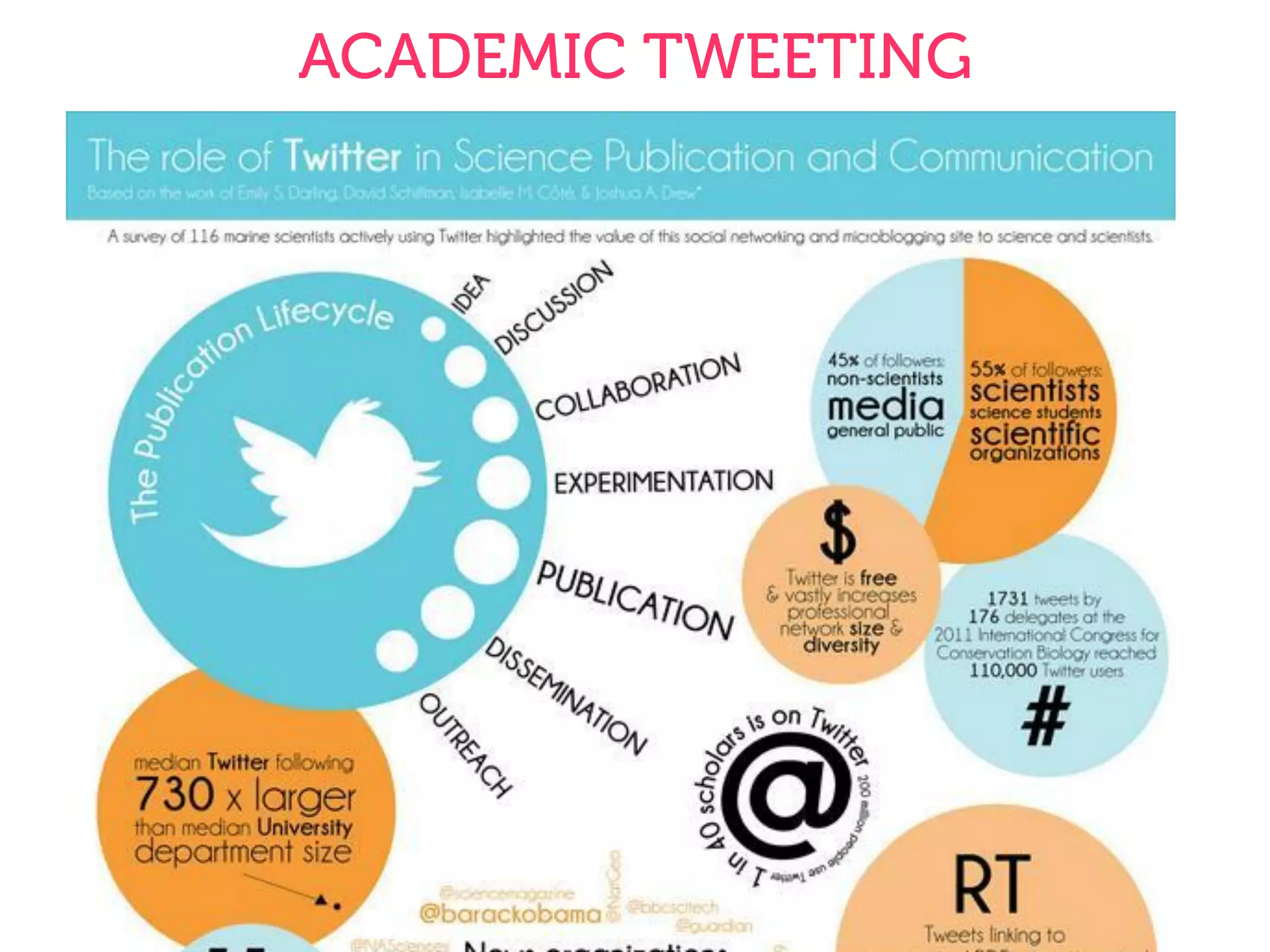
ACADEMIC TWEETING
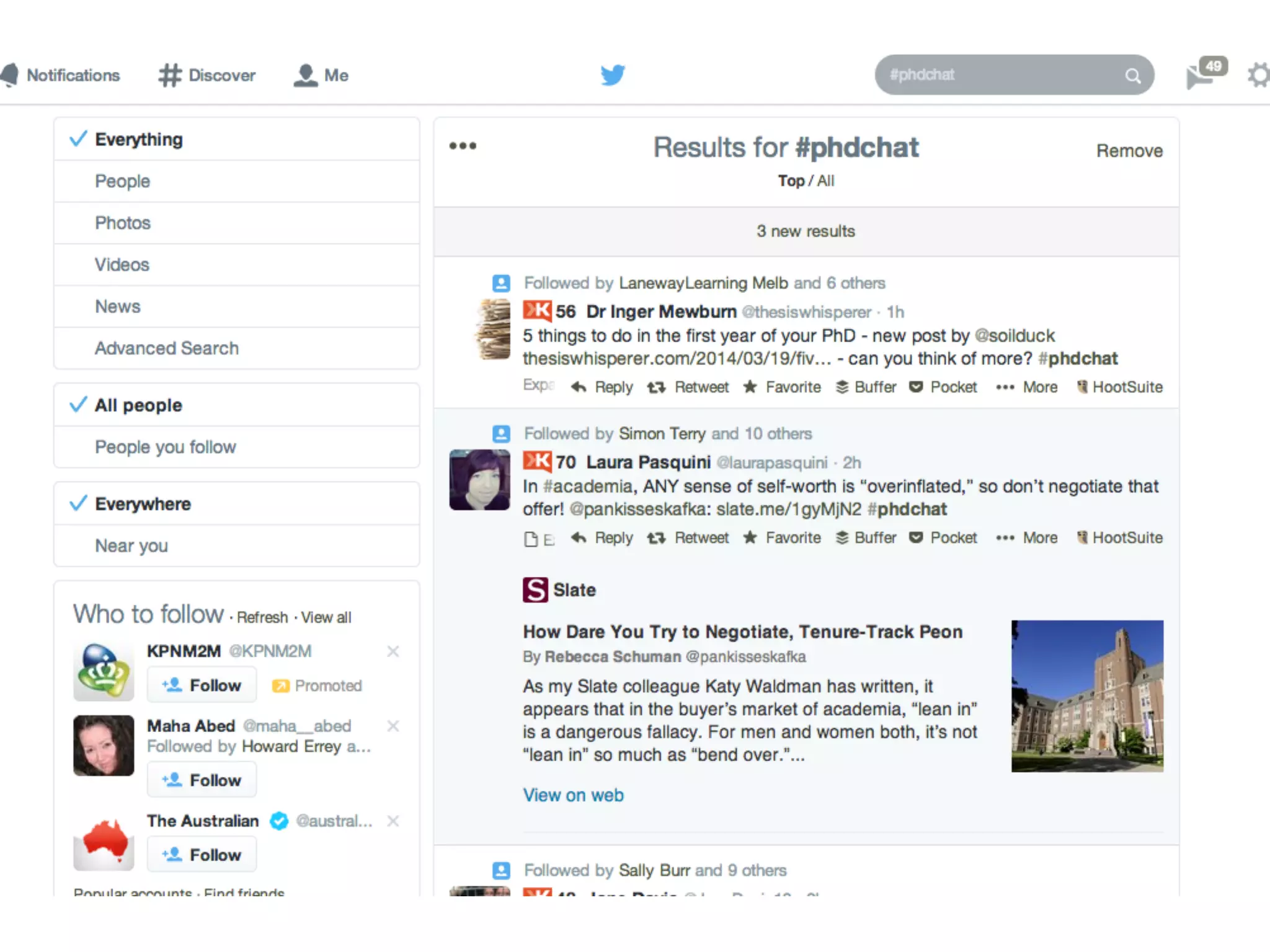
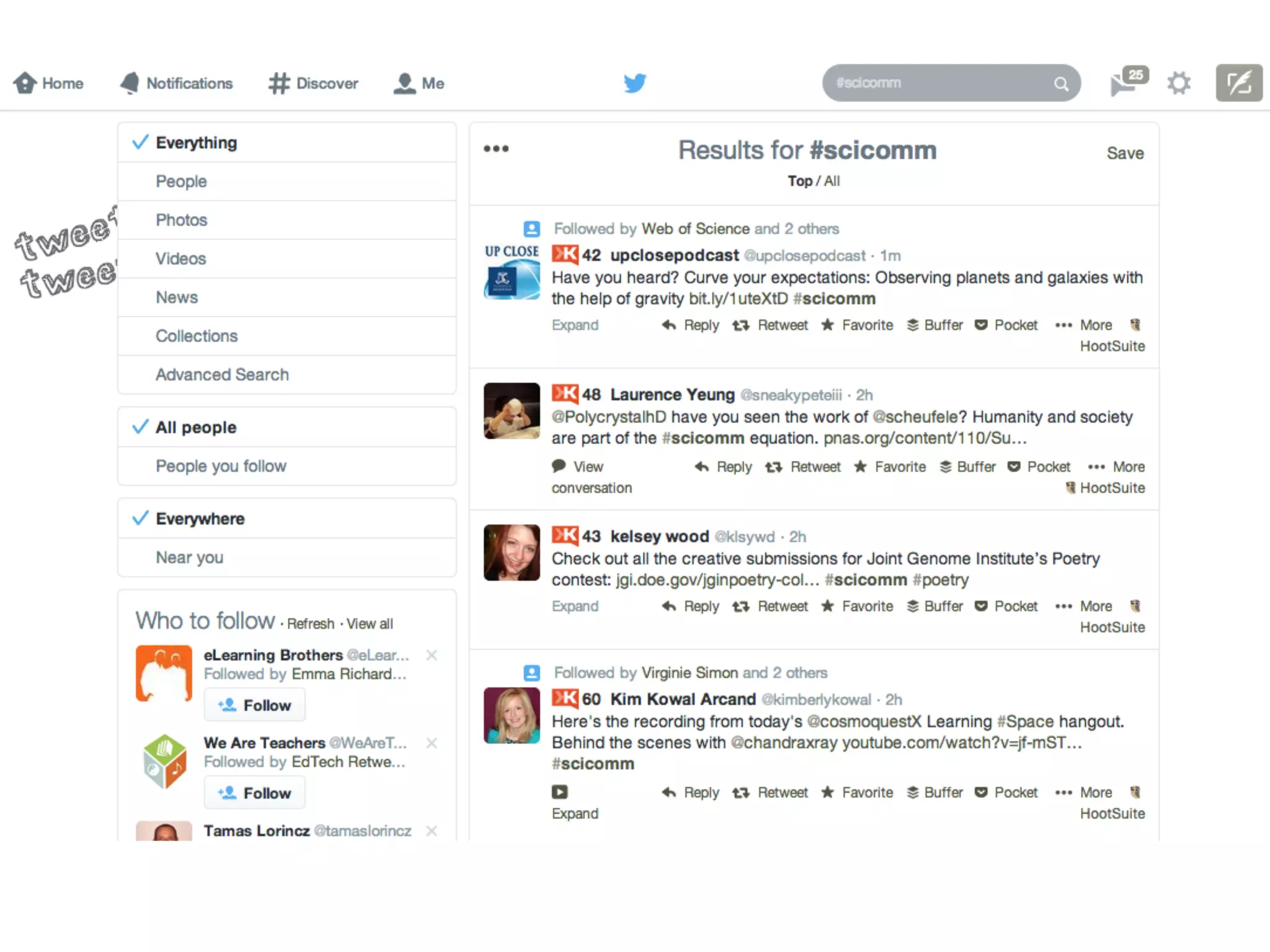
5 TWITTER & SCIENCE MYTHS
1.  Serious scientists don’t tweet
2.  Twitter takes too much time
3.  You can’t be meaningful in 140 characters
4.  Twitter erases boundaries between students
and faculty
5.  Twitter is only for self-promoters
Sarah Boon, http://www.cdnsciencepub.com/
blog/scientists-using-twitter-dispelling-the-
myths.aspx
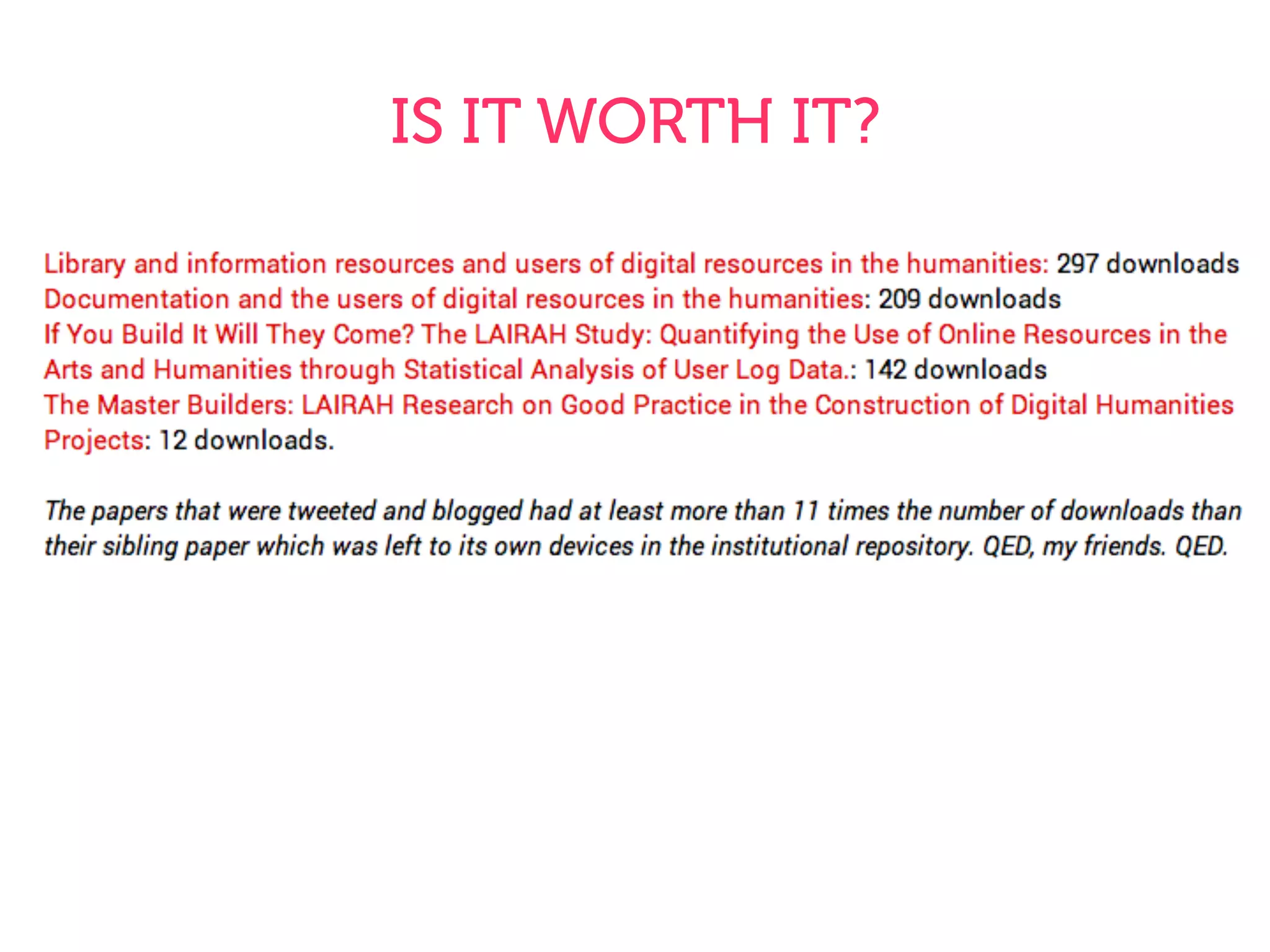
IS IT WORTH IT?
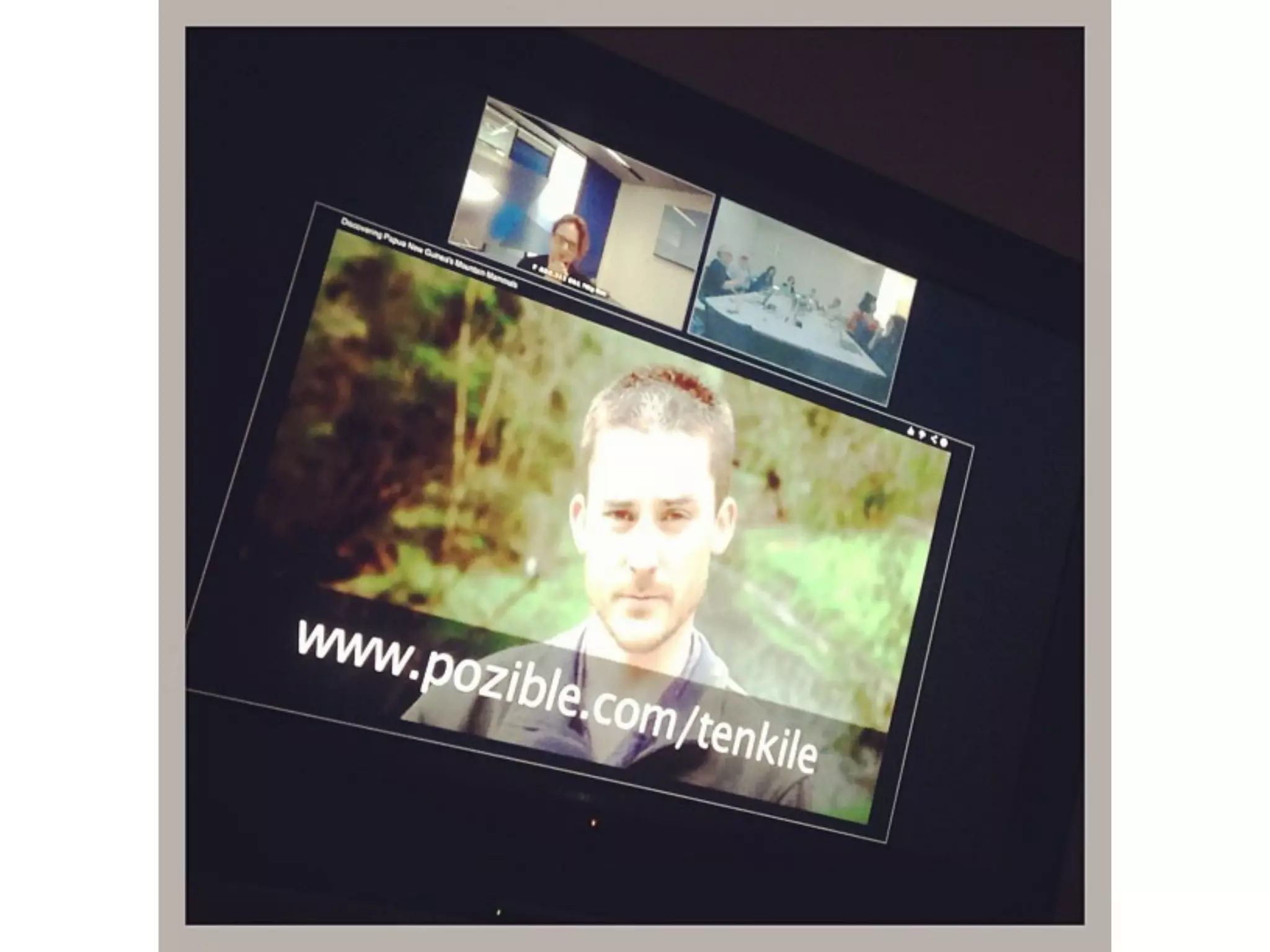
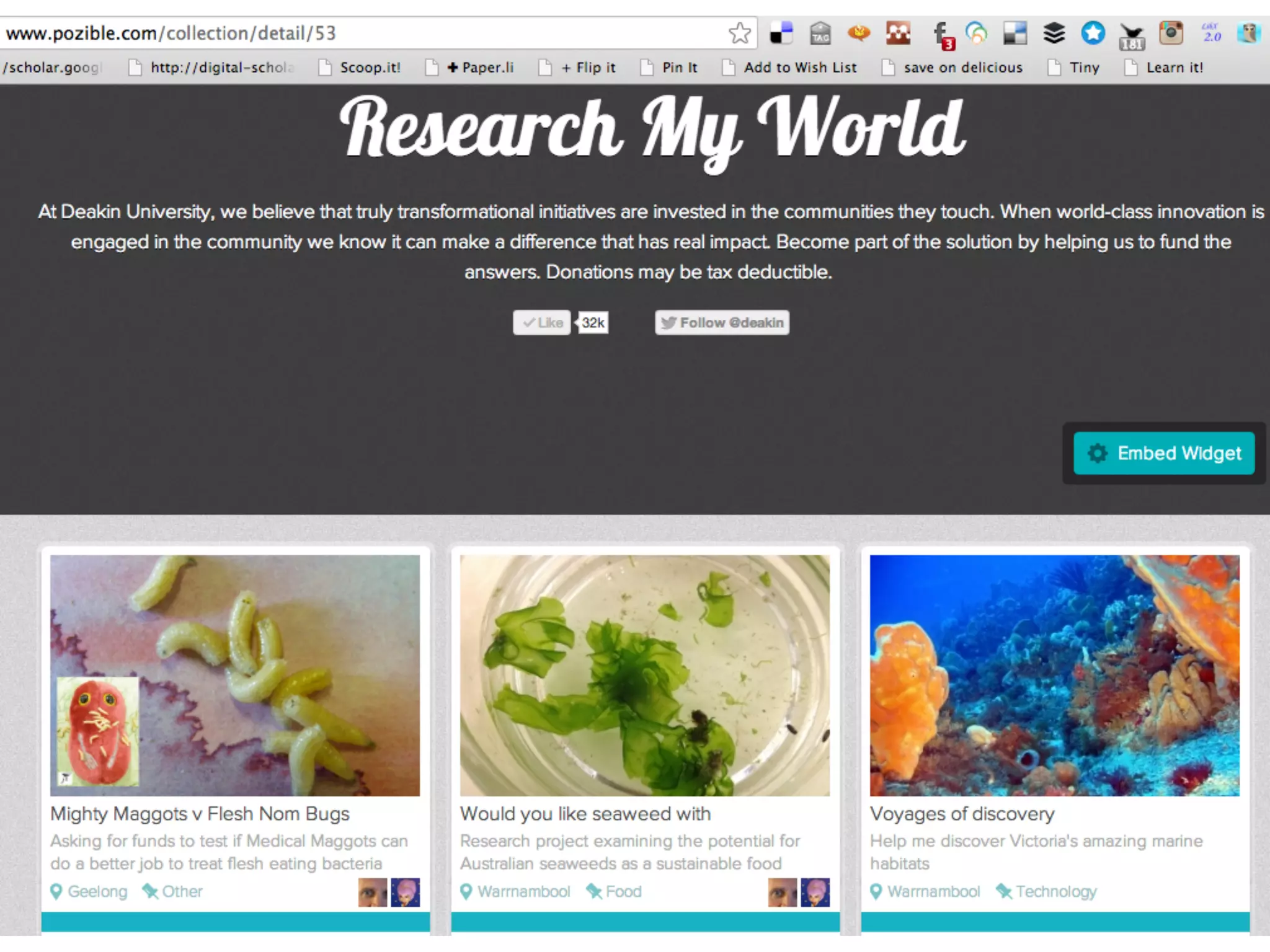
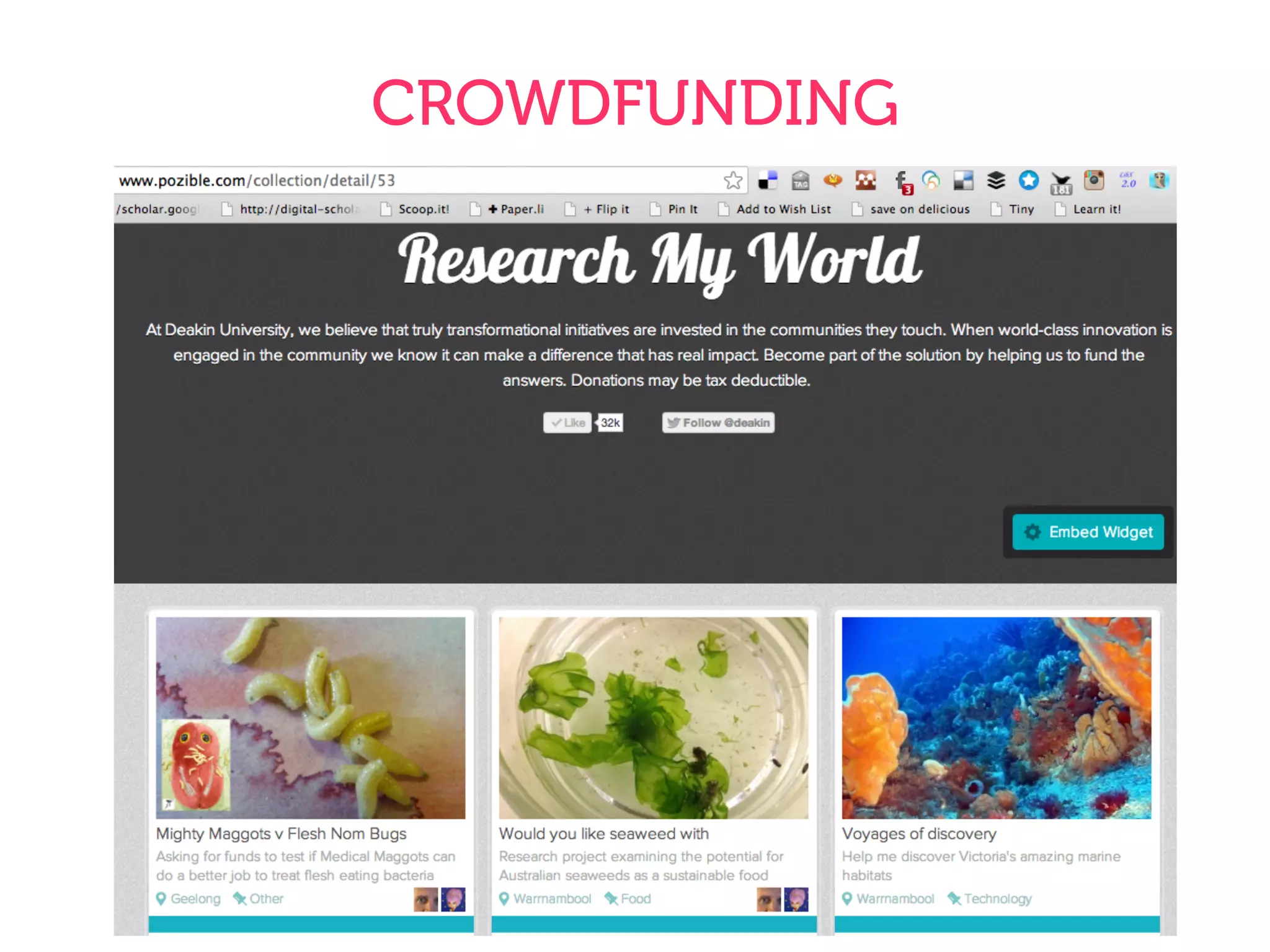
CROWDFUNDING
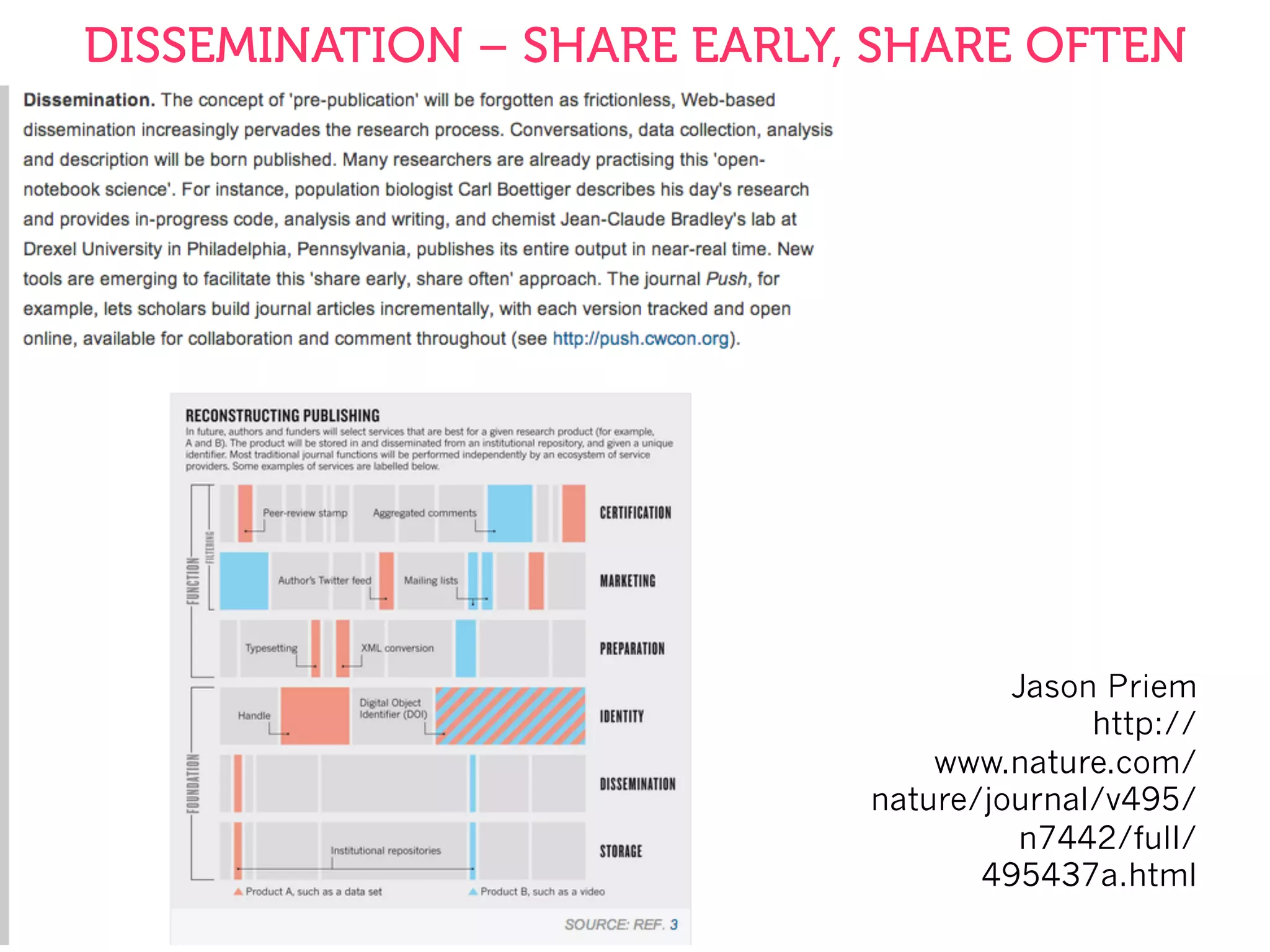
DISSEMINATION – SHARE EARLY, SHARE OFTEN
Jason Priem
http://
www.nature.com/
nature/journal/v495/
n7442/full/
495437a.html
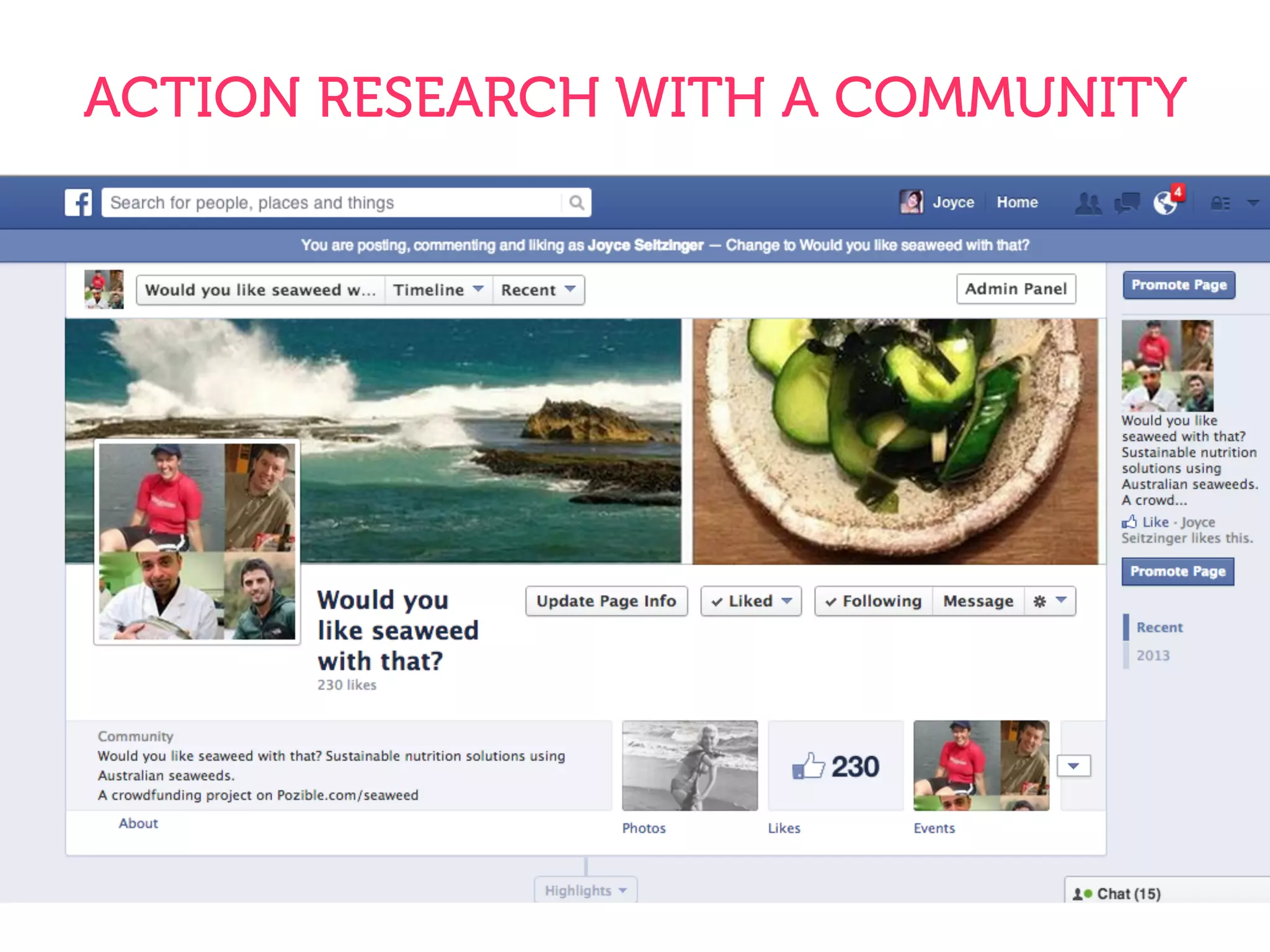
ACTION RESEARCH WITH A COMMUNITY
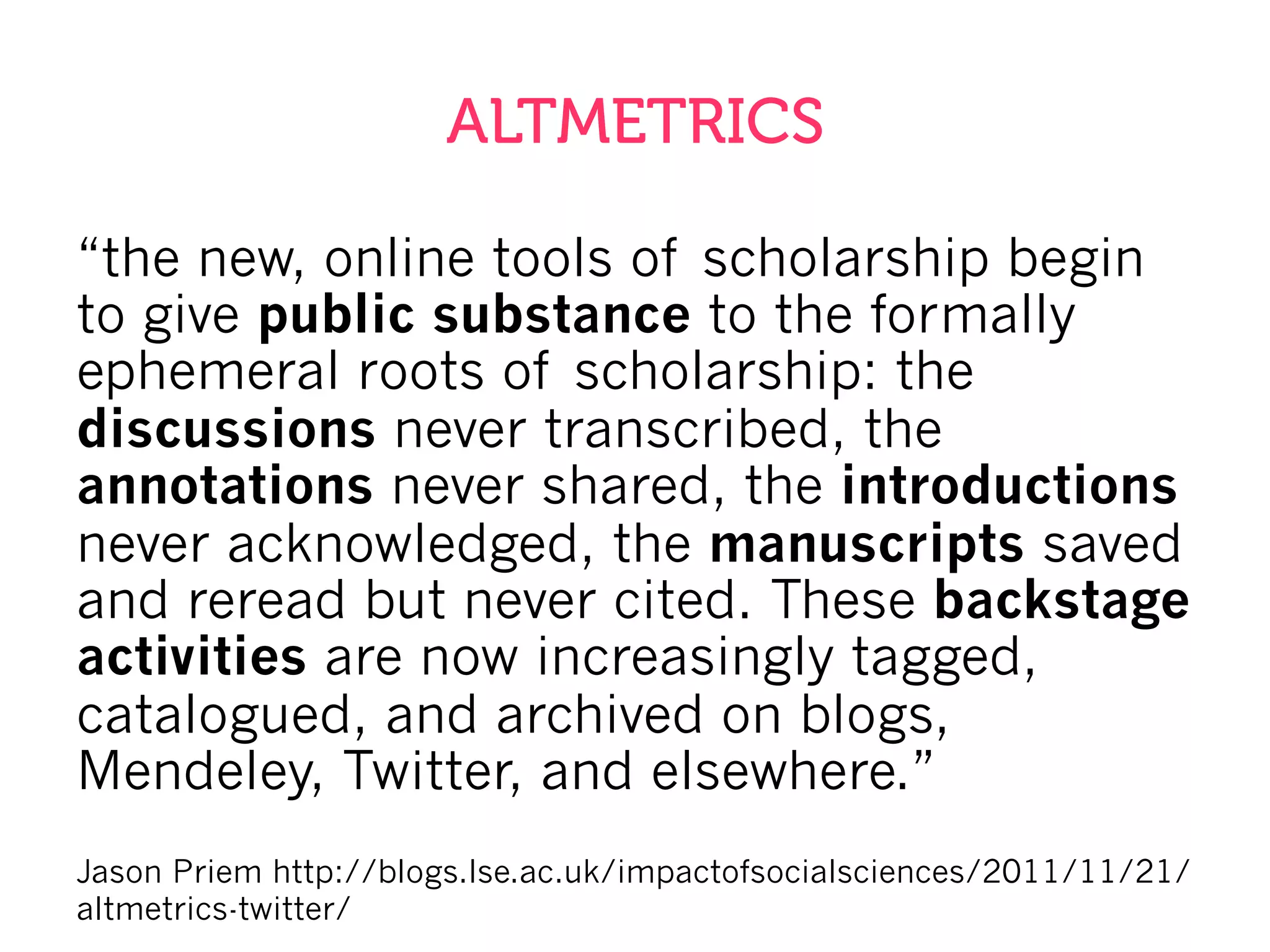
ALTMETRICS
“the new, online tools of scholarship begin
to give public substance to the formally
ephemeral roots of scholarship: the
discussions never transcribed, the
annotations never shared, the introductions
never acknowledged, the manuscripts saved
and reread but never cited. These backstage
activities are now increasingly tagged,
catalogued, and archived on blogs,
Mendeley, Twitter, and elsewhere.”
Jason Priem http://blogs.lse.ac.uk/impactofsocialsciences/2011/11/21/
altmetrics-twitter/
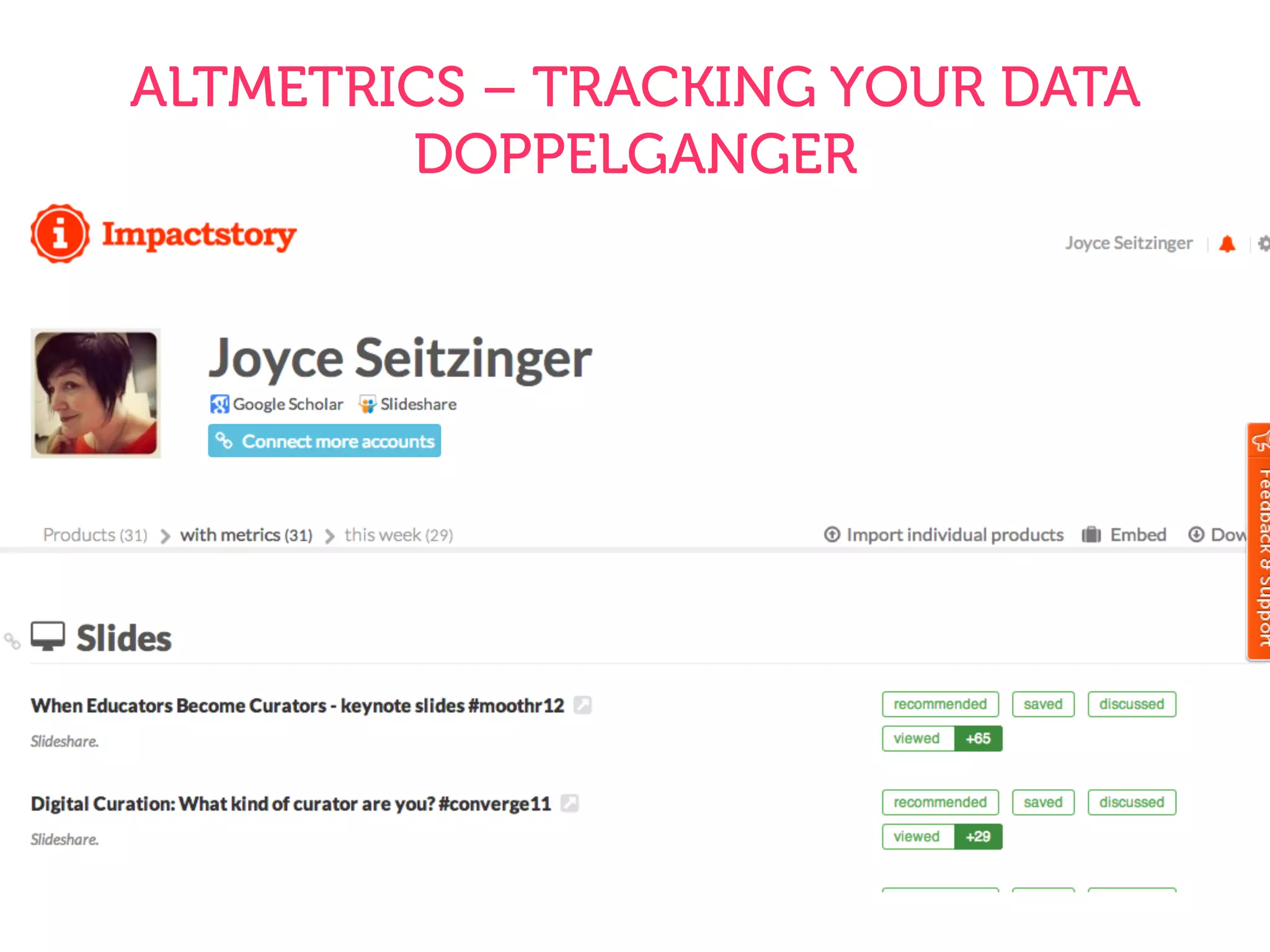
ALTMETRICS – TRACKING YOUR DATA
DOPPELGANGER
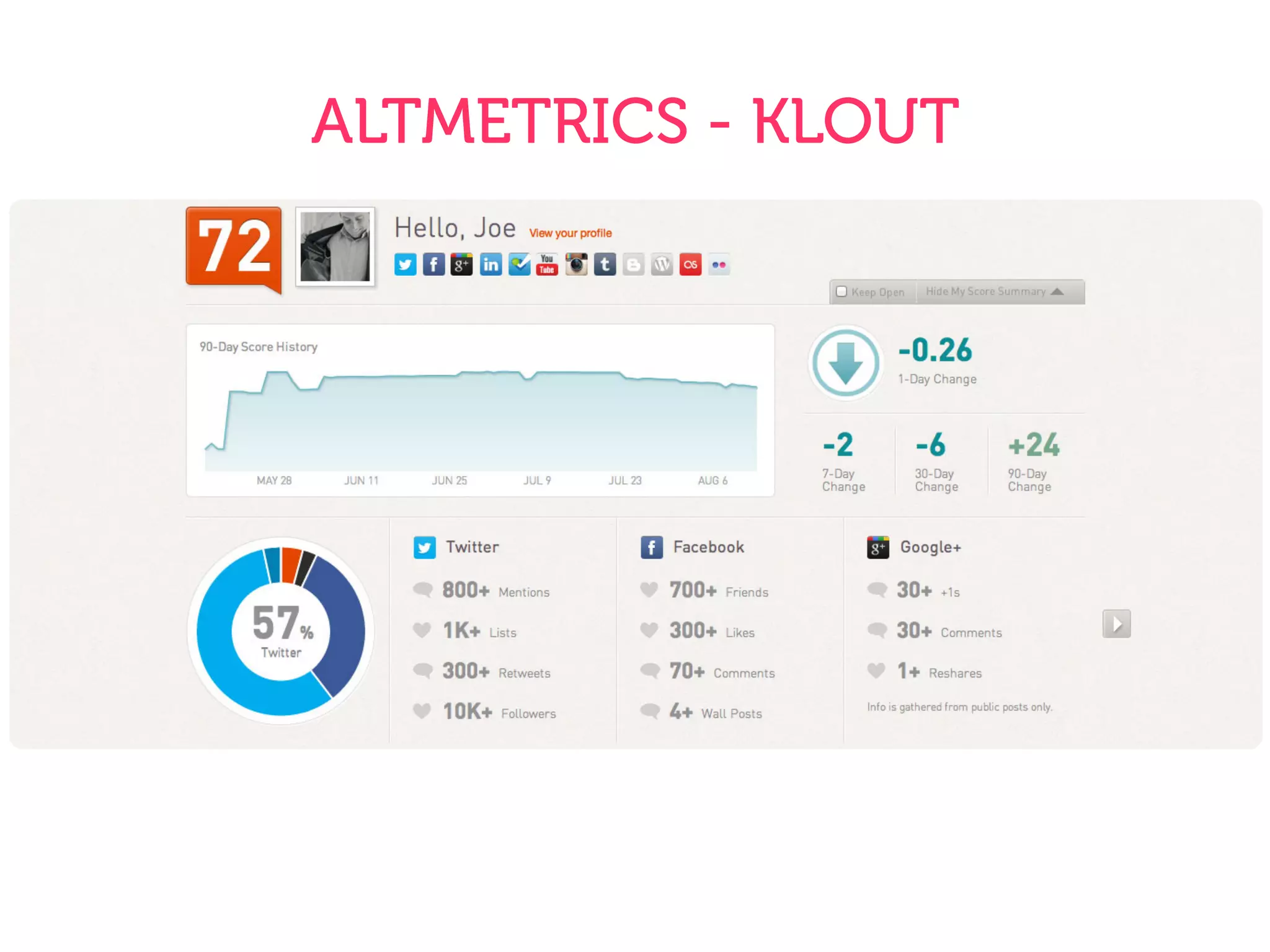
ALTMETRICS - KLOUT
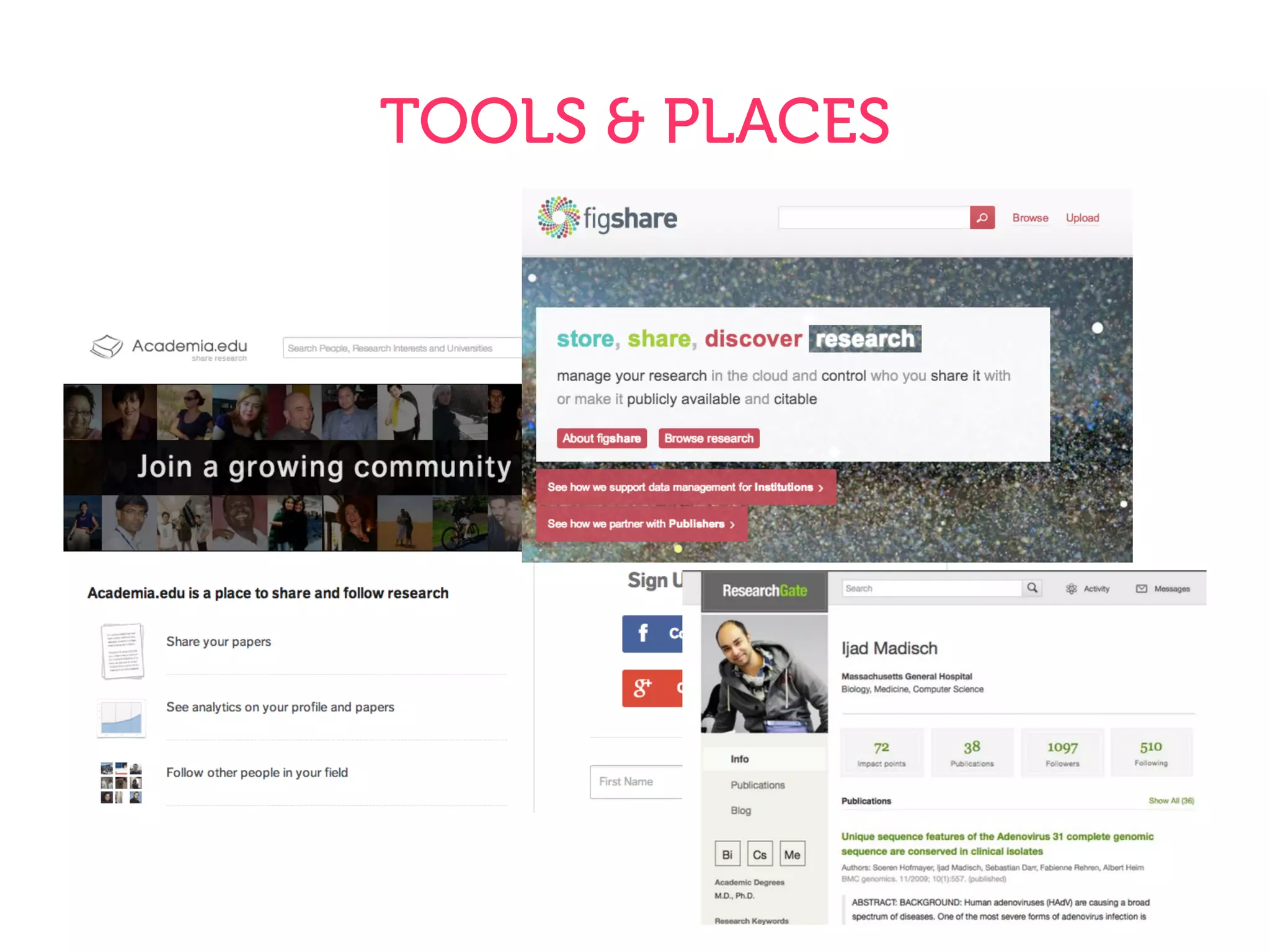
TOOLS & PLACES
TOOLS & PLACES
•  Buffer
•  Pocket
•  IFTTT
•  Hootsuite
•  Tweetbot
•  And a notebook
We’ve gone from
Publish or Perish
To
Be Visible or Vanish
Joyce Seitzinger
@catspyjamasnz
joyceseitzinger@gmail.com
academictribe.co
Questions?

Social Media for Scientists - University of Melbourne guest lecture May 2014

  • 1.
    SOCIAL MEDIA FOR SCIENTISTS A lecturefor @scidocmartin By Joyce Seitzinger University of Melbourne 15 May 204 lickrcclicenseFunksouphttp://www.flickr.com/photos/funksoup/403990660/
  • 2.
  • 3.
  • 4.
    2 PARTS •  Mappingyour use of social media •  What is happening with science and social media?
  • 5.
    LINK TO DIGITALHANDOUT http://tiny.cc/scidocmartin
  • 7.
    MY E-LEARNING ROLE Moodle Admin Course Builder Learning DesignerTeacher eLearning policy & strategy Trainer Moodle Helpdesk Graphic Designer
  • 8.
  • 9.
    MY STATS •  OnTwitter since Nov 2007 •  Followers - 7400 •  Tweets - 34557 •  Organiser PLE Conference 2012 •  Blogger – 16K downloads •  Instagram – 1043 pics •  Linkedin – 500+ connections •  Slideshare most viewed: 26555 views •  Most shared open educational resource: Moodle Tool Guide •  Flickr – 5989 photos •  Klout – 70 •  Scoopit – 5 boards •  Dropbox & Google Drive/Docs •  And counting….
  • 10.
    NETPRAX Deakin University, Facultyof Health March 2013 - Jun 2014 100 participants Embedding networked practice for personal learning, teaching practice and research practice iPad based Mozilla Open Badges Yammer/Facebook/Blog Twitter.com/netprax
  • 13.
  • 14.
    People live theirlives and learn across multiple settings, and this holds true not only across the span of our lives but also across and within the institutions and communities they inhabit – even classrooms, for example. I take an approach that urges me to consider the significant overlap across these boundaries as people, tools, and practices travel through different and even contradictory contexts and activities. KRIS GUTIERREZ
  • 15.
    JOI ITO “I don’tthink education is about centralized instruction anymore; rather, it is the process [of] establishing oneself as a node in a broad network of distributed creativity.” @joi
  • 16.
  • 17.
  • 18.
  • 19.
    DIGITAL VISITOR /DIGITAL RESIDENT MAPPING Personal Institutional ResidentVisitor
  • 21.
  • 22.
  • 23.
    cc licensed flickrphoto by courosa: http://flickr.com/photos/courosa/ 344832659/
  • 24.
    cc licensed flickrphoto by courosa: http://flickr.com/photos/courosa/2922421696/ INSERT ANY PROFESSIONAL
  • 25.
  • 26.
    ABOUT THE PEOPLE cclicensed flickr photo by shareski: http://flickr.com/photos/shareski/
  • 27.
    Everyone has thesame building blocks… …but how do you put them together?
  • 28.
    •  Which platformdo you use for your information streams? •  What are advantages/ disadvantages? •  Where do you keep your work? •  Is it digital or analog? •  Private or public? • Where do you keep track of your digital files and resources? • What are restrictions/ benefits? • How safe are your collections? • Do you share collections with others? Why or why not? • Who are you connected to? • Which tools do you use to communicate with other students? • Are the tools public or private? • What are advantages or not? • How much do you share about you? Conversation/ Hub Curation Information Streams Portfolio You Exercise: Sketch your diagram and tools as we go through the PLN model
  • 29.
    •  Which platformdo you use for your information streams? •  What are advantages/ disadvantages? •  Where do you keep your work? •  Is it digital or analog? •  Private or public? • Where do you keep track of your digital files and resources? • What are restrictions/ benefits? • How safe are your collections? • Do you share collections with others? Why or why not? • Who are you connected to? • Which tools do you use to communicate with other students? • Are the tools public or private? • What are advantages or not? • How much do you share about you? Conversation/ Hub Curation Information Streams Portfolio You
  • 30.
  • 36.
    Many students alreadyhave confident social identities online, but developing identities as learners, writers, scholars, citizens — these are important tasks as part of higher education. - Catherine Cronin http://catherinecronin.wordpress.com/2014/02/12/openeducation-and- identities/ ROLE OF INSTITUTION IN DIGITAL IDENTITY
  • 37.
    If institutions oflearning are going to help learners with the real challenges they face… [they] will have to shift their focus from imparting curriculum to supporting the negotiation of productive identities through landscapes of practice.” - Etienne Wenger (Digital Habitats, 2010) ROLE OF INSTITUTION IN DIGITAL IDENTITY
  • 38.
    •  Which platformdo you use for your information streams? •  What are advantages/ disadvantages? •  Where do you keep your work? •  Is it digital or analog? •  Private or public? • Where do you keep track of your digital files and resources? • What are restrictions/ benefits? • How safe are your collections? • Do you share collections with others? Why or why not? • Who are you connected to? • Which tools do you use to communicate with other students? • Are the tools public or private? • What are advantages or not? • How much do you share about you? Conversation /Hub Curation Information Streams Portfolio You
  • 39.
    cc licensed flickrphoto by Will Lion: http://flickr.com/photos/will-lion/
  • 40.
    Artefacts Discovery SelectionCollection Sharing The social curation process Social curation is: “the discovery, selection, collection and sharing of digital artefacts by an individual for a social purpose such as learning, collaboration, identity expression or community participation.” Seitzinger, 2014, Networked Learning Conference Proceedings
  • 41.
    Artefacts Discovery SelectionCollection Sharing The social curation process
  • 51.
    •  Which platformdo you use for your information streams? •  What are advantages/ disadvantages? •  Where do you keep your work? •  Is it digital or analog? •  Private or public? • Where do you keep track of your digital files and resources? • What are restrictions/ benefits? • How safe are your collections? • Do you share collections with others? Why or why not? • Who are you connected to? • Which tools do you use to communicate with other students? • Are the tools public or private? • What are advantages or not? • How much do you share about you? Conversation Curation Information Streams Portfolio You
  • 52.
    MAKER CULTURE •  HereComes Everybody •  Making is Connecting
  • 53.
    START EASY -SLIDES •  www.slideshare.net/timbuckteeth •  www.slideshare.net/gconole •  www.slideshare.net/courosa
  • 54.
    A NEW FRONTIERFOR UNIVERSITIES & ACADEMICS
  • 55.
  • 56.
    ACADEMIC BLOGGING Using socialmedia has helped give my research a media profile which otherwise would have been impossible, particularly at this stage of my career. It’s made me easy to discover for journalists and it’s helped me forged a rich array of connections with the broader community who have been the subject of my research. I’ve also found that, increasingly, journalists have read my blog posts or listened to my podcasts before they contact me and it hugely aids the subsequent dialogue. Mark Carrigan http://blogs.lse.ac.uk/impactofsocialsciences/ 2013/02/04/the-value-of-academic-blogging/
  • 57.
  • 58.
    5 TWITTER &SCIENCE MYTHS 1.  Serious scientists don’t tweet 2.  Twitter takes too much time 3.  You can’t be meaningful in 140 characters 4.  Twitter erases boundaries between students and faculty 5.  Twitter is only for self-promoters Sarah Boon, http://www.cdnsciencepub.com/ blog/scientists-using-twitter-dispelling-the- myths.aspx
  • 59.
  • 60.
  • 61.
    DISSEMINATION – SHAREEARLY, SHARE OFTEN Jason Priem http:// www.nature.com/ nature/journal/v495/ n7442/full/ 495437a.html
  • 62.
  • 63.
    ALTMETRICS “the new, onlinetools of scholarship begin to give public substance to the formally ephemeral roots of scholarship: the discussions never transcribed, the annotations never shared, the introductions never acknowledged, the manuscripts saved and reread but never cited. These backstage activities are now increasingly tagged, catalogued, and archived on blogs, Mendeley, Twitter, and elsewhere.” Jason Priem http://blogs.lse.ac.uk/impactofsocialsciences/2011/11/21/ altmetrics-twitter/
  • 64.
    ALTMETRICS – TRACKINGYOUR DATA DOPPELGANGER
  • 65.
  • 66.
  • 67.
    TOOLS & PLACES • Buffer •  Pocket •  IFTTT •  Hootsuite •  Tweetbot •  And a notebook
  • 68.
    We’ve gone from Publishor Perish To Be Visible or Vanish
  • 69.