Quantum Numbers and their
Role in NMR
Guided by:
Dr. Raja Chakraborty
Department of Pharmacy, ADTU
Presented By:
Atul Adhikari
M.Pharm, 1st sem,
Assam Down Town University, Guwahati.
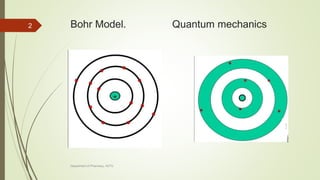
Bohr Model. Quantum mechanics2
Department of Pharmacy, ADTU
Quantum Numbers
 A number which occurs in the theoretical expression for the value of some
quantized property of a subatomic particle, atom, or molecule and can only have
certain integral or half-integral values.
1. Principal quantum number(n)
2. Angular momentum quantum number(l)
3. Magnetic quantum number (ml)
4. Spin quantum number(ms )
3
Department of Pharmacy, ADTU
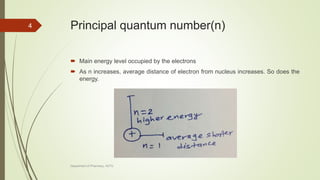
Principal quantum number(n)
 Main energy level occupied by the electrons
 As n increases, average distance of electron from nucleus increases. So does the
energy.
4
Department of Pharmacy, ADTU
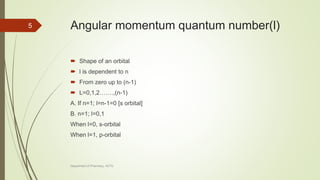
Angular momentum quantum number(l)
 Shape of an orbital
 l is dependent to n
 From zero up to (n-1)
 L=0,1,2…….,(n-1)
A. If n=1; l=n-1=0 [s orbital]
B. n=1; l=0,1
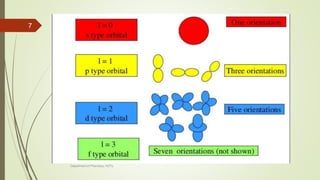
When l=0, s-orbital
When l=1, p-orbital
5
Department of Pharmacy, ADTU
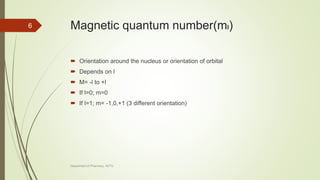
Magnetic quantum number(ml)
 Orientation around the nucleus or orientation of orbital
 Depends on l
 M= -l to +l
 If l=0; m=0
 If l=1; m= -1,0,+1 (3 different orientation)
6
Department of Pharmacy, ADTU
7
Department of Pharmacy, ADTU
Spin quantum number (ms)
 Spin Quantum Numbe describes the angular momentum of an electron.
 Because angular momentum is a vector, the Spin Quantum Number has both a
magnitude and direction (+ or -).
8
Department of Pharmacy, ADTU
Spin
 Form of angular momentum
 Form of intrinsic property shown by elementary particles and some atomic nuclei
 Particles having charges and spin generates own magnetic field and interact with
magnetic field.
9
Department of Pharmacy, ADTU
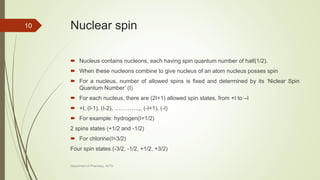
Nuclear spin
 Nucleus contains nucleons, each having spin quantum number of half(1/2).
 When these nucleons combine to give nucleus of an atom nucleus posses spin
 For a nucleus, number of allowed spins is fixed and determined by its ‘Niclear Spin
Quantum Number’ (I)
 For each nucleus, there are (2I+1) allowed spin states, from +I to –I
 +I, (I-1), (I-2), ………….,, (-I+1), (-I)
 For example: hydrogen(I=1/2)
2 spins states (+1/2 and -1/2)
 For chlorine(I=3/2)
Four spin states (-3/2, -1/2, +1/2, +3/2)
10
Department of Pharmacy, ADTU
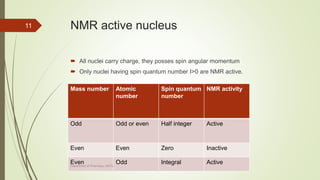
NMR active nucleus
 All nuclei carry charge, they posses spin angular momentum
 Only nuclei having spin quantum number I>0 are NMR active.
Mass number Atomic
number
Spin quantum
number
NMR activity
Odd Odd or even Half integer Active
Even Even Zero Inactive
Even Odd Integral Active
11
Department of Pharmacy, ADTU
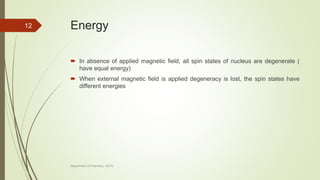
Energy
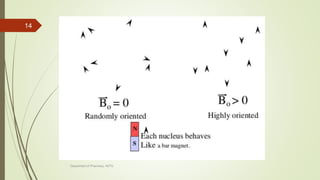
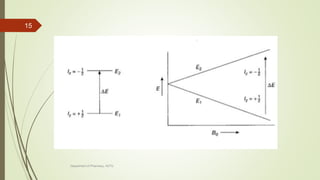
 In absence of applied magnetic field, all spin states of nucleus are degenerate (
have equal energy)
 When external magnetic field is applied degeneracy is lost, the spin states have
different energies
12
Department of Pharmacy, ADTU
Alignment and opposition
 For example hydrogen nucleus have 2 spin states, (+1/2) and (-1/2)
 Spin oriented opposite to the field(-1/2) has higher energy than
that oriented with the field(+1/2)
13
Department of Pharmacy, ADTU
14
Department of Pharmacy, ADTU
15
Department of Pharmacy, ADTU
 NMR is the physical phenomena of resonance transition between magnetic energy
levels, happening when atomic nuclei are immersed in an external magnetic field
and applied an EM radiation with specific frequency.
 NMR occurs when nuclei aligned to applied field absorb energy and oppose it.
 It is th quantized process and energy absorbed should be equal to the difference in
energy between two spin states.
 When energy in the form of radio frequency is applied and when applied frequency
is equal to energy difference two spin states, absorption of energy occurs and a
NMR signal is recorded.
16
Department of Pharmacy, ADTU
References
 A complete introduction to Modern NMR spectroscopy; Roger S., Macomber; John
Wiley & Sons Inc, New York,1998
 Encyclopedia of spectroscopy and spectrometry; Lindon J, Tranier G., Holmes J,
vol 3, elsevier, 2000
 Nuclear Magnetic Resonance Spectroscopy, Lambert J., Mazzola E.; Pearson
Education Inc, New Jersey
 NMR Spectroscopy Explained, Neil E.; A. John Wiley &Sons, Inc. Publication,
2007
17
Department of Pharmacy, ADTU