THERMAL METHODS OF ANALYSIS
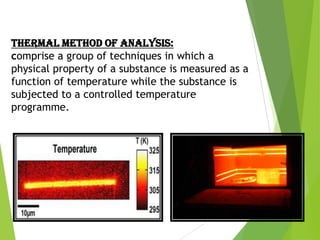
Thermal method of analysis:
comprise a group of techniques in which a

physical property of a substance is measured as a
function of temperature while the substance is
subjected to a controlled temperature
programme.
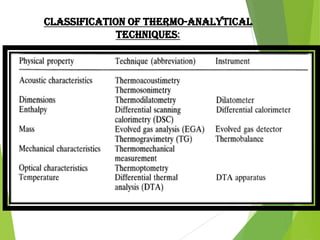
Classification of thermo-analytical
techniques:
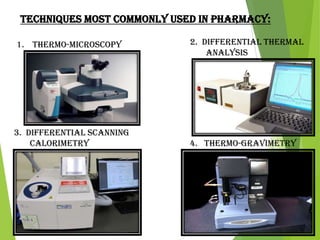
Techniques most commonly used in pharmacy:
1. Thermo-microscopy

3. Differential scanning
calorimetry

2. Differential thermal
analysis

4. thermo-gravimetry
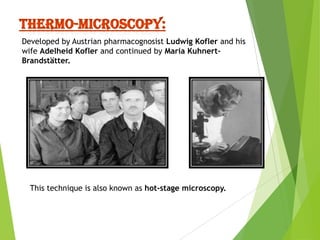
Developed by Austrian pharmacognosist Ludwig Kofler and his
wife Adelheid Kofler and continued by Maria KuhnertBrandstätter.

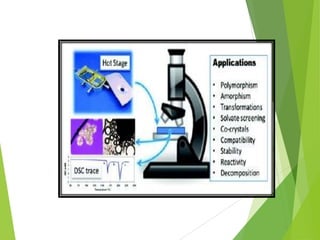
This technique is also known as hot-stage microscopy.
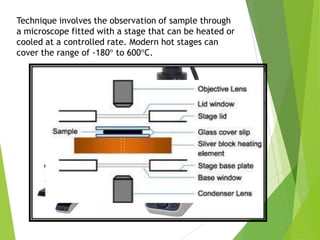
Technique involves the observation of sample through
a microscope fitted with a stage that can be heated or
cooled at a controlled rate. Modern hot stages can
cover the range of -180 to 600 C.
DIFFERENTIAL THERMAL ANALYSIS

Speakers:
 Anam hassan
 Bushra khan
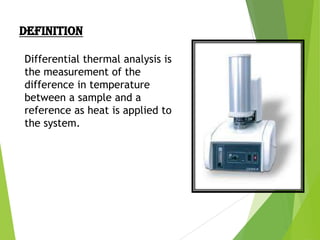
DEFINITION
Differential thermal analysis is
the measurement of the
difference in temperature
between a sample and a
reference as heat is applied to
the system.
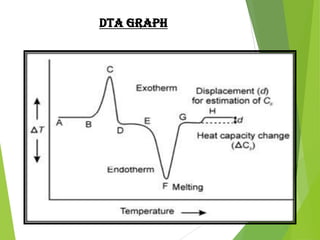
DTA GRAPH
FACTORS AFFECT RESULT IN DTA


Sample weight



Heating rate



Particle size



Atmospheric condition
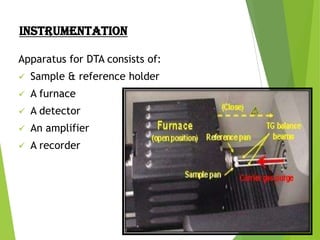
INSTRUMENTATION
Apparatus for DTA consists of:


Sample & reference holder



A furnace



A detector



An amplifier



A recorder
APPLICATIONS








Qualitative and quantitative
identification of minerals.
Analysis of biological material
To determine M.P, B.P, decomposition
temperature of organic compounds.
Widely used for the quality control of
a large number of substances like
cement, glass, soil etc.
Also used for the thermal stability of
inorganic compounds and complexes.
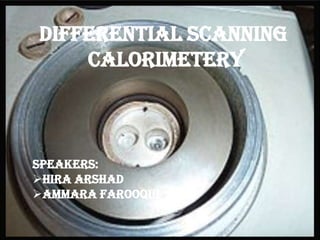
DIFFERENTIAL SCANNING
CALORIMETERy

SPEAKERS:
HIRA ARSHAD
AMMARA FAROOQUI
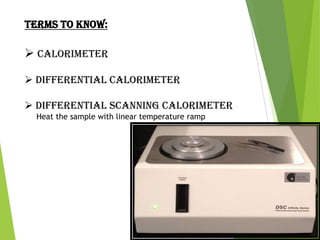
TERMS TO KNOW:

 CALORIMETER
 DIFFERENTIAL CALORIMETER
 DIFFERENTIAL SCANNING CALORIMETER
Heat the sample with linear temperature ramp
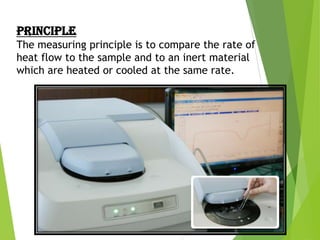
PRINCIPLE
The measuring principle is to compare the rate of
heat flow to the sample and to an inert material
which are heated or cooled at the same rate.
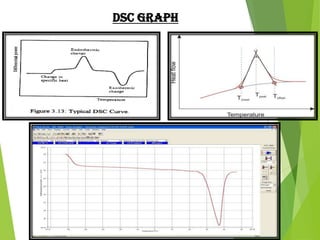
DSC GRAPH
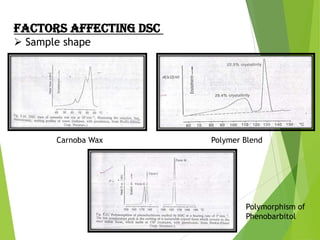
FACTORS AFFECTING DSC
 Sample shape

Carnoba Wax

Polymer Blend

Polymorphism of
Phenobarbitol
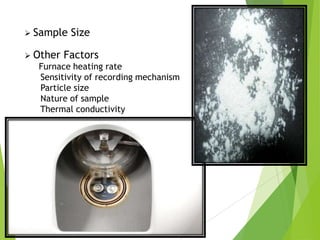
 Sample
 Other

Size

Factors

Furnace heating rate
Sensitivity of recording mechanism
Particle size
Nature of sample
Thermal conductivity
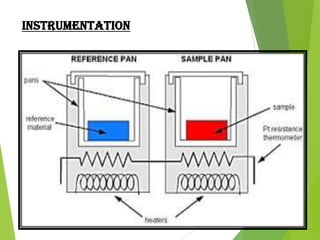
INSTRUMENTATION
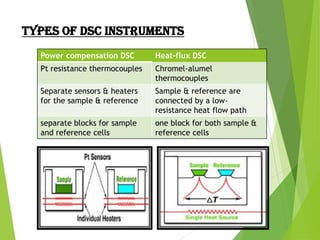
TYPES OF DSC INSTRUMENTS
Power compensation DSC

Heat-flux DSC

Pt resistance thermocouples

Chromel-alumel
thermocouples

Separate sensors & heaters
for the sample & reference

Sample & reference are
connected by a lowresistance heat flow path

separate blocks for sample
and reference cells

one block for both sample &
reference cells
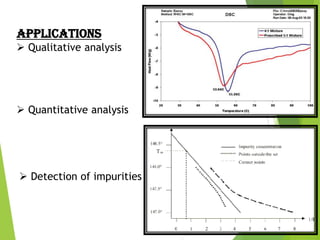
APPLICATIONS
 Qualitative analysis

 Quantitative analysis

 Detection of impurities
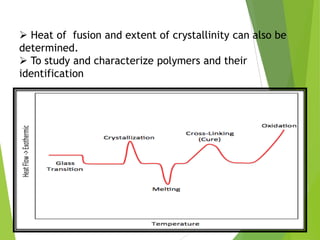
 Heat of fusion and extent of crystallinity can also be
determined.
 To study and characterize polymers and their
identification
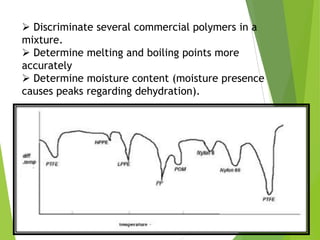
 Discriminate several commercial polymers in a
mixture.
 Determine melting and boiling points more
accurately
 Determine moisture content (moisture presence
causes peaks regarding dehydration).
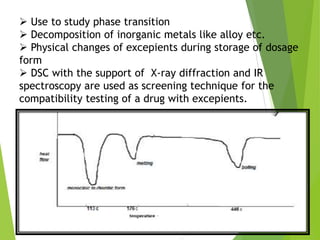
 Use to study phase transition
 Decomposition of inorganic metals like alloy etc.
 Physical changes of excepients during storage of dosage
form
 DSC with the support of X-ray diffraction and IR
spectroscopy are used as screening technique for the
compatibility testing of a drug with excepients.
SPEAKERS:
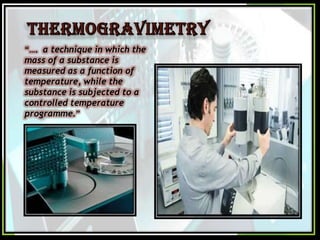
“…. a technique in which the

mass of a substance is
measured as a function of
temperature, while the
substance is subjected to a
controlled temperature
programme.”
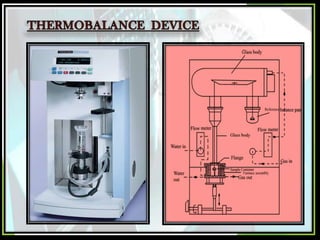
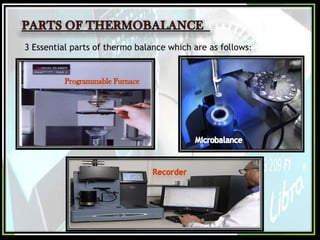
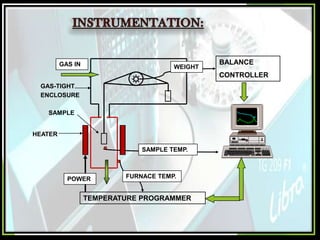
3 Essential parts of thermo balance which are as follows:
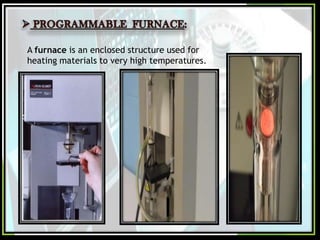
A furnace is an enclosed structure used for
heating materials to very high temperatures.
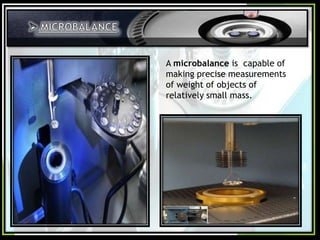
A microbalance is capable of
making precise measurements
of weight of objects of
relatively small mass.
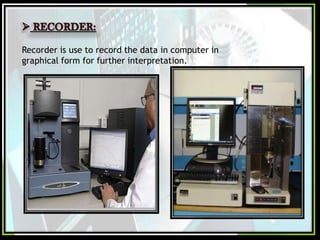
Recorder is use to record the data in computer in
graphical form for further interpretation.
GAS IN

WEIGHT

BALANCE
CONTROLLER

GAS-TIGHT
ENCLOSURE
SAMPLE

HEATER
SAMPLE TEMP.

POWER

FURNACE TEMP.

TEMPERATURE PROGRAMMER
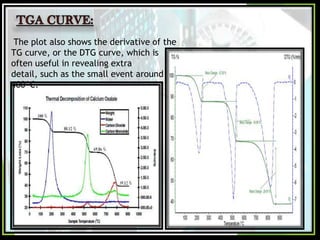
The plot also shows the derivative of the
TG curve, or the DTG curve, which is
often useful in revealing extra
detail, such as the small event around
400°C.
Thermal methods of analysis

Thermal methods of analysis