Presented By-
ROHIT
R.K.S.D college of
pharmacy ,Kaithal.
M.Pharm 1st year
(Pharmaceutics)
 Excipients play an important role in formulating a
dosage form.
 These are ingredients which along with active
pharmaceutical ingredients make up the dosage forms.
 Excipients act as protective agents, bulking agents and
can also be used to improve bioavailability of drug.
 Excipients as like other active pharmaceutical
ingredients need to be stabilized and standardized
An excipient is a substance formulated alongside the
active ingredient of a medication, included for the
purpose of long-term stabilization, bulking up solid
formulations that contain potent active ingredients in
small amounts
 Consistency of drug release and bioavailability.
 Stability including protection from degradation.
 Ease of administration to the target patient
population(s) by the intended route.
 Binders
 Disintegrants
 Fillers (diluents)
 Lubricants
 Glidants
 Compression aids
 Colors
 Sweeteners
 Preservatives
 Flavors
 Film formers/coatings
 Suspending/dispersing agents/surfactants
 Anti adherents
 Sorbents
 Antioxidants
 Buffering agent
 Chelating agent
 Viscosity imparting agent
 Humectants
 In pharmaceutical dosage forms the active
pharmaceutical ingredients are in intimate contact
with the excipient which are greater quantity excipient
and drugs may have certain incompatibility which lead
to drug excipient interaction.
 1.Physical interactions.
 2.Chemical interactions.
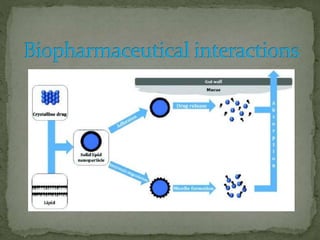
 3.Biopharmceutical interactions.
 4. Excipient –Excipient interactions.
 Physical interactions alter the rate of dissolution ,
dosage uniformity ,etc.
 physical interactions do not involve chemical changes
thus permitting the components in the formulation to
retain their molecular structure .
 physical interactions are difficult to detect .
Interaction
Complexation:-
(1). Usually binds reversibly with
drugs to form
complex. (2). Insoluble complexes
are formed which lead to slower
dissolution.
(3). Decreased absorption of
drug.
Beneficial effect
examples
 Cyclodextrin is often used to improve bioavailability
of poorly water soluble drugs.
 This increases bioavailability and increases
 rate
Tetracycline formed insoluble complex with calcium
carbonate leading to slower dissolution and decreased
absorption.
 Active pharmaceutical ingredients and exciepients
react with each other to form unstable compounds.
 In presence of moisture, many drug substances
hydrolyze react with other excipients or oxidize.
 These tests are performed by exposing the drug to
different relative humidity conditions.
 Preformulation data of this type is helpful in
determining if the material should be protected and
stored in a controlled low –humidity environment or if
aqueous based granulation should be avoided.
 Oxidation is broadly defined as a loss of electrons in a
system, but it can be restated as an increase in oxygen
or a decrease in hydrogen content.
 Oxidation always occurs in tandem with reduction ;
the so called REDOX reaction couple.
 It can be defined as the loss of an electron positive
atom, radical or electron, or the addition of an
electronegative moiety.
 Oxidation reaction can be catalysed heavy metals,
light, leading to free radical formation. Free radicals
then react with oxygen to form peroxy radicals.
 This type of interaction occurs between two or more
excipients in a drug molecule.
 Example:- In proper addition of electrolyte such as-
Ca++ or Mg++ ion in suspension containing sodium
carboxymethyl cellulose (Na CMC) which will cause
formation of Calcium/Magnesium CMC.
 The suspending agent will be destroyed and cannot
perform its function.
1. Thermal methods of analysis
– DSC- Differential Scanning Calorimetry
– DTA- Differential Thermal Analysis
2. Accelerated Stability Study
3. FT-IR Spectroscopy
4. DRS-Diffuse Reflectance Spectroscopy
5. Chromatography
– SIC-Self Interactive Chromatography
– TLC-Thin Layer Chromatography
– HPLC-High Pressure Liquid Chromatography
6. Miscellaneous
– Radiolabelled Techniques
– Vapour Pressure Osmometry
– Flourescence Spectroscopy
o DSC is widely used to investigate and predict any physico
chemical interaction between drug and excipients involving
thermal changes..
o METHOD
 The preformulation screening of drug-excipient
interaction requires (1 : 1)Drug:excipient ratio.
 To maximize the likehood of observing an interaction.
 Mixture should be examined under N2 to eliminate
oxidative and pyrrolytic effects at heating rate ( 2, 5 or 100
c / min) on DSC apparatus.
-Fast
-Reliable and very less sample required.
LIMITATIONS OF DSC
•If thermal changes are very small, DSC can’t be used.
•DSC can not detect the incompatibilities which
occur after long term storage.
•Eg. MCC / ASPIRIN…
•Not applicable if test material exhibits properties
that make data interpretation difficult.
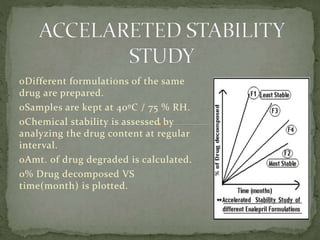
oDifferent formulations of the same
drug are prepared.
oSamples are kept at 40ºC / 75 % RH.
oChemical stability is assessed by
analyzing the drug content at regular
interval.
oAmt. of drug degraded is calculated.
o% Drug decomposed VS
time(month) is plotted.
• Principle: “Penetration of a portion of incident radiation
flux into the interior of the solid sample, return of some
portion of radiation to the surface of sample following partial
absorption and multiple scattering at boundary of individual
sample particles.”
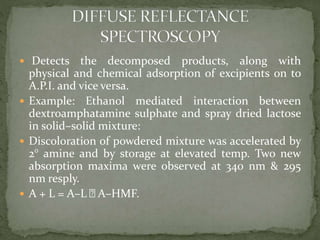
 Detects the decomposed products, along with
physical and chemical adsorption of excipients on to
A.P.I. and vice versa.
 Example: Ethanol mediated interaction between
dextroamphatamine sulphate and spray dried lactose
in solid–solid mixture:
 Discoloration of powdered mixture was accelerated by
2° amine and by storage at elevated temp. Two new
absorption maxima were observed at 340 nm & 295
nm resply.
 A + L = A–L A–HMF.
A shift in the diffuse reflectance spectrum of the drug due
to the presence of the excipient indicates physical
adsorption.
whereas the appearance of a new peak indicates
chemisorption or formation of a degradation product.
DRS is more useful than HPLC assay to detect surface
discoloration due to oxidation or reaction with excipients.
• SIC is useful for proteinous drug and excipients.
• METHOD:-
• SIC is a modified type of affinity chromatography.
• Here,drug is made immobilized as the SP & soln. to be
tested( excipient soln.) acts as MP.
• Measure Rt (Retention time) & compare with non –retained
marker.
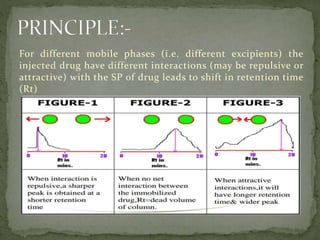
For different mobile phases (i.e. different excipients) the
injected drug have different interactions (may be repulsive or
attractive) with the SP of drug leads to shift in retention time
(Rt)
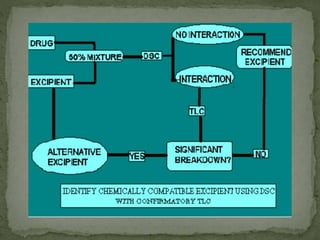
• TLC is generally used as confirmative test of compatibility
after performing DSC.
• S.P. consist of powder (Silica, Alumina, Polyamide,
Cellulose & Ion exchange resin) adhered onto glass, plastic or
metal plate.
• Solution of Drug, Excipient & Drug: Excipient mixture are
prepared & spotted on the same baseline at the end of plate.
• The plate is then placed upright in a closed chamber
containing the solvent which constitutes the M.P
• HPLC (high pressure liquid chromatography)
Characteristics: -The APIs and model compounds of
diversified chemical structure was studied.
-Elution rate: 7.5 ml/hr at ambient temp.
-Allows the detection and quantification of impurities, which
span a wide range of polarities, including nonpolar
compounds.
• FLUORESCENT MEASUREMENT:
-This technique is restricted to those compounds, which can
generate florescence. As the no. of such compounds are
restricted, this method is used in Analysis and not in
preformulation
• Principle: ‘samples of solutions and pure solvent are
introduced into a temperature-controlled enclosure, which is
saturated with solvent vapor.Since the vapor pressure of
solution is lower than that of solvent, solvent vapor
condenses on solution sample causing its temperature to rise.
The temperature rise is predicted by Clausis –Clapcyron
equation.’
• Characteristics: Either liquid or solid sample and must be
soluble in organic solvent or in water
Sample must not undego association in solution.
Sample size is approx. 3 gms for multiple analysis.
Measures a no. of avg. mole. Wt. of about 10,000 Daltons.
This method measures interactions, & records the
interaction caused by variation of particle
It is important when the API is having radio–activity.
Method is carried out by using either 3H or 13C.
Highly sensitive method but the cost of carrying out the
method & the availability of well established other
techniques & methods, this method is generally not
preferred.
Drug excipient interaction different method

Drug excipient interaction different method

  • 1.
    Presented By- ROHIT R.K.S.D collegeof pharmacy ,Kaithal. M.Pharm 1st year (Pharmaceutics)
  • 2.
     Excipients playan important role in formulating a dosage form.  These are ingredients which along with active pharmaceutical ingredients make up the dosage forms.  Excipients act as protective agents, bulking agents and can also be used to improve bioavailability of drug.  Excipients as like other active pharmaceutical ingredients need to be stabilized and standardized
  • 3.
    An excipient isa substance formulated alongside the active ingredient of a medication, included for the purpose of long-term stabilization, bulking up solid formulations that contain potent active ingredients in small amounts  Consistency of drug release and bioavailability.  Stability including protection from degradation.  Ease of administration to the target patient population(s) by the intended route.
  • 5.
     Binders  Disintegrants Fillers (diluents)  Lubricants  Glidants  Compression aids  Colors
  • 6.
     Sweeteners  Preservatives Flavors  Film formers/coatings  Suspending/dispersing agents/surfactants  Anti adherents  Sorbents  Antioxidants  Buffering agent  Chelating agent  Viscosity imparting agent  Humectants
  • 7.
     In pharmaceuticaldosage forms the active pharmaceutical ingredients are in intimate contact with the excipient which are greater quantity excipient and drugs may have certain incompatibility which lead to drug excipient interaction.
  • 8.
     1.Physical interactions. 2.Chemical interactions.  3.Biopharmceutical interactions.  4. Excipient –Excipient interactions.
  • 9.
     Physical interactionsalter the rate of dissolution , dosage uniformity ,etc.  physical interactions do not involve chemical changes thus permitting the components in the formulation to retain their molecular structure .  physical interactions are difficult to detect .
  • 10.
    Interaction Complexation:- (1). Usually bindsreversibly with drugs to form complex. (2). Insoluble complexes are formed which lead to slower dissolution. (3). Decreased absorption of drug.
  • 11.
    Beneficial effect examples  Cyclodextrinis often used to improve bioavailability of poorly water soluble drugs.  This increases bioavailability and increases  rate Tetracycline formed insoluble complex with calcium carbonate leading to slower dissolution and decreased absorption.
  • 12.
     Active pharmaceuticalingredients and exciepients react with each other to form unstable compounds.
  • 13.
     In presenceof moisture, many drug substances hydrolyze react with other excipients or oxidize.  These tests are performed by exposing the drug to different relative humidity conditions.  Preformulation data of this type is helpful in determining if the material should be protected and stored in a controlled low –humidity environment or if aqueous based granulation should be avoided.
  • 14.
     Oxidation isbroadly defined as a loss of electrons in a system, but it can be restated as an increase in oxygen or a decrease in hydrogen content.  Oxidation always occurs in tandem with reduction ; the so called REDOX reaction couple.  It can be defined as the loss of an electron positive atom, radical or electron, or the addition of an electronegative moiety.  Oxidation reaction can be catalysed heavy metals, light, leading to free radical formation. Free radicals then react with oxygen to form peroxy radicals.
  • 16.
     This typeof interaction occurs between two or more excipients in a drug molecule.  Example:- In proper addition of electrolyte such as- Ca++ or Mg++ ion in suspension containing sodium carboxymethyl cellulose (Na CMC) which will cause formation of Calcium/Magnesium CMC.  The suspending agent will be destroyed and cannot perform its function.
  • 17.
    1. Thermal methodsof analysis – DSC- Differential Scanning Calorimetry – DTA- Differential Thermal Analysis 2. Accelerated Stability Study 3. FT-IR Spectroscopy 4. DRS-Diffuse Reflectance Spectroscopy 5. Chromatography – SIC-Self Interactive Chromatography – TLC-Thin Layer Chromatography – HPLC-High Pressure Liquid Chromatography 6. Miscellaneous – Radiolabelled Techniques – Vapour Pressure Osmometry – Flourescence Spectroscopy
  • 18.
    o DSC iswidely used to investigate and predict any physico chemical interaction between drug and excipients involving thermal changes.. o METHOD  The preformulation screening of drug-excipient interaction requires (1 : 1)Drug:excipient ratio.  To maximize the likehood of observing an interaction.  Mixture should be examined under N2 to eliminate oxidative and pyrrolytic effects at heating rate ( 2, 5 or 100 c / min) on DSC apparatus.
  • 20.
    -Fast -Reliable and veryless sample required. LIMITATIONS OF DSC •If thermal changes are very small, DSC can’t be used. •DSC can not detect the incompatibilities which occur after long term storage. •Eg. MCC / ASPIRIN… •Not applicable if test material exhibits properties that make data interpretation difficult.
  • 22.
    oDifferent formulations ofthe same drug are prepared. oSamples are kept at 40ºC / 75 % RH. oChemical stability is assessed by analyzing the drug content at regular interval. oAmt. of drug degraded is calculated. o% Drug decomposed VS time(month) is plotted.
  • 23.
    • Principle: “Penetrationof a portion of incident radiation flux into the interior of the solid sample, return of some portion of radiation to the surface of sample following partial absorption and multiple scattering at boundary of individual sample particles.”
  • 24.
     Detects thedecomposed products, along with physical and chemical adsorption of excipients on to A.P.I. and vice versa.  Example: Ethanol mediated interaction between dextroamphatamine sulphate and spray dried lactose in solid–solid mixture:  Discoloration of powdered mixture was accelerated by 2° amine and by storage at elevated temp. Two new absorption maxima were observed at 340 nm & 295 nm resply.  A + L = A–L A–HMF.
  • 25.
    A shift inthe diffuse reflectance spectrum of the drug due to the presence of the excipient indicates physical adsorption. whereas the appearance of a new peak indicates chemisorption or formation of a degradation product. DRS is more useful than HPLC assay to detect surface discoloration due to oxidation or reaction with excipients.
  • 26.
    • SIC isuseful for proteinous drug and excipients. • METHOD:- • SIC is a modified type of affinity chromatography. • Here,drug is made immobilized as the SP & soln. to be tested( excipient soln.) acts as MP. • Measure Rt (Retention time) & compare with non –retained marker.
  • 27.
    For different mobilephases (i.e. different excipients) the injected drug have different interactions (may be repulsive or attractive) with the SP of drug leads to shift in retention time (Rt)
  • 28.
    • TLC isgenerally used as confirmative test of compatibility after performing DSC. • S.P. consist of powder (Silica, Alumina, Polyamide, Cellulose & Ion exchange resin) adhered onto glass, plastic or metal plate. • Solution of Drug, Excipient & Drug: Excipient mixture are prepared & spotted on the same baseline at the end of plate. • The plate is then placed upright in a closed chamber containing the solvent which constitutes the M.P
  • 29.
    • HPLC (highpressure liquid chromatography) Characteristics: -The APIs and model compounds of diversified chemical structure was studied. -Elution rate: 7.5 ml/hr at ambient temp. -Allows the detection and quantification of impurities, which span a wide range of polarities, including nonpolar compounds. • FLUORESCENT MEASUREMENT: -This technique is restricted to those compounds, which can generate florescence. As the no. of such compounds are restricted, this method is used in Analysis and not in preformulation
  • 30.
    • Principle: ‘samplesof solutions and pure solvent are introduced into a temperature-controlled enclosure, which is saturated with solvent vapor.Since the vapor pressure of solution is lower than that of solvent, solvent vapor condenses on solution sample causing its temperature to rise. The temperature rise is predicted by Clausis –Clapcyron equation.’ • Characteristics: Either liquid or solid sample and must be soluble in organic solvent or in water Sample must not undego association in solution. Sample size is approx. 3 gms for multiple analysis. Measures a no. of avg. mole. Wt. of about 10,000 Daltons. This method measures interactions, & records the interaction caused by variation of particle
  • 31.
    It is importantwhen the API is having radio–activity. Method is carried out by using either 3H or 13C. Highly sensitive method but the cost of carrying out the method & the availability of well established other techniques & methods, this method is generally not preferred.