Presented by- Anupriya Singh
M.pharm-1st year
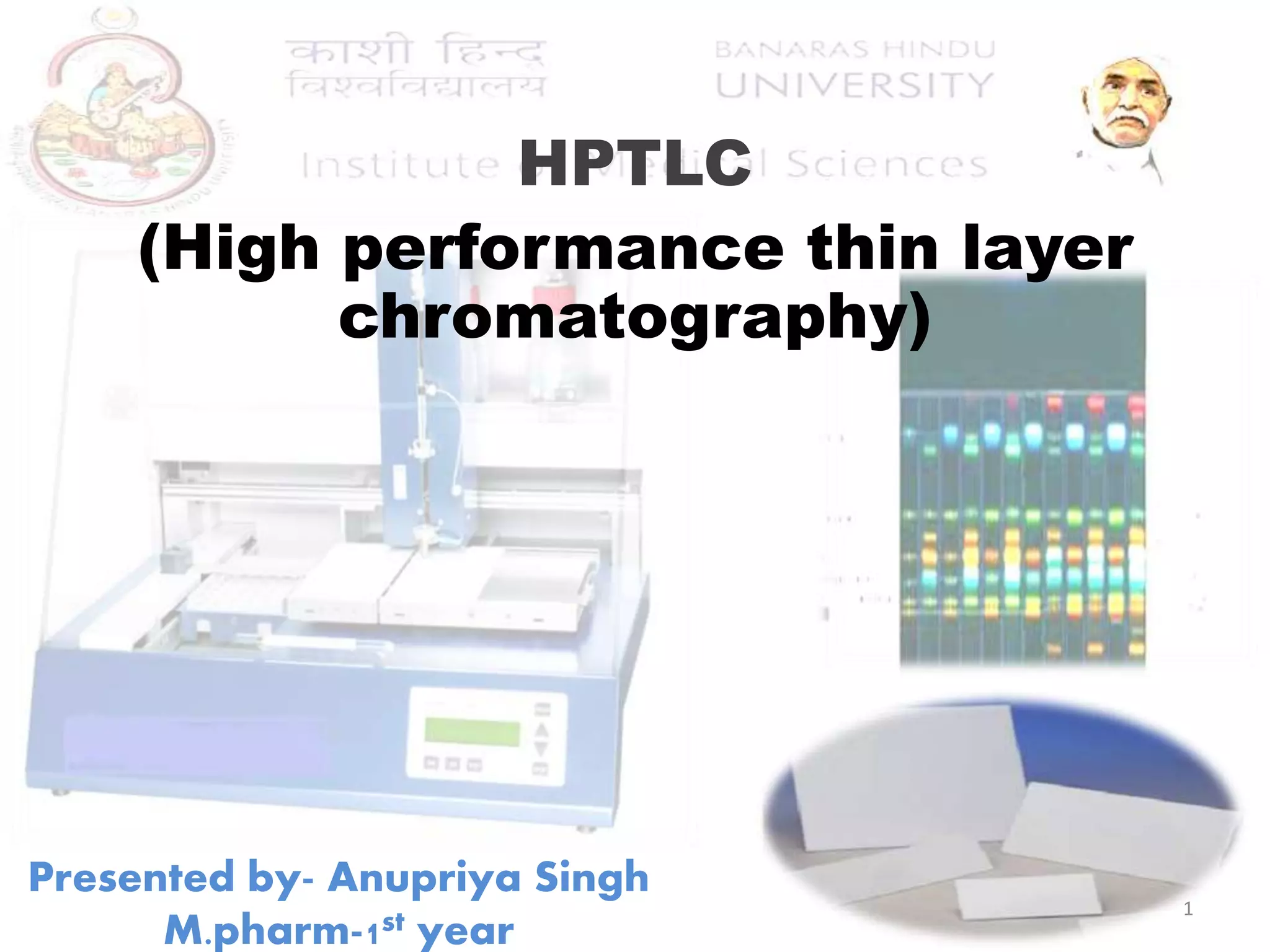
HPTLC
(High performance thin layer
chromatography)
1
Content-• Content-
• introduction
• Principle
• Instrumentation
• Difference between TLC and HPTLC
• Steps involving in HPTLC
• Factors influencing separation and resolution of
spots
• Applications of HPTLC
2
.
• Introduction-.
• HPTLC (High performance thin layer chromatography) is
the automated, sophisticated form and improved
method of TLC.
• It is a powerful analytical method equally suitable for
qualitative and quantitative analytical tasks.
• It is also known as planer or flat bed chromatography.
• HPTLC is very popular for many reasons such as-
• Visual chromatogram,
• Multiple sample handling,
• Enables the most complicated separation,
3
.
• Detection limit in nanogram range with UV-
absorption detection and in picogram range with
fluorimetric detection.
• Large no of theoretical plates in minimum area of
plates .
• Analysis time is greatly redused in HPTLC due to
shorter migration distant.
• Higher efficiency due to smaller particle size(5 μm).
4
.• Principle-
• Same theoretical principle of TLC (Adsorption
chromatography ) i.e. the principle of separation is
adsorption.
• Mobile phase flow by capillary action effect .
• And component move according to their affinities
towards the adsorbent.
• The component with higher affinity toward adsorbent
travels slowly.
• And the component with lesser affinity towards the
stationary phase travels faster.
• Thus the components are separated on a
chromatographic plate according to their affinity and
seperation also based on their solubility in mobile
phase.
5
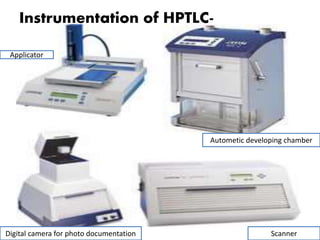
Instrumentation of HPTLC-
6
Scanner
Applicator
Digital camera for photo documentation
Autometic developing chamber
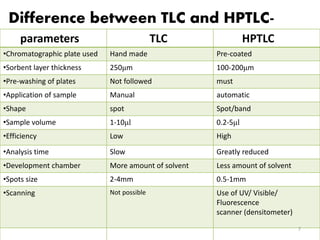
Difference between TLC and HPTLC-
parameters TLC HPTLC
•Chromatographic plate used Hand made Pre-coated
•Sorbent layer thickness 250μm 100-200μm
•Pre-washing of plates Not followed must
•Application of sample Manual automatic
•Shape spot Spot/band
•Sample volume 1-10μl 0.2-5μl
•Efficiency Low High
•Analysis time Slow Greatly reduced
•Development chamber More amount of solvent Less amount of solvent
•Spots size 2-4mm 0.5-1mm
•Scanning Not possible Use of UV/ Visible/
Fluorescence
scanner (densitometer)
7
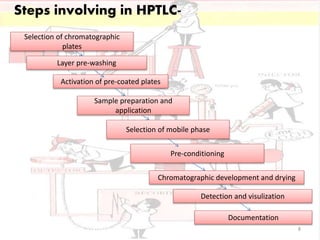
Steps involving in HPTLC-
8
Activation of pre-coated plates
Selection of chromatographic
plates
Layer pre-washing
Sample preparation and
application
Selection of mobile phase
Pre-conditioning
Chromatographic development and drying
Detection and visulization
Documentation
1. Selection of chromatographic plates-
• Hand made plates which are made up of cellulose and other
materials which are not used much now a day.
• Pre-coated plates- The plates with different support
materials and sorbent layers with different format and
thickness are used for qualitative and quantitative analysis.
• Support materials used in plates- Glass
Polyester/polyethylyne
Aluminium
• Sorbents used in plates-Silica gel 60F, Aluminium oxide,
Cellulose, silica gel chemically modified –a)amino
group(NH2), b) CN group
• Smaller particle size of silica helps in greater resolution and
sensitivity.
9
2. Layer pre-washing-
• It is purification step.
• The main purpose of the pre-washing is to remove impurities
which include water vapours and other volatile substances from
the atmosphere when they get exposed in the lab environment.
• In case of silica 60F( most widely used sorbent) the major
disadvantage of this sorbent is that it contain iron as impurity.
• This iron is removed by using Methanol : water (9:1), this is the
major advantage of the step of pre-washing.
• Some common methods are- Asending
Dipping
Continuous
• Solvents used for pre-washing-
Methanol
Chloroform:Methanol ( 1:1)
Choloroform: Methanol: Ammonia (90:10:1 )
10
3.Activation of pre coated plates-
• Freshly opened box of HPTLC plates doesn’t need
activation.
• If plates exposed to high humidity or kept in hand for
longer time then activation is required and it’s
activation results by removing moisture.
• The plates are activated by placing in an oven at 110-
1200 C for 30 min, this step will removes water that has
been physically absorbed on surface at solvent layer.
• Activation at higher temp and for longer time is
avoided which leads to very active layer and there is
risk of sample being decomposed.
11
4.Sample preparation and application-
Sample preparation-
• It’s important to prepare proper sample for successful
separation.
• Sample and reference substances should be dissolved in the
same solvent to ensure comparable distribution at starting
zones.
• It needs a high concentrated solution,as very less amount of
sample need to be applied.
• After that dry the plates and store in dust free atmosphere.
• Solvents used are-
• Methanol,
• Chloroform: Methanol (1:1),
• Ethyl acetate: Methanol (1:1),
• Chloroform: Methanol: Ammonia (90:!0:1),
12
Sample application-
• Usual concentration range is 0.1-1µg / µl,above this causes poor
separation and volume recommended for HPTLC-0.5-5μl .
• The size of sample spot applied must not exceed 1mm in
diameter.
• Problem from overloading can be overcome by applying the
sample as band.
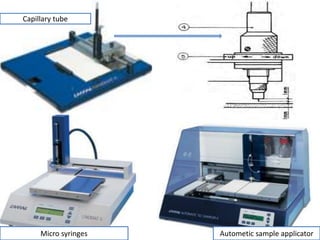
• Some applicators used for application of sample-
Selection of applicator to be used depends on-
-Sample volume
-No. of sample to be applied
a) Capillary tubes
b) Micro bulb pipettes.
c) Micro syringes.
d)Automatic sample applicator. 13
.
14
Autometic sample applicator
Capillary tube
Micro syringes
.
• The major criteria is that they shouldn’t damage the
surface while applying sample.
• The sample are completely transfer to the layer.
• Advantage of application of sample as bands are-
Better seperation due to rectengular shape.
Response of densitometer is higher in case of
band because of uniform distribution of sample in
band.
15
5.Selection of mobile phase-
• Chemical properties of analytes and sorbent layer factors
should be considered while selection of mobile phase.
• Various components of Mobile Phase should be measured
separately and then placed in mixing vessel.
• The less amount of mobile phase is required then TLC .
• This prevents contamination of solvents and also error arising
from volumes expansion or contraction on mixing.
• Multi component mobile phase once used not recommonded
for further use due to diffirent evaporation and adsorption by
layer.
16
6.Pre-conditioning (chamber saturation)-
• Un- saturated chamber causes high Rf values.
• Saturated chamber by lining with filter paper for
30min prior to development-uniform distribution of
solvent vapours-less solvent for the sample to
travel-lower RF values
• For low polarity mobile phase there is no need of
saturation.However saturation is needed for highly
polar mobile phase.
• Chamber saturation influence separation profile.
17
7.Chromatographic development and drying-
• Plates are spotted with sample and air dried and placed in
the developing chambers.
• The different methods used for development of chambers
are like-
Ascending
Descending
Horizontal
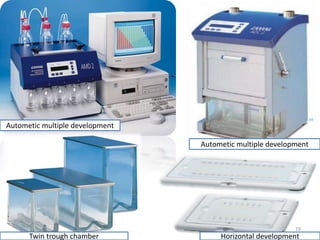
• Autometic multiple development,Circular, anti-circular device
and multiple developments are some other methods.
• After development, remove the plate and mobile phase is
removed from the plate to avoid contamination of lab
atmosphere.
• Dry in vacuum desiccators with protection from heat and
light.
18
.
19
Autometic multiple development
Horizontal development
Autometic multiple development
Twin trough chamber
8.Detection and visulization-
• Detection under UV light is first choice.
• Non destructive and spots of fluorescent compounds
can be seen at 254 nm (short wave length) or at 366
nm (long wave length).
• Spots of non fluorescent compounds can be seen
fluorescent stationary phase is used - silica gel Gf.
• Non UV absorbing compounds like ethambutol,
dicylomine dipping the plates in 0.1% iodine solution
.
20
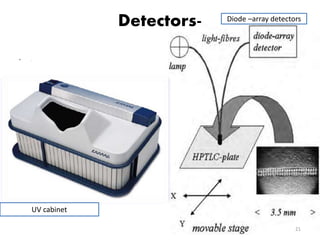
Detectors-
21
UV cabinet
Diode –array detectors
• .
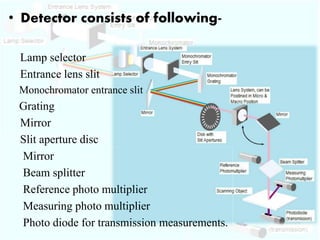
Instrumentation-
22
• Detector consists of following-
Lamp selector
Entrance lens slit
Monochromator entrance slit
Grating
Mirror
Slit aperture disc
Mirror
Beam splitter
Reference photo multiplier
Measuring photo multiplier
Photo diode for transmission measurements.
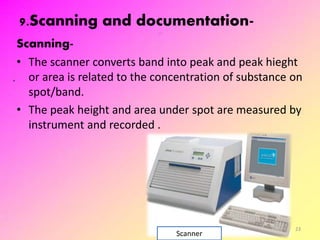
9.Scanning and documentation-
Scanning-
• The scanner converts band into peak and peak hieght
or area is related to the concentration of substance on
spot/band.
• The peak height and area under spot are measured by
instrument and recorded .
23
Scanner
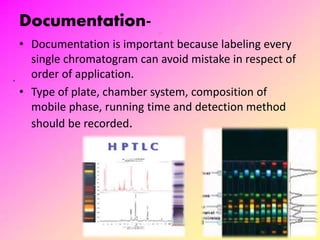
Documentation-
• Documentation is important because labeling every
single chromatogram can avoid mistake in respect of
order of application.
• Type of plate, chamber system, composition of
mobile phase, running time and detection method
should be recorded.
24
Factor affecting HPTLC
• Types of stationary phase.
• Mobile phase
• Layer thickness
• Temperature
• Mode of development
• Amount of sample
• Dipping zone, etc.
25
Applications of HPTLC
• Pharmaceutical industry- Quality control,identity purity test etc.
• Food Analysis- : Quality control , additives , pesticides ,stability testing
etc.
• Clinical Applications- Metabolism studies , drug screening ,stability
testing etc
• Industrial Applications- Process development and optimization
etc.
• Forensic- Poisoning investigations
• Biomedical Analysis- Seperation of gangliosides
• Environment Analysis-Pesticides in drinking water etc.
• Cosmetics- Hydrocortisone & cinchocaine in lanolin ointment etc.
• Natural products ,plant ingredients- Glycosides in herbal
drugs,Piperine in piper longum etc.
• Finger print Analysis-Finger prints for identification of liquorice,
ginseng etc.
• Analysis of drugs in blood-
26
.
.
27

Hptlc presentation ppt

  • 1.
    Presented by- AnupriyaSingh M.pharm-1st year HPTLC (High performance thin layer chromatography) 1
  • 2.
    Content-• Content- • introduction •Principle • Instrumentation • Difference between TLC and HPTLC • Steps involving in HPTLC • Factors influencing separation and resolution of spots • Applications of HPTLC 2
  • 3.
    . • Introduction-. • HPTLC(High performance thin layer chromatography) is the automated, sophisticated form and improved method of TLC. • It is a powerful analytical method equally suitable for qualitative and quantitative analytical tasks. • It is also known as planer or flat bed chromatography. • HPTLC is very popular for many reasons such as- • Visual chromatogram, • Multiple sample handling, • Enables the most complicated separation, 3
  • 4.
    . • Detection limitin nanogram range with UV- absorption detection and in picogram range with fluorimetric detection. • Large no of theoretical plates in minimum area of plates . • Analysis time is greatly redused in HPTLC due to shorter migration distant. • Higher efficiency due to smaller particle size(5 μm). 4
  • 5.
    .• Principle- • Sametheoretical principle of TLC (Adsorption chromatography ) i.e. the principle of separation is adsorption. • Mobile phase flow by capillary action effect . • And component move according to their affinities towards the adsorbent. • The component with higher affinity toward adsorbent travels slowly. • And the component with lesser affinity towards the stationary phase travels faster. • Thus the components are separated on a chromatographic plate according to their affinity and seperation also based on their solubility in mobile phase. 5
  • 6.
    Instrumentation of HPTLC- 6 Scanner Applicator Digitalcamera for photo documentation Autometic developing chamber
  • 7.
    Difference between TLCand HPTLC- parameters TLC HPTLC •Chromatographic plate used Hand made Pre-coated •Sorbent layer thickness 250μm 100-200μm •Pre-washing of plates Not followed must •Application of sample Manual automatic •Shape spot Spot/band •Sample volume 1-10μl 0.2-5μl •Efficiency Low High •Analysis time Slow Greatly reduced •Development chamber More amount of solvent Less amount of solvent •Spots size 2-4mm 0.5-1mm •Scanning Not possible Use of UV/ Visible/ Fluorescence scanner (densitometer) 7
  • 8.
    Steps involving inHPTLC- 8 Activation of pre-coated plates Selection of chromatographic plates Layer pre-washing Sample preparation and application Selection of mobile phase Pre-conditioning Chromatographic development and drying Detection and visulization Documentation
  • 9.
    1. Selection ofchromatographic plates- • Hand made plates which are made up of cellulose and other materials which are not used much now a day. • Pre-coated plates- The plates with different support materials and sorbent layers with different format and thickness are used for qualitative and quantitative analysis. • Support materials used in plates- Glass Polyester/polyethylyne Aluminium • Sorbents used in plates-Silica gel 60F, Aluminium oxide, Cellulose, silica gel chemically modified –a)amino group(NH2), b) CN group • Smaller particle size of silica helps in greater resolution and sensitivity. 9
  • 10.
    2. Layer pre-washing- •It is purification step. • The main purpose of the pre-washing is to remove impurities which include water vapours and other volatile substances from the atmosphere when they get exposed in the lab environment. • In case of silica 60F( most widely used sorbent) the major disadvantage of this sorbent is that it contain iron as impurity. • This iron is removed by using Methanol : water (9:1), this is the major advantage of the step of pre-washing. • Some common methods are- Asending Dipping Continuous • Solvents used for pre-washing- Methanol Chloroform:Methanol ( 1:1) Choloroform: Methanol: Ammonia (90:10:1 ) 10
  • 11.
    3.Activation of precoated plates- • Freshly opened box of HPTLC plates doesn’t need activation. • If plates exposed to high humidity or kept in hand for longer time then activation is required and it’s activation results by removing moisture. • The plates are activated by placing in an oven at 110- 1200 C for 30 min, this step will removes water that has been physically absorbed on surface at solvent layer. • Activation at higher temp and for longer time is avoided which leads to very active layer and there is risk of sample being decomposed. 11
  • 12.
    4.Sample preparation andapplication- Sample preparation- • It’s important to prepare proper sample for successful separation. • Sample and reference substances should be dissolved in the same solvent to ensure comparable distribution at starting zones. • It needs a high concentrated solution,as very less amount of sample need to be applied. • After that dry the plates and store in dust free atmosphere. • Solvents used are- • Methanol, • Chloroform: Methanol (1:1), • Ethyl acetate: Methanol (1:1), • Chloroform: Methanol: Ammonia (90:!0:1), 12
  • 13.
    Sample application- • Usualconcentration range is 0.1-1µg / µl,above this causes poor separation and volume recommended for HPTLC-0.5-5μl . • The size of sample spot applied must not exceed 1mm in diameter. • Problem from overloading can be overcome by applying the sample as band. • Some applicators used for application of sample- Selection of applicator to be used depends on- -Sample volume -No. of sample to be applied a) Capillary tubes b) Micro bulb pipettes. c) Micro syringes. d)Automatic sample applicator. 13
  • 14.
  • 15.
    . • The majorcriteria is that they shouldn’t damage the surface while applying sample. • The sample are completely transfer to the layer. • Advantage of application of sample as bands are- Better seperation due to rectengular shape. Response of densitometer is higher in case of band because of uniform distribution of sample in band. 15
  • 16.
    5.Selection of mobilephase- • Chemical properties of analytes and sorbent layer factors should be considered while selection of mobile phase. • Various components of Mobile Phase should be measured separately and then placed in mixing vessel. • The less amount of mobile phase is required then TLC . • This prevents contamination of solvents and also error arising from volumes expansion or contraction on mixing. • Multi component mobile phase once used not recommonded for further use due to diffirent evaporation and adsorption by layer. 16
  • 17.
    6.Pre-conditioning (chamber saturation)- •Un- saturated chamber causes high Rf values. • Saturated chamber by lining with filter paper for 30min prior to development-uniform distribution of solvent vapours-less solvent for the sample to travel-lower RF values • For low polarity mobile phase there is no need of saturation.However saturation is needed for highly polar mobile phase. • Chamber saturation influence separation profile. 17
  • 18.
    7.Chromatographic development anddrying- • Plates are spotted with sample and air dried and placed in the developing chambers. • The different methods used for development of chambers are like- Ascending Descending Horizontal • Autometic multiple development,Circular, anti-circular device and multiple developments are some other methods. • After development, remove the plate and mobile phase is removed from the plate to avoid contamination of lab atmosphere. • Dry in vacuum desiccators with protection from heat and light. 18
  • 19.
    . 19 Autometic multiple development Horizontaldevelopment Autometic multiple development Twin trough chamber
  • 20.
    8.Detection and visulization- •Detection under UV light is first choice. • Non destructive and spots of fluorescent compounds can be seen at 254 nm (short wave length) or at 366 nm (long wave length). • Spots of non fluorescent compounds can be seen fluorescent stationary phase is used - silica gel Gf. • Non UV absorbing compounds like ethambutol, dicylomine dipping the plates in 0.1% iodine solution . 20
  • 21.
  • 22.
    Instrumentation- 22 • Detector consistsof following- Lamp selector Entrance lens slit Monochromator entrance slit Grating Mirror Slit aperture disc Mirror Beam splitter Reference photo multiplier Measuring photo multiplier Photo diode for transmission measurements.
  • 23.
    9.Scanning and documentation- Scanning- •The scanner converts band into peak and peak hieght or area is related to the concentration of substance on spot/band. • The peak height and area under spot are measured by instrument and recorded . 23 Scanner
  • 24.
    Documentation- • Documentation isimportant because labeling every single chromatogram can avoid mistake in respect of order of application. • Type of plate, chamber system, composition of mobile phase, running time and detection method should be recorded. 24
  • 25.
    Factor affecting HPTLC •Types of stationary phase. • Mobile phase • Layer thickness • Temperature • Mode of development • Amount of sample • Dipping zone, etc. 25
  • 26.
    Applications of HPTLC •Pharmaceutical industry- Quality control,identity purity test etc. • Food Analysis- : Quality control , additives , pesticides ,stability testing etc. • Clinical Applications- Metabolism studies , drug screening ,stability testing etc • Industrial Applications- Process development and optimization etc. • Forensic- Poisoning investigations • Biomedical Analysis- Seperation of gangliosides • Environment Analysis-Pesticides in drinking water etc. • Cosmetics- Hydrocortisone & cinchocaine in lanolin ointment etc. • Natural products ,plant ingredients- Glycosides in herbal drugs,Piperine in piper longum etc. • Finger print Analysis-Finger prints for identification of liquorice, ginseng etc. • Analysis of drugs in blood- 26
  • 27.