DIFFERENTIAL SCANNING CALORIMETRY
 Differential scanning calorimetry (DSC) is a thermoanalytical
technique in which the difference in the amount of heat required to
increase the temperature of a sample and reference is measured as a
function of temperature
 Both the sample and reference are maintained at nearly the same
temperature throughout the experiment.
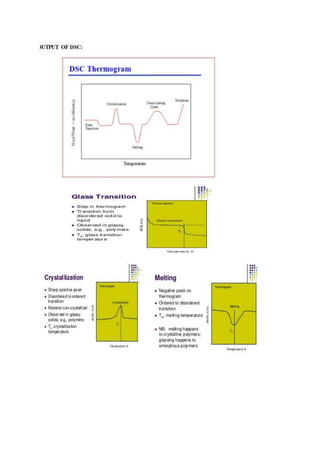
 The area of peak measures the total energy transfer to or from the
sample.
 DSC measures the temperatures and heat flows associated with
transitions in materials as a function of time and temperature in a
controlled atmosphere.
 These measurements provide quantitative and qualitative information
about physical and chemical changes that involve endothermic or
exothermic processes, orchanges in heat capacity.
PRINCIPLE:
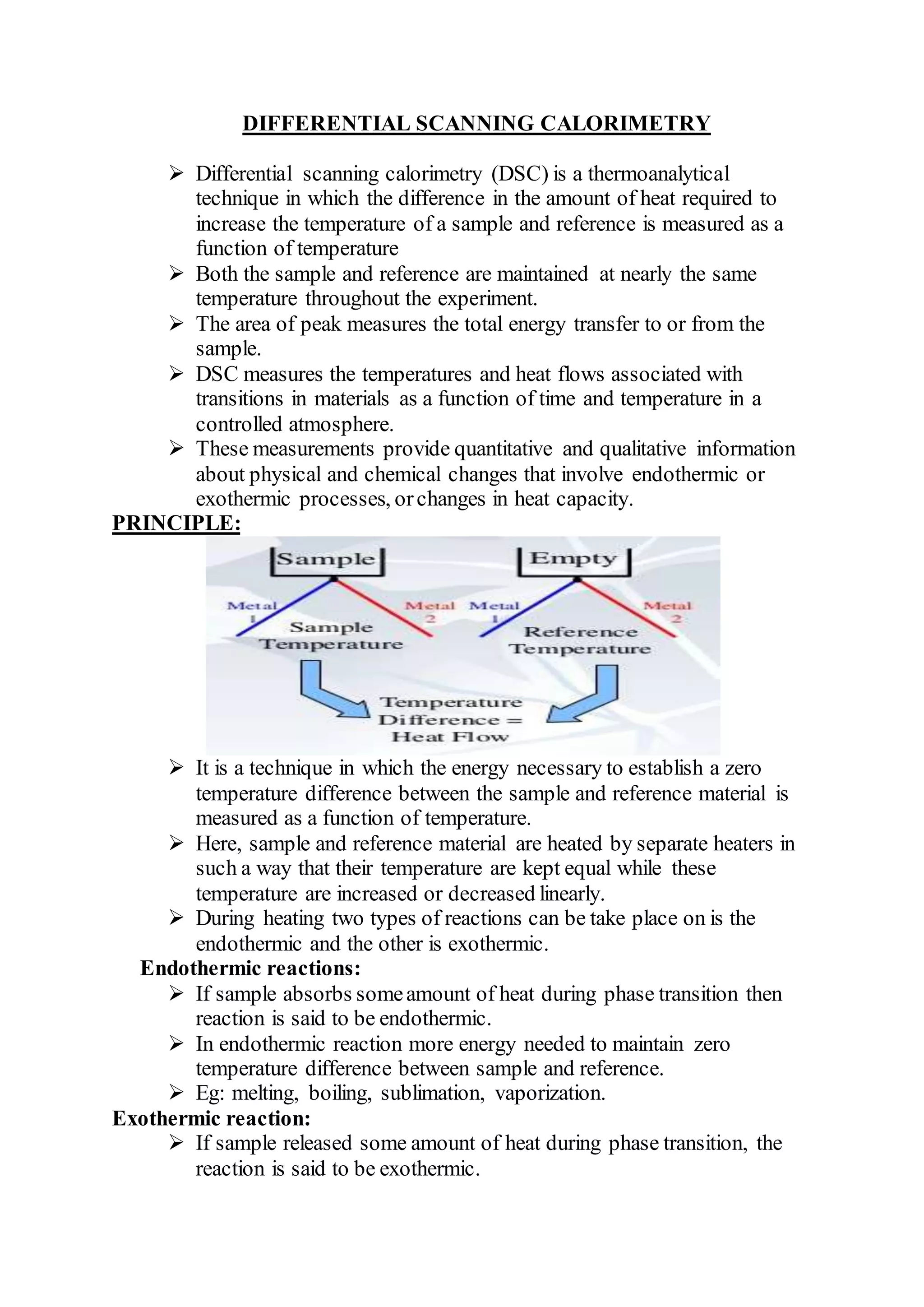
 It is a technique in which the energy necessary to establish a zero
temperature difference between the sample and reference material is
measured as a function of temperature.
 Here, sample and reference material are heated by separate heaters in
such a way that their temperature are kept equal while these
temperature are increased or decreased linearly.
 During heating two types of reactions can be take place on is the
endothermic and the other is exothermic.
Endothermic reactions:
 If sample absorbs someamount of heat during phase transition then
reaction is said to be endothermic.
 In endothermic reaction more energy needed to maintain zero
temperature difference between sample and reference.
 Eg: melting, boiling, sublimation, vaporization.
Exothermic reaction:
 If sample released some amount of heat during phase transition, the
reaction is said to be exothermic.
 In exothermic reaction, less energy needed to maintain zero
temperature difference between sample and reference/
 Eg: crystallization, degradation, polymerization.
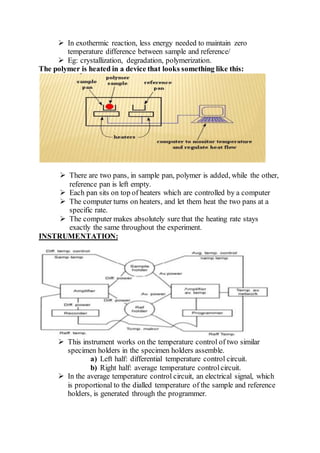
The polymer is heated in a device that looks something like this:
 There are two pans, in sample pan, polymer is added, while the other,
reference pan is left empty.
 Each pan sits on top of heaters which are controlled by a computer
 The computer turns on heaters, and let them heat the two pans at a
specific rate.
 The computer makes absolutely sure that the heating rate stays
exactly the same throughout the experiment.
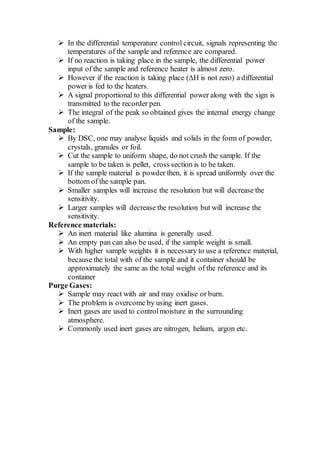
INSTRUMENTATION:
 This instrument works on the temperature control of two similar
specimen holders in the specimen holders assemble.
a) Left half: differential temperature control circuit.
b) Right half: average temperature controlcircuit.
 In the average temperature control circuit, an electrical signal, which
is proportional to the dialled temperature of the sample and reference
holders, is generated through the programmer.
 In the differential temperature control circuit, signals representing the
temperatures of the sample and reference are compared.
 If no reaction is taking place in the sample, the differential power
input of the sample and reference heater is almost zero.
 However if the reaction is taking place (∆H is not zero) a differential
power is fed to the heaters.
 A signal proportional to this differential power along with the sign is
transmitted to the recorder pen.
 The integral of the peak so obtained gives the internal energy change
of the sample.
Sample:
 By DSC, one may analyse liquids and solids in the form of powder,
crystals, granules or foil.
 Cut the sample to uniform shape, do not crush the sample. If the
sample to be taken is pellet, cross section is to be taken.
 If the sample material is powder then, it is spread uniformly over the
bottom of the sample pan.
 Smaller samples will increase the resolution but will decrease the
sensitivity.
 Larger samples will decrease the resolution but will increase the
sensitivity.
Reference materials:
 An inert material like alumina is generally used.
 An empty pan can also be used, if the sample weight is small.
 With higher sample weights it is necessary to use a reference material,
because the total with of the sample and it container should be
approximately the same as the total weight of the reference and its
container
Purge Gases:
 Sample may react with air and may oxidise or burn.
 The problem is overcome by using inert gases.
 Inert gases are used to controlmoisture in the surrounding
atmosphere.
 Commonly used inert gases are nitrogen, helium, argon etc.
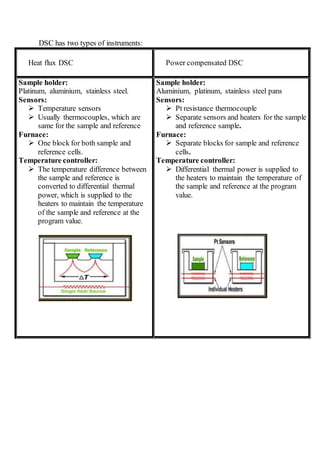
DSC has two types of instruments:
Heat flux DSC Power compensated DSC
Sample holder:
Platinum, aluminium, stainless steel.
Sensors:
 Temperature sensors
 Usually thermocouples, which are
same for the sample and reference
Furnace:
 One block for both sample and
reference cells.
Temperature controller:
 The temperature difference between
the sample and reference is
converted to differential thermal
power, which is supplied to the
heaters to maintain the temperature
of the sample and reference at the
program value.
Sample holder:
Aluminium, platinum, stainless steel pans
Sensors:
 Pt resistance thermocouple
 Separate sensors and heaters for the sample
and reference sample.
Furnace:
 Separate blocks for sample and reference
cells.
Temperature controller:
 Differential thermal power is supplied to
the heaters to maintain the temperature of
the sample and reference at the program
value.
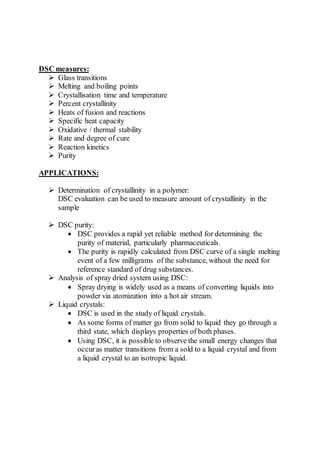
DSC measures:
 Glass transitions
 Melting and boiling points
 Crystallisation time and temperature
 Percent crystallinity
 Heats of fusion and reactions
 Specific heat capacity
 Oxidative / thermal stability
 Rate and degree of cure
 Reaction kinetics
 Purity
APPLICATIONS:
 Determination of crystallinity in a polymer:
DSC evaluation can be used to measure amount of crystallinity in the
sample
 DSC purity:
 DSC provides a rapid yet reliable method for determining the
purity of material, particularly pharmaceuticals.
 The purity is rapidly calculated from DSC curve of a single melting
event of a few milligrams of the substance, without the need for
reference standard of drug substances.
 Analysis of spray dried system using DSC:
 Spray drying is widely used as a means of converting liquids into
powder via atomization into a hot air stream.
 Liquid crystals:
 DSC is used in the study of liquid crystals.
 As some forms of matter go from solid to liquid they go through a
third state, which displays properties of both phases.
 Using DSC, it is possible to observe the small energy changes that
occuras matter transitions from a sold to a liquid crystal and from
a liquid crystal to an isotropic liquid.
Differential scanning calorimetry

Differential scanning calorimetry

  • 1.
    DIFFERENTIAL SCANNING CALORIMETRY Differential scanning calorimetry (DSC) is a thermoanalytical technique in which the difference in the amount of heat required to increase the temperature of a sample and reference is measured as a function of temperature  Both the sample and reference are maintained at nearly the same temperature throughout the experiment.  The area of peak measures the total energy transfer to or from the sample.  DSC measures the temperatures and heat flows associated with transitions in materials as a function of time and temperature in a controlled atmosphere.  These measurements provide quantitative and qualitative information about physical and chemical changes that involve endothermic or exothermic processes, orchanges in heat capacity. PRINCIPLE:  It is a technique in which the energy necessary to establish a zero temperature difference between the sample and reference material is measured as a function of temperature.  Here, sample and reference material are heated by separate heaters in such a way that their temperature are kept equal while these temperature are increased or decreased linearly.  During heating two types of reactions can be take place on is the endothermic and the other is exothermic. Endothermic reactions:  If sample absorbs someamount of heat during phase transition then reaction is said to be endothermic.  In endothermic reaction more energy needed to maintain zero temperature difference between sample and reference.  Eg: melting, boiling, sublimation, vaporization. Exothermic reaction:  If sample released some amount of heat during phase transition, the reaction is said to be exothermic.
  • 2.
     In exothermicreaction, less energy needed to maintain zero temperature difference between sample and reference/  Eg: crystallization, degradation, polymerization. The polymer is heated in a device that looks something like this:  There are two pans, in sample pan, polymer is added, while the other, reference pan is left empty.  Each pan sits on top of heaters which are controlled by a computer  The computer turns on heaters, and let them heat the two pans at a specific rate.  The computer makes absolutely sure that the heating rate stays exactly the same throughout the experiment. INSTRUMENTATION:  This instrument works on the temperature control of two similar specimen holders in the specimen holders assemble. a) Left half: differential temperature control circuit. b) Right half: average temperature controlcircuit.  In the average temperature control circuit, an electrical signal, which is proportional to the dialled temperature of the sample and reference holders, is generated through the programmer.
  • 3.
     In thedifferential temperature control circuit, signals representing the temperatures of the sample and reference are compared.  If no reaction is taking place in the sample, the differential power input of the sample and reference heater is almost zero.  However if the reaction is taking place (∆H is not zero) a differential power is fed to the heaters.  A signal proportional to this differential power along with the sign is transmitted to the recorder pen.  The integral of the peak so obtained gives the internal energy change of the sample. Sample:  By DSC, one may analyse liquids and solids in the form of powder, crystals, granules or foil.  Cut the sample to uniform shape, do not crush the sample. If the sample to be taken is pellet, cross section is to be taken.  If the sample material is powder then, it is spread uniformly over the bottom of the sample pan.  Smaller samples will increase the resolution but will decrease the sensitivity.  Larger samples will decrease the resolution but will increase the sensitivity. Reference materials:  An inert material like alumina is generally used.  An empty pan can also be used, if the sample weight is small.  With higher sample weights it is necessary to use a reference material, because the total with of the sample and it container should be approximately the same as the total weight of the reference and its container Purge Gases:  Sample may react with air and may oxidise or burn.  The problem is overcome by using inert gases.  Inert gases are used to controlmoisture in the surrounding atmosphere.  Commonly used inert gases are nitrogen, helium, argon etc.
  • 4.
    DSC has twotypes of instruments: Heat flux DSC Power compensated DSC Sample holder: Platinum, aluminium, stainless steel. Sensors:  Temperature sensors  Usually thermocouples, which are same for the sample and reference Furnace:  One block for both sample and reference cells. Temperature controller:  The temperature difference between the sample and reference is converted to differential thermal power, which is supplied to the heaters to maintain the temperature of the sample and reference at the program value. Sample holder: Aluminium, platinum, stainless steel pans Sensors:  Pt resistance thermocouple  Separate sensors and heaters for the sample and reference sample. Furnace:  Separate blocks for sample and reference cells. Temperature controller:  Differential thermal power is supplied to the heaters to maintain the temperature of the sample and reference at the program value.
  • 5.
    DSC measures:  Glasstransitions  Melting and boiling points  Crystallisation time and temperature  Percent crystallinity  Heats of fusion and reactions  Specific heat capacity  Oxidative / thermal stability  Rate and degree of cure  Reaction kinetics  Purity APPLICATIONS:  Determination of crystallinity in a polymer: DSC evaluation can be used to measure amount of crystallinity in the sample  DSC purity:  DSC provides a rapid yet reliable method for determining the purity of material, particularly pharmaceuticals.  The purity is rapidly calculated from DSC curve of a single melting event of a few milligrams of the substance, without the need for reference standard of drug substances.  Analysis of spray dried system using DSC:  Spray drying is widely used as a means of converting liquids into powder via atomization into a hot air stream.  Liquid crystals:  DSC is used in the study of liquid crystals.  As some forms of matter go from solid to liquid they go through a third state, which displays properties of both phases.  Using DSC, it is possible to observe the small energy changes that occuras matter transitions from a sold to a liquid crystal and from a liquid crystal to an isotropic liquid.