Seminar on
“THERMOGRAVIMETRIC ANALYSIS
AND
DIFFERENTIAL SCANNING CALORIMETRY”
Thermal Analysis
Differential Scanning
Calorimetry (DSC)
Measure heat absorbed or
liberated during heating
or cooling
Thermal Gravimetric
Analysis (TGA)
Measure change in weight
during heating or cooling
Differential Scanning
Calorimetry (DSC)
Calorimeter-Heat flow in sample
Differential calorimeter-heat flow in sample vs referance as function of time
mJ/sec.
• Differential Scanning Calorimetry (DSC) measures the
temperatures and heat flows associated with transitions in
materials as a function of time and temperature in a
controlled atmosphere.
• These measurements provide quantitative and qualitative
information about physical and chemical changes that
involve endothermicor exothermicprocesses, or changes
in heat capacity.
DSC: The Technique
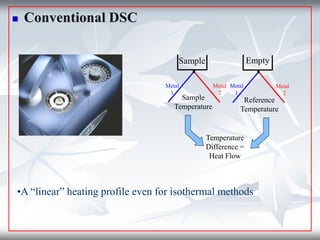
 Conventional DSC
Metal
1
Metal
2
Metal
1
Metal
2
Sample Empty
Sample
Temperature
Reference
Temperature
Temperature
Difference =
Heat Flow
•A “linear” heating profile even for isothermal methods
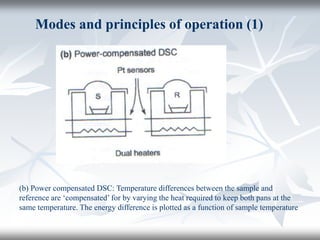
Modes and principles of operation (1)
(b) Power compensated DSC: Temperature differences between the sample and
reference are ‘compensated’ for by varying the heat required to keep both pans at the
same temperature. The energy difference is plotted as a function of sample temperature
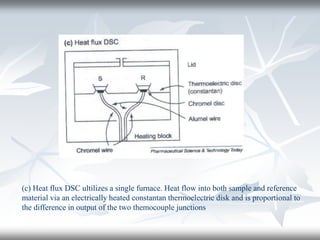
(c) Heat flux DSC ultilizes a single furnace. Heat flow into both sample and reference
material via an electrically heated constantan thermoelectric disk and is proportional to
the difference in output of the two themocouple junctions
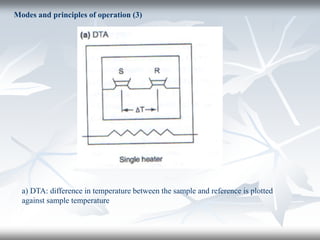
Modes and principles of operation (3)
a) DTA: difference in temperature between the sample and reference is plotted
against sample temperature
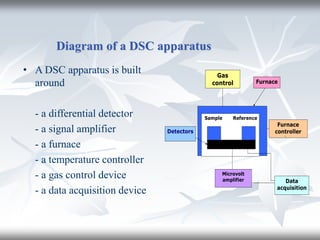
• A DSC apparatus is built
around
- a differential detector
- a signal amplifier
- a furnace
- a temperature controller
- a gas control device
- a data acquisition device
Diagram of a DSC apparatus
Sample Reference
Gas
control
Furnace
controller
four
Data
acquisition
Microvolt
amplifier
Detectors
Furnace
DSC measures:-
•Glass transitions
•Melting and boiling points
•Crystallisation time and temperature
•Percent crystallinity
•Heats of fusion and reactions
•Specific heat capacity
•Oxidative/thermal stability
•Rate and degree of cure
•Reaction kinetics
•Purity
6
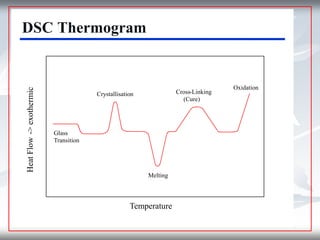
DSC Thermogram
Temperature
HeatFlow->exothermic
Glass
Transition
Crystallisation
Melting
Cross-Linking
(Cure)
Oxidation
Main Sources of Errors
•Calibration
•Contamination
•Sample preparation – how sample is loaded into a pan
•Residual solvents and moisture.
•Thermal lag
•Heating/Cooling rates
•Sample mass
•Processing errors
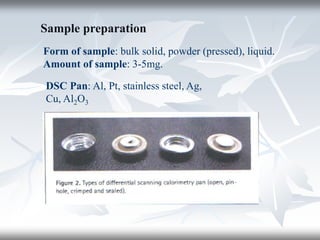
Sample preparation
Form of sample: bulk solid, powder (pressed), liquid.
Amount of sample: 3-5mg.
DSC Pan: Al, Pt, stainless steel, Ag,
Cu, Al2O3
99
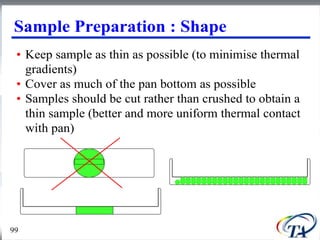
Sample Preparation : Shape
• Keep sample as thin as possible (to minimise thermal
gradients)
• Cover as much of the pan bottom as possible
• Samples should be cut rather than crushed to obtain a
thin sample (better and more uniform thermal contact
with pan)
Operation procedures
Calibration of instrument
• Temperature, heat of reaction, heat capacity scale using
high purity standards (In, Sn, Bi, Pb,Au)
•Baseline correction for a given scan rate (1 - 40K/min).
• Weight samples before (and maybe after) experiment.
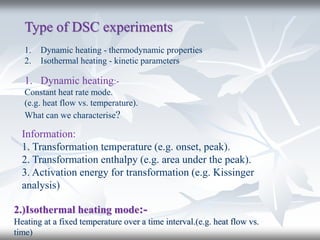
Type of DSC experiments
1. Dynamic heating - thermodynamic properties
2. Isothermal heating - kinetic parameters
1. Dynamic heating:-
Constant heat rate mode.
(e.g. heat flow vs. temperature).
What can we characterise?
Information:
1. Transformation temperature (e.g. onset, peak).
2. Transformation enthalpy (e.g. area under the peak).
3. Activation energy for transformation (e.g. Kissinger
analysis)
2.)Isothermal heating mode:-
Heating at a fixed temperature over a time interval.(e.g. heat flow vs.
time)
THERMOGAVIMETRIC ANALYSIS
(TGA)
 Principle: TGA measures the amount and the rate of weight change
of a material with respect to temperature or time in controlled
environments.
 A TGA consists of three major parts a furnace,
1. A microgram balance,
2. An auto sampler and
3. A thermocouple.
.
Instrument:
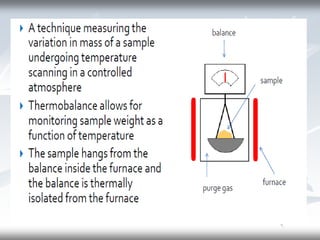
 Instrument used for thermogravimetry is “Thermobalance”.
Data recorded in form of curve known as ‘Thermogram’
 The furnace can raise the temperature as high as 1000°C
which is made of quartz.
 The auto sampler helps to load the samples on to the
microbalance.
 The thermocouple sits right above the sample.
 Care should be taken at all times that the thermocouple is not
in touch with the sample which is in a platinum pan.
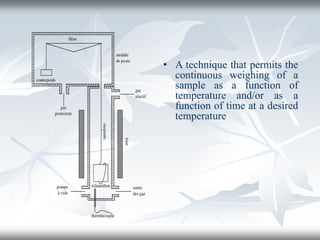
• A technique that permits the
continuous weighing of a
sample as a function of
temperature and/or as a
function of time at a desired
temperature
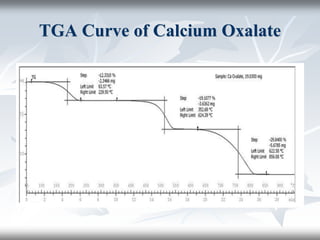
TGA Curve of Calcium Oxalate
Sample Preparation
Sample preparation has a significant effect in obtaining good data.
It is suggested that maximizing the surface area of the sample in a
TGA pan improves resolution and reproducibility of weight loss
temperatures.
The sample weight affects the accuracy of weight loss
measurements.
Typically 10-20mg of sample is preferred in most applications.
Whereas, if the sample has volatiles 50-100mg of sample is
considered adequate.
It is to be noted that most TGA instruments have baseline drift of
±0.025mg which is ±0.25% of a 10mg sample.
Experimental Conditions
 Heating Rate
 Purge gas
Experimental Conditions -Heating Rate
 Samples are heated at a rate of 10 or 20°C/min in most
cases.
 Lowering the heating rates is known to improve the
resolution of overlapping weight losses.
Experimental Conditions -Purge gas
• Nitrogen is the most common gas used to purge samples in TGA due
to its inert nature.
• Whereas, helium provides the best baseline.
• Air is known to improve resolution because of a difference in the
oxidative stability of components in the sample.
• Vacuum may be used where the sample contains volatile components,
which helps improve separation from the onset of decomposition
since the volatiles come off at lower temperatures in vacuum.
• e.g. oil in a rubber tire product.
Calibration
 Blank test
 Calibration of mass changes
 Calibration of temperature
Applications of TGA
 Determination of the bound and unbound water in the
suspension of Milk of Magnesia (MoM), used as a laxative.
 In an overview of thermal analysis testing it is always
preferable to do a TGA experiment on unknown samples
before doing a DSC experiment (especially for
pharmaceuticals).
 Decomposition of pharmaceuticals renders products which are
insoluble and generally sticky on the inside of a DSC cell.
 These products will lower the life use of a DSC cell.
 Therefore, know the decomposition temperatures of all drugs
and heat in a DSC evaluation to 50°C below those
temperatures.
Applications of TGA
 Evaporation of free (unbound) water begins at room
temperature due to dry gas flowing over the sample.

 Dehydration/Desolvation of bound water almost always
begins at temperatures above room temperature and
typically 125°C.
 Decomposition can have multiple stages (weight losses)
but the presence of multiple weight loss steps can also
indicate the presence of multiple components in the
sample.
leparlouer@thermalconsulting.com
Referances:-
www.evitherm.com
www.ictac.org
Therm@l Consulting
http://www.tainst.com Mettler Toledo Thermal Analysis Systems
TGA and DSC ppt

TGA and DSC ppt

  • 1.
  • 2.
    Thermal Analysis Differential Scanning Calorimetry(DSC) Measure heat absorbed or liberated during heating or cooling Thermal Gravimetric Analysis (TGA) Measure change in weight during heating or cooling
  • 3.
    Differential Scanning Calorimetry (DSC) Calorimeter-Heatflow in sample Differential calorimeter-heat flow in sample vs referance as function of time mJ/sec.
  • 4.
    • Differential ScanningCalorimetry (DSC) measures the temperatures and heat flows associated with transitions in materials as a function of time and temperature in a controlled atmosphere. • These measurements provide quantitative and qualitative information about physical and chemical changes that involve endothermicor exothermicprocesses, or changes in heat capacity. DSC: The Technique
  • 5.
     Conventional DSC Metal 1 Metal 2 Metal 1 Metal 2 SampleEmpty Sample Temperature Reference Temperature Temperature Difference = Heat Flow •A “linear” heating profile even for isothermal methods
  • 6.
    Modes and principlesof operation (1) (b) Power compensated DSC: Temperature differences between the sample and reference are ‘compensated’ for by varying the heat required to keep both pans at the same temperature. The energy difference is plotted as a function of sample temperature
  • 7.
    (c) Heat fluxDSC ultilizes a single furnace. Heat flow into both sample and reference material via an electrically heated constantan thermoelectric disk and is proportional to the difference in output of the two themocouple junctions
  • 8.
    Modes and principlesof operation (3) a) DTA: difference in temperature between the sample and reference is plotted against sample temperature
  • 9.
    • A DSCapparatus is built around - a differential detector - a signal amplifier - a furnace - a temperature controller - a gas control device - a data acquisition device Diagram of a DSC apparatus Sample Reference Gas control Furnace controller four Data acquisition Microvolt amplifier Detectors Furnace
  • 10.
    DSC measures:- •Glass transitions •Meltingand boiling points •Crystallisation time and temperature •Percent crystallinity •Heats of fusion and reactions •Specific heat capacity •Oxidative/thermal stability •Rate and degree of cure •Reaction kinetics •Purity
  • 11.
  • 12.
    Main Sources ofErrors •Calibration •Contamination •Sample preparation – how sample is loaded into a pan •Residual solvents and moisture. •Thermal lag •Heating/Cooling rates •Sample mass •Processing errors
  • 13.
    Sample preparation Form ofsample: bulk solid, powder (pressed), liquid. Amount of sample: 3-5mg. DSC Pan: Al, Pt, stainless steel, Ag, Cu, Al2O3
  • 14.
    99 Sample Preparation :Shape • Keep sample as thin as possible (to minimise thermal gradients) • Cover as much of the pan bottom as possible • Samples should be cut rather than crushed to obtain a thin sample (better and more uniform thermal contact with pan)
  • 15.
    Operation procedures Calibration ofinstrument • Temperature, heat of reaction, heat capacity scale using high purity standards (In, Sn, Bi, Pb,Au) •Baseline correction for a given scan rate (1 - 40K/min). • Weight samples before (and maybe after) experiment.
  • 16.
    Type of DSCexperiments 1. Dynamic heating - thermodynamic properties 2. Isothermal heating - kinetic parameters 1. Dynamic heating:- Constant heat rate mode. (e.g. heat flow vs. temperature). What can we characterise? Information: 1. Transformation temperature (e.g. onset, peak). 2. Transformation enthalpy (e.g. area under the peak). 3. Activation energy for transformation (e.g. Kissinger analysis) 2.)Isothermal heating mode:- Heating at a fixed temperature over a time interval.(e.g. heat flow vs. time)
  • 17.
    THERMOGAVIMETRIC ANALYSIS (TGA)  Principle:TGA measures the amount and the rate of weight change of a material with respect to temperature or time in controlled environments.  A TGA consists of three major parts a furnace, 1. A microgram balance, 2. An auto sampler and 3. A thermocouple. .
  • 18.
    Instrument:  Instrument usedfor thermogravimetry is “Thermobalance”. Data recorded in form of curve known as ‘Thermogram’  The furnace can raise the temperature as high as 1000°C which is made of quartz.  The auto sampler helps to load the samples on to the microbalance.  The thermocouple sits right above the sample.  Care should be taken at all times that the thermocouple is not in touch with the sample which is in a platinum pan.
  • 19.
    • A techniquethat permits the continuous weighing of a sample as a function of temperature and/or as a function of time at a desired temperature
  • 21.
    TGA Curve ofCalcium Oxalate
  • 22.
    Sample Preparation Sample preparationhas a significant effect in obtaining good data. It is suggested that maximizing the surface area of the sample in a TGA pan improves resolution and reproducibility of weight loss temperatures. The sample weight affects the accuracy of weight loss measurements. Typically 10-20mg of sample is preferred in most applications. Whereas, if the sample has volatiles 50-100mg of sample is considered adequate. It is to be noted that most TGA instruments have baseline drift of ±0.025mg which is ±0.25% of a 10mg sample. Experimental Conditions  Heating Rate  Purge gas
  • 23.
    Experimental Conditions -HeatingRate  Samples are heated at a rate of 10 or 20°C/min in most cases.  Lowering the heating rates is known to improve the resolution of overlapping weight losses. Experimental Conditions -Purge gas • Nitrogen is the most common gas used to purge samples in TGA due to its inert nature. • Whereas, helium provides the best baseline. • Air is known to improve resolution because of a difference in the oxidative stability of components in the sample. • Vacuum may be used where the sample contains volatile components, which helps improve separation from the onset of decomposition since the volatiles come off at lower temperatures in vacuum. • e.g. oil in a rubber tire product.
  • 24.
    Calibration  Blank test Calibration of mass changes  Calibration of temperature
  • 25.
    Applications of TGA Determination of the bound and unbound water in the suspension of Milk of Magnesia (MoM), used as a laxative.  In an overview of thermal analysis testing it is always preferable to do a TGA experiment on unknown samples before doing a DSC experiment (especially for pharmaceuticals).  Decomposition of pharmaceuticals renders products which are insoluble and generally sticky on the inside of a DSC cell.  These products will lower the life use of a DSC cell.  Therefore, know the decomposition temperatures of all drugs and heat in a DSC evaluation to 50°C below those temperatures.
  • 26.
    Applications of TGA Evaporation of free (unbound) water begins at room temperature due to dry gas flowing over the sample.   Dehydration/Desolvation of bound water almost always begins at temperatures above room temperature and typically 125°C.  Decomposition can have multiple stages (weight losses) but the presence of multiple weight loss steps can also indicate the presence of multiple components in the sample.
  • 27.