PRINCIPLE,
INSTRUMENTATION
AND
APPLICATIONS OF
THERMAL ANALYSIS
Group -1
Team members: Rampravesh, Nibedita, Balraj, Periyasamy, Durgakishore, M.S Dhar,
S.Chatterjee , V.G.Prabhu
Seminar by : Vijaykumar S Marakatti
Poornaprajna Institute of Scientific research, Bangalore
Outline of talk
 Introduction to Thermal Analysis
 Thermo Gravimetric Analysis -TGA
 Differential Thermal Analysis- DTA
 Differential Scanning Calorimetry -DSC
 Applications
Introduction
Change in physical properties of water with increase in temperature
Applied thermal analysis techniques
Heat
Change in physical property
Thermo Gravimetric
Analysis
Mass
ΔT
Differential Thermal
Analysis
ΔH
Differential Scanning
Analysis.
Deformation
Dynamic
Mechanical
Analysis
Physical Properties
Evolved Gas
Analysis
Gas
decompose
Thermal
diffusivity
Laser Flash
Analysis
volumeDilatometry
Thermo gravimetric analysis (TGA)
 It is an analysis, the mass of sample is recorded
continuously as its temperature is increased linearly from
ambient to high temperature.
 Mass of material a functions of temperature.
Processes occurring without change in mass (e.g.- Physical
transitions ) cannot be studied by TG.
Reactant(s)  Product(s) + Gas (a mass loss)
Gas + Reactant(s)  Product(s) (a mass gain)
Thermal Gravimetric Instrument
Furnace
Balance- hang down here
Auto sampler
Thermocouple
Gas flow
Crucible
Best practices for Thermal Analysis
Removal of absorbed water by drying.
 Use purge gas (N2or He) to remove corrosive off-gases
 Use samples with narrow grain size distribution.
 For measurement in vacuum, sample Grain size > 60
mesh
Calibration using the
- Curie Temperature.
-Standard compounds.
 Keep the constant heating rate, same gas atmosphere
and crucible for the analysis.
Decomposition of CaCO3 at different
gas atmosphere
Effect of gas atmosphere and crucible on TG
Decomposition of CaCO3 using
different crucible
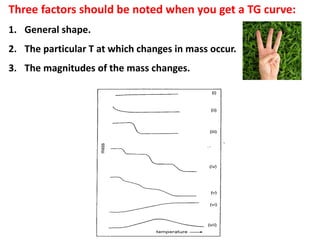
Three factors should be noted when you get a TG curve:
1. General shape.
2. The particular T at which changes in mass occur.
3. The magnitudes of the mass changes.
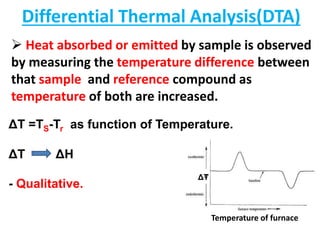
Differential Thermal Analysis(DTA)
 Heat absorbed or emitted by sample is observed
by measuring the temperature difference between
that sample and reference compound as
temperature of both are increased.
ΔT =TS-Tr as function of Temperature.
ΔT ΔH
- Qualitative.
ΔT
Temperature of furnace
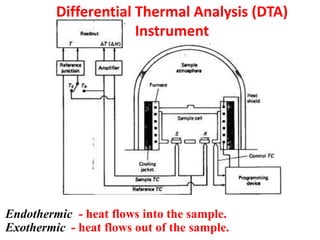
Differential Thermal Analysis (DTA)
Instrument
Endothermic - heat flows into the sample.
Exothermic - heat flows out of the sample.
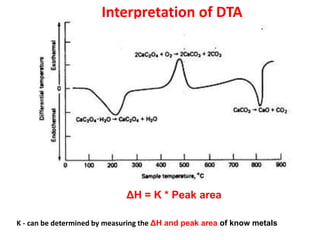
Interpretation of DTA
ΔH = K * Peak area
K - can be determined by measuring the ΔH and peak area of know metals
Limitations of Differential Thermal Analysis
(DTA)
 ΔT determined by DTA is not so accurate (2-3 ̊C).
 Small change in ΔT cannot be determined and
quantified.
 Due to heat variation between sample and reference
makes, it less sensitive.
To improve the above limitations change in the
methodology is required.
Differential Scanning Calorimeter(DSC)
Heat flux
Power Compensation DSC Cell
Applications
Polymer industryFood industry
Pharma industry Research and
development
Ceramic industry
Cosmetic industry
V.S.Marakatti et. al .RSC Adv., 2013,3, 10795-10800
Stability of the Materials
Sn(OH)Cl - Catalyst
200 ̊ C- Dehydration
200-400 ̊ C-
Dehydroxylation
400-550 ̊̊C – Formation of
oxide
Composition of a Rubber Sample
To determine Tg (glass transition temperature)
of Polymers
Application in Food Industry
Standard TGA results for Double mint chewing
gum sample
TGA auto stepwise results for Double mint
chewing gum sample
The correct combination of the gum formulation.
Elastomers, glycerin, softening agents, and carbonates, flavoring agents, poly
vinyl acetate
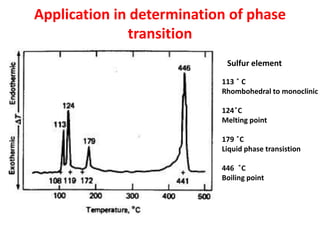
Application in determination of phase
transition
113 ̊ C
Rhombohedral to monoclinic
124 ̊C
Melting point
179 ̊C
Liquid phase transistion
446 ̊C
Boiling point
Sulfur element
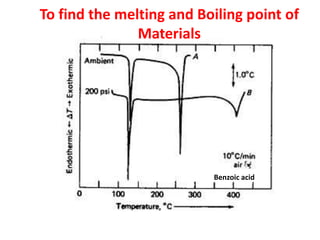
To find the melting and Boiling point of
Materials
Benzoic acid
OPEN FOR DISCUSSION
TG ?..
DTA ??
DSC ???ΔH ?
Calibration ?..
DTG
/DTA ???ΔT ?
sample ?
??....

Thermal analysis-TG-DTA

  • 1.
    PRINCIPLE, INSTRUMENTATION AND APPLICATIONS OF THERMAL ANALYSIS Group-1 Team members: Rampravesh, Nibedita, Balraj, Periyasamy, Durgakishore, M.S Dhar, S.Chatterjee , V.G.Prabhu Seminar by : Vijaykumar S Marakatti Poornaprajna Institute of Scientific research, Bangalore
  • 2.
    Outline of talk Introduction to Thermal Analysis  Thermo Gravimetric Analysis -TGA  Differential Thermal Analysis- DTA  Differential Scanning Calorimetry -DSC  Applications
  • 3.
    Introduction Change in physicalproperties of water with increase in temperature
  • 4.
    Applied thermal analysistechniques Heat Change in physical property
  • 5.
    Thermo Gravimetric Analysis Mass ΔT Differential Thermal Analysis ΔH DifferentialScanning Analysis. Deformation Dynamic Mechanical Analysis Physical Properties Evolved Gas Analysis Gas decompose Thermal diffusivity Laser Flash Analysis volumeDilatometry
  • 6.
    Thermo gravimetric analysis(TGA)  It is an analysis, the mass of sample is recorded continuously as its temperature is increased linearly from ambient to high temperature.  Mass of material a functions of temperature. Processes occurring without change in mass (e.g.- Physical transitions ) cannot be studied by TG. Reactant(s)  Product(s) + Gas (a mass loss) Gas + Reactant(s)  Product(s) (a mass gain)
  • 7.
    Thermal Gravimetric Instrument Furnace Balance-hang down here Auto sampler Thermocouple Gas flow Crucible
  • 8.
    Best practices forThermal Analysis Removal of absorbed water by drying.  Use purge gas (N2or He) to remove corrosive off-gases  Use samples with narrow grain size distribution.  For measurement in vacuum, sample Grain size > 60 mesh Calibration using the - Curie Temperature. -Standard compounds.  Keep the constant heating rate, same gas atmosphere and crucible for the analysis.
  • 9.
    Decomposition of CaCO3at different gas atmosphere Effect of gas atmosphere and crucible on TG Decomposition of CaCO3 using different crucible
  • 10.
    Three factors shouldbe noted when you get a TG curve: 1. General shape. 2. The particular T at which changes in mass occur. 3. The magnitudes of the mass changes.
  • 11.
    Differential Thermal Analysis(DTA) Heat absorbed or emitted by sample is observed by measuring the temperature difference between that sample and reference compound as temperature of both are increased. ΔT =TS-Tr as function of Temperature. ΔT ΔH - Qualitative. ΔT Temperature of furnace
  • 12.
    Differential Thermal Analysis(DTA) Instrument Endothermic - heat flows into the sample. Exothermic - heat flows out of the sample.
  • 13.
    Interpretation of DTA ΔH= K * Peak area K - can be determined by measuring the ΔH and peak area of know metals
  • 14.
    Limitations of DifferentialThermal Analysis (DTA)  ΔT determined by DTA is not so accurate (2-3 ̊C).  Small change in ΔT cannot be determined and quantified.  Due to heat variation between sample and reference makes, it less sensitive. To improve the above limitations change in the methodology is required.
  • 15.
  • 16.
  • 17.
    Applications Polymer industryFood industry Pharmaindustry Research and development Ceramic industry Cosmetic industry
  • 18.
    V.S.Marakatti et. al.RSC Adv., 2013,3, 10795-10800 Stability of the Materials Sn(OH)Cl - Catalyst 200 ̊ C- Dehydration 200-400 ̊ C- Dehydroxylation 400-550 ̊̊C – Formation of oxide
  • 19.
    Composition of aRubber Sample
  • 20.
    To determine Tg(glass transition temperature) of Polymers
  • 21.
    Application in FoodIndustry Standard TGA results for Double mint chewing gum sample TGA auto stepwise results for Double mint chewing gum sample The correct combination of the gum formulation. Elastomers, glycerin, softening agents, and carbonates, flavoring agents, poly vinyl acetate
  • 22.
    Application in determinationof phase transition 113 ̊ C Rhombohedral to monoclinic 124 ̊C Melting point 179 ̊C Liquid phase transistion 446 ̊C Boiling point Sulfur element
  • 23.
    To find themelting and Boiling point of Materials Benzoic acid
  • 25.
    OPEN FOR DISCUSSION TG?.. DTA ?? DSC ???ΔH ? Calibration ?.. DTG /DTA ???ΔT ? sample ? ??....