SEMINAR ON
PRESENTED BY
MR. Nitin P. Kanwale
M.PHARM. 1ST SEM.
M.V.P. Samaj’s college of
Pharmacy Nashik-2
GUIDED BY
DR.D.V.DERLE
UV-VISIBLE SPECTROSCOPY
NDMVP SAMAJ’S COLLEGE OF PHARMACY NASHIK-2
Content
 Introduction
 Principle and Basic concept
 Some important terms
 Instrumentation
 Applications
 Conclusion
 References
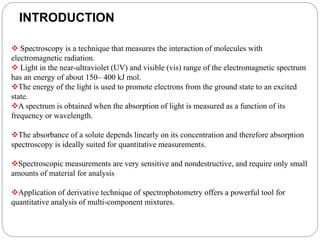
INTRODUCTION
 Spectroscopy is a technique that measures the interaction of molecules with
electromagnetic radiation.
 Light in the near-ultraviolet (UV) and visible (vis) range of the electromagnetic spectrum
has an energy of about 150– 400 kJ mol.
The energy of the light is used to promote electrons from the ground state to an excited
state.
A spectrum is obtained when the absorption of light is measured as a function of its
frequency or wavelength.
The absorbance of a solute depends linearly on its concentration and therefore absorption
spectroscopy is ideally suited for quantitative measurements.
Spectroscopic measurements are very sensitive and nondestructive, and require only small
amounts of material for analysis
Application of derivative technique of spectrophotometry offers a powerful tool for
quantitative analysis of multi-component mixtures.
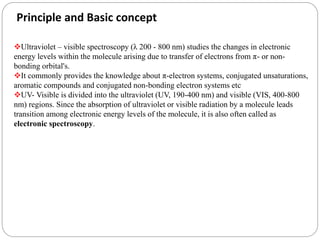
Principle and Basic concept
Ultraviolet – visible spectroscopy (λ 200 - 800 nm) studies the changes in electronic
energy levels within the molecule arising due to transfer of electrons from π- or non-
bonding orbital's.
It commonly provides the knowledge about π-electron systems, conjugated unsaturations,
aromatic compounds and conjugated non-bonding electron systems etc
UV- Visible is divided into the ultraviolet (UV, 190-400 nm) and visible (VIS, 400-800
nm) regions. Since the absorption of ultraviolet or visible radiation by a molecule leads
transition among electronic energy levels of the molecule, it is also often called as
electronic spectroscopy.
Nature of Electronic Transitions
The total energy of a molecule is the sum of its electronic, its vibrational energy and its
rotational energy.
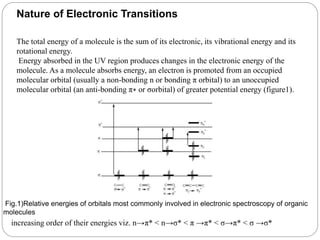
Energy absorbed in the UV region produces changes in the electronic energy of the
molecule. As a molecule absorbs energy, an electron is promoted from an occupied
molecular orbital (usually a non-bonding n or bonding π orbital) to an unoccupied
molecular orbital (an anti-bonding π∗ or σorbital) of greater potential energy (figure1).
Fig.1)Relative energies of orbitals most commonly involved in electronic spectroscopy of organic
molecules
increasing order of their energies viz. n→π* < n→σ* < π →π* < σ→π* < σ →σ*
Principles of Absorption Spectroscopy: Beer’s and Lambert’s Law
The greater the number of molecules that absorb light of a given wavelength, the greater the
extent of light absorption and higher the peak intensity in absorption spectrum .
This makes the basis of Beer-Lambert Law which states that the fraction of incident
radiation absorbed is proportional to the number of absorbing molecules in its path .
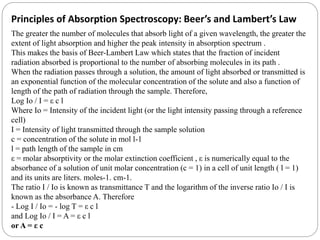
When the radiation passes through a solution, the amount of light absorbed or transmitted is
an exponential function of the molecular concentration of the solute and also a function of
length of the path of radiation through the sample. Therefore,
Log Io / I = ε c l
Where Io = Intensity of the incident light (or the light intensity passing through a reference
cell)
I = Intensity of light transmitted through the sample solution
c = concentration of the solute in mol l-1
l = path length of the sample in cm
ε = molar absorptivity or the molar extinction coefficient , ε is numerically equal to the
absorbance of a solution of unit molar concentration (c = 1) in a cell of unit length ( l = 1)
and its units are liters. moles-1. cm-1.
The ratio I / Io is known as transmittance T and the logarithm of the inverse ratio Io / I is
known as the absorbance A. Therefore
- Log I / Io = - log T = ε c l
and Log Io / I = A = ε c l
or A = ε c
Spectral Measurements
The UV-Vis spectra are usually measured in very dilute solutions and the most
important criterion in the choice of solvent is that the solvent must be transparent
within the wavelength range being examined.
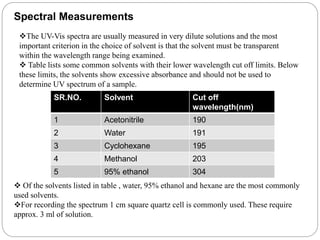
 Table lists some common solvents with their lower wavelength cut off limits. Below
these limits, the solvents show excessive absorbance and should not be used to
determine UV spectrum of a sample.
SR.NO. Solvent Cut off
wavelength(nm)
1 Acetonitrile 190
2 Water 191
3 Cyclohexane 195
4 Methanol 203
5 95% ethanol 304
 Of the solvents listed in table , water, 95% ethanol and hexane are the most commonly
used solvents.
For recording the spectrum 1 cm square quartz cell is commonly used. These require
approx. 3 ml of solution.
Solvent Effects
 Highly pure, non-polar solvents such as saturated hydrocarbons do not interact with
solute molecules either in the ground or excited state and the absorption spectrum of a
compound in these solvents is similar to the one in a pure gaseous state.
 However, polar solvents such as water, alcohols etc. may stabilize or destabilize the
molecular orbital's of a molecule either in the ground state or in excited state and the
spectrum of a compound in these solvents may significantly vary from the one recorded
in a hydrocarbon solvent.
Some important terms
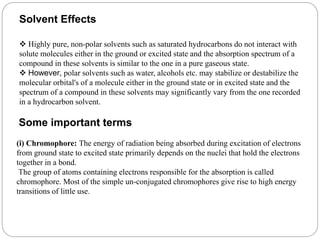
(i) Chromophore: The energy of radiation being absorbed during excitation of electrons
from ground state to excited state primarily depends on the nuclei that hold the electrons
together in a bond.
The group of atoms containing electrons responsible for the absorption is called
chromophore. Most of the simple un-conjugated chromophores give rise to high energy
transitions of little use.
(ii) Auxochrome: The substituents that themselves do not absorb ultraviolet radiations but
their presence shifts the absorption maximum to longer wavelength are called
auxochromes. The substituents like methyl, hydroxyl, alkoxy, halogen, amino group etc. are
some examples of auxochromes.
(iii) Bathochromic Shift or Red shift: A shift of an absorption maximum towards longer
wavelength or lower energy.
(iv) Hypsochromic Shift or Blue Shift: A shift of an absorption maximum towards shorter
wavelength or higher energy.
(v) Hypochromic Effect: An effect that results in decreased absorption intensity.
(vi) Hyper-chromic Effect: An effect that results in increased absorption intensity.
INSTRUMENTATION
Simultaneous Estimation of multi-component
formulation by
UV-Visible spectroscopy
Simultaneous equation is applicable for the estimation of those drugs where the
spectra of drug overlap properly whereas, DS method has been widely used to enhance
the signal and resolve the overlapped peak-signals due to its advantages in
differentiating closely adjacent peaks, and identifying weak peaks obscured by sharp
peaks.
Following are the method use
1. Derivative Spectroscopic Method
2. Simultaneous Equation
3. The Absorption Ratio Method : iso-absorptive Point Method
4. Multi-component Mode Method
5. Area Under Curve Method
Conclusions
UV-visible spectroscopy, a simple, rapid, precise and highly accurate method for
quantitative estimation is in great use now a day. Derivative spectrophotometry is an
analytical technique of great utility for extracting both qualitative and quantitative
information from spectra composed of unresolved bands by calculating and plotting one of
the mathematical derivatives of a spectral curve. Therefore the derivative spectra (first to
fourth-order) of the mixtures were checked to select a suitable spectrum to be used for the
simultaneous determination of the components.
Derivative techniques in spectroscopy often offer a powerful tool for a resolution
enhancement, when signal overlaps or interference exists. Several specific signals were
singled out for the components in the spectra of different derivative orders but the first-order
derivative spectra seemed to be generally the most suitable for analytical aim.
A derivative spectrum shows better resolution of overlapping bands than the fundamental
spectrum and may permit the accurate determination of the λmax of the individual bands.
Secondly, DS discriminates in favor of substances of narrow spectral bandwidth against
broad bandwidth substances. All the amplitudes in the derivative spectrum are proportional
to the concentration of the analyte provided that Beer's law is obeyed by the fundamental
spectrum.
References:
1) Gurdeep R. Chatwal, Sham K. Anand, Instrumental Methods Of Chemical Analysis,
Himalaya Publication, Fifth Edition, Page No.2.149-2.184
2)Douglas A. Skoog, Holler, Nieman, Principles Of Instrumental Analysis, Fifth Edition,
Page No.300-352
3)Frank A. Settle, Editor Handbook Of Instrumental Techniques For Analytical
Chemistry, Person Education, Page No.481-499
4) C. Bosch Ojeda, F. Sanchez Rojas, “Recent Applications In Derivative
Ultraviolet/Visible Absorption Spectrophotometry: 2009–2011’’,
Microchemical Journal 106 (2013) 1–16,
Contents Lists Available At SciverseSciencedirect.
Journal Homepage: Www.Elsevier.Com/Locate/Microc.
5) Franz-XaverSchmid, “Biological Macromolecules: UV-Visible Spectrophotometry’’
ENCYCLOPEDIA OF LIFE SCIENCES / & 2001 Macmillan Publishers Ltd, Nature
Publishing Group / Www.Els.Net.
6)Jasmine Chaudhary, Akash Jain, Vipin Saini, “Simultaneous Estimation Of Multi-
component Formulations By UV-Visible Spectroscopy,’’ International Research Journal
Of Pharmacy,
Available Online Www.Irjponline.Com.
7) Www.Wikipedia.Com Accessed On 2/11/2014; 06:30 PM

Presentation2

  • 1.
    SEMINAR ON PRESENTED BY MR.Nitin P. Kanwale M.PHARM. 1ST SEM. M.V.P. Samaj’s college of Pharmacy Nashik-2 GUIDED BY DR.D.V.DERLE UV-VISIBLE SPECTROSCOPY NDMVP SAMAJ’S COLLEGE OF PHARMACY NASHIK-2
  • 2.
    Content  Introduction  Principleand Basic concept  Some important terms  Instrumentation  Applications  Conclusion  References
  • 3.
    INTRODUCTION  Spectroscopy isa technique that measures the interaction of molecules with electromagnetic radiation.  Light in the near-ultraviolet (UV) and visible (vis) range of the electromagnetic spectrum has an energy of about 150– 400 kJ mol. The energy of the light is used to promote electrons from the ground state to an excited state. A spectrum is obtained when the absorption of light is measured as a function of its frequency or wavelength. The absorbance of a solute depends linearly on its concentration and therefore absorption spectroscopy is ideally suited for quantitative measurements. Spectroscopic measurements are very sensitive and nondestructive, and require only small amounts of material for analysis Application of derivative technique of spectrophotometry offers a powerful tool for quantitative analysis of multi-component mixtures.
  • 4.
    Principle and Basicconcept Ultraviolet – visible spectroscopy (λ 200 - 800 nm) studies the changes in electronic energy levels within the molecule arising due to transfer of electrons from π- or non- bonding orbital's. It commonly provides the knowledge about π-electron systems, conjugated unsaturations, aromatic compounds and conjugated non-bonding electron systems etc UV- Visible is divided into the ultraviolet (UV, 190-400 nm) and visible (VIS, 400-800 nm) regions. Since the absorption of ultraviolet or visible radiation by a molecule leads transition among electronic energy levels of the molecule, it is also often called as electronic spectroscopy.
  • 5.
    Nature of ElectronicTransitions The total energy of a molecule is the sum of its electronic, its vibrational energy and its rotational energy. Energy absorbed in the UV region produces changes in the electronic energy of the molecule. As a molecule absorbs energy, an electron is promoted from an occupied molecular orbital (usually a non-bonding n or bonding π orbital) to an unoccupied molecular orbital (an anti-bonding π∗ or σorbital) of greater potential energy (figure1). Fig.1)Relative energies of orbitals most commonly involved in electronic spectroscopy of organic molecules increasing order of their energies viz. n→π* < n→σ* < π →π* < σ→π* < σ →σ*
  • 6.
    Principles of AbsorptionSpectroscopy: Beer’s and Lambert’s Law The greater the number of molecules that absorb light of a given wavelength, the greater the extent of light absorption and higher the peak intensity in absorption spectrum . This makes the basis of Beer-Lambert Law which states that the fraction of incident radiation absorbed is proportional to the number of absorbing molecules in its path . When the radiation passes through a solution, the amount of light absorbed or transmitted is an exponential function of the molecular concentration of the solute and also a function of length of the path of radiation through the sample. Therefore, Log Io / I = ε c l Where Io = Intensity of the incident light (or the light intensity passing through a reference cell) I = Intensity of light transmitted through the sample solution c = concentration of the solute in mol l-1 l = path length of the sample in cm ε = molar absorptivity or the molar extinction coefficient , ε is numerically equal to the absorbance of a solution of unit molar concentration (c = 1) in a cell of unit length ( l = 1) and its units are liters. moles-1. cm-1. The ratio I / Io is known as transmittance T and the logarithm of the inverse ratio Io / I is known as the absorbance A. Therefore - Log I / Io = - log T = ε c l and Log Io / I = A = ε c l or A = ε c
  • 7.
    Spectral Measurements The UV-Visspectra are usually measured in very dilute solutions and the most important criterion in the choice of solvent is that the solvent must be transparent within the wavelength range being examined.  Table lists some common solvents with their lower wavelength cut off limits. Below these limits, the solvents show excessive absorbance and should not be used to determine UV spectrum of a sample. SR.NO. Solvent Cut off wavelength(nm) 1 Acetonitrile 190 2 Water 191 3 Cyclohexane 195 4 Methanol 203 5 95% ethanol 304  Of the solvents listed in table , water, 95% ethanol and hexane are the most commonly used solvents. For recording the spectrum 1 cm square quartz cell is commonly used. These require approx. 3 ml of solution.
  • 8.
    Solvent Effects  Highlypure, non-polar solvents such as saturated hydrocarbons do not interact with solute molecules either in the ground or excited state and the absorption spectrum of a compound in these solvents is similar to the one in a pure gaseous state.  However, polar solvents such as water, alcohols etc. may stabilize or destabilize the molecular orbital's of a molecule either in the ground state or in excited state and the spectrum of a compound in these solvents may significantly vary from the one recorded in a hydrocarbon solvent. Some important terms (i) Chromophore: The energy of radiation being absorbed during excitation of electrons from ground state to excited state primarily depends on the nuclei that hold the electrons together in a bond. The group of atoms containing electrons responsible for the absorption is called chromophore. Most of the simple un-conjugated chromophores give rise to high energy transitions of little use.
  • 9.
    (ii) Auxochrome: Thesubstituents that themselves do not absorb ultraviolet radiations but their presence shifts the absorption maximum to longer wavelength are called auxochromes. The substituents like methyl, hydroxyl, alkoxy, halogen, amino group etc. are some examples of auxochromes. (iii) Bathochromic Shift or Red shift: A shift of an absorption maximum towards longer wavelength or lower energy. (iv) Hypsochromic Shift or Blue Shift: A shift of an absorption maximum towards shorter wavelength or higher energy. (v) Hypochromic Effect: An effect that results in decreased absorption intensity. (vi) Hyper-chromic Effect: An effect that results in increased absorption intensity.
  • 10.
  • 11.
    Simultaneous Estimation ofmulti-component formulation by UV-Visible spectroscopy Simultaneous equation is applicable for the estimation of those drugs where the spectra of drug overlap properly whereas, DS method has been widely used to enhance the signal and resolve the overlapped peak-signals due to its advantages in differentiating closely adjacent peaks, and identifying weak peaks obscured by sharp peaks. Following are the method use 1. Derivative Spectroscopic Method 2. Simultaneous Equation 3. The Absorption Ratio Method : iso-absorptive Point Method 4. Multi-component Mode Method 5. Area Under Curve Method
  • 12.
    Conclusions UV-visible spectroscopy, asimple, rapid, precise and highly accurate method for quantitative estimation is in great use now a day. Derivative spectrophotometry is an analytical technique of great utility for extracting both qualitative and quantitative information from spectra composed of unresolved bands by calculating and plotting one of the mathematical derivatives of a spectral curve. Therefore the derivative spectra (first to fourth-order) of the mixtures were checked to select a suitable spectrum to be used for the simultaneous determination of the components. Derivative techniques in spectroscopy often offer a powerful tool for a resolution enhancement, when signal overlaps or interference exists. Several specific signals were singled out for the components in the spectra of different derivative orders but the first-order derivative spectra seemed to be generally the most suitable for analytical aim. A derivative spectrum shows better resolution of overlapping bands than the fundamental spectrum and may permit the accurate determination of the λmax of the individual bands. Secondly, DS discriminates in favor of substances of narrow spectral bandwidth against broad bandwidth substances. All the amplitudes in the derivative spectrum are proportional to the concentration of the analyte provided that Beer's law is obeyed by the fundamental spectrum.
  • 13.
    References: 1) Gurdeep R.Chatwal, Sham K. Anand, Instrumental Methods Of Chemical Analysis, Himalaya Publication, Fifth Edition, Page No.2.149-2.184 2)Douglas A. Skoog, Holler, Nieman, Principles Of Instrumental Analysis, Fifth Edition, Page No.300-352 3)Frank A. Settle, Editor Handbook Of Instrumental Techniques For Analytical Chemistry, Person Education, Page No.481-499 4) C. Bosch Ojeda, F. Sanchez Rojas, “Recent Applications In Derivative Ultraviolet/Visible Absorption Spectrophotometry: 2009–2011’’, Microchemical Journal 106 (2013) 1–16, Contents Lists Available At SciverseSciencedirect. Journal Homepage: Www.Elsevier.Com/Locate/Microc. 5) Franz-XaverSchmid, “Biological Macromolecules: UV-Visible Spectrophotometry’’ ENCYCLOPEDIA OF LIFE SCIENCES / & 2001 Macmillan Publishers Ltd, Nature Publishing Group / Www.Els.Net. 6)Jasmine Chaudhary, Akash Jain, Vipin Saini, “Simultaneous Estimation Of Multi- component Formulations By UV-Visible Spectroscopy,’’ International Research Journal Of Pharmacy, Available Online Www.Irjponline.Com. 7) Www.Wikipedia.Com Accessed On 2/11/2014; 06:30 PM