BasmatiRice
PatentBattle
Presented By:
Nitin P. Kanwale
NDMVP Collage Of Pharmacy Nashik
Intellectual Property
• Intellectual property (IP) is a legal concept which refers
to creations of mind for which exclusive rights are
recognized.
• Under intellectual property law, owners are granted
certain exclusive rights to their tangible and intangible
assets.
Intellectual Property Rights
• Trademarks™: A trademark is a sign that individualizes the
goods of a given enterprise and distinguishes them from the goods
of others. It can be in the form of words, designs, letters or numerals
etc.
• Patent: A patent is a set of exclusive rights granted by a state to
an inventor or assignee for limited period of time. Only the assignee
have rights to make and sell the invented product.
• Copyrights©: Copyright deals with the protection of literary and
artistic works. These include writings, music, and
works of the fine arts, such as paintings and
sculptures, and technology-based works such
as computer programs and electronic databases.
Intellectual Property Rights
• Geographical Indications: Geographical Indication in relation
to goods, means , an indication which identifies such goods, as
originating or manufactured or produced in a territory of a qualifying
country or a region or a locality of a qualifying country , where a
given quality, reputation or other characteristic of such goods, is
essentially attributable to its geographical origin.
• GRTKF: GRTKF stands for Genetic Resources, Traditional
Knowledge and Folklore. GRTKF have been identified as types of
non-conventional Intellectual Property (IP) during last few decades.
IPRs Controlling Authorities
• World Intellectual Property Organization (WIPO)
• World Trade Organization (WTO)
• TRIPS
• African Regional Intellectual Property Organization
(ARIPO)
Agriculture IPRs
History:
Intellectual property protection has been extended in the
last 25 years to a wide range of information, materials and
products relevant to food and agriculture. The US Supreme
Court decision in Diamond vs Chakrabarty influenced
national legislation and case law in many jurisdictions,
opening the door for the patentability of living organisms,
including microbes, plants and animals and their parts and
components.
Agriculture IPRs
• Plant Breeder’s Rights (PBR): Plant Breeders' Rights
(PBR), also known as plant variety rights (PVR), are rights granted
to the breeder of a new variety of plant that give them exclusive
control over the propagating material (including seed, cuttings,
divisions, tissue culture) and harvested material (cut flowers, fruit,
foliage) of a new variety for a number of years.
Agriculture IPRs
• Benefits of Plant Breeder’s Rights
PBR protection allows you to exclude others from:
• producing or reproducing the material
• conditioning the material for the purpose of propagation
• offering the material for sale
• selling the material
• importing the material
• exporting the material
• stocking the material for any of the purposes
described above.
Agriculture Patent
The main criteria for agriculture patent in PBR
is:
• Novelty
• Inventiveness (non-obviousness)
• Utility
• Reproducibility
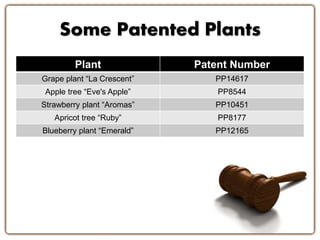
Some Patented Plants
Plant Patent Number
Grape plant “La Crescent” PP14617
Apple tree “Eve's Apple” PP8544
Strawberry plant “Aromas” PP10451
Apricot tree “Ruby” PP8177
Blueberry plant “Emerald” PP12165
Bioprospecting
• Bioprospecting is an umbrella term describing the
process of discovery and commercialization of new
products based on biological resources. Bioprospecting
often draws on indigenous knowledge about uses and
characteristics of plants and animals.
Biopiracy
• Biopiracy is a situation where indigenous knowledge of
nature, originating with indigenous peoples, is used by
others for profit, without permission from and with little or
no compensation or recognition to the indigenous people
themselves.
Biopiracy Cases
• The Rosy Periwinkle
• The Neem Tree
• The Enola Bean
• Hoodia
• Basmati Rice
Basmati Rice Patent Case
• CASE NUMBER: 493
• CASE MNEMONIC: Basmati
• CASE NAME: India-US Basmati Rice Dispute
• Patent number: US5663484 A
• Publication type: Grant
• Application number: US 08/272,353
• Publication date: Sep 2, 1997
• Filing date: Jul 8, 1994
• Rice is an important aspect of life in the
Southeast and other parts of Asia.
• For centuries, it has been the cornerstone of
their food and culture.
• Basmati has been grown in the foothills of the
Himalayas for thousands of years.
Basmati Rice and Asia
• Basmati rice is being grown in subcontinent for
centuries.
• Its flavour and aroma has been developed
through selective breeding for thousands of
years.
• It is common knowledge that what Champagne
is to France, Basmati is to subcontinent
(Pakistan and India).
Basmati Rice
• Basmati means the “queen of fragrance or the perfumed
one”.
• Origin: Pakistan and India
• Indian varieties are Safidon, Haryana, Kasturi (Baran,
Rajasthan), Basmati 198, Basmati 217, Basmati 370,
Kasturi, Mahi Suganda.
• Pakistani varieties Basmati 370, Super Basmati, Pak
(Kernal) Basmati, Basmati 386, Basmati 385 and
Basmati 198.
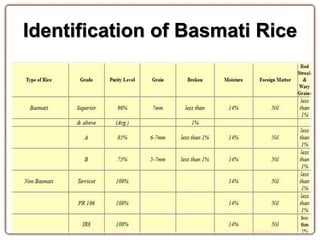
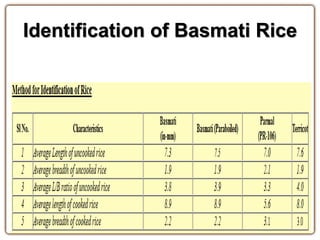
Identification of Basmati Rice
The Case Issue
In the late 1997, when an American company RiceTec Inc. was granted
a patent by the US patent office to call the aromatic rice grown outside
India "Basmati", India objected to it. India has been one of the major
exporters of Basmati to several countries and such a grant by the US
patent office was likely to affect its trade. Since Basmati rice is
traditionally grown in India and Pakistan, it was opined that granting
patent to RiceTec violated the Geographical Indications Act under the
TRIPS agreement. A geographical indication (sometimes abbreviated
to GI) is a name or sign used on certain products which corresponds to
a specific geographical location or origin (e.g.. a town, region, or
country). The use of a GI may act as a certification that the product
possesses certain qualities, or enjoys a certain reputation, due to its
geographical origin. RiceTec's usage of the name Basmati for rice
which was derived from Indian rice but not grown in India, and hence
not of the same quality as Basmati, would have lead to the violation of
the concept of GI and would have been a deception to the consumers.
RiceTec Company Details
• Owned by Prince Hans-Adam of Liechtenstein.
• 120 company employees.
• Annual sales 10 million US Dollars.
• Rice developed by RiceTec are: Bas 867, RT 1117, RT
112.
Company’s Words
“We are absolutely confident in our patent
and viability and legality. There is no basis
for challenging the patent”.
RiceTec Inc. Patent Claims
RiceTec put 20 claims about their product from which
few ones are:
• semi-dwarf in stature
• substantially photoperiod insensitive
• high yield
• Having characteristics similar or superior to those of good quality
basmati rice
• The invention provides a method for breeding these novel lines
• Starch index (SI) of a rice grain can predict the grain's cooking and
starch properties
• Claiming that “Aroma” has been developed by RiceTech
Inc. is misleading
– RiceTech Inc. claimed that it tool them 10 years to
develop the Aroma in their rice line
• Branding a Basmati lookalike as Basmati
– They used inbreeding of ordinary american rice with
sub continental Basmati rice and patented this hybrid
as Basmati
Patent Advantage to RiceTech
• RiceTec able to not only call its aromatic rice Basmati
within the US, but also label it Basmati for its exports.
• Captures the whole US trade market.
• Exclusive use of the term “basmati”.
• Monopoly on breeding 22 farmer-bred Pakistani basmati
varieties with any other varieties in the Western
Hemisphere.
• Proprietary rights on the seeds and grains from any
crosses.
Disadvantage of Patent to
India and Pakistan
• Economic loses.
• Global trade losses.
• Both countries lose their global market
share.
• Brand Association
• Reputation
• Market share
• Superior features/characteristics
• Confusing the customers into buying their
product (Passing Off)
Why the Name Basmati
• Government of India under severe pressure
from its exporters and farmers logged an appeal
with USPTO.
• They submitted the evidence to USPTO.
Government of India
Response to Patent
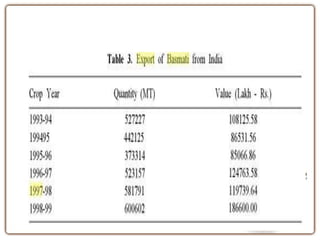
• India exports about 400,000 - 500,000 metric
tons of Basmati annually. In 1996-97, India
exported approximately 523,000 tonnes of
Basmati to Europe.
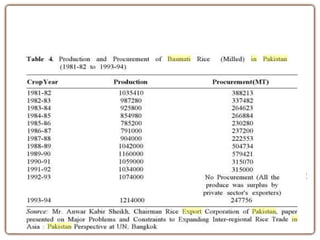
• No official response was given to the situation.
• It is speculated that because share of Indian
Basmati is more in International Market, hence,
the more severe response from them.
• So do you think Pakistani Government and
Exporters need more education in IPRs?
Government of Pakistan
Response
• RiceTec Inc has earlier tried to enter the market.
• Their two main brands of rice were:
– Texmati.
– Kashmati.
Facts of the case
Whether the term ‘basmati’ is a generic one
to describe aromatic rice, or does it refer
specifically to the long aromatic rice grown in India
and Pakistan?
Whether the strain developed by RiceTec is a
novelty?
Whether RiceTec is guilty of biopiracy?
Whether US government’s decision to grant a
patent for the prized Basmati rice violates the
International Treaty on Trade Related Intellectual
Property Rights (TRIPS)?
Whether the basmati patent should be revoked in
the light of protests from India?
• RiceTec Inc. took back 15 claims out of 20
• They also took back its claim on the name
“Basmati”.
Result
• Large numbers of patents on living organisms
have been granted in US and Europe.
• patents have become a driving force behind
genetic engineering.
• It has allowed the agricultural and breeding
sectors to be organized in an completely new
economic context.
A Global Appeal is necessary
• Reorganization of the seed market.
• Leading to a greater integration with the agrochemicals
sector.
• All large seed companies have been bought up by
agrochemical companies.
– Monsanto
– Syngenta
– Dupont
– Baye
– BASF
Patents on conventional seeds,
plants and animals
• Monsanto , had spent about 10 billions US dollars in 10
years to take over companies in the agricultural sector
• Today, around 50% of the global seed market is
controlled by only 10 multinational companies
• European laws were changed to erode the prohibition of
patents on plant varieties (EC Directive 98/44)
• The public is skeptical about genetic engineering.
• Only a very few traits being commercialized via genetic
engineering.
• Conventional plant breeding in combination with some
specific technological procedures, such as gene
identification,- so called marker assisted breeding - has
became more interesting for the big companies.
Shifts in technology and public
rejection of genetic engineering
• To establish monopolies.
• To establish exclusive control over trade.
• To have competitive advantage.
Why Agricultural Patents are
being pursued?
EXAMPLES OF BIO-PIRACY
1. US Patent 5401504 granted for the use of turmeric
powder for healing wounds. Applicant did not disclose
fully existence traditional knowledge on the subject
matter in India. This was made available by India to
USPTO, and the patent was revoked.
2. European Patent Office granted Patent EP0436257 on
a method for controlling fungi on plants by the aid of a
hydrophobic extracted neem oil, a knowledge that was
extensively used in India already. NGOs and a
European Parliament helped in getting the patent
revoked.
REMEDIES FOR BIO-PIRACY
• National policies for sustainable use of biological
resources.
• National laws implementing obligations under
Convention on Biological Diversity (CBD).
• International recognition of these policies and laws
through binding obligations.
• Implementation of these binding obligations universally.
STEPS TO PREVENT BIO-PIRACY BY
DEVELOPING COUNTRIES
• CBD is negotiating an international agreement; results
possible by 2010.
• WIPO has a programe for assessing ways to contribute
to sustainable commercial use; not much progress.
• Developing countries have a proposal in the WTO
seeking an amendment of the trips agreement to provide
for disclosure of source providing biological resources
and evidence of access and benefit sharing.
FUTURE STEPS
• Many countries have national access and benefit sharing
laws; more should follow.
• Switzerland’s effort to amend the patent law in the right
direction-giving the patent system a human face; worries
of biotech companies unnecessary.
• Industry should follow best practices in the meanwhile,
as shown by Novozymes A/S, Denmark.
THANK YOU

basmatiricepatentbattle-140914084532-phpapp01

  • 1.
    BasmatiRice PatentBattle Presented By: Nitin P.Kanwale NDMVP Collage Of Pharmacy Nashik
  • 2.
    Intellectual Property • Intellectualproperty (IP) is a legal concept which refers to creations of mind for which exclusive rights are recognized. • Under intellectual property law, owners are granted certain exclusive rights to their tangible and intangible assets.
  • 3.
    Intellectual Property Rights •Trademarks™: A trademark is a sign that individualizes the goods of a given enterprise and distinguishes them from the goods of others. It can be in the form of words, designs, letters or numerals etc. • Patent: A patent is a set of exclusive rights granted by a state to an inventor or assignee for limited period of time. Only the assignee have rights to make and sell the invented product. • Copyrights©: Copyright deals with the protection of literary and artistic works. These include writings, music, and works of the fine arts, such as paintings and sculptures, and technology-based works such as computer programs and electronic databases.
  • 4.
    Intellectual Property Rights •Geographical Indications: Geographical Indication in relation to goods, means , an indication which identifies such goods, as originating or manufactured or produced in a territory of a qualifying country or a region or a locality of a qualifying country , where a given quality, reputation or other characteristic of such goods, is essentially attributable to its geographical origin. • GRTKF: GRTKF stands for Genetic Resources, Traditional Knowledge and Folklore. GRTKF have been identified as types of non-conventional Intellectual Property (IP) during last few decades.
  • 5.
    IPRs Controlling Authorities •World Intellectual Property Organization (WIPO) • World Trade Organization (WTO) • TRIPS • African Regional Intellectual Property Organization (ARIPO)
  • 6.
    Agriculture IPRs History: Intellectual propertyprotection has been extended in the last 25 years to a wide range of information, materials and products relevant to food and agriculture. The US Supreme Court decision in Diamond vs Chakrabarty influenced national legislation and case law in many jurisdictions, opening the door for the patentability of living organisms, including microbes, plants and animals and their parts and components.
  • 7.
    Agriculture IPRs • PlantBreeder’s Rights (PBR): Plant Breeders' Rights (PBR), also known as plant variety rights (PVR), are rights granted to the breeder of a new variety of plant that give them exclusive control over the propagating material (including seed, cuttings, divisions, tissue culture) and harvested material (cut flowers, fruit, foliage) of a new variety for a number of years.
  • 8.
    Agriculture IPRs • Benefitsof Plant Breeder’s Rights PBR protection allows you to exclude others from: • producing or reproducing the material • conditioning the material for the purpose of propagation • offering the material for sale • selling the material • importing the material • exporting the material • stocking the material for any of the purposes described above.
  • 9.
    Agriculture Patent The maincriteria for agriculture patent in PBR is: • Novelty • Inventiveness (non-obviousness) • Utility • Reproducibility
  • 10.
    Some Patented Plants PlantPatent Number Grape plant “La Crescent” PP14617 Apple tree “Eve's Apple” PP8544 Strawberry plant “Aromas” PP10451 Apricot tree “Ruby” PP8177 Blueberry plant “Emerald” PP12165
  • 11.
    Bioprospecting • Bioprospecting isan umbrella term describing the process of discovery and commercialization of new products based on biological resources. Bioprospecting often draws on indigenous knowledge about uses and characteristics of plants and animals.
  • 12.
    Biopiracy • Biopiracy isa situation where indigenous knowledge of nature, originating with indigenous peoples, is used by others for profit, without permission from and with little or no compensation or recognition to the indigenous people themselves.
  • 13.
    Biopiracy Cases • TheRosy Periwinkle • The Neem Tree • The Enola Bean • Hoodia • Basmati Rice
  • 14.
    Basmati Rice PatentCase • CASE NUMBER: 493 • CASE MNEMONIC: Basmati • CASE NAME: India-US Basmati Rice Dispute • Patent number: US5663484 A • Publication type: Grant • Application number: US 08/272,353 • Publication date: Sep 2, 1997 • Filing date: Jul 8, 1994
  • 15.
    • Rice isan important aspect of life in the Southeast and other parts of Asia. • For centuries, it has been the cornerstone of their food and culture. • Basmati has been grown in the foothills of the Himalayas for thousands of years. Basmati Rice and Asia
  • 16.
    • Basmati riceis being grown in subcontinent for centuries. • Its flavour and aroma has been developed through selective breeding for thousands of years. • It is common knowledge that what Champagne is to France, Basmati is to subcontinent (Pakistan and India).
  • 17.
    Basmati Rice • Basmatimeans the “queen of fragrance or the perfumed one”. • Origin: Pakistan and India • Indian varieties are Safidon, Haryana, Kasturi (Baran, Rajasthan), Basmati 198, Basmati 217, Basmati 370, Kasturi, Mahi Suganda. • Pakistani varieties Basmati 370, Super Basmati, Pak (Kernal) Basmati, Basmati 386, Basmati 385 and Basmati 198.
  • 18.
  • 19.
  • 20.
    The Case Issue Inthe late 1997, when an American company RiceTec Inc. was granted a patent by the US patent office to call the aromatic rice grown outside India "Basmati", India objected to it. India has been one of the major exporters of Basmati to several countries and such a grant by the US patent office was likely to affect its trade. Since Basmati rice is traditionally grown in India and Pakistan, it was opined that granting patent to RiceTec violated the Geographical Indications Act under the TRIPS agreement. A geographical indication (sometimes abbreviated to GI) is a name or sign used on certain products which corresponds to a specific geographical location or origin (e.g.. a town, region, or country). The use of a GI may act as a certification that the product possesses certain qualities, or enjoys a certain reputation, due to its geographical origin. RiceTec's usage of the name Basmati for rice which was derived from Indian rice but not grown in India, and hence not of the same quality as Basmati, would have lead to the violation of the concept of GI and would have been a deception to the consumers.
  • 21.
    RiceTec Company Details •Owned by Prince Hans-Adam of Liechtenstein. • 120 company employees. • Annual sales 10 million US Dollars. • Rice developed by RiceTec are: Bas 867, RT 1117, RT 112.
  • 22.
    Company’s Words “We areabsolutely confident in our patent and viability and legality. There is no basis for challenging the patent”.
  • 23.
    RiceTec Inc. PatentClaims RiceTec put 20 claims about their product from which few ones are: • semi-dwarf in stature • substantially photoperiod insensitive • high yield • Having characteristics similar or superior to those of good quality basmati rice • The invention provides a method for breeding these novel lines • Starch index (SI) of a rice grain can predict the grain's cooking and starch properties
  • 24.
    • Claiming that“Aroma” has been developed by RiceTech Inc. is misleading – RiceTech Inc. claimed that it tool them 10 years to develop the Aroma in their rice line • Branding a Basmati lookalike as Basmati – They used inbreeding of ordinary american rice with sub continental Basmati rice and patented this hybrid as Basmati
  • 25.
    Patent Advantage toRiceTech • RiceTec able to not only call its aromatic rice Basmati within the US, but also label it Basmati for its exports. • Captures the whole US trade market. • Exclusive use of the term “basmati”. • Monopoly on breeding 22 farmer-bred Pakistani basmati varieties with any other varieties in the Western Hemisphere. • Proprietary rights on the seeds and grains from any crosses.
  • 26.
    Disadvantage of Patentto India and Pakistan • Economic loses. • Global trade losses. • Both countries lose their global market share.
  • 27.
    • Brand Association •Reputation • Market share • Superior features/characteristics • Confusing the customers into buying their product (Passing Off) Why the Name Basmati
  • 28.
    • Government ofIndia under severe pressure from its exporters and farmers logged an appeal with USPTO. • They submitted the evidence to USPTO. Government of India Response to Patent
  • 29.
    • India exportsabout 400,000 - 500,000 metric tons of Basmati annually. In 1996-97, India exported approximately 523,000 tonnes of Basmati to Europe.
  • 31.
    • No officialresponse was given to the situation. • It is speculated that because share of Indian Basmati is more in International Market, hence, the more severe response from them. • So do you think Pakistani Government and Exporters need more education in IPRs? Government of Pakistan Response
  • 33.
    • RiceTec Inchas earlier tried to enter the market. • Their two main brands of rice were: – Texmati. – Kashmati. Facts of the case
  • 34.
    Whether the term‘basmati’ is a generic one to describe aromatic rice, or does it refer specifically to the long aromatic rice grown in India and Pakistan?
  • 35.
    Whether the straindeveloped by RiceTec is a novelty?
  • 36.
    Whether RiceTec isguilty of biopiracy?
  • 37.
    Whether US government’sdecision to grant a patent for the prized Basmati rice violates the International Treaty on Trade Related Intellectual Property Rights (TRIPS)?
  • 38.
    Whether the basmatipatent should be revoked in the light of protests from India?
  • 39.
    • RiceTec Inc.took back 15 claims out of 20 • They also took back its claim on the name “Basmati”. Result
  • 40.
    • Large numbersof patents on living organisms have been granted in US and Europe. • patents have become a driving force behind genetic engineering. • It has allowed the agricultural and breeding sectors to be organized in an completely new economic context. A Global Appeal is necessary
  • 41.
    • Reorganization ofthe seed market. • Leading to a greater integration with the agrochemicals sector. • All large seed companies have been bought up by agrochemical companies. – Monsanto – Syngenta – Dupont – Baye – BASF Patents on conventional seeds, plants and animals
  • 42.
    • Monsanto ,had spent about 10 billions US dollars in 10 years to take over companies in the agricultural sector • Today, around 50% of the global seed market is controlled by only 10 multinational companies • European laws were changed to erode the prohibition of patents on plant varieties (EC Directive 98/44)
  • 43.
    • The publicis skeptical about genetic engineering. • Only a very few traits being commercialized via genetic engineering. • Conventional plant breeding in combination with some specific technological procedures, such as gene identification,- so called marker assisted breeding - has became more interesting for the big companies. Shifts in technology and public rejection of genetic engineering
  • 44.
    • To establishmonopolies. • To establish exclusive control over trade. • To have competitive advantage. Why Agricultural Patents are being pursued?
  • 45.
    EXAMPLES OF BIO-PIRACY 1.US Patent 5401504 granted for the use of turmeric powder for healing wounds. Applicant did not disclose fully existence traditional knowledge on the subject matter in India. This was made available by India to USPTO, and the patent was revoked. 2. European Patent Office granted Patent EP0436257 on a method for controlling fungi on plants by the aid of a hydrophobic extracted neem oil, a knowledge that was extensively used in India already. NGOs and a European Parliament helped in getting the patent revoked.
  • 46.
    REMEDIES FOR BIO-PIRACY •National policies for sustainable use of biological resources. • National laws implementing obligations under Convention on Biological Diversity (CBD). • International recognition of these policies and laws through binding obligations. • Implementation of these binding obligations universally.
  • 47.
    STEPS TO PREVENTBIO-PIRACY BY DEVELOPING COUNTRIES • CBD is negotiating an international agreement; results possible by 2010. • WIPO has a programe for assessing ways to contribute to sustainable commercial use; not much progress. • Developing countries have a proposal in the WTO seeking an amendment of the trips agreement to provide for disclosure of source providing biological resources and evidence of access and benefit sharing.
  • 48.
    FUTURE STEPS • Manycountries have national access and benefit sharing laws; more should follow. • Switzerland’s effort to amend the patent law in the right direction-giving the patent system a human face; worries of biotech companies unnecessary. • Industry should follow best practices in the meanwhile, as shown by Novozymes A/S, Denmark.
  • 49.