1
• CHOICE OF SOLVENTS AND SOLVENT EFFECTS
• APPLICATIONS
• DIFFERENCE SPECTROSCOPY
• DERIVATIVE SPECTROSCOPY
PRESENTED BY
DIVYA V
FIRST M PHARM
PHARMACEUTICAL CHEMISTRY
2
3
REQUIREMENTS
• It does not interact with solute
• Does not show absorption at wavelength to be
determined
• Good solvent-for substance
• For inorganic compounds-Water
• For organic compounds-Organic solvent
DISADVANTAGE OF POLAR SOLVENT-
It destroys fine structure of spectra-so non polar
must be used
4
• Solvent-Transparent in required wavelength
• E.g. 95% Ethanol-Transparent down 210nm
• Cyclohexane-210nm
• 1,4-dioxane-220nm
Solvent λmax(nm) Solvent Λmax(nm)
Methanol 210 Cyclohexane 212
Hexane 199 Chloroform 247
Heptane 200 Acetone 331
Ether 205 Acetic acid 270
5
6
• Change in polarity-Position and intensity of peak
shifted for a particular chromophore
• ∏→∏*-Excited state(∏*)is more polar & is more
stabilized by polar solvent.Thus in going from
nonpolar →polar solvent-red shift occurs(increase
in λmax , decrease in ∆E).A small energy is needed
for such kind of transitions.
• n→∏*-n state is more stabilized by polar
solvent.Thus in going from nonpolar →polar
solvent-blue shift occurs(decrease in λmax ,
increase in ∆E)
7
• n→σ*-This is very sensitive to H-bonding. Here
ground state is more polar than excited state.
Alcohols,amines form H-bonding with solvent
Molecules.Therefore such transition requires high
energy and blue shift occurs.
8
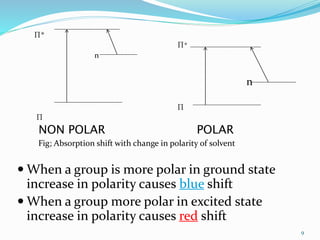
∏*
∏*
n
n
∏
∏
NON POLAR POLAR
Fig; Absorption shift with change in polarity of solvent
 When a group is more polar in ground state
increase in polarity causes blue shift
 When a group more polar in excited state
increase in polarity causes red shift
9
10
1.QUANTITATIVE ANALYSIS
 Concentration of a drug or absorbing species in a given
sample can be easily analyzed by measuring the
absorbance of the solution prepared in transparent
solution
11
a) SINGLE COMPONENTS
 Only one component in the sample absorbs
significantly.
Methods used are :
1 Standard absorptivity value method
2 Single standard or direct comparison method
3 Multiple standard or Calibration curve method
12
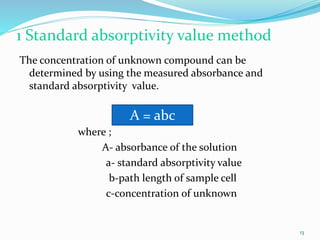
1 Standard absorptivity value method
The concentration of unknown compound can be
determined by using the measured absorbance and
standard absorptivity value.
where ;
A- absorbance of the solution
a- standard absorptivity value
b-path length of sample cell
c-concentration of unknown
A = abc
13
2 Single standard method
 Absorbance of standard solution of known
concentration is compared with sample solution.
Where as,
c1 &c2 = Concentration of standard & sample
A1 & A2 = Absorbance of standard & sample
c2=c1*(A2/A1)
14
3 Calibration curve method
A calibration curve is plotted using
concentration vs. absorbance value of 5 or more
standard solutions.
A
C
15
b) MULTIPLE COMPONENTS
 By this the actual amount of sample under
investigation can be easily calculated after
removing the irrelevant absorption.
METHODS
1. Using absorbance corrected for interference
2. After solvent extraction of the sample
3. Absorption ratio method
4. Simultaneous equation method
16
1) Absorbance corrected for interference
Corrected absorbance will be the difference
between the total absorbance and the absorbance
of the interfering substance
 E.g. : Determination of concentration of ephedrine
hydrochloride and chlorocresol in ephedrine
hydrochloride injection
17
2) After solvent extraction of the sample
 Separate the absorbing interferants from the
analyte by solvent extraction procedures.
 Appropriate for acidic and basic drugs.
 The concentration of the analyte can be obtained
by simple measurement of the absorbance of the
extract containing the analyte.
 E.g. : Assay of caffeine in aspirin and caffeine
tablets.
18
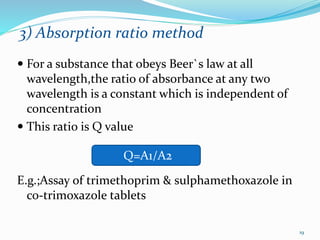
3) Absorption ratio method
 For a substance that obeys Beer`s law at all
wavelength,the ratio of absorbance at any two
wavelength is a constant which is independent of
concentration
 This ratio is Q value
E.g.;Assay of trimethoprim & sulphamethoxazole in
co-trimoxazole tablets
Q=A1/A2
19
4) Simultaneous equation method
 Based on the fact that total absorbance of solution
is Sum of absorbance of individual components
Cx & Cy=Concentration of drug X & Y in g/L
respectively
A1 & A2=Absorbance at λ1 & λ2
ax1 & ay1=Absorptivity of drug X & Y at λ1
ax2 & ay2=Absorptivity of drug X & Y at λ2
Cx =A2*ay1-A1*ay2/ax2*ay1-(ax2*ay2)
Cy =A1*ax2-A2*ax1/ax2*ay1-(ax2*ay2)
20
2. QUALITATIVE ANALYSIS
 Identification is done by comparing absorption
spectrum with spectra of standard compounds.
 Includes detection of impurities, structural
elucidation of organic compounds, detection of
conjugation, detection of geometrical isomers etc.
21
a)Detection of functional groups
 Presence and absence of chromophore can be
easily detected.
 If the spectrum is transparent above 200 nm it
shows the absence of :
 Conjugation/ unsaturation
 Carbonyl groups like aldehydes and ketones
 Benzene or aromatic groups
 Bromo or iodo atoms
22
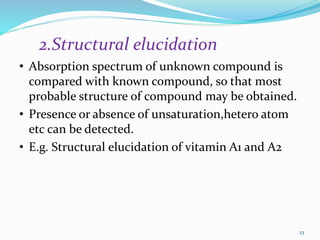
2.Structural elucidation
• Absorption spectrum of unknown compound is
compared with known compound, so that most
probable structure of compound may be obtained.
• Presence or absence of unsaturation,hetero atom
etc can be detected.
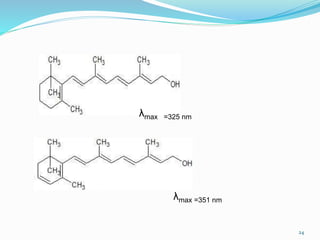
• E.g. Structural elucidation of vitamin A1 and A2
23
λmax =325 nm
λmax =351 nm
24
3. Detection Of Extent of Conjugation
 Extension of conjugation in a unsaturated
compound shifts the λmax to longer wavelength-
Bathochromic shift /red shift
 Reduction of double bond shifts the λmax to
shorter wavelength – Hypsochromic shift / Blue
shift
E.g. Nitrobenzene – 252 nm
o- nitro toluene- 250 nm
25
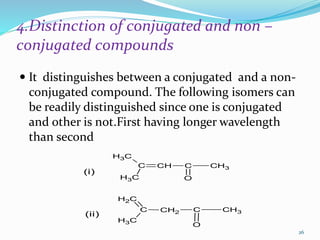
4.Distinction of conjugated and non –
conjugated compounds
 It distinguishes between a conjugated and a non-
conjugated compound. The following isomers can
be readily distinguished since one is conjugated
and other is not.First having longer wavelength
than second
CH3
C
CH3
CH C CH3
O
C CH2 C CH3
O
CH3
CH2
(i)
(ii)
26
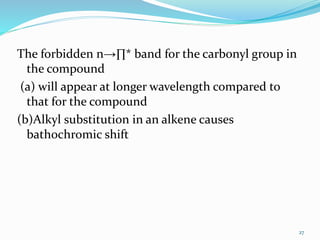
The forbidden n→∏* band for the carbonyl group in
the compound
(a) will appear at longer wavelength compared to
that for the compound
(b)Alkyl substitution in an alkene causes
bathochromic shift
27
5.Detection of impurities
 If impurities are present then the absorption
spectra will differ from the characteristic spectra of
pure substances as the impurities will also absorb
light .
 Additional peaks will be obtained.
 E.g.: The drug adrenaline shows λmax at 280nm
and the presence of adrenalone in adrenaline can
be detected from its absorption maximum at
310nm.
28
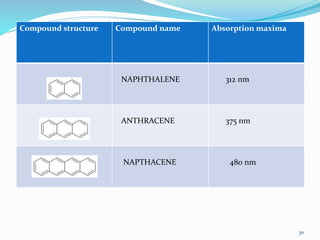
6.Detection of polynuclear hydrocarbons
 Made comparison with unknown with known
spectra of polynuclear hydrocarbons
 Presence of substituents in the ring shifts the
λmax to longer wavelength
 Increase in number of benzene ring-shift λmax in
to longer wavelength
29
Compound structure Compound name Absorption maxima
NAPHTHALENE 312 nm
ANTHRACENE 375 nm
NAPTHACENE 480 nm
30
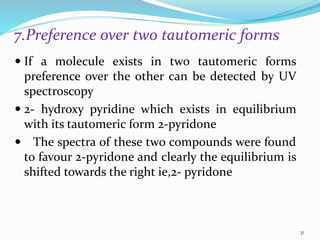
7.Preference over two tautomeric forms
 If a molecule exists in two tautomeric forms
preference over the other can be detected by UV
spectroscopy
 2- hydroxy pyridine which exists in equilibrium
with its tautomeric form 2-pyridone
 The spectra of these two compounds were found
to favour 2-pyridone and clearly the equilibrium is
shifted towards the right ie,2- pyridone
31
2- hydroxy pyridine 2-pyridone
32
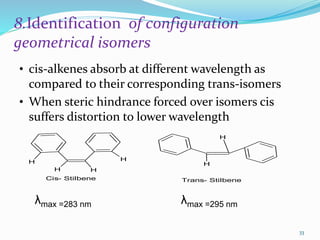
8.Identification of configuration
geometrical isomers
• cis-alkenes absorb at different wavelength as
compared to their corresponding trans-isomers
• When steric hindrance forced over isomers cis
suffers distortion to lower wavelength
H H
H H
H
H
Cis- Stilbene Trans- Stilbene
λmax =283 nm λmax =295 nm
33
9. Identification of a compound in
different solvents
 Sometimes, the structure of the compound
changes with the change in the solvent.
 Chloral hydrate shows an absorption maximum at
290nm in hexane while the absorption disappears
in the aqueous solution.
34
3. DETERMINATION OF MOLECULAR WEIGHT OF
AMINES
A known weight of amines is taken and converted
into amine picrate and the absorbance of the
solution is found measured.Using the
equation,molecular weight can be find out.
where A – absorbance of solution
c – concentration
t- path length
For most of the amine drugs, molecular extinction
co-efficient of amine picrate at 380 nm is 13,400.
Molecular weight =13,400*ct/A
35
4.DETERMINATIONOF DISSOCIATION COSTANT of
indicators
RH R- + H+ RH=Indicator
 Concentration vs. absorbance at different pH is
plotted and pKa can be calculated from the
equation.
pKa = pH – (log [R-]/[RH])
36
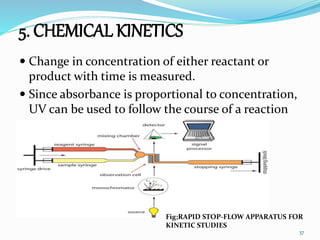
5. CHEMICAL KINETICS
 Change in concentration of either reactant or
product with time is measured.
 Since absorbance is proportional to concentration,
UV can be used to follow the course of a reaction
Fig;RAPID STOP-FLOW APPARATUS FOR
KINETIC STUDIES
37
6. SPECTROPHoTOMETRIC TITRATIONS
 It is the titration in which the absorption of the reactant
,product is followed as a function of titrant
 ADVANTAGE; Sharp end point,no interference from other
absorbing species
 CONDITIONS;Either product/substance/titrant
absorbs,Beer `s law must be obeyed
 E.g. Titrant only absorbs (substance-Ar(III))
A
endpoint
volume of bromate bromide 38
DIFFERENCE SPECTROSCOPY
39
• The selectivity and accuracy of spectrophotometric
analysis of sample containing absorbing
interference may be markedly improved by the
technique of difference spectroscopy
• Sensitive method for detecting small changes in
environment of chromophore
• In this spectra of 2 samples of slightly different
composition or physical state can be compared
40
FEATURE OF DIFFERENCE
SPECTROSCOPY
 Measured value is the difference in absorbance
(∆A) between two equimolar solution of analyte
in different chemical forms which exhibit spectral
characteristics
41
CRITERIA FOR APPLYING DIFFERENCE
SPECTROPHOTOMETRY
• Reproducible changes may be induced in the
spectrum of the analyte by the addition of one or
more reagents.
• commonly employed technique for altering the
spectral properties is adjustment of pH by means of
aqueous solution of acid,alkali,or buffers.
• The uv-visible spectra of many substance containing
ionisable functional groups are depend on the state
of ionisation of the functional group and pH of the
solution.
42
43
• Another simplest method for an increasing
selectivity is derivatisation of spectra.
• This operation allows to remove spectral
interferences and as a consequence leads to
increase selectivity of assay.
• Ability to detect and measure minor spectral
features enhanced.So similar spectra can be
distinguished
44
• Involves conversion of a normal spectrum to it’s
first, second or higher derivative spectrum.
• Normal absorption spectrum - D0 spectrum
• The first derivative D1 spectrum - plot of the rate of
change of absorbance with wavelength against
wavelength (dA/dʎ VS λ)
• The second derivative spectrum - plot of the
curvature of the D0 spectrum against wavelength or
a plot of d2A/dʎ2 ʎ
45
Types of derivative spectra
46
INSTRUMENTATION
• Derivative spectra-generated by following
techniques,
# Modification of the optical system
• Spectrophotometers with dual
monochromators,photodetectors used
• Generates a signal with an amplitude proportional
to the slope of the spectrum over the wavelength
interval
• Disadvantage: Expensive ,Restricted to the
recording of first derivative spectra only.
47
dual wavelength instrument with two monochromator
operated at the same speed but with a lag of few nm from
each other. A chopper will sequentially pass the beams from
both monochromators and thus their difference divided by
the constant nm lag value is recorded versus the average
wavelength.
48
#Based upon microcomputers differentiation
• Micro computers incorporated in to or interfaced
with spectrophotometer
To provide
 Derivative spectra during or after scan
 To measure derivative amplitudes between
specified wavelengths
 To calculate concentrations and associated
statistics from the measured amplitudes
49
APPLICATIONS
 Multicomponent analysis
used in pharmaceutical analysis for assaying of a
main ingredient in presence of others components
or its degradation product.
 Accurate determination of λmax
 Better qualitative analysis of & identification of
absorbing species in a sample
 Calculation of some physico-chemical constants,
e.g. reaction, complexation or binding constants
 Disadvantage: Poor reproducibility
50
REFERENCES
 Hobart.H.Willard,Lynne.L.Merrit.Instrume-ntal
method of analysis.PBS Publications.2009;6:66-82
 H.Kaur.Instrumental methods of chemical
analysis.Pragati Prakashan.2013;9:279-363
 Gurdeep.R.Chatwal,Sham.k.Anand.Instrumental
methods of chemical analysis.Himalaya Publishing
home.2013;5:2.107-2.184
• Google search
51
52

UV-Visible spectroscopy

  • 1.
  • 2.
    • CHOICE OFSOLVENTS AND SOLVENT EFFECTS • APPLICATIONS • DIFFERENCE SPECTROSCOPY • DERIVATIVE SPECTROSCOPY PRESENTED BY DIVYA V FIRST M PHARM PHARMACEUTICAL CHEMISTRY 2
  • 3.
  • 4.
    REQUIREMENTS • It doesnot interact with solute • Does not show absorption at wavelength to be determined • Good solvent-for substance • For inorganic compounds-Water • For organic compounds-Organic solvent DISADVANTAGE OF POLAR SOLVENT- It destroys fine structure of spectra-so non polar must be used 4
  • 5.
    • Solvent-Transparent inrequired wavelength • E.g. 95% Ethanol-Transparent down 210nm • Cyclohexane-210nm • 1,4-dioxane-220nm Solvent λmax(nm) Solvent Λmax(nm) Methanol 210 Cyclohexane 212 Hexane 199 Chloroform 247 Heptane 200 Acetone 331 Ether 205 Acetic acid 270 5
  • 6.
  • 7.
    • Change inpolarity-Position and intensity of peak shifted for a particular chromophore • ∏→∏*-Excited state(∏*)is more polar & is more stabilized by polar solvent.Thus in going from nonpolar →polar solvent-red shift occurs(increase in λmax , decrease in ∆E).A small energy is needed for such kind of transitions. • n→∏*-n state is more stabilized by polar solvent.Thus in going from nonpolar →polar solvent-blue shift occurs(decrease in λmax , increase in ∆E) 7
  • 8.
    • n→σ*-This isvery sensitive to H-bonding. Here ground state is more polar than excited state. Alcohols,amines form H-bonding with solvent Molecules.Therefore such transition requires high energy and blue shift occurs. 8
  • 9.
    ∏* ∏* n n ∏ ∏ NON POLAR POLAR Fig;Absorption shift with change in polarity of solvent  When a group is more polar in ground state increase in polarity causes blue shift  When a group more polar in excited state increase in polarity causes red shift 9
  • 10.
  • 11.
    1.QUANTITATIVE ANALYSIS  Concentrationof a drug or absorbing species in a given sample can be easily analyzed by measuring the absorbance of the solution prepared in transparent solution 11
  • 12.
    a) SINGLE COMPONENTS Only one component in the sample absorbs significantly. Methods used are : 1 Standard absorptivity value method 2 Single standard or direct comparison method 3 Multiple standard or Calibration curve method 12
  • 13.
    1 Standard absorptivityvalue method The concentration of unknown compound can be determined by using the measured absorbance and standard absorptivity value. where ; A- absorbance of the solution a- standard absorptivity value b-path length of sample cell c-concentration of unknown A = abc 13
  • 14.
    2 Single standardmethod  Absorbance of standard solution of known concentration is compared with sample solution. Where as, c1 &c2 = Concentration of standard & sample A1 & A2 = Absorbance of standard & sample c2=c1*(A2/A1) 14
  • 15.
    3 Calibration curvemethod A calibration curve is plotted using concentration vs. absorbance value of 5 or more standard solutions. A C 15
  • 16.
    b) MULTIPLE COMPONENTS By this the actual amount of sample under investigation can be easily calculated after removing the irrelevant absorption. METHODS 1. Using absorbance corrected for interference 2. After solvent extraction of the sample 3. Absorption ratio method 4. Simultaneous equation method 16
  • 17.
    1) Absorbance correctedfor interference Corrected absorbance will be the difference between the total absorbance and the absorbance of the interfering substance  E.g. : Determination of concentration of ephedrine hydrochloride and chlorocresol in ephedrine hydrochloride injection 17
  • 18.
    2) After solventextraction of the sample  Separate the absorbing interferants from the analyte by solvent extraction procedures.  Appropriate for acidic and basic drugs.  The concentration of the analyte can be obtained by simple measurement of the absorbance of the extract containing the analyte.  E.g. : Assay of caffeine in aspirin and caffeine tablets. 18
  • 19.
    3) Absorption ratiomethod  For a substance that obeys Beer`s law at all wavelength,the ratio of absorbance at any two wavelength is a constant which is independent of concentration  This ratio is Q value E.g.;Assay of trimethoprim & sulphamethoxazole in co-trimoxazole tablets Q=A1/A2 19
  • 20.
    4) Simultaneous equationmethod  Based on the fact that total absorbance of solution is Sum of absorbance of individual components Cx & Cy=Concentration of drug X & Y in g/L respectively A1 & A2=Absorbance at λ1 & λ2 ax1 & ay1=Absorptivity of drug X & Y at λ1 ax2 & ay2=Absorptivity of drug X & Y at λ2 Cx =A2*ay1-A1*ay2/ax2*ay1-(ax2*ay2) Cy =A1*ax2-A2*ax1/ax2*ay1-(ax2*ay2) 20
  • 21.
    2. QUALITATIVE ANALYSIS Identification is done by comparing absorption spectrum with spectra of standard compounds.  Includes detection of impurities, structural elucidation of organic compounds, detection of conjugation, detection of geometrical isomers etc. 21
  • 22.
    a)Detection of functionalgroups  Presence and absence of chromophore can be easily detected.  If the spectrum is transparent above 200 nm it shows the absence of :  Conjugation/ unsaturation  Carbonyl groups like aldehydes and ketones  Benzene or aromatic groups  Bromo or iodo atoms 22
  • 23.
    2.Structural elucidation • Absorptionspectrum of unknown compound is compared with known compound, so that most probable structure of compound may be obtained. • Presence or absence of unsaturation,hetero atom etc can be detected. • E.g. Structural elucidation of vitamin A1 and A2 23
  • 24.
  • 25.
    3. Detection OfExtent of Conjugation  Extension of conjugation in a unsaturated compound shifts the λmax to longer wavelength- Bathochromic shift /red shift  Reduction of double bond shifts the λmax to shorter wavelength – Hypsochromic shift / Blue shift E.g. Nitrobenzene – 252 nm o- nitro toluene- 250 nm 25
  • 26.
    4.Distinction of conjugatedand non – conjugated compounds  It distinguishes between a conjugated and a non- conjugated compound. The following isomers can be readily distinguished since one is conjugated and other is not.First having longer wavelength than second CH3 C CH3 CH C CH3 O C CH2 C CH3 O CH3 CH2 (i) (ii) 26
  • 27.
    The forbidden n→∏*band for the carbonyl group in the compound (a) will appear at longer wavelength compared to that for the compound (b)Alkyl substitution in an alkene causes bathochromic shift 27
  • 28.
    5.Detection of impurities If impurities are present then the absorption spectra will differ from the characteristic spectra of pure substances as the impurities will also absorb light .  Additional peaks will be obtained.  E.g.: The drug adrenaline shows λmax at 280nm and the presence of adrenalone in adrenaline can be detected from its absorption maximum at 310nm. 28
  • 29.
    6.Detection of polynuclearhydrocarbons  Made comparison with unknown with known spectra of polynuclear hydrocarbons  Presence of substituents in the ring shifts the λmax to longer wavelength  Increase in number of benzene ring-shift λmax in to longer wavelength 29
  • 30.
    Compound structure Compoundname Absorption maxima NAPHTHALENE 312 nm ANTHRACENE 375 nm NAPTHACENE 480 nm 30
  • 31.
    7.Preference over twotautomeric forms  If a molecule exists in two tautomeric forms preference over the other can be detected by UV spectroscopy  2- hydroxy pyridine which exists in equilibrium with its tautomeric form 2-pyridone  The spectra of these two compounds were found to favour 2-pyridone and clearly the equilibrium is shifted towards the right ie,2- pyridone 31
  • 32.
    2- hydroxy pyridine2-pyridone 32
  • 33.
    8.Identification of configuration geometricalisomers • cis-alkenes absorb at different wavelength as compared to their corresponding trans-isomers • When steric hindrance forced over isomers cis suffers distortion to lower wavelength H H H H H H Cis- Stilbene Trans- Stilbene λmax =283 nm λmax =295 nm 33
  • 34.
    9. Identification ofa compound in different solvents  Sometimes, the structure of the compound changes with the change in the solvent.  Chloral hydrate shows an absorption maximum at 290nm in hexane while the absorption disappears in the aqueous solution. 34
  • 35.
    3. DETERMINATION OFMOLECULAR WEIGHT OF AMINES A known weight of amines is taken and converted into amine picrate and the absorbance of the solution is found measured.Using the equation,molecular weight can be find out. where A – absorbance of solution c – concentration t- path length For most of the amine drugs, molecular extinction co-efficient of amine picrate at 380 nm is 13,400. Molecular weight =13,400*ct/A 35
  • 36.
    4.DETERMINATIONOF DISSOCIATION COSTANTof indicators RH R- + H+ RH=Indicator  Concentration vs. absorbance at different pH is plotted and pKa can be calculated from the equation. pKa = pH – (log [R-]/[RH]) 36
  • 37.
    5. CHEMICAL KINETICS Change in concentration of either reactant or product with time is measured.  Since absorbance is proportional to concentration, UV can be used to follow the course of a reaction Fig;RAPID STOP-FLOW APPARATUS FOR KINETIC STUDIES 37
  • 38.
    6. SPECTROPHoTOMETRIC TITRATIONS It is the titration in which the absorption of the reactant ,product is followed as a function of titrant  ADVANTAGE; Sharp end point,no interference from other absorbing species  CONDITIONS;Either product/substance/titrant absorbs,Beer `s law must be obeyed  E.g. Titrant only absorbs (substance-Ar(III)) A endpoint volume of bromate bromide 38
  • 39.
  • 40.
    • The selectivityand accuracy of spectrophotometric analysis of sample containing absorbing interference may be markedly improved by the technique of difference spectroscopy • Sensitive method for detecting small changes in environment of chromophore • In this spectra of 2 samples of slightly different composition or physical state can be compared 40
  • 41.
    FEATURE OF DIFFERENCE SPECTROSCOPY Measured value is the difference in absorbance (∆A) between two equimolar solution of analyte in different chemical forms which exhibit spectral characteristics 41
  • 42.
    CRITERIA FOR APPLYINGDIFFERENCE SPECTROPHOTOMETRY • Reproducible changes may be induced in the spectrum of the analyte by the addition of one or more reagents. • commonly employed technique for altering the spectral properties is adjustment of pH by means of aqueous solution of acid,alkali,or buffers. • The uv-visible spectra of many substance containing ionisable functional groups are depend on the state of ionisation of the functional group and pH of the solution. 42
  • 43.
  • 44.
    • Another simplestmethod for an increasing selectivity is derivatisation of spectra. • This operation allows to remove spectral interferences and as a consequence leads to increase selectivity of assay. • Ability to detect and measure minor spectral features enhanced.So similar spectra can be distinguished 44
  • 45.
    • Involves conversionof a normal spectrum to it’s first, second or higher derivative spectrum. • Normal absorption spectrum - D0 spectrum • The first derivative D1 spectrum - plot of the rate of change of absorbance with wavelength against wavelength (dA/dʎ VS λ) • The second derivative spectrum - plot of the curvature of the D0 spectrum against wavelength or a plot of d2A/dʎ2 ʎ 45
  • 46.
  • 47.
    INSTRUMENTATION • Derivative spectra-generatedby following techniques, # Modification of the optical system • Spectrophotometers with dual monochromators,photodetectors used • Generates a signal with an amplitude proportional to the slope of the spectrum over the wavelength interval • Disadvantage: Expensive ,Restricted to the recording of first derivative spectra only. 47
  • 48.
    dual wavelength instrumentwith two monochromator operated at the same speed but with a lag of few nm from each other. A chopper will sequentially pass the beams from both monochromators and thus their difference divided by the constant nm lag value is recorded versus the average wavelength. 48
  • 49.
    #Based upon microcomputersdifferentiation • Micro computers incorporated in to or interfaced with spectrophotometer To provide  Derivative spectra during or after scan  To measure derivative amplitudes between specified wavelengths  To calculate concentrations and associated statistics from the measured amplitudes 49
  • 50.
    APPLICATIONS  Multicomponent analysis usedin pharmaceutical analysis for assaying of a main ingredient in presence of others components or its degradation product.  Accurate determination of λmax  Better qualitative analysis of & identification of absorbing species in a sample  Calculation of some physico-chemical constants, e.g. reaction, complexation or binding constants  Disadvantage: Poor reproducibility 50
  • 51.
    REFERENCES  Hobart.H.Willard,Lynne.L.Merrit.Instrume-ntal method ofanalysis.PBS Publications.2009;6:66-82  H.Kaur.Instrumental methods of chemical analysis.Pragati Prakashan.2013;9:279-363  Gurdeep.R.Chatwal,Sham.k.Anand.Instrumental methods of chemical analysis.Himalaya Publishing home.2013;5:2.107-2.184 • Google search 51
  • 52.