GROUP MEMBER’S:
CHANG PEI XIAN    D 20101037455
CHAN SU FANG      D 20101037450
LECTURER :PN. FARIDAH YUSOFF
INTRODUCTION OF
        CALORIMETER
A calorimeter (from Latin calor, meaning heat) is a
 device used for calculate the enthalpy change of
 reaction, the science of measuring the heat of
 chemical reactions or physical changes as well as heat
 capacity.
The most common types of calorimeter is the bomb
 calorimeter(constant volume calorimeter) and coffee
 cup(constant pressure calorimeter).
The other types include differential scanning
 calorimeters, isothermal micro calorimeters, titration
 calorimeters and accelerated rate calorimeters.
BASIC CONCEPT IN APPLICATION OF
         CALORIMETER
Endothermic process occurs in which the
 system absorbs heat.
Exothermic process occurs in which a system
 loses heat.
The enthalpy change that accompanies a
 reaction is called the enthalpy of reaction, or
 merely the heat of reaction, and is sometimes
 written as ∆Hrxn, where rxn means reaction.
Since , ∆H = H final – H initial, the enthalpy change
 for a chemical reaction is given by the enthalpy
 of the products minus the enthalpy of the
 reactants:
              ∆H = H products – H reactants
Typically, we can determine the magnitude of the
 heat flow produces.
The      measurement          of      heat    flow    is
 calorimetry, and the device used to measure heat
 flow is a calorimeter.
The heat capacity of an object is the amount of
 heat needed to raise the temperature by 1 K (or 1
  C).
The heat capacity of one gram of a substance is called
 its specific heat capacity, or merely is called its
 specific heat.
The specific heat, Cs, of a substance can be
 determined experimentally by measuring the
 temperature change, ∆T, that a known mass, m, of the
 substance undergoes when it gains or loses a specific
 quantity of heat, q:
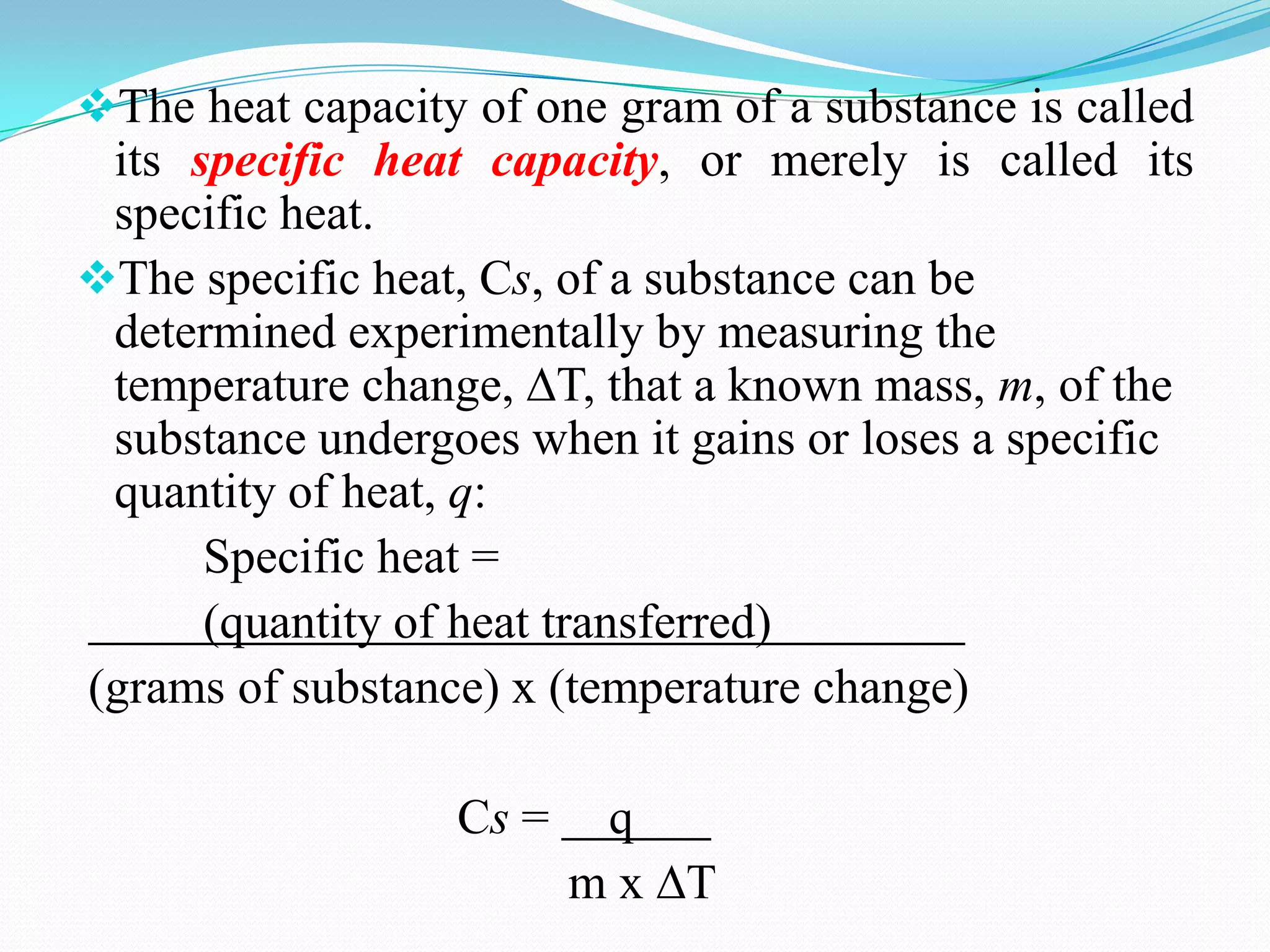
      Specific heat =
      (quantity of heat transferred)
(grams of substance) x (temperature change)

                  Cs =    q
                         m x ∆T
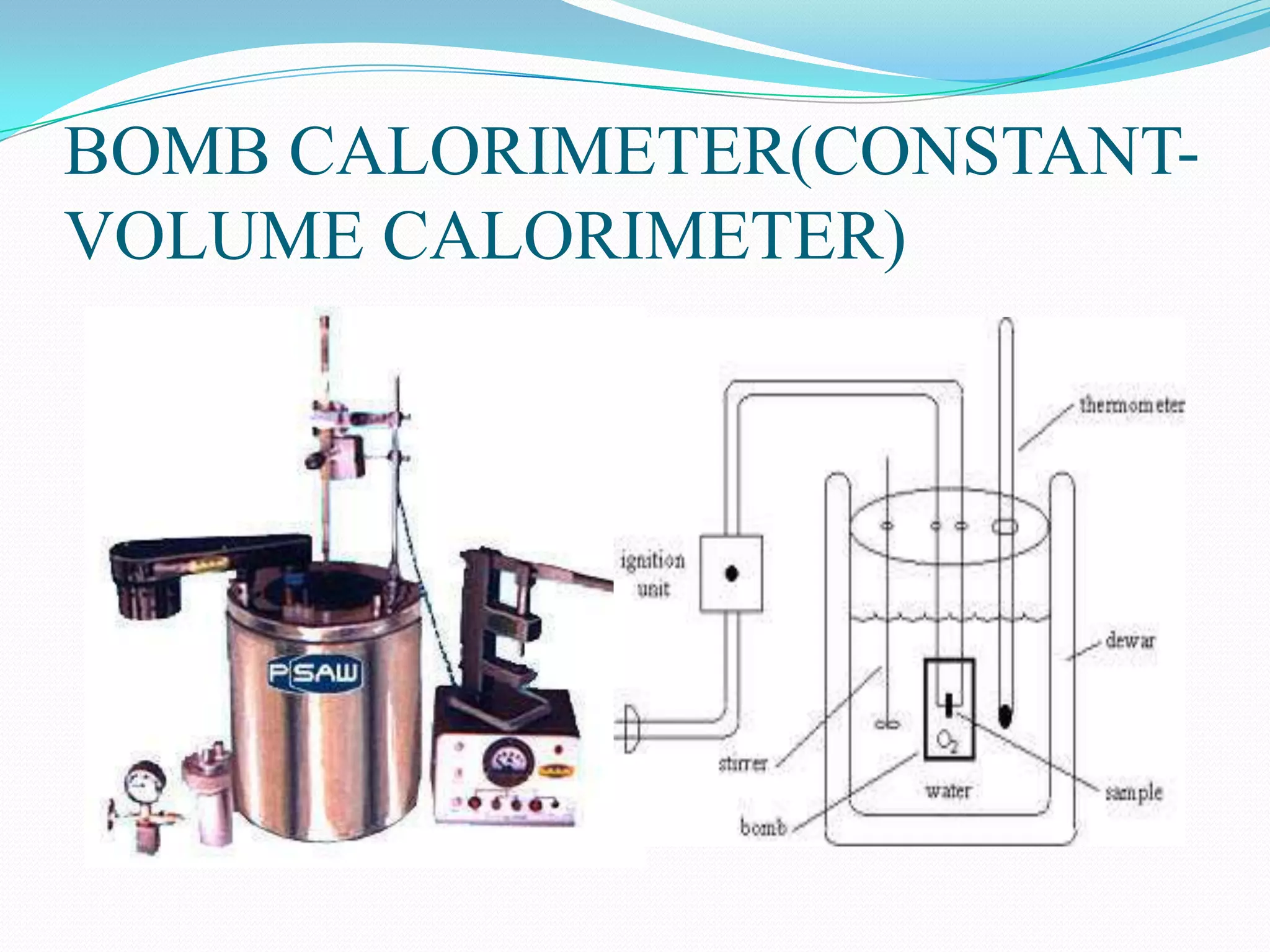
BOMB CALORIMETER(CONSTANT-
VOLUME CALORIMETER)
INTRODUCTION/THEORY
Combustion reactions are most conveniently
 studied using a bomb calorimeter.
Combustion is a process which an organic
 compound reacts completely with excess
 oxygen.
Heat is released when combustion occurs. This
 heat is absorbed by the calorimeter
 contents, causing a rise in the temperature of
 the water.
To calculate the heat of combustion, we must know the
 total heat capacity of the calorimeter, Ccal. This quantity is
 determined by measuring the resulting temperature
 change.
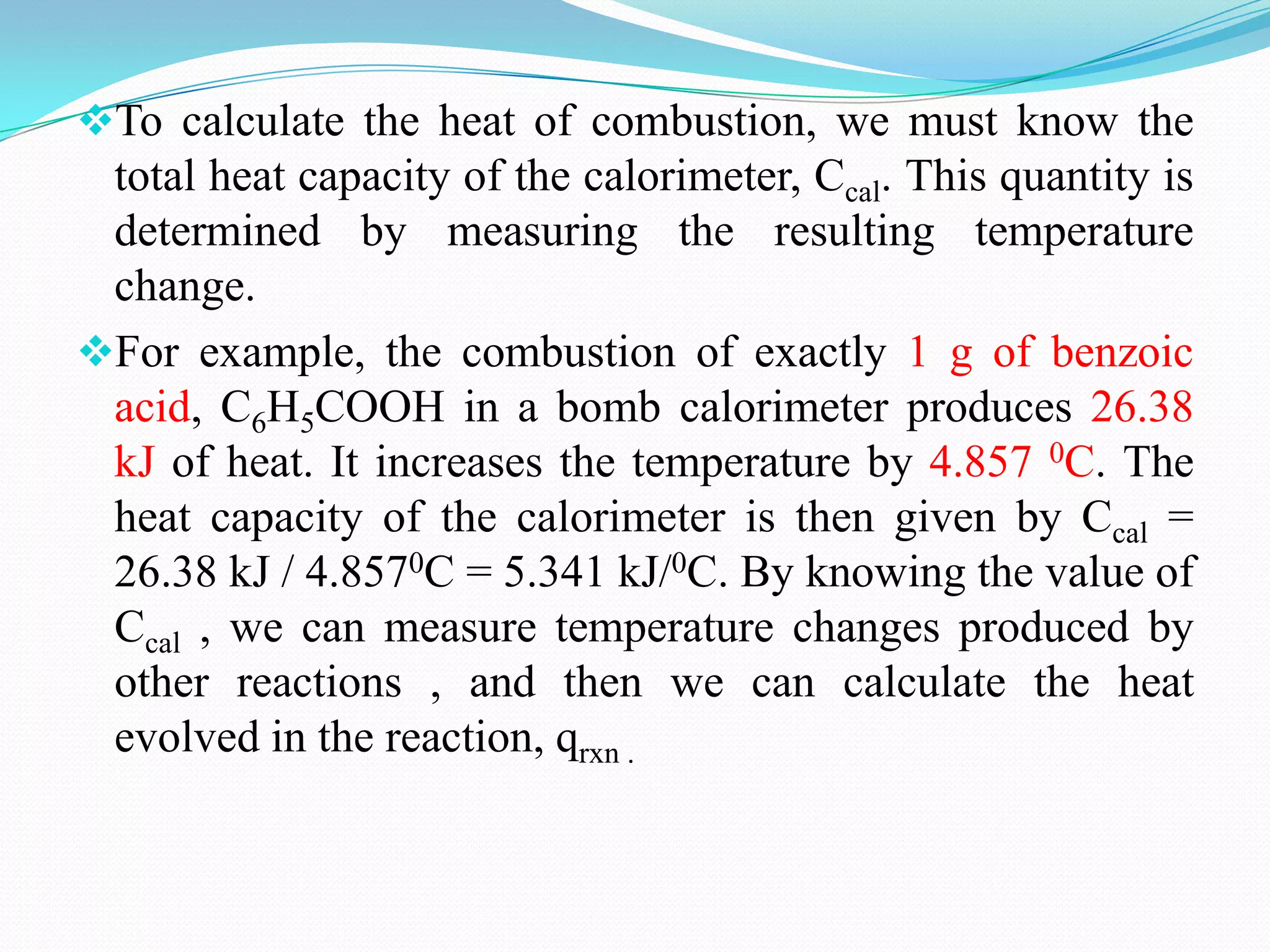
For example, the combustion of exactly 1 g of benzoic
 acid, C6H5COOH in a bomb calorimeter produces 26.38
 kJ of heat. It increases the temperature by 4.857 0C. The
 heat capacity of the calorimeter is then given by Ccal =
 26.38 kJ / 4.8570C = 5.341 kJ/0C. By knowing the value of
 Ccal , we can measure temperature changes produced by
 other reactions , and then we can calculate the heat
 evolved in the reaction, qrxn .
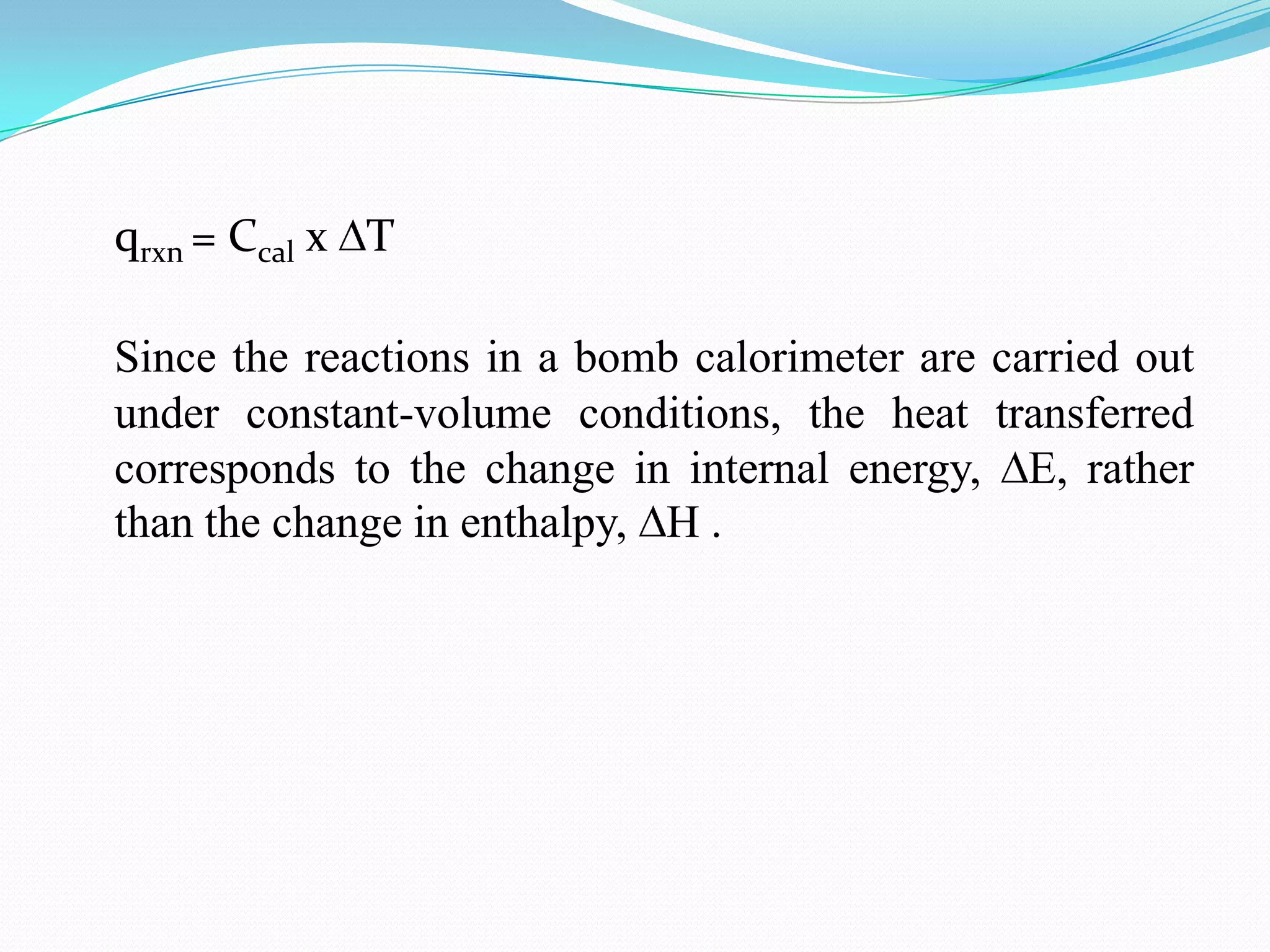
qrxn = Ccal x T

Since the reactions in a bomb calorimeter are carried out
under constant-volume conditions, the heat transferred
corresponds to the change in internal energy, E, rather
than the change in enthalpy, H .
EXAMPLE 1
   Using Bomb Calorimeter Data to Determine a Heat of
   Reaction
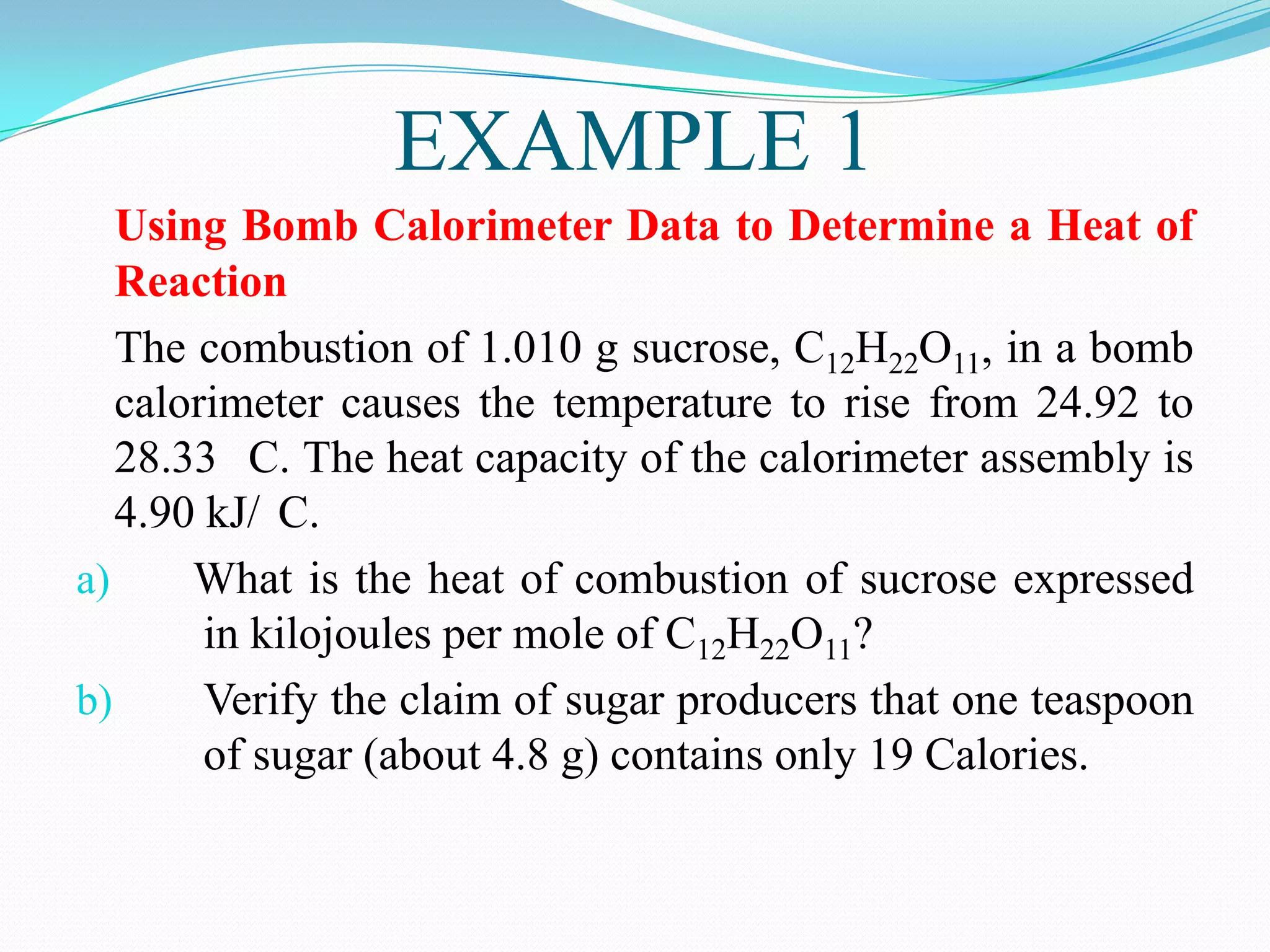
   The combustion of 1.010 g sucrose, C12H22O11, in a bomb
   calorimeter causes the temperature to rise from 24.92 to
   28.33 C. The heat capacity of the calorimeter assembly is
   4.90 kJ/ C.
a)     What is the heat of combustion of sucrose expressed
        in kilojoules per mole of C12H22O11?
b)      Verify the claim of sugar producers that one teaspoon
        of sugar (about 4.8 g) contains only 19 Calories.
Solution:
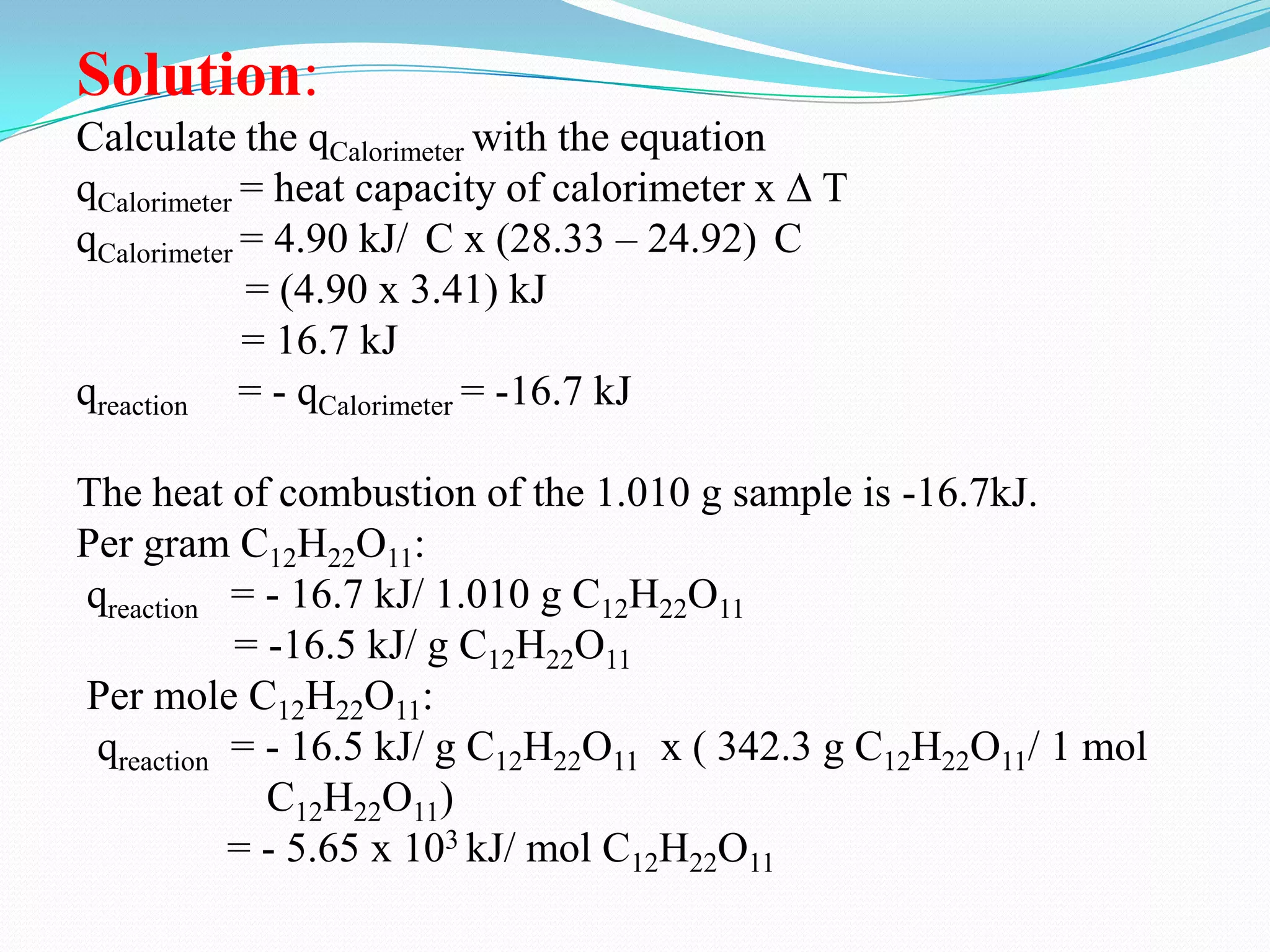
Calculate the qCalorimeter with the equation
qCalorimeter = heat capacity of calorimeter x ∆ T
qCalorimeter = 4.90 kJ/ C x (28.33 – 24.92) C
             = (4.90 x 3.41) kJ
             = 16.7 kJ
qreaction = - qCalorimeter = -16.7 kJ

The heat of combustion of the 1.010 g sample is -16.7kJ.
Per gram C12H22O11:
qreaction = - 16.7 kJ/ 1.010 g C12H22O11
           = -16.5 kJ/ g C12H22O11
Per mole C12H22O11:
 qreaction = - 16.5 kJ/ g C12H22O11 x ( 342.3 g C12H22O11/ 1 mol
             C12H22O11)
           = - 5.65 x 10³ kJ/ mol C12H22O11
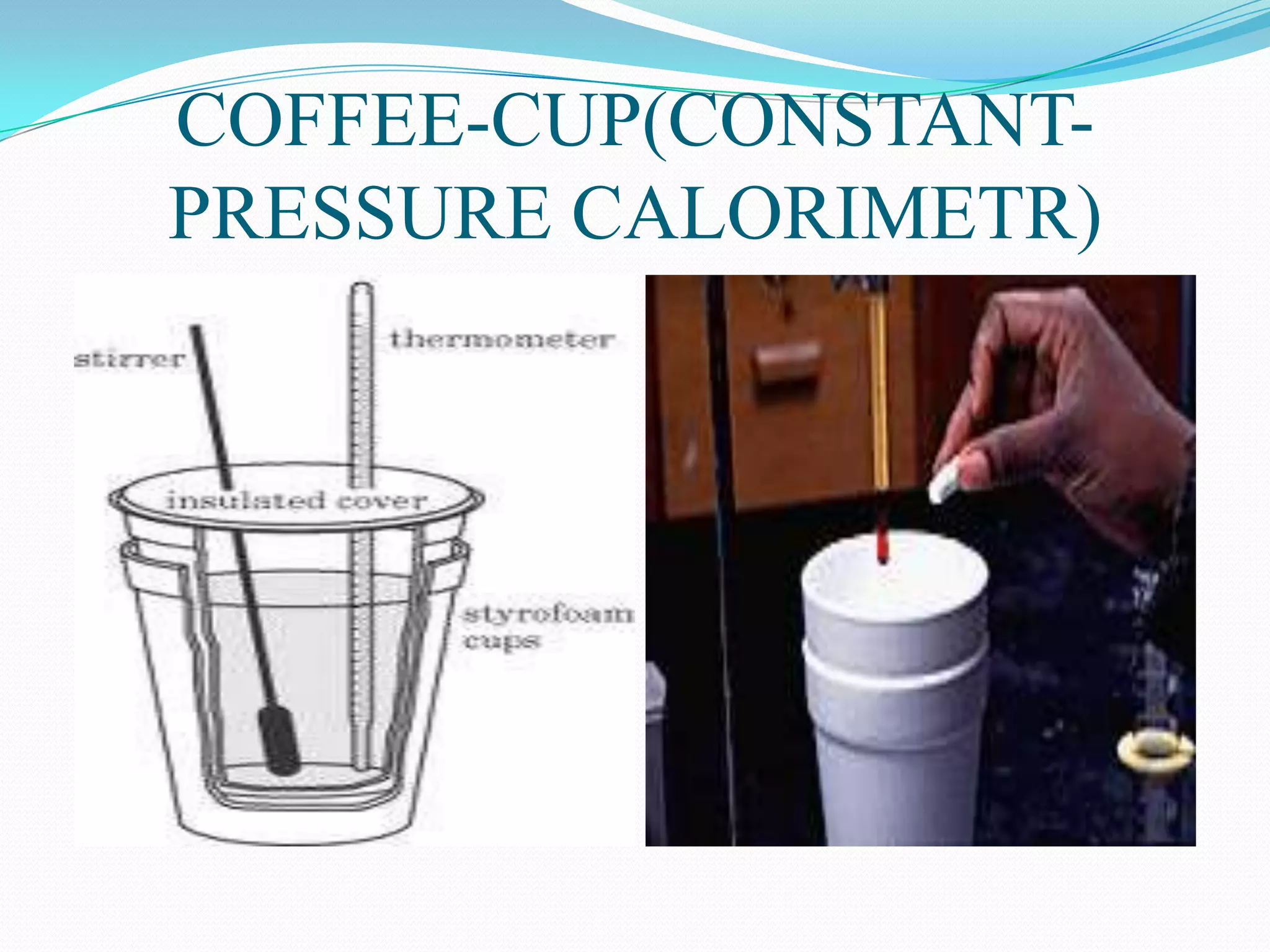
COFFEE-CUP(CONSTANT-
PRESSURE CALORIMETR)
INTRODUCTION/THEORY
A very simple “ coffee-cup” calorimeter , is
 often used in general chemistry labs to
 illustrate the principles of calorimeter.
This is because the calorimeter is not
 sealed, the reaction occurs under the essentially
 constant pressure of the atmosphere.
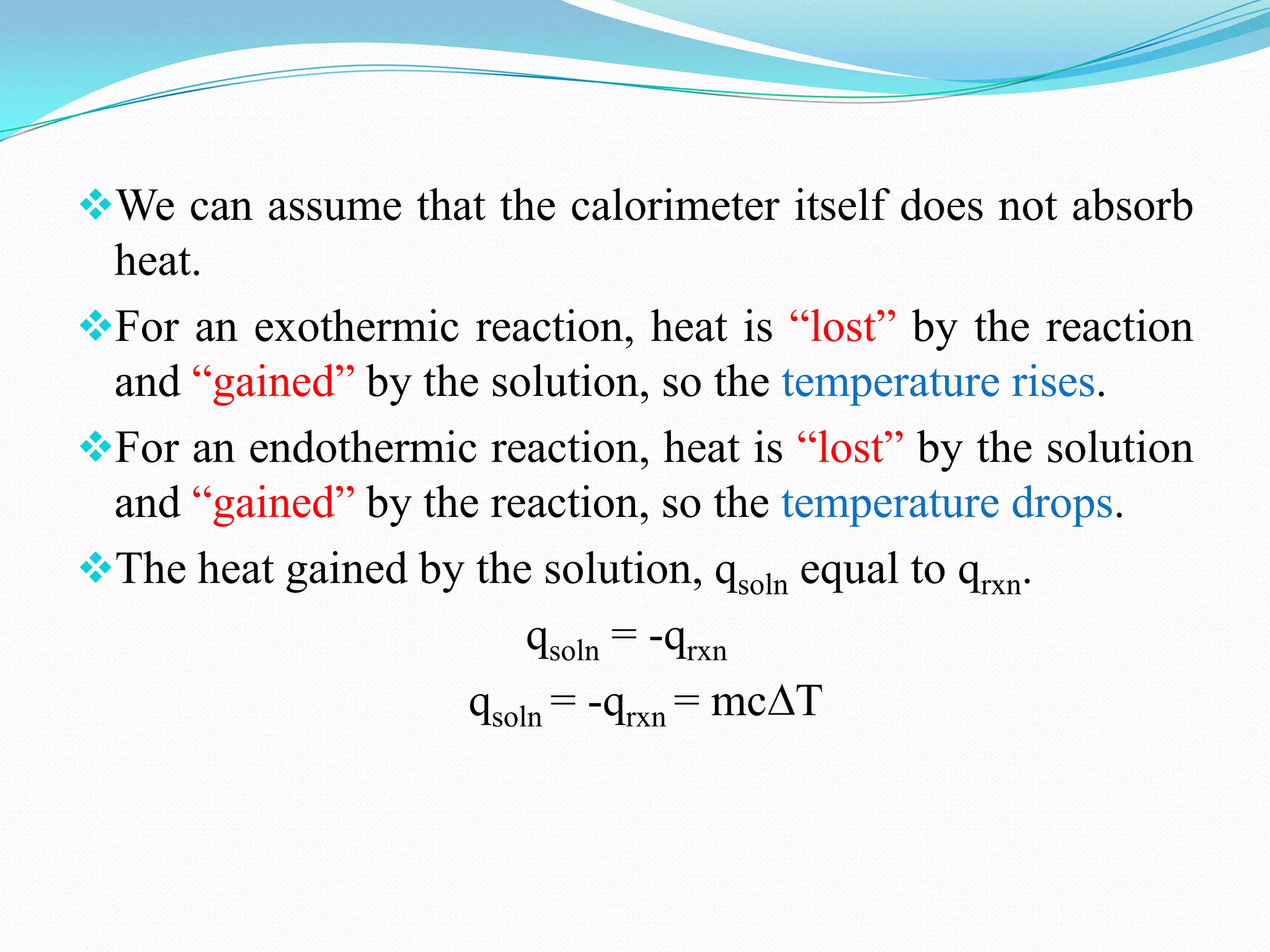
We can assume that the calorimeter itself does not absorb
 heat.
For an exothermic reaction, heat is “lost” by the reaction
 and “gained” by the solution, so the temperature rises.
For an endothermic reaction, heat is “lost” by the solution
 and “gained” by the reaction, so the temperature drops.
The heat gained by the solution, qsoln equal to qrxn.
                       qsoln = -qrxn
                   qsoln = -qrxn = mc T
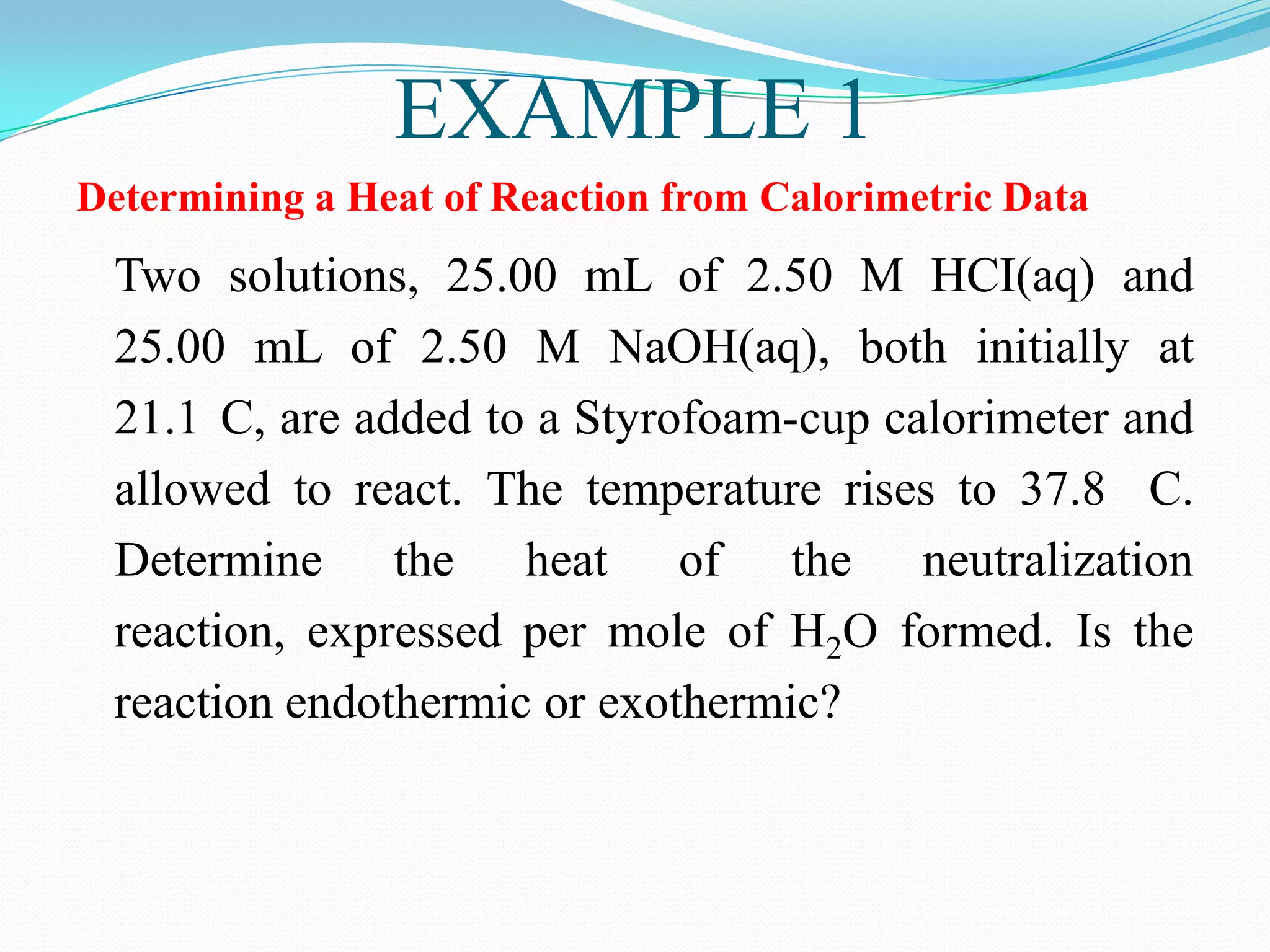
EXAMPLE 1
Determining a Heat of Reaction from Calorimetric Data
 Two solutions, 25.00 mL of 2.50 M HCI(aq) and
 25.00 mL of 2.50 M NaOH(aq), both initially at
 21.1 C, are added to a Styrofoam-cup calorimeter and
 allowed to react. The temperature rises to 37.8 C.
 Determine the heat of the neutralization
 reaction, expressed per mole of H2O formed. Is the
 reaction endothermic or exothermic?
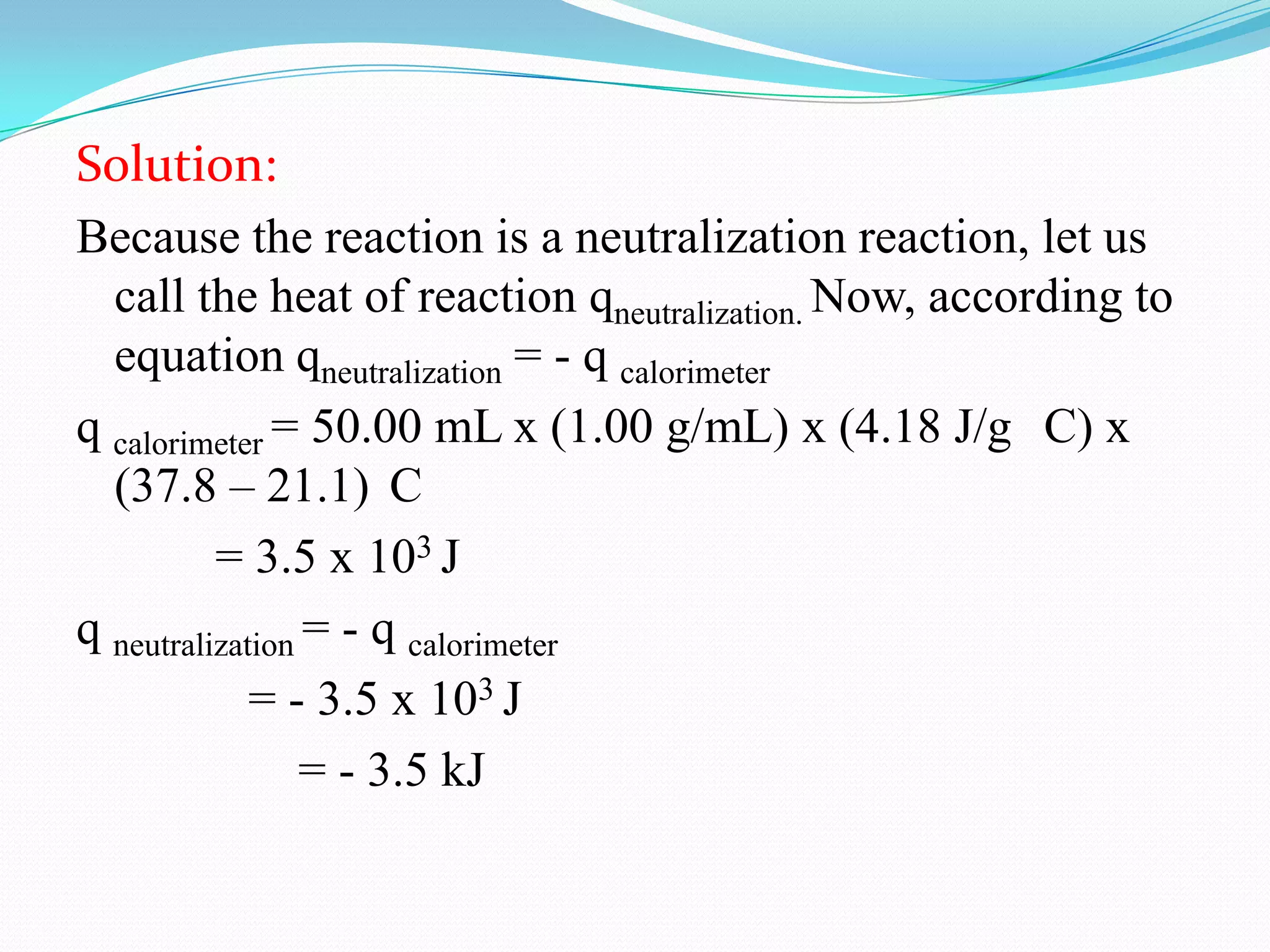
Solution:
Because the reaction is a neutralization reaction, let us
  call the heat of reaction qneutralization. Now, according to
  equation qneutralization = - q calorimeter
q calorimeter = 50.00 mL x (1.00 g/mL) x (4.18 J/g C) x
  (37.8 – 21.1) C
          = 3.5 x 10³ J
q neutralization = - q calorimeter
             = - 3.5 x 10³ J
                 = - 3.5 kJ
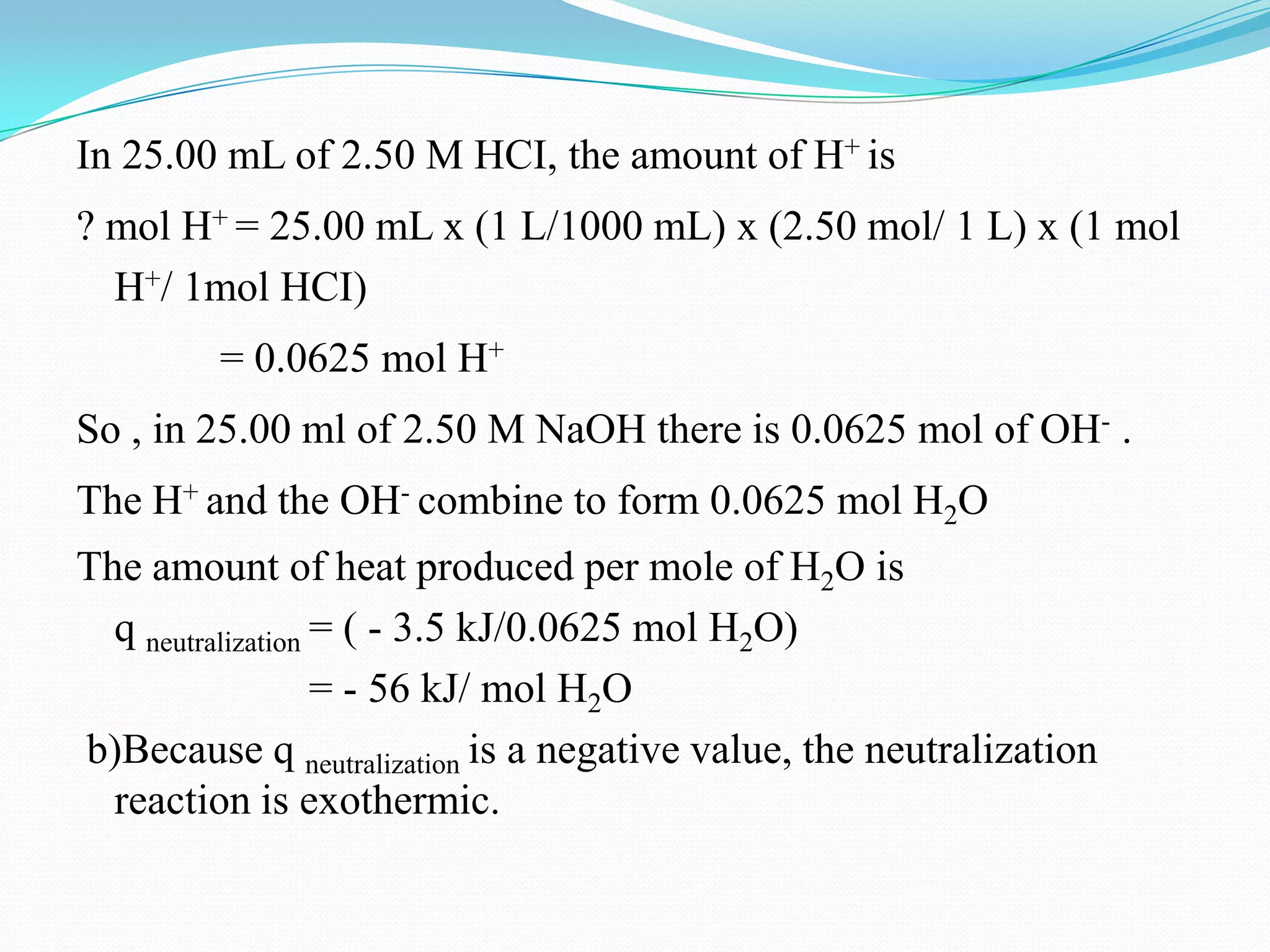
In 25.00 mL of 2.50 M HCI, the amount of H+ is
? mol H+ = 25.00 mL x (1 L/1000 mL) x (2.50 mol/ 1 L) x (1 mol
  H+/ 1mol HCI)
         = 0.0625 mol H+
So , in 25.00 ml of 2.50 M NaOH there is 0.0625 mol of OH- .
The H+ and the OH- combine to form 0.0625 mol H2O
The amount of heat produced per mole of H2O is
  q neutralization = ( - 3.5 kJ/0.0625 mol H2O)
                   = - 56 kJ/ mol H2O
b)Because q neutralization is a negative value, the neutralization
  reaction is exothermic.

Calorimeter

  • 1.
    GROUP MEMBER’S: CHANG PEIXIAN D 20101037455 CHAN SU FANG D 20101037450 LECTURER :PN. FARIDAH YUSOFF
  • 2.
    INTRODUCTION OF CALORIMETER A calorimeter (from Latin calor, meaning heat) is a device used for calculate the enthalpy change of reaction, the science of measuring the heat of chemical reactions or physical changes as well as heat capacity. The most common types of calorimeter is the bomb calorimeter(constant volume calorimeter) and coffee cup(constant pressure calorimeter). The other types include differential scanning calorimeters, isothermal micro calorimeters, titration calorimeters and accelerated rate calorimeters.
  • 3.
    BASIC CONCEPT INAPPLICATION OF CALORIMETER Endothermic process occurs in which the system absorbs heat. Exothermic process occurs in which a system loses heat. The enthalpy change that accompanies a reaction is called the enthalpy of reaction, or merely the heat of reaction, and is sometimes written as ∆Hrxn, where rxn means reaction.
  • 4.
    Since , ∆H= H final – H initial, the enthalpy change for a chemical reaction is given by the enthalpy of the products minus the enthalpy of the reactants: ∆H = H products – H reactants Typically, we can determine the magnitude of the heat flow produces. The measurement of heat flow is calorimetry, and the device used to measure heat flow is a calorimeter. The heat capacity of an object is the amount of heat needed to raise the temperature by 1 K (or 1 C).
  • 5.
    The heat capacityof one gram of a substance is called its specific heat capacity, or merely is called its specific heat. The specific heat, Cs, of a substance can be determined experimentally by measuring the temperature change, ∆T, that a known mass, m, of the substance undergoes when it gains or loses a specific quantity of heat, q: Specific heat = (quantity of heat transferred) (grams of substance) x (temperature change) Cs = q m x ∆T
  • 6.
  • 7.
    INTRODUCTION/THEORY Combustion reactions aremost conveniently studied using a bomb calorimeter. Combustion is a process which an organic compound reacts completely with excess oxygen. Heat is released when combustion occurs. This heat is absorbed by the calorimeter contents, causing a rise in the temperature of the water.
  • 8.
    To calculate theheat of combustion, we must know the total heat capacity of the calorimeter, Ccal. This quantity is determined by measuring the resulting temperature change. For example, the combustion of exactly 1 g of benzoic acid, C6H5COOH in a bomb calorimeter produces 26.38 kJ of heat. It increases the temperature by 4.857 0C. The heat capacity of the calorimeter is then given by Ccal = 26.38 kJ / 4.8570C = 5.341 kJ/0C. By knowing the value of Ccal , we can measure temperature changes produced by other reactions , and then we can calculate the heat evolved in the reaction, qrxn .
  • 9.
    qrxn = Ccalx T Since the reactions in a bomb calorimeter are carried out under constant-volume conditions, the heat transferred corresponds to the change in internal energy, E, rather than the change in enthalpy, H .
  • 10.
    EXAMPLE 1 Using Bomb Calorimeter Data to Determine a Heat of Reaction The combustion of 1.010 g sucrose, C12H22O11, in a bomb calorimeter causes the temperature to rise from 24.92 to 28.33 C. The heat capacity of the calorimeter assembly is 4.90 kJ/ C. a) What is the heat of combustion of sucrose expressed in kilojoules per mole of C12H22O11? b) Verify the claim of sugar producers that one teaspoon of sugar (about 4.8 g) contains only 19 Calories.
  • 11.
    Solution: Calculate the qCalorimeterwith the equation qCalorimeter = heat capacity of calorimeter x ∆ T qCalorimeter = 4.90 kJ/ C x (28.33 – 24.92) C = (4.90 x 3.41) kJ = 16.7 kJ qreaction = - qCalorimeter = -16.7 kJ The heat of combustion of the 1.010 g sample is -16.7kJ. Per gram C12H22O11: qreaction = - 16.7 kJ/ 1.010 g C12H22O11 = -16.5 kJ/ g C12H22O11 Per mole C12H22O11: qreaction = - 16.5 kJ/ g C12H22O11 x ( 342.3 g C12H22O11/ 1 mol C12H22O11) = - 5.65 x 10³ kJ/ mol C12H22O11
  • 12.
  • 13.
    INTRODUCTION/THEORY A very simple“ coffee-cup” calorimeter , is often used in general chemistry labs to illustrate the principles of calorimeter. This is because the calorimeter is not sealed, the reaction occurs under the essentially constant pressure of the atmosphere.
  • 14.
    We can assumethat the calorimeter itself does not absorb heat. For an exothermic reaction, heat is “lost” by the reaction and “gained” by the solution, so the temperature rises. For an endothermic reaction, heat is “lost” by the solution and “gained” by the reaction, so the temperature drops. The heat gained by the solution, qsoln equal to qrxn. qsoln = -qrxn qsoln = -qrxn = mc T
  • 15.
    EXAMPLE 1 Determining aHeat of Reaction from Calorimetric Data Two solutions, 25.00 mL of 2.50 M HCI(aq) and 25.00 mL of 2.50 M NaOH(aq), both initially at 21.1 C, are added to a Styrofoam-cup calorimeter and allowed to react. The temperature rises to 37.8 C. Determine the heat of the neutralization reaction, expressed per mole of H2O formed. Is the reaction endothermic or exothermic?
  • 16.
    Solution: Because the reactionis a neutralization reaction, let us call the heat of reaction qneutralization. Now, according to equation qneutralization = - q calorimeter q calorimeter = 50.00 mL x (1.00 g/mL) x (4.18 J/g C) x (37.8 – 21.1) C = 3.5 x 10³ J q neutralization = - q calorimeter = - 3.5 x 10³ J = - 3.5 kJ
  • 17.
    In 25.00 mLof 2.50 M HCI, the amount of H+ is ? mol H+ = 25.00 mL x (1 L/1000 mL) x (2.50 mol/ 1 L) x (1 mol H+/ 1mol HCI) = 0.0625 mol H+ So , in 25.00 ml of 2.50 M NaOH there is 0.0625 mol of OH- . The H+ and the OH- combine to form 0.0625 mol H2O The amount of heat produced per mole of H2O is q neutralization = ( - 3.5 kJ/0.0625 mol H2O) = - 56 kJ/ mol H2O b)Because q neutralization is a negative value, the neutralization reaction is exothermic.