Calorific value
GCV & HCV
2
CALORIFIC VALUE
• It is defined as “the total amount of heat liberated
,when a unit mass of fuel is burnt completely”.
• It is used to identified “the Efficiency of a Fuel “.
•Wood has calorific value of 17 Kj/g.
•The amount of heat can be measured by the
following units :
calorie,
kilocalorie,
British Thermal Unit (B.T.U),
Centigrade Heat Unit (C.H.U).
3
TYPES OF CALORIFIC VALUES
With fuels containing hydrogen, two calorificvalues are
distinguished,
Higher Or Gross Calorific Value
Lower Or Net Calorific Value
4
Higher Calorific Value
• It is defined as
• “the total amount of heat liberated ,when a unit mass of fuel
is burnt completely
• The product of the combustion are cooled to room
temperature”.
• When a Fuel containing hydrogen is burnt, the hydrogen is
converted into steam.
• If the combustion products are cooled to room temperature
,the steam gets condensed into water and latent heat is
evolved.
• The latent heat of condensation of steam is also included in
gross calorific value.
• A good Fuel posses HCV
5
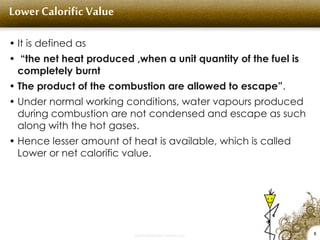
Lower Calorific Value
• It is defined as
• “the net heat produced ,when a unit quantity of the fuel is
completely burnt
• The product of the combustion are allowed to escape”.
• Under normal working conditions, water vapours produced
during combustion are not condensed and escape as such
along with the hot gases.
• Hence lesser amount of heat is available, which is called
Lower or net calorific value.
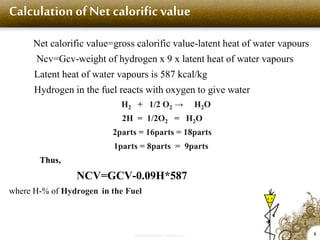
Calculation of Net calorific value
Net calorific value=gross calorific value-latent heat of water vapours
Ncv=Gcv-weight of hydrogen x 9 x latent heat of water vapours
Latent heat of water vapours is 587 kcal/kg
Hydrogen in the fuel reacts with oxygen to give water
H2 + 1/2 O2 → H2O
2H = 1/2O2 = H2O
2parts = 16parts = 18parts
1parts = 8parts = 9parts
Thus,
NCV=GCV-0.09H*587
where H-% of Hydrogen in the Fuel
6
Image size 210x302
Theoretical Calculation Of Calorific Value
Dulong’SFormula :
• If both hydrogen and oxygen are present, it may be
assumed that all the oxygen are already combined with 1/8
of its weight of hydrogen to form water.
• This fraction is then deducted from the hydrogen content of
the fuel in the calculation.
• Thus for a fuel containing carbon, hydrogen, oxygen and
sulphur, the calorific value of the fuel is given by DULONG
FORMULA
Calorific value =1/100[8080 C + 34500 {H − O/8 } +2240 S] kcal/kg
where C, H, O, S refer to % of carbon, hydrogen, oxygen and sulphur
respectively.
7
ANY DOUBT ???????
8
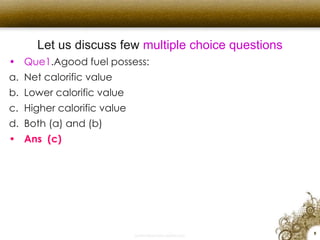
Let us discuss few multiple choice questions
• Que1.Agood fuel possess:
a. Net calorific value
b. Lower calorific value
c. Higher calorific value
d. Both (a) and (b)
• Ans (c)
9
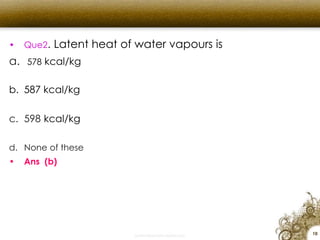
• Que2. Latent heat of water vapours is
a. 578 kcal/kg
b. 587 kcal/kg
c. 598 kcal/kg
d. None of these
• Ans (b)
10
By
Kishore thangapandi
11

Calorific Value

  • 1.
  • 2.
    2 CALORIFIC VALUE • Itis defined as “the total amount of heat liberated ,when a unit mass of fuel is burnt completely”. • It is used to identified “the Efficiency of a Fuel “. •Wood has calorific value of 17 Kj/g. •The amount of heat can be measured by the following units : calorie, kilocalorie, British Thermal Unit (B.T.U), Centigrade Heat Unit (C.H.U).
  • 3.
    3 TYPES OF CALORIFICVALUES With fuels containing hydrogen, two calorificvalues are distinguished, Higher Or Gross Calorific Value Lower Or Net Calorific Value
  • 4.
    4 Higher Calorific Value •It is defined as • “the total amount of heat liberated ,when a unit mass of fuel is burnt completely • The product of the combustion are cooled to room temperature”. • When a Fuel containing hydrogen is burnt, the hydrogen is converted into steam. • If the combustion products are cooled to room temperature ,the steam gets condensed into water and latent heat is evolved. • The latent heat of condensation of steam is also included in gross calorific value. • A good Fuel posses HCV
  • 5.
    5 Lower Calorific Value •It is defined as • “the net heat produced ,when a unit quantity of the fuel is completely burnt • The product of the combustion are allowed to escape”. • Under normal working conditions, water vapours produced during combustion are not condensed and escape as such along with the hot gases. • Hence lesser amount of heat is available, which is called Lower or net calorific value.
  • 6.
    Calculation of Netcalorific value Net calorific value=gross calorific value-latent heat of water vapours Ncv=Gcv-weight of hydrogen x 9 x latent heat of water vapours Latent heat of water vapours is 587 kcal/kg Hydrogen in the fuel reacts with oxygen to give water H2 + 1/2 O2 → H2O 2H = 1/2O2 = H2O 2parts = 16parts = 18parts 1parts = 8parts = 9parts Thus, NCV=GCV-0.09H*587 where H-% of Hydrogen in the Fuel 6 Image size 210x302
  • 7.
    Theoretical Calculation OfCalorific Value Dulong’SFormula : • If both hydrogen and oxygen are present, it may be assumed that all the oxygen are already combined with 1/8 of its weight of hydrogen to form water. • This fraction is then deducted from the hydrogen content of the fuel in the calculation. • Thus for a fuel containing carbon, hydrogen, oxygen and sulphur, the calorific value of the fuel is given by DULONG FORMULA Calorific value =1/100[8080 C + 34500 {H − O/8 } +2240 S] kcal/kg where C, H, O, S refer to % of carbon, hydrogen, oxygen and sulphur respectively. 7
  • 8.
  • 9.
    Let us discussfew multiple choice questions • Que1.Agood fuel possess: a. Net calorific value b. Lower calorific value c. Higher calorific value d. Both (a) and (b) • Ans (c) 9
  • 10.
    • Que2. Latentheat of water vapours is a. 578 kcal/kg b. 587 kcal/kg c. 598 kcal/kg d. None of these • Ans (b) 10
  • 11.