Quality control process
Presented By :
Akshi Tamta
Mahima Bhatnagar
Roshni Rajendra
Introduction
• Quality control is a universal managerial process
for conducting operations so as to provide
stability—to prevent adverse change and to
“maintain the status quo.”
• Function:
▫ evaluates actual performance
▫ compares actual performance to goals
▫ takes action on the difference
17 July 2015 2National Institute of Fashion Technology, Bangalore
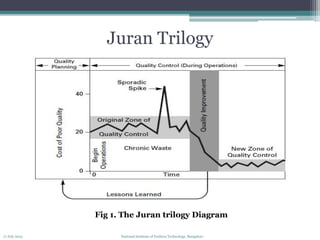
Juran Trilogy
Fig 1. The Juran trilogy Diagram
17 July 2015 3National Institute of Fashion Technology, Bangalore
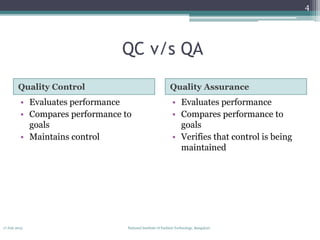
QC v/s QA
Quality Control Quality Assurance
• Evaluates performance
• Compares performance to
goals
• Maintains control
• Evaluates performance
• Compares performance to
goals
• Verifies that control is being
maintained
17 July 2015
4
National Institute of Fashion Technology, Bangalore
Quality Control Concepts
• Feedback loop
• Process capability
• Self-control
17 July 2015 5National Institute of Fashion Technology, Bangalore
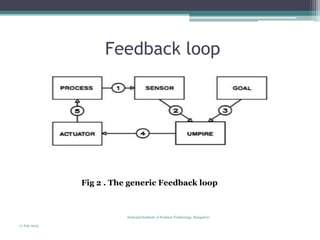
Feedback loop
17 July 2015 6
National Institute of Fashion Technology, Bangalore
Fig 2 . The generic Feedback loop
Elements of Feedback Loop
17 July 2015 7
National Institute of Fashion Technology, Bangalore
Fig 3. The Quality control process
Self Control
17 July 2015 8
National Institute of Fashion Technology, Bangalore
Fig 4. Self Control
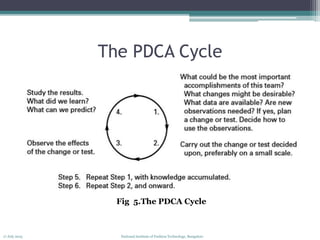
The PDCA Cycle
• Also called Deming wheel and Shewhart cycle
▫ Plan: includes choosing control subjects and
setting goals
▫ Do: includes running the process
▫ Check: includes sensing and umpiring
▫ Act: includes stimulating the actuator to take
corrective action
17 July 2015 9National Institute of Fashion Technology, Bangalore
The PDCA Cycle
17 July 2015 10National Institute of Fashion Technology, Bangalore
Fig 5.The PDCA Cycle
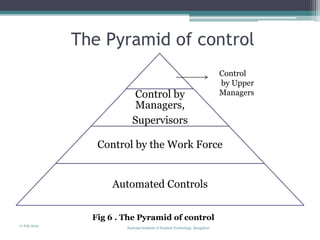
The Pyramid of control
Control by
Managers,
Supervisors
Control by the Work Force
Automated Controls
17 July 2015 11National Institute of Fashion Technology, Bangalore
Control
by Upper
Managers
Fig 6 . The Pyramid of control
Contrast of Quality Control
17 July 2015 12National Institute of Fashion Technology, Bangalore
Table 1. Contrast of Quality Control at Two Levels—Work Force and Upper
Management
Planning for Quality Control
• Planning for control is the activity which provides the
system—the concepts, methodology, and tools—through
which company personnel can keep the operating
processes stable and thereby produce the product
features required to meet customer needs
17 July 2015 13National Institute of Fashion Technology, Bangalore
The Customers and Their Needs
• The company personnel engaged in control
• carry out the steps which form the feedback loop
• Such personnel require
▫ an understanding of customers’ quality needs
▫ a definition of their own role in meeting those
needs
17 July 2015 14
National Institute of Fashion Technology, Bangalore
Planning for Quality Control
• helps to bridge that gap
• provides operating personnel with information on
customer needs (whether direct or translated) and
definition of the related control responsibilities of the
operating personnel.
17 July 2015 15National Institute of Fashion Technology, Bangalore
Planning for Quality Control
Who plans?
• Staff planners who also plan operating processes
• Staff quality specialists
• Multifunctional teams of planners and operating
personnel
• Departmental managers and supervisors
• Work force
17 July 2015 16
National Institute of Fashion Technology, Bangalore
Quality Control Concepts
• Flow diagram- helps the planning team to
understand the overall operating process
• Control stations- area in which quality control
takes place
17 July 2015 17National Institute of Fashion Technology, Bangalore
Quality Control Concepts
17 July 2015 National Institute of Fashion Technology, Bangalore 18
Fig 7 .The Flow Diagram
Bibliography
• Joseph M. Juran, A. Blanton Godfrey (1998),
Juran’s Quality handbook, 5th edition, McGraw-
Hill
17 July 2015
National Institute of Fashion Technology, Bangalore
19

Quality control process

  • 1.
    Quality control process PresentedBy : Akshi Tamta Mahima Bhatnagar Roshni Rajendra
  • 2.
    Introduction • Quality controlis a universal managerial process for conducting operations so as to provide stability—to prevent adverse change and to “maintain the status quo.” • Function: ▫ evaluates actual performance ▫ compares actual performance to goals ▫ takes action on the difference 17 July 2015 2National Institute of Fashion Technology, Bangalore
  • 3.
    Juran Trilogy Fig 1.The Juran trilogy Diagram 17 July 2015 3National Institute of Fashion Technology, Bangalore
  • 4.
    QC v/s QA QualityControl Quality Assurance • Evaluates performance • Compares performance to goals • Maintains control • Evaluates performance • Compares performance to goals • Verifies that control is being maintained 17 July 2015 4 National Institute of Fashion Technology, Bangalore
  • 5.
    Quality Control Concepts •Feedback loop • Process capability • Self-control 17 July 2015 5National Institute of Fashion Technology, Bangalore
  • 6.
    Feedback loop 17 July2015 6 National Institute of Fashion Technology, Bangalore Fig 2 . The generic Feedback loop
  • 7.
    Elements of FeedbackLoop 17 July 2015 7 National Institute of Fashion Technology, Bangalore Fig 3. The Quality control process
  • 8.
    Self Control 17 July2015 8 National Institute of Fashion Technology, Bangalore Fig 4. Self Control
  • 9.
    The PDCA Cycle •Also called Deming wheel and Shewhart cycle ▫ Plan: includes choosing control subjects and setting goals ▫ Do: includes running the process ▫ Check: includes sensing and umpiring ▫ Act: includes stimulating the actuator to take corrective action 17 July 2015 9National Institute of Fashion Technology, Bangalore
  • 10.
    The PDCA Cycle 17July 2015 10National Institute of Fashion Technology, Bangalore Fig 5.The PDCA Cycle
  • 11.
    The Pyramid ofcontrol Control by Managers, Supervisors Control by the Work Force Automated Controls 17 July 2015 11National Institute of Fashion Technology, Bangalore Control by Upper Managers Fig 6 . The Pyramid of control
  • 12.
    Contrast of QualityControl 17 July 2015 12National Institute of Fashion Technology, Bangalore Table 1. Contrast of Quality Control at Two Levels—Work Force and Upper Management
  • 13.
    Planning for QualityControl • Planning for control is the activity which provides the system—the concepts, methodology, and tools—through which company personnel can keep the operating processes stable and thereby produce the product features required to meet customer needs 17 July 2015 13National Institute of Fashion Technology, Bangalore
  • 14.
    The Customers andTheir Needs • The company personnel engaged in control • carry out the steps which form the feedback loop • Such personnel require ▫ an understanding of customers’ quality needs ▫ a definition of their own role in meeting those needs 17 July 2015 14 National Institute of Fashion Technology, Bangalore
  • 15.
    Planning for QualityControl • helps to bridge that gap • provides operating personnel with information on customer needs (whether direct or translated) and definition of the related control responsibilities of the operating personnel. 17 July 2015 15National Institute of Fashion Technology, Bangalore
  • 16.
    Planning for QualityControl Who plans? • Staff planners who also plan operating processes • Staff quality specialists • Multifunctional teams of planners and operating personnel • Departmental managers and supervisors • Work force 17 July 2015 16 National Institute of Fashion Technology, Bangalore
  • 17.
    Quality Control Concepts •Flow diagram- helps the planning team to understand the overall operating process • Control stations- area in which quality control takes place 17 July 2015 17National Institute of Fashion Technology, Bangalore
  • 18.
    Quality Control Concepts 17July 2015 National Institute of Fashion Technology, Bangalore 18 Fig 7 .The Flow Diagram
  • 19.
    Bibliography • Joseph M.Juran, A. Blanton Godfrey (1998), Juran’s Quality handbook, 5th edition, McGraw- Hill 17 July 2015 National Institute of Fashion Technology, Bangalore 19