Quality Control and 
Quality Assurance
What is Quality ? 
 In manufacturing, a measure of excellence or a state of 
being free from defects, deficiencies and significant variations. It is 
brought about by strict and consistent commitment to certain 
standards that achieve uniformity of a product in order to satisfy 
specific customer or user requirements. 
(http://www.businessdictionary.com) 
the totality of features and characteristics of a product 
or service that bears its ability to satisfy stated or implied needs. 
(ISO 8402-1986)
Common Meanings of Quality 
• Quality is fitness for use 
• Quality is meeting customers 
expectations 
• Quality is exceeding the customers 
expectations 
• Quality is superiority to competitors
Quality Control (QC) 
- The standard(s) to which the construction or assembly of a building 
component has been incorporated into the project’s design.
• Quality control is concerned with the operational 
activities and techniques that are used to fulfill the 
requirements of quality. 
• The quality control process includes the activities 
which ensure a high quality product. These activities 
focus on identifying defects in the actual product 
being produced. 
• Quality control functions start once the project work 
has begun. Quality control is a reactive approach and 
helps you find defects in deliverables.
Quality Assurance (QA) 
- Is all those planned and systematic actions 
necessary to provide adequate confidence that 
an entity will fulfill requirements for quality.
• Quality assurance is a process based approach whose 
prime objective is to prevent defects in deliverables in 
the planning process itself to avoid the rework, which 
costs a lot. 
• Quality assurance is a proactive process, and it starts 
at the very beginning of the project to understand the 
product’s stated and non-stated requirements and 
expectations, and then develop the plan to meet 
these requirements and expectations. 
• Quality audit is an example of a quality assurance 
process. Other examples of quality assurance are 
training, process definition, selection of tools, etc.
The Difference between Quality Assurance and 
Quality Control 
QA 
QC 
• On the other hand in quality control, 
you try to find defects and correct 
them while making the product. 
• Quality control is all about the 
detection. 
• Quality control is a product based 
approach. 
• Quality control is used to verify the 
quality of the product. 
• In quality assurance, you plan to 
avoid the defect in the first place. 
• Quality assurance is all about 
prevention. 
• Quality assurance is a process 
based approach. 
• Quality assurance involves 
processes managing quality.
The Difference between Quality Assurance and Quality Control 
QA 
QC 
• Inspection and testing are 
examples of the quality 
control process. 
• Quality control identifies the 
defects after the product is 
produced but is not yet 
released or is still in the 
production phase. 
• Quality audit is an example 
of quality assurance. 
• The goal of the quality 
assurance process is to 
develop a process so that 
defects do not arise when 
you are producing the 
product
The Benefits of Quality Assurance and Quality 
Control 
• It gives you a high quality output. 
• It increases the efficiency of operations. 
• It brings customer satisfaction, which affects your 
brand and helps you grow your business. 
• If your product is of good quality, you will not need 
much rework and there will not be much after-sale 
support required. This will help you save a lot of 
money. 
• A high level of confidence and a motivated team.
Quality Begins with 
Quality Design
Quality Design 
- It means the intentions of the designers to 
include/ exclude features in a product or service 
i.e. the degree to which the quality characteristics 
are embedded into the product/ service.
FMI/ CMAA Survey 
• The process of computer-assisted design has not only greatly increased 
productivity but has also resulted in less attention to single elements w/in 
the design process. 
• Owners, demanding compressed design time, compound the lack of 
attention to details and problems associated with coordination issues. 
• Tremendous pressure on design fees leads to less experienced individuals 
working on design details. 
• Mechanical and electrical subcontractors and their manufacturer 
representatives often more aware of technological advances than design 
engineers. 
• The advances in materials and systems make design more complex; 
therefore, shop drawing s are more accurate in detail than the designs 
created by the architect.
Total Quality Management 
(TQM) 
- Encompasses elements that form the basis of a 
company wide focus on quality- elements that extend 
from the office to the field.
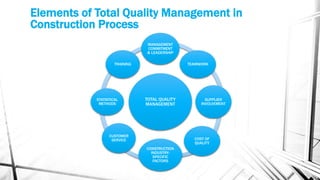
Elements of Total Quality Management in 
Construction Process 
MANAGEMENT 
COMMITMENT 
& LEADERSHIP 
TOTAL QUALITY 
MANAGEMENT 
TEAMWORK 
SUPPLIER 
INVOLVEMENT 
COST OF 
QUALITY 
CONSTRUCTION 
INDUSTRY-SPECIFIC 
FACTORS 
TRAINING 
STATISTICAL 
METHODS 
CUSTOMER 
SERVICE
• Management Commitment & Leadership - TQM is a culture and philosophy that 
must permeate an organization as the method of management. It can thrive only 
under a senior management that establishes TQM as a top priority. This 
commitment must be coupled with a thorough understanding of TQM. Only if 
supported by this commitment and understanding, can senior management lead 
the company toward the realization of higher quality in its undertakings. 
• Training - There should be customized training plans for management, engineers, 
technicians, home and field office staff, support personnel and field labor. 
• Teamwork - TQM concept to the parties mentioned above in the form of joint 
teams achieves higher customer satisfaction. These joint teams are responsible 
for establishing joint goals, plans, and controls. 
• Statistical Method - provide problem-solving tools to the TQM process.
• Cost of Quality - the primary tool for measuring quality. (Crosby, P. B., Cutting the Cost of Quality. 
Farnsworth, Boston, 1967. ; Juran, J. M. (Ed.), Juran's Quality Control Handbook, 4th edn. McGraw-Hill, New York, 1988. ) 
• Supplier Involvement - The ability to produce a quality product largely depends on the 
relationship among the parties involved in the process; the supplier, the processor, and the 
customer. 
• Customer Service - Customers may be either internal or external. Satisfying the needs of 
these customers is an essential part of the process of supplying the final external customer 
with a quality product. 
• Construction Industry- Specific Factors 
1. Quality of codes and standards - According to the ASCE manual, 2 the primary 
purpose of codes and standards is to protect the public's health and safety. 
2. Quality of drawings and specifications- Drawings and specifications are the two 
sets of documents given to the constructor that provide technical information on 
materials, performance of the constructed facility, and quality requirements. 
3. Constructability of design-the design professional must consider the 
requirements of the constructor. The project must be constructible by those 
retained to build the project.
Benchmarking 
- Is the procedure where a company seeks out and studies 
the best practices in order to produce a superior 
performance.
Forms of Benchmarking 
• Internal Benchmarking- investigates 
the practices and performance within 
the company. 
• External Benchmarking- compares 
the company’s practices and 
performance with world-class 
performers.
• External Competitive Benchmarking- is comparison 
of company’s activity with direct competitors 
• External Industrial or Functional Benchmarking-compares 
company’s functions with functions of 
other companies. 
• External Generic Benchmarking- broadens fields of 
application of benchmarking process beyond the 
limits of specific company and industry it belongs 
to.
Quality control and quality assurance

Quality control and quality assurance

  • 1.
    Quality Control and Quality Assurance
  • 3.
    What is Quality?  In manufacturing, a measure of excellence or a state of being free from defects, deficiencies and significant variations. It is brought about by strict and consistent commitment to certain standards that achieve uniformity of a product in order to satisfy specific customer or user requirements. (http://www.businessdictionary.com) the totality of features and characteristics of a product or service that bears its ability to satisfy stated or implied needs. (ISO 8402-1986)
  • 4.
    Common Meanings ofQuality • Quality is fitness for use • Quality is meeting customers expectations • Quality is exceeding the customers expectations • Quality is superiority to competitors
  • 5.
    Quality Control (QC) - The standard(s) to which the construction or assembly of a building component has been incorporated into the project’s design.
  • 6.
    • Quality controlis concerned with the operational activities and techniques that are used to fulfill the requirements of quality. • The quality control process includes the activities which ensure a high quality product. These activities focus on identifying defects in the actual product being produced. • Quality control functions start once the project work has begun. Quality control is a reactive approach and helps you find defects in deliverables.
  • 7.
    Quality Assurance (QA) - Is all those planned and systematic actions necessary to provide adequate confidence that an entity will fulfill requirements for quality.
  • 8.
    • Quality assuranceis a process based approach whose prime objective is to prevent defects in deliverables in the planning process itself to avoid the rework, which costs a lot. • Quality assurance is a proactive process, and it starts at the very beginning of the project to understand the product’s stated and non-stated requirements and expectations, and then develop the plan to meet these requirements and expectations. • Quality audit is an example of a quality assurance process. Other examples of quality assurance are training, process definition, selection of tools, etc.
  • 9.
    The Difference betweenQuality Assurance and Quality Control QA QC • On the other hand in quality control, you try to find defects and correct them while making the product. • Quality control is all about the detection. • Quality control is a product based approach. • Quality control is used to verify the quality of the product. • In quality assurance, you plan to avoid the defect in the first place. • Quality assurance is all about prevention. • Quality assurance is a process based approach. • Quality assurance involves processes managing quality.
  • 10.
    The Difference betweenQuality Assurance and Quality Control QA QC • Inspection and testing are examples of the quality control process. • Quality control identifies the defects after the product is produced but is not yet released or is still in the production phase. • Quality audit is an example of quality assurance. • The goal of the quality assurance process is to develop a process so that defects do not arise when you are producing the product
  • 11.
    The Benefits ofQuality Assurance and Quality Control • It gives you a high quality output. • It increases the efficiency of operations. • It brings customer satisfaction, which affects your brand and helps you grow your business. • If your product is of good quality, you will not need much rework and there will not be much after-sale support required. This will help you save a lot of money. • A high level of confidence and a motivated team.
  • 12.
    Quality Begins with Quality Design
  • 13.
    Quality Design -It means the intentions of the designers to include/ exclude features in a product or service i.e. the degree to which the quality characteristics are embedded into the product/ service.
  • 14.
    FMI/ CMAA Survey • The process of computer-assisted design has not only greatly increased productivity but has also resulted in less attention to single elements w/in the design process. • Owners, demanding compressed design time, compound the lack of attention to details and problems associated with coordination issues. • Tremendous pressure on design fees leads to less experienced individuals working on design details. • Mechanical and electrical subcontractors and their manufacturer representatives often more aware of technological advances than design engineers. • The advances in materials and systems make design more complex; therefore, shop drawing s are more accurate in detail than the designs created by the architect.
  • 15.
    Total Quality Management (TQM) - Encompasses elements that form the basis of a company wide focus on quality- elements that extend from the office to the field.
  • 16.
    Elements of TotalQuality Management in Construction Process MANAGEMENT COMMITMENT & LEADERSHIP TOTAL QUALITY MANAGEMENT TEAMWORK SUPPLIER INVOLVEMENT COST OF QUALITY CONSTRUCTION INDUSTRY-SPECIFIC FACTORS TRAINING STATISTICAL METHODS CUSTOMER SERVICE
  • 17.
    • Management Commitment& Leadership - TQM is a culture and philosophy that must permeate an organization as the method of management. It can thrive only under a senior management that establishes TQM as a top priority. This commitment must be coupled with a thorough understanding of TQM. Only if supported by this commitment and understanding, can senior management lead the company toward the realization of higher quality in its undertakings. • Training - There should be customized training plans for management, engineers, technicians, home and field office staff, support personnel and field labor. • Teamwork - TQM concept to the parties mentioned above in the form of joint teams achieves higher customer satisfaction. These joint teams are responsible for establishing joint goals, plans, and controls. • Statistical Method - provide problem-solving tools to the TQM process.
  • 18.
    • Cost ofQuality - the primary tool for measuring quality. (Crosby, P. B., Cutting the Cost of Quality. Farnsworth, Boston, 1967. ; Juran, J. M. (Ed.), Juran's Quality Control Handbook, 4th edn. McGraw-Hill, New York, 1988. ) • Supplier Involvement - The ability to produce a quality product largely depends on the relationship among the parties involved in the process; the supplier, the processor, and the customer. • Customer Service - Customers may be either internal or external. Satisfying the needs of these customers is an essential part of the process of supplying the final external customer with a quality product. • Construction Industry- Specific Factors 1. Quality of codes and standards - According to the ASCE manual, 2 the primary purpose of codes and standards is to protect the public's health and safety. 2. Quality of drawings and specifications- Drawings and specifications are the two sets of documents given to the constructor that provide technical information on materials, performance of the constructed facility, and quality requirements. 3. Constructability of design-the design professional must consider the requirements of the constructor. The project must be constructible by those retained to build the project.
  • 19.
    Benchmarking - Isthe procedure where a company seeks out and studies the best practices in order to produce a superior performance.
  • 20.
    Forms of Benchmarking • Internal Benchmarking- investigates the practices and performance within the company. • External Benchmarking- compares the company’s practices and performance with world-class performers.
  • 21.
    • External CompetitiveBenchmarking- is comparison of company’s activity with direct competitors • External Industrial or Functional Benchmarking-compares company’s functions with functions of other companies. • External Generic Benchmarking- broadens fields of application of benchmarking process beyond the limits of specific company and industry it belongs to.