Textile Finishing
Yuvraj Garg
Introduction to Textiles
A Textile is a flexible material comprised of a
network of natural or artificial fibres often referred
to as thread or yarn.
Textile refers to any material made of interlacing
fibres
Textiles are made in various strengths and degrees
of durability, from the finest gossamer to the
sturdiest canvas
There can be Animal Textiles, Plant Textiles, Mineral
Textiles, Synthetic Textiles
Departments Of Textiles
Textiles are divided in 3 major categories
» Spinning
» Weaving
» Wet-Processing
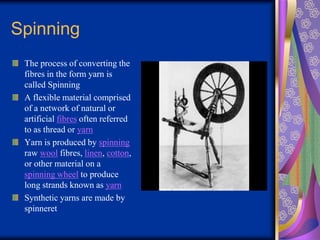
Spinning
The process of converting the
fibres in the form yarn is
called Spinning
A flexible material comprised
of a network of natural or
artificial fibres often referred
to as thread or yarn
Yarn is produced by spinning
raw wool fibres, linen, cotton,
or other material on a
spinning wheel to produce
long strands known as yarn
Synthetic yarns are made by
spinneret
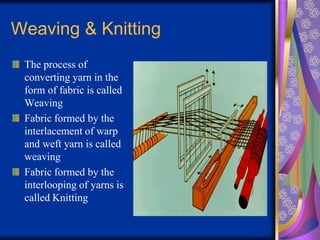
Weaving & Knitting
The process of
converting yarn in the
form of fabric is called
Weaving
Fabric formed by the
interlacement of warp
and weft yarn is called
weaving
Fabric formed by the
interlooping of yarns is
called Knitting
Wet-Processing
This is the another entirely different stage of textile sector. It
involves various stages, and can be divided as such
Pretreatments
» singe
» desize
» scour
» bleach
» mercerize
Dyeing/Printing
Finishing
Pretreatments
The term “pretreatments” include all operations of
preparing the textile material, such as fibres yarn and
woven, knit and non-woven fabrics and garments for
the subsequent processes for dyeing printing and
finishing.
For all practical purposes the pretreatments are carried
out along with dyeing and printing and their equipments
is part of the wet-processing plant
Dyeing and Printing
The process of application of dyes on to the substrate (fabric, yarn
or fibres ) in the solution form is called Dyeing.
The process of application of dyes on the substrate (fabric) in the
paste form is called Printing
Dyes can of various classes as mentioned
– Direct dyes
– Reactive dyes
– Vat dyes
– Sulphur dyes
– Azoic dyes
– Disperse dyes
– Acid or Anionic dyes, pre-mettalised or mordant
dyes
– Basic or cationic dyes
Finishing
Textile finishing is a term commonly applied to different
processes that the textile materials undergo after
pretreatments, dyeing or printing for final embellishments to
enhance their attractiveness and sale appeals well as for
comfort and usefulness.
Finishing treatments are basically meant to give the textile
material certain desirable properties like
» Softness
» Lusture
» Pleasant handle
» Drape
» Dimensional stability
» Crease recovery
» Antistatic
» Non-slip
» Soil release
However these also include finishes that have to meet
certain specific end uses such as
» water repellency
» Flame retardency
» Mildew proofing
Chemical and Mechanical finishing
The finishing processes are applied in various forms
and various types of finishes effect can be obtained
such as discussed below
A finish that is classified as durable is one that will
endure through successive wet or dry cleaning
Textile finishes applied after the coloring process
generally fall into one of two general categories
according to purpose or end result. These categories are
» wet finishes
» mechanical finishes
Types of finishing
Permanent finishes usually involve a chemical
change in fibre structure and will not change or
alter throughout the life of a fabric.
Durable finishes usually last throughout the life of
the article, but effectiveness becomes diminished
after each cleaning, and near the end of the
normal use life of the article, the finish is nearly
removed.
Semi-durable finishes last through several
launderings or dry cleanings and many are
renewable in home laundering or dry cleaning
A non-durable, or soluble finish, is one that will be
removed through successive washing or dry cleanings
Standard Chemical or Wet finishes
Standard, chemical or wet finishes augment the textile's
durability or ability to perform in a given way. These finishes
include
antibacterial or antiseptic
Anti-static
Easy Care
Flame retardant
Insulative
Lamination or Bonding
Mothproof
Soil repellent
Water repellent
Water absorbency finishes
Mechanical Finishing Treatments
Mechanical finishing processes can be
referred to as those processes generally
carried out on open-width dry fabrics, with
or without heat application, which give the
fabric
good dimensional
stability (shrink proof and shape retention)
modify the "hand" of the textile product by
altering its structure (at least its surface
structure)
Dry Finshing
Dry finishing
Calendering: a lustrous, dense and compact
appearance can be obtained by means of friction,
pressure and heat.
Ciréing: this calendering operation is carried out
using special calenders and exploiting the
combined actions of heat, friction and polishing
agents.
Embossing: this particular type of calendering
process allows engraving a simple patternon the
fabric.
Dry finishing
Sueding: thanks to this process, the fabric has a much
softer hand and an improved insulating effect thanks to the
fibre end pulled out of the fabric surface. Thisprocess is
carried out by means of a roller coated with abrasive
material.
Raising: he fibre end pulled out to the fabric surface imparts
an insulating effect. Thisprocess is carried out by means of
hook-needles running in different directions on the fabric.
Shearing: the fibre ends on the fabric surface are cut by
using special cutting tools.
Singeing: the fibre ends pulled out to the fabric surface are
burnt by means of a flame
Mechanical Finishing Treatments
Wet finishing
Wet calendering:
this process is quite similar to the dry one. The only difference is the
use of steam.
Fulling:
the structure, bulk and shrinkage of wool are modified by applying heat
combined with friction and compression.
Sanforising:
the fabric is given an optimum dimensional stability by applying
mechanic forces and water vapour.
Decating:
the lustrous appearance of the textile material is eliminated, the surface
is smoothed and the fabric is given an optimum dimensional stability
thanks to the action of dry or overheated saturated vapour.
Calendering
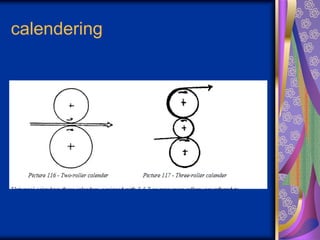
Fundamentally, a ealender is a mechanical device
consisting of two or more large rotating cylindrical
rollers stacked on top of each other and usually
heated.
The cylindrical rollers are in contact with each
other under pressure. Fabric being calendered
passes around and between these cylinders.
The specific type of calendered finished fabric
varies with the nature of the cylinder surface, the
speed of the cylinders and the nature of the fabric
being finished.
Calendering
Calendering
This non-permanent mechanical finishing treatment is
applied to fabrics made of cellulose, protein and synthetic
fibres, by means of a calender.
This machine generally includes one or aseries of couples of
rollers pressed one against the other with adjustable
pressure and identical orsimilar tip speeds.
The cloth passes through one or more couples of rollers,
which exert asmoothing and a pressing action.
Some rollers are stiff while some others are made of
softermaterial. Stiff rollers are generally made of steel or
hardened cast iron and the surface can bechrome-plated,
nickel-plated or made of stainless steel
calendering
Calendering
Sheen appearance:
it can be obtained by smoothing the cloth surface, which ensures a better
reflection of light.
Better coverage:
it is due to the compression of the cloth, which generates a flattening of each
single yarn.
Softer hand:
it is obtained thanks to a slight ironing effect, which produces a smoother,
and softer cloth surface.
Surface patterns:
they can be obtained by means of special effects ("embossing" for example)
for decorative purposes or to modify the surface smoothness.
Yarn swelling and rounding effect:
they give a modest glaze finishing to the fabric, a surface smoothness and
above all a full and soft hadle
Embossing
Embossing is a particular calendering
process through which a simple
pattern can be engravedon the cloth.
The embossing machine is made up
of a heated and embossed roller
made of steel, which is pressed
against another roller coated with
paper or cotton,
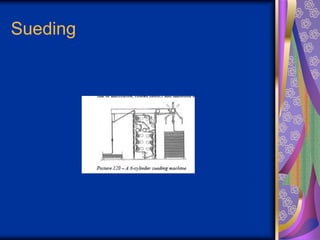
Sueding
This operation is often carried out before the
raising process to reduce the friction between the
fibres making up the cloth and consequently to
facilitate the extraction of the fibre end.
The sueding process is carried out on both sides
of the fabric and modifies the appearance andthe
final hand of the cloth; when touched it gives a soft
and smooth sensation similar to the one given by
a peach-grain surface.
Sueding
Raising
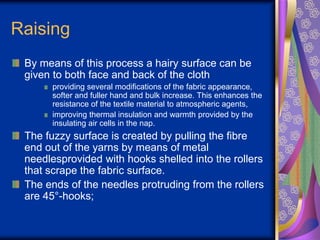
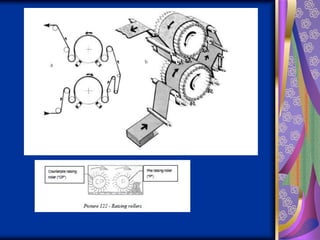
By means of this process a hairy surface can be
given to both face and back of the cloth
providing several modifications of the fabric appearance,
softer and fuller hand and bulk increase. This enhances the
resistance of the textile material to atmospheric agents,
improving thermal insulation and warmth provided by the
insulating air cells in the nap.
The fuzzy surface is created by pulling the fibre
end out of the yarns by means of metal
needlesprovided with hooks shelled into the rollers
that scrape the fabric surface.
The ends of the needles protruding from the rollers
are 45°-hooks;
Shearing
Shearing
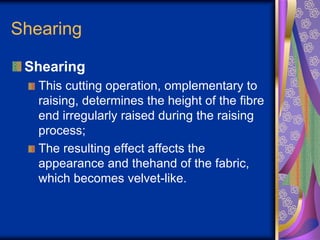
This cutting operation, omplementary to
raising, determines the height of the fibre
end irregularly raised during the raising
process;
The resulting effect affects the
appearance and thehand of the fabric,
which becomes velvet-like.
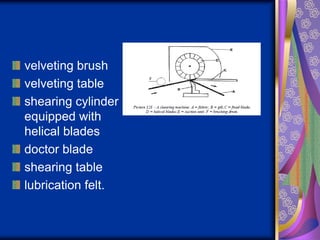
velveting brush
velveting table
shearing cylinder
equipped with
helical blades
doctor blade
shearing table
lubrication felt.
Decating
This process is mainly carried out on wool
by exploiting its elastic properties in hot
and wet conditions by the direct action of
the steam on the fabric. This treatment
gives the processed
Fabric the following characteristics:
– 1) dimensional stability;
– 2) setting of pile after raising;
– 3) reduction of possible glazing effect after calendering,
thank to the swelling caused by steamblown on fibres;
– 4) modification of the hand, which is much more
consistent after the treatment;
– 5) pre-stabilisation to autoclave dyeing
decating
Alternated decating.
In discontinuous decating processes,
the fabric is wound, together with the
.satin. blanket. on a large perforated
drum (90 cm) on which some meters
of blanket or similar cloth have been
previously rolled
decating
The steam, at a temperature that can reach
130°C and a pressure of up to 6 bars, is
forced into the cylinder through the fabric
roll (i.e. it is forced through both fabric and
blanket) for an interval of time that can
range from 1 and 3-4 minutes, according to
the desired effect.
The steam is then exhausted by means of
a pump.
Anti Crease treatment
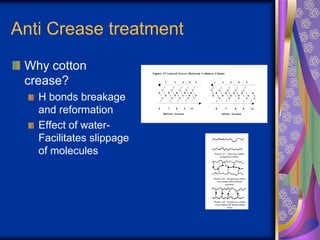
Why cotton
crease?
H bonds breakage
and reformation
Effect of water-
Facilitates slippage
of molecules
Shape retentive finish /Anti crease
finish
Majority of these finishes are all
based on resins or reacts that will
combine chemically with the fiber
through the process known as cross
linking, whereby adjacent molecular
chains of cellulose in the fiber are
linked or tied together to provide
greater molecular rigidity and pervent
inter molecular slippage
Shape retention chemicals
Variation of formaldehydes
urea formaldehydes
Melamine formaldehyde
Disadvantages
Fish-order
Allergic reaction eye tearing and skin
irritation
Carcinogen
Shape retention chemical
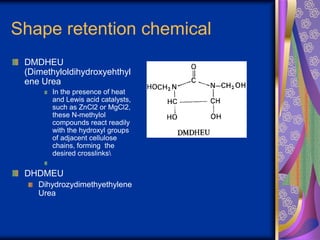
DMDHEU
(Dimethyloldihydroxyehthyl
ene Urea
In the presence of heat
and Lewis acid catalysts,
such as ZnCl2 or MgCl2,
these N-methylol
compounds react readily
with the hydroxyl groups
of adjacent cellulose
chains, forming the
desired crosslinks
DHDMEU
Dihydrozydimethyethylene
Urea
Disadvantages of shape retention
chemical
Reduce tensile and tear strength by
30% to 40%
Reducing abrasion resistance
Fiber becomes less absorptive
Less comfortable in humid weather
Wrinkle Resistant Finish
To prevent deformation of fabric by
undesirable and unintentionally
introduced folds and rumples
To keep fabric flat and smooth as
compared with crease or pleats that
are deliberately placed in fabric
To impart resiliency property in cotton
fabric
Wash – and – wear Finish/Drip dry
finish
Fabric made of fabric with wash – and
– wear finishes will dry smooth and
need little or no ironing after washing,
depending upon quality of finish and
construction
No ironing needed
Mild washing
Yellowing when chlorine bleach
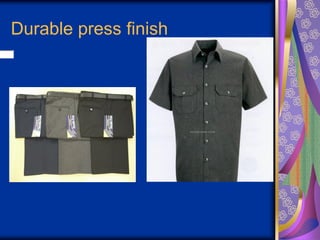
Durable press finish
X_WAORX_WAERDMEN-F
Permanent Press (Durable Press)
Disadvantage of Wash –n –
wear/wrinkle resistant finish
– Finish give the fabric a built-in memory which
interfered with shaping garment to conform to
body contours.
– Pre cure finishes- these finishes are cured before
the goods are cut and sewn into garments
Durable press is Post cure
Dis advatage
» Reduction strength
» Reduction in abrasion resistance
Modification of permanent press
finishes
Modification of molecular structure of
cotton fiber
By NAOH treatment without tension allowing cotton to
shrink
Then stretch while it remains in caustic soda to
increase strength of cotton
Pretreatment of cotton and cotton/polyester
with liquid ammonia improves lusture
,tensile strength, wrinkle resistance
Steam cured
Inherent permanent heat setting of
thermoplastic fabric
Cellulose cross linkers-Chemistry
part
Cross link cellulose
Self polymerisation (Aminoplasts)
N.N-l.3dimethylol-4.5-
dihydroxyethylenurea (DMDHEU)
combined withmagnesium chloride as
acid catalsyt
Reaction with formaldehyde
Chemistry part
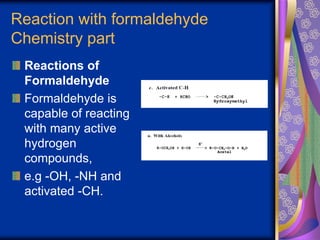
Reactions of
Formaldehyde
Formaldehyde is
capable of reacting
with many active
hydrogen
compounds,
e.g -OH, -NH and
activated -CH.
Resin treatment
B. Resin Formers (Aminoplasts)
There are two major types of formaldehyde
condensates that fall into the resin former
category,
urea/formaldehyde
melamine/formaldehyde
Aminoplasts
These condensatesare capable of self-crosslinking to
form resinous, three-dimensional polymers as wellas
crosslinking cellulose.
Urea formaldehyde
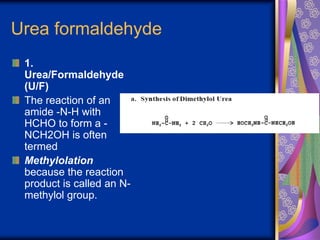
1.
Urea/Formaldehyde
(U/F)
The reaction of an
amide -N-H with
HCHO to form a -
NCH2OH is often
termed
Methylolation
because the reaction
product is called an N-
methylol group.
b. Important Features
The condensate has an extremely
short shelf life. It must be used within
a few days after its been made. When
formulated with catalyst, the finish
bath must be used within a few hours.
The solution has high free formaldehyde
and will readily liberate formaldehyde
into the work place.
Melamine/formadehyde
Melamine/Formaldehyde
Melamine can react with up to 6
moles of formaldehyde to form a
variety of products.
C. Reactants
Reactant N-methylol compounds
differ from aminoplasts in that
reactants donot form three-
dimensional polymers by self-
condensation.
When applied to cellulose, they mainly
crosslink adjacent polymer molecules.
Reactants
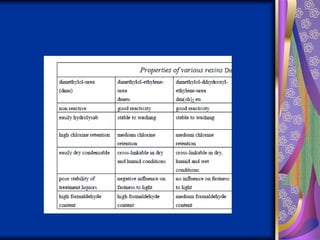
1. Dimethylolethylene Urea (DMEU)
It was widely used prior to 1961 as a wash and
wear finish.
2. The product has moderately good shelf life,
much better than the aminoplasts. Even with
catalystmixed in, the bath life is more than
adequate for most commercial applications.
3.DMEU is easily cured. It will begin to cure at
90 to 1000 C.
4. It is highly efficientand gives good wrinkle
recovery with nominal losses in fabric strength.
Properties of Dimethylolethylene
Urea (DMEU)
5. The product does affect lightfastness of
certain direct and fiber reactive dyes.
6. Chlorine resistance is poor even though
there are no remaining N-H groups.
7. Hydrolysis resistance is poor. Crosslinks
are not durable to laundering, especially
industrial laundering conditions.
DMDHEU
Dimethylol-4,5-Dihydroxyethylene Urea
(DMDHEU)
DMDHEU is the workhorse durable press finish.
It and some of its modified versions account for
over 85% of all crease resistant chemicals
consumed today.
DMDHEU achieved this prominent role in
1961 when delay cure processing came
into being. In the trade, DMDHEU is often
referred to as the Glyoxal resin.
DMDHEU
The commercial product has low free
formaldehyde which makes it easy to handle in a
finishing plant. It does not liberate formaldehyde
from the reverse reaction as rapidly as do other
reagents.
The product has extremely good shelf life and
even finish baths with catalyst present are stable
for prolong periods of time.
Fabric temperatures exceeding 1300 C are
needed before the cross-linking reaction takes
place. This feature is responsible for why it has
become the dominate DP finish.
DMDHEU
The reactant does not crosslink on storage
so fabrics can be left in a sensitized state
(uncured) for over six months before post
curing. Hydrolysis resistance of the
cellulose crosslinks are much better than
DMEU so durability to laundering is very
acceptable.
Resistance to chlorine bleach is also
acceptable.While this finish reduces the
light fastness of direct and fiber reactive
dyes, it isbetter than DMEU.
Finishing
Finishing

Finishing

  • 1.
  • 2.
    Introduction to Textiles ATextile is a flexible material comprised of a network of natural or artificial fibres often referred to as thread or yarn. Textile refers to any material made of interlacing fibres Textiles are made in various strengths and degrees of durability, from the finest gossamer to the sturdiest canvas There can be Animal Textiles, Plant Textiles, Mineral Textiles, Synthetic Textiles
  • 3.
    Departments Of Textiles Textilesare divided in 3 major categories » Spinning » Weaving » Wet-Processing
  • 4.
    Spinning The process ofconverting the fibres in the form yarn is called Spinning A flexible material comprised of a network of natural or artificial fibres often referred to as thread or yarn Yarn is produced by spinning raw wool fibres, linen, cotton, or other material on a spinning wheel to produce long strands known as yarn Synthetic yarns are made by spinneret
  • 5.
    Weaving & Knitting Theprocess of converting yarn in the form of fabric is called Weaving Fabric formed by the interlacement of warp and weft yarn is called weaving Fabric formed by the interlooping of yarns is called Knitting
  • 6.
    Wet-Processing This is theanother entirely different stage of textile sector. It involves various stages, and can be divided as such Pretreatments » singe » desize » scour » bleach » mercerize Dyeing/Printing Finishing
  • 7.
    Pretreatments The term “pretreatments”include all operations of preparing the textile material, such as fibres yarn and woven, knit and non-woven fabrics and garments for the subsequent processes for dyeing printing and finishing. For all practical purposes the pretreatments are carried out along with dyeing and printing and their equipments is part of the wet-processing plant
  • 8.
    Dyeing and Printing Theprocess of application of dyes on to the substrate (fabric, yarn or fibres ) in the solution form is called Dyeing. The process of application of dyes on the substrate (fabric) in the paste form is called Printing Dyes can of various classes as mentioned – Direct dyes – Reactive dyes – Vat dyes – Sulphur dyes – Azoic dyes – Disperse dyes – Acid or Anionic dyes, pre-mettalised or mordant dyes – Basic or cationic dyes
  • 9.
    Finishing Textile finishing isa term commonly applied to different processes that the textile materials undergo after pretreatments, dyeing or printing for final embellishments to enhance their attractiveness and sale appeals well as for comfort and usefulness. Finishing treatments are basically meant to give the textile material certain desirable properties like » Softness » Lusture » Pleasant handle » Drape » Dimensional stability » Crease recovery » Antistatic » Non-slip » Soil release
  • 10.
    However these alsoinclude finishes that have to meet certain specific end uses such as » water repellency » Flame retardency » Mildew proofing
  • 11.
    Chemical and Mechanicalfinishing The finishing processes are applied in various forms and various types of finishes effect can be obtained such as discussed below A finish that is classified as durable is one that will endure through successive wet or dry cleaning Textile finishes applied after the coloring process generally fall into one of two general categories according to purpose or end result. These categories are » wet finishes » mechanical finishes
  • 12.
    Types of finishing Permanentfinishes usually involve a chemical change in fibre structure and will not change or alter throughout the life of a fabric. Durable finishes usually last throughout the life of the article, but effectiveness becomes diminished after each cleaning, and near the end of the normal use life of the article, the finish is nearly removed. Semi-durable finishes last through several launderings or dry cleanings and many are renewable in home laundering or dry cleaning A non-durable, or soluble finish, is one that will be removed through successive washing or dry cleanings
  • 13.
    Standard Chemical orWet finishes Standard, chemical or wet finishes augment the textile's durability or ability to perform in a given way. These finishes include antibacterial or antiseptic Anti-static Easy Care Flame retardant Insulative Lamination or Bonding Mothproof Soil repellent Water repellent Water absorbency finishes
  • 14.
    Mechanical Finishing Treatments Mechanicalfinishing processes can be referred to as those processes generally carried out on open-width dry fabrics, with or without heat application, which give the fabric good dimensional stability (shrink proof and shape retention) modify the "hand" of the textile product by altering its structure (at least its surface structure)
  • 15.
    Dry Finshing Dry finishing Calendering:a lustrous, dense and compact appearance can be obtained by means of friction, pressure and heat. Ciréing: this calendering operation is carried out using special calenders and exploiting the combined actions of heat, friction and polishing agents. Embossing: this particular type of calendering process allows engraving a simple patternon the fabric.
  • 16.
    Dry finishing Sueding: thanksto this process, the fabric has a much softer hand and an improved insulating effect thanks to the fibre end pulled out of the fabric surface. Thisprocess is carried out by means of a roller coated with abrasive material. Raising: he fibre end pulled out to the fabric surface imparts an insulating effect. Thisprocess is carried out by means of hook-needles running in different directions on the fabric. Shearing: the fibre ends on the fabric surface are cut by using special cutting tools. Singeing: the fibre ends pulled out to the fabric surface are burnt by means of a flame
  • 17.
    Mechanical Finishing Treatments Wetfinishing Wet calendering: this process is quite similar to the dry one. The only difference is the use of steam. Fulling: the structure, bulk and shrinkage of wool are modified by applying heat combined with friction and compression. Sanforising: the fabric is given an optimum dimensional stability by applying mechanic forces and water vapour. Decating: the lustrous appearance of the textile material is eliminated, the surface is smoothed and the fabric is given an optimum dimensional stability thanks to the action of dry or overheated saturated vapour.
  • 18.
    Calendering Fundamentally, a ealenderis a mechanical device consisting of two or more large rotating cylindrical rollers stacked on top of each other and usually heated. The cylindrical rollers are in contact with each other under pressure. Fabric being calendered passes around and between these cylinders. The specific type of calendered finished fabric varies with the nature of the cylinder surface, the speed of the cylinders and the nature of the fabric being finished.
  • 19.
    Calendering Calendering This non-permanent mechanicalfinishing treatment is applied to fabrics made of cellulose, protein and synthetic fibres, by means of a calender. This machine generally includes one or aseries of couples of rollers pressed one against the other with adjustable pressure and identical orsimilar tip speeds. The cloth passes through one or more couples of rollers, which exert asmoothing and a pressing action. Some rollers are stiff while some others are made of softermaterial. Stiff rollers are generally made of steel or hardened cast iron and the surface can bechrome-plated, nickel-plated or made of stainless steel
  • 20.
  • 21.
    Calendering Sheen appearance: it canbe obtained by smoothing the cloth surface, which ensures a better reflection of light. Better coverage: it is due to the compression of the cloth, which generates a flattening of each single yarn. Softer hand: it is obtained thanks to a slight ironing effect, which produces a smoother, and softer cloth surface. Surface patterns: they can be obtained by means of special effects ("embossing" for example) for decorative purposes or to modify the surface smoothness. Yarn swelling and rounding effect: they give a modest glaze finishing to the fabric, a surface smoothness and above all a full and soft hadle
  • 22.
    Embossing Embossing is aparticular calendering process through which a simple pattern can be engravedon the cloth. The embossing machine is made up of a heated and embossed roller made of steel, which is pressed against another roller coated with paper or cotton,
  • 23.
    Sueding This operation isoften carried out before the raising process to reduce the friction between the fibres making up the cloth and consequently to facilitate the extraction of the fibre end. The sueding process is carried out on both sides of the fabric and modifies the appearance andthe final hand of the cloth; when touched it gives a soft and smooth sensation similar to the one given by a peach-grain surface.
  • 24.
  • 25.
    Raising By means ofthis process a hairy surface can be given to both face and back of the cloth providing several modifications of the fabric appearance, softer and fuller hand and bulk increase. This enhances the resistance of the textile material to atmospheric agents, improving thermal insulation and warmth provided by the insulating air cells in the nap. The fuzzy surface is created by pulling the fibre end out of the yarns by means of metal needlesprovided with hooks shelled into the rollers that scrape the fabric surface. The ends of the needles protruding from the rollers are 45°-hooks;
  • 27.
    Shearing Shearing This cutting operation,omplementary to raising, determines the height of the fibre end irregularly raised during the raising process; The resulting effect affects the appearance and thehand of the fabric, which becomes velvet-like.
  • 28.
    velveting brush velveting table shearingcylinder equipped with helical blades doctor blade shearing table lubrication felt.
  • 29.
    Decating This process ismainly carried out on wool by exploiting its elastic properties in hot and wet conditions by the direct action of the steam on the fabric. This treatment gives the processed Fabric the following characteristics: – 1) dimensional stability; – 2) setting of pile after raising; – 3) reduction of possible glazing effect after calendering, thank to the swelling caused by steamblown on fibres; – 4) modification of the hand, which is much more consistent after the treatment; – 5) pre-stabilisation to autoclave dyeing
  • 30.
    decating Alternated decating. In discontinuousdecating processes, the fabric is wound, together with the .satin. blanket. on a large perforated drum (90 cm) on which some meters of blanket or similar cloth have been previously rolled
  • 31.
    decating The steam, ata temperature that can reach 130°C and a pressure of up to 6 bars, is forced into the cylinder through the fabric roll (i.e. it is forced through both fabric and blanket) for an interval of time that can range from 1 and 3-4 minutes, according to the desired effect. The steam is then exhausted by means of a pump.
  • 32.
    Anti Crease treatment Whycotton crease? H bonds breakage and reformation Effect of water- Facilitates slippage of molecules
  • 33.
    Shape retentive finish/Anti crease finish Majority of these finishes are all based on resins or reacts that will combine chemically with the fiber through the process known as cross linking, whereby adjacent molecular chains of cellulose in the fiber are linked or tied together to provide greater molecular rigidity and pervent inter molecular slippage
  • 34.
    Shape retention chemicals Variationof formaldehydes urea formaldehydes Melamine formaldehyde Disadvantages Fish-order Allergic reaction eye tearing and skin irritation Carcinogen
  • 35.
    Shape retention chemical DMDHEU (Dimethyloldihydroxyehthyl eneUrea In the presence of heat and Lewis acid catalysts, such as ZnCl2 or MgCl2, these N-methylol compounds react readily with the hydroxyl groups of adjacent cellulose chains, forming the desired crosslinks DHDMEU Dihydrozydimethyethylene Urea
  • 36.
    Disadvantages of shaperetention chemical Reduce tensile and tear strength by 30% to 40% Reducing abrasion resistance Fiber becomes less absorptive Less comfortable in humid weather
  • 37.
    Wrinkle Resistant Finish Toprevent deformation of fabric by undesirable and unintentionally introduced folds and rumples To keep fabric flat and smooth as compared with crease or pleats that are deliberately placed in fabric To impart resiliency property in cotton fabric
  • 38.
    Wash – and– wear Finish/Drip dry finish Fabric made of fabric with wash – and – wear finishes will dry smooth and need little or no ironing after washing, depending upon quality of finish and construction No ironing needed Mild washing Yellowing when chlorine bleach
  • 39.
  • 41.
    Permanent Press (DurablePress) Disadvantage of Wash –n – wear/wrinkle resistant finish – Finish give the fabric a built-in memory which interfered with shaping garment to conform to body contours. – Pre cure finishes- these finishes are cured before the goods are cut and sewn into garments Durable press is Post cure Dis advatage » Reduction strength » Reduction in abrasion resistance
  • 42.
    Modification of permanentpress finishes Modification of molecular structure of cotton fiber By NAOH treatment without tension allowing cotton to shrink Then stretch while it remains in caustic soda to increase strength of cotton Pretreatment of cotton and cotton/polyester with liquid ammonia improves lusture ,tensile strength, wrinkle resistance Steam cured Inherent permanent heat setting of thermoplastic fabric
  • 43.
    Cellulose cross linkers-Chemistry part Crosslink cellulose Self polymerisation (Aminoplasts) N.N-l.3dimethylol-4.5- dihydroxyethylenurea (DMDHEU) combined withmagnesium chloride as acid catalsyt
  • 44.
    Reaction with formaldehyde Chemistrypart Reactions of Formaldehyde Formaldehyde is capable of reacting with many active hydrogen compounds, e.g -OH, -NH and activated -CH.
  • 45.
    Resin treatment B. ResinFormers (Aminoplasts) There are two major types of formaldehyde condensates that fall into the resin former category, urea/formaldehyde melamine/formaldehyde Aminoplasts These condensatesare capable of self-crosslinking to form resinous, three-dimensional polymers as wellas crosslinking cellulose.
  • 46.
    Urea formaldehyde 1. Urea/Formaldehyde (U/F) The reactionof an amide -N-H with HCHO to form a - NCH2OH is often termed Methylolation because the reaction product is called an N- methylol group.
  • 47.
    b. Important Features Thecondensate has an extremely short shelf life. It must be used within a few days after its been made. When formulated with catalyst, the finish bath must be used within a few hours. The solution has high free formaldehyde and will readily liberate formaldehyde into the work place.
  • 48.
    Melamine/formadehyde Melamine/Formaldehyde Melamine can reactwith up to 6 moles of formaldehyde to form a variety of products.
  • 49.
    C. Reactants Reactant N-methylolcompounds differ from aminoplasts in that reactants donot form three- dimensional polymers by self- condensation. When applied to cellulose, they mainly crosslink adjacent polymer molecules.
  • 50.
    Reactants 1. Dimethylolethylene Urea(DMEU) It was widely used prior to 1961 as a wash and wear finish. 2. The product has moderately good shelf life, much better than the aminoplasts. Even with catalystmixed in, the bath life is more than adequate for most commercial applications. 3.DMEU is easily cured. It will begin to cure at 90 to 1000 C. 4. It is highly efficientand gives good wrinkle recovery with nominal losses in fabric strength.
  • 51.
    Properties of Dimethylolethylene Urea(DMEU) 5. The product does affect lightfastness of certain direct and fiber reactive dyes. 6. Chlorine resistance is poor even though there are no remaining N-H groups. 7. Hydrolysis resistance is poor. Crosslinks are not durable to laundering, especially industrial laundering conditions.
  • 52.
    DMDHEU Dimethylol-4,5-Dihydroxyethylene Urea (DMDHEU) DMDHEU isthe workhorse durable press finish. It and some of its modified versions account for over 85% of all crease resistant chemicals consumed today. DMDHEU achieved this prominent role in 1961 when delay cure processing came into being. In the trade, DMDHEU is often referred to as the Glyoxal resin.
  • 53.
    DMDHEU The commercial producthas low free formaldehyde which makes it easy to handle in a finishing plant. It does not liberate formaldehyde from the reverse reaction as rapidly as do other reagents. The product has extremely good shelf life and even finish baths with catalyst present are stable for prolong periods of time. Fabric temperatures exceeding 1300 C are needed before the cross-linking reaction takes place. This feature is responsible for why it has become the dominate DP finish.
  • 54.
    DMDHEU The reactant doesnot crosslink on storage so fabrics can be left in a sensitized state (uncured) for over six months before post curing. Hydrolysis resistance of the cellulose crosslinks are much better than DMEU so durability to laundering is very acceptable. Resistance to chlorine bleach is also acceptable.While this finish reduces the light fastness of direct and fiber reactive dyes, it isbetter than DMEU.