Anti-Static Finish
Praveen D Nagarajan
ANTISTATICFINISH:
During spinning, weaving and finishing of yarns and fabric, friction will be
created by rubbing.
Therefore Hydrophobic fibres tend to develop static charge.
As the cellulosic fibres are good conductors, they do not produce static
charge whereas the synthetic fibres which are not good conductors,
develop static charge.
Due to this, shocks are experienced while working on the stenter, zero-zero
machines etc., and the fabrics get entangled and soil attraction takes place
which is also a problem.
Therefore the synthetic fabrics are given a finish to prevent the static charge
generation. This is known as ‘Anti static Finish’. .
It is a chemical and property giving finish. Both durable and non-durable
finishes can be produced
ANTISTATICFINISH:
Anti static property can be brought out:
By reducing the charge,
By increasing the surface conduction power,
By making the fibre hydrophilic.
Most of the antistatic finishes are based on the first mechanism ie., by
reducing the charge and increasing the surface conduction.
Silicone emulsions, PE emulsions, PE Glycols, Poly Ammonium Quaternary
Salts, Acrylic Polymers can be used for this purpose.
In fact the Silicone emulsion when used, produces antistatic property by
reducing the friction between the fibres with added advantages of soil
release property, softness and suppleness etc.,
ANTISTATICFINISH:
• ‘Antistat PP’ is used on polyester fabrics in 5 –
10 gpl concentration by Pad – Dry – Cure
method.
• Normally it is added in the finishing bath itself
along with other additives.
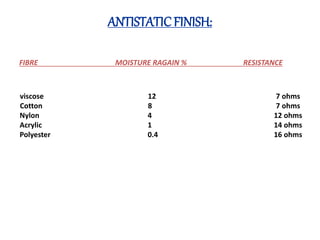
• The moisture regain of the fibre plays an
important role in static dissipation.
• The higher the moisture regain lower will be
the static accumulation
ANTISTATICFINISH:
FIBRE MOISTURE RAGAIN % RESISTANCE
viscose 12 7 ohms
Cotton 8 7 ohms
Nylon 4 12 ohms
Acrylic 1 14 ohms
Polyester 0.4 16 ohms
ANTISTATICFINISH:
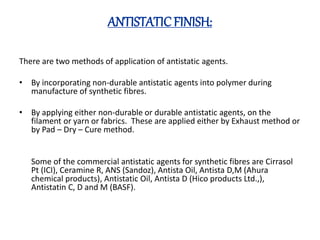
There are two methods of application of antistatic agents.
• By incorporating non-durable antistatic agents into polymer during
manufacture of synthetic fibres.
• By applying either non-durable or durable antistatic agents, on the
filament or yarn or fabrics. These are applied either by Exhaust method or
by Pad – Dry – Cure method.
Some of the commercial antistatic agents for synthetic fibres are Cirrasol
Pt (ICI), Ceramine R, ANS (Sandoz), Antista Oil, Antista D,M (Ahura
chemical products), Antistatic Oil, Antista D (Hico products Ltd.,),
Antistatin C, D and M (BASF).

Anti static finish

  • 1.
  • 2.
    ANTISTATICFINISH: During spinning, weavingand finishing of yarns and fabric, friction will be created by rubbing. Therefore Hydrophobic fibres tend to develop static charge. As the cellulosic fibres are good conductors, they do not produce static charge whereas the synthetic fibres which are not good conductors, develop static charge. Due to this, shocks are experienced while working on the stenter, zero-zero machines etc., and the fabrics get entangled and soil attraction takes place which is also a problem. Therefore the synthetic fabrics are given a finish to prevent the static charge generation. This is known as ‘Anti static Finish’. . It is a chemical and property giving finish. Both durable and non-durable finishes can be produced
  • 3.
    ANTISTATICFINISH: Anti static propertycan be brought out: By reducing the charge, By increasing the surface conduction power, By making the fibre hydrophilic. Most of the antistatic finishes are based on the first mechanism ie., by reducing the charge and increasing the surface conduction. Silicone emulsions, PE emulsions, PE Glycols, Poly Ammonium Quaternary Salts, Acrylic Polymers can be used for this purpose. In fact the Silicone emulsion when used, produces antistatic property by reducing the friction between the fibres with added advantages of soil release property, softness and suppleness etc.,
  • 4.
    ANTISTATICFINISH: • ‘Antistat PP’is used on polyester fabrics in 5 – 10 gpl concentration by Pad – Dry – Cure method. • Normally it is added in the finishing bath itself along with other additives. • The moisture regain of the fibre plays an important role in static dissipation. • The higher the moisture regain lower will be the static accumulation
  • 5.
    ANTISTATICFINISH: FIBRE MOISTURE RAGAIN% RESISTANCE viscose 12 7 ohms Cotton 8 7 ohms Nylon 4 12 ohms Acrylic 1 14 ohms Polyester 0.4 16 ohms
  • 6.
    ANTISTATICFINISH: There are twomethods of application of antistatic agents. • By incorporating non-durable antistatic agents into polymer during manufacture of synthetic fibres. • By applying either non-durable or durable antistatic agents, on the filament or yarn or fabrics. These are applied either by Exhaust method or by Pad – Dry – Cure method. Some of the commercial antistatic agents for synthetic fibres are Cirrasol Pt (ICI), Ceramine R, ANS (Sandoz), Antista Oil, Antista D,M (Ahura chemical products), Antistatic Oil, Antista D (Hico products Ltd.,), Antistatin C, D and M (BASF).