QUALITY MANAGEMENT
SYSTEMS
Sumit Bansal
B.Tech (Final Year)
QUALITY MANAGEMENT SYSTEM
DEFINITION:
 A Quality Management System is a collection of
policies, procedures, plans, resources, processes,
practices, and the specification of responsibilities
and authority of an organization designed to
achieve product and service quality levels,
customer satisfaction and company objectives.
DOCUMENTATION:
Quality Policy – describes the
organizations approach to quality
Quality Manual – Addresses each
principle of the ISO 9000 Standard
Origin Of ISO 9000 Standards
DOCUMENTATION –
PRINCIPLES OF THE ISO 9000
STANDARD:
○ Customer Focus – understand needs, meet requirements,
exceed expectations
○ Leadership – unity of purpose, organizational direction,
empowerment, achieve objectives
○ Involvement of People – fully involved employees, to
benefit the organization
○ Process Approach – accomplishments by processes,
resources must be managed
DOCUMENTATION - PRINCIPLES OF
THE ISO 9000 STANDARD – CONT. :
○ System Approach to Management- processes are managed
as a system
○ Continual Improvement – permanently applied to the
organization, its people, their processes, their systems and
their products
○ Factual Approach to Decision Making – decisions based on
analysis of accurate, relevant and reliable data
○ Mutually Beneficial Supplier relationships – organization
and suppliers benefit from each other’s resources and
knowledge
DOCUMENTATION – CONT. :
Organizational Chart
 Illustrates managements responsibility for operating the
quality system
Quality Procedures – may be referenced
in this manual
DOCUMENTATION – CONT. :
 Quality Objectives
Goals related to quality – must be in sync
with the Quality Policy
Assigned to organizational functions
Tracked by Top Management
 Quality Procedures
Step by step what the company does to
meet policy
A procedure for each ISO principle
Processes for procedures that affect
quality
DOCUMENTATION – CONT. :
Forms. Records etc.
Proof of activities
Documentation for auditors
Ensure consistency of the firms
operations
Verify conformance to standards
ISO 9000 – INTERNATIONAL
STANDARD
 Definition:
  
 A family of standards and guidelines, that sets the
requirements, for the assurance of quality and
management’s involvement in an organization. To
ensure products and services are consistent with
their intended purpose.
 Achieve customer satisfaction
 Continual improvement of performance and
competitiveness
 Continual improvement of processes, products and
services
 Comply with regulatory requirements
ISO 9000 – INTERNATIONAL
STANDARD:
 How ISO 9000 is applied
Not required by government, up to
management to follow
May require suppliers to be compliant
to standards
○ Apply QMS to the operation
○ Continually assess the effectiveness
○ Make changes for improvement
○ Conduct audits
○ Submit to third party audits
○ Submit to a new registration every 3 years
ISO 9000 – INTERNATIONAL
STANDARD:
Authority of registration
Awarded by a registrar or certification
bodies
Accredited by accreditations bodies
International Accreditation Forum
(IAF)
IAF takes authority from Article 6 of
the WTO’s 1994 Agreement on
Technical Barriers to Trade
ISO 9000 – INTERNATIONAL
STANDARD:
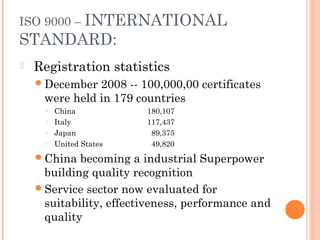
 Registration statistics
December 2008 -- 100,000,00 certificates
were held in 179 countries
○ China 180,107
○ Italy 117,437
○ Japan 89,375
○ United States 49,820
China becoming a industrial Superpower
building quality recognition
Service sector now evaluated for
suitability, effectiveness, performance and
quality
ISO 9000 – INTERNATIONAL
STANDARD:
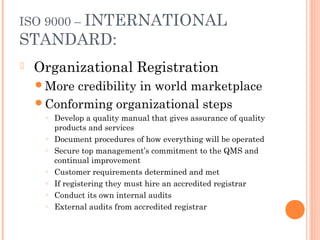
 Organizational Registration
More credibility in world marketplace
Conforming organizational steps
○ Develop a quality manual that gives assurance of quality
products and services
○ Document procedures of how everything will be operated
○ Secure top management’s commitment to the QMS and
continual improvement
○ Customer requirements determined and met
○ If registering they must hire an accredited registrar
○ Conduct its own internal audits
○ External audits from accredited registrar
ISO 9000 – INTERNATIONAL
STANDARD:
Organizational Benefits
Provides confidence to the customer and
the organization that it can provide
products and services consistently
Cost risk-management
Improved competitiveness
ISO 9000 Certification Dance
ISO 9000 – INTERNATIONAL
STANDARD:
Customer Benefits
Meet requirements
Competitive prices
Increased confidence in products
Expectation of quality
ORIGIN OF ISO 9000:
ISO the world wide federation
developed to harmonize national and
international standards
Developed by American National
Standards Institute (ANSI) and
American Society for Quality (ASQ) in
1987 after 35 years
COMPARATIVE SCOPE OF ISO
9000 AND TOTAL QUALITY
MANAGEMENT:
ISO 9000 and TQM not interchangeable
ISO 9000 is compatible with , and is
viewed as a subset of TQM
 ISO 9000 can be implemented in an non-
TQM environment
ISO 9000 can improve operations of
traditional environment
ISO 9000 may be redundant in a mature
TQM system
ISO 9000 and TQM are not in competition
MOTIVATION FOR
REGISTRATION TO ISO
9000:
Merely to obtain marketing advantage
– inappropriate
Appropriate for adopting ISO 9000
○ To improve operations by implementing a QMS
○ To create/improve a QMS that is recognized by the
customers
○ To improve product and service quality and consistency
○ To improve customer satisfaction
○ To improve competitive posture
○ To conform to major customer requirements
MANAGEMENT
WORKING TOGETHER:
TQM requires everything required by ISO
9000 registration
No international certification for TQM but
may seek ISO 9000 certification to meet
customer demands
ISO 9001 registration can be a good first
step to TQM
A organization that has documented
processes and is involved in total quality
management should find it easy to
prepare for ISO 9000 certification
Likewise an organization registered under
ISO 9001 will have a head start in
implementing total quality
The ISO 9000 effort will benefit from the
total quality preparation phase by having
the following components:
○ Executive level steering committee
○ A vision of guiding principles
○ A set of broad objectives
○ Baselines on employee and customer satisfaction
○ An objective view of the organizations strengths and
weaknesses
○ A good account of all employees at all levels of the
organization
○ Well thought out means of communicating with employees
and stakeholders
SUMMARY:
 ISO 9000 and TQM are not fully interchangeable
 ISO 9000 is compatible and can be a subset of TQM
 Vastly different origins
○ ISO 9000 was developed to harmonize national and international
standards
○ Total Quality came from Japan as a way for them to compete in
the international marketplace
 The aim of ISO 9000 is to enable organizations to better serve their
customers and be more competitive in the marketplace by adhering to
quality management principles
 Motivations for implementing ISO 9000
○ To improve operations
○ To improve/create a quality management system
○ To improve the consistency of quality
○ To improve customer satisfaction
○ To improve competitive posture
○ To conform to customer requirements
REFERENCES:
 Quality Management for Organizational
Excellence – Introduction to Total Quality –
Groetsch and Davis
 Origin Of ISO 9000 Standards -
http://www.youtube.com/watch?v=igMS5uuX4rI
 ISO 9000 Certification Dance -
http://www.youtube.com/watch?v=Ipq82fL1xyQ

Quality Management System

  • 1.
  • 2.
    QUALITY MANAGEMENT SYSTEM DEFINITION: A Quality Management System is a collection of policies, procedures, plans, resources, processes, practices, and the specification of responsibilities and authority of an organization designed to achieve product and service quality levels, customer satisfaction and company objectives.
  • 3.
    DOCUMENTATION: Quality Policy –describes the organizations approach to quality Quality Manual – Addresses each principle of the ISO 9000 Standard Origin Of ISO 9000 Standards
  • 4.
    DOCUMENTATION – PRINCIPLES OFTHE ISO 9000 STANDARD: ○ Customer Focus – understand needs, meet requirements, exceed expectations ○ Leadership – unity of purpose, organizational direction, empowerment, achieve objectives ○ Involvement of People – fully involved employees, to benefit the organization ○ Process Approach – accomplishments by processes, resources must be managed
  • 5.
    DOCUMENTATION - PRINCIPLESOF THE ISO 9000 STANDARD – CONT. : ○ System Approach to Management- processes are managed as a system ○ Continual Improvement – permanently applied to the organization, its people, their processes, their systems and their products ○ Factual Approach to Decision Making – decisions based on analysis of accurate, relevant and reliable data ○ Mutually Beneficial Supplier relationships – organization and suppliers benefit from each other’s resources and knowledge
  • 6.
    DOCUMENTATION – CONT.: Organizational Chart  Illustrates managements responsibility for operating the quality system Quality Procedures – may be referenced in this manual
  • 7.
    DOCUMENTATION – CONT.:  Quality Objectives Goals related to quality – must be in sync with the Quality Policy Assigned to organizational functions Tracked by Top Management  Quality Procedures Step by step what the company does to meet policy A procedure for each ISO principle Processes for procedures that affect quality
  • 8.
    DOCUMENTATION – CONT.: Forms. Records etc. Proof of activities Documentation for auditors Ensure consistency of the firms operations Verify conformance to standards
  • 9.
    ISO 9000 –INTERNATIONAL STANDARD  Definition:     A family of standards and guidelines, that sets the requirements, for the assurance of quality and management’s involvement in an organization. To ensure products and services are consistent with their intended purpose.  Achieve customer satisfaction  Continual improvement of performance and competitiveness  Continual improvement of processes, products and services  Comply with regulatory requirements
  • 10.
    ISO 9000 –INTERNATIONAL STANDARD:  How ISO 9000 is applied Not required by government, up to management to follow May require suppliers to be compliant to standards ○ Apply QMS to the operation ○ Continually assess the effectiveness ○ Make changes for improvement ○ Conduct audits ○ Submit to third party audits ○ Submit to a new registration every 3 years
  • 11.
    ISO 9000 –INTERNATIONAL STANDARD: Authority of registration Awarded by a registrar or certification bodies Accredited by accreditations bodies International Accreditation Forum (IAF) IAF takes authority from Article 6 of the WTO’s 1994 Agreement on Technical Barriers to Trade
  • 12.
    ISO 9000 –INTERNATIONAL STANDARD:  Registration statistics December 2008 -- 100,000,00 certificates were held in 179 countries ○ China 180,107 ○ Italy 117,437 ○ Japan 89,375 ○ United States 49,820 China becoming a industrial Superpower building quality recognition Service sector now evaluated for suitability, effectiveness, performance and quality
  • 13.
    ISO 9000 –INTERNATIONAL STANDARD:  Organizational Registration More credibility in world marketplace Conforming organizational steps ○ Develop a quality manual that gives assurance of quality products and services ○ Document procedures of how everything will be operated ○ Secure top management’s commitment to the QMS and continual improvement ○ Customer requirements determined and met ○ If registering they must hire an accredited registrar ○ Conduct its own internal audits ○ External audits from accredited registrar
  • 14.
    ISO 9000 –INTERNATIONAL STANDARD: Organizational Benefits Provides confidence to the customer and the organization that it can provide products and services consistently Cost risk-management Improved competitiveness ISO 9000 Certification Dance
  • 15.
    ISO 9000 –INTERNATIONAL STANDARD: Customer Benefits Meet requirements Competitive prices Increased confidence in products Expectation of quality
  • 16.
    ORIGIN OF ISO9000: ISO the world wide federation developed to harmonize national and international standards Developed by American National Standards Institute (ANSI) and American Society for Quality (ASQ) in 1987 after 35 years
  • 17.
    COMPARATIVE SCOPE OFISO 9000 AND TOTAL QUALITY MANAGEMENT: ISO 9000 and TQM not interchangeable ISO 9000 is compatible with , and is viewed as a subset of TQM  ISO 9000 can be implemented in an non- TQM environment ISO 9000 can improve operations of traditional environment ISO 9000 may be redundant in a mature TQM system ISO 9000 and TQM are not in competition
  • 18.
    MOTIVATION FOR REGISTRATION TOISO 9000: Merely to obtain marketing advantage – inappropriate Appropriate for adopting ISO 9000 ○ To improve operations by implementing a QMS ○ To create/improve a QMS that is recognized by the customers ○ To improve product and service quality and consistency ○ To improve customer satisfaction ○ To improve competitive posture ○ To conform to major customer requirements
  • 19.
    MANAGEMENT WORKING TOGETHER: TQM requireseverything required by ISO 9000 registration No international certification for TQM but may seek ISO 9000 certification to meet customer demands ISO 9001 registration can be a good first step to TQM A organization that has documented processes and is involved in total quality management should find it easy to prepare for ISO 9000 certification Likewise an organization registered under ISO 9001 will have a head start in implementing total quality
  • 20.
    The ISO 9000effort will benefit from the total quality preparation phase by having the following components: ○ Executive level steering committee ○ A vision of guiding principles ○ A set of broad objectives ○ Baselines on employee and customer satisfaction ○ An objective view of the organizations strengths and weaknesses ○ A good account of all employees at all levels of the organization ○ Well thought out means of communicating with employees and stakeholders
  • 21.
    SUMMARY:  ISO 9000and TQM are not fully interchangeable  ISO 9000 is compatible and can be a subset of TQM  Vastly different origins ○ ISO 9000 was developed to harmonize national and international standards ○ Total Quality came from Japan as a way for them to compete in the international marketplace  The aim of ISO 9000 is to enable organizations to better serve their customers and be more competitive in the marketplace by adhering to quality management principles  Motivations for implementing ISO 9000 ○ To improve operations ○ To improve/create a quality management system ○ To improve the consistency of quality ○ To improve customer satisfaction ○ To improve competitive posture ○ To conform to customer requirements
  • 22.
    REFERENCES:  Quality Managementfor Organizational Excellence – Introduction to Total Quality – Groetsch and Davis  Origin Of ISO 9000 Standards - http://www.youtube.com/watch?v=igMS5uuX4rI  ISO 9000 Certification Dance - http://www.youtube.com/watch?v=Ipq82fL1xyQ