

• At the end of this lecture, the student should be able to
1. Explain why Cost of Quality important?
2. Define Cost of Quality (CoQ)
3. Present different CoQ Models and compare
• Explain PAF model
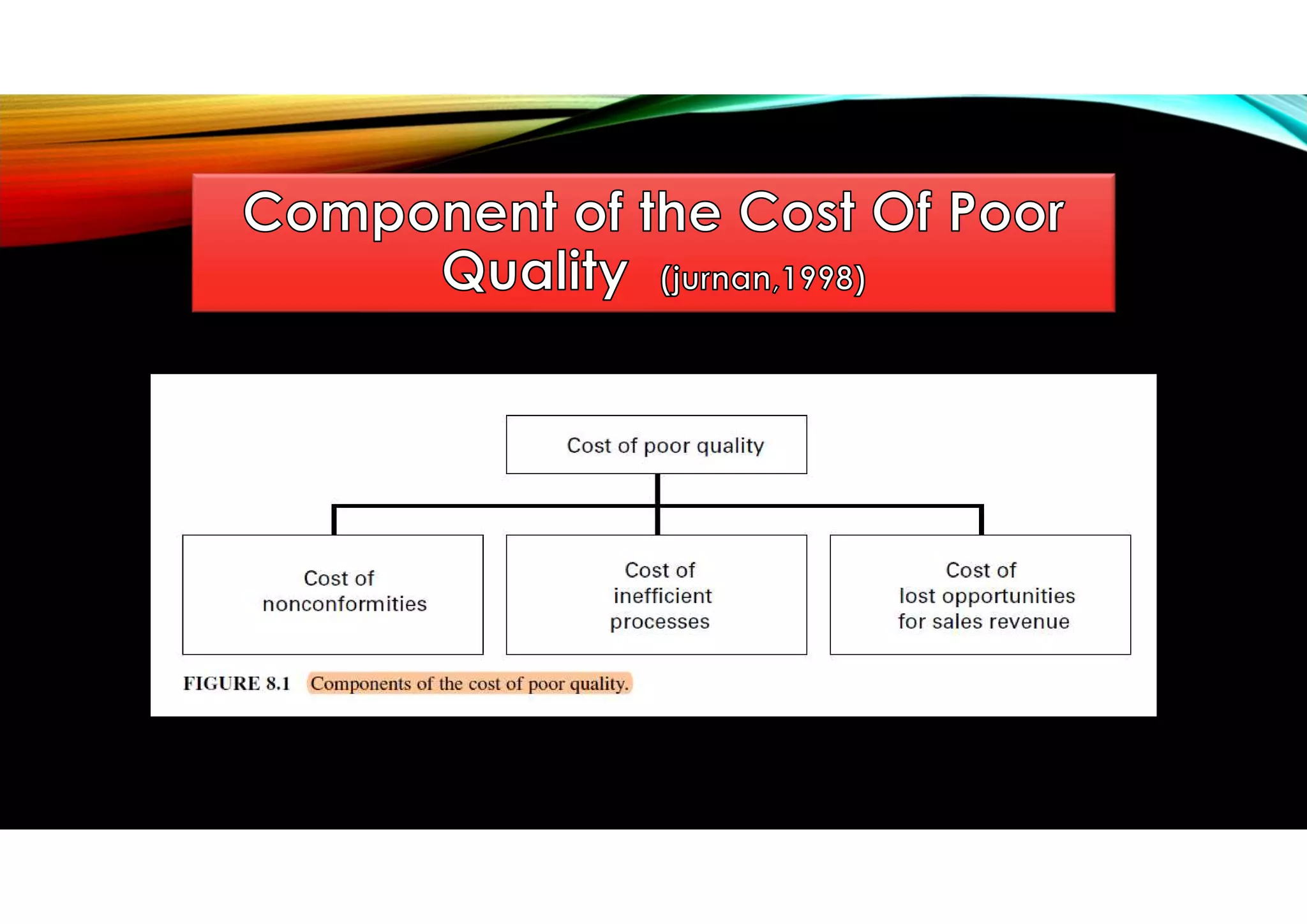
• Explain Juran’s Cost of poor Quality
• Explain Corby's Model
• Explain process Control Model Explain
• HARRINGTON MODEL
4. Analysis cost of Quality
5. Explain and compare old and new CoQ curves
6. Do Cost of Quality Analysis
7. Apply CoQ Strategy
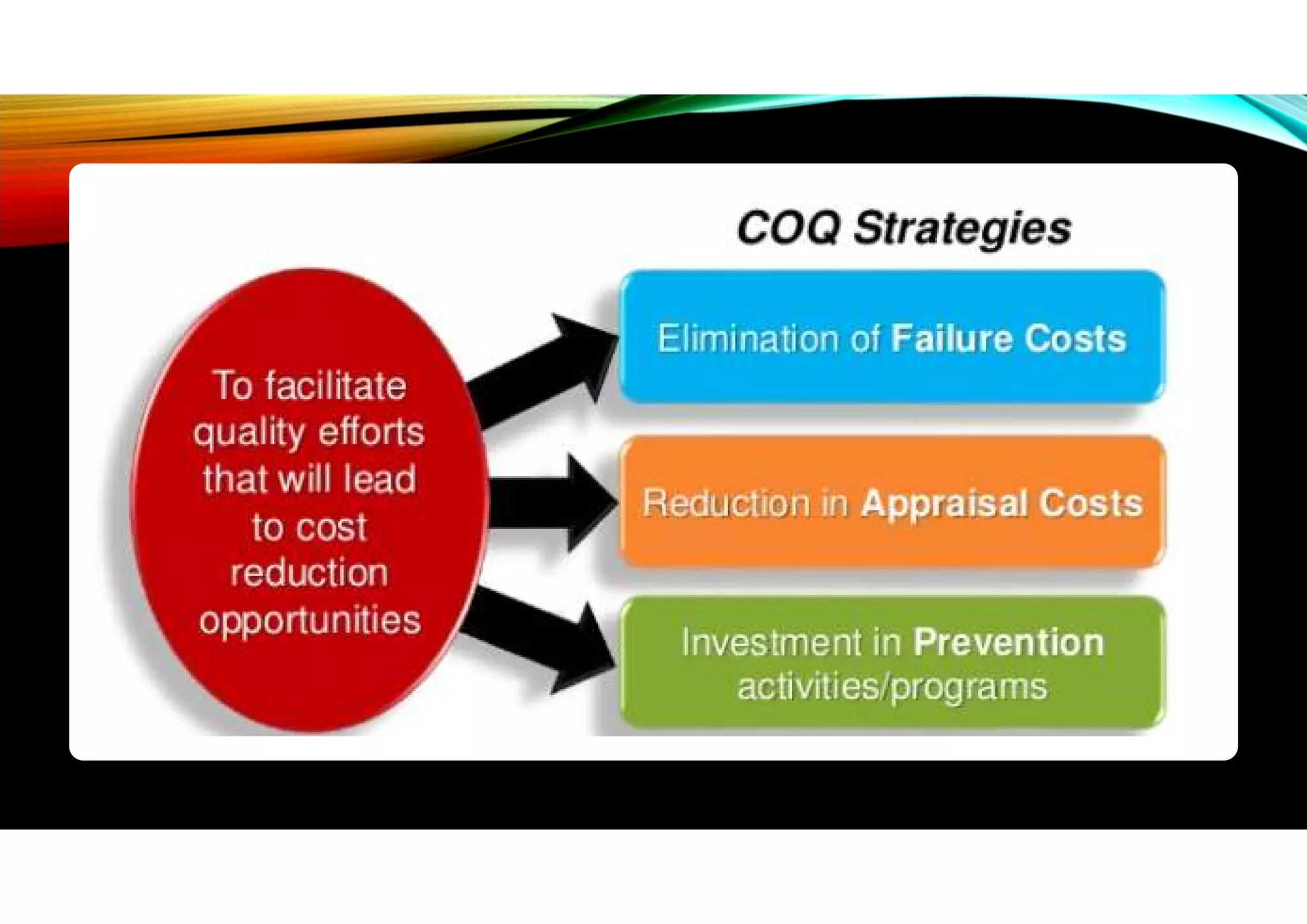
• Organizations must work to achieve
quality
• Strategy - continuous improvement
program
• In addition, organizations must work to
reduce the costs
• Therefore, it is important to measure
and report the cost of quality (CoQ)
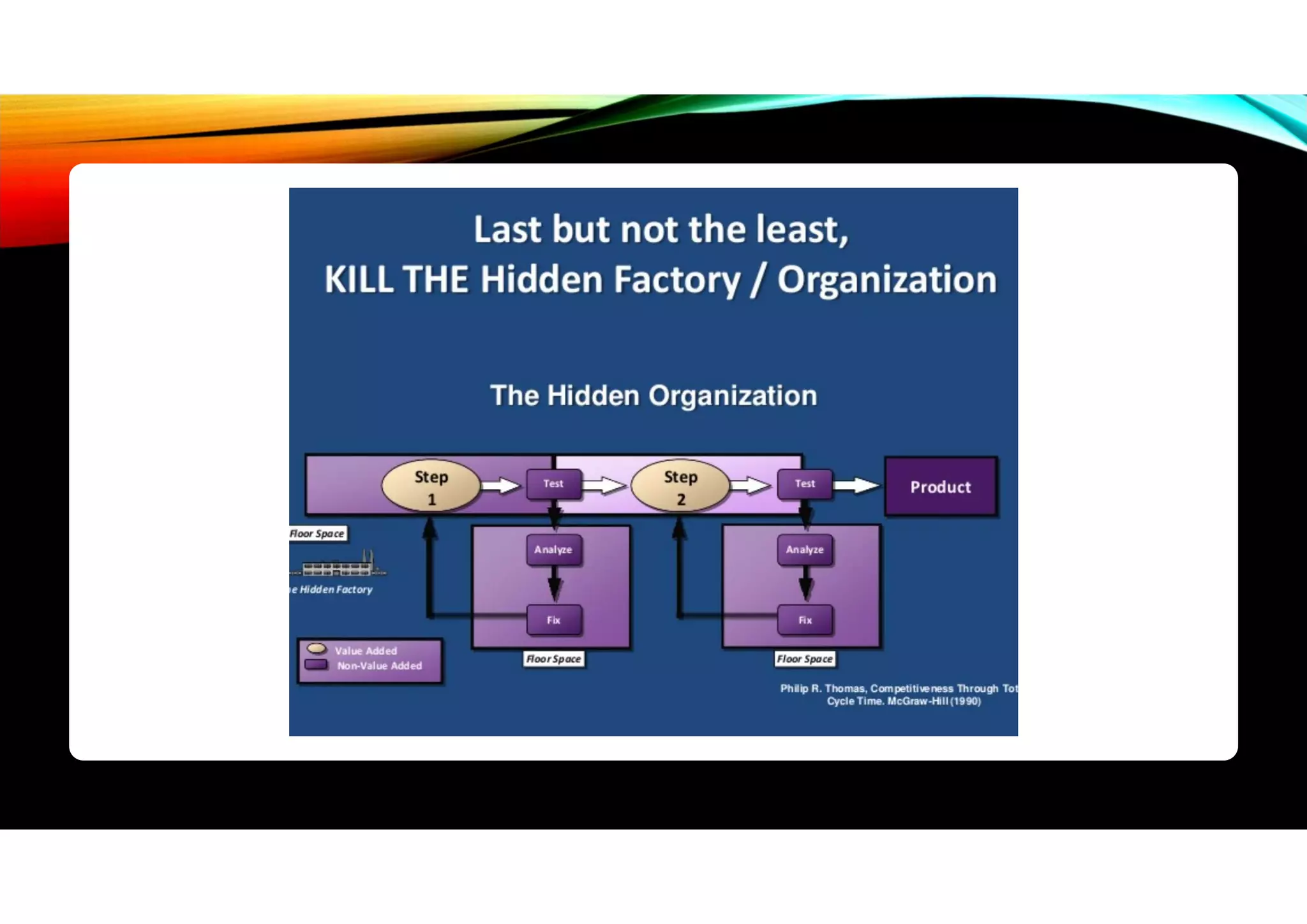
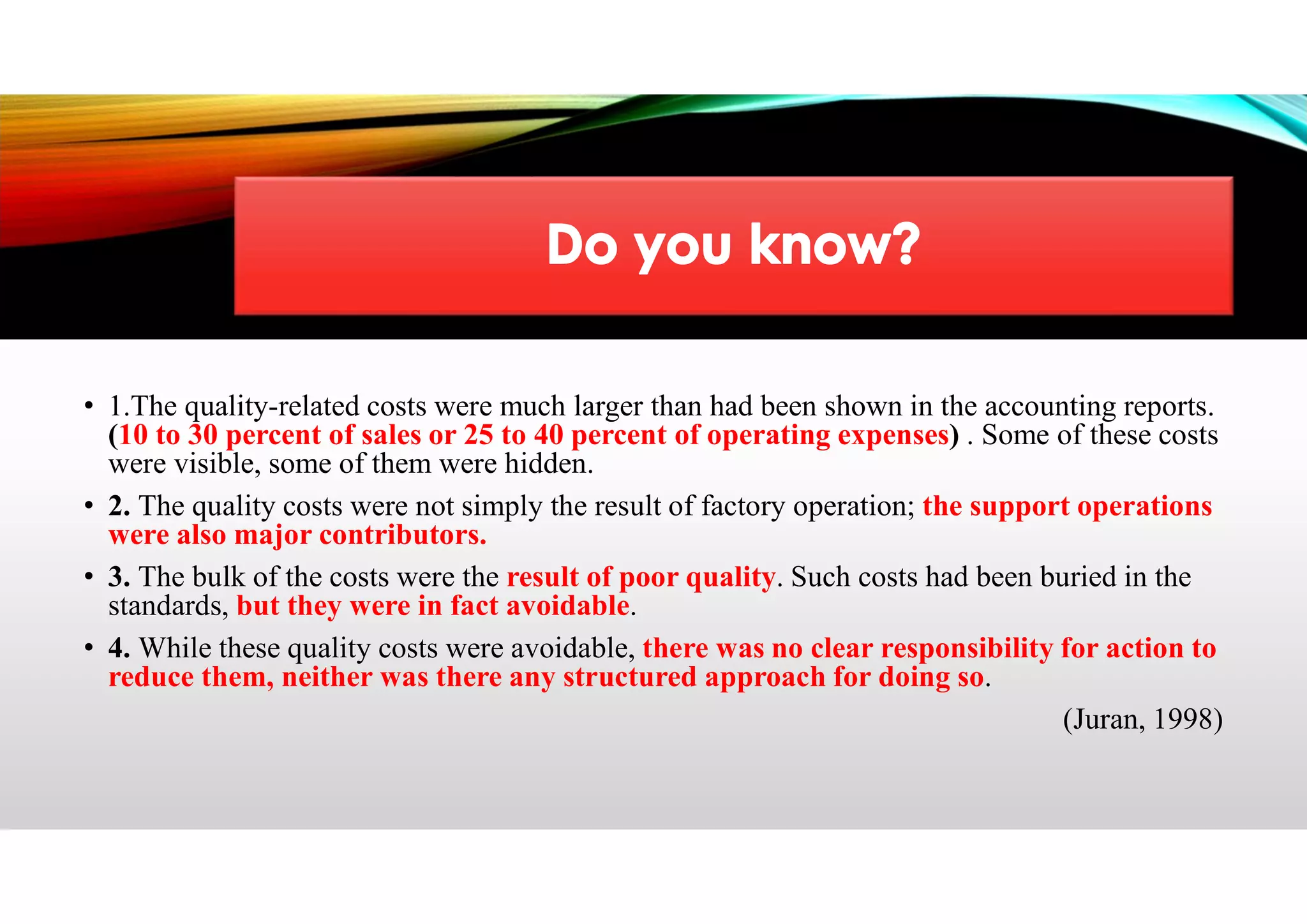
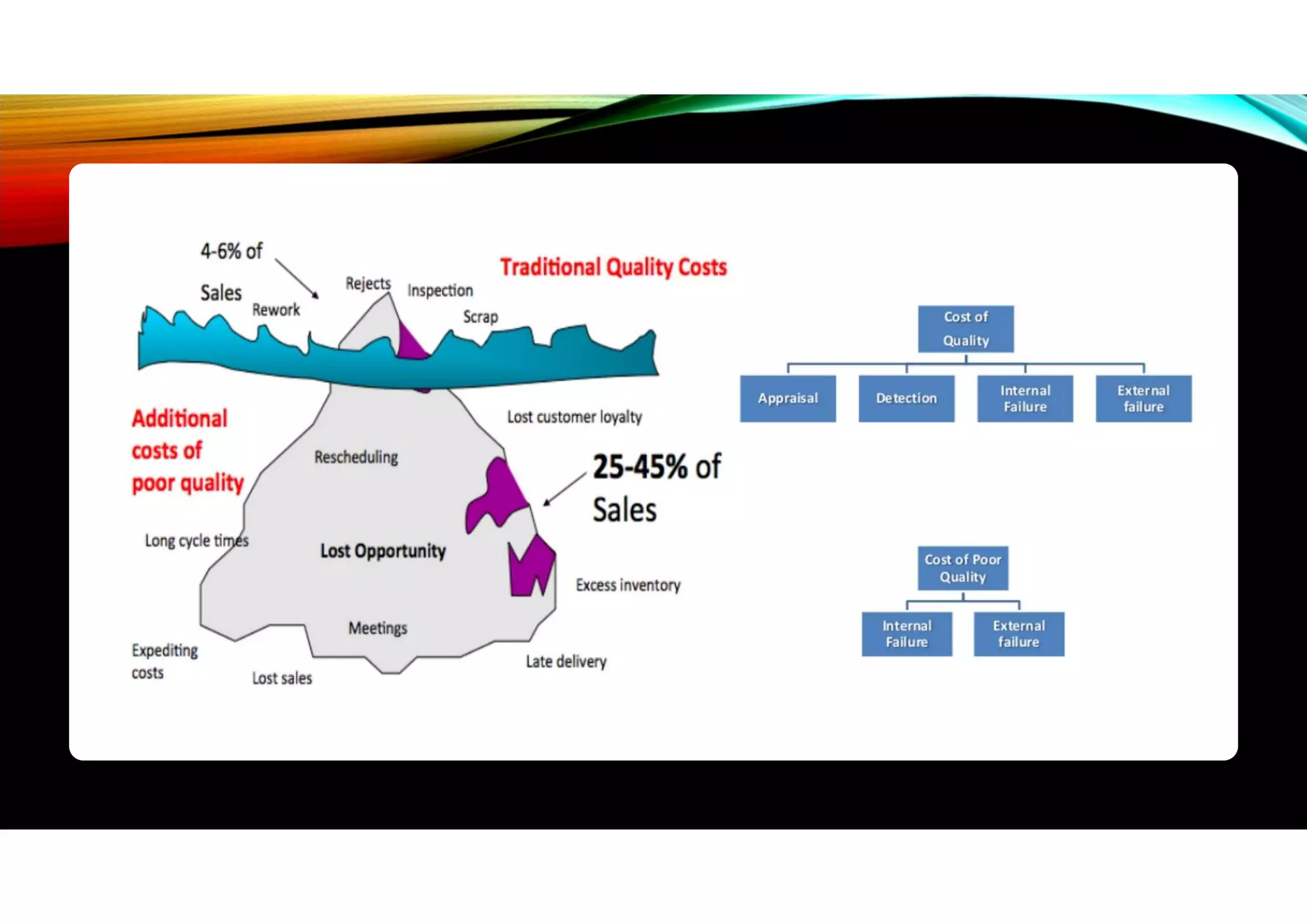
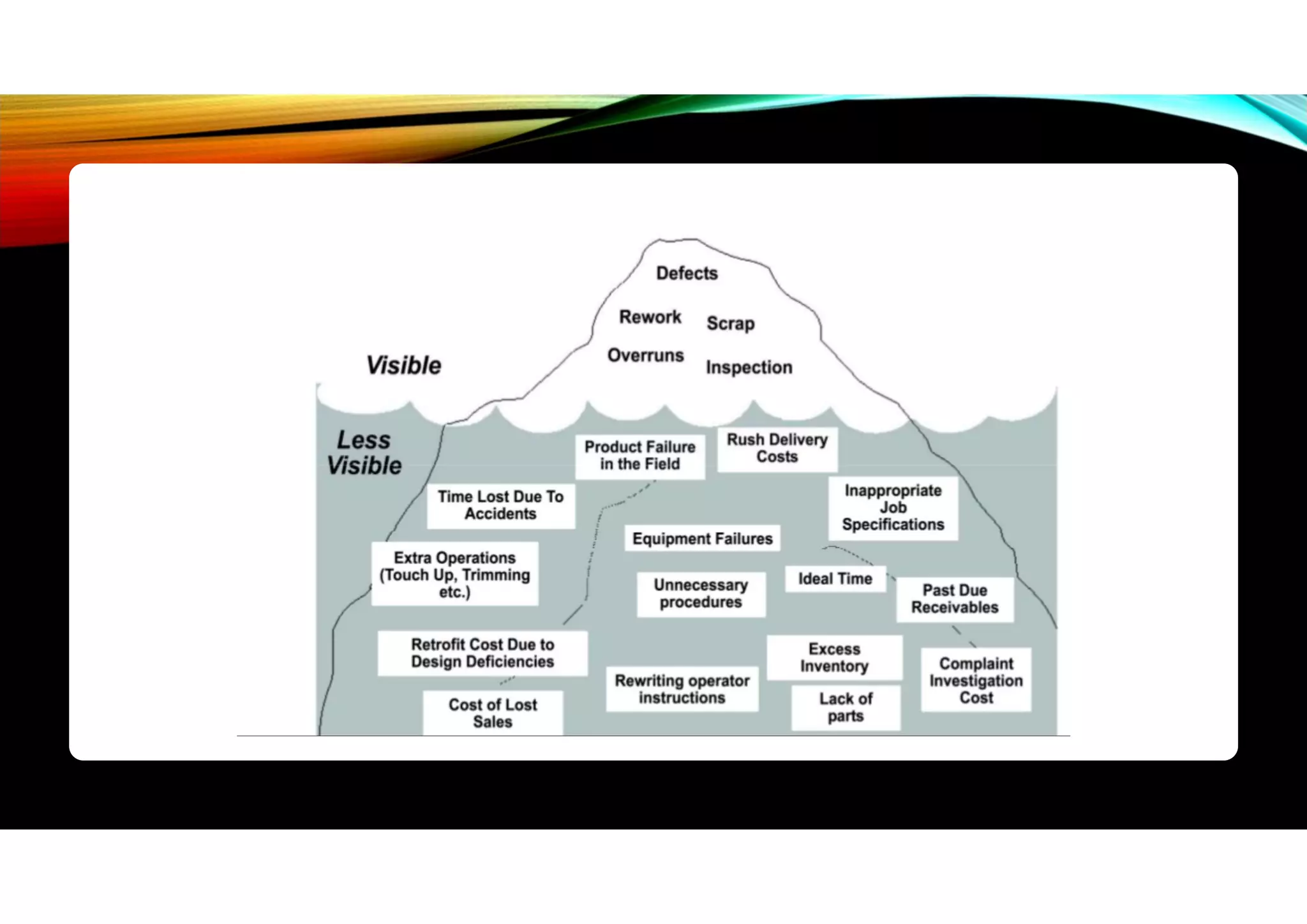
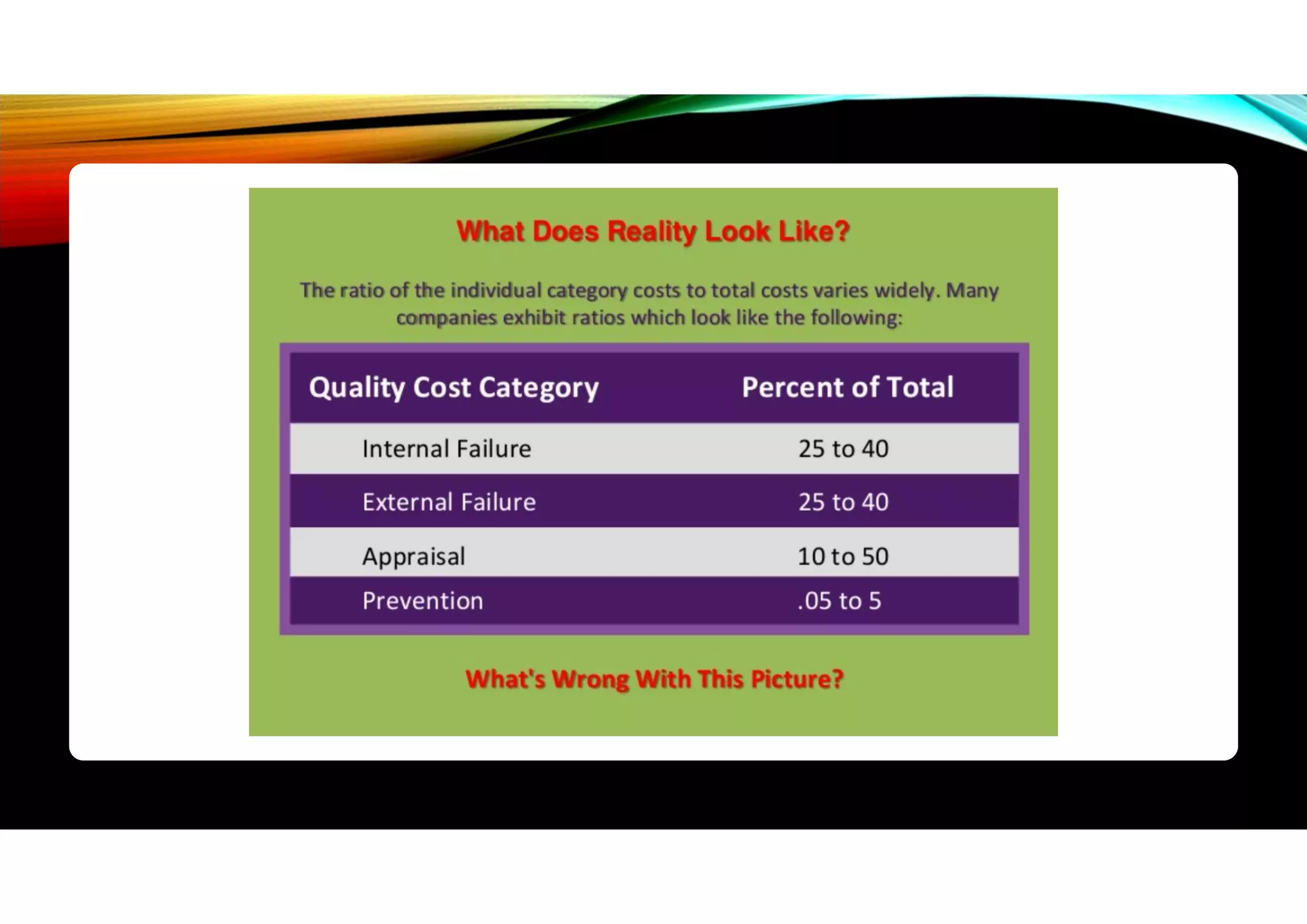
• 1.The quality-related costs were much larger than had been shown in the accounting reports.
(10 to 30 percent of sales or 25 to 40 percent of operating expenses) . Some of these costs
were visible, some of them were hidden.
• 2. The quality costs were not simply the result of factory operation; the support operations
were also major contributors.
• 3. The bulk of the costs were the result of poor quality. Such costs had been buried in the
standards, but they were in fact avoidable.
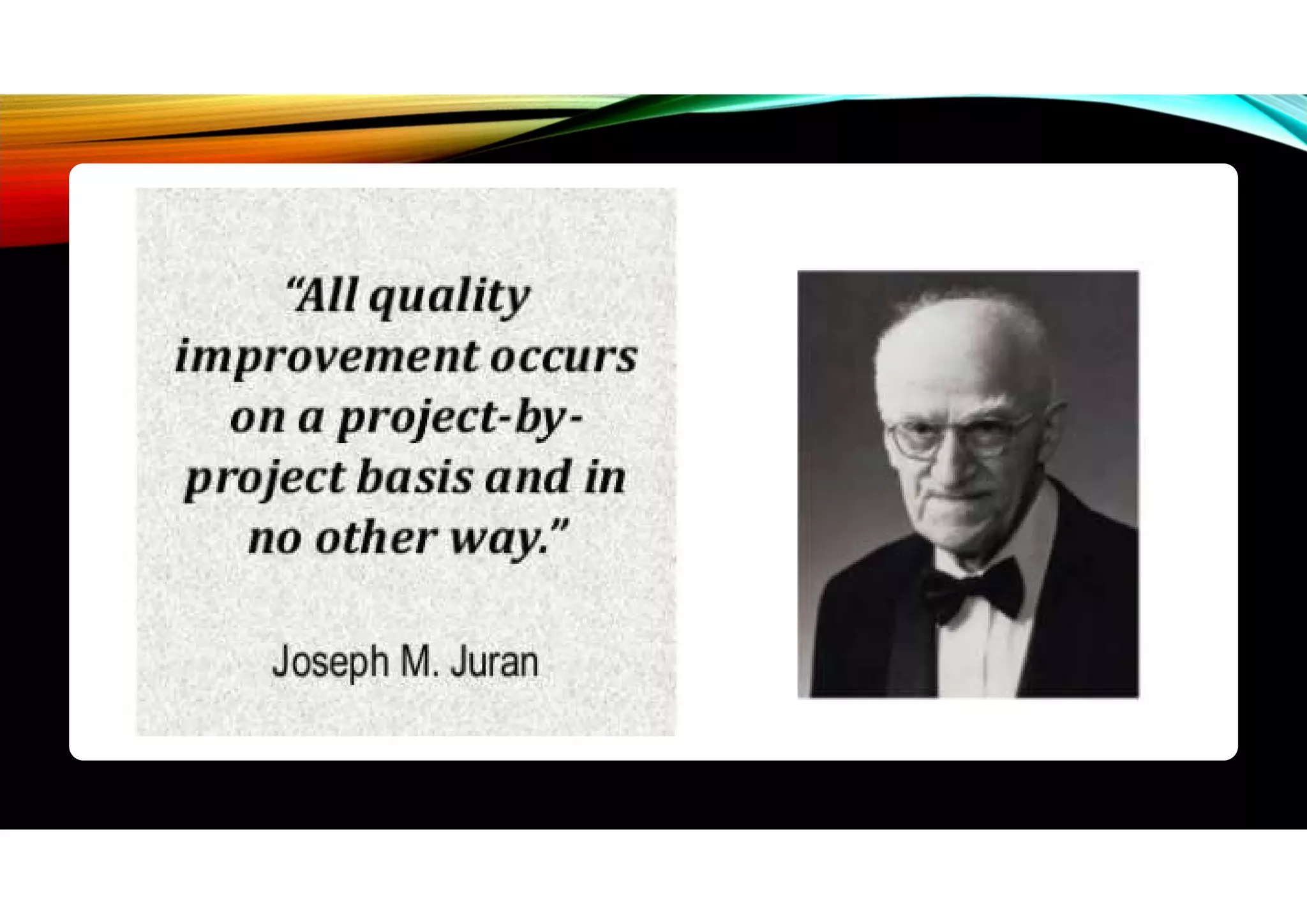
• 4. While these quality costs were avoidable, there was no clear responsibility for action to
reduce them, neither was there any structured approach for doing so.
(Juran, 1998)
• ISO Standard 8402, “totality of
characteristics of an entity that
bear on its ability to satisfy
stated or implied needs”
• "Quality Handbook", Joseph M. Juran provides two meanings that he considers of
critical importance to managing quality:
1) Quality means those features of products which meet customer
needs and thereby provide customer satisfaction. However, providing better
quality usually requires an investment and hence usually involves increases in
costs. Higher quality in this sense normally
"costs more".
2) Quality means "freedom from deficiencies" – freedom of errors that
require doing work over again or that result in field failures, customer
dissatisfaction, customer claims, etc. In this sense the meaning of quality is
oriented to costs and higher quality usually
"costs less".
• Quality costing has been primarily
used in the manufacturing
industry, but nowadays there is
a growing interest from
commerce, the public sector
and service organizations'
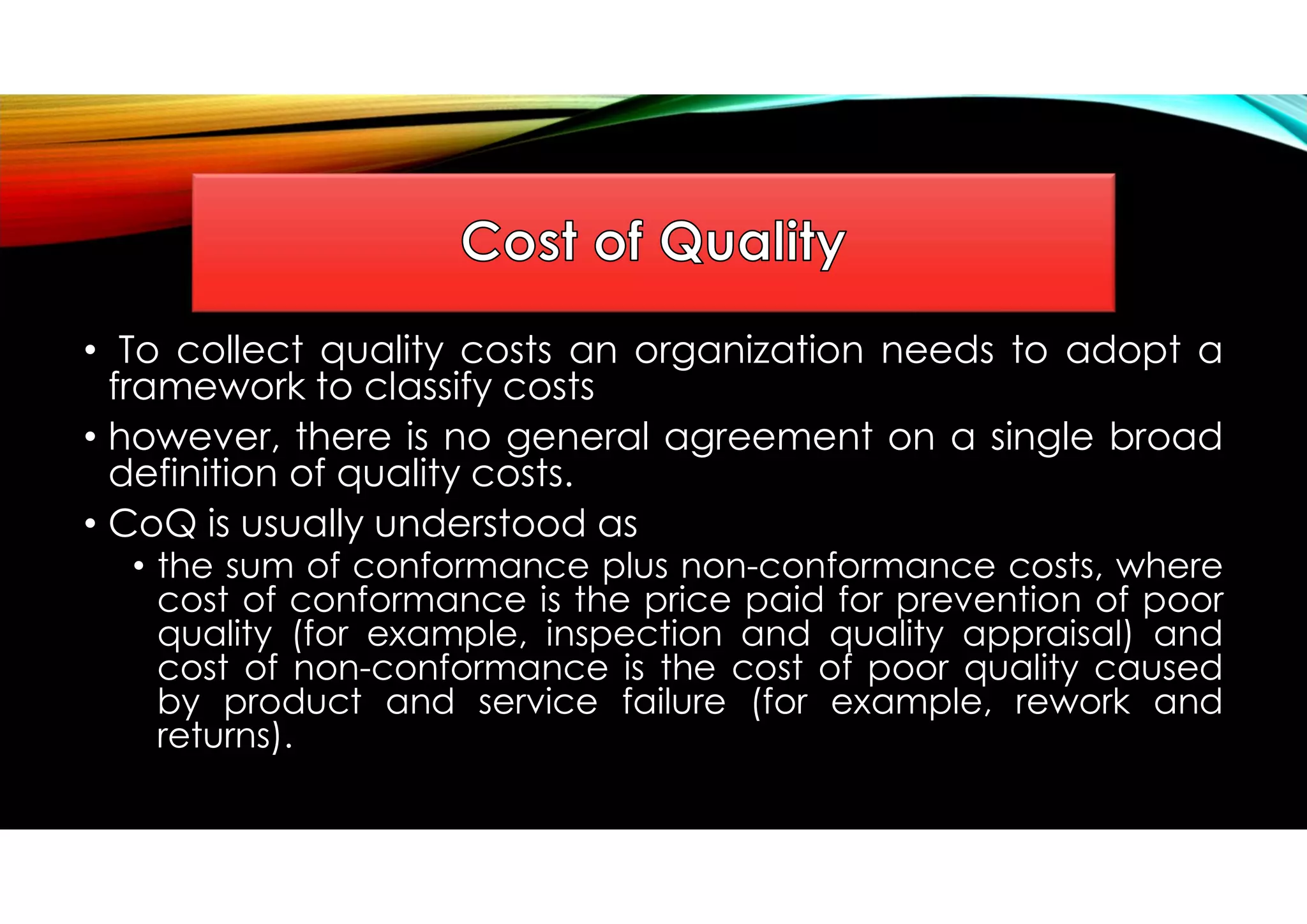
• To collect quality costs an organization needs to adopt a
framework to classify costs
• however, there is no general agreement on a single broad
definition of quality costs.
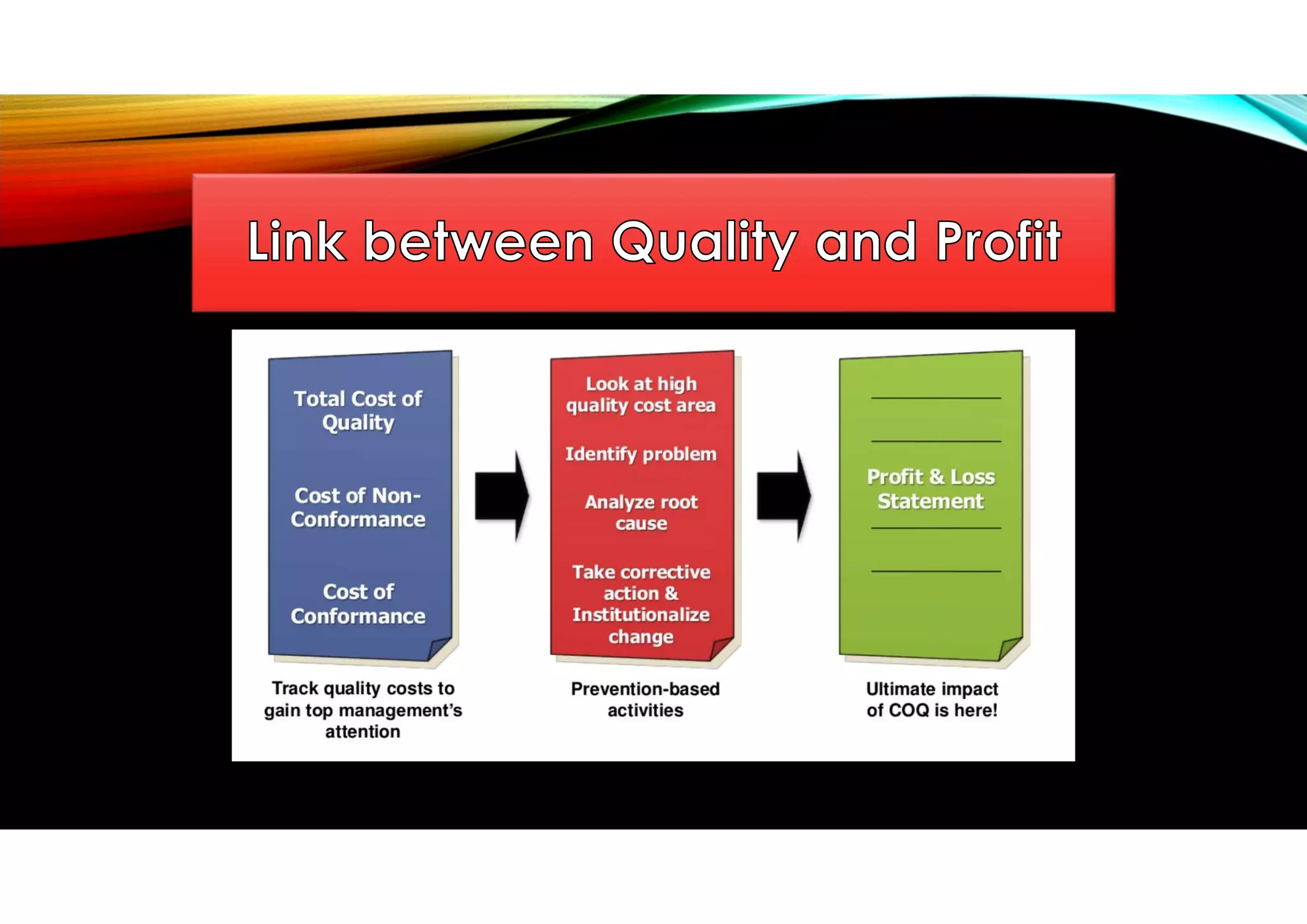
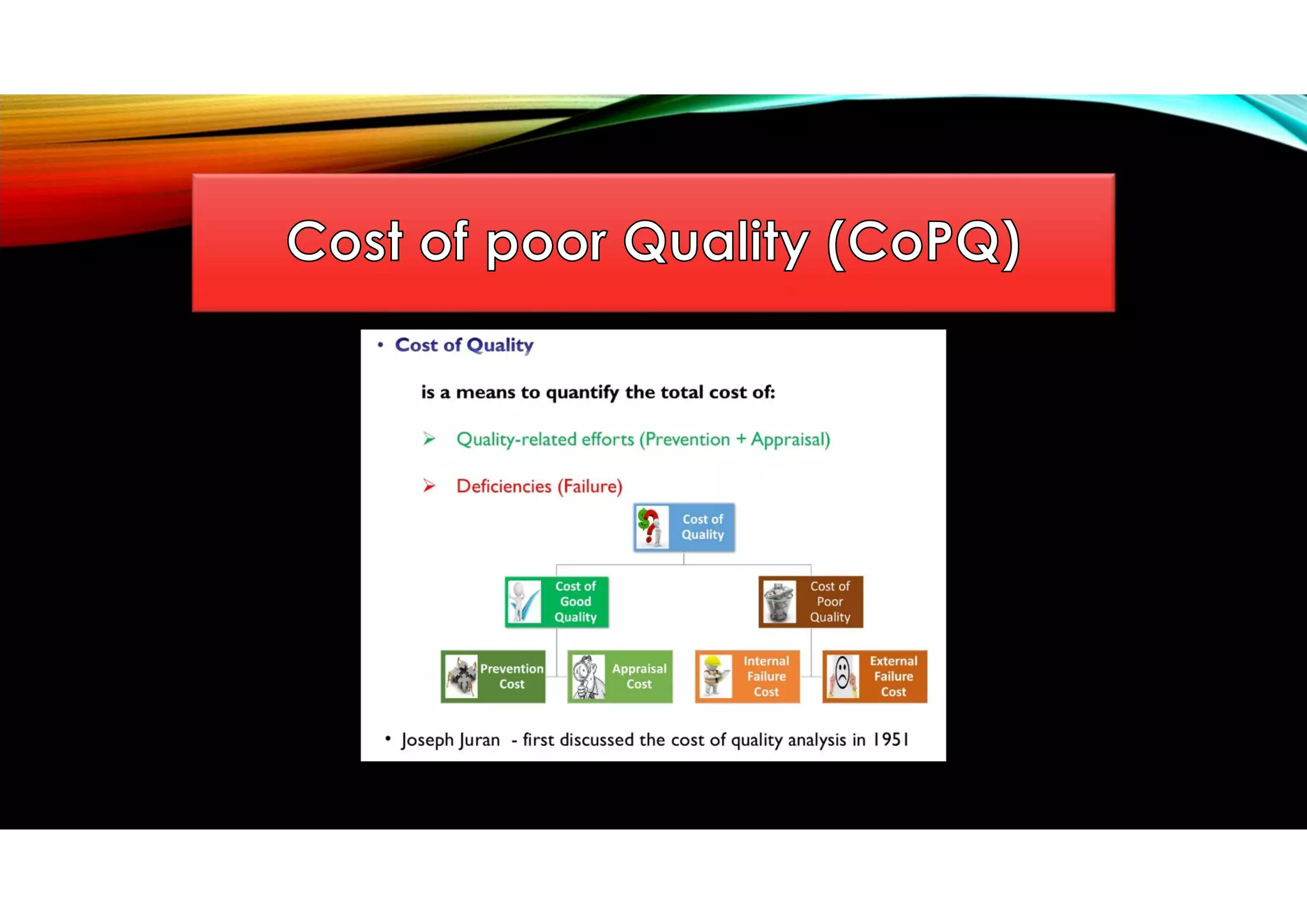
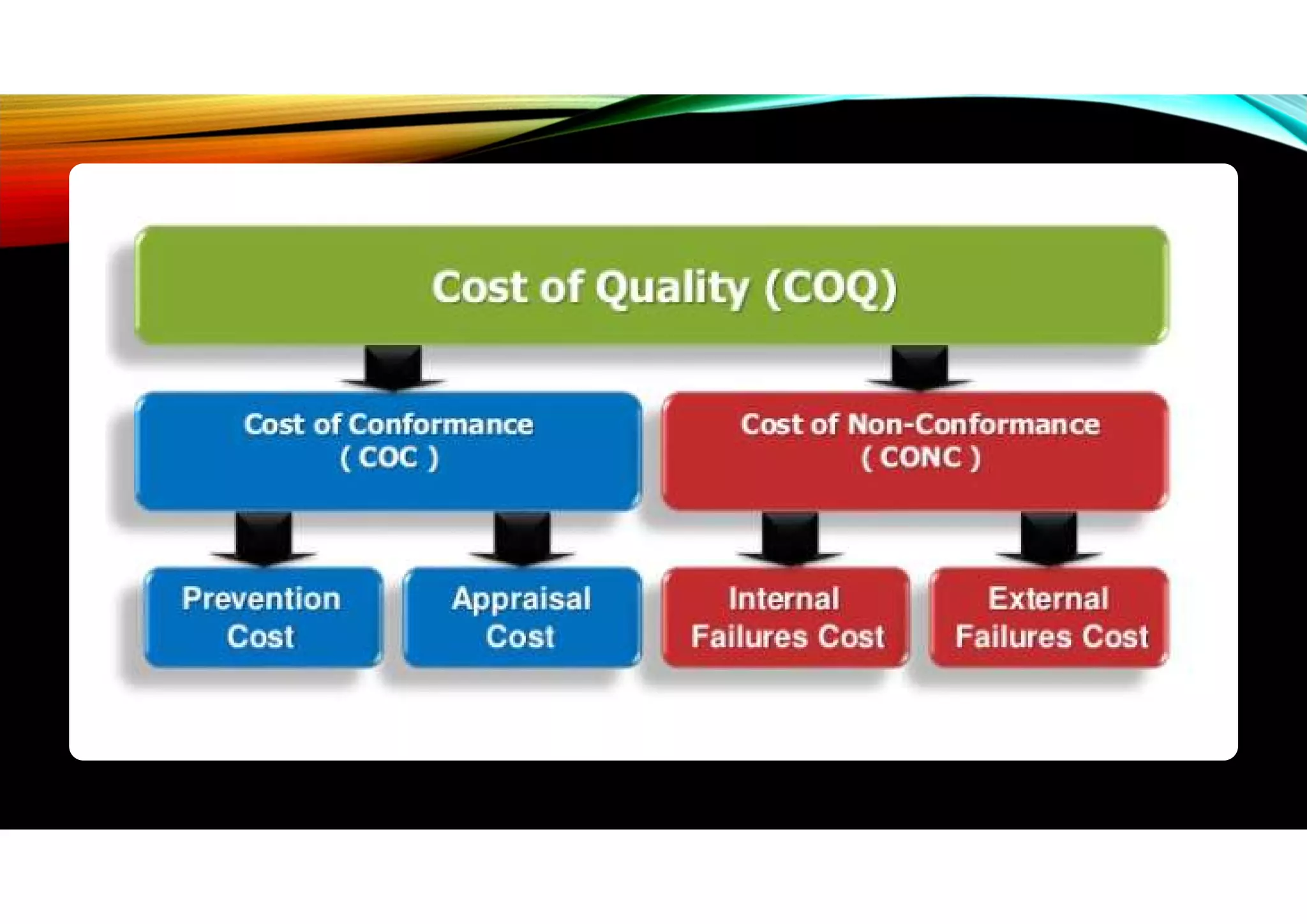
• CoQ is usually understood as
• the sum of conformance plus non-conformance costs, where
cost of conformance is the price paid for prevention of poor
quality (for example, inspection and quality appraisal) and
cost of non-conformance is the cost of poor quality caused
by product and service failure (for example, rework and
returns).
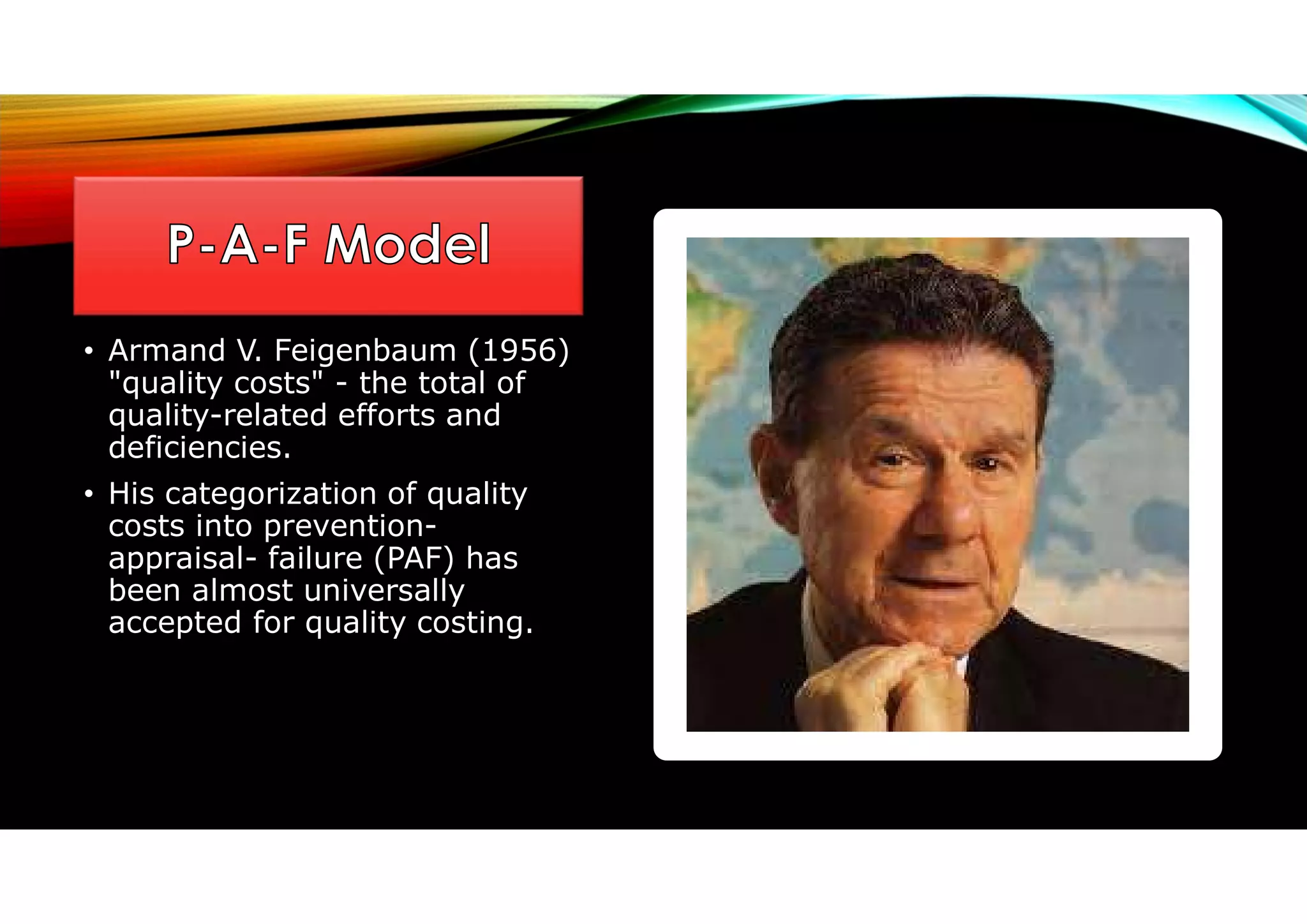
• Armand V. Feigenbaum (1956)
"quality costs" - the total of
quality-related efforts and
deficiencies.
• His categorization of quality
costs into prevention-
appraisal- failure (PAF) has
been almost universally
accepted for quality costing.
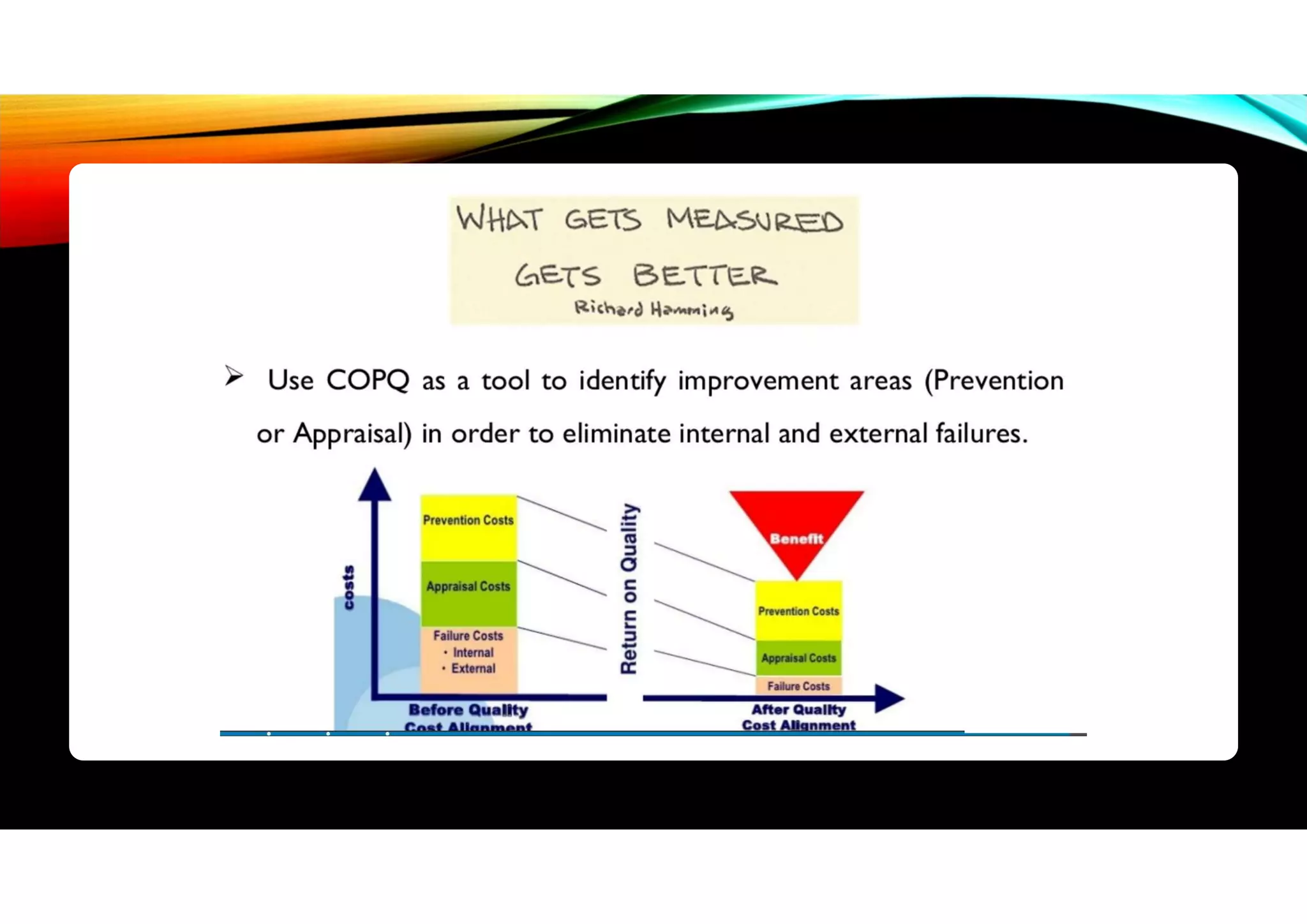
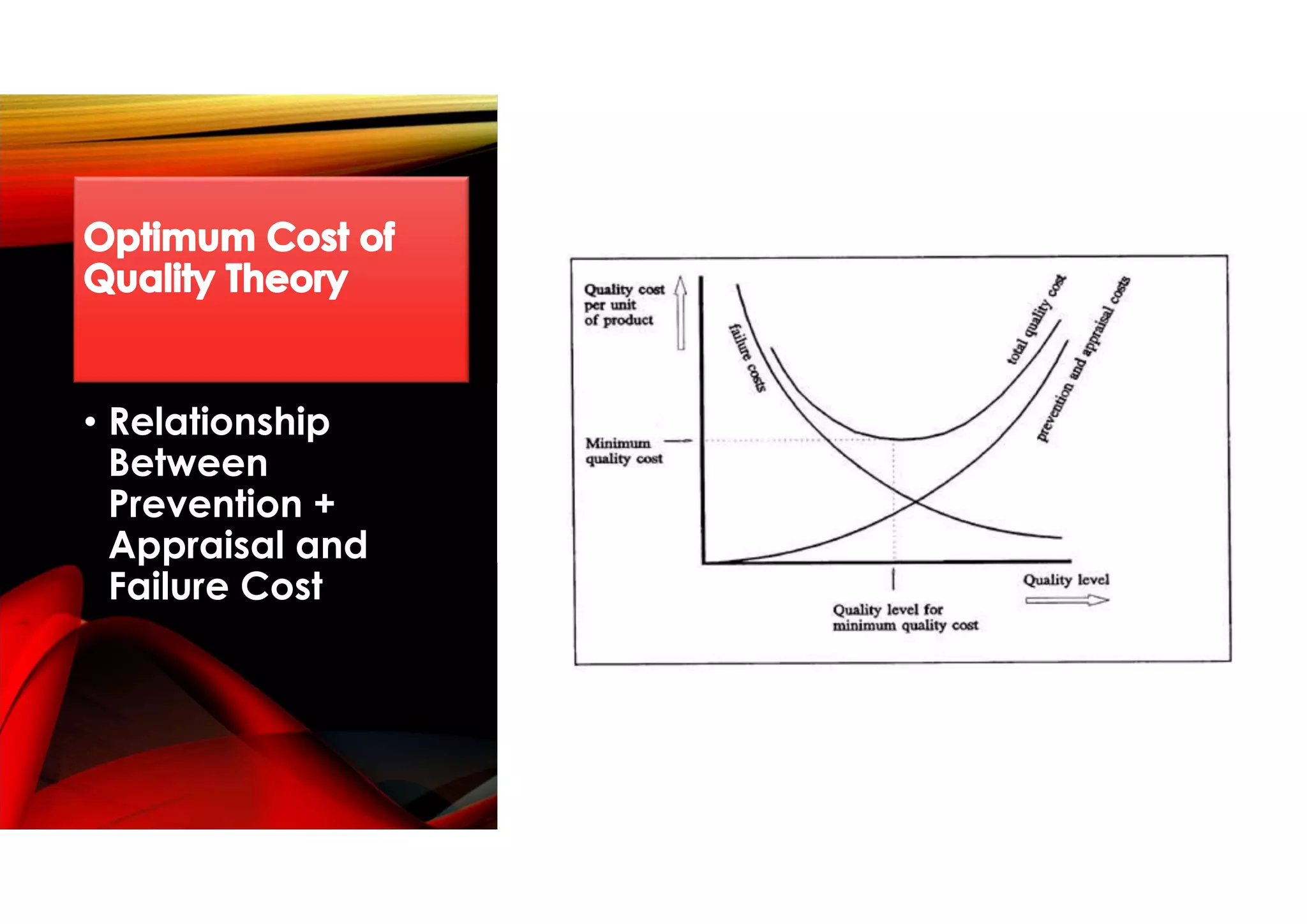
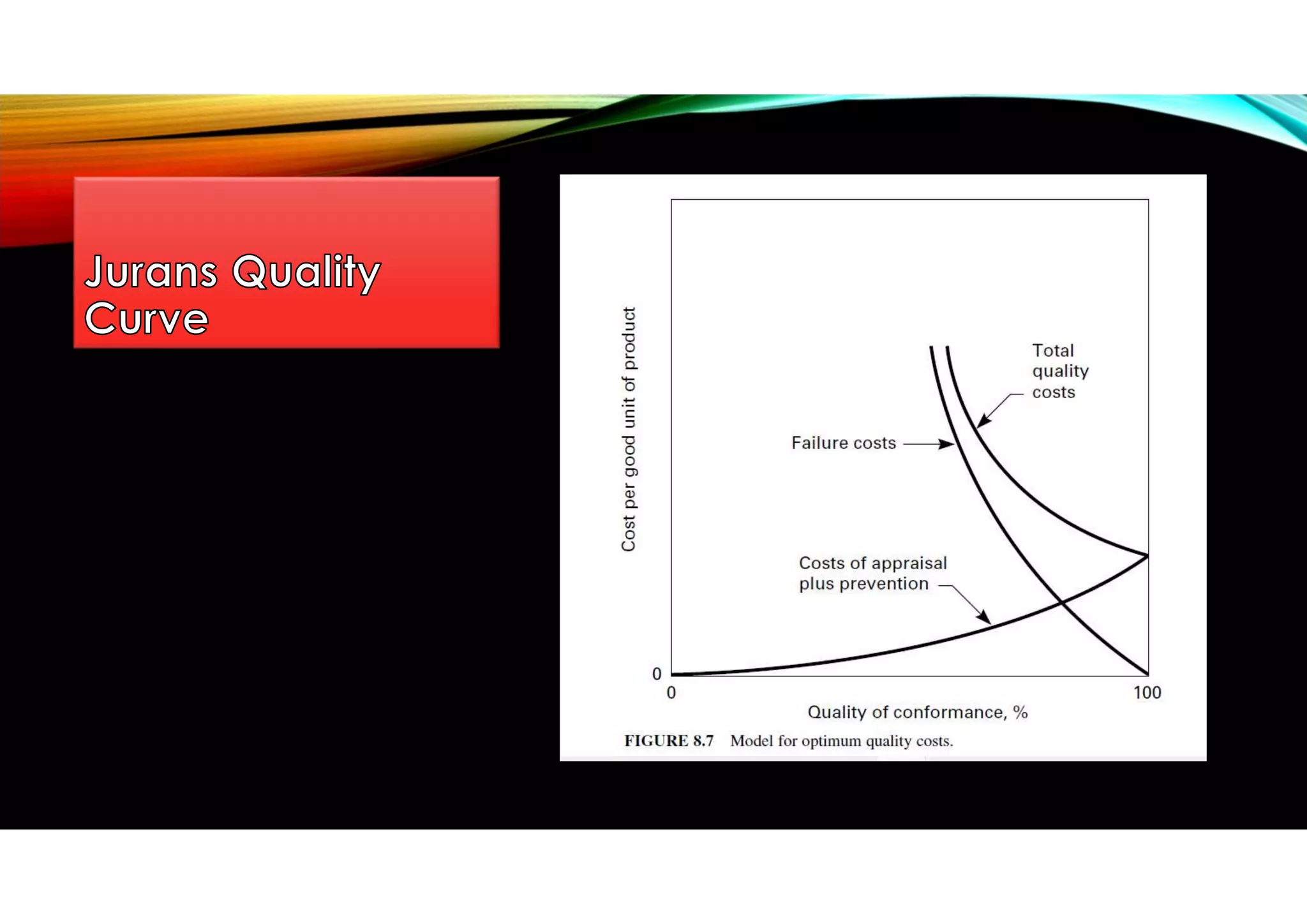
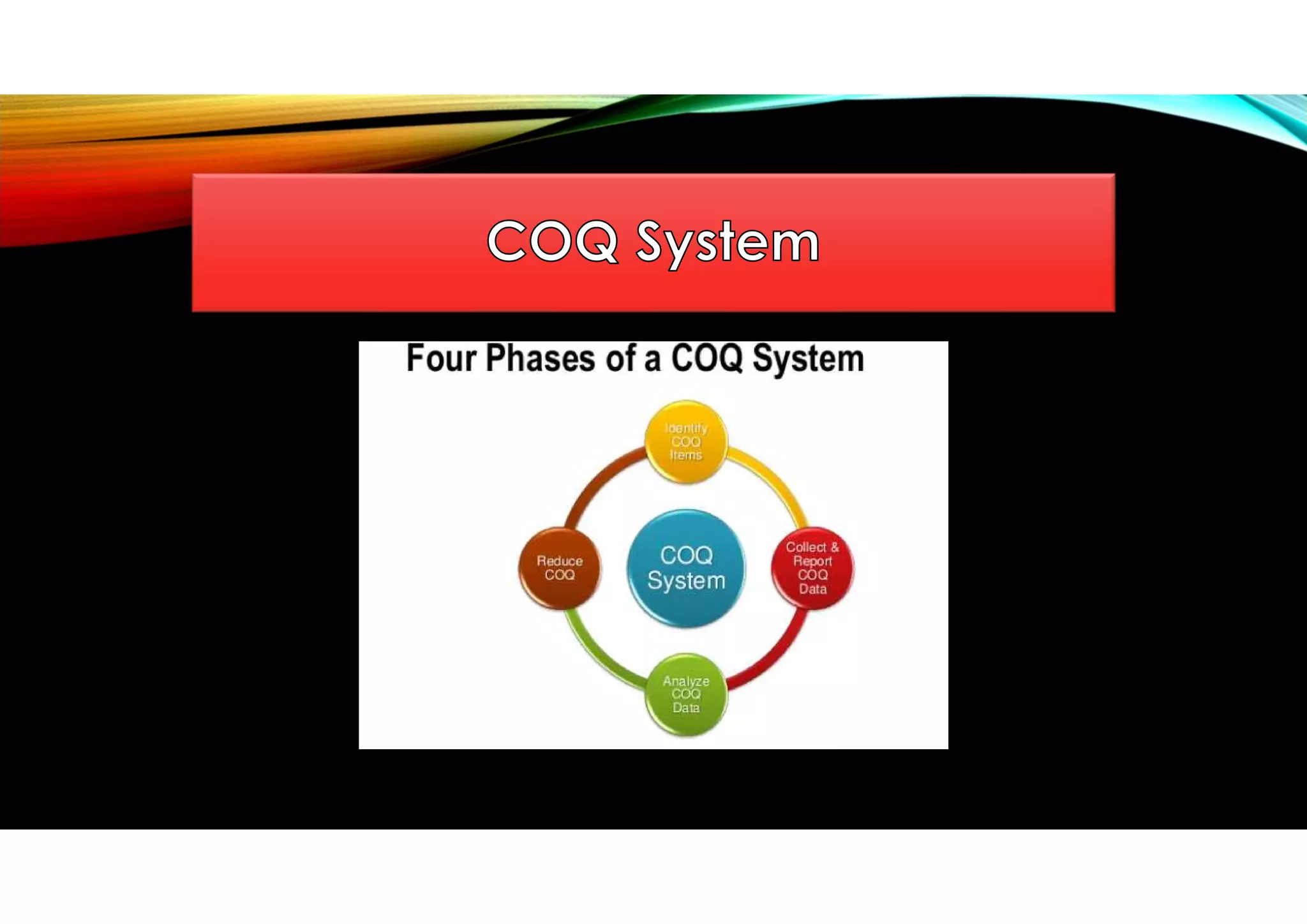
•The objective of a CoQ
system is to find the level
of quality that minimizes
total CoQ
• The basic idea of the P-A-
F model are that
investment in prevention
and appraisal activities
will reduce failure costs,
and that further
investment in prevention
activities will reduce
appraisal costs
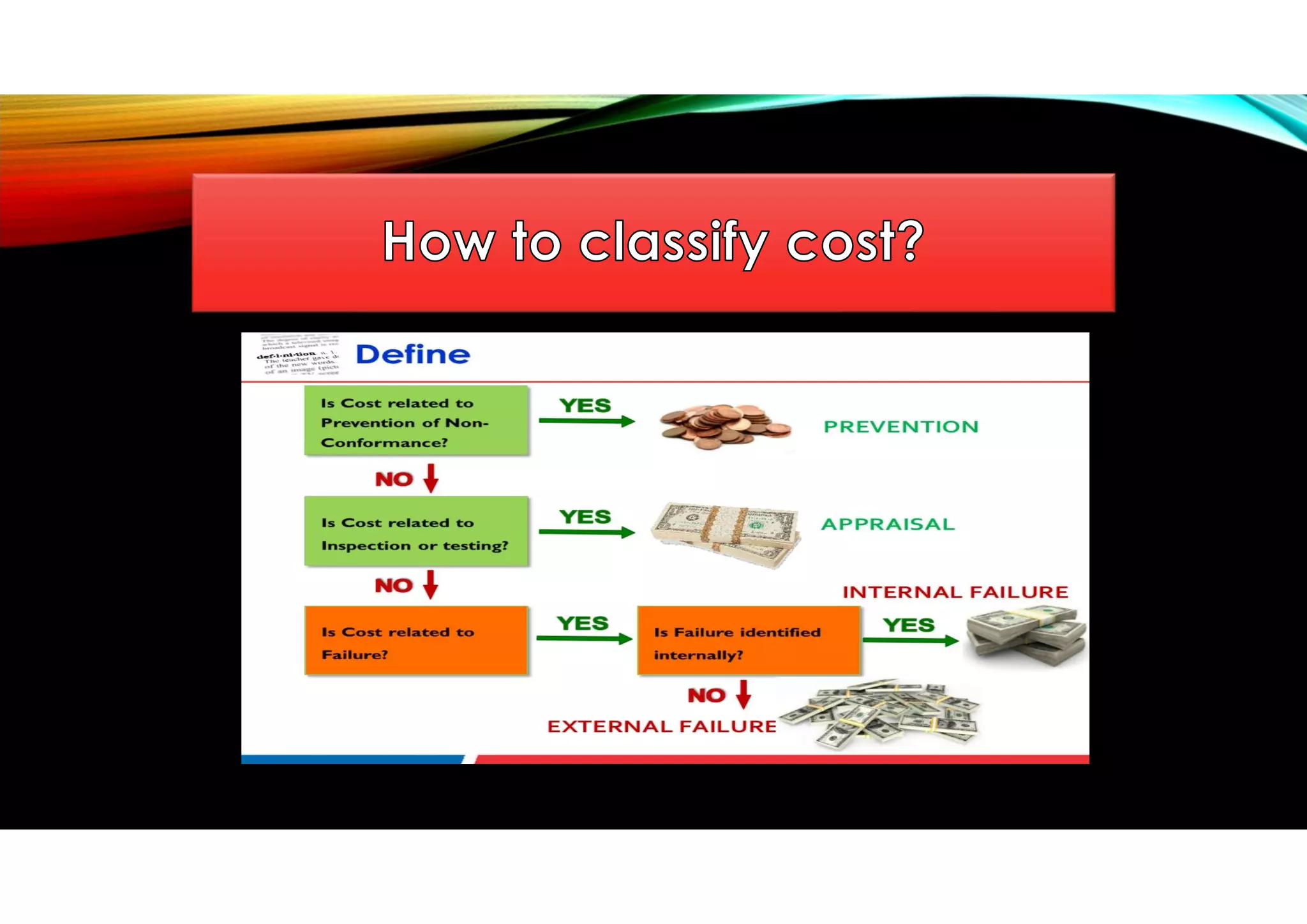
• Prevention costs are associated with all activities
specifically designed to prevent poor quality in
products or services.
• The costs of new product review
• Quality planning
• Supplier capability surveys
• Process capability evaluations
• Quality improvement team meetings
• Quality improvement projects,
• Design for six sigma
• Kaizen teams
• SPC (x & r)
• Poka-yoke (error proofing) devices quality
• Education
• Quality training.
The cost incurred to prevent the problem in the future
• Appraisal costs are costs associated
with measuring, evaluating, or
auditing products or services to
assure conformance to quality
standards and performance
requirements.
• Inspection/test of purchased material
• Validation, verification, checking ,
activities
• In-process and final inspection/test
• Product, process, or service audits
• Required compliance system costs (such
as those needed for ISO)
• Calibration of measuring and test
equipment
• Appraisal costs are costs associated with measuring,
evaluating, or auditing products or services to
assure conformance to quality standards and
performance requirements.
• Inspection/test of purchased material
• Validation, verification, checking , activities
• In-process and final inspection/test
• Product, process, or service audits
• Required compliance system costs (such as
those needed for iso)
• Calibration of measuring and test equipment
• Failure costs are costs resulting
from products or services not
conforming to requirements
or customer/user needs, that
is, the costs resulting from
poor quality.
• Failure costs are divided into
internal and external failure
cost categories
• Internal failure costs occur prior to
delivery or shipment of the
product or the furnishing of a
service.
• Costs of scrap
• Rework
• re-inspection
• re-testing material review
• Downgrading
• unplanned overtime
• External failure costs occur after delivery or shipment of the
product or during or after furnishing of a service.
• Costs of processing customer complaints
• Necessary field service
• Customer returns
• Warranty claims
• Product recalls
• Sometimes third-party
• Additional transport cost incurred to and from the
customer
• Replacement of poor product
• Replacement of poor product reduces capacity
• Drives more overtime
•“quality costs”
means the cost of
poor quality
•Cost of poor-
quality costs of
finding and
correcting
defective work)
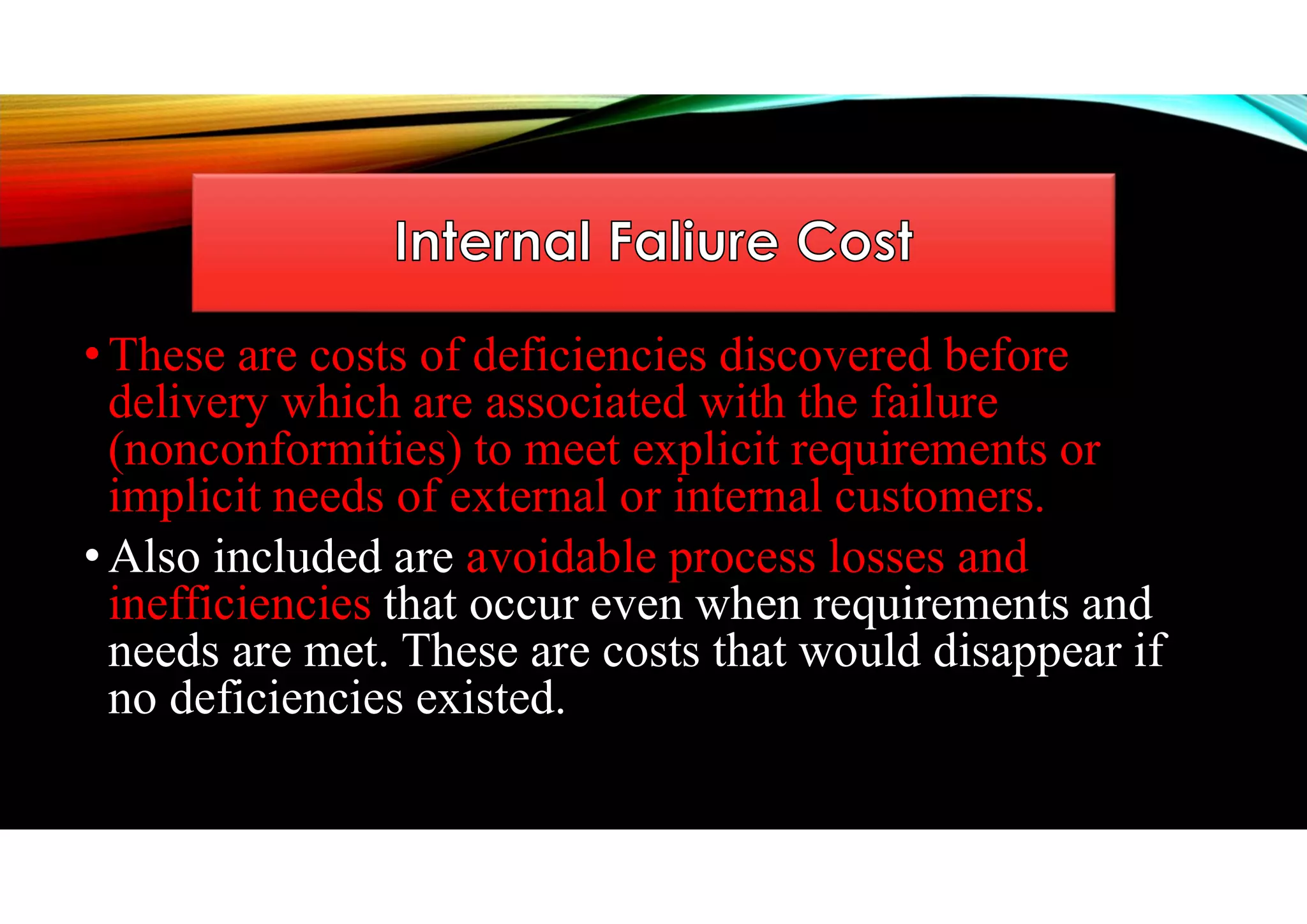
• These are costs of deficiencies discovered before
delivery which are associated with the failure
(nonconformities) to meet explicit requirements or
implicit needs of external or internal customers.
• Also included are avoidable process losses and
inefficiencies that occur even when requirements and
needs are met. These are costs that would disappear if
no deficiencies existed.
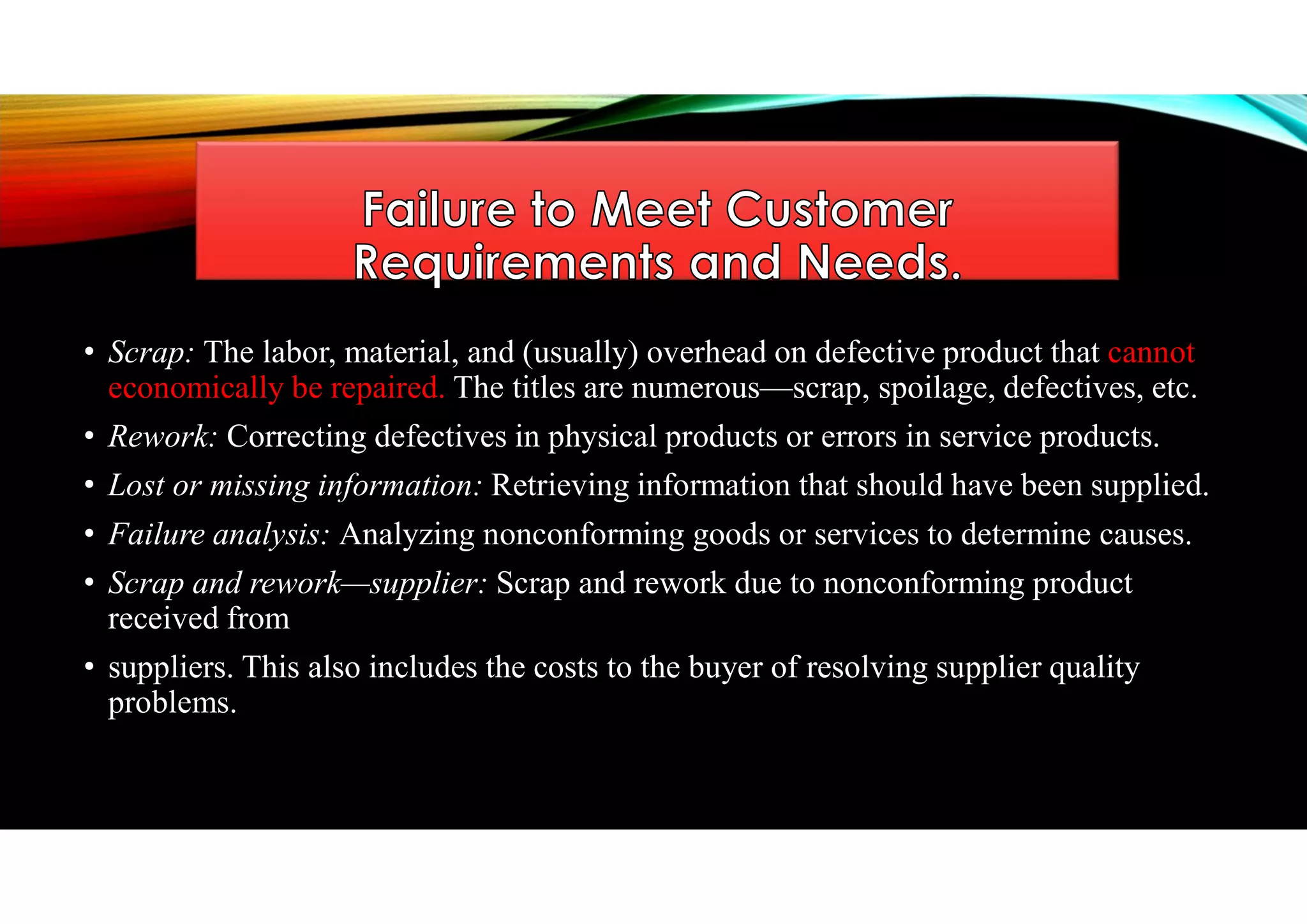
• Scrap: The labor, material, and (usually) overhead on defective product that cannot
economically be repaired. The titles are numerous—scrap, spoilage, defectives, etc.
• Rework: Correcting defectives in physical products or errors in service products.
• Lost or missing information: Retrieving information that should have been supplied.
• Failure analysis: Analyzing nonconforming goods or services to determine causes.
• Scrap and rework—supplier: Scrap and rework due to nonconforming product
received from
• suppliers. This also includes the costs to the buyer of resolving supplier quality
problems.
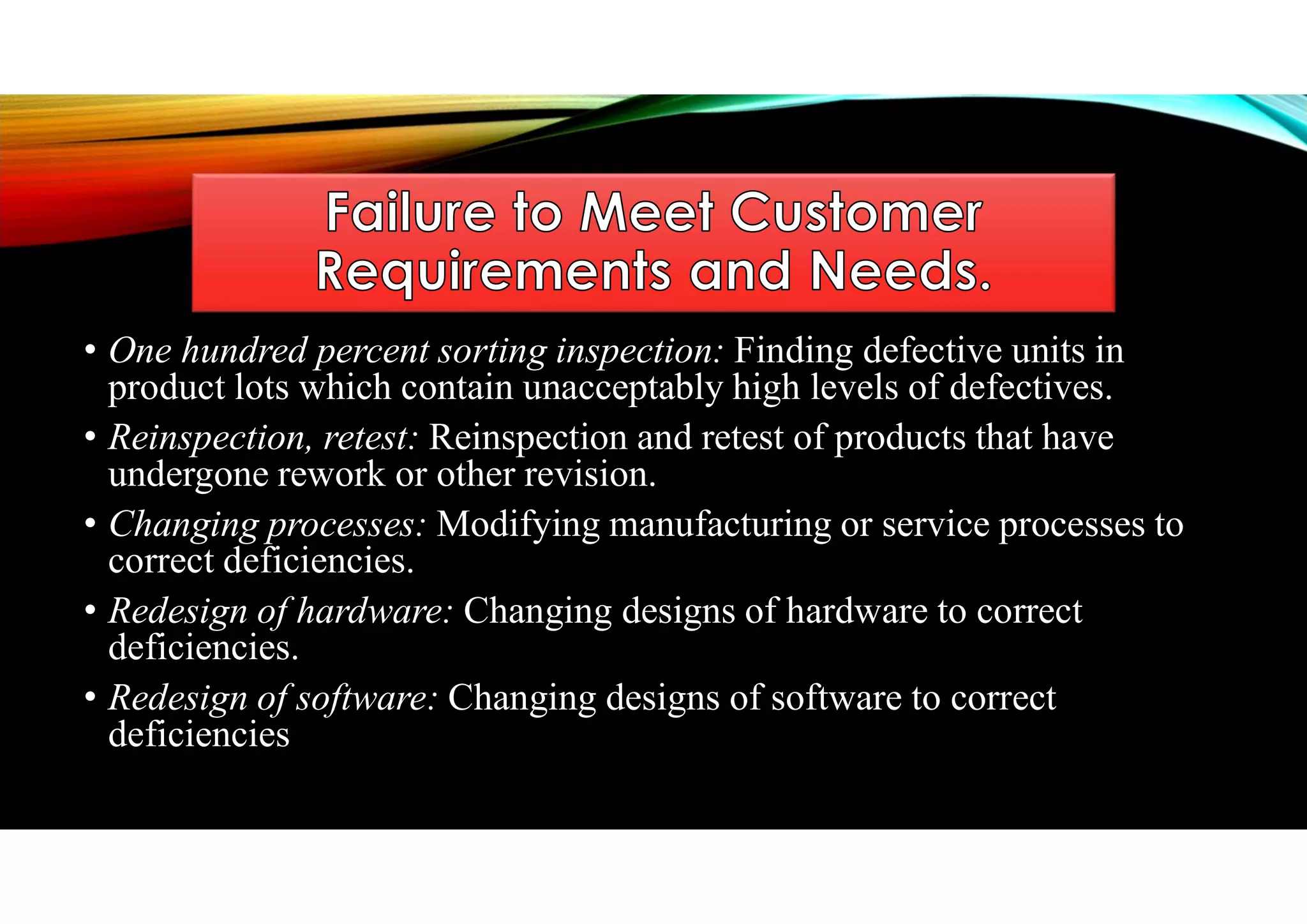
• One hundred percent sorting inspection: Finding defective units in
product lots which contain unacceptably high levels of defectives.
• Reinspection, retest: Reinspection and retest of products that have
undergone rework or other revision.
• Changing processes: Modifying manufacturing or service processes to
correct deficiencies.
• Redesign of hardware: Changing designs of hardware to correct
deficiencies.
• Redesign of software: Changing designs of software to correct
deficiencies
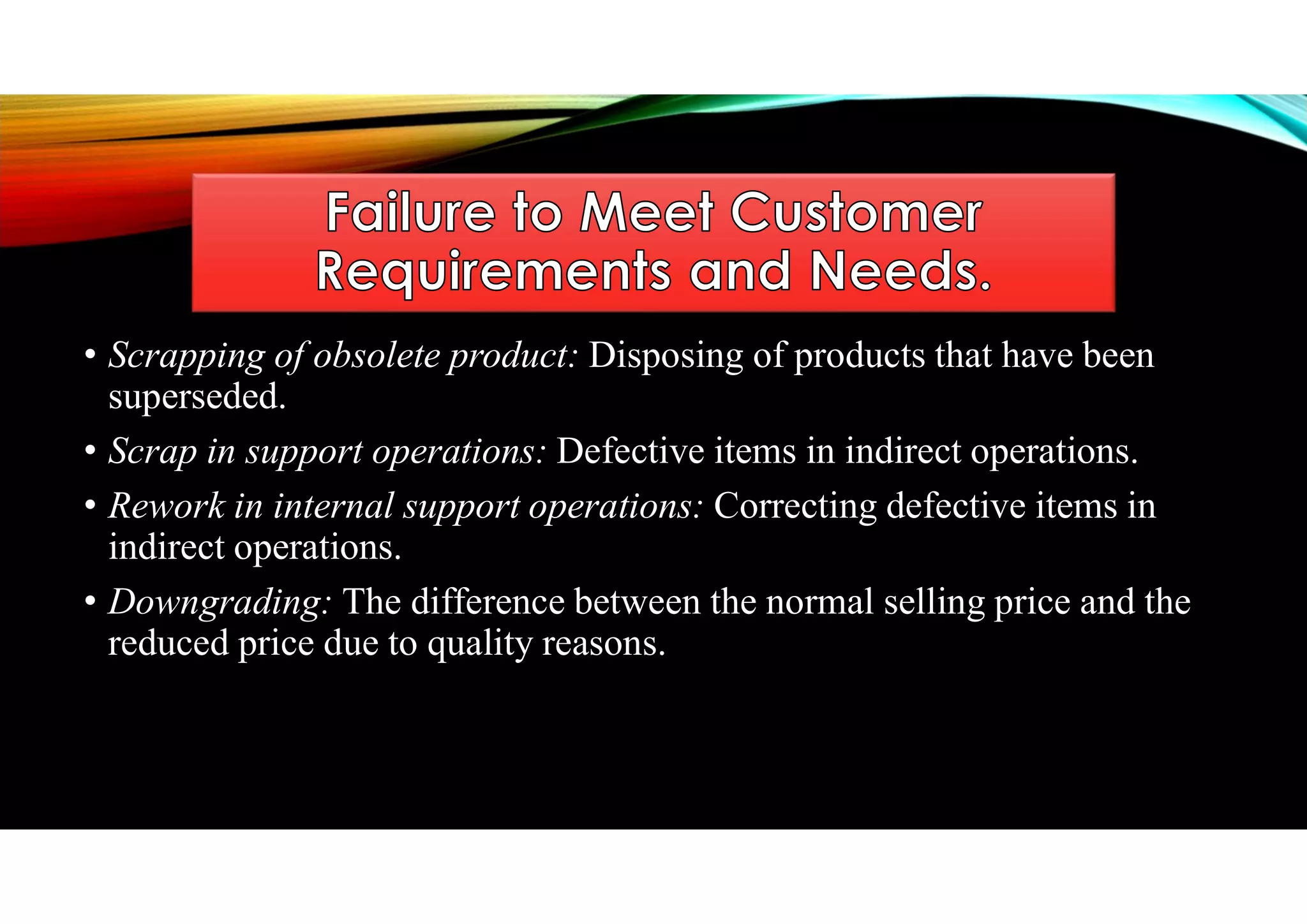
• Scrapping of obsolete product: Disposing of products that have been
superseded.
• Scrap in support operations: Defective items in indirect operations.
• Rework in internal support operations: Correcting defective items in
indirect operations.
• Downgrading: The difference between the normal selling price and the
reduced price due to quality reasons.
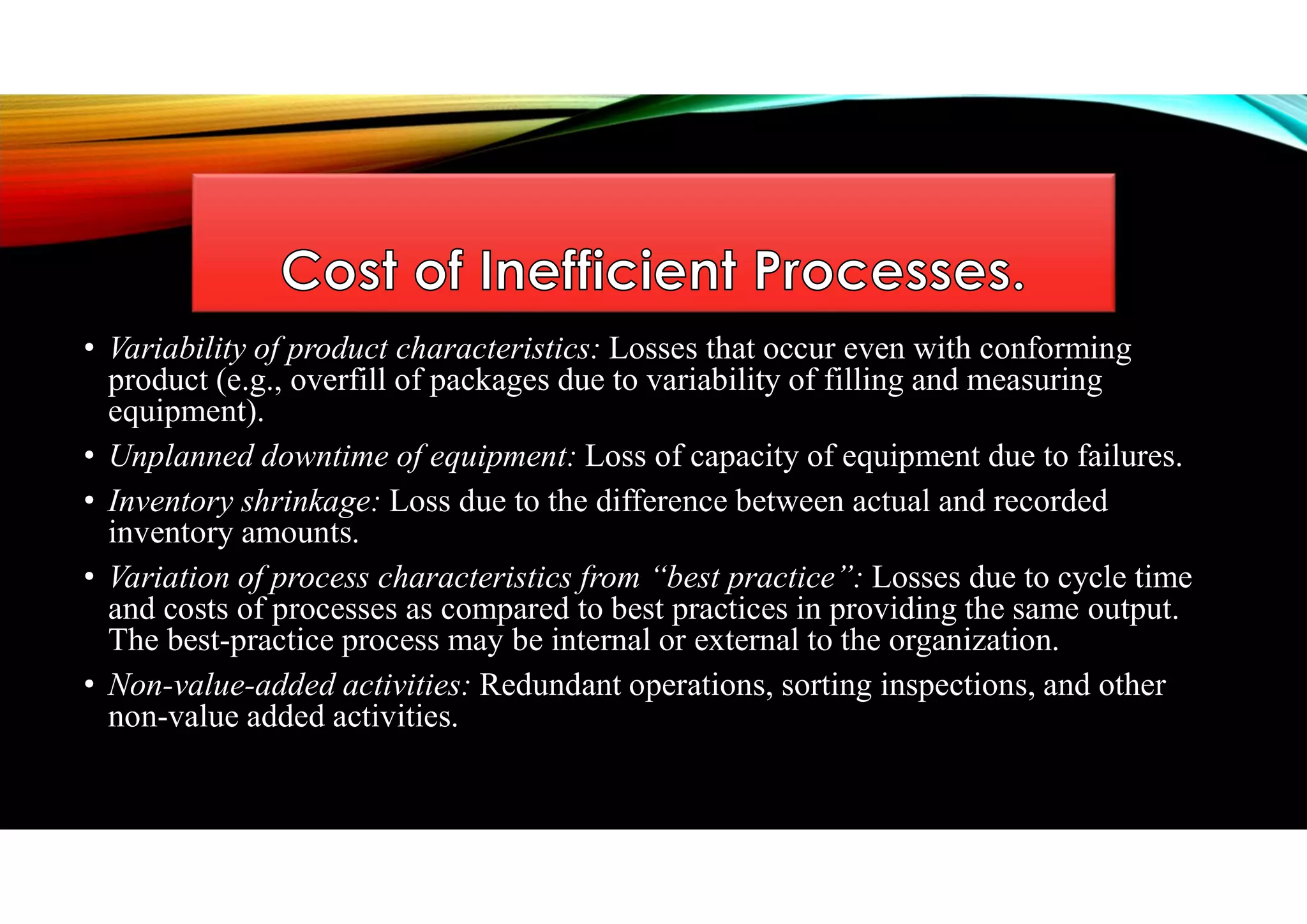
• Variability of product characteristics: Losses that occur even with conforming
product (e.g., overfill of packages due to variability of filling and measuring
equipment).
• Unplanned downtime of equipment: Loss of capacity of equipment due to failures.
• Inventory shrinkage: Loss due to the difference between actual and recorded
inventory amounts.
• Variation of process characteristics from “best practice”: Losses due to cycle time
and costs of processes as compared to best practices in providing the same output.
The best-practice process may be internal or external to the organization.
• Non-value-added activities: Redundant operations, sorting inspections, and other
non-value added activities.
• These are costs associated with deficiencies
that are found after product is received by the
customer.
• Also included are lost opportunities for sales
revenue. These costs also would disappear if
there were no deficiencies.
• Warranty charges: The costs involved in replacing or making repairs to products that are still within the warranty
period.
• Complaint adjustment: The costs of investigation and adjustment of justified complaints attributable to defective
product or installation.
• Returned material: The costs associated with receipt and replacement of defective product received from the
customer.
• Allowances: The costs of concessions made to customers due to substandard products accepted by the customer
as is or to conforming product that does not meet customer needs.
• Penalties due to poor quality: This applies to goods or services delivered or to internal processes such as late
payment of an invoice resulting in a lost discount for paying on time.
• Rework on support operations: Correcting errors on billing and other external processes.
• Revenue losses in support operations: An example is the failure to collect on receivables from some customers.
• Customer defections: Profit margin on current revenue lost due to
customers who switch for reasons of quality. An important example of
this category is current contracts that are canceled due to quality.
• New customers lost because of quality: Profit on potential customers lost
because of poor quality.
• New customers lost because of lack of capability to meet customer
needs: Profit on potential revenue lost because of inadequate processes
to meet customer needs.
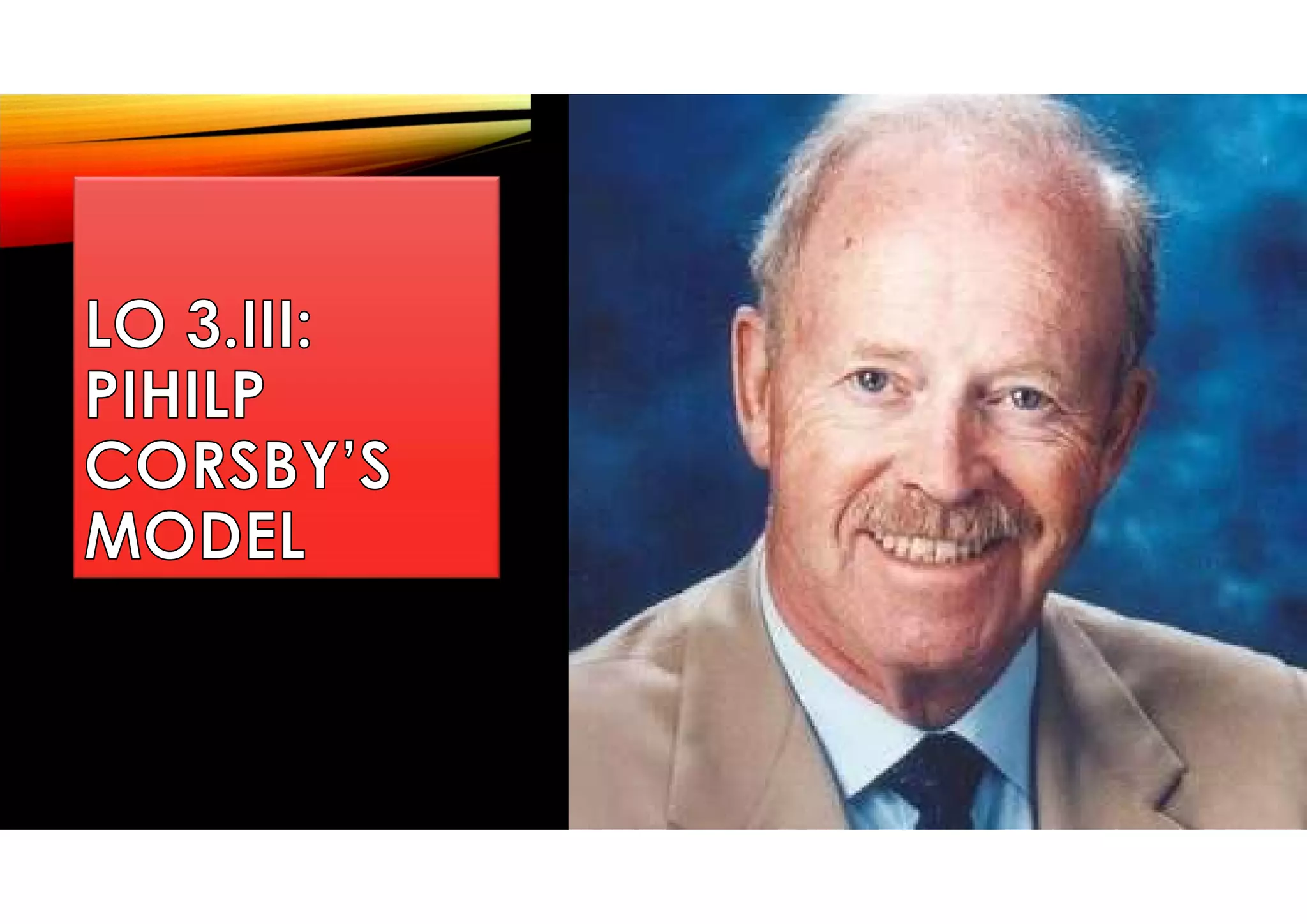
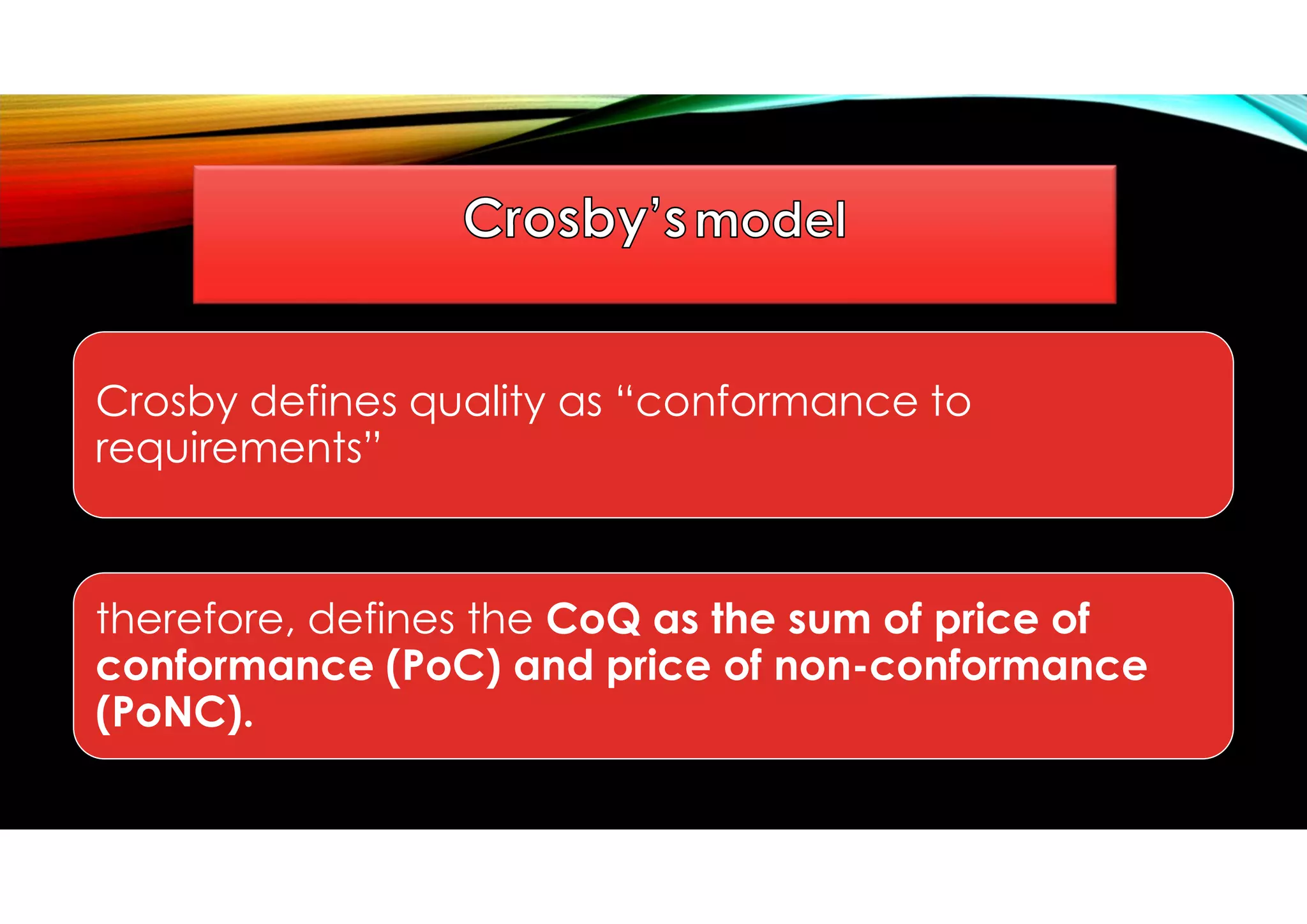
Crosby defines quality as “conformance to
requirements”
therefore, defines the CoQ as the sum of price of
conformance (PoC) and price of non-conformance
(PoNC).
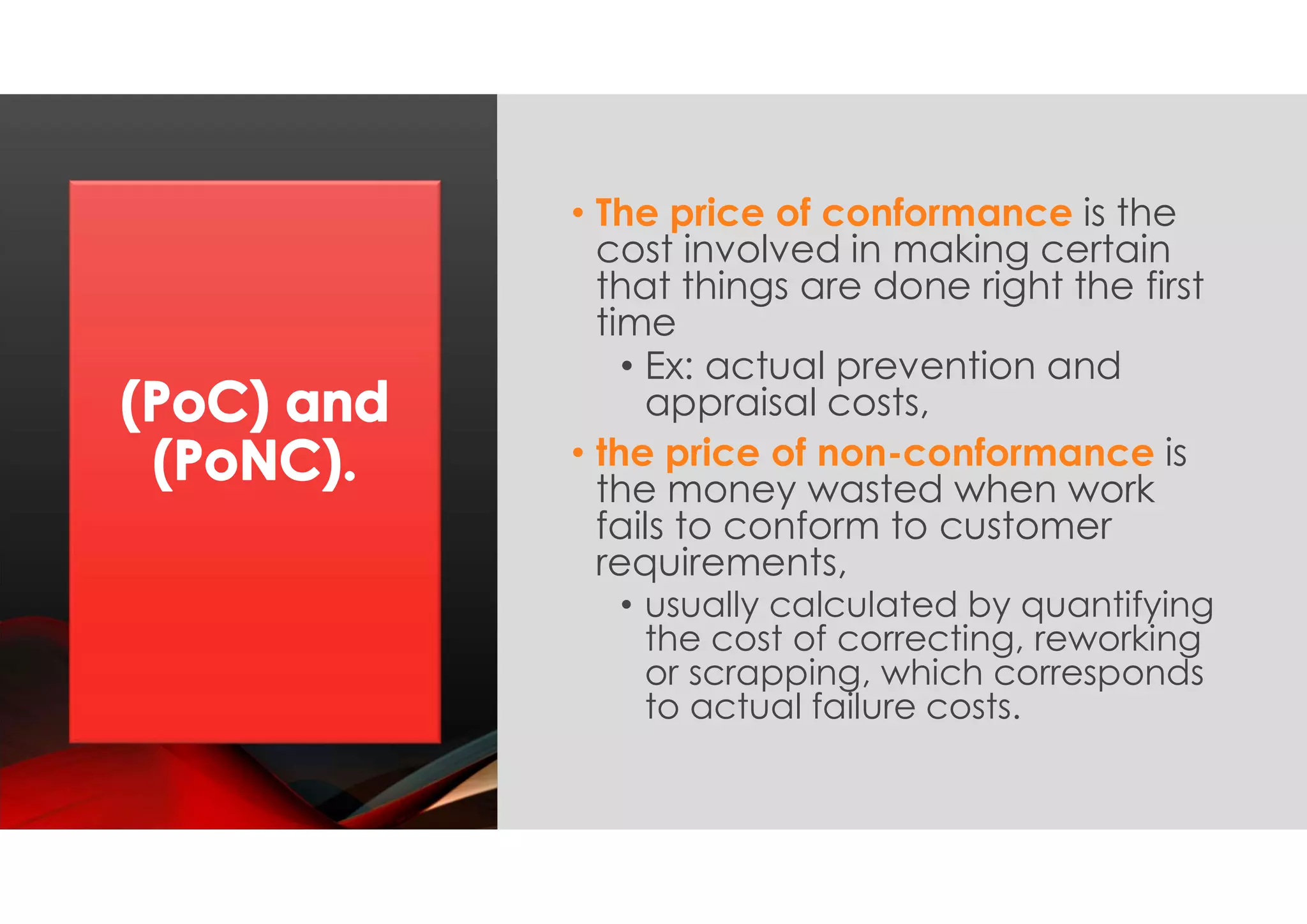
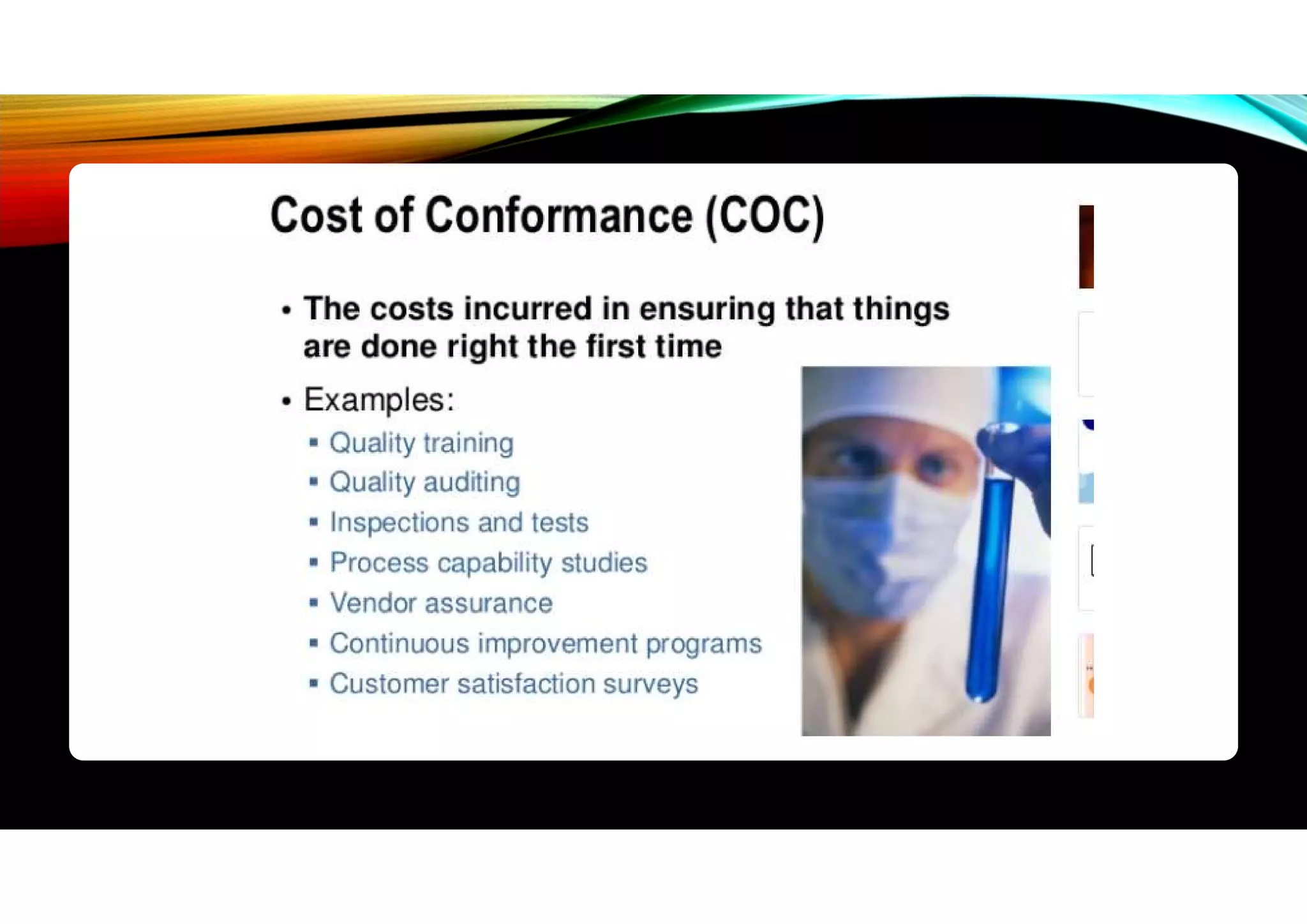
• The price of conformance is the
cost involved in making certain
that things are done right the first
time
• Ex: actual prevention and
appraisal costs,
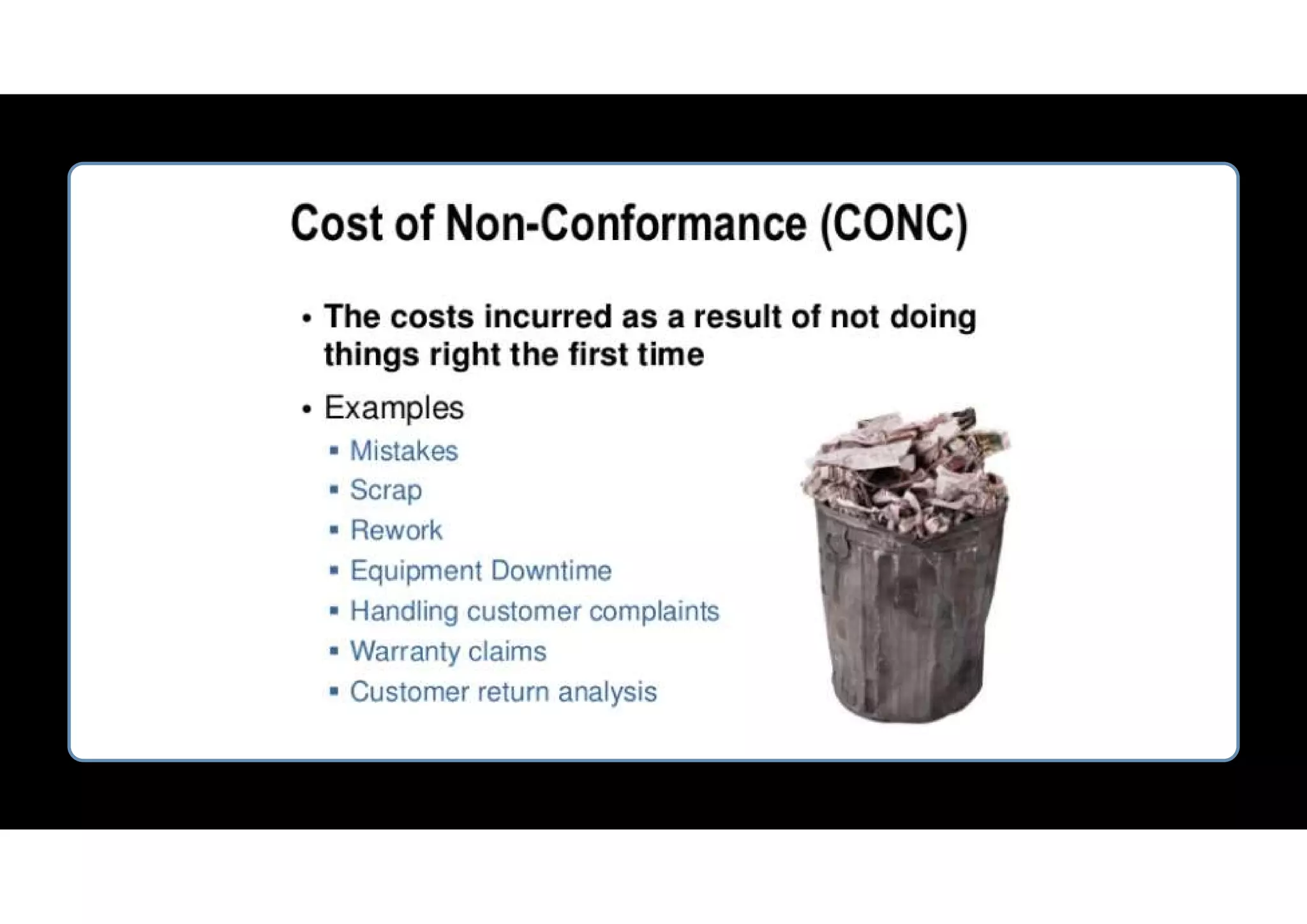
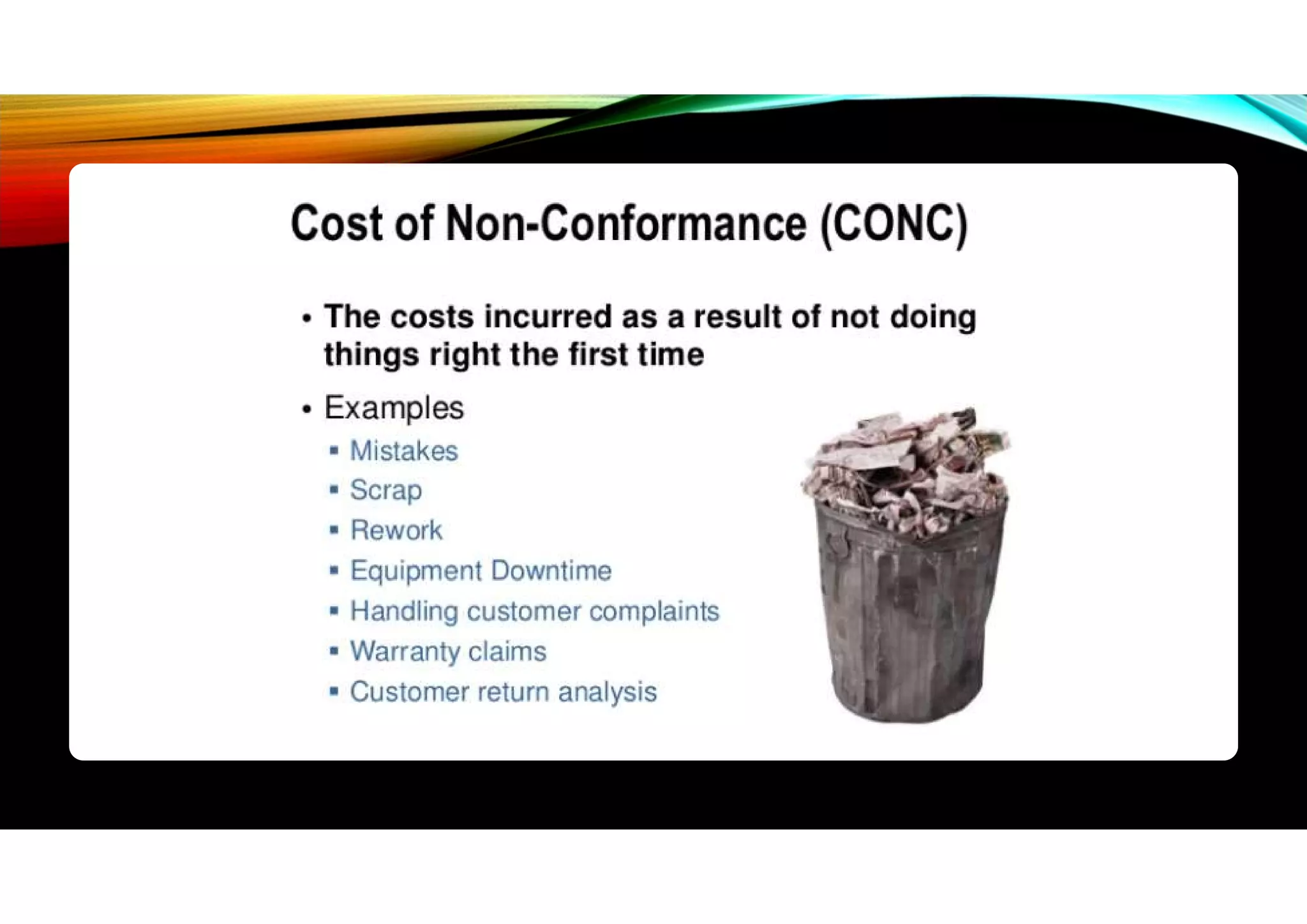
• the price of non-conformance is
the money wasted when work
fails to conform to customer
requirements,
• usually calculated by quantifying
the cost of correcting, reworking
or scrapping, which corresponds
to actual failure costs.
• Focus on process rather than products
or services.
• Process cost is the total cost of conformance and
non-conformance for a particular process.
• Cost of conformance is the actual process cost of
producing products or services first time to the
required standards by a given specified process
• Cost of nonconformance is the failure cost
associated with the process not being executed to the
required standard.
• These costs can be measured at any step of the
process.
• High non-conformance costs show the requirement
for further expenditure on failure prevention
activities
• High conformance costs indicate the need for a
process redesign
• "poor quality cost is defined as
• 1) all the cost incurred to help the employee do
the job right every time
• and
• the cost of determining if the output is acceptable,
plus any cost incurred by the company and the
customer because the output did not meet
specifications and/or customer expectations“
(Harrington)
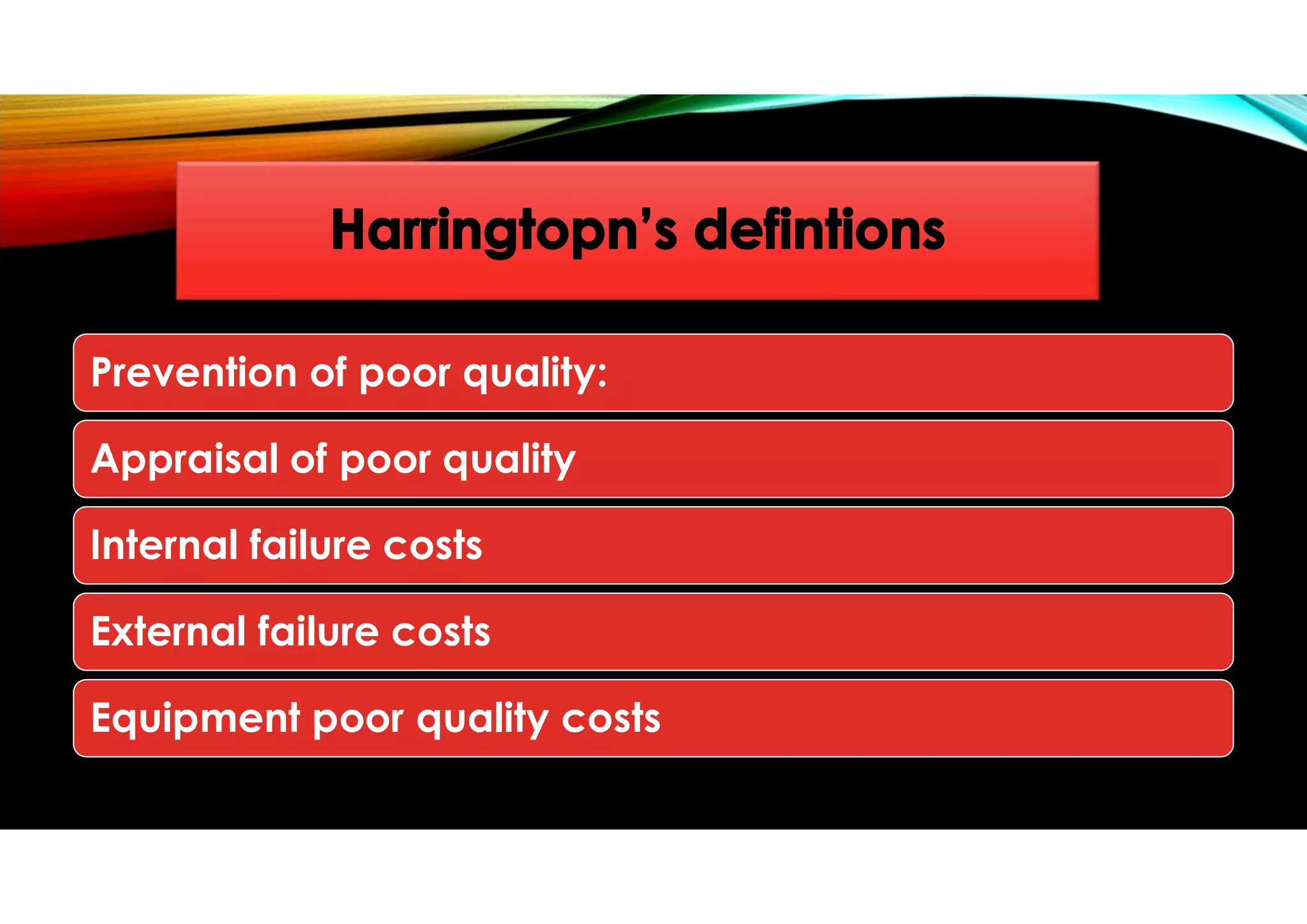
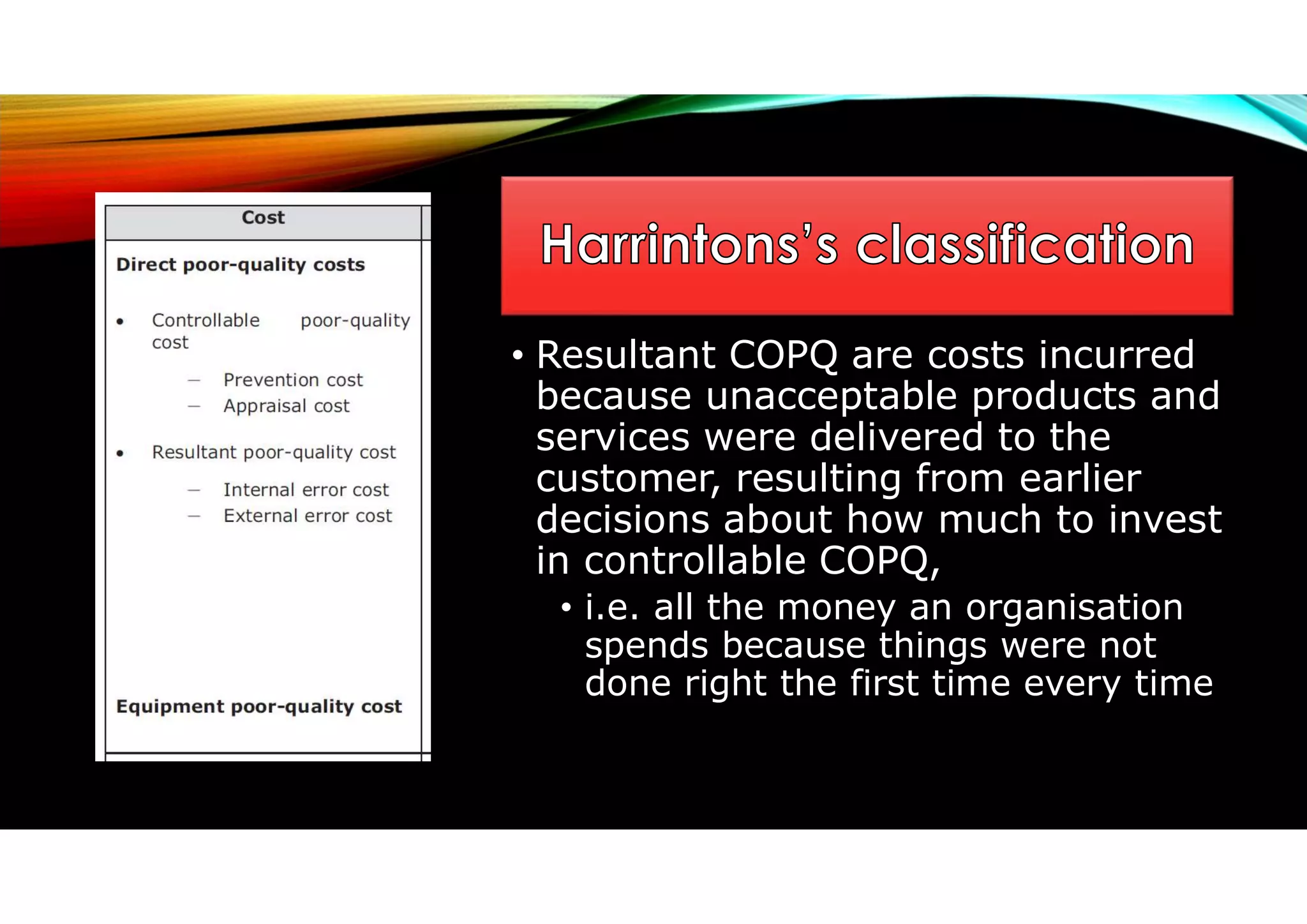
Prevention of poor quality:
Appraisal of poor quality
Internal failure costs
External failure costs
Equipment poor quality costs
• – Prevention of poor
quality:
all costs involved in
helping the employee to do
the job right every time (also
called cost-avoidance
investment).
• – Appraisal of poor quality:
• all costs expended to determine if
an activity was done right every
time. Often appraisal activities are
too late and too little.
• Internal failure costs:
the costs incurred by the company before a product is
accepted by the customer because everyone did not do the
job right every time.
• – External failure costs
the costs incurred by the company
because the appraisal system did not detect
all errors before the product or service was
delivered to the customer.
.
• – Equipment poor quality costs:
• the investment in equipment
used to measure, accept or
control the product or service
plus the cost of the space that
equipment occupies. This
includes the cost of the
equipment used to print and
report quality data (computers,
printer…).
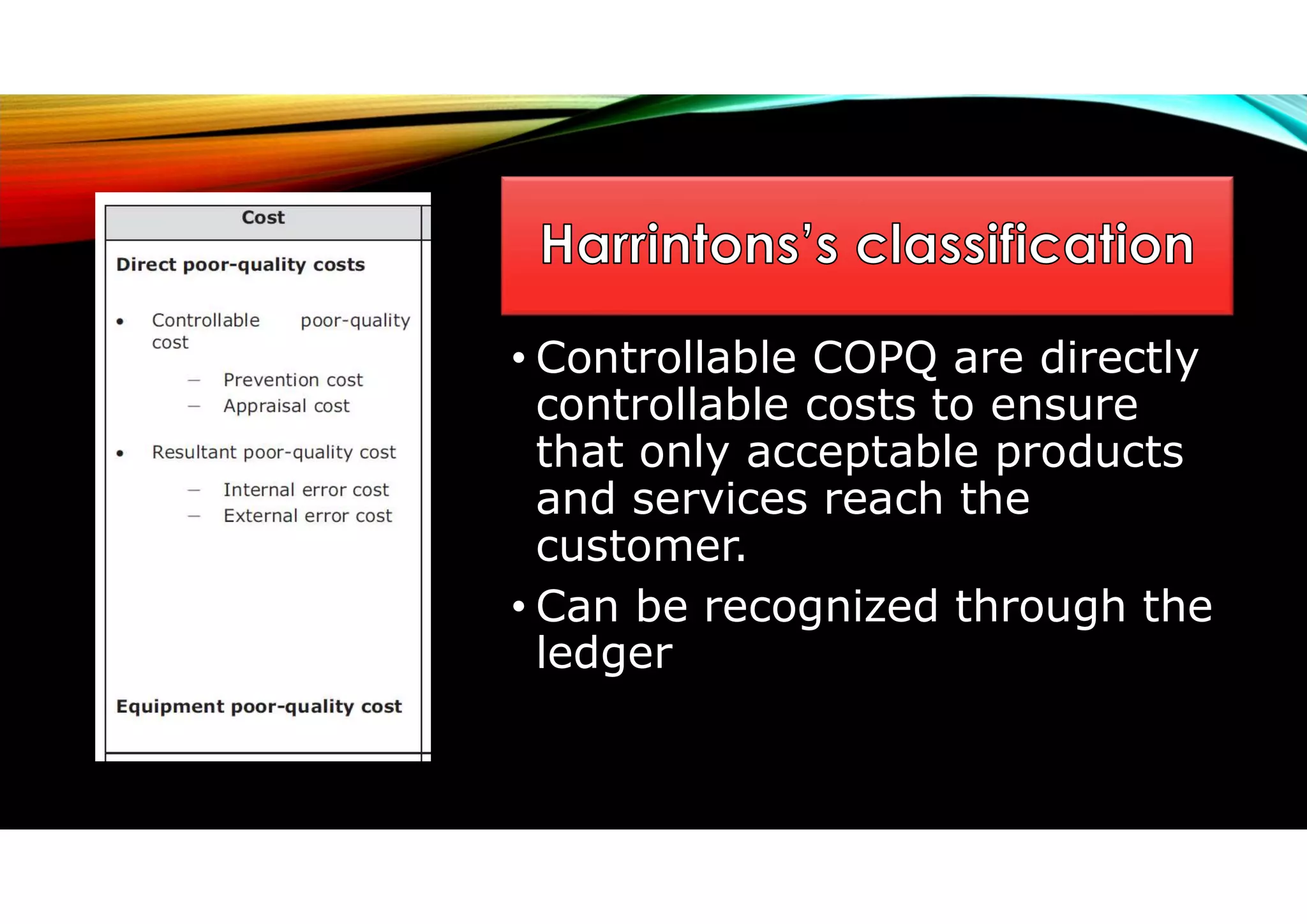
• Controllable COPQ are directly
controllable costs to ensure
that only acceptable products
and services reach the
customer.
• Can be recognized through the
ledger
• Resultant COPQ are costs incurred
because unacceptable products and
services were delivered to the
customer, resulting from earlier
decisions about how much to invest
in controllable COPQ,
• i.e. all the money an organisation
spends because things were not
done right the first time every time
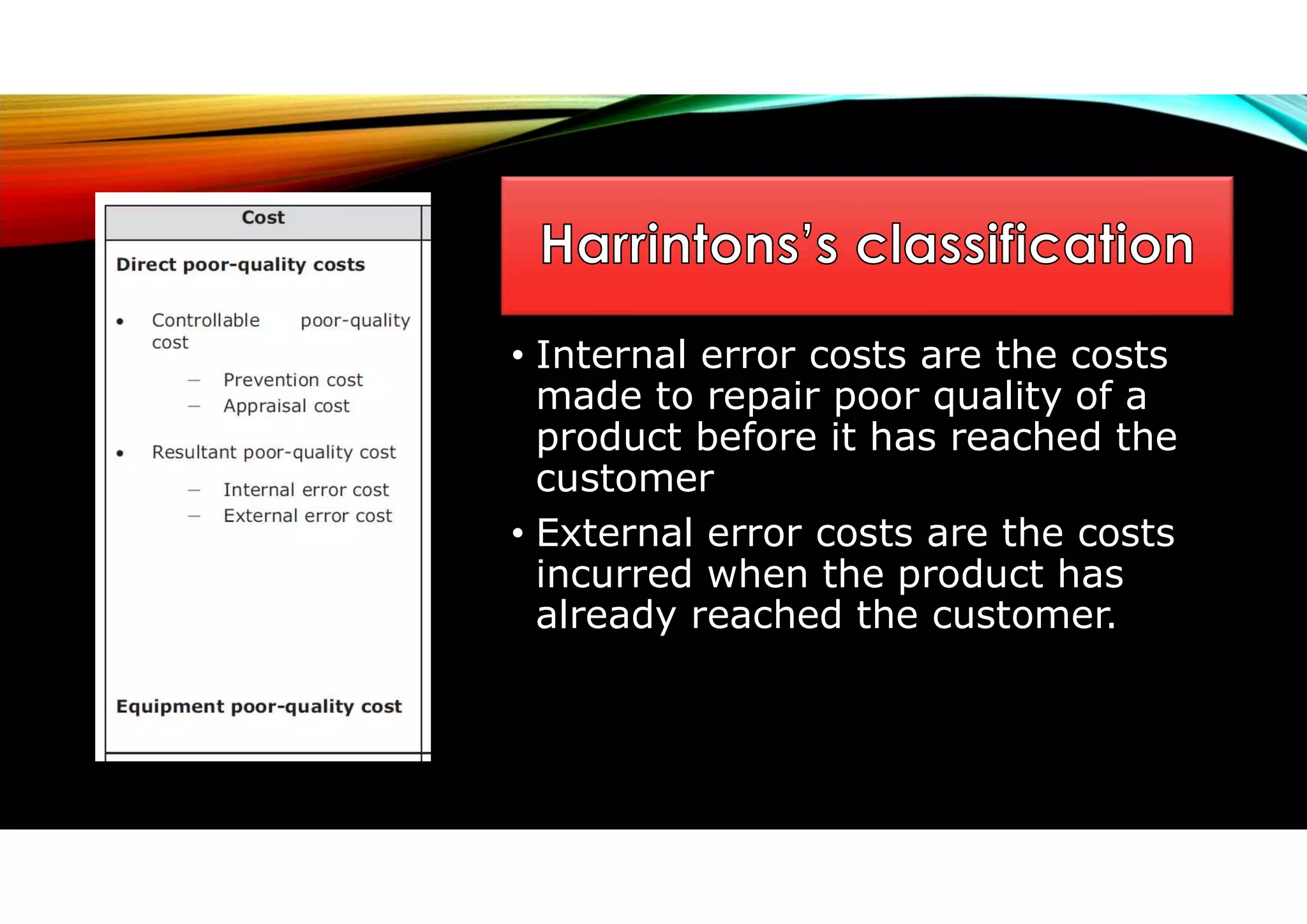
• Internal error costs are the costs
made to repair poor quality of a
product before it has reached the
customer
• External error costs are the costs
incurred when the product has
already reached the customer.
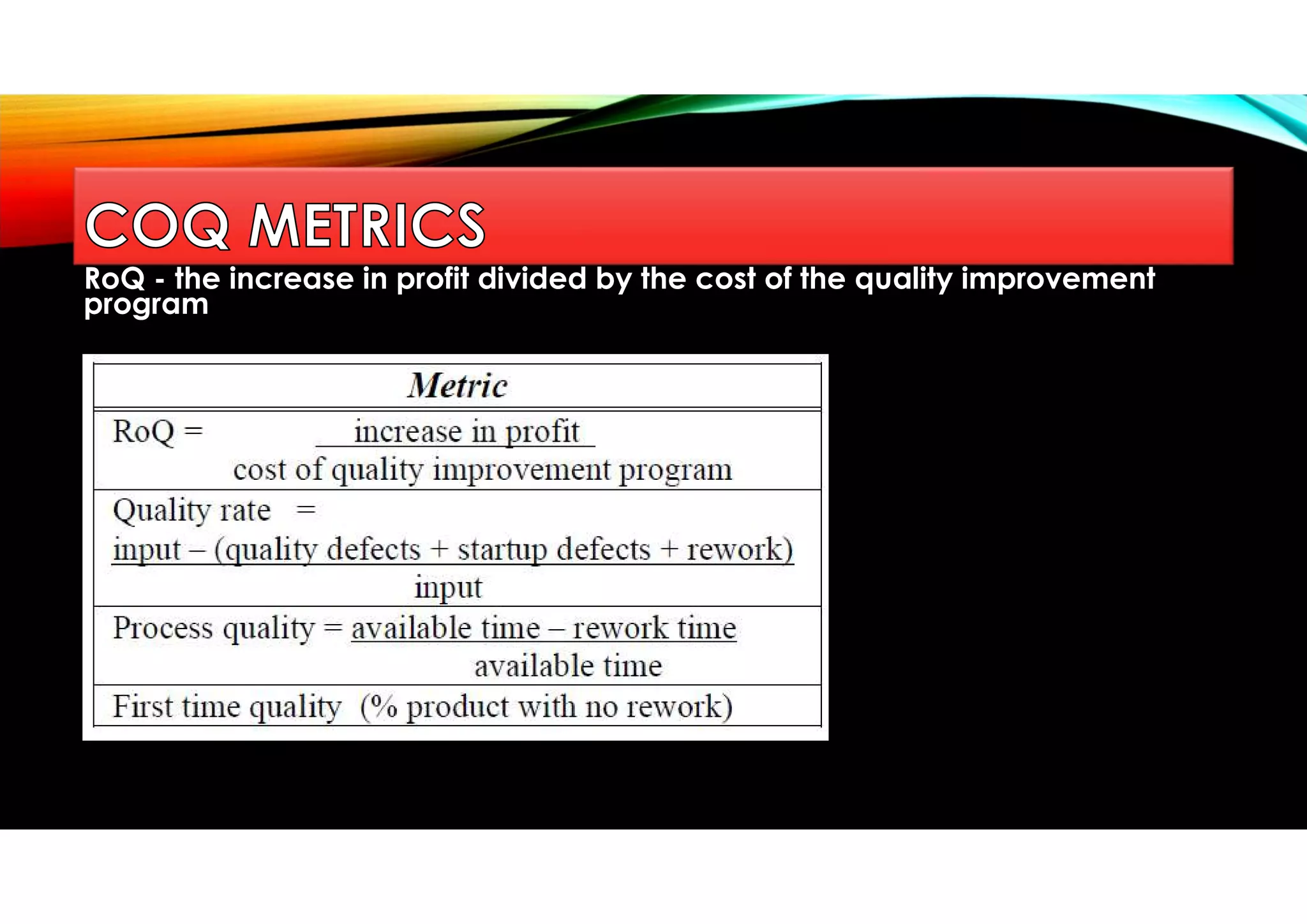
RoQ - the increase in profit divided by the cost of the quality improvement
program
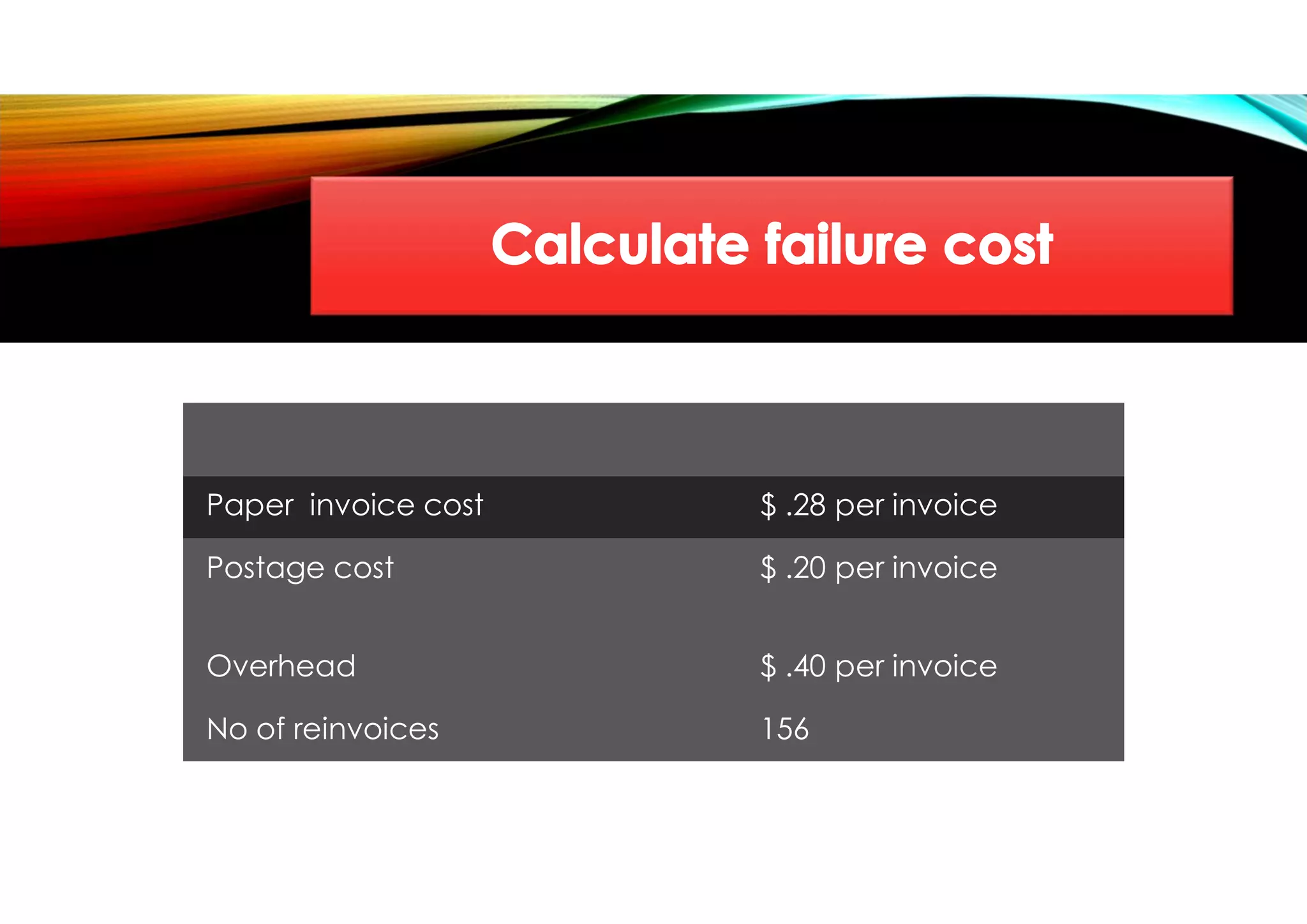
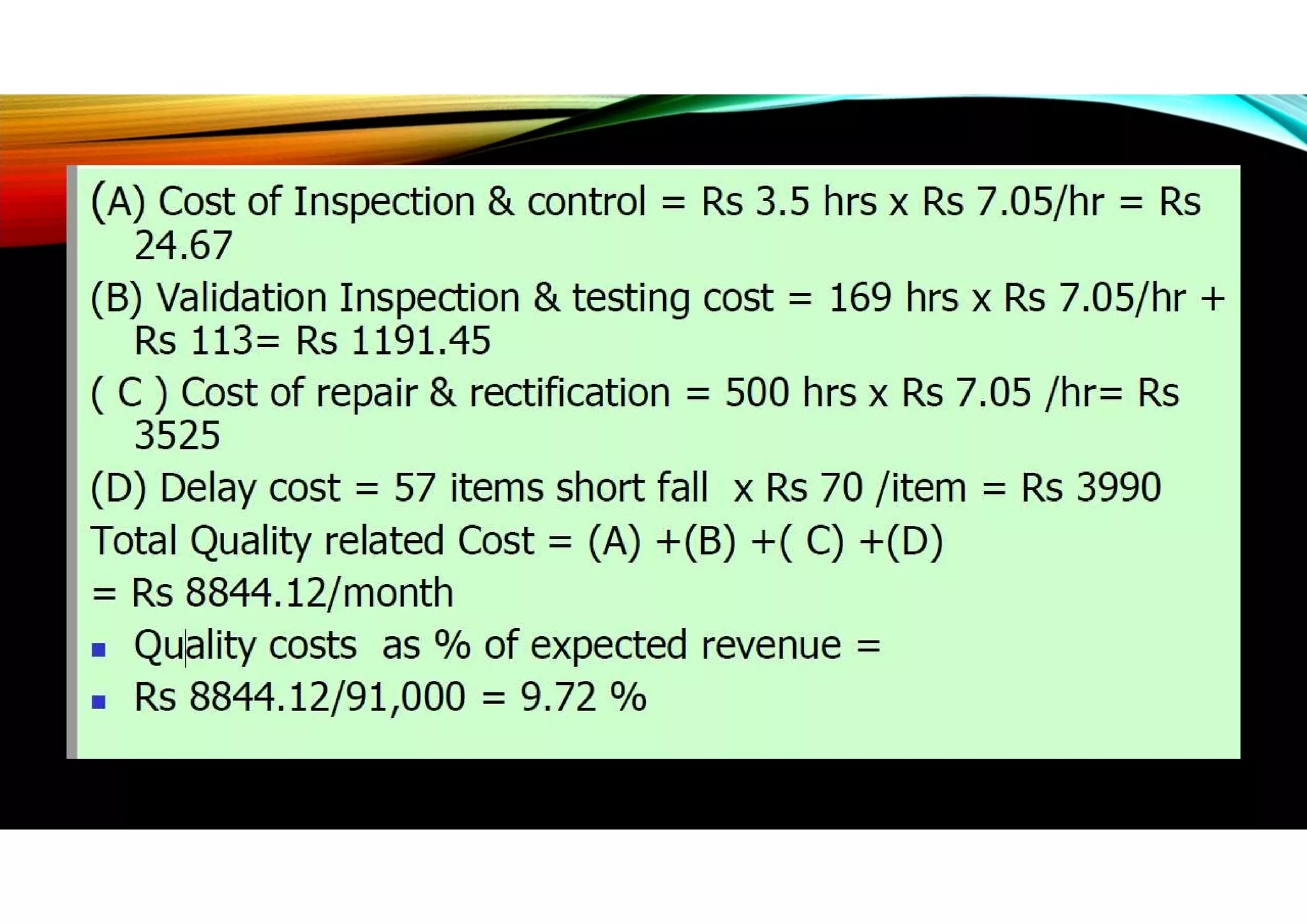
Paper invoice cost $ .28 per invoice
Postage cost $ .20 per invoice
Overhead $ .40 per invoice
No of reinvoices 156
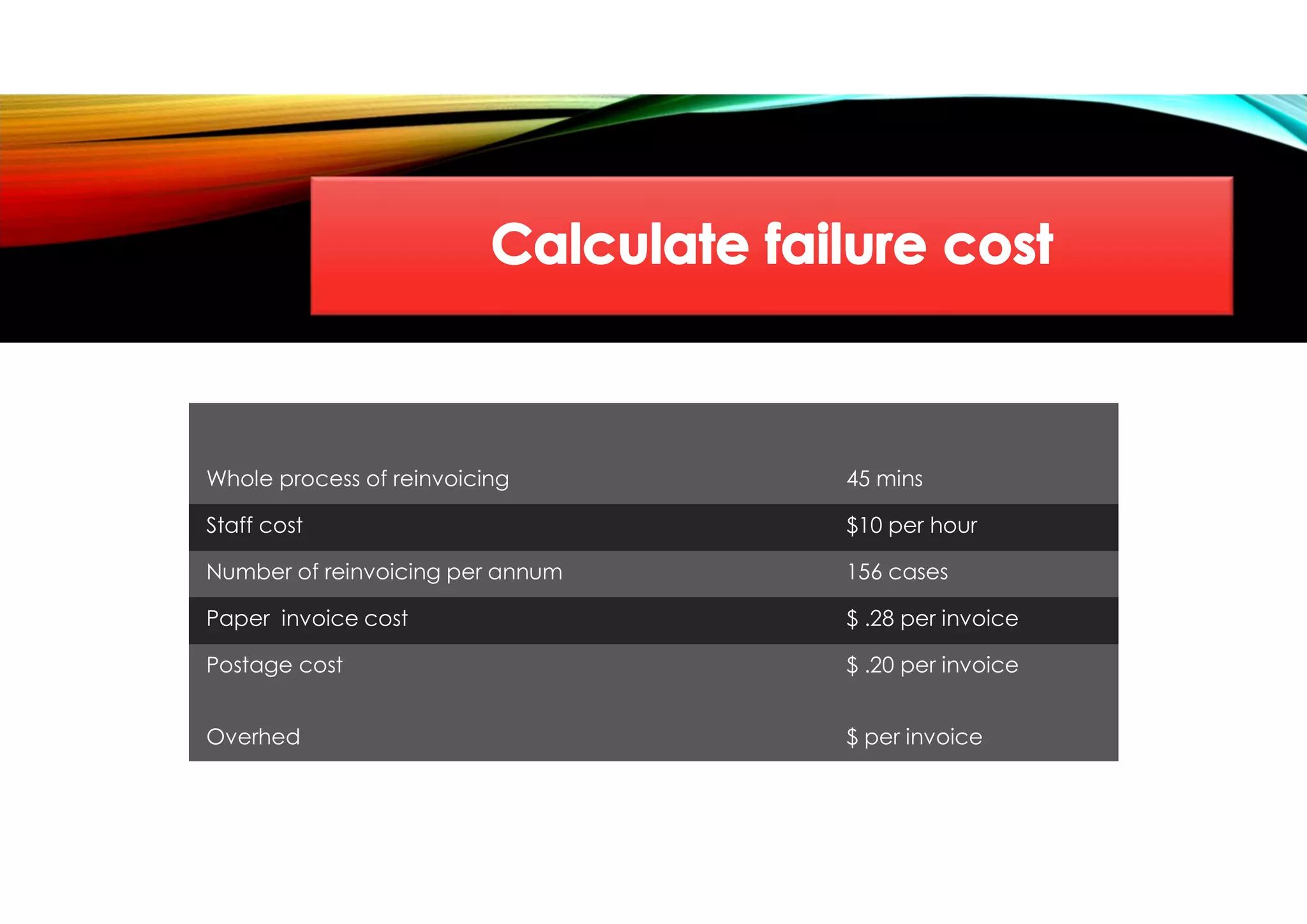
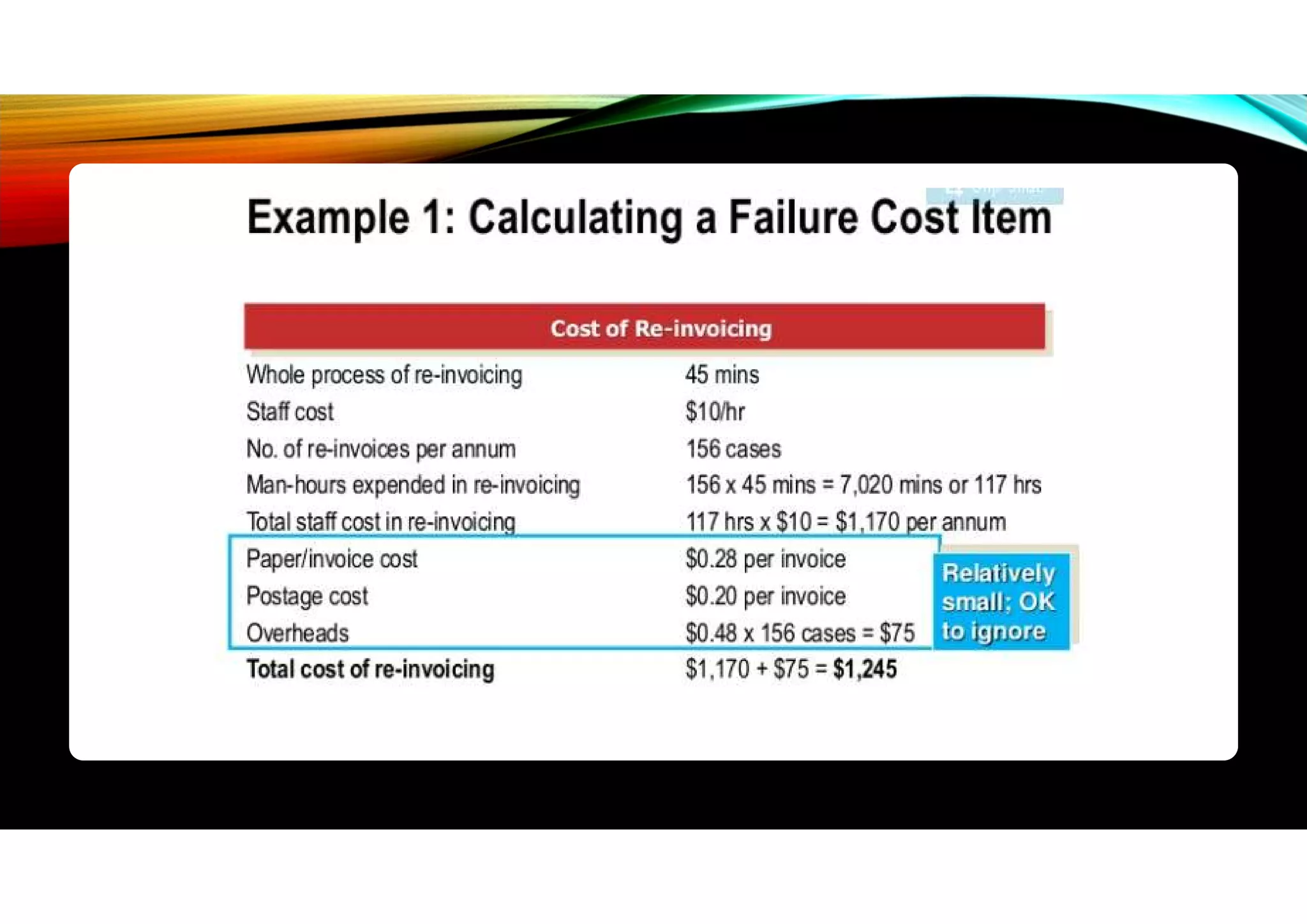
Whole process of reinvoicing 45 mins
Staff cost $10 per hour
Number of reinvoicing per annum 156 cases
Paper invoice cost $ .28 per invoice
Postage cost $ .20 per invoice
Overhed $ per invoice
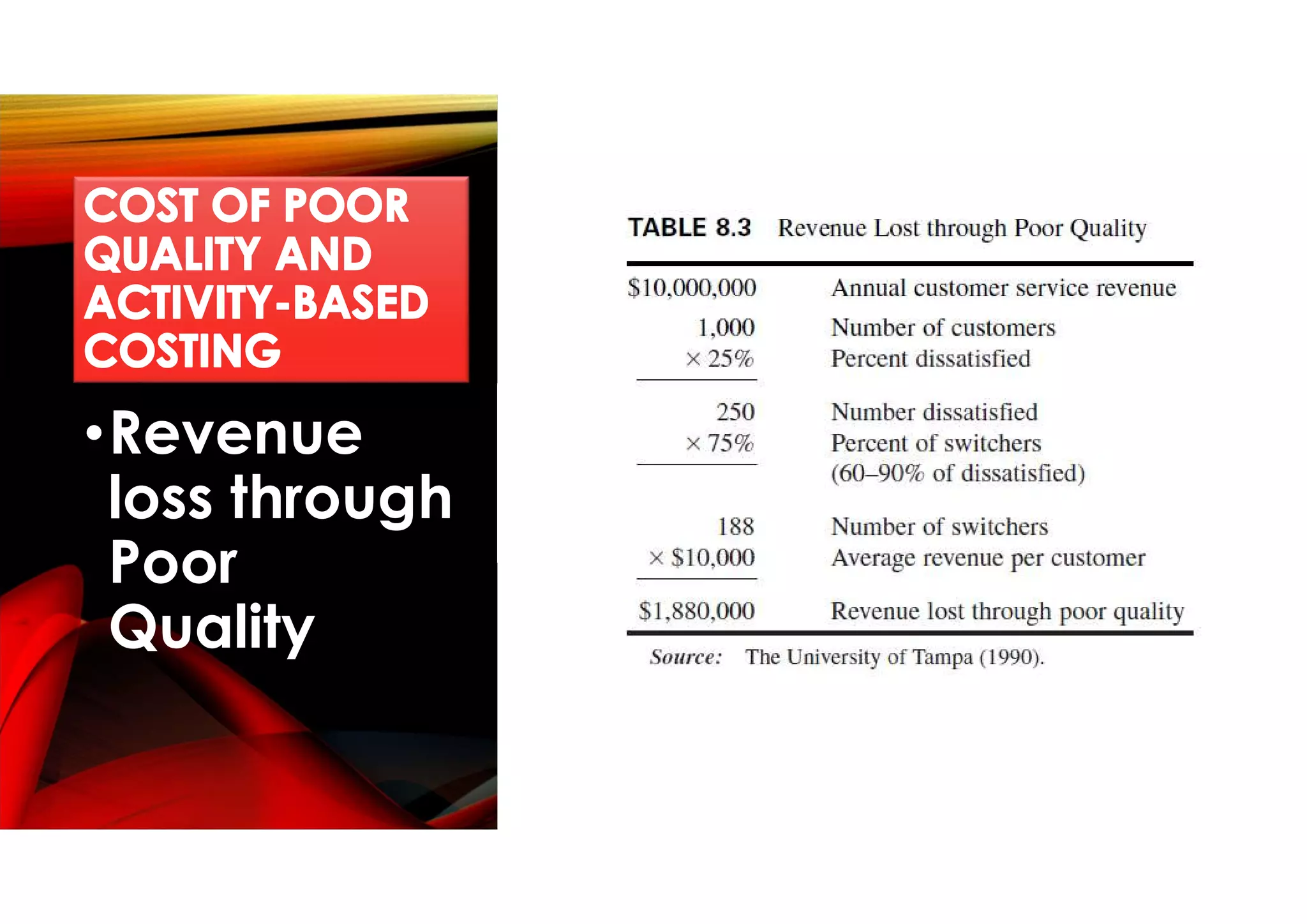
•Revenue
loss through
Poor
Quality
• The H&S motor company produces small motors for
use in lawnmowers and garden equipment. The
company instituted a quality improvement
program in 1999 and has recorded the following
quality cost data and accounting measures for 4
years. The company wants to assess its quality
assurance program and develop quality index
using sales basis for the 4 year period.
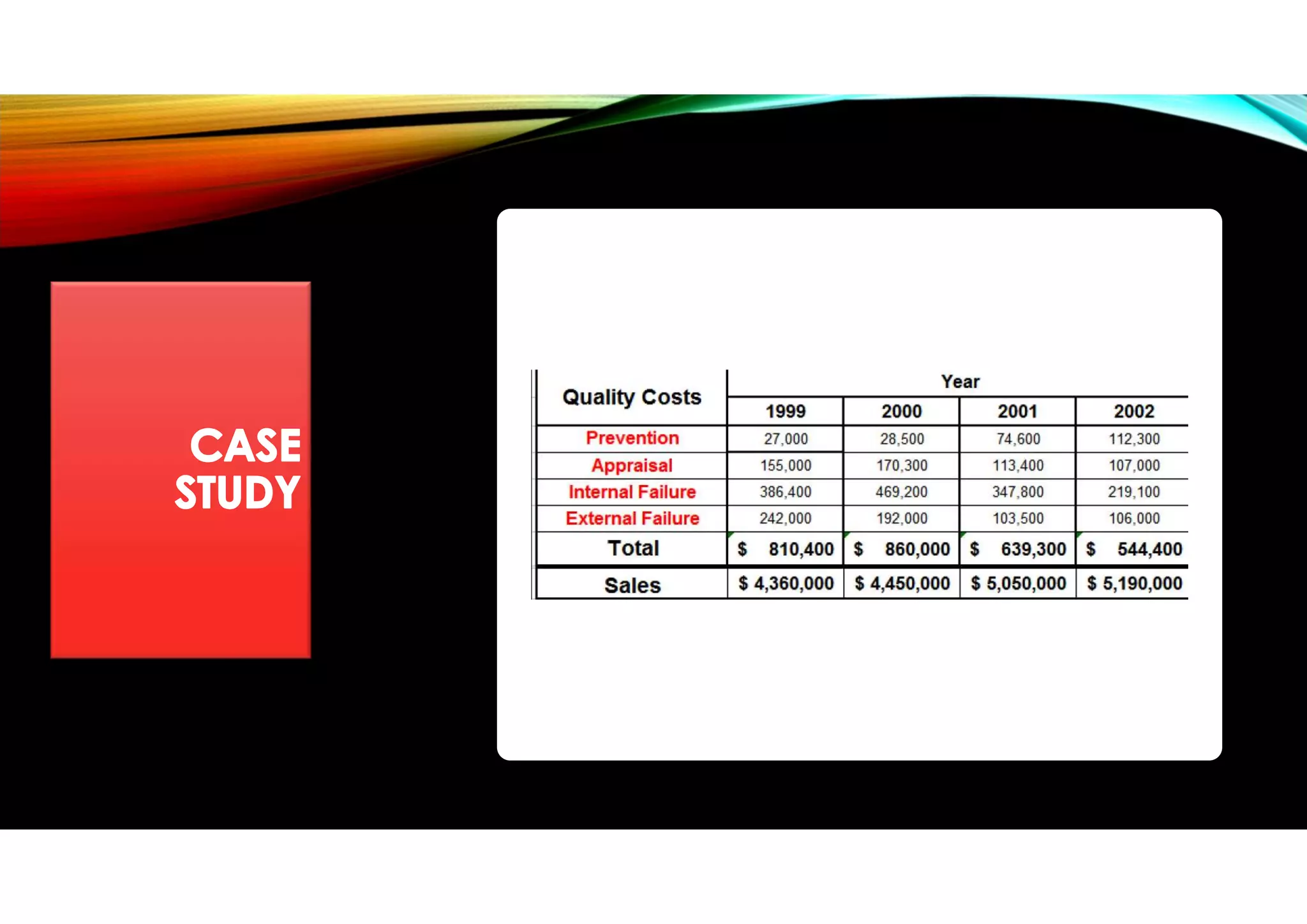
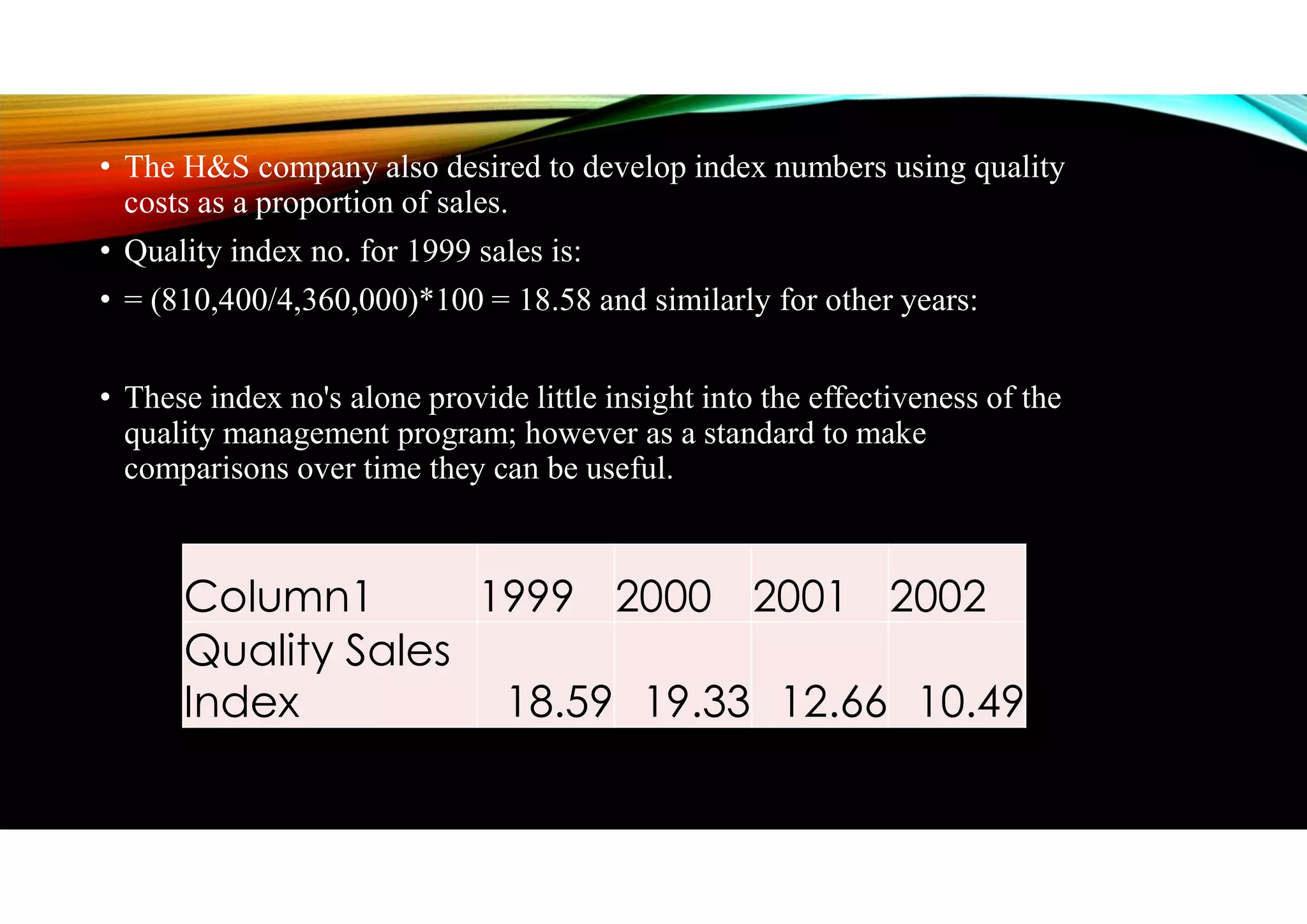
• The H&S company also desired to develop index numbers using quality
costs as a proportion of sales.
• Quality index no. for 1999 sales is:
• = (810,400/4,360,000)*100 = 18.58 and similarly for other years:
• These index no's alone provide little insight into the effectiveness of the
quality management program; however as a standard to make
comparisons over time they can be useful.
Column1 1999 2000 2001 2002
Quality Sales
Index 18.59 19.33 12.66 10.49
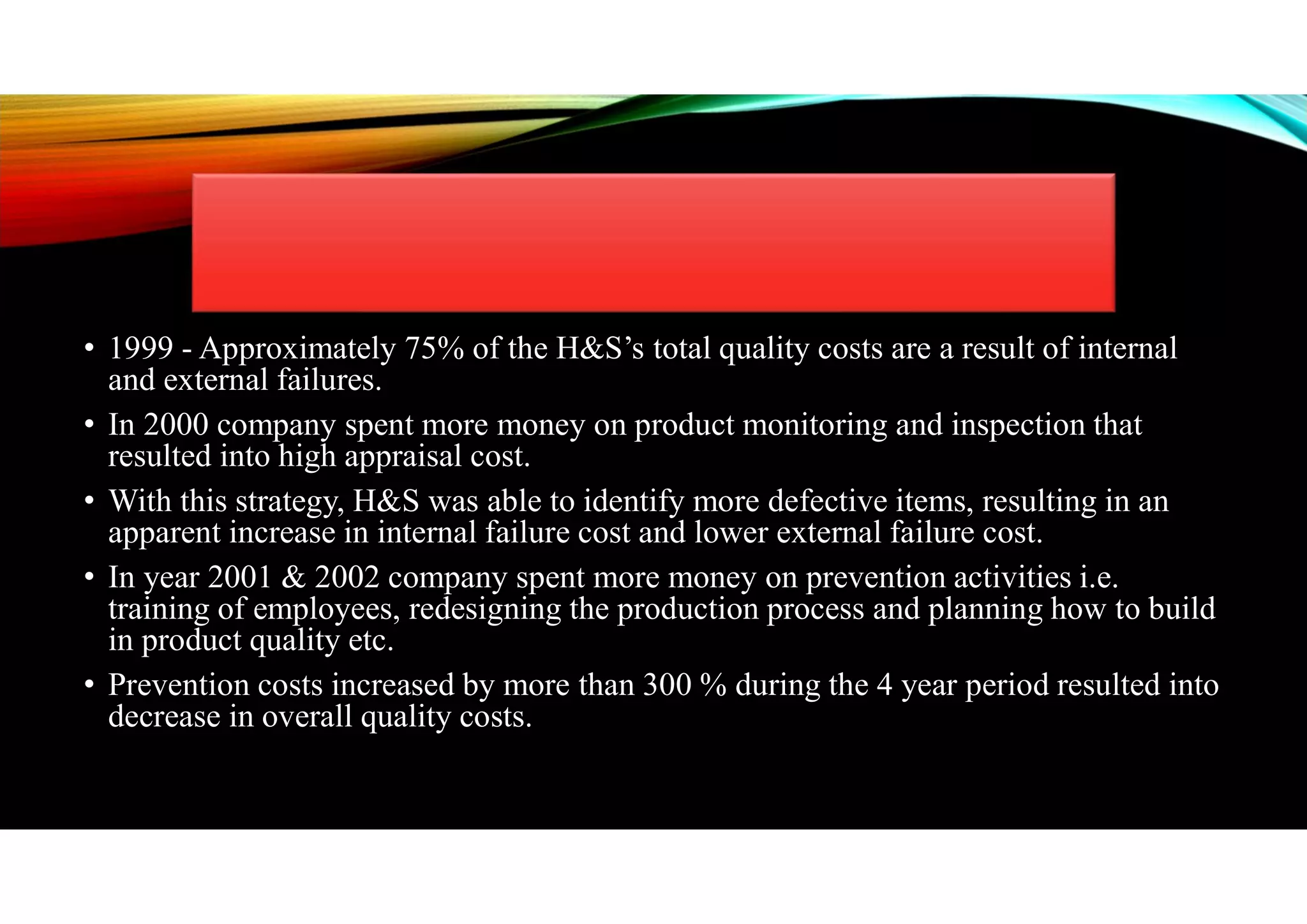
• 1999 - Approximately 75% of the H&S’s total quality costs are a result of internal
and external failures.
• In 2000 company spent more money on product monitoring and inspection that
resulted into high appraisal cost.
• With this strategy, H&S was able to identify more defective items, resulting in an
apparent increase in internal failure cost and lower external failure cost.
• In year 2001 & 2002 company spent more money on prevention activities i.e.
training of employees, redesigning the production process and planning how to build
in product quality etc.
• Prevention costs increased by more than 300 % during the 4 year period resulted into
decrease in overall quality costs.
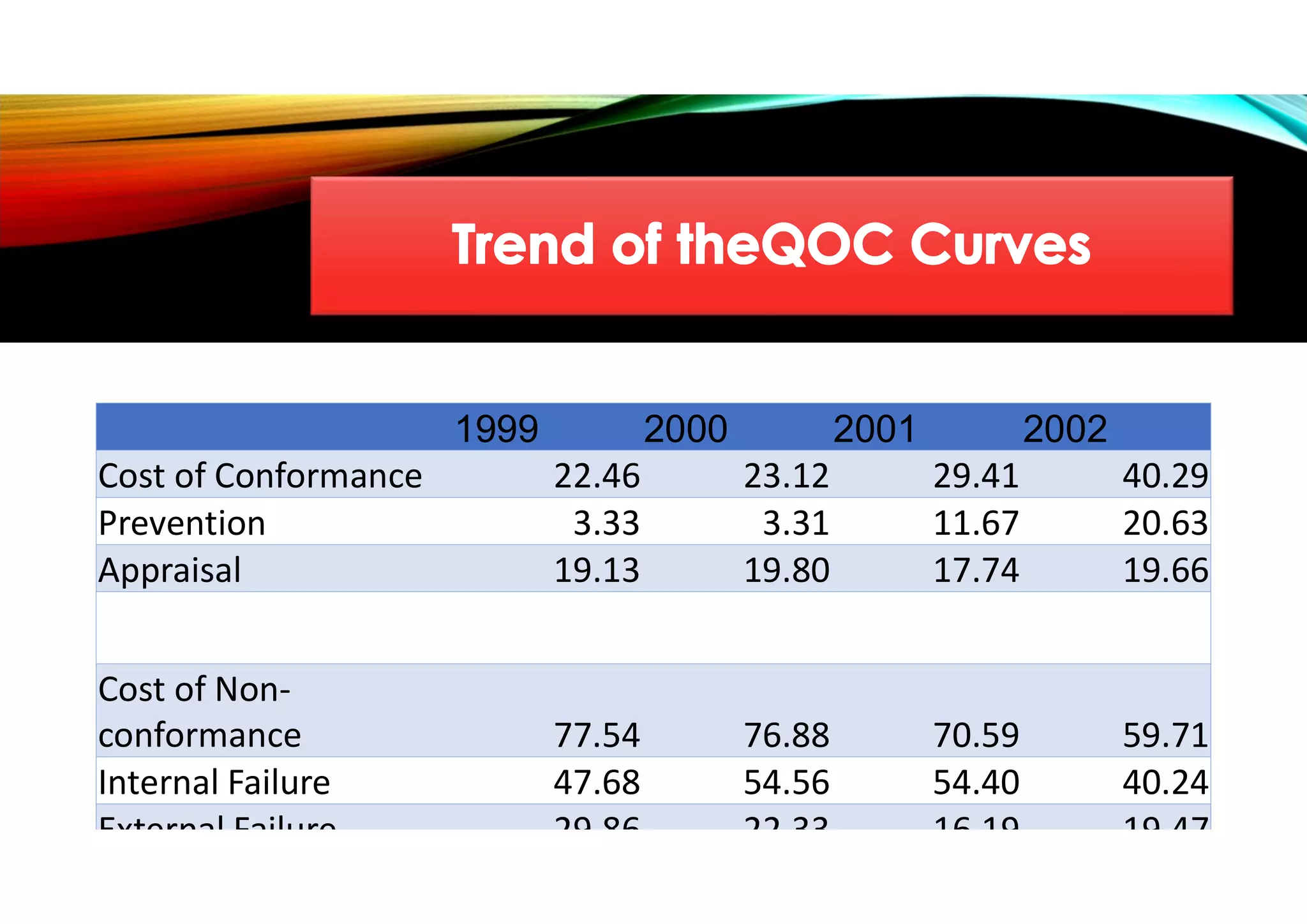
1999 2000 2001 2002
Cost of Conformance 22.46 23.12 29.41 40.29
Prevention 3.33 3.31 11.67 20.63
Appraisal 19.13 19.80 17.74 19.66
Cost of Non-
conformance 77.54 76.88 70.59 59.71
Internal Failure 47.68 54.56 54.40 40.24
External Failure 29.86 22.33 16.19 19.47
• Relationship
Between
Prevention +
Appraisal and
Failure Cost
•LO 6: Apply Cost
quality Strategy
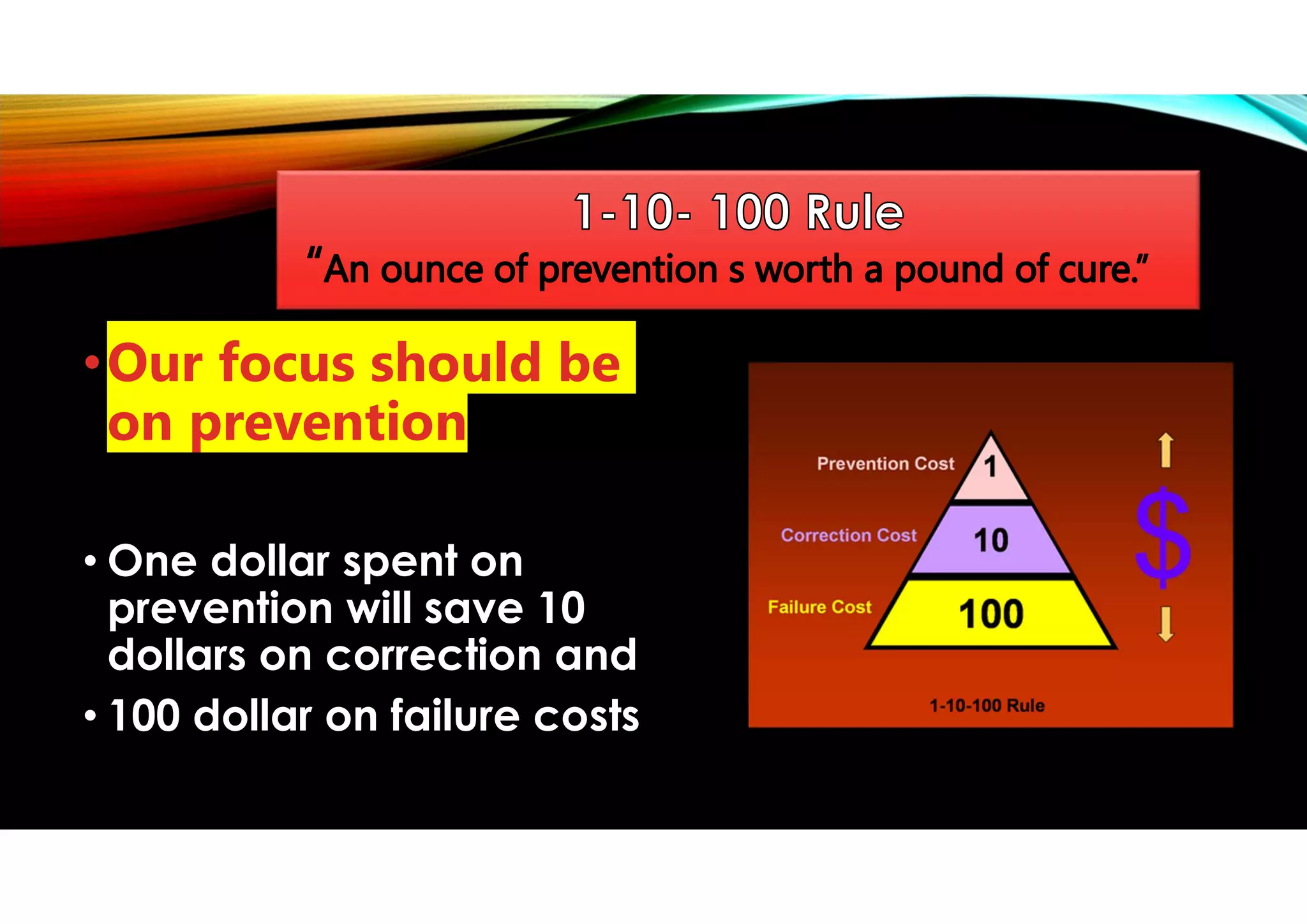
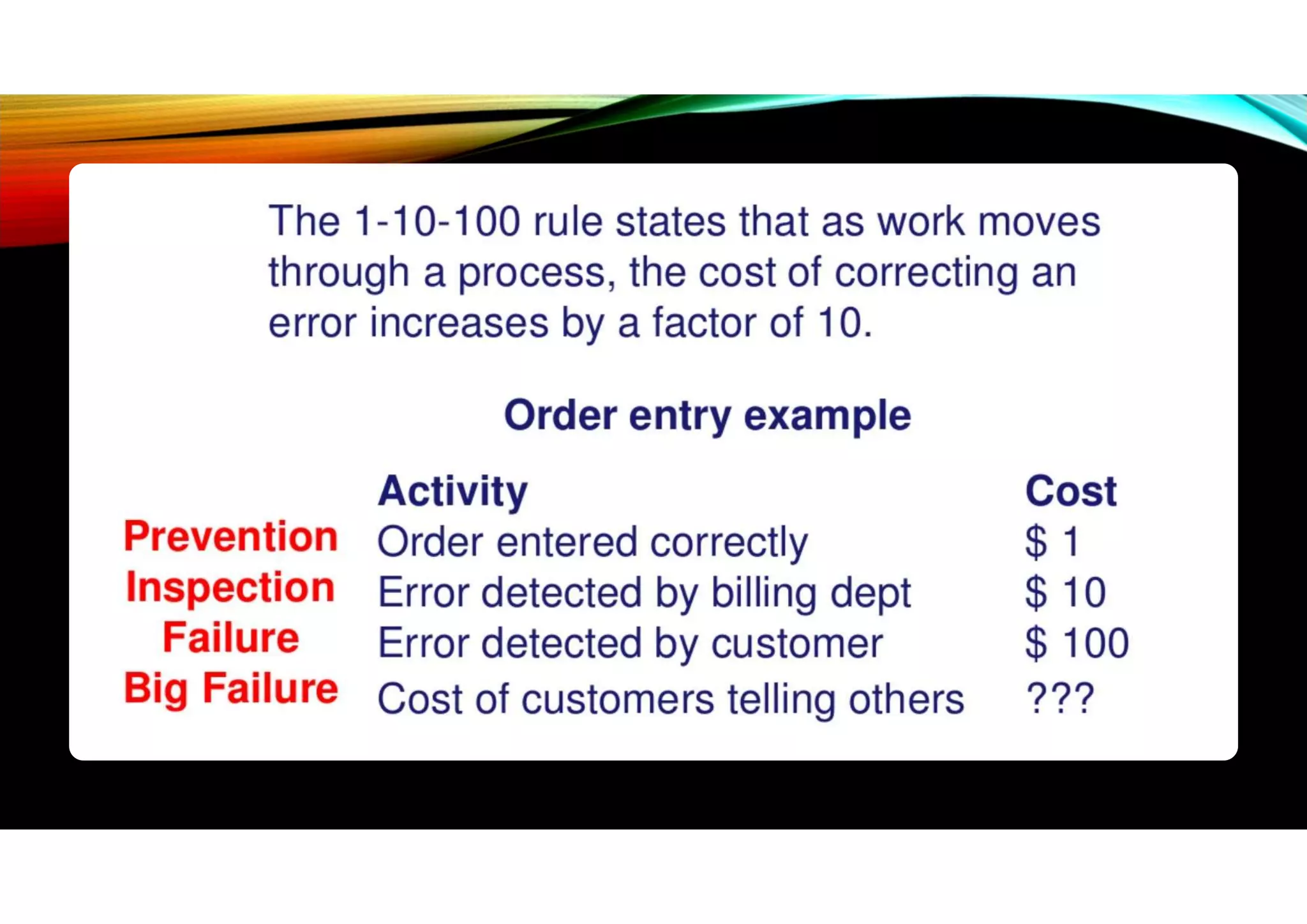
•Our focus should be
on prevention
• One dollar spent on
prevention will save 10
dollars on correction and
• 100 dollar on failure costs
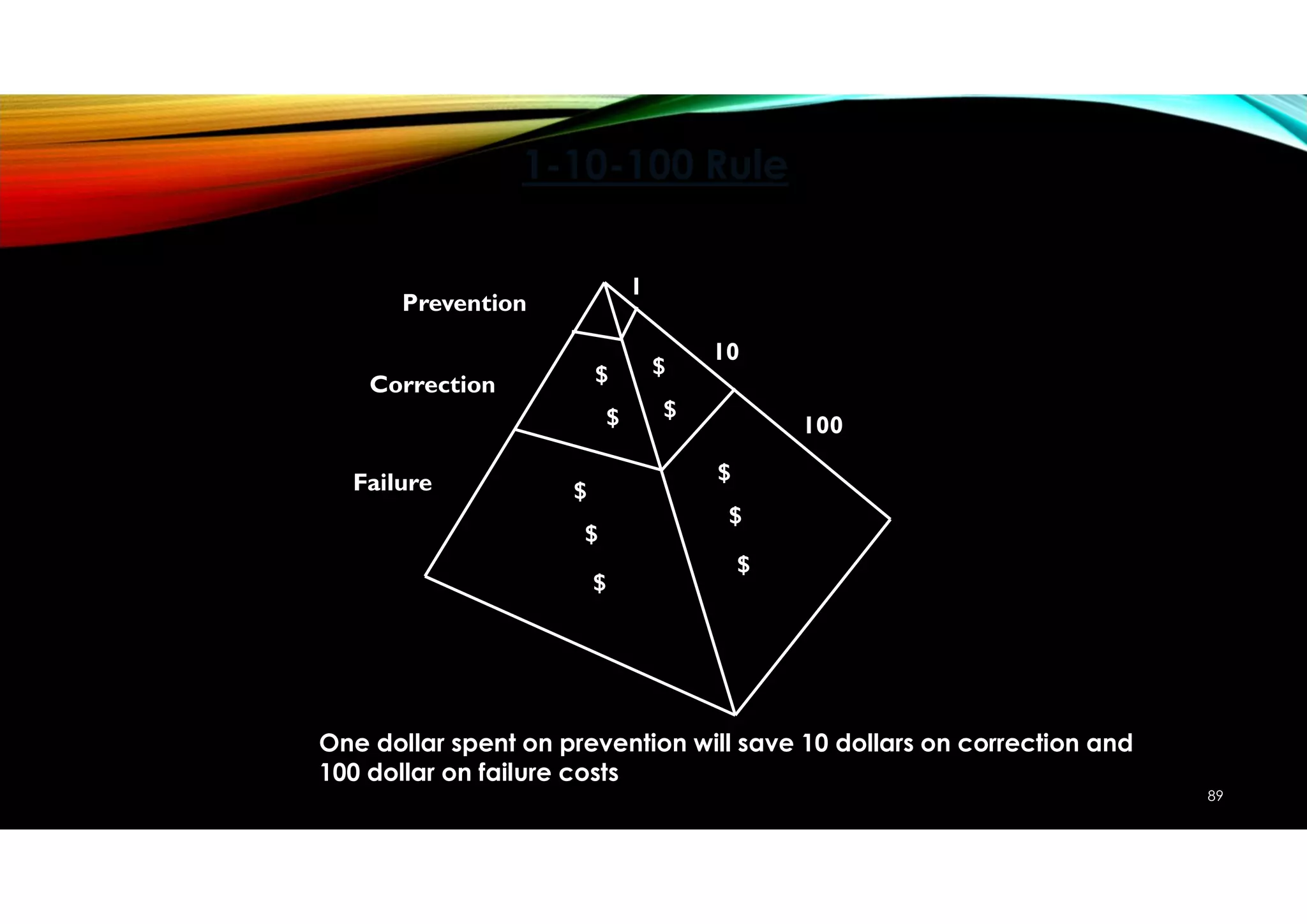
1-10-100 Rule
$
$
$
$
$
$
$
$
$
$
1
10
100
Prevention
Correction
Failure
89
One dollar spent on prevention will save 10 dollars on correction and
100 dollar on failure costs
Slide share   cost of quality

Slide share cost of quality

  • 2.
    • At theend of this lecture, the student should be able to 1. Explain why Cost of Quality important? 2. Define Cost of Quality (CoQ) 3. Present different CoQ Models and compare • Explain PAF model • Explain Juran’s Cost of poor Quality • Explain Corby's Model • Explain process Control Model Explain • HARRINGTON MODEL 4. Analysis cost of Quality 5. Explain and compare old and new CoQ curves 6. Do Cost of Quality Analysis 7. Apply CoQ Strategy
  • 4.
    • Organizations mustwork to achieve quality • Strategy - continuous improvement program • In addition, organizations must work to reduce the costs • Therefore, it is important to measure and report the cost of quality (CoQ)
  • 7.
    • 1.The quality-relatedcosts were much larger than had been shown in the accounting reports. (10 to 30 percent of sales or 25 to 40 percent of operating expenses) . Some of these costs were visible, some of them were hidden. • 2. The quality costs were not simply the result of factory operation; the support operations were also major contributors. • 3. The bulk of the costs were the result of poor quality. Such costs had been buried in the standards, but they were in fact avoidable. • 4. While these quality costs were avoidable, there was no clear responsibility for action to reduce them, neither was there any structured approach for doing so. (Juran, 1998)
  • 9.
    • ISO Standard8402, “totality of characteristics of an entity that bear on its ability to satisfy stated or implied needs”
  • 10.
    • "Quality Handbook",Joseph M. Juran provides two meanings that he considers of critical importance to managing quality: 1) Quality means those features of products which meet customer needs and thereby provide customer satisfaction. However, providing better quality usually requires an investment and hence usually involves increases in costs. Higher quality in this sense normally "costs more". 2) Quality means "freedom from deficiencies" – freedom of errors that require doing work over again or that result in field failures, customer dissatisfaction, customer claims, etc. In this sense the meaning of quality is oriented to costs and higher quality usually "costs less".
  • 14.
    • Quality costinghas been primarily used in the manufacturing industry, but nowadays there is a growing interest from commerce, the public sector and service organizations'
  • 15.
    • To collectquality costs an organization needs to adopt a framework to classify costs • however, there is no general agreement on a single broad definition of quality costs. • CoQ is usually understood as • the sum of conformance plus non-conformance costs, where cost of conformance is the price paid for prevention of poor quality (for example, inspection and quality appraisal) and cost of non-conformance is the cost of poor quality caused by product and service failure (for example, rework and returns).
  • 18.
    • Armand V.Feigenbaum (1956) "quality costs" - the total of quality-related efforts and deficiencies. • His categorization of quality costs into prevention- appraisal- failure (PAF) has been almost universally accepted for quality costing.
  • 19.
    •The objective ofa CoQ system is to find the level of quality that minimizes total CoQ
  • 20.
    • The basicidea of the P-A- F model are that investment in prevention and appraisal activities will reduce failure costs, and that further investment in prevention activities will reduce appraisal costs
  • 22.
    • Prevention costsare associated with all activities specifically designed to prevent poor quality in products or services. • The costs of new product review • Quality planning • Supplier capability surveys • Process capability evaluations • Quality improvement team meetings • Quality improvement projects, • Design for six sigma • Kaizen teams • SPC (x & r) • Poka-yoke (error proofing) devices quality • Education • Quality training. The cost incurred to prevent the problem in the future
  • 24.
    • Appraisal costsare costs associated with measuring, evaluating, or auditing products or services to assure conformance to quality standards and performance requirements. • Inspection/test of purchased material • Validation, verification, checking , activities • In-process and final inspection/test • Product, process, or service audits • Required compliance system costs (such as those needed for ISO) • Calibration of measuring and test equipment
  • 25.
    • Appraisal costsare costs associated with measuring, evaluating, or auditing products or services to assure conformance to quality standards and performance requirements. • Inspection/test of purchased material • Validation, verification, checking , activities • In-process and final inspection/test • Product, process, or service audits • Required compliance system costs (such as those needed for iso) • Calibration of measuring and test equipment
  • 26.
    • Failure costsare costs resulting from products or services not conforming to requirements or customer/user needs, that is, the costs resulting from poor quality. • Failure costs are divided into internal and external failure cost categories
  • 27.
    • Internal failurecosts occur prior to delivery or shipment of the product or the furnishing of a service. • Costs of scrap • Rework • re-inspection • re-testing material review • Downgrading • unplanned overtime
  • 28.
    • External failurecosts occur after delivery or shipment of the product or during or after furnishing of a service. • Costs of processing customer complaints • Necessary field service • Customer returns • Warranty claims • Product recalls • Sometimes third-party • Additional transport cost incurred to and from the customer • Replacement of poor product • Replacement of poor product reduces capacity • Drives more overtime
  • 29.
    •“quality costs” means thecost of poor quality •Cost of poor- quality costs of finding and correcting defective work)
  • 32.
    • These arecosts of deficiencies discovered before delivery which are associated with the failure (nonconformities) to meet explicit requirements or implicit needs of external or internal customers. • Also included are avoidable process losses and inefficiencies that occur even when requirements and needs are met. These are costs that would disappear if no deficiencies existed.
  • 33.
    • Scrap: Thelabor, material, and (usually) overhead on defective product that cannot economically be repaired. The titles are numerous—scrap, spoilage, defectives, etc. • Rework: Correcting defectives in physical products or errors in service products. • Lost or missing information: Retrieving information that should have been supplied. • Failure analysis: Analyzing nonconforming goods or services to determine causes. • Scrap and rework—supplier: Scrap and rework due to nonconforming product received from • suppliers. This also includes the costs to the buyer of resolving supplier quality problems.
  • 34.
    • One hundredpercent sorting inspection: Finding defective units in product lots which contain unacceptably high levels of defectives. • Reinspection, retest: Reinspection and retest of products that have undergone rework or other revision. • Changing processes: Modifying manufacturing or service processes to correct deficiencies. • Redesign of hardware: Changing designs of hardware to correct deficiencies. • Redesign of software: Changing designs of software to correct deficiencies
  • 35.
    • Scrapping ofobsolete product: Disposing of products that have been superseded. • Scrap in support operations: Defective items in indirect operations. • Rework in internal support operations: Correcting defective items in indirect operations. • Downgrading: The difference between the normal selling price and the reduced price due to quality reasons.
  • 36.
    • Variability ofproduct characteristics: Losses that occur even with conforming product (e.g., overfill of packages due to variability of filling and measuring equipment). • Unplanned downtime of equipment: Loss of capacity of equipment due to failures. • Inventory shrinkage: Loss due to the difference between actual and recorded inventory amounts. • Variation of process characteristics from “best practice”: Losses due to cycle time and costs of processes as compared to best practices in providing the same output. The best-practice process may be internal or external to the organization. • Non-value-added activities: Redundant operations, sorting inspections, and other non-value added activities.
  • 37.
    • These arecosts associated with deficiencies that are found after product is received by the customer. • Also included are lost opportunities for sales revenue. These costs also would disappear if there were no deficiencies.
  • 38.
    • Warranty charges:The costs involved in replacing or making repairs to products that are still within the warranty period. • Complaint adjustment: The costs of investigation and adjustment of justified complaints attributable to defective product or installation. • Returned material: The costs associated with receipt and replacement of defective product received from the customer. • Allowances: The costs of concessions made to customers due to substandard products accepted by the customer as is or to conforming product that does not meet customer needs. • Penalties due to poor quality: This applies to goods or services delivered or to internal processes such as late payment of an invoice resulting in a lost discount for paying on time. • Rework on support operations: Correcting errors on billing and other external processes. • Revenue losses in support operations: An example is the failure to collect on receivables from some customers.
  • 39.
    • Customer defections:Profit margin on current revenue lost due to customers who switch for reasons of quality. An important example of this category is current contracts that are canceled due to quality. • New customers lost because of quality: Profit on potential customers lost because of poor quality. • New customers lost because of lack of capability to meet customer needs: Profit on potential revenue lost because of inadequate processes to meet customer needs.
  • 45.
    Crosby defines qualityas “conformance to requirements” therefore, defines the CoQ as the sum of price of conformance (PoC) and price of non-conformance (PoNC).
  • 46.
    • The priceof conformance is the cost involved in making certain that things are done right the first time • Ex: actual prevention and appraisal costs, • the price of non-conformance is the money wasted when work fails to conform to customer requirements, • usually calculated by quantifying the cost of correcting, reworking or scrapping, which corresponds to actual failure costs.
  • 52.
    • Focus onprocess rather than products or services. • Process cost is the total cost of conformance and non-conformance for a particular process. • Cost of conformance is the actual process cost of producing products or services first time to the required standards by a given specified process • Cost of nonconformance is the failure cost associated with the process not being executed to the required standard. • These costs can be measured at any step of the process. • High non-conformance costs show the requirement for further expenditure on failure prevention activities • High conformance costs indicate the need for a process redesign
  • 54.
    • "poor qualitycost is defined as • 1) all the cost incurred to help the employee do the job right every time • and • the cost of determining if the output is acceptable, plus any cost incurred by the company and the customer because the output did not meet specifications and/or customer expectations“ (Harrington)
  • 55.
    Prevention of poorquality: Appraisal of poor quality Internal failure costs External failure costs Equipment poor quality costs
  • 56.
    • – Preventionof poor quality: all costs involved in helping the employee to do the job right every time (also called cost-avoidance investment).
  • 57.
    • – Appraisalof poor quality: • all costs expended to determine if an activity was done right every time. Often appraisal activities are too late and too little.
  • 58.
    • Internal failurecosts: the costs incurred by the company before a product is accepted by the customer because everyone did not do the job right every time.
  • 59.
    • – Externalfailure costs the costs incurred by the company because the appraisal system did not detect all errors before the product or service was delivered to the customer.
  • 60.
    . • – Equipmentpoor quality costs: • the investment in equipment used to measure, accept or control the product or service plus the cost of the space that equipment occupies. This includes the cost of the equipment used to print and report quality data (computers, printer…).
  • 61.
    • Controllable COPQare directly controllable costs to ensure that only acceptable products and services reach the customer. • Can be recognized through the ledger
  • 62.
    • Resultant COPQare costs incurred because unacceptable products and services were delivered to the customer, resulting from earlier decisions about how much to invest in controllable COPQ, • i.e. all the money an organisation spends because things were not done right the first time every time
  • 63.
    • Internal errorcosts are the costs made to repair poor quality of a product before it has reached the customer • External error costs are the costs incurred when the product has already reached the customer.
  • 65.
    RoQ - theincrease in profit divided by the cost of the quality improvement program
  • 66.
    Paper invoice cost$ .28 per invoice Postage cost $ .20 per invoice Overhead $ .40 per invoice No of reinvoices 156
  • 67.
    Whole process ofreinvoicing 45 mins Staff cost $10 per hour Number of reinvoicing per annum 156 cases Paper invoice cost $ .28 per invoice Postage cost $ .20 per invoice Overhed $ per invoice
  • 71.
  • 72.
    • The H&Smotor company produces small motors for use in lawnmowers and garden equipment. The company instituted a quality improvement program in 1999 and has recorded the following quality cost data and accounting measures for 4 years. The company wants to assess its quality assurance program and develop quality index using sales basis for the 4 year period.
  • 74.
    • The H&Scompany also desired to develop index numbers using quality costs as a proportion of sales. • Quality index no. for 1999 sales is: • = (810,400/4,360,000)*100 = 18.58 and similarly for other years: • These index no's alone provide little insight into the effectiveness of the quality management program; however as a standard to make comparisons over time they can be useful. Column1 1999 2000 2001 2002 Quality Sales Index 18.59 19.33 12.66 10.49
  • 75.
    • 1999 -Approximately 75% of the H&S’s total quality costs are a result of internal and external failures. • In 2000 company spent more money on product monitoring and inspection that resulted into high appraisal cost. • With this strategy, H&S was able to identify more defective items, resulting in an apparent increase in internal failure cost and lower external failure cost. • In year 2001 & 2002 company spent more money on prevention activities i.e. training of employees, redesigning the production process and planning how to build in product quality etc. • Prevention costs increased by more than 300 % during the 4 year period resulted into decrease in overall quality costs.
  • 76.
    1999 2000 20012002 Cost of Conformance 22.46 23.12 29.41 40.29 Prevention 3.33 3.31 11.67 20.63 Appraisal 19.13 19.80 17.74 19.66 Cost of Non- conformance 77.54 76.88 70.59 59.71 Internal Failure 47.68 54.56 54.40 40.24 External Failure 29.86 22.33 16.19 19.47
  • 79.
  • 81.
    •LO 6: ApplyCost quality Strategy
  • 87.
    •Our focus shouldbe on prevention • One dollar spent on prevention will save 10 dollars on correction and • 100 dollar on failure costs
  • 89.
    1-10-100 Rule $ $ $ $ $ $ $ $ $ $ 1 10 100 Prevention Correction Failure 89 One dollarspent on prevention will save 10 dollars on correction and 100 dollar on failure costs