Quality
Assurance
Hareesh.S
II MSc Nursing
Definitions
QUALITY
• “Quality is defined as the degree to which health services for
the individuals and populations increase the likelihood of the
desired health outcomes and are consistent with current
professional knowledge”.
-Joint Commission on Accreditation of Healthcare
Organizations (2002)
• “Quality of a service is defined as the totality of features and
characteristics of a service that bear on its ability to satisfy
the stated and implied needs of the patients.”
-International Organization for Standardization (ISO 8402)
2
Definitions
QUALITY ASSURANCE
• “Quality Assurance is an on-going, systematic
comprehensive evaluation of health care services and
the impact of those services on health care services.
- Kozier.
• Quality assurance is defined as all activities undertaken
to predate and prevent poor quality.
-Neetvert(1992)
3
KEY TERMS RELATED TO
QUALITY ASSURANCE
• Quality improvement
• Total Quality Management/ Continuous Quality
Improvement
• Quality Control
• Quality circles
4
OBJECTIVES OF QUALITY
ASSURANCE
According to Jonas (2000), the two main objectives are;
• To ensure the delivery of quality client care
• To demonstrate the efforts of the health care providers
to provide the best possible results
5
Other specific objectives are;
• Formulate plan of care
• Attend the patients physical and non-physical
needs
• Evaluate achievement of nursing care
• Support delivery of nursing care with
administrative and managerial services
6
PRINCIPLES OF QUALITY
ASSURANCE
• Customer focus
• Leadership
• Involvement of people
• Process approach
• System approach to management
• Continual improvement
• Factual approach to decision making
• Mutually beneficial supplier relationship
7
COMPONENTS OF QUALITY
ASSURANCE
• STRUCTURE EVALUATION
• PROCESS EVALUATION
• OUTCOME EVALUATION
8
QUALITY ASSURANCE PROCESS
1. Establishment of standards or criteria
2. Identify the information relevant to criteria
3. Determine ways to collect information
4. Collect and analyze the information
5. Compare collected information with established
criteria
9
Cont..
6. Make a judgment about quality
7. Provide information and if necessary, take
corrective action regarding findings of appropriate
sources
8. Determine ways to collect the information
10
MODELS OF
QUALITY
ASSURANCE
11
1. System Model
1. Input
2. Throughput
3. Output
4. Feedback
12
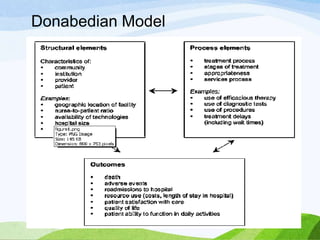
Donabedian Model
13
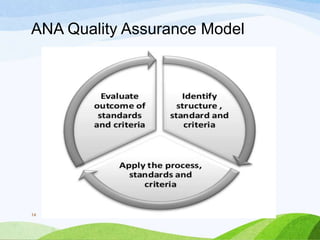
ANA Quality Assurance Model
14
Plan, Do, Study, Act cycle
15
LEVELS OF EVALUATION OF
QUALITY OF CARE
• National Level
• Trust or organization level
• Local Level
16
APPROACHES OF QUALITY
IMPROVEMENT
General Approaches
• Credentialing
• Licensure
• Accreditation
• Certification
• Charter
• Academic Degrees
17
Cont…
Specific Approaches
• Peer Review Committees (Staff Review
Committees)
• Standard as a device for quality assurance
18
FACTORS AFFECTING QUALITY
ASSURANCE IN NURSING PRACTICE
• Lack of resources
• Personnel problem
• Improper maintenance
• Unreasonable patients and attendants
• Absence of well-informed population
• Absence of accreditation laws
• Lack of incident review procedure
19
cont
• Lack of good hospital information system
• Absence of patient Satisfaction Surveys
• Lack of nursing care research
• Miscellaneous Factors
20
BARRIERS OF QUALITY IMPROVEMENT EFFORTS
• The Nurse Manager might become pre occupied with quality
assessment
• It is impossible to identify all factors that influence nursing care
quality.
• Difficulty in defining outcome criteria that result solely from
nursing intervention
• Nurse’s documentation of care measures is at times
vague, incomplete and lacking in objectivity
• There is still no single, all purpose, all site quality assessment tool
that is universally appropriate for all health agencies.
• High cost
21
ROLE OF NURSES IN
QUALITY ASSURANCE
• Nurses are the active participant of
interdisciplinary quality improvement team
• Develop mechanism for continually monitoring
the effectiveness of nursing care both a
collaborative and an individual professional activity.
• Contribute innovations and improvement of
patient care
• Participating in improvement projects and
patient safety initiatives
22
Cont….
• Participate continuing educational programs and in-
service educational programs for continuing professional
development
• Periodic and continuing appraisal and evaluation of
health care situation of the patient
• Participate research works related to quality assurance
• Identify any area of needed improvement in delivery of
care.
23
Thank you
24

Quality assurance

  • 1.
  • 2.
    Definitions QUALITY • “Quality isdefined as the degree to which health services for the individuals and populations increase the likelihood of the desired health outcomes and are consistent with current professional knowledge”. -Joint Commission on Accreditation of Healthcare Organizations (2002) • “Quality of a service is defined as the totality of features and characteristics of a service that bear on its ability to satisfy the stated and implied needs of the patients.” -International Organization for Standardization (ISO 8402) 2
  • 3.
    Definitions QUALITY ASSURANCE • “QualityAssurance is an on-going, systematic comprehensive evaluation of health care services and the impact of those services on health care services. - Kozier. • Quality assurance is defined as all activities undertaken to predate and prevent poor quality. -Neetvert(1992) 3
  • 4.
    KEY TERMS RELATEDTO QUALITY ASSURANCE • Quality improvement • Total Quality Management/ Continuous Quality Improvement • Quality Control • Quality circles 4
  • 5.
    OBJECTIVES OF QUALITY ASSURANCE Accordingto Jonas (2000), the two main objectives are; • To ensure the delivery of quality client care • To demonstrate the efforts of the health care providers to provide the best possible results 5
  • 6.
    Other specific objectivesare; • Formulate plan of care • Attend the patients physical and non-physical needs • Evaluate achievement of nursing care • Support delivery of nursing care with administrative and managerial services 6
  • 7.
    PRINCIPLES OF QUALITY ASSURANCE •Customer focus • Leadership • Involvement of people • Process approach • System approach to management • Continual improvement • Factual approach to decision making • Mutually beneficial supplier relationship 7
  • 8.
    COMPONENTS OF QUALITY ASSURANCE •STRUCTURE EVALUATION • PROCESS EVALUATION • OUTCOME EVALUATION 8
  • 9.
    QUALITY ASSURANCE PROCESS 1.Establishment of standards or criteria 2. Identify the information relevant to criteria 3. Determine ways to collect information 4. Collect and analyze the information 5. Compare collected information with established criteria 9
  • 10.
    Cont.. 6. Make ajudgment about quality 7. Provide information and if necessary, take corrective action regarding findings of appropriate sources 8. Determine ways to collect the information 10
  • 11.
  • 12.
    1. System Model 1.Input 2. Throughput 3. Output 4. Feedback 12
  • 13.
  • 14.
  • 15.
    Plan, Do, Study,Act cycle 15
  • 16.
    LEVELS OF EVALUATIONOF QUALITY OF CARE • National Level • Trust or organization level • Local Level 16
  • 17.
    APPROACHES OF QUALITY IMPROVEMENT GeneralApproaches • Credentialing • Licensure • Accreditation • Certification • Charter • Academic Degrees 17
  • 18.
    Cont… Specific Approaches • PeerReview Committees (Staff Review Committees) • Standard as a device for quality assurance 18
  • 19.
    FACTORS AFFECTING QUALITY ASSURANCEIN NURSING PRACTICE • Lack of resources • Personnel problem • Improper maintenance • Unreasonable patients and attendants • Absence of well-informed population • Absence of accreditation laws • Lack of incident review procedure 19
  • 20.
    cont • Lack ofgood hospital information system • Absence of patient Satisfaction Surveys • Lack of nursing care research • Miscellaneous Factors 20
  • 21.
    BARRIERS OF QUALITYIMPROVEMENT EFFORTS • The Nurse Manager might become pre occupied with quality assessment • It is impossible to identify all factors that influence nursing care quality. • Difficulty in defining outcome criteria that result solely from nursing intervention • Nurse’s documentation of care measures is at times vague, incomplete and lacking in objectivity • There is still no single, all purpose, all site quality assessment tool that is universally appropriate for all health agencies. • High cost 21
  • 22.
    ROLE OF NURSESIN QUALITY ASSURANCE • Nurses are the active participant of interdisciplinary quality improvement team • Develop mechanism for continually monitoring the effectiveness of nursing care both a collaborative and an individual professional activity. • Contribute innovations and improvement of patient care • Participating in improvement projects and patient safety initiatives 22
  • 23.
    Cont…. • Participate continuingeducational programs and in- service educational programs for continuing professional development • Periodic and continuing appraisal and evaluation of health care situation of the patient • Participate research works related to quality assurance • Identify any area of needed improvement in delivery of care. 23
  • 24.