Submitted by: Group 1
Ambarish Nigam(20135005)
Amit Kumar(20135006)
Greeshma Nair (20135020)
Yashvendra Jadaun(20135060)
MBA-GM
SubmittedTo: Prof Harit Joshi
Visiting Faculty
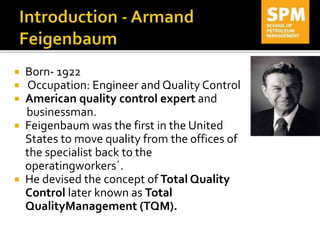
 Born- 1922
 Occupation: Engineer and Quality Control
 American quality control expert and
businessman.
 Feigenbaum was the first in the United
States to move quality from the offices of
the specialist back to the
operatingworkers´.
 He devised the concept of Total Quality
Control later known as Total
QualityManagement (TQM).
 Total quality control
 The concept of a Hidden plant.
 Accountability for quality
 The concept of quality costs.
Total quality control is an effective system for
integrating the quality development, quality
maintenance, and quality improvement efforts of
the various groups in an organization so as to
enable production and service at the most
economical levels which allow full customer
satisfaction.
 Quality control is management’s
responsibility.
 Management should thoroughly understand
the aspects that control quality, namely
humans.
 Therefore, management needs to work on
improving employee consistency and quality.
 According to Feigenbaum, statistical tools
make up a very small percentage of the
quality control program.
 According to Feigenbaum, quality did not
mean giving the best product to the customer.
 More important as a tool was control, which
focuses on the following:
 1. Devising clear and achievable quality standards
 2. Enhancing existing working conditions to reach
the desired quality standards.
 3. Setting new quality standards with an aim to
further improve.
 According to him, quality must encompass all the
phases in the manufacturing of a product.This
includes design, manufacturing, quality checks, sales,
after-sales services, and customer satisfaction when
the product is delivered to the customer.
 Given that these factors control the perception of
quality, he proposed controls to control the above-
mentioned phases.
 New-design control
 Incoming material control
 Product control
 Special process studies.
 Quality Leadership-motivating force for
quality improvement
 QualityTechnology -statistics and
machinery used to improve technology
 Organizational Commitment -includes
everyone in the quality struggle
 Quality is a company wide process
 Quality is what customer says it is
 Quality and costs are a sum not a difference
 Quality requires both individual and teamwork
 Quality is a way of managing
 Quality and innovation are mutually dependant
 Quality is an ethic
 Quality requires continuous improvement
 Quality is most cost-effective
 Quality is implemented with a total system
connected with costumers and suppliers.
Hot House Quality
 Quality programs that receive a lot of hoopla
and no follow-through
 WishfulThinking-Those who would pursue
protectionism to keep American firms from
having to compete on quality
 Producing Overseas
 Confining Quality to the Factory
 When quality is viewed as a shop-floor concern,
verses the responsibility of everyone
 Total quality control is defined as a system
for improvement.
 Big Q quality (company-wide commitment to
TQC) is more important than little q quality
(improvements on the production line)
 Control is a management tool with four steps
 Quality control requires integration of
uncoordinated activities
 Quality increases profits
 Quality is expected, not desired
 Humans affect quality
 TQC applies to all products and services
 Quality is a total life-cycle consideration
 Control the process
 Total quality system involves the entire
company-wide operating work structure
 There are many operating and financial
benefits of quality
 The costs of quality are a means
for measuring quality control activities
 Organize for quality control
 Managers are quality facilitators, not quality
cops
 Strive for continuous commitment
 Use statistical tools
 Automation is not a panacea
 Control quality at the source.
 QualityControl:Principles,Practice, and Administration, McGraw-Hill, 1951
 Total Quality Control: Achieving Productivity, MarketPenetration, and
Advantage in the Global Economy,1983, 1985, 1991, 2010(Yet to
be Released)
 The Power of Management Capital, McGraw-Hill, 2003( co-author Donald
S. Feigenbaum)
 Total Quality Control , McGraw-Hill Professional, 2004
 http://www.qualitygurus.com/gurus/list-of-gurus/armand-v-feigenbaum/
 http://tenstep.fr/01_Publique/90.3_EspaceDeLaQualite/Anglais/700Arman
dVFeigenbaum.pdf
 https://www.scribd.com/doc/22398244/Armand-Feigenbaum
 https://www.academia.edu/1342975/Paradigms_of_Total_Quality_Manag
ement
Armand V Feiganbaum

Armand V Feiganbaum

  • 1.
    Submitted by: Group1 Ambarish Nigam(20135005) Amit Kumar(20135006) Greeshma Nair (20135020) Yashvendra Jadaun(20135060) MBA-GM SubmittedTo: Prof Harit Joshi Visiting Faculty
  • 2.
     Born- 1922 Occupation: Engineer and Quality Control  American quality control expert and businessman.  Feigenbaum was the first in the United States to move quality from the offices of the specialist back to the operatingworkers´.  He devised the concept of Total Quality Control later known as Total QualityManagement (TQM).
  • 3.
     Total qualitycontrol  The concept of a Hidden plant.  Accountability for quality  The concept of quality costs.
  • 4.
    Total quality controlis an effective system for integrating the quality development, quality maintenance, and quality improvement efforts of the various groups in an organization so as to enable production and service at the most economical levels which allow full customer satisfaction.
  • 5.
     Quality controlis management’s responsibility.  Management should thoroughly understand the aspects that control quality, namely humans.  Therefore, management needs to work on improving employee consistency and quality.  According to Feigenbaum, statistical tools make up a very small percentage of the quality control program.
  • 6.
     According toFeigenbaum, quality did not mean giving the best product to the customer.  More important as a tool was control, which focuses on the following:  1. Devising clear and achievable quality standards  2. Enhancing existing working conditions to reach the desired quality standards.  3. Setting new quality standards with an aim to further improve.
  • 7.
     According tohim, quality must encompass all the phases in the manufacturing of a product.This includes design, manufacturing, quality checks, sales, after-sales services, and customer satisfaction when the product is delivered to the customer.  Given that these factors control the perception of quality, he proposed controls to control the above- mentioned phases.  New-design control  Incoming material control  Product control  Special process studies.
  • 8.
     Quality Leadership-motivatingforce for quality improvement  QualityTechnology -statistics and machinery used to improve technology  Organizational Commitment -includes everyone in the quality struggle
  • 9.
     Quality isa company wide process  Quality is what customer says it is  Quality and costs are a sum not a difference  Quality requires both individual and teamwork  Quality is a way of managing  Quality and innovation are mutually dependant  Quality is an ethic  Quality requires continuous improvement  Quality is most cost-effective  Quality is implemented with a total system connected with costumers and suppliers.
  • 10.
    Hot House Quality Quality programs that receive a lot of hoopla and no follow-through  WishfulThinking-Those who would pursue protectionism to keep American firms from having to compete on quality  Producing Overseas  Confining Quality to the Factory  When quality is viewed as a shop-floor concern, verses the responsibility of everyone
  • 11.
     Total qualitycontrol is defined as a system for improvement.  Big Q quality (company-wide commitment to TQC) is more important than little q quality (improvements on the production line)  Control is a management tool with four steps  Quality control requires integration of uncoordinated activities  Quality increases profits  Quality is expected, not desired  Humans affect quality
  • 12.
     TQC appliesto all products and services  Quality is a total life-cycle consideration  Control the process  Total quality system involves the entire company-wide operating work structure  There are many operating and financial benefits of quality  The costs of quality are a means for measuring quality control activities
  • 13.
     Organize forquality control  Managers are quality facilitators, not quality cops  Strive for continuous commitment  Use statistical tools  Automation is not a panacea  Control quality at the source.
  • 14.
     QualityControl:Principles,Practice, andAdministration, McGraw-Hill, 1951  Total Quality Control: Achieving Productivity, MarketPenetration, and Advantage in the Global Economy,1983, 1985, 1991, 2010(Yet to be Released)  The Power of Management Capital, McGraw-Hill, 2003( co-author Donald S. Feigenbaum)  Total Quality Control , McGraw-Hill Professional, 2004  http://www.qualitygurus.com/gurus/list-of-gurus/armand-v-feigenbaum/  http://tenstep.fr/01_Publique/90.3_EspaceDeLaQualite/Anglais/700Arman dVFeigenbaum.pdf  https://www.scribd.com/doc/22398244/Armand-Feigenbaum  https://www.academia.edu/1342975/Paradigms_of_Total_Quality_Manag ement