Textile Finishing
Spotting-Stains
D.Praveen Nagarajan
INTRODUCTION
Stain is a soil / spot / dust or
any unwanted undesirable marks
over the fabric it can be over the
surface of the fabric, can be at
interstitial sites or even inside the
molecular structure of the fabric.
Stains can be prevented at various stages of production.
This problem can be up to large extent at the initial stage
itself.
For this what we need is to take a little extra care and few
precautionary measures at different stages as well as
awareness among the operators and helpers they should be
made to know the importance of quality in garment and
should be trained to avoid quality related mistakes.
If these measures are followed in the industry we can surely
improve the quality and increase the already dipping profit
margin at the same time we can fulfill our shipment
commitments.
Soil / Stain removal is therefore an
essential aspect of caring of fabrics if they
are to be maintained in good condition.
Soil can be removed from fabrics by
laundering or by dry cleaning.
Though the principle utilized in home
laundering and professional are same, the
equipment and cleaning products may
vary.
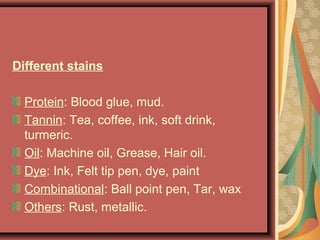
Different stains
Protein: Blood glue, mud.
Tannin: Tea, coffee, ink, soft drink,
turmeric.
Oil: Machine oil, Grease, Hair oil.
Dye: Ink, Felt tip pen, dye, paint
Combinational: Ball point pen, Tar, wax
Others: Rust, metallic.
Tannin Stain
Tannin stains are defined as any wet
side stain originating from something
that grows from the ground, e.g.,
vegetable.
This includes stains such as coffee,
tea, juice, liquor, soft drinks, etc.
SOIL CLASSIFICATION
Soiling of fabrics occur as over all
soiling, localized soiling (stains) or
combination of two. The obvious
effect of soil on a fabric is staining or
dulling, stiffening, colour changing.
Soils having similar characteristics
are grouped together.
CLASSIFICATION OF STAINS BASED ON
STRUCTURE
Classification of stain into three different categories
Surface tension
Interstitial stain
Molecular stain
Surface tension:
This stain is classified depending on the type and the
presence of stain in between the fiber. The stain is present
at the surface of the fabric
Interstitial stain:
Void created between the fiber.
Molecular stain:
Reacts with the molecular structure of the fiber.
Their classification includes:
Solvent soluble soils (oil, grease, waxes)
Water solube soils – Partially / Completely
(built up food stains, salts, sugars)
Insoluble soils (Carbon, dust, sand lint,
oxidized oil stains) are removed by
spotters.
Soluble Soils
Soluble dirt is made up of organic acids,
alkaline substances, blood, starches and
sugars. All these substances dissolve in
cool or warm water and although they may
some times require special stain removing
techniques. These soluble substances are
not serious problems to the cleaning
process.
In-Soluble Soils
Insoluble soils may be held onto the
fabrics by physical attraction or in
film, greases or oils.
Such soil requires the use of
detergents or other special laundry or
cleaning products.
PROCESS OF CONDITION ANALYSIS
Before beginning the actual cleaning of a textile, an analysis
must be made of the piece in question to decide whether to
dry clean or to wet clean. Determinations must be made on
Generic type of fibres present must be identified,
Textile Structure (Woven / Non-Woven),
Type of colorants present (Natural dye / Synthetic dye),
Kinds of soil / grease present (decide the cleaning method),
Condition of textile material (strong / fragile),
Medium of cleaning,
Temperature required for cleaning
Drying Facility
STAIN IDENTIFICATION
Of prime importance in stain removal is Identification of
Stain. Common observations can be used to identify the
stains present in garments.
Appearance of Spot or stains:
Color,
Appearance,
Shape,
Observation under UV light,
Odour – Perfume, Medicinal Stains,
Location – Under arm (perspiration), food stains on tie
Feel – Stiff, Sticky (glue type), rough or smooth (paint),
STAIN REMOVAL
Successful removal of stains from fabrics depends
on the basic principle of not allowing the spot to
stain to become set.
A stain should be removed at the first possible
opportunity because it may be more easily
dissolved when fresh.
The type of fabrics may limit selection of method
to use in removing the stain will be determined by
the type of stain and the type of stain remover.
Use of an incorrect remover may damage or even
destroy the fiber content of a fabric.
Hot water should never be used on an unknown
stain. The heat may set the stain, making it more
difficult to remove.
STAIN REMOVAL TECHNIQUES
Sponging –
Place the stain face down on absorbent, clean,
white paper towels or cloth. Apply the stain
remover sparingly to the stain with a clean, soft,
lintless cloth.
Avoid circling and spreading the stain. Use light,
brushing strokes, working from the outside of the
stain toward the center.
When the stain is removed, place the sponged
area between layer of dry, absorbent towels to
speed the drying process.
STAIN REMOVAL TECHNIQUES
Soaking –
Put the item in cool water unless the stain
removal procedure you are following
specifies warm or hot water. Soaking aids
stain removal. Soaking time may vary
depending on the type of stain. Avoid
soaking some colored items for a long time
to prevent damage to the color.
STAIN REMOVAL TECHNIQUES
Flushing –
Place clean absorbent materials under the
stain, than add the stain remover in small
amounts with a medicine dropper. Give
fabric time to a soak in the fluid. Change
the absorbent material as you flush out the
stain. Rinse out the stain remover from the
fabric with water.
KINDS OF STAIN REMOVERS
No single chemical can be used to remove
all spots from the many different kinds of
fibers.
For example, since acids destroy cotton
and linen, they cannot be used to remove
stains from these fibers.
Similarly, alkalies cannot be used on silk
and wool.
Acetate requires special care, as it
dissolves in acetone, acetic acid, and
chloroform.
WATER, ALKALIES AND ACIDS
Acids and alkalis should be used only as mild
solutions.
When using a mild acid such as vinegar, any
possible damage that might occur to the fabric
must be counteracted by applying a weak alkali,
such as a solution of bicarbonate of soda or
ammonia water, to neutralize the acid.
The fabric should be thoroughly rinsed in clear
water.
If an alkali solution is necessary, it
should be followed immediately with a
mild acid solution (such as lemon
juice, vinegar, or a dilute solution of
acetic acid) to neutralize the action of
the alkali.
The fabric should be well rinsed.
WATER, ALKALIES AND ACIDS
Many manmade fibers, such as the
polyesters, acrylics, modacrylics &
polypropylenes are not very
absorbent, and fabrics of such fibers
do not readily stain.
Removal of stains for these fibers
generally requires merely wiping with
a damp cloth or washing with a mild
soap in warm water.
BLEACHING AGENTS
Various bleaching chemicals are commonly used
to remove stains. But such chemicals must be
used carefully because they extract color and
weaken the cloth.
Household bleaches of chlorine solutions (sodium
hypochlorite) should be used only on cottons
linens, and rayon's – never on silk or wool.
If a stain is to be removed with a bleaching
chemical, the fabric should be stretched over a
bowl of hot water and tied around the edges of the
bowl.
BLEACHING AGENTS
The bleaching agent should be dropped on the
stained area with a medicine dropper. This
application must be followed immediately with a
thorough rinsing.
The entire procedure must be done quickly so that
the bleaching agent will no remain too long on the
material and cause undue weakening of the fabric.
To prevent weakening, a few drops of oxalic acid
or sodium thiosulfate (Photographer’s hypo) will
neutralize the action of any chlorine bleach that
may remain in the fabric.
If a bleaching agent is used on a colored fabric,
the dipping method is advisable to avoid unequal
distribution of any subsequent loss of color.
Sodium-per-borate and oxalic acid
Sodium per borate and oxalic acid are effective in removing
iron rust, metal stains, and some ink stains from all types of
fabrics. These chemicals are the least harmful of all
bleaches, but they must be used quickly to prevent
abstraction of the dye.
For white woolens, sodium per borate is particularly effective
and harmless.
For the removal of mildew, ink, iron rust, dye stains, a
solution of one teaspoon of sodium hydrosulfite in a glass of
water is one of the most effective bleaches. But the liquid
must used be quickly and the fabric should be well rinsed.
Otherwise, the color may destroyed and weakened the
fabric.
Hydrogen peroxide
Hydrogen peroxide maybe used on
all kinds of fabrics.
It is a mild bleach, but it can be made
more effective by the addition of a
little ammonia.
Oxalic acid and sodium hydrosulfite
cannot be used on weighted silk.
SOLVENTS
Where a stain is known to be of a greasy nature,
the use of a solvent alone is sufficient.
Grease stains are easily removed by the following
solvents:
Per-chloro-ethylene,
Turpentine,
Stoddard solvent,
Gasoline,
Ether,
Acetone &
Alcohol.
SOLVENTS
Even though water is the universal solvent and
can be absorbed by almost all fibres, the
increased weight and fibre size (swelling) can
cause damage to the fibres.
Water cannot always successfully remove oil
borne stains, so other solvents are necessary.
Most dyes will not be affected by dry cleaning.
There are three dry cleaning solutions namely
Stoddard – petroleum based solvent
Per chloro ethylene – Chlorinated hydro carbon,
typically used in commercial cleaners
Valclene A – Fluorinated hydro carbon from
Dupont which can be applied without heating.
LAUNDERING
Laundering is based on the use of water as a
solvent.
Water is effective in dissolving or suspending
particulate soils such as salts, clay, dust and water
based spots and stains.
The agitation is washing machine or rubbing often
employed in hand washing provide mechanical
action to loosen soil and stains.
Higher water temperature usually enhance
cleaning but may have detrimental effects on other
properties like colour retention.
DETERGENTS
Detergents contain Surfactants, Anti-redepositing agents,
Bleaches, Fluorescent Whiteners, Perfumes, and
Processing aids to improve detergent power.
Detergents and Soaps surround the soil particles that are
removed and suspend them in wash water preventing their
re-deposition on the textile substrate.
They have a hydrophobic end that attracts oily substances,
and an ionic end that attracts charged or hydrophilic
substances. These substances form micelle, which are
carried away when water is remove.
Recommended levels of detergents by the manufacturers
indicated the level required to ensure critical micelle
concentration.
DETERGENTS
Much soil is acidic in nature and will tend to
neutralize some of alkalinity of the soap, therefore,
heavily soiled garments require more detergents.
To ensure the presence of adequate alkalinity
throughout washing, alkali boosters are added to
increase the effectiveness.
DRY CLEANING AND DRY CLEANING SOLVENTS
Dry cleaning is called so because only
minimum amount of water is used and
because of the same reason.
The fibers do not swell and also do not
shrink as much. Organic solvents are used
in textile cleaning when the conventional
water-soluble cleaners do not dissolve
certain type of stains.
The most commonly encountered stains
are varnishes, waxes, tars, cooking oils,
fats, resins, and paints.
DRY CLEANING AND DRY CLEANING SOLVENTS
Petroleum based solvents are obtained from
distillation by-products of crude oil processing.
These solvents solubilize stains and become even
more effective as a stain remover when “charged”
i.e. combined with water and dry cleaning soap in
small quantities.
It is rarely used now days because of its
flammability.
FACTORS AFFECTING SOIL REMOVAL
1. Type of soil,
2. Extent of soiling,
3. Age of soil and
4. Nature stained fabrics.
.
Causes of Re-deposition
Re-deposition refers only to the fact
that the fabric has darkened.
When suspension power of
detergents gets decreased, the
occurrence of re-deposition
increases.
Other reasons are overloading the
fabric, improper soaking, improper
suds returning system
STAIN REMOVAL GUIDES
Asphalt, Tar
Scrape excess from fabric with a dull
knife. Sponge with dry-cleaning
solvent.
Rinse with water, Apply detergent to
stain.
Launder, using hottest water for
fabric.
Use chlorine bleach if safe for fabric.
BEVERAGES (WINE, ALCOHOL AND SOFT DRINKS)
Sponge with cool water, Soak for 15
minutes in 1 qt. of lukewarm water,
½ tsp. liquid dish detergent and 1
tbsp. of white vinegar.
Launder.
If stain remains, soak in an enzyme
BLOOD
Soak in cold water for 30 minutes.
Wash with warm water and a detergent.
If stain remains, soak in an enzyme
presoak and lukewarm water for 15 to 30
minutes or apply a few drops of hydrogen
peroxide.
For old stains, apply a few drops of
ammonia and wash with detergent.
CANDLE WAX
Scrape excess from fabric with a dull knife.
Spray or sponge with dry-cleaning solvent,
then rub with heavy-duty liquid detergent
before washing.
Pressing the wax between paper may set
the candle dye more permanently by
making it harder for the solvent to
penetrate the wax.
Launder using hot water and chlorine
bleach if safe for fabric.
CHEWING GUM
Rub with ice cube and remove
excess with a dull knife.
Sponge with dry-cleaning solvent or
pre-wash stain remover and rinse
with water.
Launder garment as usual.
CHOCOLATE OR COCOA
Sponge with dry-cleaning solvent or treat with pre-
wash stain remover. Rinse.
Apply liquid dish detergent to stain. Launder using
hot water and chlorine bleach if safe for fabric.
If stain remains, soak for 30 minutes in enzyme
presoak. Rinse and launder.
OR Bleach chocolate stains with hydrogen
peroxide. Rinse with water and wash as usual
COFFEE, TEA
Soak in solution of 1qt. water, ½ tsp.
liquid dish detergent and 1 Tbsp.
vinegar for 15 minutes.
Rinse with water.
If stain remains, sponge with alcohol
or soak in enzyme presoak and warm
water for 30 minutes.
CREAM, MILK AND ICE CREAM
Sponge with dry-cleaning solvent, pre-
wash stain remover or dry spotter (see
recipe).
Allow to dry. Rinse with water.
Apply liquid dish detergent and launder in
hottest water possible for fabric.
OR Soak in warm water and enzyme
presoak for 15 to 30 minutes then launder.
DEODORANTS,ANTIPERSPIRANTS
Soak in cool water.
Apply detergent to stain and launder.
If fabric is discolored, treat fresh
stains with ammonia and old stains
with vinegar.
EGG
Soak in cool water with enzyme for
15-30 minutes.
Rinse and let dry.
Rub in detergent before laundering.
If greasy stain remains, apply pre-
wash stain remover and launder.
FRUITS OR BERRIES
Soak in 1qt warm water, 1 tsp. liquid
dish detergent and 1 Tbsp. White
vinegar for 15 minutes. Rinse.
If stain remains, sponge with alcohol,
rinse and launder.
If color stain remains, launder using
chlorine beach if safe for fabric or use
oxygen bleach.
GRAVY
Sponge with dry-cleaning solvent or
use pre-wash stain remover.
Rinse with water.
Air dry, then apply heavy-duty liquid
detergent to stain and launder.
OR Soak in warm water and enzyme
presoak for 15 to 30 minutes.
Launder.
GREASE, OIL AND BUTTER
Sponge with dry-cleaning solvent,
then air dry.
Apply detergent to stain and launder.
OR use pre-wash stain remover and
launder.
INK, BALL POINT, FELT TIP MARKER
Sponge on any of the following until stain is
forced out: dry-cleaning solvent, alcohol,
acetone or pre-wash stain remover.
Let dry. Repeat if necessary.
If any stain remains, apply heavy-duty
liquid detergent and launder.
Certain hair sprays are effective on ball
point, but some may leave a gummy
residue and perfume.
NAIL POLISH
Apply nail polish remover, amyl
acetate or acetone to back of stain
over absorbent material.
Do not use if fabric is acetate,
triacetate or modacrylic.
Rinse and launder
PAINT, OIL BASE
Remove the paint before it dries.
Sponge with dry-cleaning solvent.
Rinse.
If a thinner is recommended for the
paint, treat stain with it.
Work in liquid dish detergent and
launder using hot water if safe for
fabric.
PAINT, WATER BASE
Remove the paint before it dries.
Sponge with dry spotter.
Soak stain in cool water.
Apply detergent and launder.
PENCIL MARKS
Use an art gum eraser to erase
marks.
Sponge with dry-cleaning solvent or
apply pre-wash stain remover
Launder.
RUST
Apply a commercial rust remover.
Follow manufacturer’s directions.
Rinse before putting item in washer.
Use lemon juice and salt on stain.
Spread in the sun to dry.
Rinse launder.
SHOE POLISH
Sponge with dry-cleaning solvent or
pre-wash stain remover.
Rinse.
Apply heavy-duty liquid detergent to
stain and launder using hot water if
safe for fabric.
If stain remains, sponge with rubbing
alcohol Rinse.
URINE, VOMIT AND MUCUS
Sponge or soak stain in cool water.
Apply detergent to stain.
Launder.
If stain remains, soak in an enzyme
presoak for 30 minutes.
Launder using oxygen bleach.
Thank You

Textile finishing stains

  • 1.
  • 2.
    INTRODUCTION Stain is asoil / spot / dust or any unwanted undesirable marks over the fabric it can be over the surface of the fabric, can be at interstitial sites or even inside the molecular structure of the fabric.
  • 3.
    Stains can beprevented at various stages of production. This problem can be up to large extent at the initial stage itself. For this what we need is to take a little extra care and few precautionary measures at different stages as well as awareness among the operators and helpers they should be made to know the importance of quality in garment and should be trained to avoid quality related mistakes. If these measures are followed in the industry we can surely improve the quality and increase the already dipping profit margin at the same time we can fulfill our shipment commitments.
  • 4.
    Soil / Stainremoval is therefore an essential aspect of caring of fabrics if they are to be maintained in good condition. Soil can be removed from fabrics by laundering or by dry cleaning. Though the principle utilized in home laundering and professional are same, the equipment and cleaning products may vary.
  • 5.
    Different stains Protein: Bloodglue, mud. Tannin: Tea, coffee, ink, soft drink, turmeric. Oil: Machine oil, Grease, Hair oil. Dye: Ink, Felt tip pen, dye, paint Combinational: Ball point pen, Tar, wax Others: Rust, metallic.
  • 6.
    Tannin Stain Tannin stainsare defined as any wet side stain originating from something that grows from the ground, e.g., vegetable. This includes stains such as coffee, tea, juice, liquor, soft drinks, etc.
  • 7.
    SOIL CLASSIFICATION Soiling offabrics occur as over all soiling, localized soiling (stains) or combination of two. The obvious effect of soil on a fabric is staining or dulling, stiffening, colour changing. Soils having similar characteristics are grouped together.
  • 8.
    CLASSIFICATION OF STAINSBASED ON STRUCTURE Classification of stain into three different categories Surface tension Interstitial stain Molecular stain Surface tension: This stain is classified depending on the type and the presence of stain in between the fiber. The stain is present at the surface of the fabric Interstitial stain: Void created between the fiber. Molecular stain: Reacts with the molecular structure of the fiber.
  • 9.
    Their classification includes: Solventsoluble soils (oil, grease, waxes) Water solube soils – Partially / Completely (built up food stains, salts, sugars) Insoluble soils (Carbon, dust, sand lint, oxidized oil stains) are removed by spotters.
  • 10.
    Soluble Soils Soluble dirtis made up of organic acids, alkaline substances, blood, starches and sugars. All these substances dissolve in cool or warm water and although they may some times require special stain removing techniques. These soluble substances are not serious problems to the cleaning process.
  • 11.
    In-Soluble Soils Insoluble soilsmay be held onto the fabrics by physical attraction or in film, greases or oils. Such soil requires the use of detergents or other special laundry or cleaning products.
  • 12.
    PROCESS OF CONDITIONANALYSIS Before beginning the actual cleaning of a textile, an analysis must be made of the piece in question to decide whether to dry clean or to wet clean. Determinations must be made on Generic type of fibres present must be identified, Textile Structure (Woven / Non-Woven), Type of colorants present (Natural dye / Synthetic dye), Kinds of soil / grease present (decide the cleaning method), Condition of textile material (strong / fragile), Medium of cleaning, Temperature required for cleaning Drying Facility
  • 13.
    STAIN IDENTIFICATION Of primeimportance in stain removal is Identification of Stain. Common observations can be used to identify the stains present in garments. Appearance of Spot or stains: Color, Appearance, Shape, Observation under UV light, Odour – Perfume, Medicinal Stains, Location – Under arm (perspiration), food stains on tie Feel – Stiff, Sticky (glue type), rough or smooth (paint),
  • 14.
    STAIN REMOVAL Successful removalof stains from fabrics depends on the basic principle of not allowing the spot to stain to become set. A stain should be removed at the first possible opportunity because it may be more easily dissolved when fresh. The type of fabrics may limit selection of method to use in removing the stain will be determined by the type of stain and the type of stain remover. Use of an incorrect remover may damage or even destroy the fiber content of a fabric. Hot water should never be used on an unknown stain. The heat may set the stain, making it more difficult to remove.
  • 15.
    STAIN REMOVAL TECHNIQUES Sponging– Place the stain face down on absorbent, clean, white paper towels or cloth. Apply the stain remover sparingly to the stain with a clean, soft, lintless cloth. Avoid circling and spreading the stain. Use light, brushing strokes, working from the outside of the stain toward the center. When the stain is removed, place the sponged area between layer of dry, absorbent towels to speed the drying process.
  • 16.
    STAIN REMOVAL TECHNIQUES Soaking– Put the item in cool water unless the stain removal procedure you are following specifies warm or hot water. Soaking aids stain removal. Soaking time may vary depending on the type of stain. Avoid soaking some colored items for a long time to prevent damage to the color.
  • 17.
    STAIN REMOVAL TECHNIQUES Flushing– Place clean absorbent materials under the stain, than add the stain remover in small amounts with a medicine dropper. Give fabric time to a soak in the fluid. Change the absorbent material as you flush out the stain. Rinse out the stain remover from the fabric with water.
  • 18.
    KINDS OF STAINREMOVERS No single chemical can be used to remove all spots from the many different kinds of fibers. For example, since acids destroy cotton and linen, they cannot be used to remove stains from these fibers. Similarly, alkalies cannot be used on silk and wool. Acetate requires special care, as it dissolves in acetone, acetic acid, and chloroform.
  • 19.
    WATER, ALKALIES ANDACIDS Acids and alkalis should be used only as mild solutions. When using a mild acid such as vinegar, any possible damage that might occur to the fabric must be counteracted by applying a weak alkali, such as a solution of bicarbonate of soda or ammonia water, to neutralize the acid. The fabric should be thoroughly rinsed in clear water.
  • 20.
    If an alkalisolution is necessary, it should be followed immediately with a mild acid solution (such as lemon juice, vinegar, or a dilute solution of acetic acid) to neutralize the action of the alkali. The fabric should be well rinsed.
  • 21.
    WATER, ALKALIES ANDACIDS Many manmade fibers, such as the polyesters, acrylics, modacrylics & polypropylenes are not very absorbent, and fabrics of such fibers do not readily stain. Removal of stains for these fibers generally requires merely wiping with a damp cloth or washing with a mild soap in warm water.
  • 22.
    BLEACHING AGENTS Various bleachingchemicals are commonly used to remove stains. But such chemicals must be used carefully because they extract color and weaken the cloth. Household bleaches of chlorine solutions (sodium hypochlorite) should be used only on cottons linens, and rayon's – never on silk or wool. If a stain is to be removed with a bleaching chemical, the fabric should be stretched over a bowl of hot water and tied around the edges of the bowl.
  • 23.
    BLEACHING AGENTS The bleachingagent should be dropped on the stained area with a medicine dropper. This application must be followed immediately with a thorough rinsing. The entire procedure must be done quickly so that the bleaching agent will no remain too long on the material and cause undue weakening of the fabric. To prevent weakening, a few drops of oxalic acid or sodium thiosulfate (Photographer’s hypo) will neutralize the action of any chlorine bleach that may remain in the fabric. If a bleaching agent is used on a colored fabric, the dipping method is advisable to avoid unequal distribution of any subsequent loss of color.
  • 24.
    Sodium-per-borate and oxalicacid Sodium per borate and oxalic acid are effective in removing iron rust, metal stains, and some ink stains from all types of fabrics. These chemicals are the least harmful of all bleaches, but they must be used quickly to prevent abstraction of the dye. For white woolens, sodium per borate is particularly effective and harmless. For the removal of mildew, ink, iron rust, dye stains, a solution of one teaspoon of sodium hydrosulfite in a glass of water is one of the most effective bleaches. But the liquid must used be quickly and the fabric should be well rinsed. Otherwise, the color may destroyed and weakened the fabric.
  • 25.
    Hydrogen peroxide Hydrogen peroxidemaybe used on all kinds of fabrics. It is a mild bleach, but it can be made more effective by the addition of a little ammonia. Oxalic acid and sodium hydrosulfite cannot be used on weighted silk.
  • 26.
    SOLVENTS Where a stainis known to be of a greasy nature, the use of a solvent alone is sufficient. Grease stains are easily removed by the following solvents: Per-chloro-ethylene, Turpentine, Stoddard solvent, Gasoline, Ether, Acetone & Alcohol.
  • 27.
    SOLVENTS Even though wateris the universal solvent and can be absorbed by almost all fibres, the increased weight and fibre size (swelling) can cause damage to the fibres. Water cannot always successfully remove oil borne stains, so other solvents are necessary. Most dyes will not be affected by dry cleaning.
  • 28.
    There are threedry cleaning solutions namely Stoddard – petroleum based solvent Per chloro ethylene – Chlorinated hydro carbon, typically used in commercial cleaners Valclene A – Fluorinated hydro carbon from Dupont which can be applied without heating.
  • 29.
    LAUNDERING Laundering is basedon the use of water as a solvent. Water is effective in dissolving or suspending particulate soils such as salts, clay, dust and water based spots and stains. The agitation is washing machine or rubbing often employed in hand washing provide mechanical action to loosen soil and stains. Higher water temperature usually enhance cleaning but may have detrimental effects on other properties like colour retention.
  • 30.
    DETERGENTS Detergents contain Surfactants,Anti-redepositing agents, Bleaches, Fluorescent Whiteners, Perfumes, and Processing aids to improve detergent power. Detergents and Soaps surround the soil particles that are removed and suspend them in wash water preventing their re-deposition on the textile substrate. They have a hydrophobic end that attracts oily substances, and an ionic end that attracts charged or hydrophilic substances. These substances form micelle, which are carried away when water is remove. Recommended levels of detergents by the manufacturers indicated the level required to ensure critical micelle concentration.
  • 31.
    DETERGENTS Much soil isacidic in nature and will tend to neutralize some of alkalinity of the soap, therefore, heavily soiled garments require more detergents. To ensure the presence of adequate alkalinity throughout washing, alkali boosters are added to increase the effectiveness.
  • 32.
    DRY CLEANING ANDDRY CLEANING SOLVENTS Dry cleaning is called so because only minimum amount of water is used and because of the same reason. The fibers do not swell and also do not shrink as much. Organic solvents are used in textile cleaning when the conventional water-soluble cleaners do not dissolve certain type of stains. The most commonly encountered stains are varnishes, waxes, tars, cooking oils, fats, resins, and paints.
  • 33.
    DRY CLEANING ANDDRY CLEANING SOLVENTS Petroleum based solvents are obtained from distillation by-products of crude oil processing. These solvents solubilize stains and become even more effective as a stain remover when “charged” i.e. combined with water and dry cleaning soap in small quantities. It is rarely used now days because of its flammability.
  • 34.
    FACTORS AFFECTING SOILREMOVAL 1. Type of soil, 2. Extent of soiling, 3. Age of soil and 4. Nature stained fabrics. .
  • 35.
    Causes of Re-deposition Re-depositionrefers only to the fact that the fabric has darkened. When suspension power of detergents gets decreased, the occurrence of re-deposition increases. Other reasons are overloading the fabric, improper soaking, improper suds returning system
  • 36.
    STAIN REMOVAL GUIDES Asphalt,Tar Scrape excess from fabric with a dull knife. Sponge with dry-cleaning solvent. Rinse with water, Apply detergent to stain. Launder, using hottest water for fabric. Use chlorine bleach if safe for fabric.
  • 37.
    BEVERAGES (WINE, ALCOHOLAND SOFT DRINKS) Sponge with cool water, Soak for 15 minutes in 1 qt. of lukewarm water, ½ tsp. liquid dish detergent and 1 tbsp. of white vinegar. Launder. If stain remains, soak in an enzyme
  • 38.
    BLOOD Soak in coldwater for 30 minutes. Wash with warm water and a detergent. If stain remains, soak in an enzyme presoak and lukewarm water for 15 to 30 minutes or apply a few drops of hydrogen peroxide. For old stains, apply a few drops of ammonia and wash with detergent.
  • 39.
    CANDLE WAX Scrape excessfrom fabric with a dull knife. Spray or sponge with dry-cleaning solvent, then rub with heavy-duty liquid detergent before washing. Pressing the wax between paper may set the candle dye more permanently by making it harder for the solvent to penetrate the wax. Launder using hot water and chlorine bleach if safe for fabric.
  • 40.
    CHEWING GUM Rub withice cube and remove excess with a dull knife. Sponge with dry-cleaning solvent or pre-wash stain remover and rinse with water. Launder garment as usual.
  • 41.
    CHOCOLATE OR COCOA Spongewith dry-cleaning solvent or treat with pre- wash stain remover. Rinse. Apply liquid dish detergent to stain. Launder using hot water and chlorine bleach if safe for fabric. If stain remains, soak for 30 minutes in enzyme presoak. Rinse and launder. OR Bleach chocolate stains with hydrogen peroxide. Rinse with water and wash as usual
  • 42.
    COFFEE, TEA Soak insolution of 1qt. water, ½ tsp. liquid dish detergent and 1 Tbsp. vinegar for 15 minutes. Rinse with water. If stain remains, sponge with alcohol or soak in enzyme presoak and warm water for 30 minutes.
  • 43.
    CREAM, MILK ANDICE CREAM Sponge with dry-cleaning solvent, pre- wash stain remover or dry spotter (see recipe). Allow to dry. Rinse with water. Apply liquid dish detergent and launder in hottest water possible for fabric. OR Soak in warm water and enzyme presoak for 15 to 30 minutes then launder.
  • 44.
    DEODORANTS,ANTIPERSPIRANTS Soak in coolwater. Apply detergent to stain and launder. If fabric is discolored, treat fresh stains with ammonia and old stains with vinegar.
  • 45.
    EGG Soak in coolwater with enzyme for 15-30 minutes. Rinse and let dry. Rub in detergent before laundering. If greasy stain remains, apply pre- wash stain remover and launder.
  • 46.
    FRUITS OR BERRIES Soakin 1qt warm water, 1 tsp. liquid dish detergent and 1 Tbsp. White vinegar for 15 minutes. Rinse. If stain remains, sponge with alcohol, rinse and launder. If color stain remains, launder using chlorine beach if safe for fabric or use oxygen bleach.
  • 47.
    GRAVY Sponge with dry-cleaningsolvent or use pre-wash stain remover. Rinse with water. Air dry, then apply heavy-duty liquid detergent to stain and launder. OR Soak in warm water and enzyme presoak for 15 to 30 minutes. Launder.
  • 48.
    GREASE, OIL ANDBUTTER Sponge with dry-cleaning solvent, then air dry. Apply detergent to stain and launder. OR use pre-wash stain remover and launder.
  • 49.
    INK, BALL POINT,FELT TIP MARKER Sponge on any of the following until stain is forced out: dry-cleaning solvent, alcohol, acetone or pre-wash stain remover. Let dry. Repeat if necessary. If any stain remains, apply heavy-duty liquid detergent and launder. Certain hair sprays are effective on ball point, but some may leave a gummy residue and perfume.
  • 50.
    NAIL POLISH Apply nailpolish remover, amyl acetate or acetone to back of stain over absorbent material. Do not use if fabric is acetate, triacetate or modacrylic. Rinse and launder
  • 51.
    PAINT, OIL BASE Removethe paint before it dries. Sponge with dry-cleaning solvent. Rinse. If a thinner is recommended for the paint, treat stain with it. Work in liquid dish detergent and launder using hot water if safe for fabric.
  • 52.
    PAINT, WATER BASE Removethe paint before it dries. Sponge with dry spotter. Soak stain in cool water. Apply detergent and launder.
  • 53.
    PENCIL MARKS Use anart gum eraser to erase marks. Sponge with dry-cleaning solvent or apply pre-wash stain remover Launder.
  • 54.
    RUST Apply a commercialrust remover. Follow manufacturer’s directions. Rinse before putting item in washer. Use lemon juice and salt on stain. Spread in the sun to dry. Rinse launder.
  • 55.
    SHOE POLISH Sponge withdry-cleaning solvent or pre-wash stain remover. Rinse. Apply heavy-duty liquid detergent to stain and launder using hot water if safe for fabric. If stain remains, sponge with rubbing alcohol Rinse.
  • 56.
    URINE, VOMIT ANDMUCUS Sponge or soak stain in cool water. Apply detergent to stain. Launder. If stain remains, soak in an enzyme presoak for 30 minutes. Launder using oxygen bleach.
  • 57.