TOTAL QUALITY MANAGEMENT:
TQM
Origins, Evolution & key elements
The Evolution. . .
 The ISO comprises standards that specify
requirements for the documentation,
implementation and maintenance of a
quality system.
 21st Century, TQM has developed in
many countries into holistic frameworks,
aimed to achieve excellent performance
particularly in customer and business
results.
The Evolution of Quality
 Early days of manufacturing : inspection
and decision making – accept or reject
 Separate inspection department with a
“chief inspector”
 Evolution of quality control department
with “quality control manager”
 1920’s the birth of statistical quality
control
 1924 Modern control chart by Shewhart;
later developed by Deming
The Evolution . . .
 Shewhart, Deming, Dodge and Romig
introduced the theory of statistical process
control (SPC) and it was used until late
1940s.
 1940s – Japan’s industrial system was
virtually destroyed and had a reputation for
cheap imitation products and illiterate
workforce.
 Japan solved these problems with the help of
Juran, Deming and Feigenbaum.
The Evolution . . .
 1950s Quality management practices
developed rapidly in Japan and became
their management philosophy.
 1960s-1970s Japan’s imports into the
USA and Europe increased significantly
due to its cheaper, higher quality products,
compared to the Western counterparts.
The Evolution . . .
 1969 First International conference on
quality control, sponsored by Japan,
America and Europe.
 On Feigenbaum paper, the term “total
quality” was used for the first time. This
constitutes wider issues such as
planning, organization, and
management responsibility.
The Evolution . . .
 Ishikawa introduced new meaning for “total
quality control” which means “company
wide quality control”. He described how all
employees, from top management to the
workers must participate in quality control.
 Late 1970s Company wide quality
management became common in Japanese
companies.
The Evolution . . .
 Quality revolution in the West was slow
and did not begin until early 1980s.
 Total quality management (TQM)
became the centre in most cases.
 1979 - The British Standard (BS)
5750 for quality systems was
published.
The Evolution . . .
 1983 - The National Quality Campaign
was launched using BS5750 main
theme. The aim was to popularize to the
industry the importance of quality for
competitiveness and survival in the world
market. Since then the International
Standardisation Organization (ISO)
9000 became the internationally
recognised standard for quality
management systems.
What TQM means?
 TQM is an approach to improving the
competitiveness, effectiveness and flexibility
of an organization for the benefit of all
stakeholders.
 It is a way of planning, organizing and
undertaking each activity and of removing all
the wasted effort and energy that is routinely
spent in organizations.
 It ensures the leaders to adopt a strategic
overview of quality and focus on prevention not
detection of problems.
The core of TQM is the customer-supplier
interfaces, both externally and internally,
and at each interface lie a number of
processes. This core must be surrounded by
commitment to quality, communication of the
quality message, and recognition of the need
to change the culture of the organisation to
create total quality. These are the
foundations of TQM, and they are
supported by the key management functions
of people, processes and systems in the
organisation.
What is quality?
 Quality is “Delighting the customer by fully
meeting their needs and expectations”.
These may include performance,
appearance, availability, delivery, reliability,
maintainability, cost effectiveness and price.
 Quality starts with market research – to
establish the true requirements for the
product or service and the true needs of the
customers.
Every person in the “quality chain” must
be trained to ask the ff. questions:
 Who are my customers?
 What are their true needs and expectations?
 How do, or can, I find out what these are?
 How I can measure my ability to meet their needs and
expectations?
 Do I have their capability to meet their needs and
expectations? (if not, hat must I do to improve this
capability?)
 Do I continually meet their needs and expectations?
 How do I monitor changes in their needs and expectations?
Customers (internal and external)
 Suppliers (internal and external)
 Who are my internal suppliers?
 What are my true needs and expectations?
 How do I communicate my needs and
expectations to my suppliers?
 Do my suppliers have the capability to
measure and meet these needs and
expectations?
 How do I inform them of changes in my
needs and expectations?
 Being fully aware of customers’ needs
and expectations, each person must
respect the needs and expectations of
their suppliers. The ideal situation is
an open partnership style
relationship, where both parties share
and benefit.
Poor practices
 Leaders not giving clear direction
 Not understanding, or ignoring
competitive positioning
 Each department working only for itself
 Trying to control people through systems
 Confusing quality with grade
 Accepting that a level of defects or errors
is inevitable
 Firefighting, reactive behavior
 The “It’s not my problem” attitude
The Essential Components
of TQM
 Commitment
 Leadership
The Essential Components
of TQM
 All senior managers must
demonstrate their seriousness and
commitment to quality, and middle
managers must demonstrate their
commitment; ensure they
communicate the principles,
strategies and benefits to the people
for whom they have responsibility.
Only then the right attitudes spread
throughout the organization.
The Essential . . .
 Sound quality policy, supported by
plans and facilities to implement it.
 Leaders must take responsibility for
preparing, reviewing and monitoring
the policy and lead in regular
improvements of it and ensure it is
understood at all levels of the
organization.
The Essential . . .
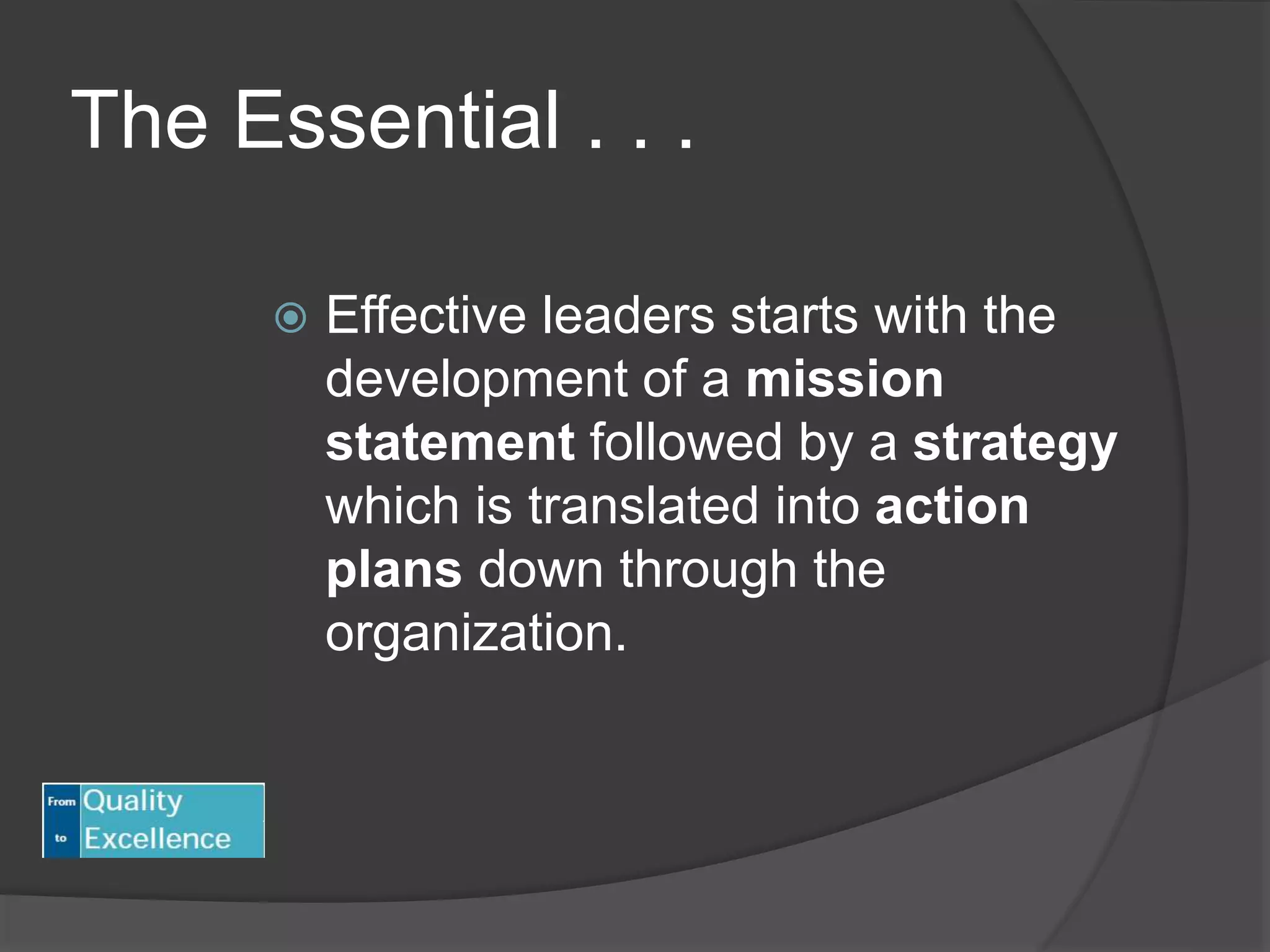
 Effective leaders starts with the
development of a mission
statement followed by a strategy
which is translated into action
plans down through the
organization.
Five Requirements for
Effective Leadership
1. Developing and publishing corporate
beliefs, values and objectives, often
as a mission statement.
2. Personal involvement and acting as
role models for a culture of total quality.
3. Developing clear and effective
strategies and supporting plans for
achieving the mission and objectives
Five Requirements . . .
4. Reviewing and improving the
management system
5. Communicating, motivating and
supporting people and
encouraging effective employee
participation.
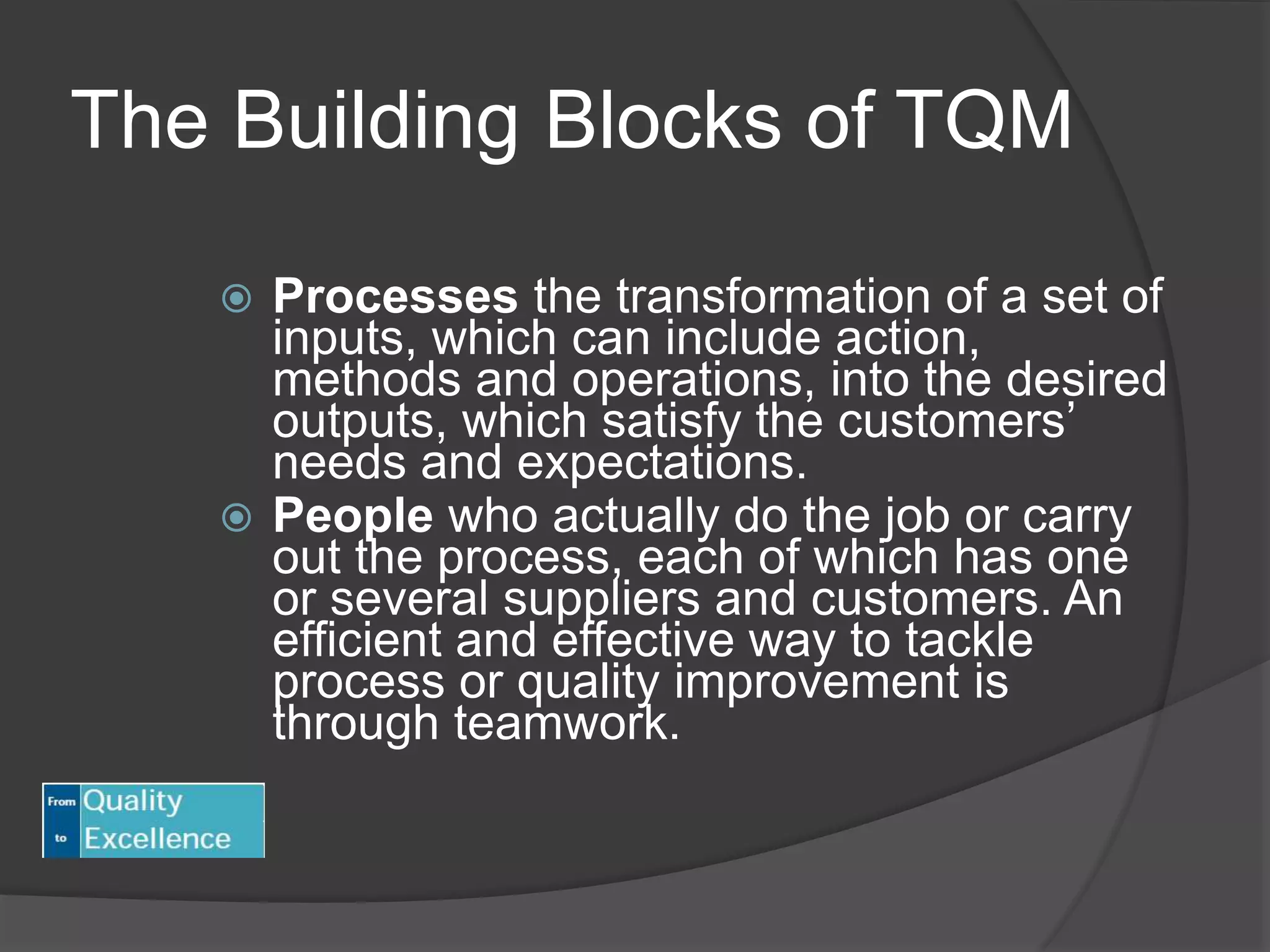
The Building Blocks of TQM
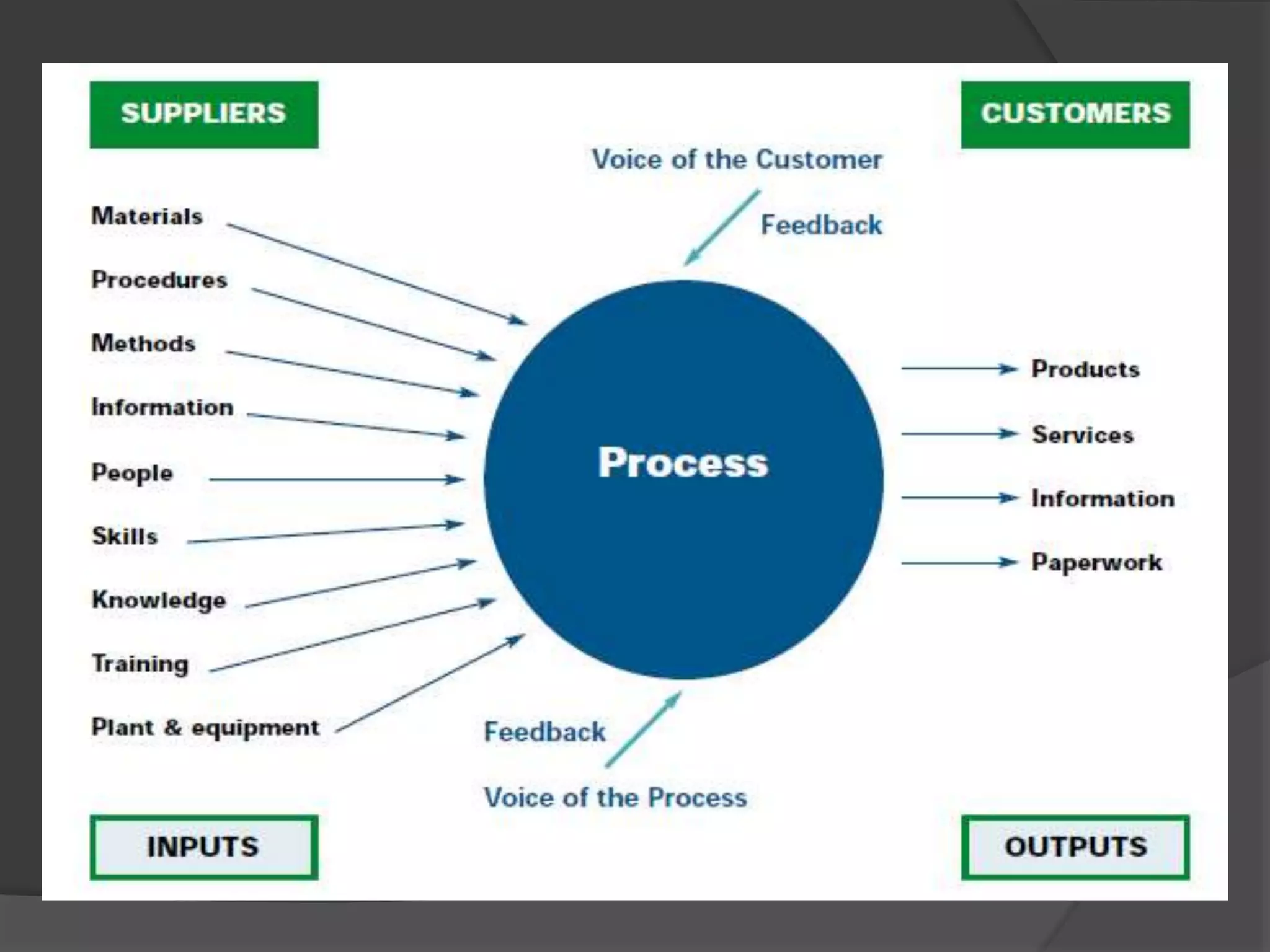
 Processes the transformation of a set of
inputs, which can include action,
methods and operations, into the desired
outputs, which satisfy the customers’
needs and expectations.
 People who actually do the job or carry
out the process, each of which has one
or several suppliers and customers. An
efficient and effective way to tackle
process or quality improvement is
through teamwork.
The Building Blocks . . .
 Management systems involves proper
adoption and documentation of
appropriate management systems
 Performance Measurement Once the
strategic direction for the organization’s
quality journey has been set, it needs
Performance Measures to monitor and
control the journey, and to ensure the
desired level of performance is being
achieved and sustained.
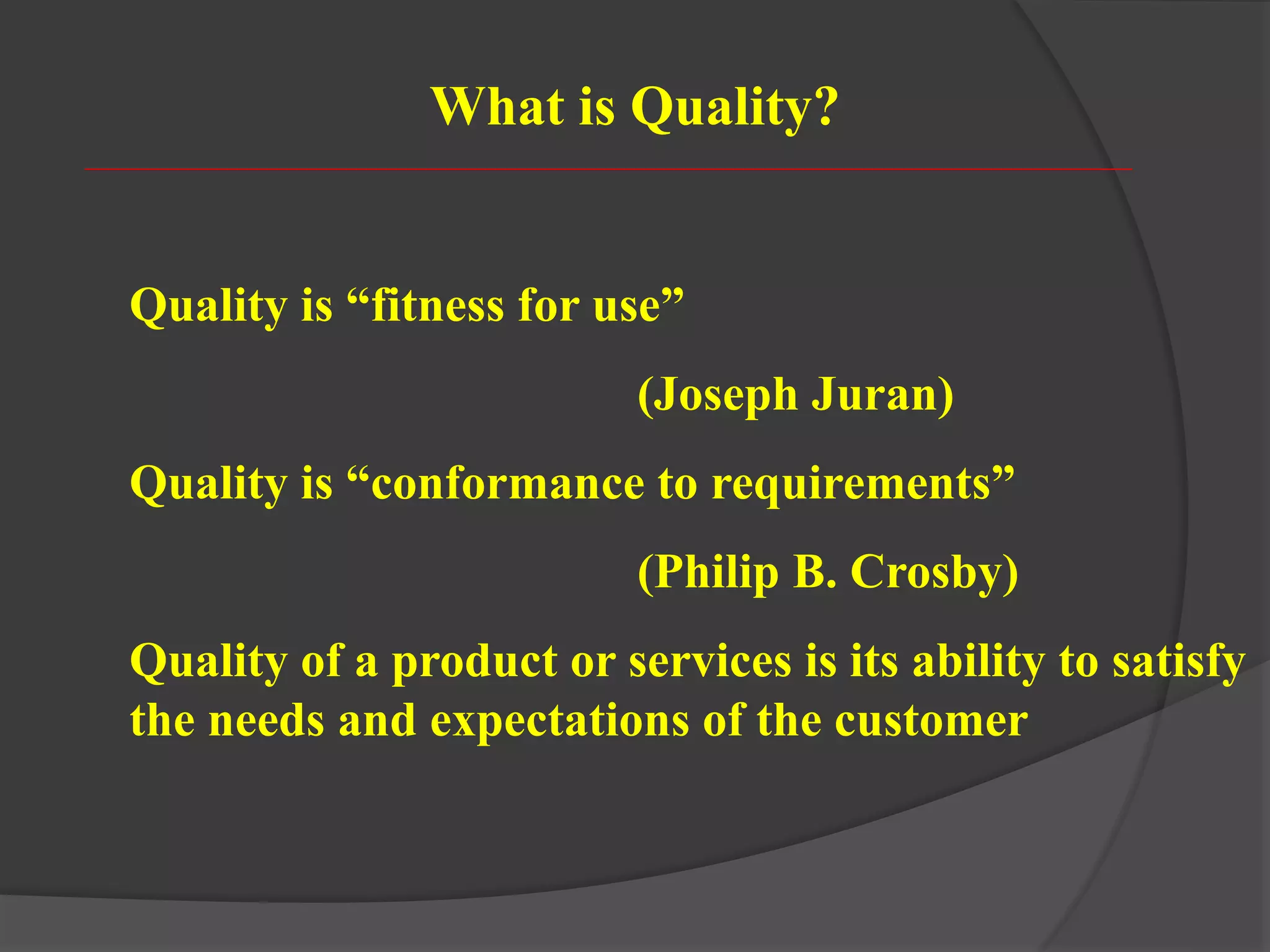
What is Quality?
Quality is “fitness for use”
(Joseph Juran)
Quality is “conformance to requirements”
(Philip B. Crosby)
Quality of a product or services is its ability to satisfy
the needs and expectations of the customer
Dimensions of Quality for
Goods
 Operation
 Reliability & durability
 Conformance
 Serviceability
 Appearance
 Perceived quality
Quality
Importance of Quality
 Company’s
reputation
 Product
liability
 International
implications
Market Gains
Reputation
Volume
Price
Lower Costs
Productivity
Rework/Scrap
Warranty
Improved
Quality
Increased
Profits
Market Gains
Reputation
Volume
Price
Lower Costs
Productivity
Rework/Scrap
Warranty
Improved
Quality
Increased
Profits
 Costs & market
share
Traditional
Quality Process (Mfg.)
Interprets
Need
Specifies
Need
Designs
Product
Defines
Quality
Produces
Product
Plans
Quality
Monitors
Quality
Customer Marketing Engineering Operations
Quality is customer driven!
Evolution of Quality Management
Inspection
Quality
Control
Quality
Assurance
TQM
Salvage, sorting, grading, blending, corrective
actions, identify sources of non-conformance
Develop quality manual, process performance
data, self-inspection, product testing, basic
quality planning, use of basic statistics,
paperwork control.
Quality systems development, advanced quality
planning, comprehensive quality manuals, use of
quality costs, involvement of non-production
operations, failure mode and effects analysis, SPC.
Policy deployment, involve supplier & customers,
involve all operations, process management,
performance measurement, teamwork, employee
involvement.
Deming’s view of a production as a system
Consumer
Research
Design &
redesign
Receipt & test of
materials
Suppliers,
materials &
equipment
Production,
assembly,
inspection
Distribution Consumers
Test of processes, machines,
methods, cost
Improve Quality
Productivity improves
Provide jobs and
more jobs
Deming’s Chain Reaction
Cost decreases because
of less rework, fewer
mistakes, fewer delays,
snags, better use of
machine time and
materials
Stay in business
Capture the market with
better quality and lower price
Definition:
Total Quality Management
 Total Quality Management (TQ, QM or TQM) and Six Sigma
(6) are sweeping “culture change” efforts to position a
company for greater customer satisfaction, profitability and
competitiveness.
 TQ may be defined as managing the entire organization so that
it excels on all dimensions of products and services that are
important to the customer.
 We often think of features when we think of the quality of a
product or service; TQ is about conformance quality, not
features.
Total Quality Is…
 Meeting Our Customer’s Requirements
 Doing Things Right the First Time;
Freedom from Failure (Defects)
 Consistency (Reduction in Variation)
 Continuous Improvement
 Quality in Everything We Do
What is TQM?
Constant drive
for continuous
improvement and
learning.
Concern for
employee
involvement and
development
Management
by Fact
Result Focus
Passion to deliver
customer value /
excellence
Organisation
response
ability
Actions not just
words
(implementation)
Process
Management
Partnership
perspective
(internal /
external)
BASIC PRINCIPLES OF TQM
Approach Management Led
Scope Company Wide
Scale Everyone is responsible for Quality
Philosophy Prevention not Detection
Standard Right First Time
Control Cost of Quality
Theme On going Improvement
Total Quality Is…
 Meeting Our Customer’s Requirements
 Doing Things Right the First Time;
Freedom from Failure (Defects)
 Consistency (Reduction in Variation)
 Continuous Improvement
 Quality in Everything We Do
A Quality Management System Is…
 A belief in the employee’s ability to solve
problems
 A belief that people doing the work are best able
to improve it
 A belief that everyone is responsible for quality
Elements for Success
 Management Support
 Mission Statement
 Proper Planning
 Customer and Bottom Line Focus
 Measurement
 Empowerment
 Teamwork/Effective Meetings
 Continuous Process Improvement
 Dedicated Resources
Measurement
Measurement
Measurement
Measurement
Empowerment/
Shared Leadership
Process
Improvement/
Problem
Solving
Team
Management
Customer
Satisfaction
Business
Results
The Continuous Improvement Process
. . .
Modern History of Quality Management
 Frederick W. Taylor wrote Principles of Scientific Management in
1911.
 Walter A. Shewhart used statistics in quality control and inspection,
and showed that productivity improves when variation is reduced
(1924); wrote Economic Control of Manufactured Product in 1931.
 W. Edwards Deming and Joseph M. Juran, students of Shewhart,
went to Japan in 1950; began transformation from “shoddy” to “world
class” goods.
 In 1960, Dr. K. Ishikawa formalized “quality circles” - the use of small
groups to eliminate variation and improve processes.
 In the late ‘70’s and early ‘80’s:
 Deming returned from Japan to write Out of the Crisis,
and began his famous 4-day seminars in the United States
 Phil Crosby wrote Quality is Free
 NBC ran “If Japan can do it, why can’t we?”
 Motorola began 6 Sigma
What is a guru?
 By definition, a guru is a good
person, a wise person and a
teacher. A quality guru should be all
of these, and must have a concept
and approach to quality within
business that has made a major
and lasting impact.
W. Edwards Deming’s 14 Points
Create constancy of purpose towards improvement
of product and services.
Adopt the new philosophy. We can no longer live
with commonly accepted levels of delays, mistakes,
defective workmanship.
Cease dependence on mass inspection. Require,
instead, statistical evidence that quality is built in.
End the practice of awarding business on the basis of
price tag.
1)
2)
3)
4)
W. Edwards Deming’s 14 Points
Find problems. It is management’s job to work
continually on the system.
Institute modern methods of training on the job.
Institute modern methods of supervision of
production workers. The responsibility of foremen
must be changed from numbers to quality.
Drive out fear that everyone may work effectively for
the company.
5)
6)
7)
8)
Break down barriers between departments.
Eliminate numerical goals, posters and slogans for
the workforce asking for new levels of productivity
without providing methods.
Eliminate work standards that prescribe numerical
quotas.
Remove barriers that stand between the hourly
worker and his right to pride of workmanship.
9)
10)
11)
12)
W. Edwards Deming’s 14 Points
Institute a vigorous programme of education and
retraining.
Create a structure in top management that will push
everyday on the above 13 points.
13)
14)
W. Edwards Deming’s 14 Points
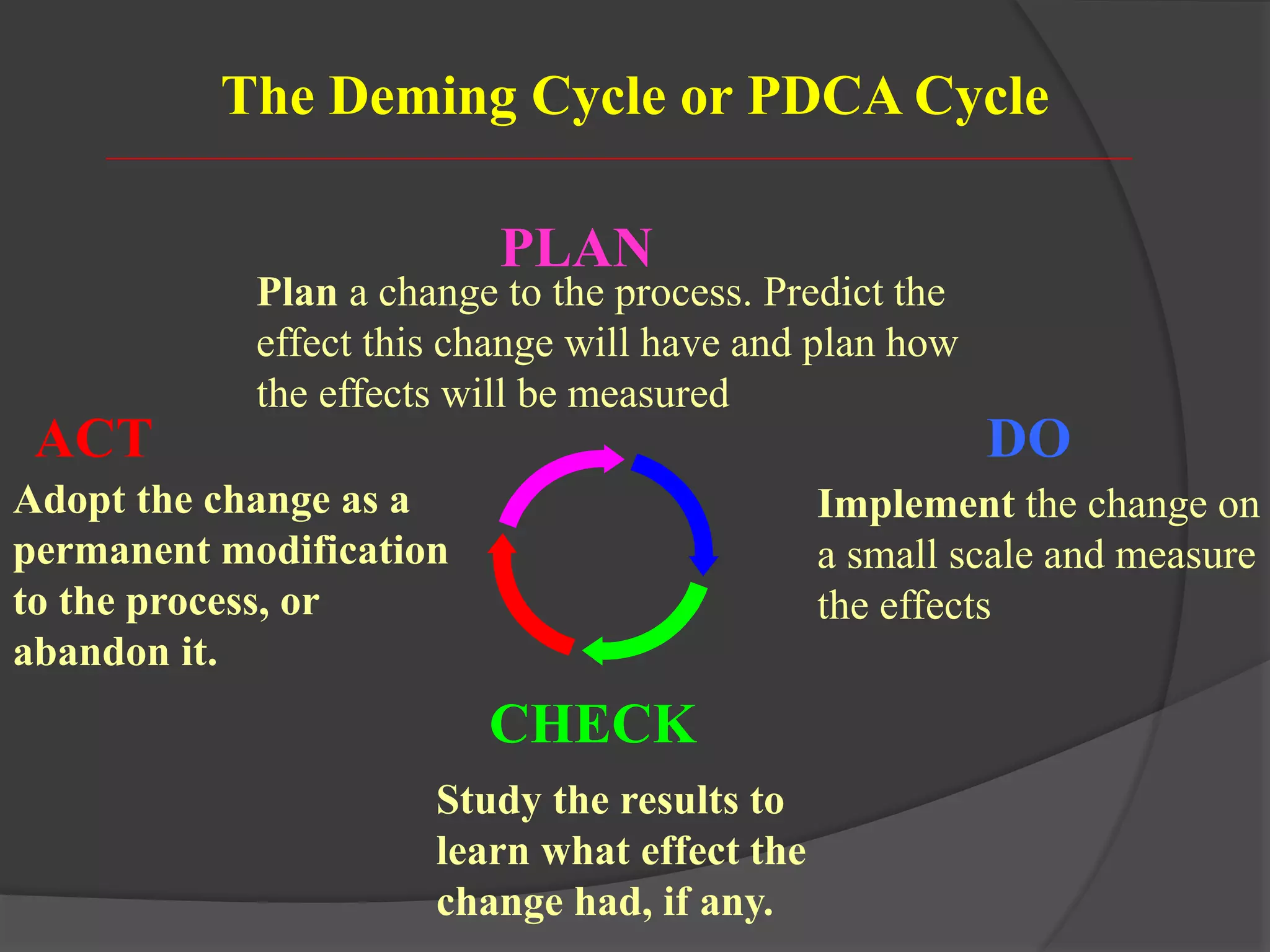
PLAN
CHECK
DOACT
The Deming Cycle or PDCA Cycle
Plan a change to the process. Predict the
effect this change will have and plan how
the effects will be measured
Implement the change on
a small scale and measure
the effects
Adopt the change as a
permanent modification
to the process, or
abandon it.
Study the results to
learn what effect the
change had, if any.
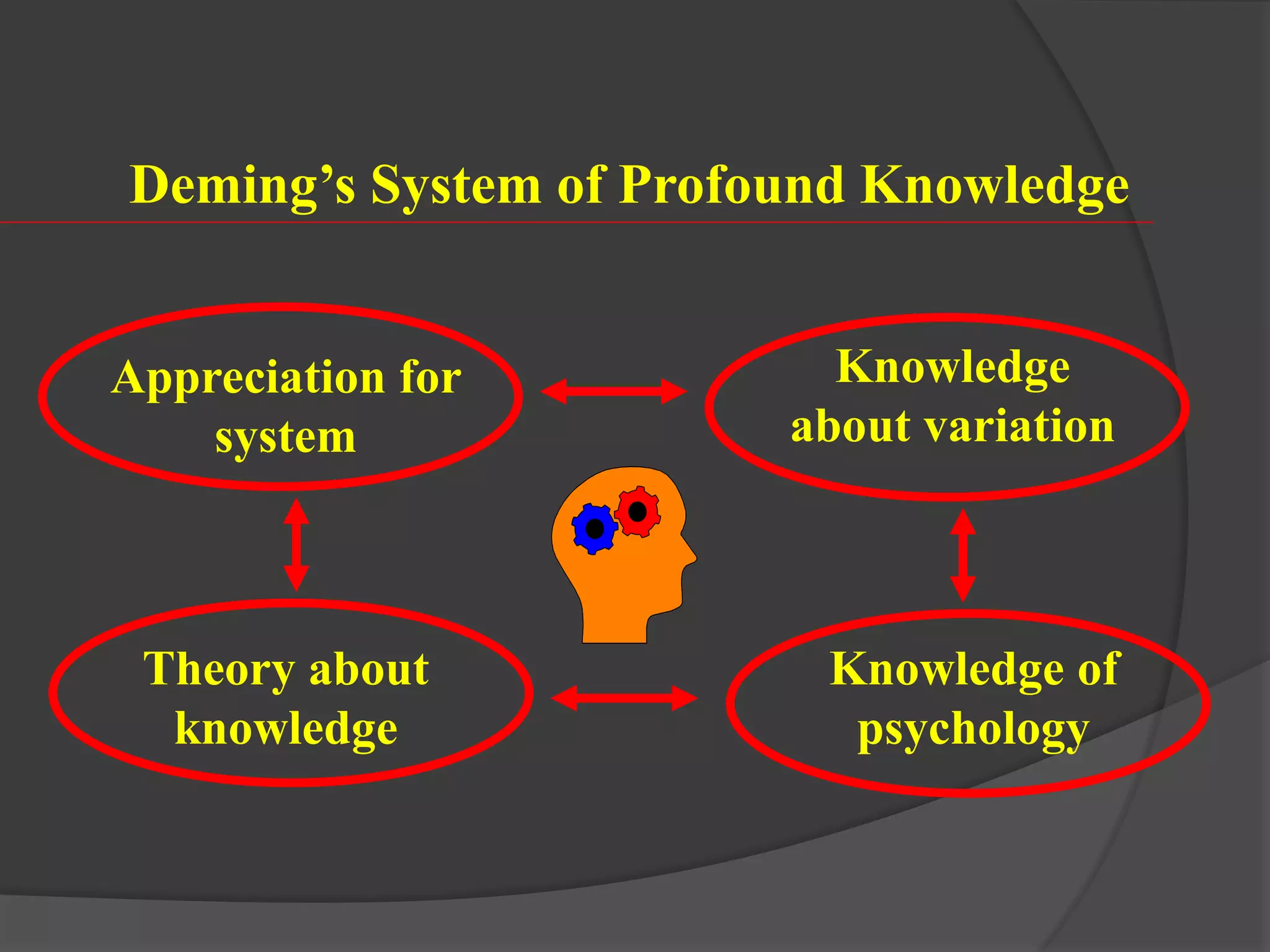
Deming’s System of Profound Knowledge
Appreciation for
system
Knowledge
about variation
Theory about
knowledge
Knowledge of
psychology
Learning
LEARNING AND TQM
Process Improvement
Quality Improvement
Customer
Satisfaction
Shareholder
Satisfaction
Employee
Satisfaction
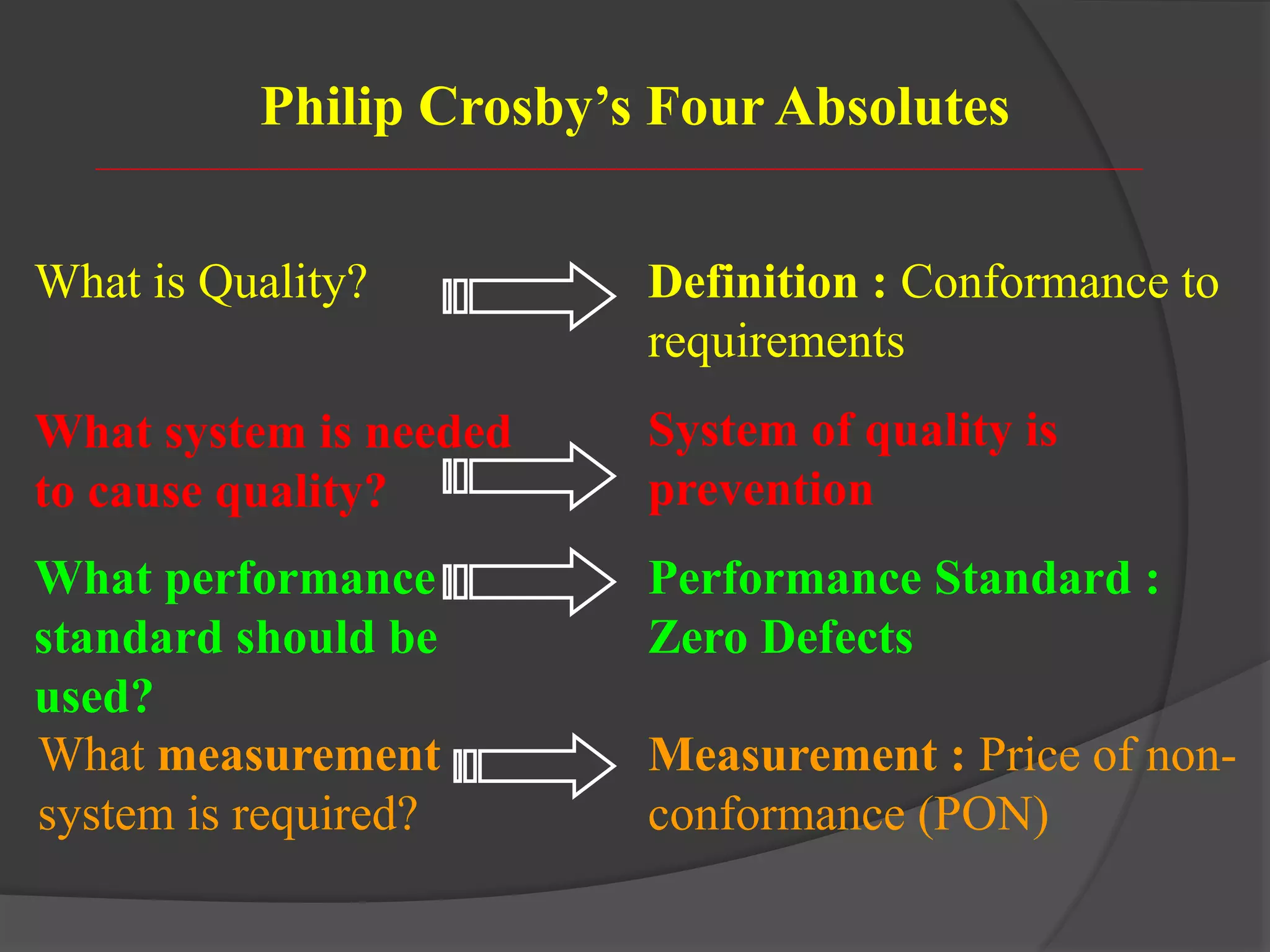
Philip Crosby’s Four Absolutes
Definition : Conformance to
requirements
System of quality is
prevention
Performance Standard :
Zero Defects
Measurement : Price of non-
conformance (PON)
What is Quality?
What system is needed
to cause quality?
What performance
standard should be
used?
What measurement
system is required?
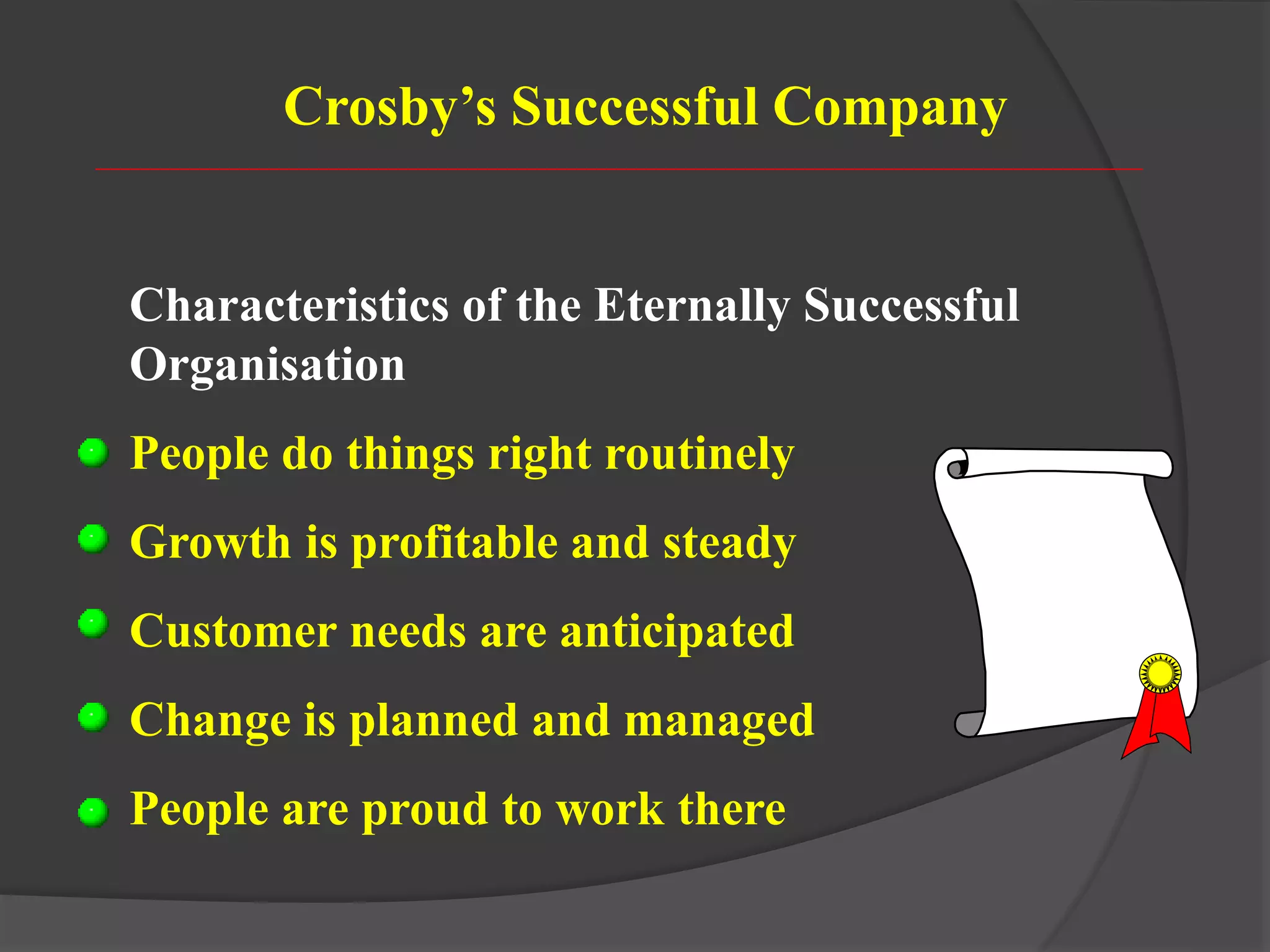
Crosby’s Successful Company
Characteristics of the Eternally Successful
Organisation
People do things right routinely
Growth is profitable and steady
Customer needs are anticipated
Change is planned and managed
People are proud to work there
Dr Joseph M Juran
The Quality Trilogy
The process achieves control at one level of quality performance,
then plans are made to improve the performance on a project by
project basis, using tools and techniques such as Pareto analysis.
Joseph M. Juran’s Quality Trilogy
Quality Planning
Establish quality goals
Identify customer needs
Translate needs into our
language
Develop a product for
these needs
Optimise product
features for these needs
Quality Control
Prove the process can
produce under
operating conditions
Transfer process to
operation
Quality
Improvement
Seek to optimise the
process via tools of
diagnosis
Juran . . .
 Juran believed quality is associated with
customer satisfaction and dissatisfaction
with the product, and emphasised the
necessity for ongoing quality improvement
through a succession of small
improvement projects carried out
throughout the organisation.
1) Identify who are the customers
2) Determine the customer’s needs
3) Translate the needs into our language
4) Develop a product to meet those needs
5) Optimise a product so as to meets our needs
as well as the customer’s.
6) Develop a process which is able to produce the
product
7) Optimise the process
8) Prove the process can make the product
under operating conditions
Juran’s Quality Planning Road Map
Joseph M.Juran and the Cost Of Quality
2 types of costs:
Unavoidable Costs: preventing defects (inspection,
sampling, sorting, QC)
Avoidable Costs: defects and product failures
(scrapped materials, labour for re-work, complaint
processing, losses from unhappy customers
“Gold in the Mine”
Armand V Feigenbaum
 Feigenbaum is the originator of “total quality
control”. He defined total quality control as:
“An effective system for integrating
quality development, quality maintenance
and quality
improvement efforts of the various groups
within an organisation, so as to enable
production and
Feigenbaum . . .
3 Steps to Quality
 Quality leadership
 Modern quality technology
 Organisational commitment
Dr Kaoru Ishikawa
Seven Basic Tools of Quality
• which are the big problems?
• what causes the problems?
• how is the data made up?
• how often it occurs or is done?
• what do overall variations look like?
• what are the relationships between factors?
• which variations to control and how?
• Pareto analysis
• Cause and effect diagrams
• Stratification
• Check sheets
• Histograms
•Scatter charts
•Process control charts
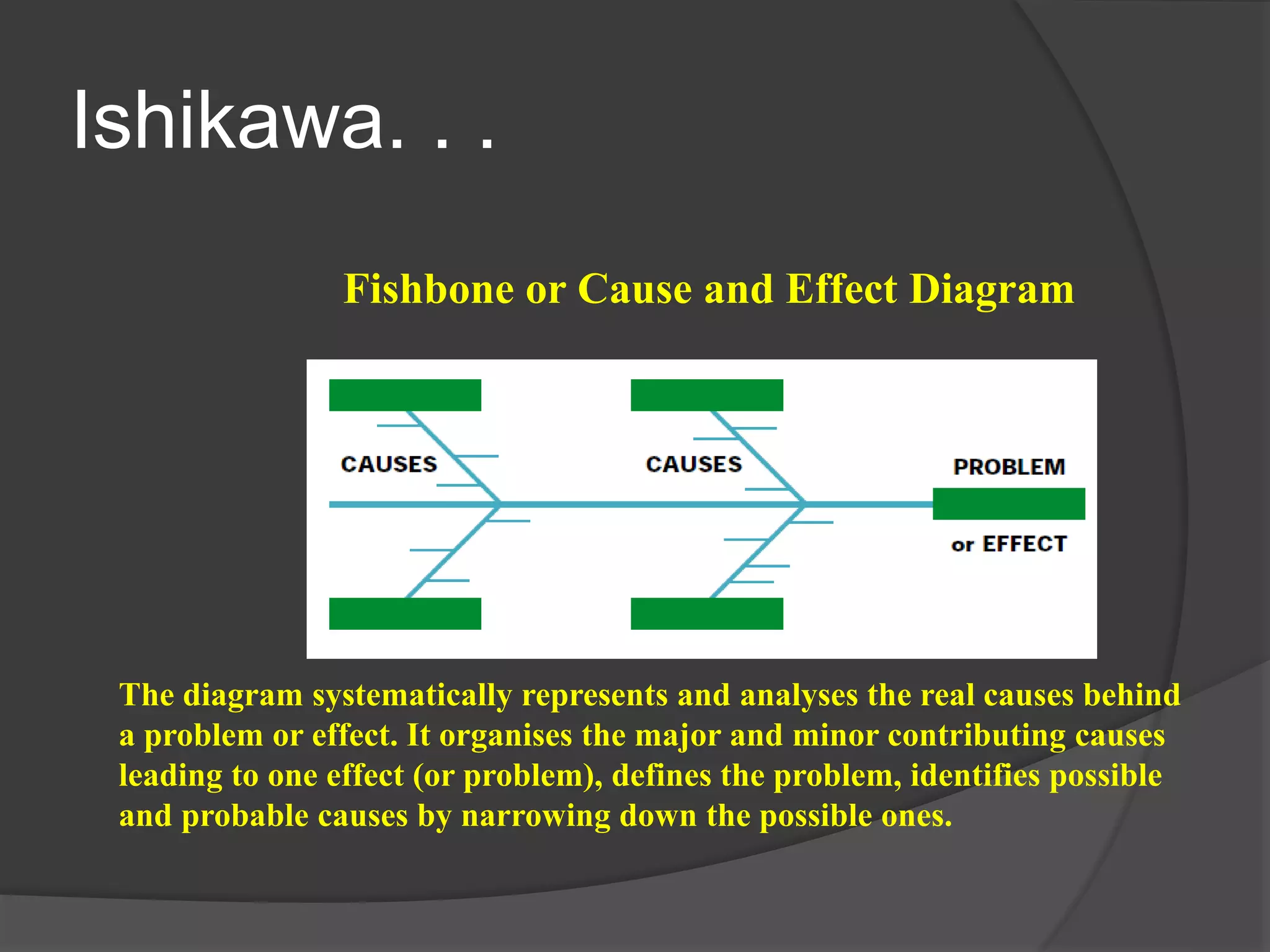
Ishikawa. . .
Fishbone or Cause and Effect Diagram
The diagram systematically represents and analyses the real causes behind
a problem or effect. It organises the major and minor contributing causes
leading to one effect (or problem), defines the problem, identifies possible
and probable causes by narrowing down the possible ones.
Dr Genichi Taguchi
 “Taguchi
methodology” is
fundamentally a
prototyping method
that enables the
designer to identify
the optimal settings to
produce a robust
product that can
survive
manufacturing time
after time, piece
afterpiece, and
provide what the
customer wants.
Shigeo Shingo
 Just-in-Time manufacturing
 Single minute exchange of die
(SMED) system
 Poka-Yoke (mistake proofing)
system
Tom Peters
 Discarding the word “Management” for
“Leadership”
 “Managing by walking about”
(MBWA), enabling the leader to keep in
touch with customers, innovation and
people, the three main areas in the
pursuit of excellence.
Tom Peters . . .
Tom Peters . . .
 He believes that, as the effective leader walks, at
least 3 major activities are happening:
Listening Suggests caring
Teaching Values are transmitted
Facilitating Able to give on-the-spot help
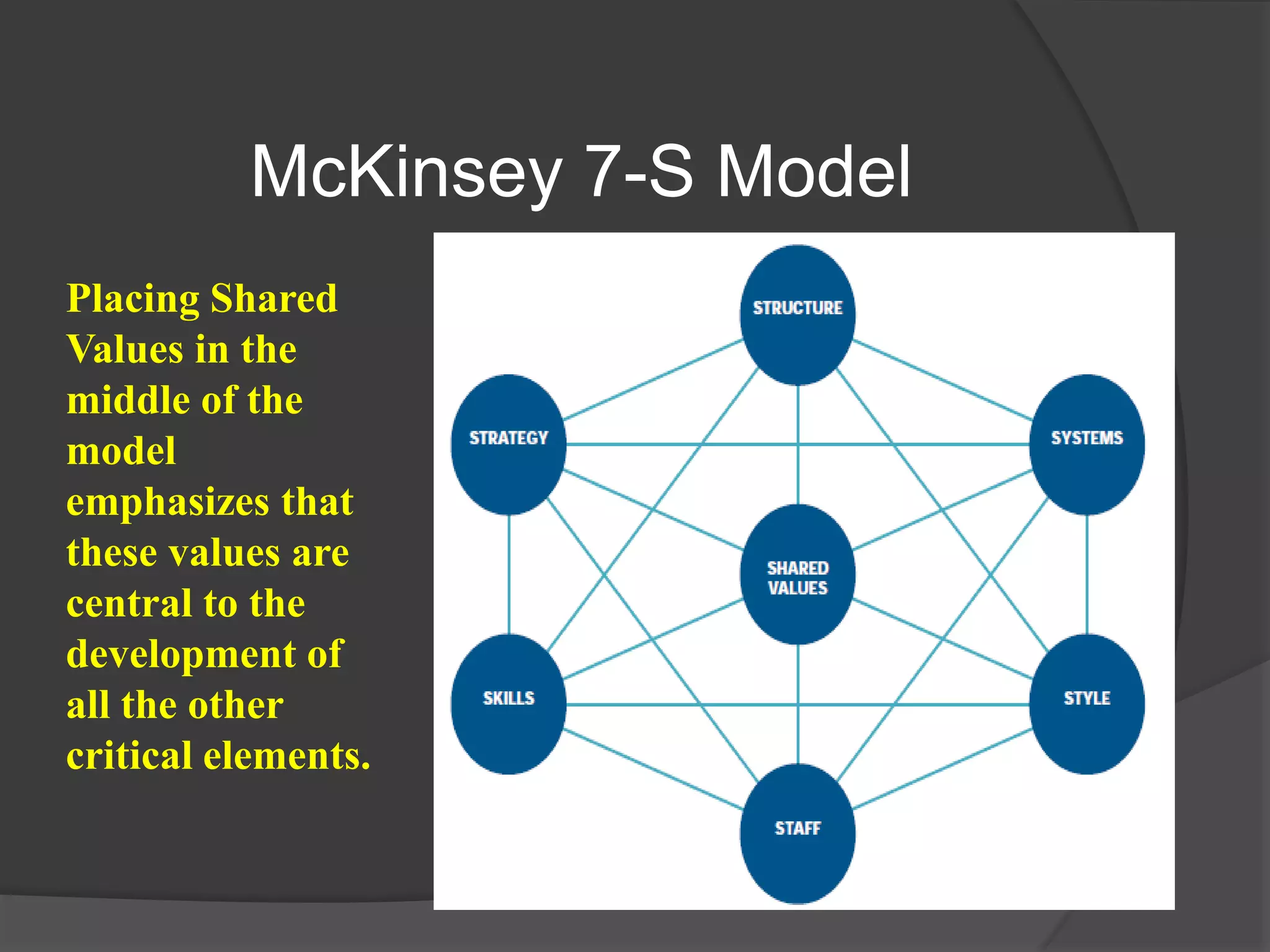
McKinsey 7-S Model
Placing Shared
Values in the
middle of the
model
emphasizes that
these values are
central to the
development of
all the other
critical elements.
SEVEN DEADLY SINS OF TQM
•Flight to nowhere
•One size fits all
•Substituting TQM for leadership
•Inside - Out indicators
•Mandatory religion
•Quality kept as a separate activity
•Teaching to the test
Quality is a Journey,
not a Destination

1 quality & tqm

  • 1.
  • 2.
    The Evolution. ..  The ISO comprises standards that specify requirements for the documentation, implementation and maintenance of a quality system.  21st Century, TQM has developed in many countries into holistic frameworks, aimed to achieve excellent performance particularly in customer and business results.
  • 3.
    The Evolution ofQuality  Early days of manufacturing : inspection and decision making – accept or reject  Separate inspection department with a “chief inspector”  Evolution of quality control department with “quality control manager”  1920’s the birth of statistical quality control  1924 Modern control chart by Shewhart; later developed by Deming
  • 4.
    The Evolution .. .  Shewhart, Deming, Dodge and Romig introduced the theory of statistical process control (SPC) and it was used until late 1940s.  1940s – Japan’s industrial system was virtually destroyed and had a reputation for cheap imitation products and illiterate workforce.  Japan solved these problems with the help of Juran, Deming and Feigenbaum.
  • 5.
    The Evolution .. .  1950s Quality management practices developed rapidly in Japan and became their management philosophy.  1960s-1970s Japan’s imports into the USA and Europe increased significantly due to its cheaper, higher quality products, compared to the Western counterparts.
  • 6.
    The Evolution .. .  1969 First International conference on quality control, sponsored by Japan, America and Europe.  On Feigenbaum paper, the term “total quality” was used for the first time. This constitutes wider issues such as planning, organization, and management responsibility.
  • 7.
    The Evolution .. .  Ishikawa introduced new meaning for “total quality control” which means “company wide quality control”. He described how all employees, from top management to the workers must participate in quality control.  Late 1970s Company wide quality management became common in Japanese companies.
  • 8.
    The Evolution .. .  Quality revolution in the West was slow and did not begin until early 1980s.  Total quality management (TQM) became the centre in most cases.  1979 - The British Standard (BS) 5750 for quality systems was published.
  • 9.
    The Evolution .. .  1983 - The National Quality Campaign was launched using BS5750 main theme. The aim was to popularize to the industry the importance of quality for competitiveness and survival in the world market. Since then the International Standardisation Organization (ISO) 9000 became the internationally recognised standard for quality management systems.
  • 11.
    What TQM means? TQM is an approach to improving the competitiveness, effectiveness and flexibility of an organization for the benefit of all stakeholders.  It is a way of planning, organizing and undertaking each activity and of removing all the wasted effort and energy that is routinely spent in organizations.  It ensures the leaders to adopt a strategic overview of quality and focus on prevention not detection of problems.
  • 12.
    The core ofTQM is the customer-supplier interfaces, both externally and internally, and at each interface lie a number of processes. This core must be surrounded by commitment to quality, communication of the quality message, and recognition of the need to change the culture of the organisation to create total quality. These are the foundations of TQM, and they are supported by the key management functions of people, processes and systems in the organisation.
  • 13.
    What is quality? Quality is “Delighting the customer by fully meeting their needs and expectations”. These may include performance, appearance, availability, delivery, reliability, maintainability, cost effectiveness and price.  Quality starts with market research – to establish the true requirements for the product or service and the true needs of the customers.
  • 14.
    Every person inthe “quality chain” must be trained to ask the ff. questions:  Who are my customers?  What are their true needs and expectations?  How do, or can, I find out what these are?  How I can measure my ability to meet their needs and expectations?  Do I have their capability to meet their needs and expectations? (if not, hat must I do to improve this capability?)  Do I continually meet their needs and expectations?  How do I monitor changes in their needs and expectations? Customers (internal and external)
  • 15.
     Suppliers (internaland external)  Who are my internal suppliers?  What are my true needs and expectations?  How do I communicate my needs and expectations to my suppliers?  Do my suppliers have the capability to measure and meet these needs and expectations?  How do I inform them of changes in my needs and expectations?
  • 16.
     Being fullyaware of customers’ needs and expectations, each person must respect the needs and expectations of their suppliers. The ideal situation is an open partnership style relationship, where both parties share and benefit.
  • 17.
    Poor practices  Leadersnot giving clear direction  Not understanding, or ignoring competitive positioning  Each department working only for itself  Trying to control people through systems  Confusing quality with grade  Accepting that a level of defects or errors is inevitable  Firefighting, reactive behavior  The “It’s not my problem” attitude
  • 18.
    The Essential Components ofTQM  Commitment  Leadership
  • 19.
    The Essential Components ofTQM  All senior managers must demonstrate their seriousness and commitment to quality, and middle managers must demonstrate their commitment; ensure they communicate the principles, strategies and benefits to the people for whom they have responsibility. Only then the right attitudes spread throughout the organization.
  • 20.
    The Essential .. .  Sound quality policy, supported by plans and facilities to implement it.  Leaders must take responsibility for preparing, reviewing and monitoring the policy and lead in regular improvements of it and ensure it is understood at all levels of the organization.
  • 21.
    The Essential .. .  Effective leaders starts with the development of a mission statement followed by a strategy which is translated into action plans down through the organization.
  • 22.
    Five Requirements for EffectiveLeadership 1. Developing and publishing corporate beliefs, values and objectives, often as a mission statement. 2. Personal involvement and acting as role models for a culture of total quality. 3. Developing clear and effective strategies and supporting plans for achieving the mission and objectives
  • 23.
    Five Requirements .. . 4. Reviewing and improving the management system 5. Communicating, motivating and supporting people and encouraging effective employee participation.
  • 24.
    The Building Blocksof TQM  Processes the transformation of a set of inputs, which can include action, methods and operations, into the desired outputs, which satisfy the customers’ needs and expectations.  People who actually do the job or carry out the process, each of which has one or several suppliers and customers. An efficient and effective way to tackle process or quality improvement is through teamwork.
  • 25.
    The Building Blocks. . .  Management systems involves proper adoption and documentation of appropriate management systems  Performance Measurement Once the strategic direction for the organization’s quality journey has been set, it needs Performance Measures to monitor and control the journey, and to ensure the desired level of performance is being achieved and sustained.
  • 27.
    What is Quality? Qualityis “fitness for use” (Joseph Juran) Quality is “conformance to requirements” (Philip B. Crosby) Quality of a product or services is its ability to satisfy the needs and expectations of the customer
  • 28.
    Dimensions of Qualityfor Goods  Operation  Reliability & durability  Conformance  Serviceability  Appearance  Perceived quality Quality
  • 29.
    Importance of Quality Company’s reputation  Product liability  International implications Market Gains Reputation Volume Price Lower Costs Productivity Rework/Scrap Warranty Improved Quality Increased Profits Market Gains Reputation Volume Price Lower Costs Productivity Rework/Scrap Warranty Improved Quality Increased Profits  Costs & market share
  • 30.
  • 31.
    Evolution of QualityManagement Inspection Quality Control Quality Assurance TQM Salvage, sorting, grading, blending, corrective actions, identify sources of non-conformance Develop quality manual, process performance data, self-inspection, product testing, basic quality planning, use of basic statistics, paperwork control. Quality systems development, advanced quality planning, comprehensive quality manuals, use of quality costs, involvement of non-production operations, failure mode and effects analysis, SPC. Policy deployment, involve supplier & customers, involve all operations, process management, performance measurement, teamwork, employee involvement.
  • 32.
    Deming’s view ofa production as a system Consumer Research Design & redesign Receipt & test of materials Suppliers, materials & equipment Production, assembly, inspection Distribution Consumers Test of processes, machines, methods, cost
  • 33.
    Improve Quality Productivity improves Providejobs and more jobs Deming’s Chain Reaction Cost decreases because of less rework, fewer mistakes, fewer delays, snags, better use of machine time and materials Stay in business Capture the market with better quality and lower price
  • 34.
    Definition: Total Quality Management Total Quality Management (TQ, QM or TQM) and Six Sigma (6) are sweeping “culture change” efforts to position a company for greater customer satisfaction, profitability and competitiveness.  TQ may be defined as managing the entire organization so that it excels on all dimensions of products and services that are important to the customer.  We often think of features when we think of the quality of a product or service; TQ is about conformance quality, not features.
  • 35.
    Total Quality Is… Meeting Our Customer’s Requirements  Doing Things Right the First Time; Freedom from Failure (Defects)  Consistency (Reduction in Variation)  Continuous Improvement  Quality in Everything We Do
  • 36.
    What is TQM? Constantdrive for continuous improvement and learning. Concern for employee involvement and development Management by Fact Result Focus Passion to deliver customer value / excellence Organisation response ability Actions not just words (implementation) Process Management Partnership perspective (internal / external)
  • 37.
    BASIC PRINCIPLES OFTQM Approach Management Led Scope Company Wide Scale Everyone is responsible for Quality Philosophy Prevention not Detection Standard Right First Time Control Cost of Quality Theme On going Improvement
  • 38.
    Total Quality Is… Meeting Our Customer’s Requirements  Doing Things Right the First Time; Freedom from Failure (Defects)  Consistency (Reduction in Variation)  Continuous Improvement  Quality in Everything We Do
  • 39.
    A Quality ManagementSystem Is…  A belief in the employee’s ability to solve problems  A belief that people doing the work are best able to improve it  A belief that everyone is responsible for quality
  • 40.
    Elements for Success Management Support  Mission Statement  Proper Planning  Customer and Bottom Line Focus  Measurement  Empowerment  Teamwork/Effective Meetings  Continuous Process Improvement  Dedicated Resources
  • 41.
  • 42.
    Modern History ofQuality Management  Frederick W. Taylor wrote Principles of Scientific Management in 1911.  Walter A. Shewhart used statistics in quality control and inspection, and showed that productivity improves when variation is reduced (1924); wrote Economic Control of Manufactured Product in 1931.  W. Edwards Deming and Joseph M. Juran, students of Shewhart, went to Japan in 1950; began transformation from “shoddy” to “world class” goods.  In 1960, Dr. K. Ishikawa formalized “quality circles” - the use of small groups to eliminate variation and improve processes.  In the late ‘70’s and early ‘80’s:  Deming returned from Japan to write Out of the Crisis, and began his famous 4-day seminars in the United States  Phil Crosby wrote Quality is Free  NBC ran “If Japan can do it, why can’t we?”  Motorola began 6 Sigma
  • 44.
    What is aguru?  By definition, a guru is a good person, a wise person and a teacher. A quality guru should be all of these, and must have a concept and approach to quality within business that has made a major and lasting impact.
  • 45.
    W. Edwards Deming’s14 Points Create constancy of purpose towards improvement of product and services. Adopt the new philosophy. We can no longer live with commonly accepted levels of delays, mistakes, defective workmanship. Cease dependence on mass inspection. Require, instead, statistical evidence that quality is built in. End the practice of awarding business on the basis of price tag. 1) 2) 3) 4)
  • 46.
    W. Edwards Deming’s14 Points Find problems. It is management’s job to work continually on the system. Institute modern methods of training on the job. Institute modern methods of supervision of production workers. The responsibility of foremen must be changed from numbers to quality. Drive out fear that everyone may work effectively for the company. 5) 6) 7) 8)
  • 47.
    Break down barriersbetween departments. Eliminate numerical goals, posters and slogans for the workforce asking for new levels of productivity without providing methods. Eliminate work standards that prescribe numerical quotas. Remove barriers that stand between the hourly worker and his right to pride of workmanship. 9) 10) 11) 12) W. Edwards Deming’s 14 Points
  • 48.
    Institute a vigorousprogramme of education and retraining. Create a structure in top management that will push everyday on the above 13 points. 13) 14) W. Edwards Deming’s 14 Points
  • 49.
    PLAN CHECK DOACT The Deming Cycleor PDCA Cycle Plan a change to the process. Predict the effect this change will have and plan how the effects will be measured Implement the change on a small scale and measure the effects Adopt the change as a permanent modification to the process, or abandon it. Study the results to learn what effect the change had, if any.
  • 50.
    Deming’s System ofProfound Knowledge Appreciation for system Knowledge about variation Theory about knowledge Knowledge of psychology
  • 51.
    Learning LEARNING AND TQM ProcessImprovement Quality Improvement Customer Satisfaction Shareholder Satisfaction Employee Satisfaction
  • 52.
    Philip Crosby’s FourAbsolutes Definition : Conformance to requirements System of quality is prevention Performance Standard : Zero Defects Measurement : Price of non- conformance (PON) What is Quality? What system is needed to cause quality? What performance standard should be used? What measurement system is required?
  • 53.
    Crosby’s Successful Company Characteristicsof the Eternally Successful Organisation People do things right routinely Growth is profitable and steady Customer needs are anticipated Change is planned and managed People are proud to work there
  • 54.
    Dr Joseph MJuran The Quality Trilogy The process achieves control at one level of quality performance, then plans are made to improve the performance on a project by project basis, using tools and techniques such as Pareto analysis.
  • 55.
    Joseph M. Juran’sQuality Trilogy Quality Planning Establish quality goals Identify customer needs Translate needs into our language Develop a product for these needs Optimise product features for these needs Quality Control Prove the process can produce under operating conditions Transfer process to operation Quality Improvement Seek to optimise the process via tools of diagnosis
  • 56.
    Juran . ..  Juran believed quality is associated with customer satisfaction and dissatisfaction with the product, and emphasised the necessity for ongoing quality improvement through a succession of small improvement projects carried out throughout the organisation.
  • 57.
    1) Identify whoare the customers 2) Determine the customer’s needs 3) Translate the needs into our language 4) Develop a product to meet those needs 5) Optimise a product so as to meets our needs as well as the customer’s. 6) Develop a process which is able to produce the product 7) Optimise the process 8) Prove the process can make the product under operating conditions Juran’s Quality Planning Road Map
  • 58.
    Joseph M.Juran andthe Cost Of Quality 2 types of costs: Unavoidable Costs: preventing defects (inspection, sampling, sorting, QC) Avoidable Costs: defects and product failures (scrapped materials, labour for re-work, complaint processing, losses from unhappy customers “Gold in the Mine”
  • 59.
    Armand V Feigenbaum Feigenbaum is the originator of “total quality control”. He defined total quality control as: “An effective system for integrating quality development, quality maintenance and quality improvement efforts of the various groups within an organisation, so as to enable production and
  • 60.
    Feigenbaum . .. 3 Steps to Quality  Quality leadership  Modern quality technology  Organisational commitment
  • 61.
    Dr Kaoru Ishikawa SevenBasic Tools of Quality • which are the big problems? • what causes the problems? • how is the data made up? • how often it occurs or is done? • what do overall variations look like? • what are the relationships between factors? • which variations to control and how? • Pareto analysis • Cause and effect diagrams • Stratification • Check sheets • Histograms •Scatter charts •Process control charts
  • 62.
    Ishikawa. . . Fishboneor Cause and Effect Diagram The diagram systematically represents and analyses the real causes behind a problem or effect. It organises the major and minor contributing causes leading to one effect (or problem), defines the problem, identifies possible and probable causes by narrowing down the possible ones.
  • 63.
    Dr Genichi Taguchi “Taguchi methodology” is fundamentally a prototyping method that enables the designer to identify the optimal settings to produce a robust product that can survive manufacturing time after time, piece afterpiece, and provide what the customer wants.
  • 64.
    Shigeo Shingo  Just-in-Timemanufacturing  Single minute exchange of die (SMED) system  Poka-Yoke (mistake proofing) system
  • 65.
    Tom Peters  Discardingthe word “Management” for “Leadership”  “Managing by walking about” (MBWA), enabling the leader to keep in touch with customers, innovation and people, the three main areas in the pursuit of excellence.
  • 66.
  • 67.
    Tom Peters .. .  He believes that, as the effective leader walks, at least 3 major activities are happening: Listening Suggests caring Teaching Values are transmitted Facilitating Able to give on-the-spot help
  • 68.
    McKinsey 7-S Model PlacingShared Values in the middle of the model emphasizes that these values are central to the development of all the other critical elements.
  • 69.
    SEVEN DEADLY SINSOF TQM •Flight to nowhere •One size fits all •Substituting TQM for leadership •Inside - Out indicators •Mandatory religion •Quality kept as a separate activity •Teaching to the test
  • 70.
    Quality is aJourney, not a Destination