Domina Petric, MD
Premotor cortex, brainstem and
emotional motor system
Premotor cortex includes anterior portion of precentral
gyrus and posterior parts of superior, middle and
inferior frontal gyri.
Premotor cortex gives rise to descending projections
to lower motor neurons.
It is a mosaic of areas with modular organisation.
Premotor cortex
 Medial division of the premotor cortex corresponds
as supplementary motor area (SMA).
 There is a part of medial premotor cortex that is
involved in the expression of emotional behavior.
 There is also a part of medial premotor cortex
concerned with organising bimanual activites.
 There is a division concerned with governing
voluntary saccadic eye movements (frontal eye
field).
Premotor cortex, medial part
 In the lateral premotor cortex are present areas
that are concerned with organising movements
guided by sensory information, including social
interactions.
 Inferior lateral part is concerned with social
communication.
 Broca´s area is located in the posterior inferior
lateral part of the premotor cortex: this area
organizes the vocal motor apparatus for
production of speech.
Premotor cortex, lateral part
Near the Broca´s area are
parts of premotor cortex
concerned with
production of speech in
written form.
Premotor cortex, lateral part
There is activation of mirror motor neurons when
we do some movement and when we observe
another person doing the same movement.
Mirror motor neurons are located in lateral
premotor cortex.
These neurons are important in understanding the
intention of some motor act.
Mirror motor neurons
II.
BRAINSTEM UPPER MOTOR
NEURONS
Reticular formation extends throughout the entire
brainstem.
Lateral and medial vestibulospinal tract: adjustment
of posture.
Lateral vestibulospinal tract from lateral vestibular
nuclei goes ipsilaterally and terminates in the spinal
cord cell group concerned with extensor muscles
tone (primarily in the lower extremities).
Vestibulospinal tracts
Medial vestibulospinal tract is
bilateral and terminates among
medial lower motor neuronal
columns, mainly found in the
cervical region of the spinal
cord: vestibulocervical reflexes.
Vestibulospinal tracts
 Visceral and somatic motor control.
 Mesencephalic and rostral pontine reticular
formation modulates forebrain activity.
 Caudal pontine and medullary reticular
formation is concerned with premotor
coordination of lower somatic and visceral
motor neuronal pools.
 Reticulospinal system is concerned primarily
with making anticipatory adjustments of
posture.
Reticulospinal tract
It is a motor structure
that integrates sensory
information from vision,
audition, pain and
temperature sensation.
Superior colliculus
III.
EMOTIONAL MOTOR
SYSTEMS
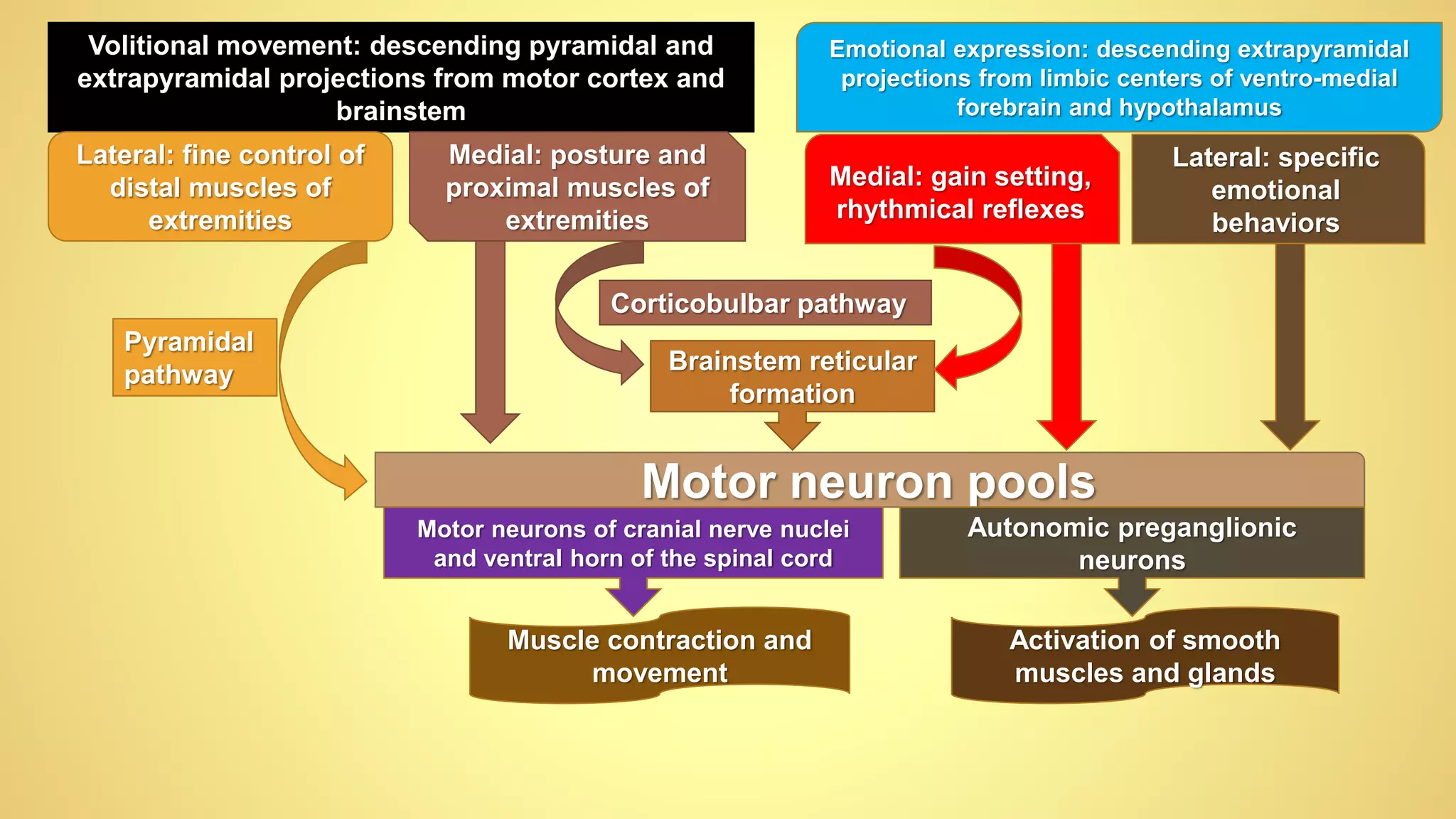
Volitional movement: descending pyramidal and
extrapyramidal projections from motor cortex and
brainstem
Lateral: fine control of
distal muscles of
extremities
Medial: posture and
proximal muscles of
extremities
Brainstem reticular
formation
Motor neuron pools
Motor neurons of cranial nerve nuclei
and ventral horn of the spinal cord
Autonomic preganglionic
neurons
Muscle contraction and
movement
Activation of smooth
muscles and glands
Emotional expression: descending extrapyramidal
projections from limbic centers of ventro-medial
forebrain and hypothalamus
Medial: gain setting,
rhythmical reflexes
Lateral: specific
emotional
behaviors
Pyramidal
pathway
Corticobulbar pathway
https://www.coursera.org/learn/m
edical-neuroscience/lecture:
Leonard E. White, PhD, Duke
University
Literature

Premotor cortex, brainstem and emotional motor system

  • 1.
    Domina Petric, MD Premotorcortex, brainstem and emotional motor system
  • 2.
    Premotor cortex includesanterior portion of precentral gyrus and posterior parts of superior, middle and inferior frontal gyri. Premotor cortex gives rise to descending projections to lower motor neurons. It is a mosaic of areas with modular organisation. Premotor cortex
  • 3.
     Medial divisionof the premotor cortex corresponds as supplementary motor area (SMA).  There is a part of medial premotor cortex that is involved in the expression of emotional behavior.  There is also a part of medial premotor cortex concerned with organising bimanual activites.  There is a division concerned with governing voluntary saccadic eye movements (frontal eye field). Premotor cortex, medial part
  • 4.
     In thelateral premotor cortex are present areas that are concerned with organising movements guided by sensory information, including social interactions.  Inferior lateral part is concerned with social communication.  Broca´s area is located in the posterior inferior lateral part of the premotor cortex: this area organizes the vocal motor apparatus for production of speech. Premotor cortex, lateral part
  • 5.
    Near the Broca´sarea are parts of premotor cortex concerned with production of speech in written form. Premotor cortex, lateral part
  • 6.
    There is activationof mirror motor neurons when we do some movement and when we observe another person doing the same movement. Mirror motor neurons are located in lateral premotor cortex. These neurons are important in understanding the intention of some motor act. Mirror motor neurons
  • 7.
  • 8.
    Reticular formation extendsthroughout the entire brainstem. Lateral and medial vestibulospinal tract: adjustment of posture. Lateral vestibulospinal tract from lateral vestibular nuclei goes ipsilaterally and terminates in the spinal cord cell group concerned with extensor muscles tone (primarily in the lower extremities). Vestibulospinal tracts
  • 9.
    Medial vestibulospinal tractis bilateral and terminates among medial lower motor neuronal columns, mainly found in the cervical region of the spinal cord: vestibulocervical reflexes. Vestibulospinal tracts
  • 10.
     Visceral andsomatic motor control.  Mesencephalic and rostral pontine reticular formation modulates forebrain activity.  Caudal pontine and medullary reticular formation is concerned with premotor coordination of lower somatic and visceral motor neuronal pools.  Reticulospinal system is concerned primarily with making anticipatory adjustments of posture. Reticulospinal tract
  • 11.
    It is amotor structure that integrates sensory information from vision, audition, pain and temperature sensation. Superior colliculus
  • 12.
  • 13.
    Volitional movement: descendingpyramidal and extrapyramidal projections from motor cortex and brainstem Lateral: fine control of distal muscles of extremities Medial: posture and proximal muscles of extremities Brainstem reticular formation Motor neuron pools Motor neurons of cranial nerve nuclei and ventral horn of the spinal cord Autonomic preganglionic neurons Muscle contraction and movement Activation of smooth muscles and glands Emotional expression: descending extrapyramidal projections from limbic centers of ventro-medial forebrain and hypothalamus Medial: gain setting, rhythmical reflexes Lateral: specific emotional behaviors Pyramidal pathway Corticobulbar pathway
  • 14.