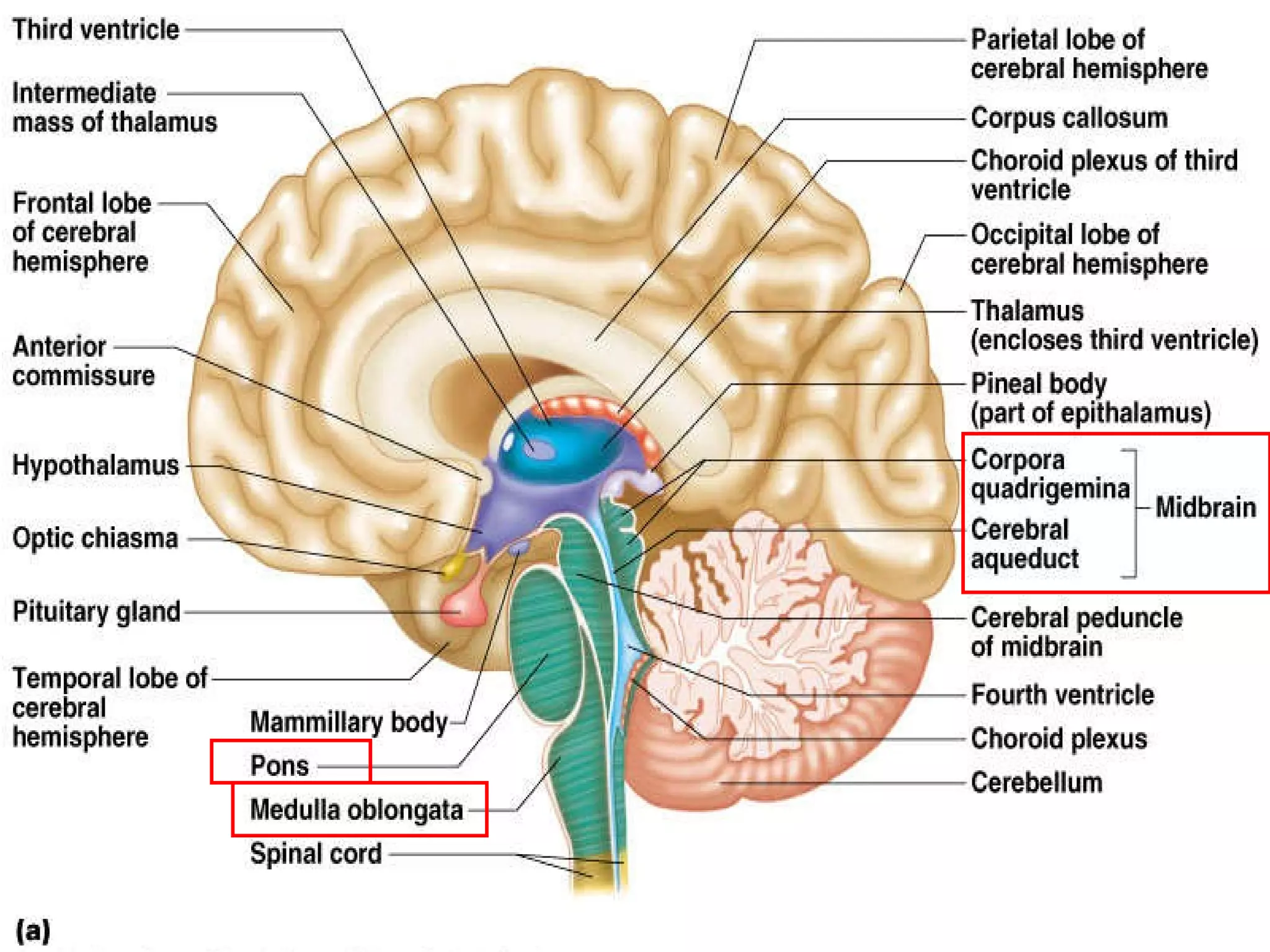
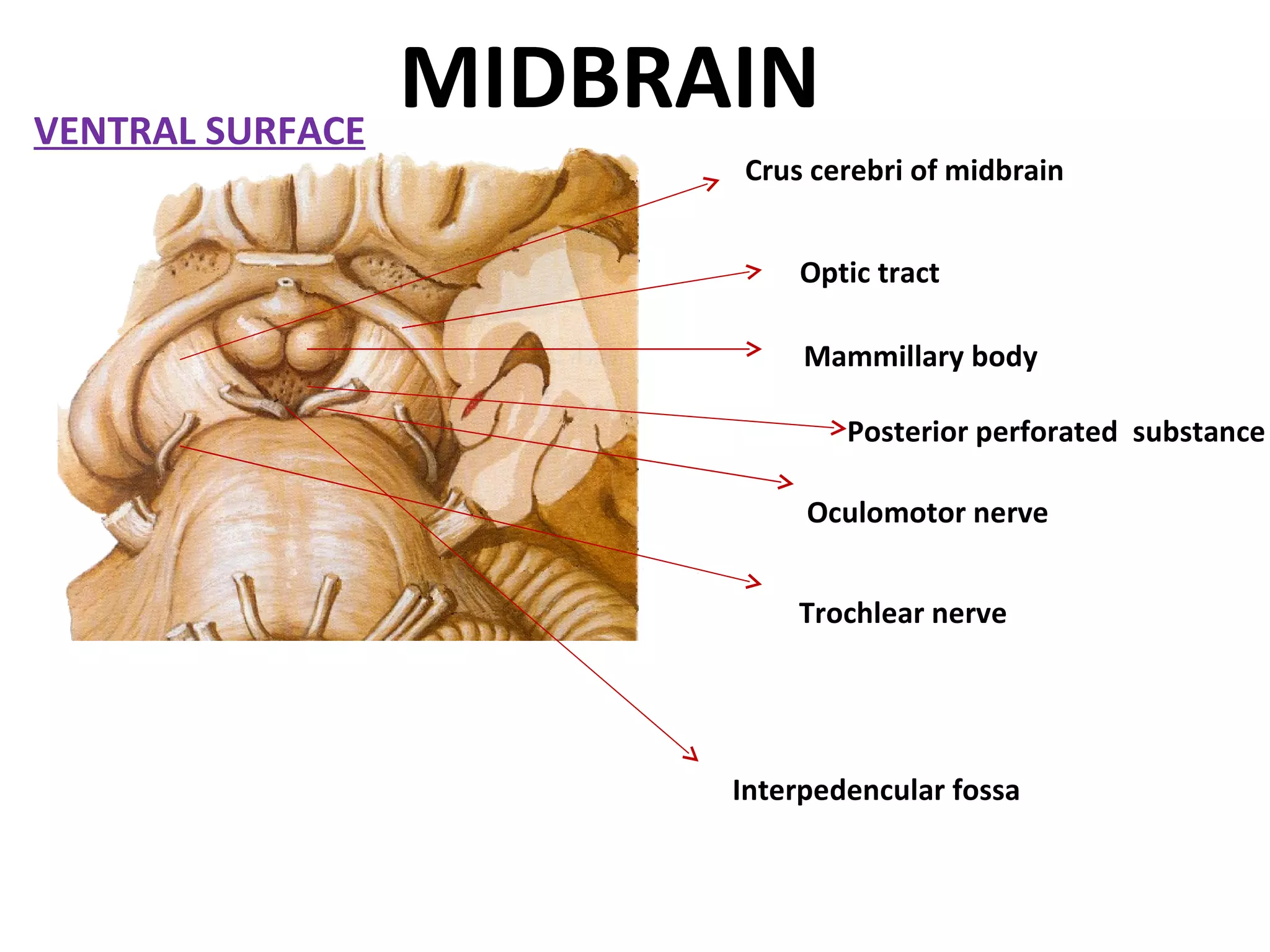
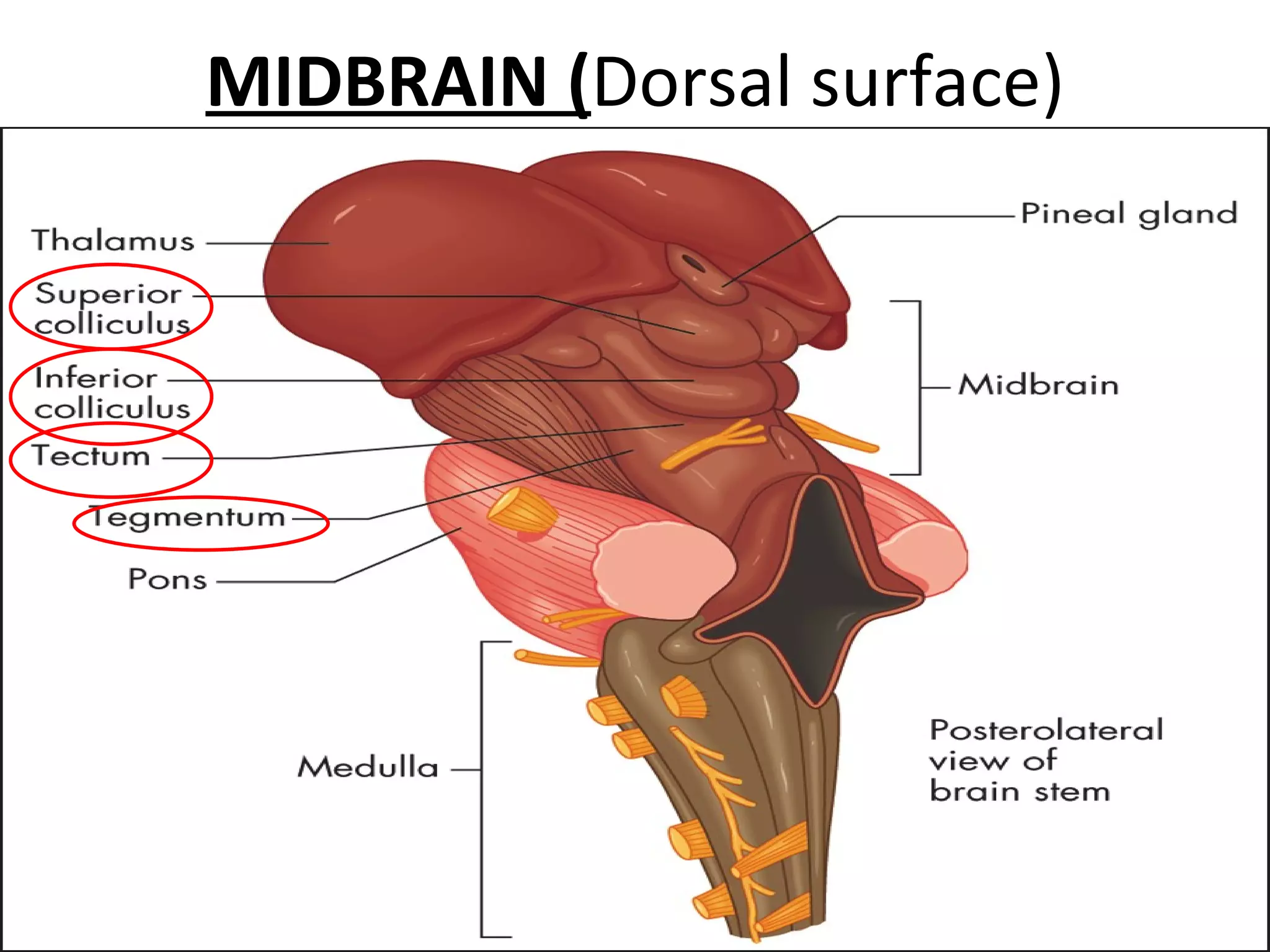
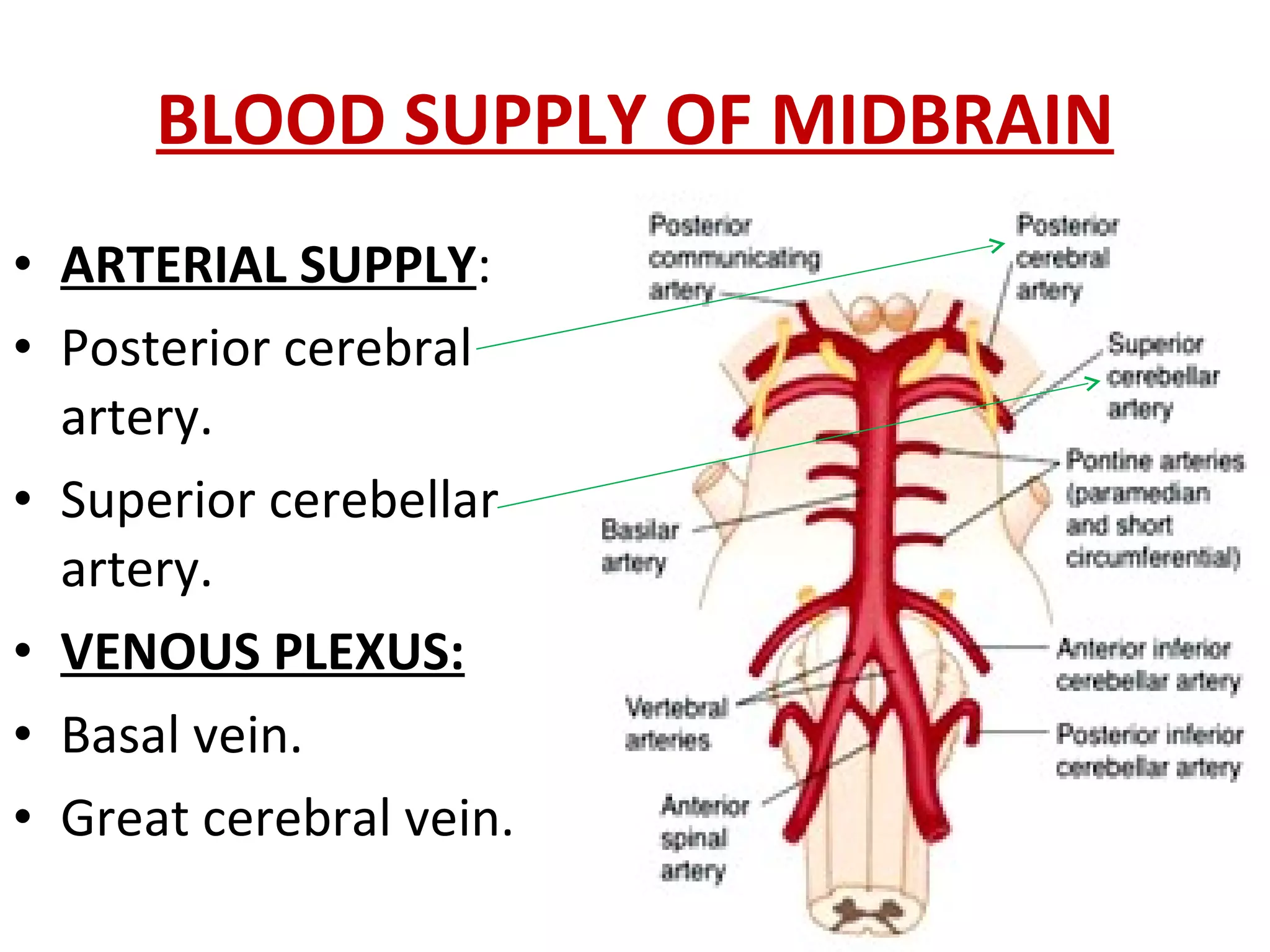
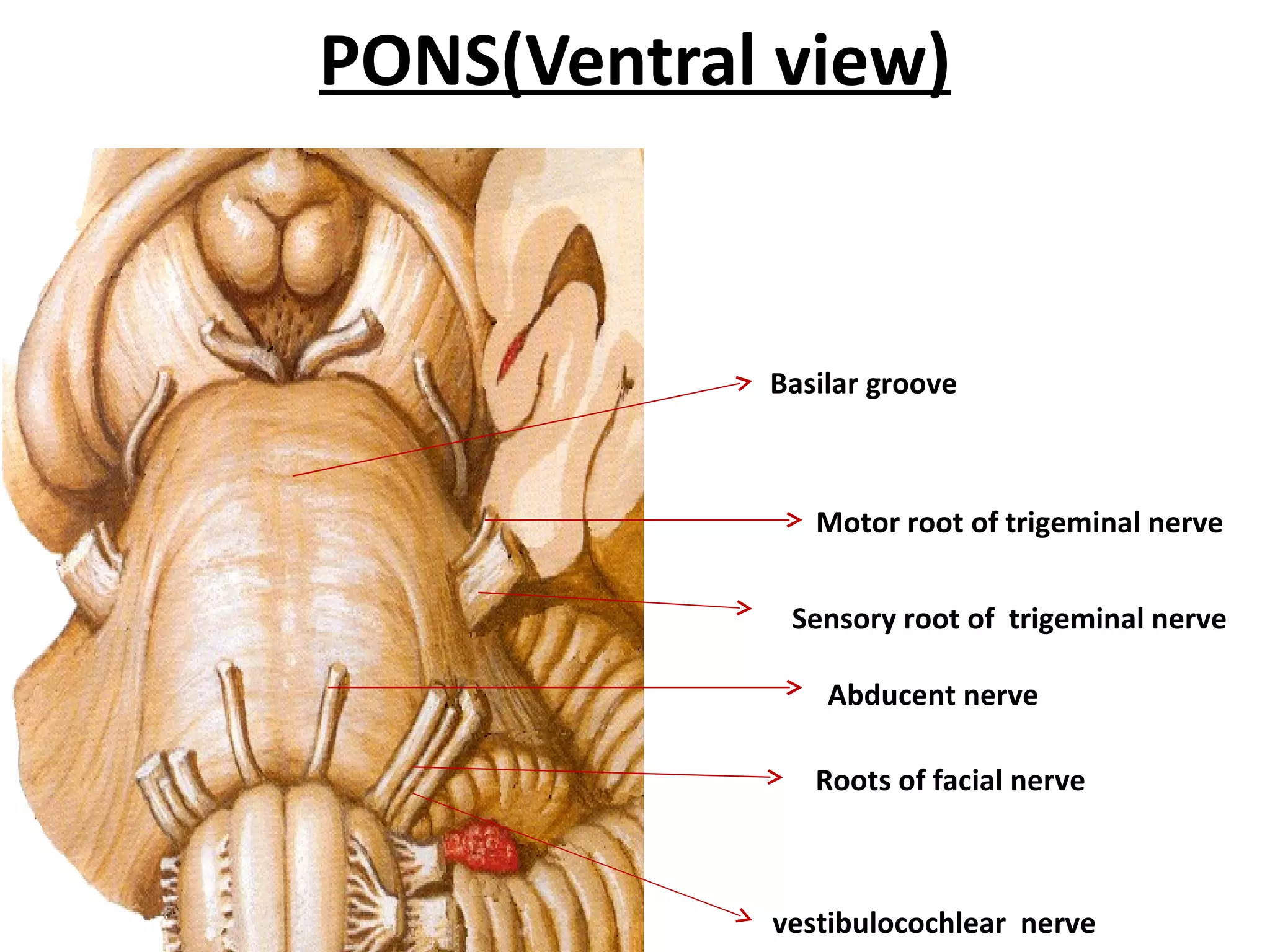
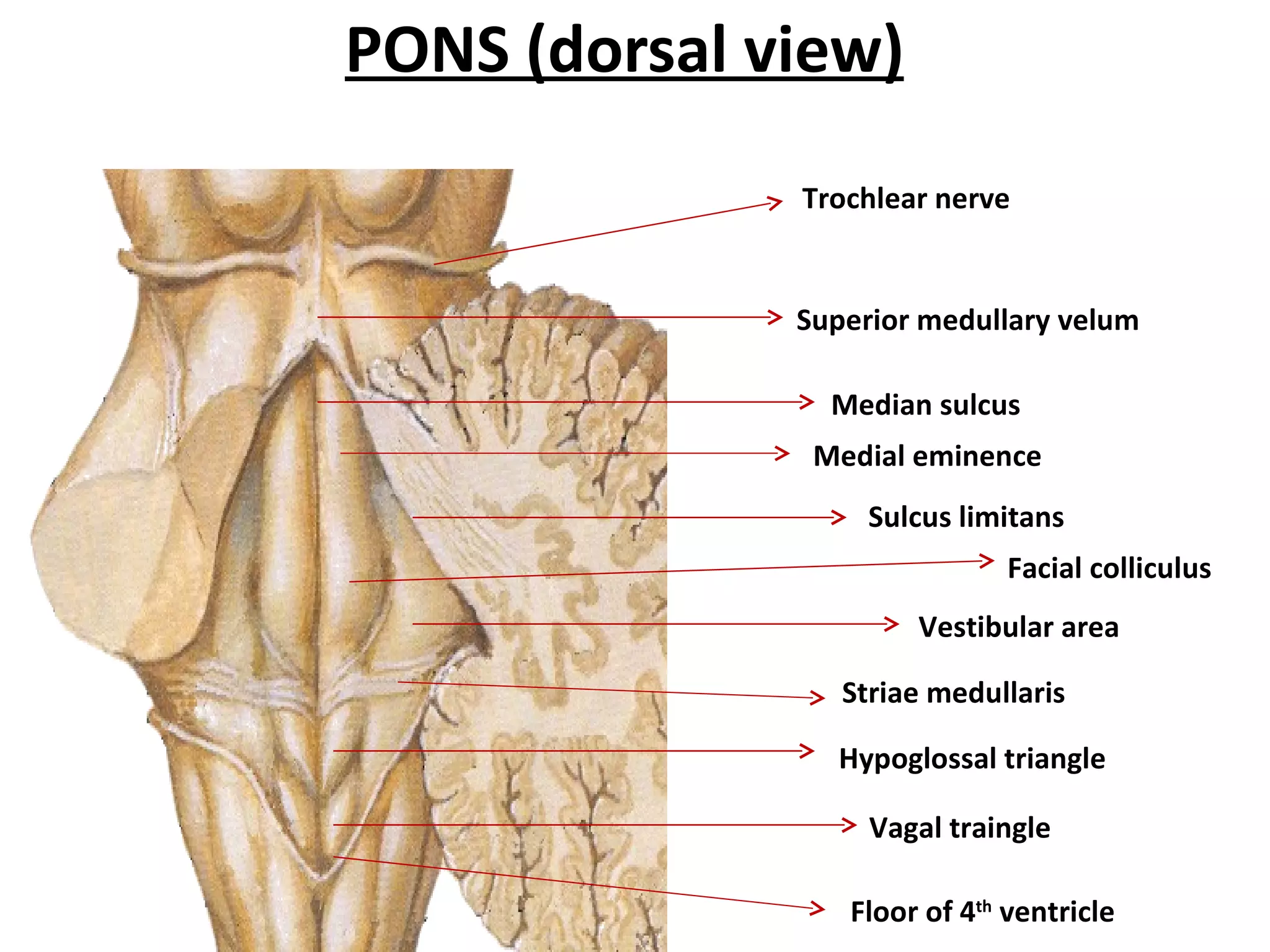
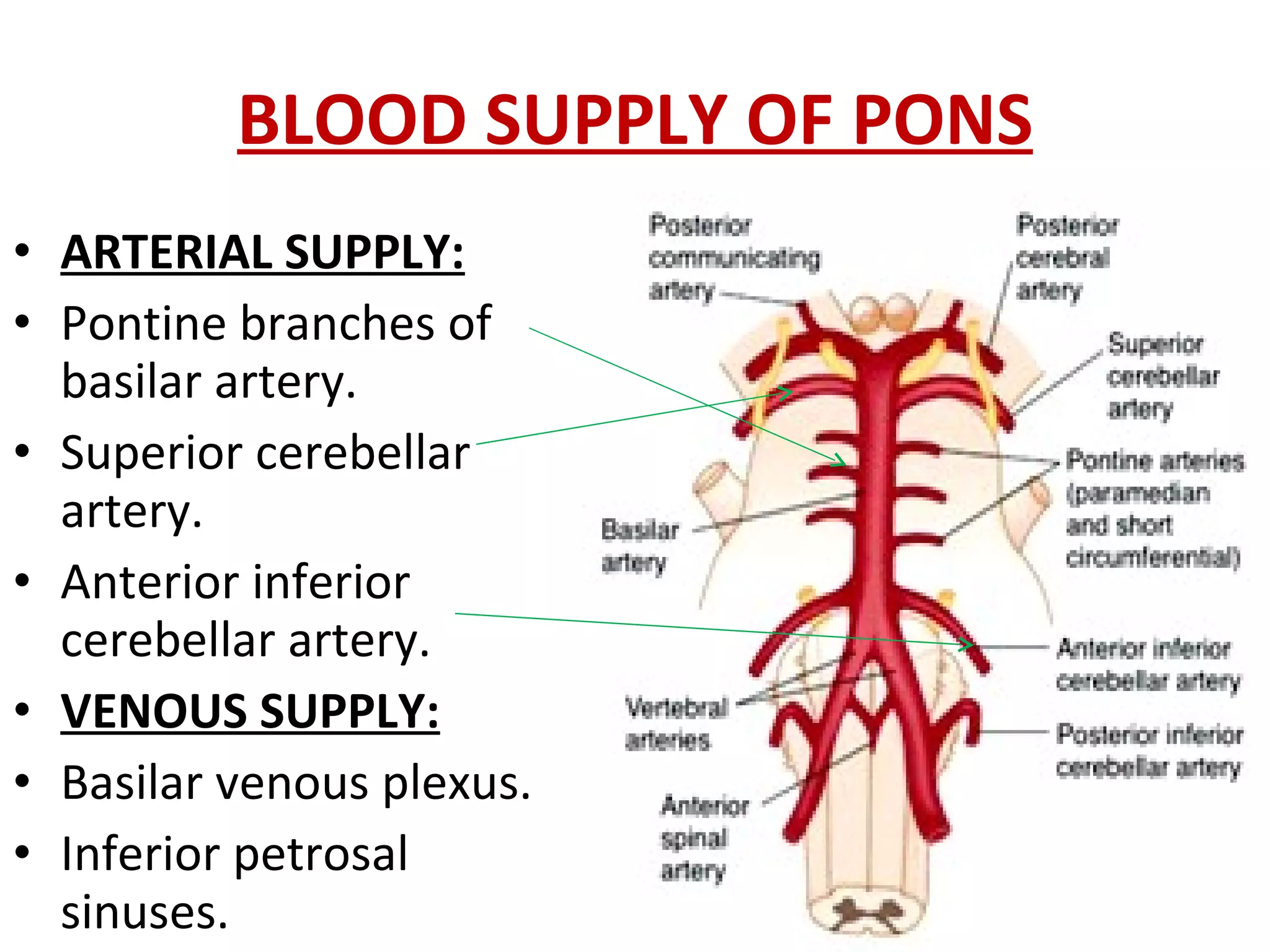
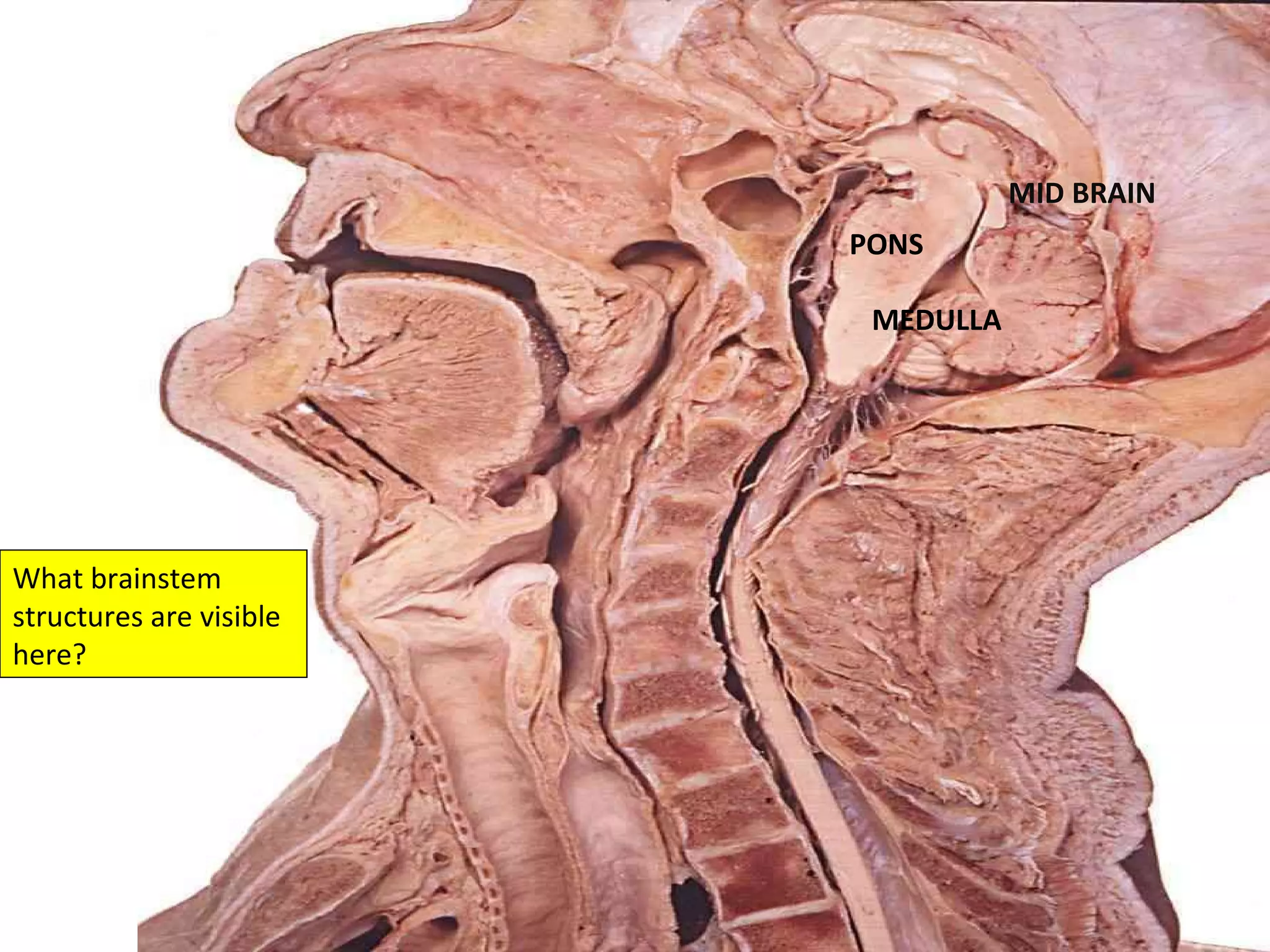
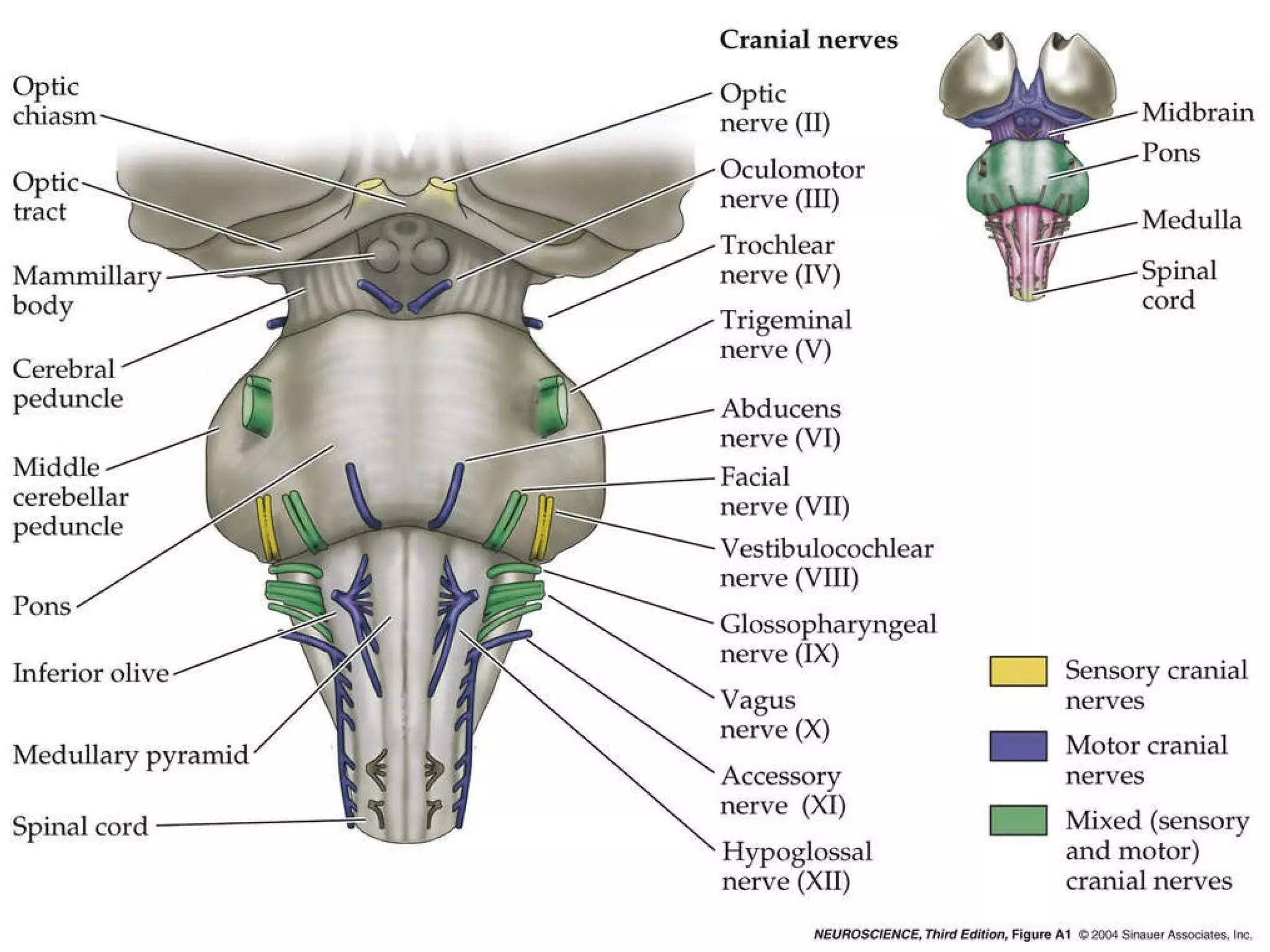
The brainstem consists of three parts: the midbrain, pons, and medulla oblongata. It serves several broad functions including transmitting ascending and descending nerve pathways, containing important reflex centers that control cardiovascular and other bodily functions, and housing the nuclei of cranial nerves III through XII. The midbrain is involved in visual and auditory processing as well as voluntary motor control. The pons acts as a relay station between the cerebellum and medulla and helps control subconscious movements. The medulla regulates vital functions like respiration, circulation, and digestion.
BRAIN STEM 3 PARTS : MIDBRAIN PONS MEDULLA OBLANGATA HAS 3 BROAD FUNCTIONS – Serves as a conduit for the ascending & descending tracts Contains important reflex centers(RS.CVS) Control of consciousness Contains cranial nerves nuclei (CN3-CN12) Brainstem occupies the posterior cranial fossa of the skull
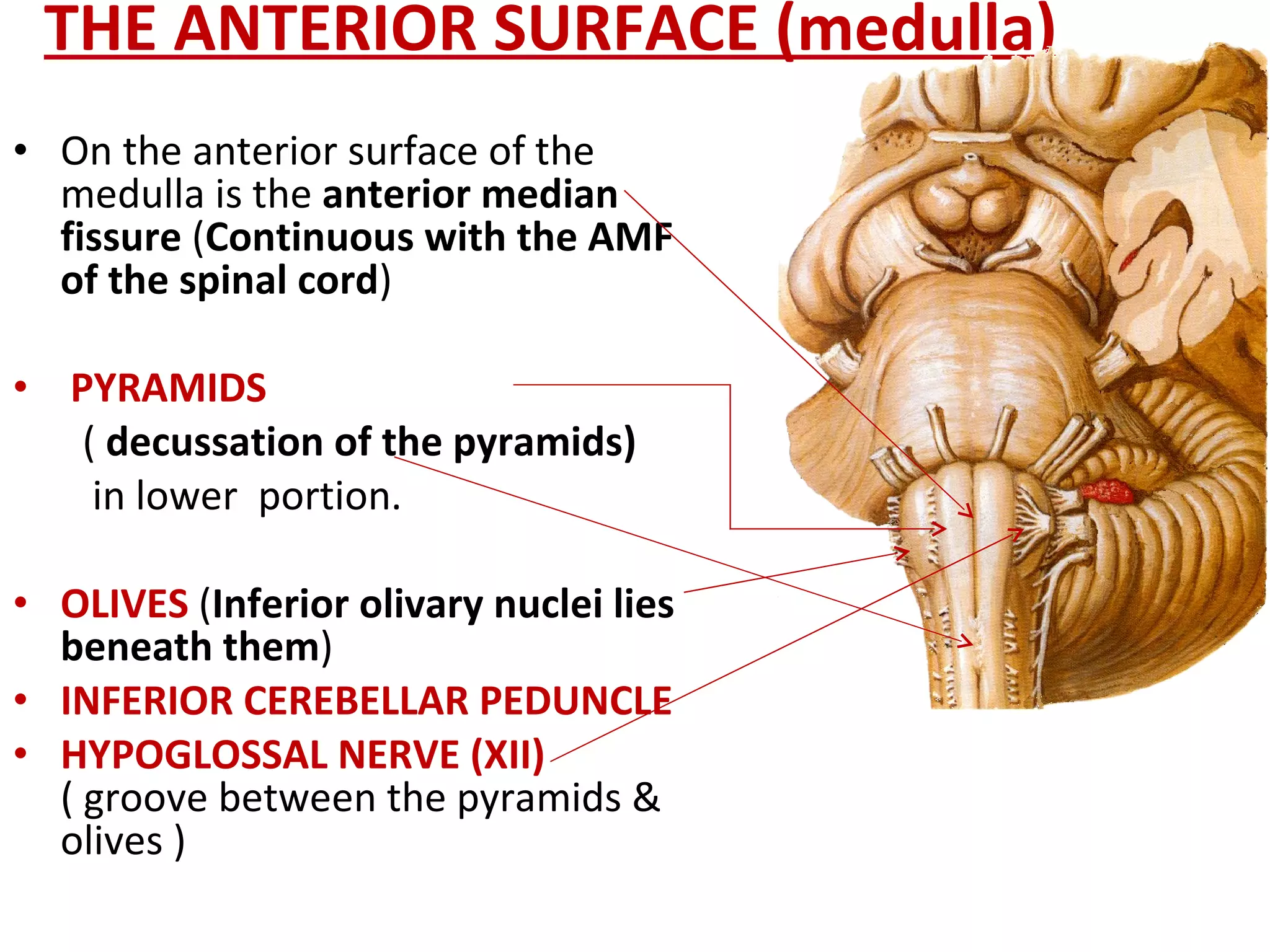
THE ANTERIOR SURFACE(medulla) On the anterior surface of the medulla is the anterior median fissure ( Continuous with the AMF of the spinal cord ) PYRAMIDS ( decussation of the pyramids) in lower portion. OLIVES ( Inferior olivary nuclei lies beneath them ) INFERIOR CEREBELLAR PEDUNCLE HYPOGLOSSAL NERVE (XII) ( groove between the pyramids & olives )
14.
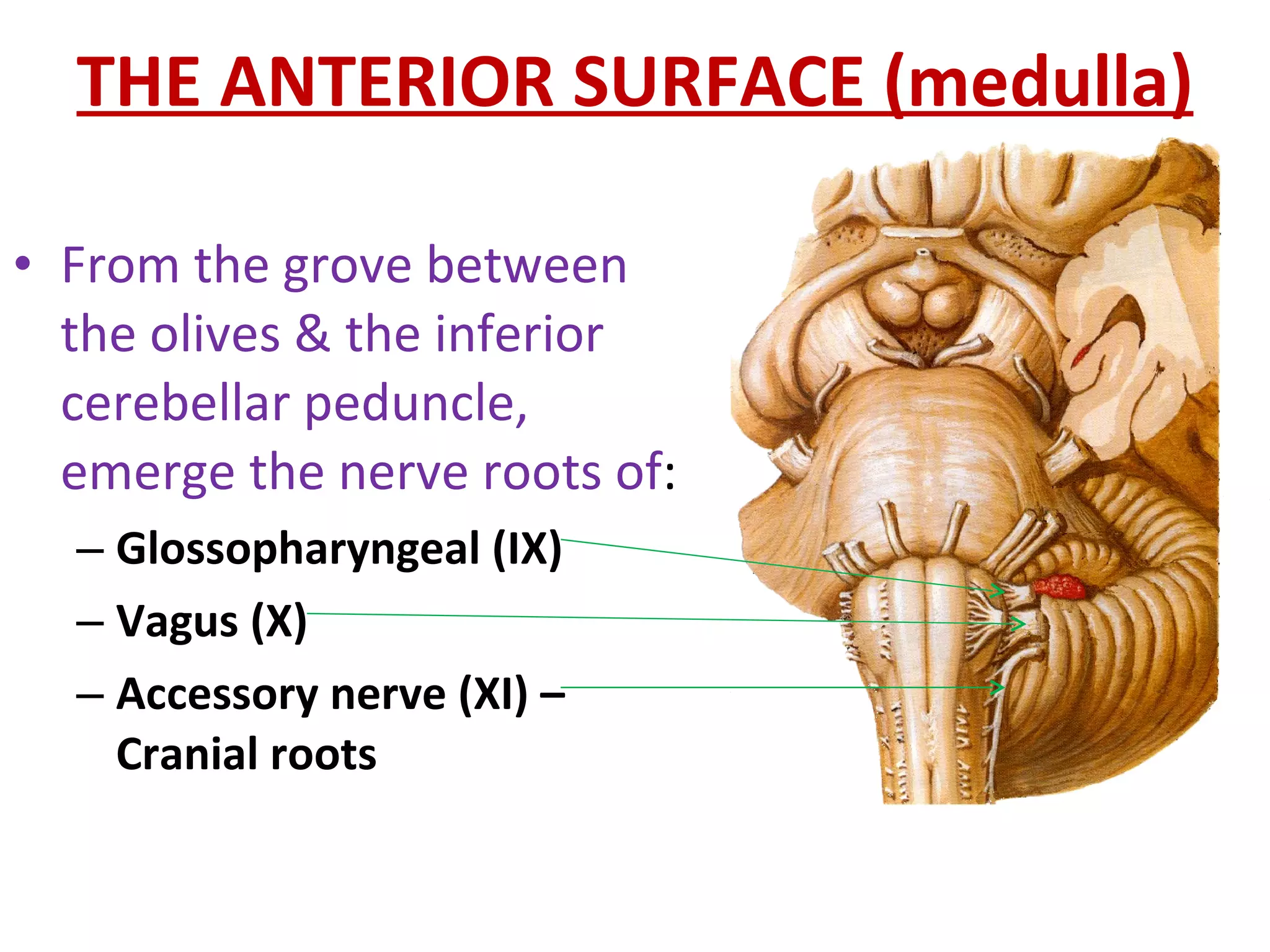
THE ANTERIOR SURFACE(medulla) From the grove between the olives & the inferior cerebellar peduncle, emerge the nerve roots of : Glossopharyngeal (IX) Vagus (X) Accessory nerve (XI) – Cranial roots
15.
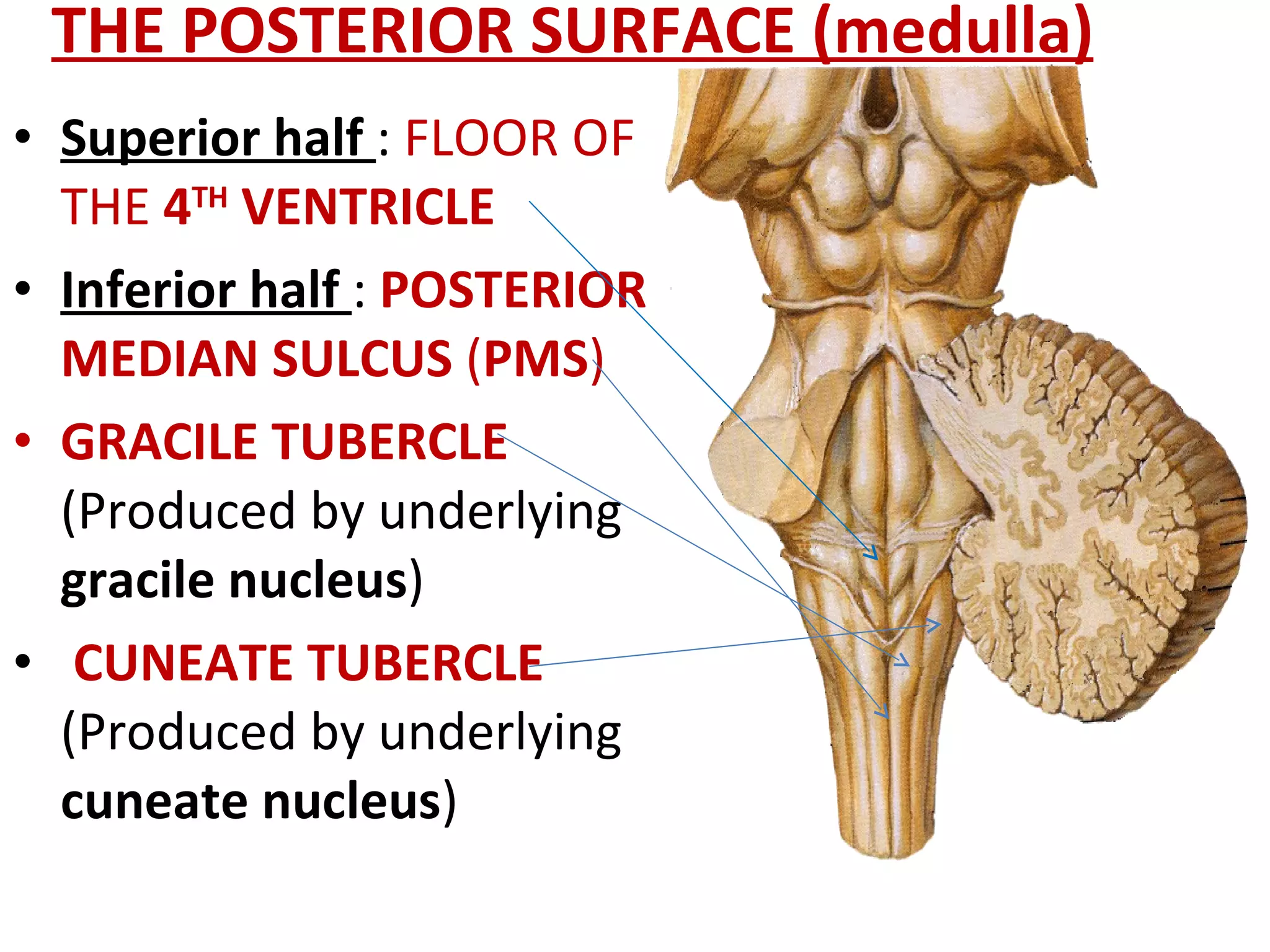
THE POSTERIOR SURFACE(medulla) Superior half : FLOOR OF THE 4 TH VENTRICLE Inferior half : POSTERIOR MEDIAN SULCUS ( PMS ) GRACILE TUBERCLE (Produced by underlying gracile nucleus ) CUNEATE TUBERCLE (Produced by underlying cuneate nucleus )
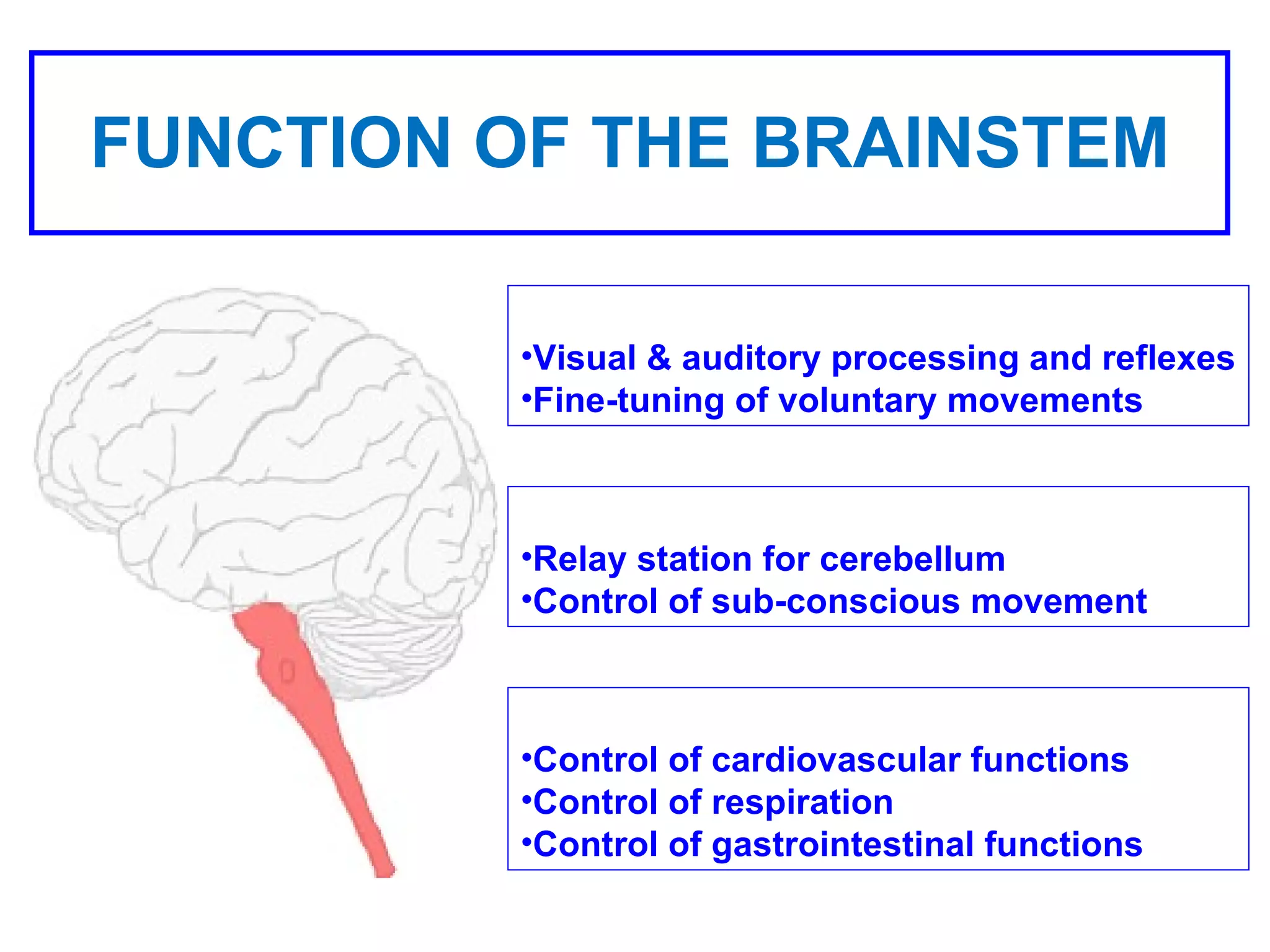
FUNCTION OF THEBRAINSTEM Midbrain: Visual & auditory processing and reflexes Fine-tuning of voluntary movements Pons: Relay station for cerebellum Control of sub-conscious movement Medulla Oblongata: Control of cardiovascular functions Control of respiration Control of gastrointestinal functions