Primary motor cortex
Domina Petric, MD
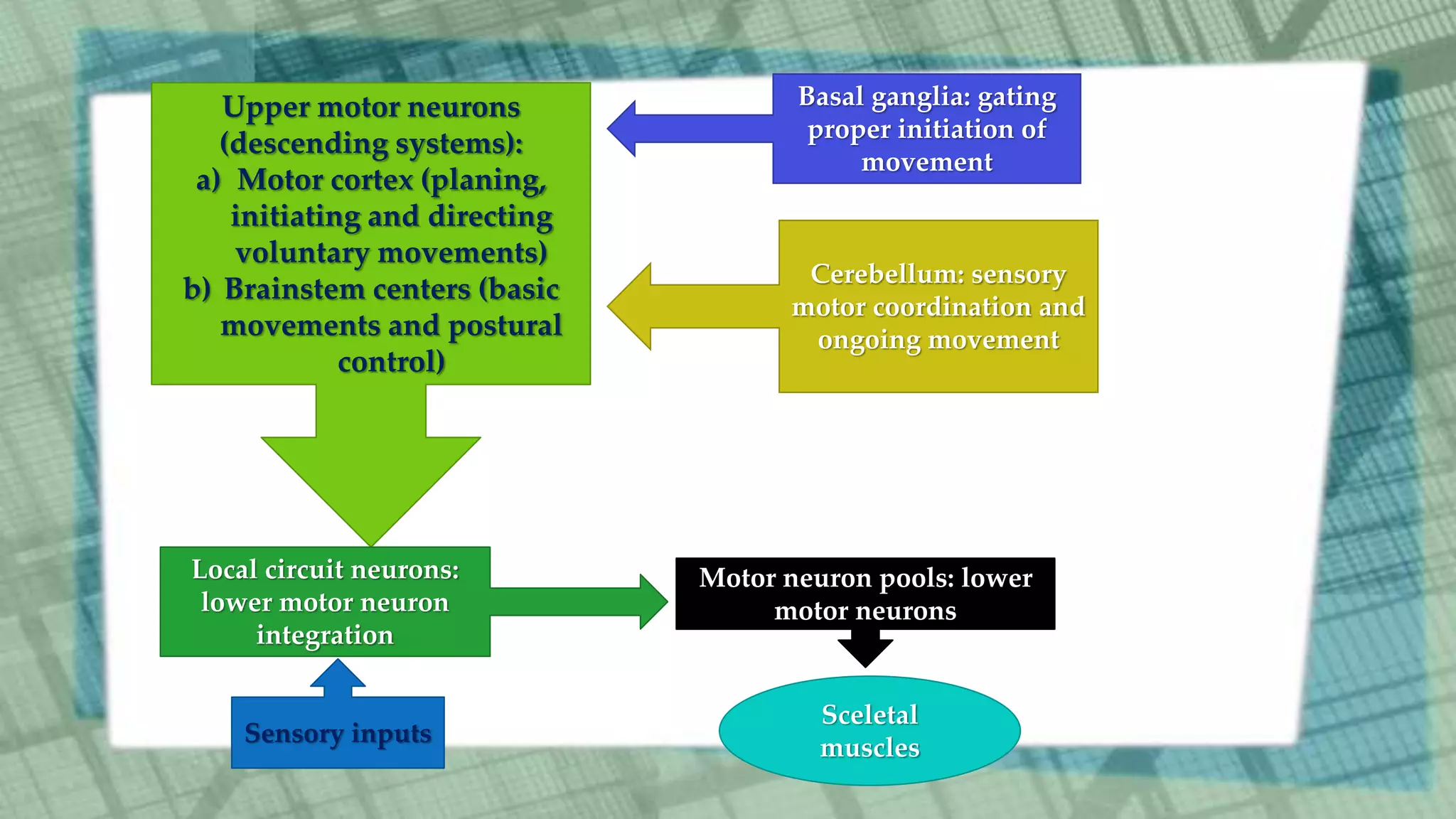
Upper motor neurons
(descending systems):
a) Motor cortex (planing,
initiating and directing
voluntary movements)
b) Brainstem centers (basic
movements and postural
control)
Basal ganglia: gating
proper initiation of
movement
Cerebellum: sensory
motor coordination and
ongoing movement
Local circuit neurons:
lower motor neuron
integration
Motor neuron pools: lower
motor neurons
Sceletal
muscles
Sensory inputs
Motor cortex
• It is concerned with encoding the movement intention.
• Motor cortex includes precentral gyrus and posterior parts of superior,
middle and inferior frontal gyri.
• Motor cortex is mostly concerned with voluntary movements, but it is
also related to behaviors that are concerned with expression of
emotions.
• So, the motor cortex is also concerned with non-verbal communication
(facial gestures, body posture).
• Brainstem motor centers are concerned with adjustment of posture,
with setting the gain of segmental reflexes and it is important for
expressing the skill.
www.studyblue.com
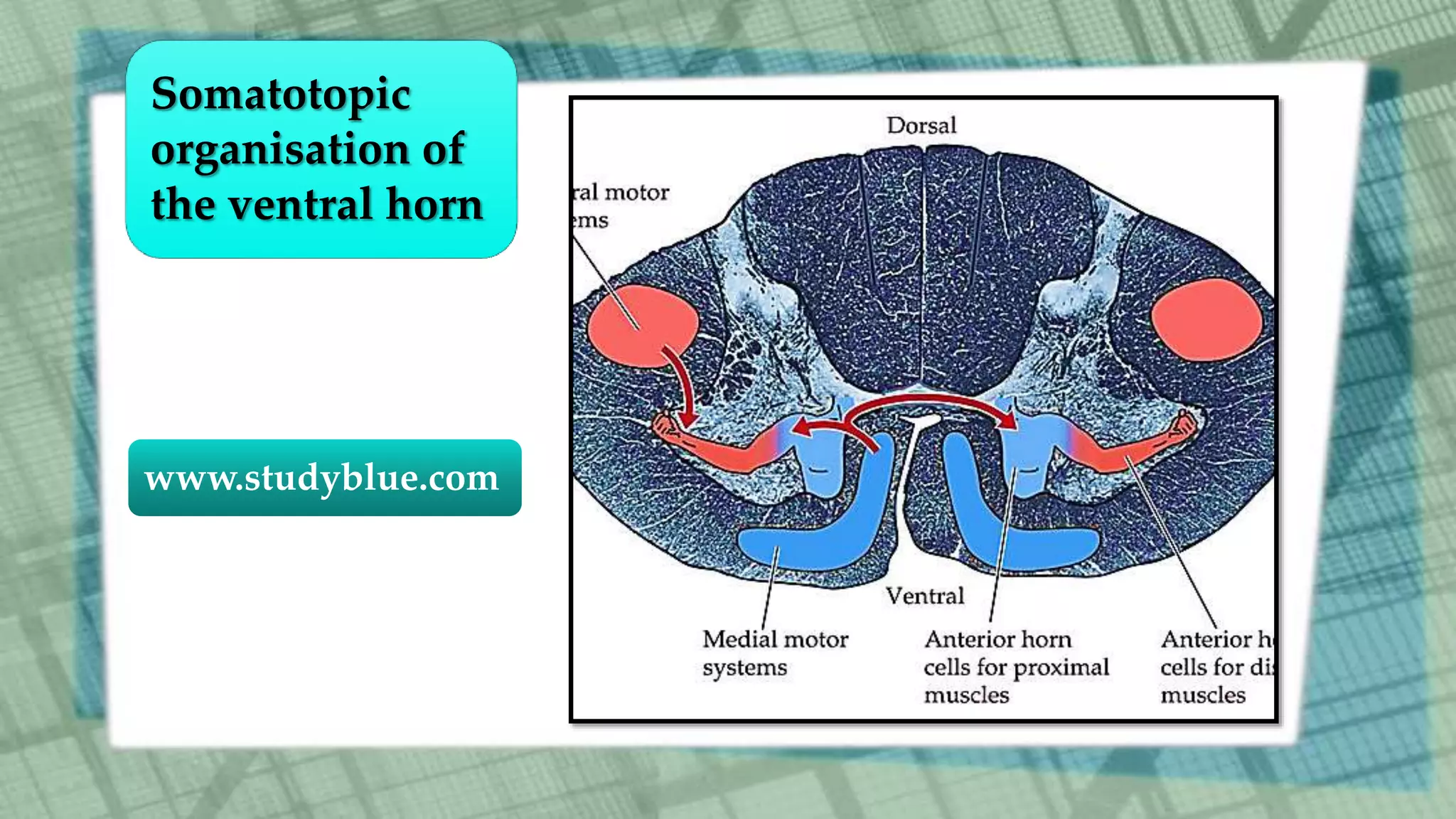
Somatotopic
organisation of
the ventral horn
Spinal cord
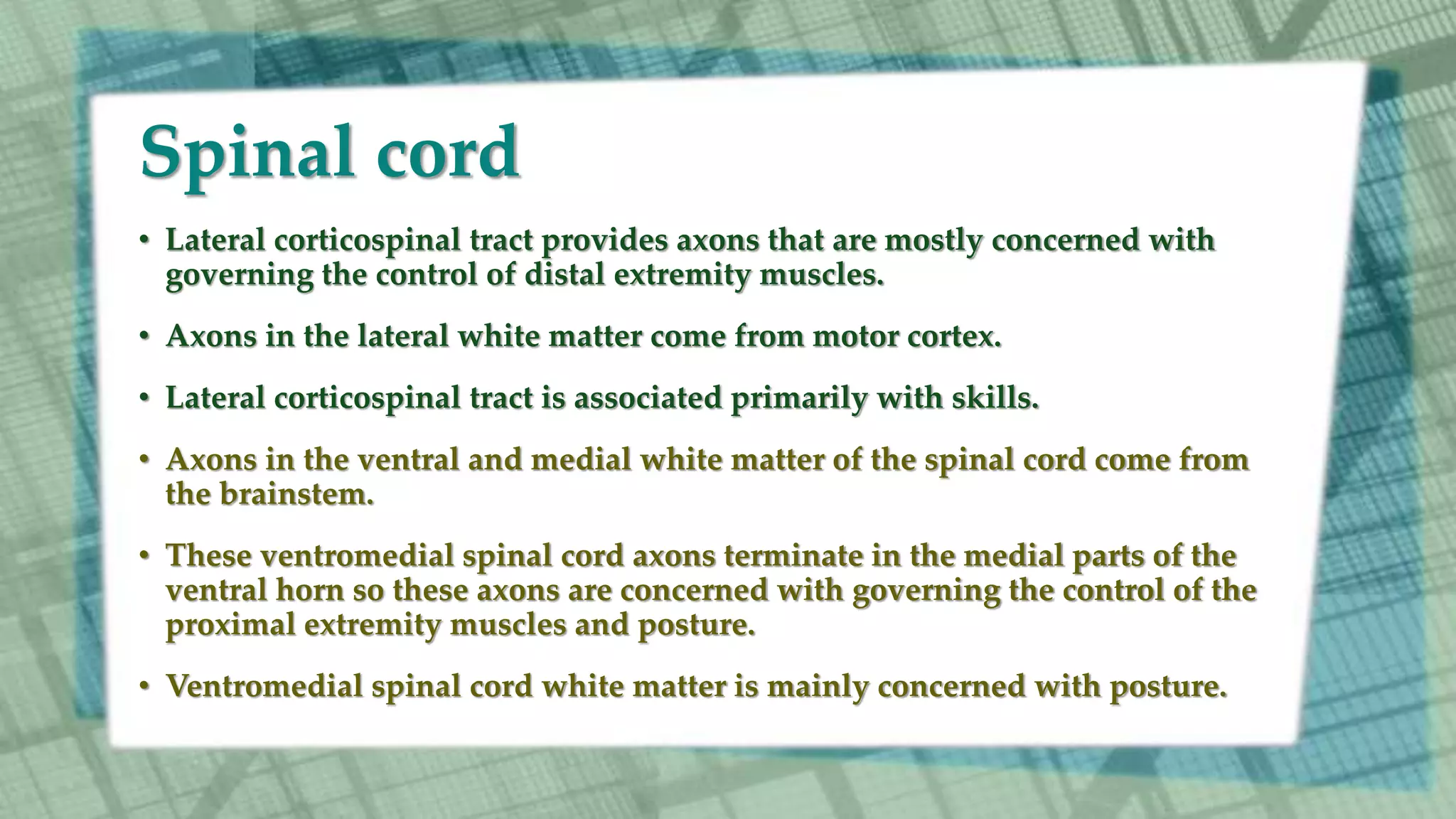
• Lateral corticospinal tract provides axons that are mostly concerned with
governing the control of distal extremity muscles.
• Axons in the lateral white matter come from motor cortex.
• Lateral corticospinal tract is associated primarily with skills.
• Axons in the ventral and medial white matter of the spinal cord come from
the brainstem.
• These ventromedial spinal cord axons terminate in the medial parts of the
ventral horn so these axons are concerned with governing the control of the
proximal extremity muscles and posture.
• Ventromedial spinal cord white matter is mainly concerned with posture.
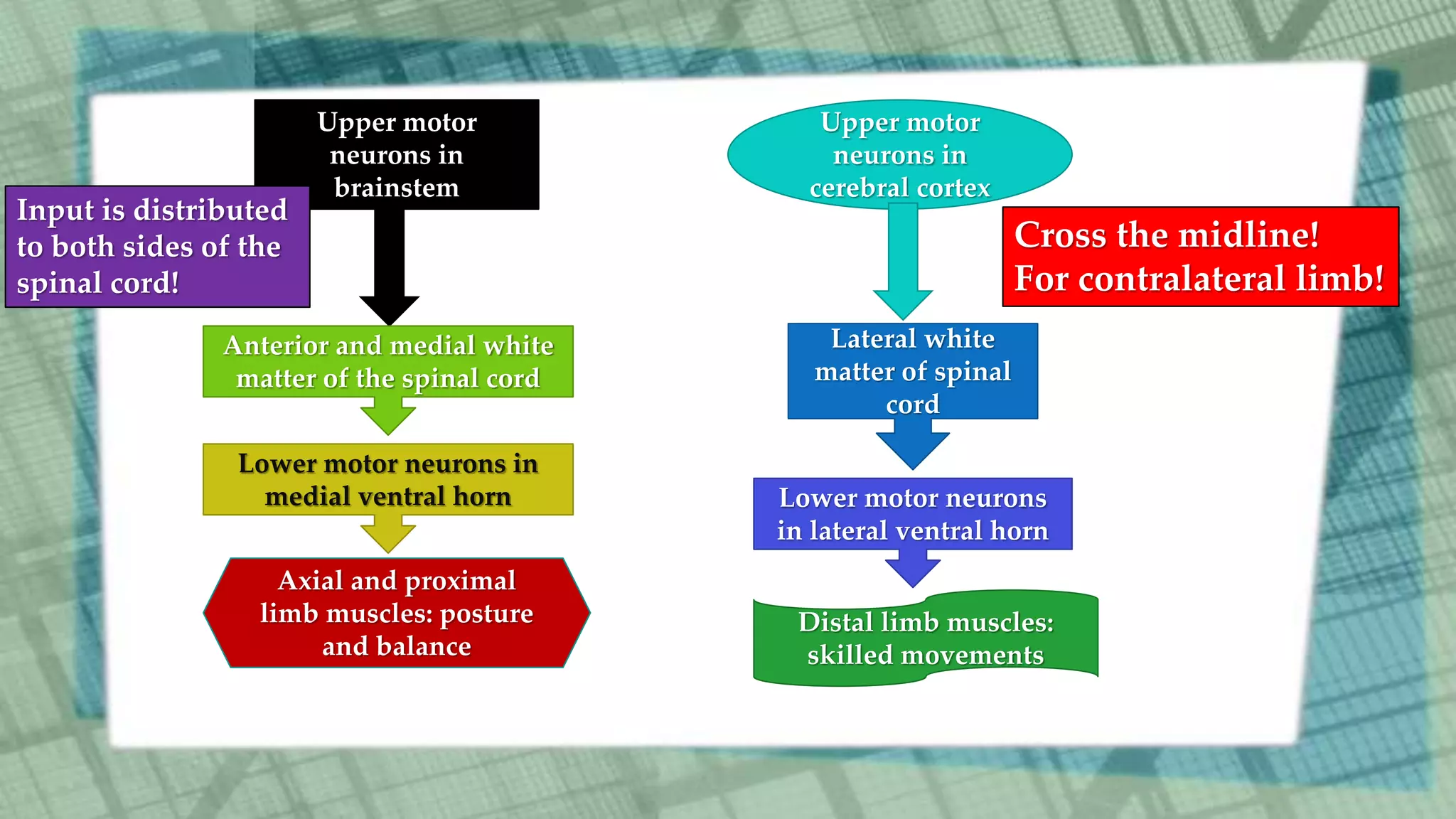
Upper motor
neurons in
cerebral cortex
Lateral white
matter of spinal
cord
Lower motor neurons
in lateral ventral horn
Distal limb muscles:
skilled movements
Upper motor
neurons in
brainstem
Anterior and medial white
matter of the spinal cord
Lower motor neurons in
medial ventral horn
Axial and proximal
limb muscles: posture
and balance
Cross the midline!
For contralateral limb!
Input is distributed
to both sides of the
spinal cord!
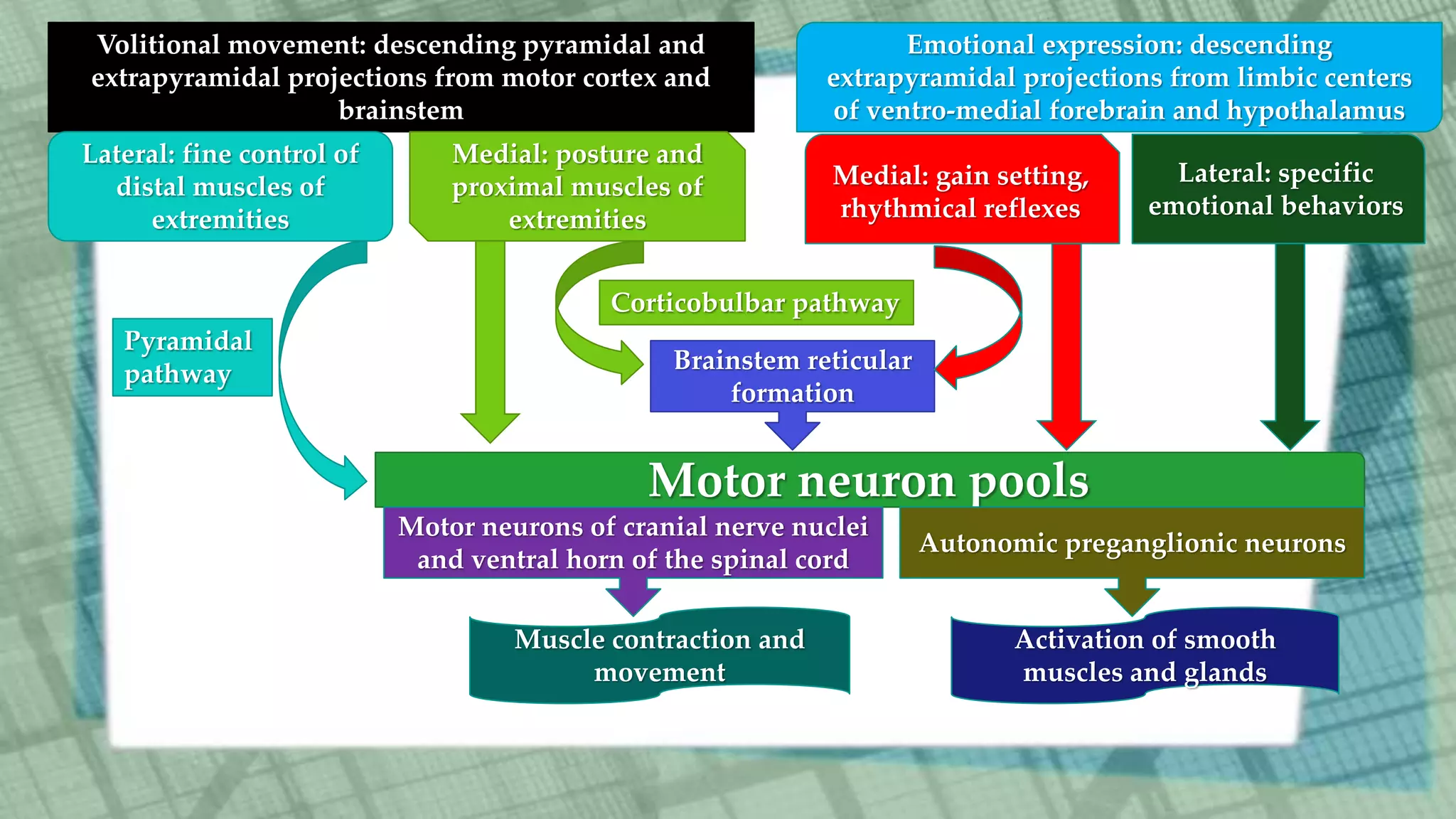
Volitional movement: descending pyramidal and
extrapyramidal projections from motor cortex and
brainstem
Lateral: fine control of
distal muscles of
extremities
Medial: posture and
proximal muscles of
extremities
Brainstem reticular
formation
Motor neuron pools
Motor neurons of cranial nerve nuclei
and ventral horn of the spinal cord
Autonomic preganglionic neurons
Muscle contraction and
movement
Activation of smooth
muscles and glands
Emotional expression: descending
extrapyramidal projections from limbic centers
of ventro-medial forebrain and hypothalamus
Medial: gain setting,
rhythmical reflexes
Lateral: specific
emotional behaviors
Pyramidal
pathway
Corticobulbar pathway
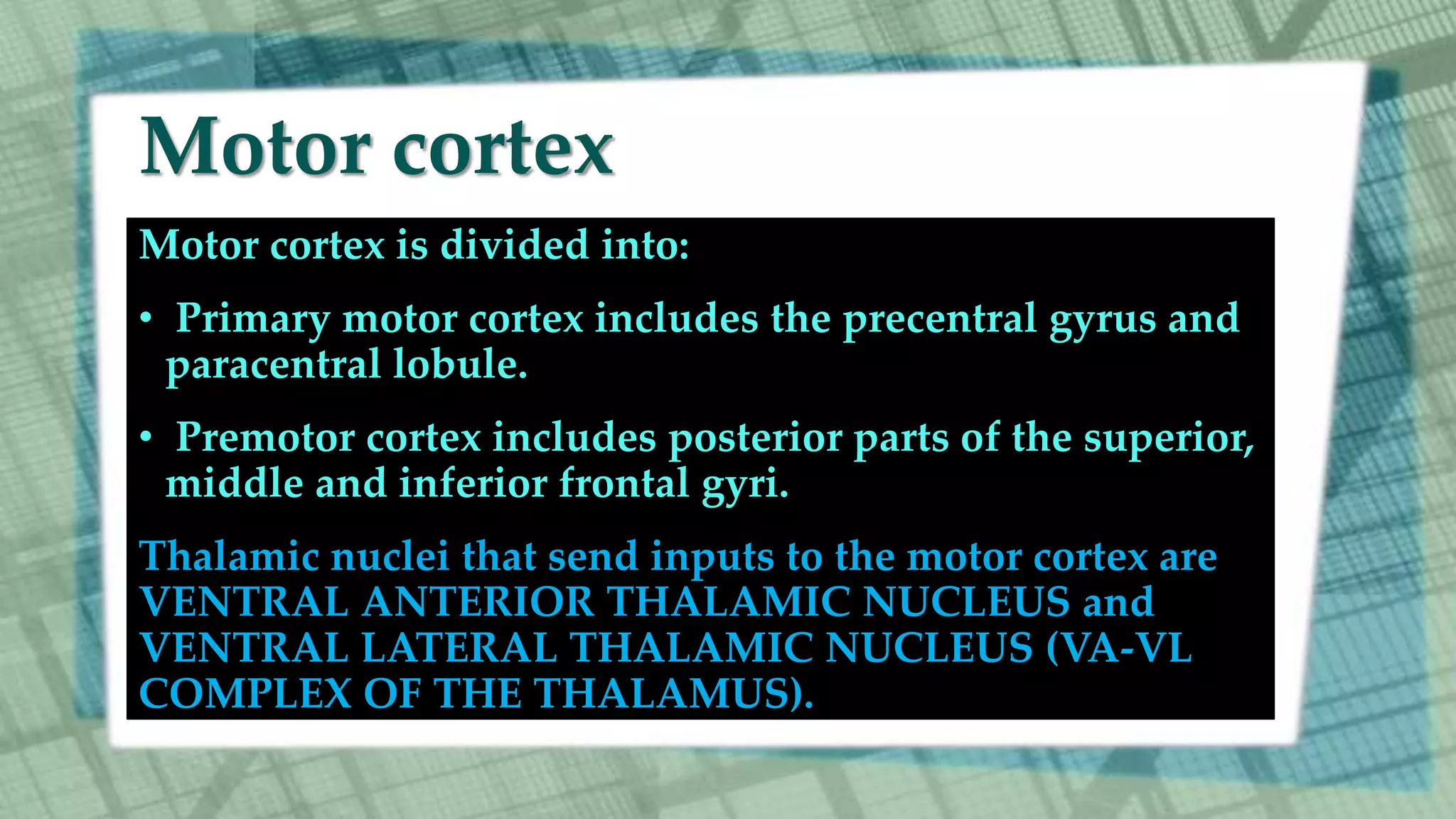
Motor cortex
Motor cortex is divided into:
• Primary motor cortex includes the precentral gyrus and
paracentral lobule.
• Premotor cortex includes posterior parts of the superior,
middle and inferior frontal gyri.
Thalamic nuclei that send inputs to the motor cortex are
VENTRAL ANTERIOR THALAMIC NUCLEUS and
VENTRAL LATERAL THALAMIC NUCLEUS (VA-VL
COMPLEX OF THE THALAMUS).
Motor cortex
Somatosensory cortex also sends inputs to the
motor cortex, both primary motor cortex and
premotor cortex.
˝Where˝ (magnocellular) visual pathway sends
inputs to the premotor cortex.
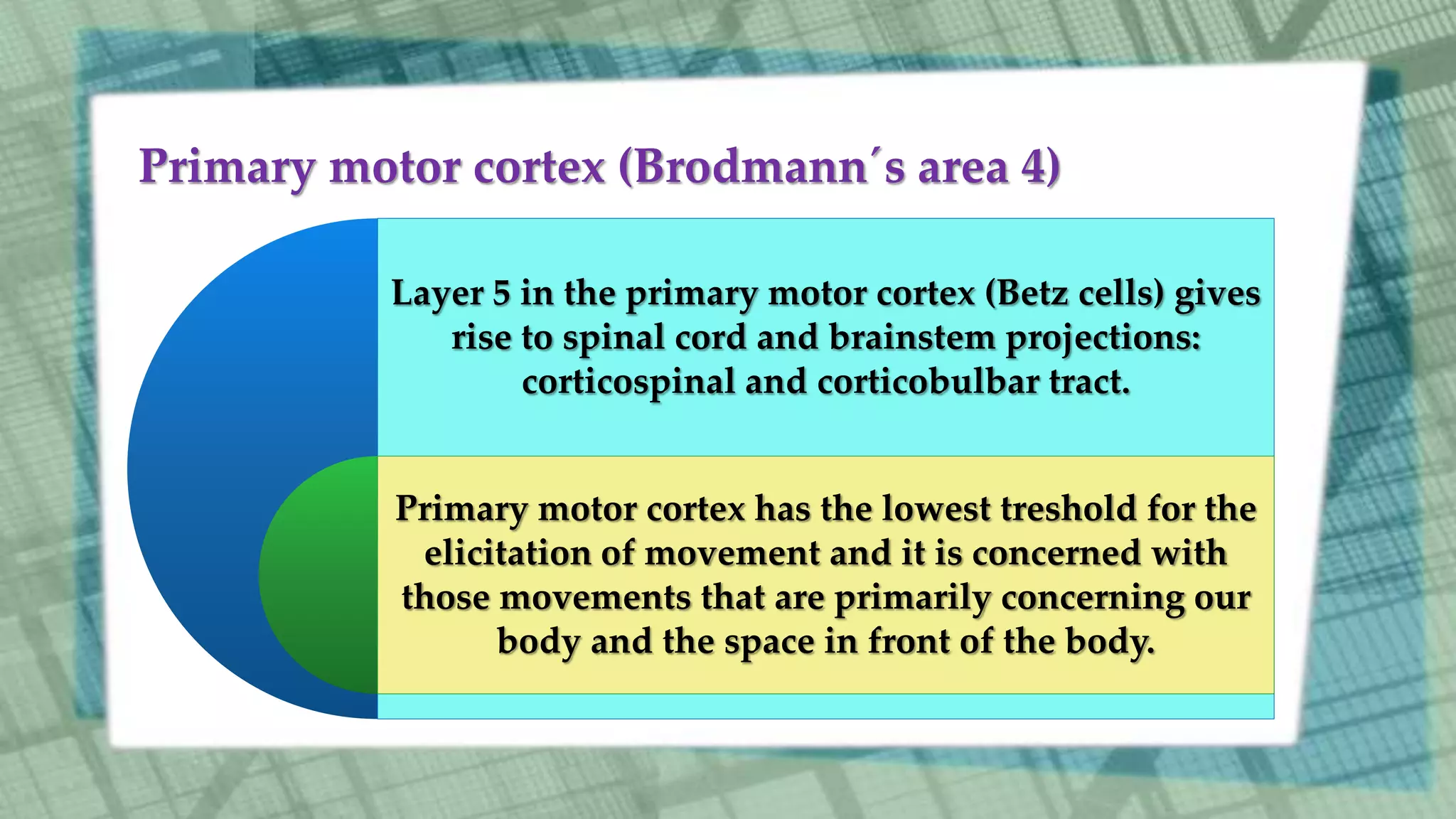
Primary motor cortex (Brodmann´s area 4)
Layer 5 in the primary motor cortex (Betz cells) gives
rise to spinal cord and brainstem projections:
corticospinal and corticobulbar tract.
Primary motor cortex has the lowest treshold for the
elicitation of movement and it is concerned with
those movements that are primarily concerning our
body and the space in front of the body.
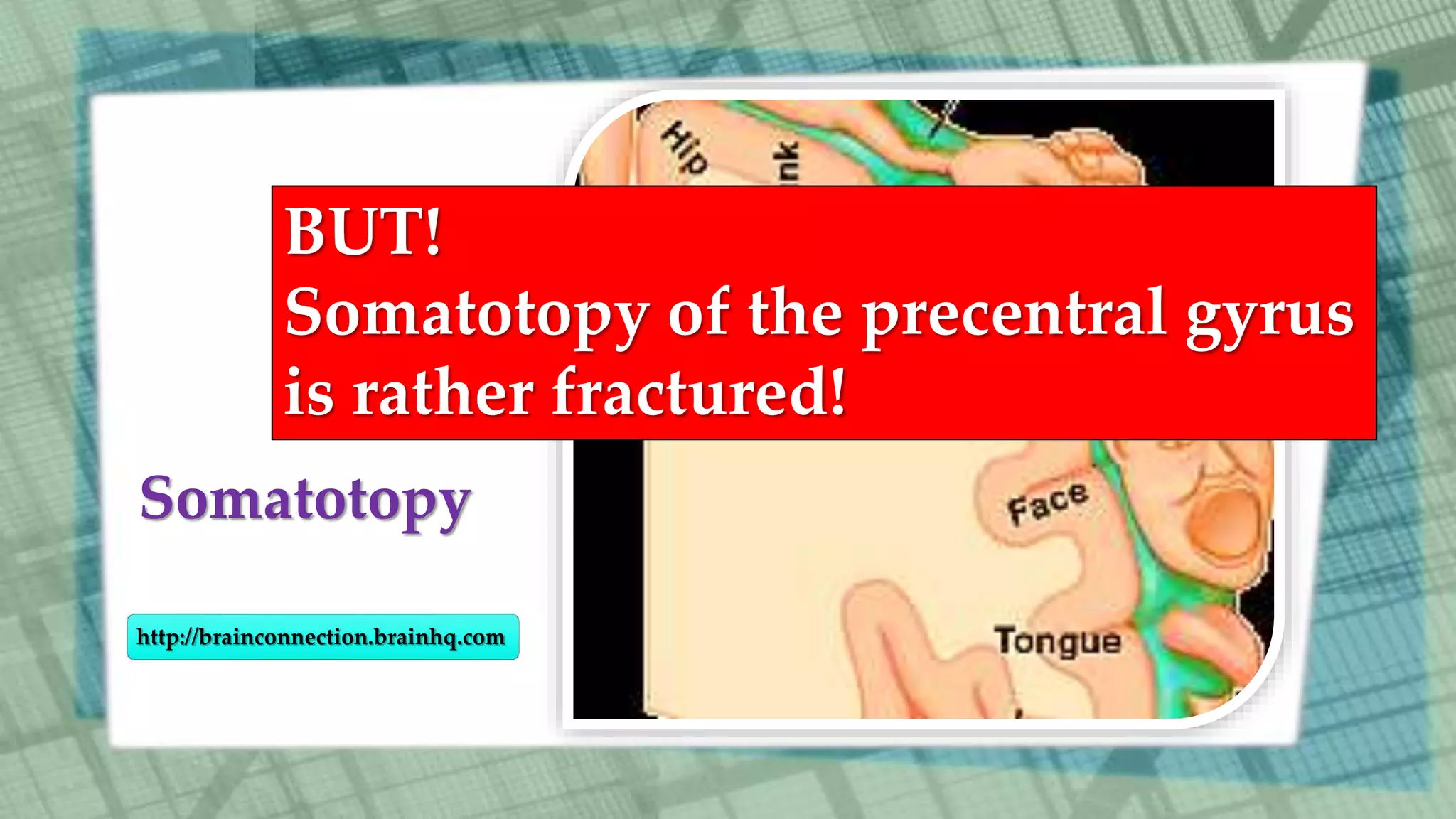
Somatotopy
http://brainconnection.brainhq.com
BUT!
Somatotopy of the precentral gyrus
is rather fractured!
Fractured somatotopy
There are overlapping representations in the
precentral gyrus for flexor and extensor muscles.
There are multiple representations of the same body
region.
There is no internal somatotopy in the region for arm
in the precentral gyrus.
Fractured somatotopy
Single corticospinal axon supplies
multiple columns of lower motor
neurons in ventral horn.
Single spike in a corticospinal
axon activates many different
muscles in the forelimb.
Representations of the primary motor cortex
movements (not muscles) or movement intentions
multiple dimensions of movement (force, direction, amplitude)
movements that engage hand, lower face and hand to mouth
coordination
skilled manual behavior in central personal space
lesions impair fractionated (skilled) finger-facial movements
Literature
https://www.coursera.org/learn/medical-
neuroscience/lecture: Leonard E. White,
PhD, Duke University
www.studyblue.com
http://brainconnection.brainhq.com

Primary motor cortex

  • 1.
  • 2.
    Upper motor neurons (descendingsystems): a) Motor cortex (planing, initiating and directing voluntary movements) b) Brainstem centers (basic movements and postural control) Basal ganglia: gating proper initiation of movement Cerebellum: sensory motor coordination and ongoing movement Local circuit neurons: lower motor neuron integration Motor neuron pools: lower motor neurons Sceletal muscles Sensory inputs
  • 3.
    Motor cortex • Itis concerned with encoding the movement intention. • Motor cortex includes precentral gyrus and posterior parts of superior, middle and inferior frontal gyri. • Motor cortex is mostly concerned with voluntary movements, but it is also related to behaviors that are concerned with expression of emotions. • So, the motor cortex is also concerned with non-verbal communication (facial gestures, body posture). • Brainstem motor centers are concerned with adjustment of posture, with setting the gain of segmental reflexes and it is important for expressing the skill.
  • 4.
  • 5.
    Spinal cord • Lateralcorticospinal tract provides axons that are mostly concerned with governing the control of distal extremity muscles. • Axons in the lateral white matter come from motor cortex. • Lateral corticospinal tract is associated primarily with skills. • Axons in the ventral and medial white matter of the spinal cord come from the brainstem. • These ventromedial spinal cord axons terminate in the medial parts of the ventral horn so these axons are concerned with governing the control of the proximal extremity muscles and posture. • Ventromedial spinal cord white matter is mainly concerned with posture.
  • 6.
    Upper motor neurons in cerebralcortex Lateral white matter of spinal cord Lower motor neurons in lateral ventral horn Distal limb muscles: skilled movements Upper motor neurons in brainstem Anterior and medial white matter of the spinal cord Lower motor neurons in medial ventral horn Axial and proximal limb muscles: posture and balance Cross the midline! For contralateral limb! Input is distributed to both sides of the spinal cord!
  • 7.
    Volitional movement: descendingpyramidal and extrapyramidal projections from motor cortex and brainstem Lateral: fine control of distal muscles of extremities Medial: posture and proximal muscles of extremities Brainstem reticular formation Motor neuron pools Motor neurons of cranial nerve nuclei and ventral horn of the spinal cord Autonomic preganglionic neurons Muscle contraction and movement Activation of smooth muscles and glands Emotional expression: descending extrapyramidal projections from limbic centers of ventro-medial forebrain and hypothalamus Medial: gain setting, rhythmical reflexes Lateral: specific emotional behaviors Pyramidal pathway Corticobulbar pathway
  • 8.
    Motor cortex Motor cortexis divided into: • Primary motor cortex includes the precentral gyrus and paracentral lobule. • Premotor cortex includes posterior parts of the superior, middle and inferior frontal gyri. Thalamic nuclei that send inputs to the motor cortex are VENTRAL ANTERIOR THALAMIC NUCLEUS and VENTRAL LATERAL THALAMIC NUCLEUS (VA-VL COMPLEX OF THE THALAMUS).
  • 9.
    Motor cortex Somatosensory cortexalso sends inputs to the motor cortex, both primary motor cortex and premotor cortex. ˝Where˝ (magnocellular) visual pathway sends inputs to the premotor cortex.
  • 10.
    Primary motor cortex(Brodmann´s area 4) Layer 5 in the primary motor cortex (Betz cells) gives rise to spinal cord and brainstem projections: corticospinal and corticobulbar tract. Primary motor cortex has the lowest treshold for the elicitation of movement and it is concerned with those movements that are primarily concerning our body and the space in front of the body.
  • 11.
  • 12.
    Fractured somatotopy There areoverlapping representations in the precentral gyrus for flexor and extensor muscles. There are multiple representations of the same body region. There is no internal somatotopy in the region for arm in the precentral gyrus.
  • 13.
    Fractured somatotopy Single corticospinalaxon supplies multiple columns of lower motor neurons in ventral horn. Single spike in a corticospinal axon activates many different muscles in the forelimb.
  • 14.
    Representations of theprimary motor cortex movements (not muscles) or movement intentions multiple dimensions of movement (force, direction, amplitude) movements that engage hand, lower face and hand to mouth coordination skilled manual behavior in central personal space lesions impair fractionated (skilled) finger-facial movements
  • 15.
    Literature https://www.coursera.org/learn/medical- neuroscience/lecture: Leonard E.White, PhD, Duke University www.studyblue.com http://brainconnection.brainhq.com