DNA As The Genetic Material, 
DNA Damage & Repair Mechanisms. 
台大農藝系 遺傳學 601 20000 
Preety Sweta Hembrom. 
M.Sc. Genomic science. 
Central University Of Kerala 
Chapter 2 
slide 1 
GENETICS 
TOPIC:
 The genetic material must perform three 
essential function: 
1. The Genotypic function, 
2. The Phenotypic function, 
3. The Evolutionary function. 
 This means that genetic material must 
replicate in order to transmit copies from 
parents to offspring. 
2
 In the early 1900s, chromosomes were shown 
to be the carriers of hereditary information. 
 In eukaryotes they are composed of both 
DNA and protein, and most scientists initially 
believed that protein must be the genetic 
material. 
3
 Chromosome consists of protein and nucleic 
acid 
 Protein v.s. nucleic acid 
Protein: 20 kinds of amino acid 
Nucleic acid: 2 types – DNA & RNA 
 During the 1940s and early 1940s through the 
result of elegant experiments it was clearly 
established that genetic information is stored 
in nucleic acids & not in proteins. 
4
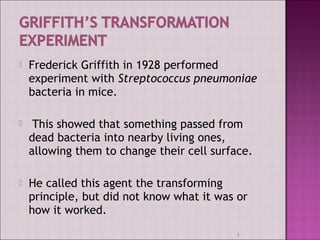
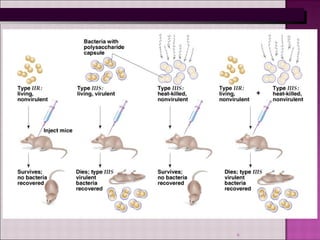
 Frederick Griffith in 1928 performed 
experiment with Streptococcus pneumoniae 
bacteria in mice. 
 This showed that something passed from 
dead bacteria into nearby living ones, 
allowing them to change their cell surface. 
 He called this agent the transforming 
principle, but did not know what it was or 
how it worked. 
5
6
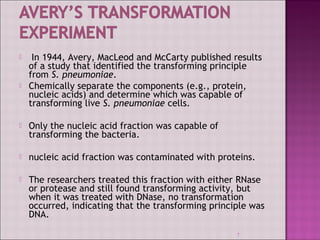
 In 1944, Avery, MacLeod and McCarty published results 
of a study that identified the transforming principle 
from S. pneumoniae. 
 Chemically separate the components (e.g., protein, 
nucleic acids) and determine which was capable of 
transforming live S. pneumoniae cells. 
 Only the nucleic acid fraction was capable of 
transforming the bacteria. 
 nucleic acid fraction was contaminated with proteins. 
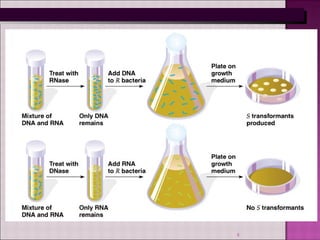
 The researchers treated this fraction with either RNase 
or protease and still found transforming activity, but 
when it was treated with DNase, no transformation 
occurred, indicating that the transforming principle was 
DNA. 
7
8
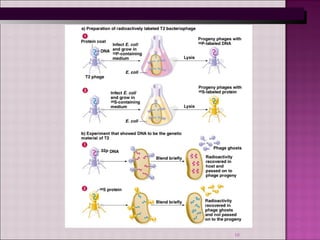
 1. More evidence for DNA as the genetic material came 
in 1953 with Alfred Hershey and Martha Chase’s work on 
E. coli infected with bacteriophage T2. 
 2. In one part of the experiment, T2 proteins were 
labeled with 35S, and in the other part, T2 DNA was 
labeled with 32P. 
 3. The 35S-labeled protein was found outside the 
infected cells, while the 32P-labeled DNA was inside the 
E. coli, indicating that DNA carried the information 
needed for viral infection. This provided additional 
support for the idea that genetic inheritance occurs via 
DNA. 
9
10
A BRIEF INTRODUCTION: 
11
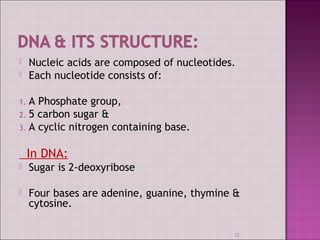
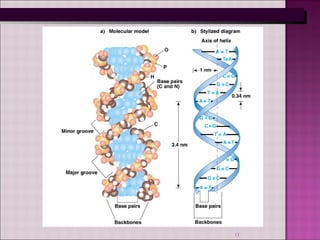
 Nucleic acids are composed of nucleotides. 
 Each nucleotide consists of: 
12 
1. A Phosphate group, 
2. 5 carbon sugar & 
3. A cyclic nitrogen containing base. 
In DNA: 
 Sugar is 2-deoxyribose 
 Four bases are adenine, guanine, thymine & 
cytosine.
13
 The faithful transmission of genetic material 
from one cell to another is based on the 
ability to replicate. 
 The process of DNA replication is based on 
the complementary nature of the strands 
that makeup DNA duplex. 
 These strands are held together by hydrogen 
bonds between specific base pairs- A paired 
with T & G paired with C. 
14
 Thus the expression of genetic information is 
that the flow of information is from DNA to 
RNA to polypeptide which is known as:- 
Central Dogma Of Biology 
15
16
 DNA is easily damaged under normal 
physiological conditions. 
 The return of damaged DNA to its normal 
sequence and structure is called Repair. 
 Many different kinds of physical & chemical 
agents damage DNA. Some of these are:- 
1. Endogenous agents 
2. Exogenous agents 
 Cells usually can survive DNA damage 
provided that the replication and 
transcription machinery can still perform 
their functions. 
17
Hence, agents that damage DNA can be 
mutagenic, cytotoxic or both. 
DNA damaging agents that cause mutations 
are called Mutagens. 
19
 Mutations are inherited changes in the 
genetic material which provide new genetic 
variation that allows organisms to evolve. 
 Mutations occur in 2 ways: 
1. Spontaneous mutations 
2. Induced mutation 
19
 Damages are physical abnormalities in the 
DNA, such as single and double strand breaks 
etc. 
In DNA damage transcription of a gene 
can be prevented & thus translation as well 
as replication of a gene will also be blocked 
& the cell may die. 
 Mutation is a change in the base sequence of 
the DNA. It is replicated when the cell 
replicate. 
 Cause alteration in protein function & 
regulation. 
20
 Although distinctly different from each 
other, DNA damages & mutations are related 
to each other because DNA damage often 
cause errors of DNA synthesis during 
replication or repair, these errors are a 
major source of mutation. 
21
 The 4 major types of DNA damages are: 
1. Radiation damage 
2. DNA instability in water 
3. Oxidative damage 
4. Alkylation damage 
22
 The high energy electromagnetic radiation to 
the exposure of which cell experience 
considerable damage to their DNA are: 
1. Ultraviolet light: 
 The major type of damage caused by UV light 
is divided into three bands: 
I. UV-A (321-400 nm) 
II.UV-B (296-320 nm) 
III.UV-C (100-295 nm) 
23
 Two major photoproducts account for nearly 
all of the UV induced DNA damage are: 
a) Cyclobutane pyrimidine dimer- 75% of the UV 
induced damage. Formed by introducing 2 
new bonds between adjacent pyrimidines (C 
& T) on the same DNA strand. 
b) (6-4) photoproducts- Remaining of the UV 
induced damage. Formed by introducing a 
bond between the c-6 atom of one 
pyrimidine & the c-4 atom of atoms of 
adjacent pyrimidine on the same DNA strand. 
24
2. X- Rays 
3. Gamma Rays 
 Through these direct damage takes place 
when DNA or water tightly bound to it 
absorbs the radiation. 
Indirect damage takes place when 
water or other molecules surrounding the 
DNA absorbs the radiation & form reactive 
species that then damage DNA. 
25
 DNA is damaged by hydrolytic cleavage 
reactions. 
 DNA has 2 kinds of bonds with the potential 
for hydrolytic cleavage: 
1. Phosphodiester bonds- Introduces a nick into 
a DNA strand. 
2. N- glycosyl bond- leads to the formation of 
an abasic site also known as AP site. AP site 
sensitizes the neighbouring 3’- 
phosphodiester bond to cleavage. 
26
 Two of the oxidized base products that 
cause damage are: 
1. 8- oxoguanine (oxoG)- Base pair with A or 
C. If uncorrected 8- oxoG- A base pair will 
be replicated to form A-T base pair causing 
transversion mutation. 
Guanine oxidizes to 8-oxoguanine, 
causes single & double strand breaks. 
2. Thymine glycol- Inhibits DNA replication & 
is therefore cytotoxic. 
27
 Alkylating agents damage DNA by 
transferring alkyl groups to centers of 
negative charge. 
 Formation of monoadduct. 
 Some of the DNA methylating agents are: 
1. Dimethylguanosine 
2. Dimethylsulfate. 
28
 There are five types of DNA repair 
mechanisms: 
1. Light- Dependent repair. 
2. Excision repair. 
3. Mismatch repair. 
4. Post replication repair. 
5. SOS response. 
29
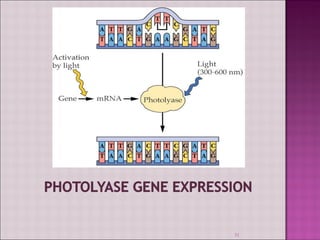
 Carried out by light activated enzyme called 
photolyase. 
 Production of thymine dimers. 
 DNA photolyase recognises & binds to 
thymine dimers in DNA & uses light energy to 
cleave the covalent cross- links. 
 Photolyase also splits cytosine dimers & 
cytosine- thymine dimers. 
30
31
 Two major types of excision repair: 
I. Base-Excision repair- Remove abnormal or 
modified bases from DNA. 
II. Nucleotide-Excision Repair- Remove larger 
defects like thymine dimers. 
Base- Excision Repair:- 
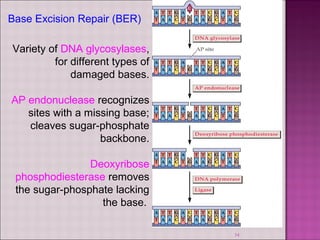
 Initiated by a group of enzymes- DNA 
glycosylases( recognize abnormal bases in 
DNA). 
 The glycosylases cleave glycosidic bond 
b/w the abnormal base & 2-deoxyribose 
creating AP sites. 
32
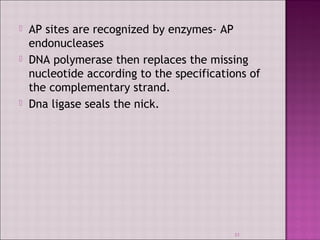
 AP sites are recognized by enzymes- AP 
endonucleases 
 DNA polymerase then replaces the missing 
nucleotide according to the specifications of 
the complementary strand. 
 Dna ligase seals the nick. 
33
34 
Base Excision Repair (BER) 
Variety of DNA glycosylases, 
for different types of 
damaged bases. 
AP endonuclease recognizes 
sites with a missing base; 
cleaves sugar-phosphate 
backbone. 
Deoxyribose 
phosphodiesterase removes 
the sugar-phosphate lacking 
the base.
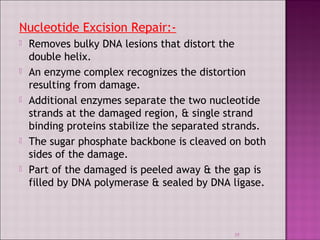
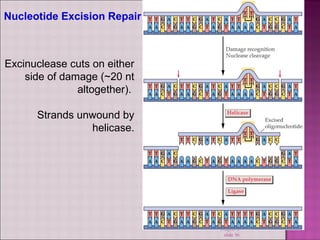
Nucleotide Excision Repair:- 
 Removes bulky DNA lesions that distort the 
double helix. 
 An enzyme complex recognizes the distortion 
resulting from damage. 
 Additional enzymes separate the two nucleotide 
strands at the damaged region, & single strand 
binding proteins stabilize the separated strands. 
 The sugar phosphate backbone is cleaved on both 
sides of the damage. 
 Part of the damaged is peeled away & the gap is 
filled by DNA polymerase & sealed by DNA ligase. 
35
Chapter 2 
slide 36 
Nucleotide Excision Repair 
Excinuclease cuts on either 
side of damage (~20 nt 
altogether). 
Strands unwound by 
helicase.
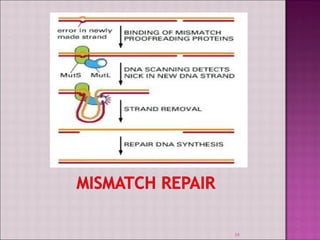
 Many incorrectly inserted nucleotides 
detected by proofreading are corrected by 
mismatch repair. 
 Enzymes cut out the distorted section of the 
newly synthesized strand of DNA & replace 
it with new nucleotides. 
 The proteins that carry out this in E.coli 
differentiate b/w old & new strands of DNA 
by the presence of methyl group. 
 Adenine nucleotides in GATC sequence is 
methylated. 
37
 The mismatch repair complex brings the 
mismatch bases close to the methylated 
GATC sequence & the new strand is 
identified. 
 Exonucleases remove nucleotides on the new 
strand b/w the GATC sequence & the 
mismatch. 
 DNA polymerase then replaces the 
nucleotides correcting the mismatch & DNA 
ligase seals the nick in the sugar phosphate 
backbone. 
38
39
 Takes place after replication. 
 When DNA polymerase III encounters a 
thymine dimer in a template strand, its 
progress is blocked. 
 The damaged DNA is repaired by a 
recombination- dependent repair process 
mediated by E.coli recA gene product. 
 The recA protein binds to the single strand of 
DNA at the gap & mediates pairing with the 
homologous segment of the sister double 
helix. 
40
 The gap opposite the dimer is filled with the 
homologous DNA strand from sister DNA 
molecule. 
 The resulting gap in the sister double helix is 
filled by DNA polymerase 
 And the nick is sealed by DNA ligase. 
41
 Discovered by Miroslav Radman in 1975. 
 Two regulatory protein that controls SOS 
response- LexA & RecA protein. 
 Synthesized at low background levels. 
 LexA binds to the DNA region that regulate 
the transcription of the genes that are 
induced during the SOS response. 
 When the cells are exposed to UV lights or 
other agents that cause DNA damage, the 
RecA protein binds to the ss region of DNA. 
42
 The interaction of RecA with DNA activates 
RecA, which then stimulates LexA to 
inactivate itself by self-cleavage. 
 With LexA inactivate, the level of expression 
of the SOS genes increases & the error prone 
repair system is activated. 
43
44

DNA as the Genetic material,DNA damage and Repair Mechanism

  • 1.
    DNA As TheGenetic Material, DNA Damage & Repair Mechanisms. 台大農藝系 遺傳學 601 20000 Preety Sweta Hembrom. M.Sc. Genomic science. Central University Of Kerala Chapter 2 slide 1 GENETICS TOPIC:
  • 2.
     The geneticmaterial must perform three essential function: 1. The Genotypic function, 2. The Phenotypic function, 3. The Evolutionary function.  This means that genetic material must replicate in order to transmit copies from parents to offspring. 2
  • 3.
     In theearly 1900s, chromosomes were shown to be the carriers of hereditary information.  In eukaryotes they are composed of both DNA and protein, and most scientists initially believed that protein must be the genetic material. 3
  • 4.
     Chromosome consistsof protein and nucleic acid  Protein v.s. nucleic acid Protein: 20 kinds of amino acid Nucleic acid: 2 types – DNA & RNA  During the 1940s and early 1940s through the result of elegant experiments it was clearly established that genetic information is stored in nucleic acids & not in proteins. 4
  • 5.
     Frederick Griffithin 1928 performed experiment with Streptococcus pneumoniae bacteria in mice.  This showed that something passed from dead bacteria into nearby living ones, allowing them to change their cell surface.  He called this agent the transforming principle, but did not know what it was or how it worked. 5
  • 6.
  • 7.
     In 1944,Avery, MacLeod and McCarty published results of a study that identified the transforming principle from S. pneumoniae.  Chemically separate the components (e.g., protein, nucleic acids) and determine which was capable of transforming live S. pneumoniae cells.  Only the nucleic acid fraction was capable of transforming the bacteria.  nucleic acid fraction was contaminated with proteins.  The researchers treated this fraction with either RNase or protease and still found transforming activity, but when it was treated with DNase, no transformation occurred, indicating that the transforming principle was DNA. 7
  • 8.
  • 9.
     1. Moreevidence for DNA as the genetic material came in 1953 with Alfred Hershey and Martha Chase’s work on E. coli infected with bacteriophage T2.  2. In one part of the experiment, T2 proteins were labeled with 35S, and in the other part, T2 DNA was labeled with 32P.  3. The 35S-labeled protein was found outside the infected cells, while the 32P-labeled DNA was inside the E. coli, indicating that DNA carried the information needed for viral infection. This provided additional support for the idea that genetic inheritance occurs via DNA. 9
  • 10.
  • 11.
  • 12.
     Nucleic acidsare composed of nucleotides.  Each nucleotide consists of: 12 1. A Phosphate group, 2. 5 carbon sugar & 3. A cyclic nitrogen containing base. In DNA:  Sugar is 2-deoxyribose  Four bases are adenine, guanine, thymine & cytosine.
  • 13.
  • 14.
     The faithfultransmission of genetic material from one cell to another is based on the ability to replicate.  The process of DNA replication is based on the complementary nature of the strands that makeup DNA duplex.  These strands are held together by hydrogen bonds between specific base pairs- A paired with T & G paired with C. 14
  • 15.
     Thus theexpression of genetic information is that the flow of information is from DNA to RNA to polypeptide which is known as:- Central Dogma Of Biology 15
  • 16.
  • 17.
     DNA iseasily damaged under normal physiological conditions.  The return of damaged DNA to its normal sequence and structure is called Repair.  Many different kinds of physical & chemical agents damage DNA. Some of these are:- 1. Endogenous agents 2. Exogenous agents  Cells usually can survive DNA damage provided that the replication and transcription machinery can still perform their functions. 17
  • 18.
    Hence, agents thatdamage DNA can be mutagenic, cytotoxic or both. DNA damaging agents that cause mutations are called Mutagens. 19
  • 19.
     Mutations areinherited changes in the genetic material which provide new genetic variation that allows organisms to evolve.  Mutations occur in 2 ways: 1. Spontaneous mutations 2. Induced mutation 19
  • 20.
     Damages arephysical abnormalities in the DNA, such as single and double strand breaks etc. In DNA damage transcription of a gene can be prevented & thus translation as well as replication of a gene will also be blocked & the cell may die.  Mutation is a change in the base sequence of the DNA. It is replicated when the cell replicate.  Cause alteration in protein function & regulation. 20
  • 21.
     Although distinctlydifferent from each other, DNA damages & mutations are related to each other because DNA damage often cause errors of DNA synthesis during replication or repair, these errors are a major source of mutation. 21
  • 22.
     The 4major types of DNA damages are: 1. Radiation damage 2. DNA instability in water 3. Oxidative damage 4. Alkylation damage 22
  • 23.
     The highenergy electromagnetic radiation to the exposure of which cell experience considerable damage to their DNA are: 1. Ultraviolet light:  The major type of damage caused by UV light is divided into three bands: I. UV-A (321-400 nm) II.UV-B (296-320 nm) III.UV-C (100-295 nm) 23
  • 24.
     Two majorphotoproducts account for nearly all of the UV induced DNA damage are: a) Cyclobutane pyrimidine dimer- 75% of the UV induced damage. Formed by introducing 2 new bonds between adjacent pyrimidines (C & T) on the same DNA strand. b) (6-4) photoproducts- Remaining of the UV induced damage. Formed by introducing a bond between the c-6 atom of one pyrimidine & the c-4 atom of atoms of adjacent pyrimidine on the same DNA strand. 24
  • 25.
    2. X- Rays 3. Gamma Rays  Through these direct damage takes place when DNA or water tightly bound to it absorbs the radiation. Indirect damage takes place when water or other molecules surrounding the DNA absorbs the radiation & form reactive species that then damage DNA. 25
  • 26.
     DNA isdamaged by hydrolytic cleavage reactions.  DNA has 2 kinds of bonds with the potential for hydrolytic cleavage: 1. Phosphodiester bonds- Introduces a nick into a DNA strand. 2. N- glycosyl bond- leads to the formation of an abasic site also known as AP site. AP site sensitizes the neighbouring 3’- phosphodiester bond to cleavage. 26
  • 27.
     Two ofthe oxidized base products that cause damage are: 1. 8- oxoguanine (oxoG)- Base pair with A or C. If uncorrected 8- oxoG- A base pair will be replicated to form A-T base pair causing transversion mutation. Guanine oxidizes to 8-oxoguanine, causes single & double strand breaks. 2. Thymine glycol- Inhibits DNA replication & is therefore cytotoxic. 27
  • 28.
     Alkylating agentsdamage DNA by transferring alkyl groups to centers of negative charge.  Formation of monoadduct.  Some of the DNA methylating agents are: 1. Dimethylguanosine 2. Dimethylsulfate. 28
  • 29.
     There arefive types of DNA repair mechanisms: 1. Light- Dependent repair. 2. Excision repair. 3. Mismatch repair. 4. Post replication repair. 5. SOS response. 29
  • 30.
     Carried outby light activated enzyme called photolyase.  Production of thymine dimers.  DNA photolyase recognises & binds to thymine dimers in DNA & uses light energy to cleave the covalent cross- links.  Photolyase also splits cytosine dimers & cytosine- thymine dimers. 30
  • 31.
  • 32.
     Two majortypes of excision repair: I. Base-Excision repair- Remove abnormal or modified bases from DNA. II. Nucleotide-Excision Repair- Remove larger defects like thymine dimers. Base- Excision Repair:-  Initiated by a group of enzymes- DNA glycosylases( recognize abnormal bases in DNA).  The glycosylases cleave glycosidic bond b/w the abnormal base & 2-deoxyribose creating AP sites. 32
  • 33.
     AP sitesare recognized by enzymes- AP endonucleases  DNA polymerase then replaces the missing nucleotide according to the specifications of the complementary strand.  Dna ligase seals the nick. 33
  • 34.
    34 Base ExcisionRepair (BER) Variety of DNA glycosylases, for different types of damaged bases. AP endonuclease recognizes sites with a missing base; cleaves sugar-phosphate backbone. Deoxyribose phosphodiesterase removes the sugar-phosphate lacking the base.
  • 35.
    Nucleotide Excision Repair:-  Removes bulky DNA lesions that distort the double helix.  An enzyme complex recognizes the distortion resulting from damage.  Additional enzymes separate the two nucleotide strands at the damaged region, & single strand binding proteins stabilize the separated strands.  The sugar phosphate backbone is cleaved on both sides of the damage.  Part of the damaged is peeled away & the gap is filled by DNA polymerase & sealed by DNA ligase. 35
  • 36.
    Chapter 2 slide36 Nucleotide Excision Repair Excinuclease cuts on either side of damage (~20 nt altogether). Strands unwound by helicase.
  • 37.
     Many incorrectlyinserted nucleotides detected by proofreading are corrected by mismatch repair.  Enzymes cut out the distorted section of the newly synthesized strand of DNA & replace it with new nucleotides.  The proteins that carry out this in E.coli differentiate b/w old & new strands of DNA by the presence of methyl group.  Adenine nucleotides in GATC sequence is methylated. 37
  • 38.
     The mismatchrepair complex brings the mismatch bases close to the methylated GATC sequence & the new strand is identified.  Exonucleases remove nucleotides on the new strand b/w the GATC sequence & the mismatch.  DNA polymerase then replaces the nucleotides correcting the mismatch & DNA ligase seals the nick in the sugar phosphate backbone. 38
  • 39.
  • 40.
     Takes placeafter replication.  When DNA polymerase III encounters a thymine dimer in a template strand, its progress is blocked.  The damaged DNA is repaired by a recombination- dependent repair process mediated by E.coli recA gene product.  The recA protein binds to the single strand of DNA at the gap & mediates pairing with the homologous segment of the sister double helix. 40
  • 41.
     The gapopposite the dimer is filled with the homologous DNA strand from sister DNA molecule.  The resulting gap in the sister double helix is filled by DNA polymerase  And the nick is sealed by DNA ligase. 41
  • 42.
     Discovered byMiroslav Radman in 1975.  Two regulatory protein that controls SOS response- LexA & RecA protein.  Synthesized at low background levels.  LexA binds to the DNA region that regulate the transcription of the genes that are induced during the SOS response.  When the cells are exposed to UV lights or other agents that cause DNA damage, the RecA protein binds to the ss region of DNA. 42
  • 43.
     The interactionof RecA with DNA activates RecA, which then stimulates LexA to inactivate itself by self-cleavage.  With LexA inactivate, the level of expression of the SOS genes increases & the error prone repair system is activated. 43
  • 44.