DNA REPAIR
Dr.Khushbu Soni
3rd Year Resident
Dept. of Biochemistry
 DNA damage, if not repaired, may affect
replication and transcription, leading to
mutation or cell death
 DNA repair is a collection of processes by
which a cell identifies and corrects damage
to the DNA molecules that encode its
genome.
What is DNA repair?
Efficient DNA replication
DNA replication is highly efficient process
Replication error rate is only 1 defect in 10 8 nucleotides
DNA repair rate is 99%
Unrepaired error rate is only 1 in 10 10
nucleotides
Human genome=6.4x10 9 base pairs
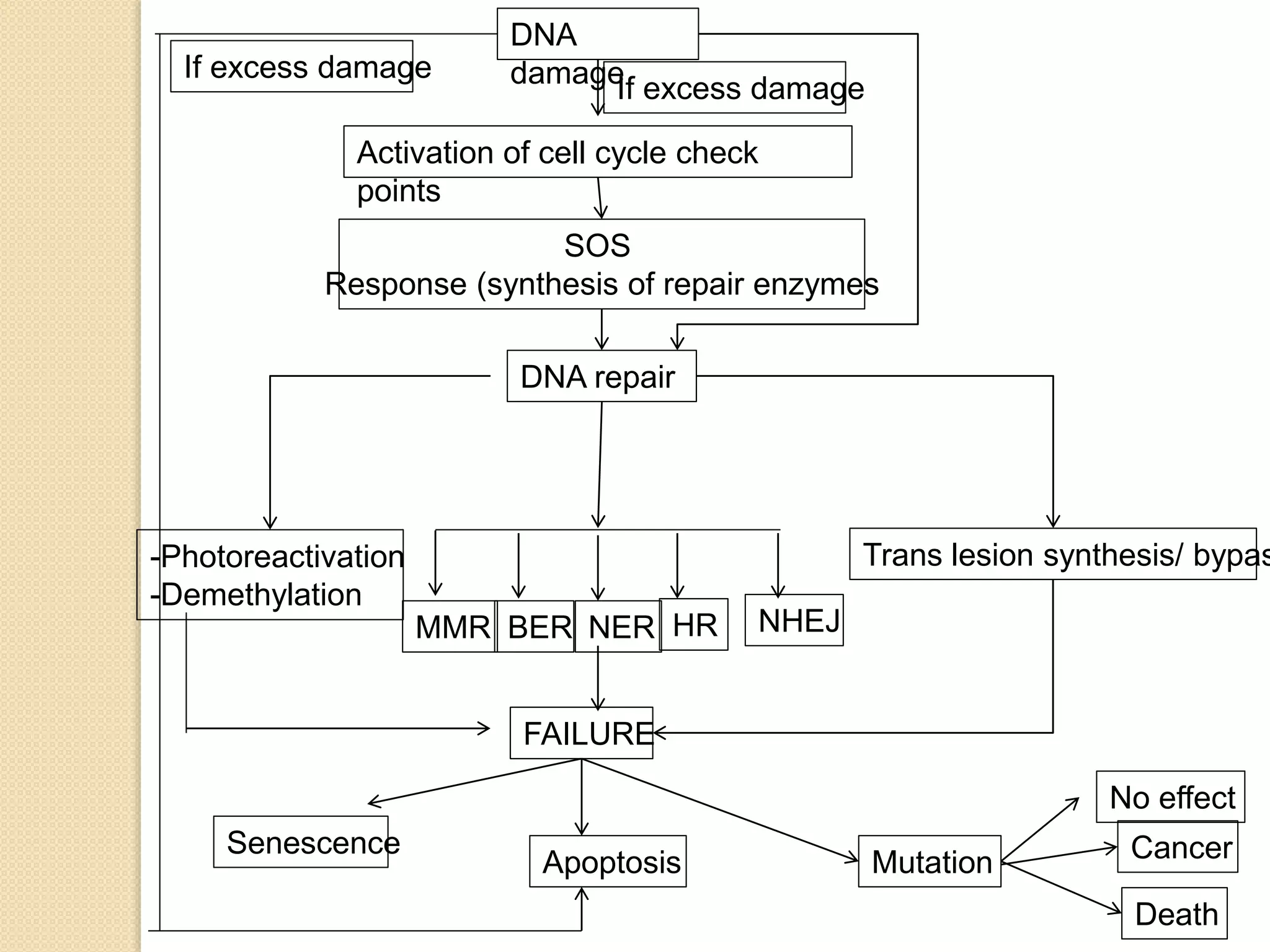
DNA
damage
Activation of cell cycle check
points
DNA repair
SOS
Response (synthesis of repair enzymes
Trans lesion synthesis/ bypas-Photoreactivation
-Demethylation
MMR BER NER HR NHEJ
FAILURE
Senescence
Apoptosis Mutation
If excess damage
If excess damage
No effect
Cancer
Death
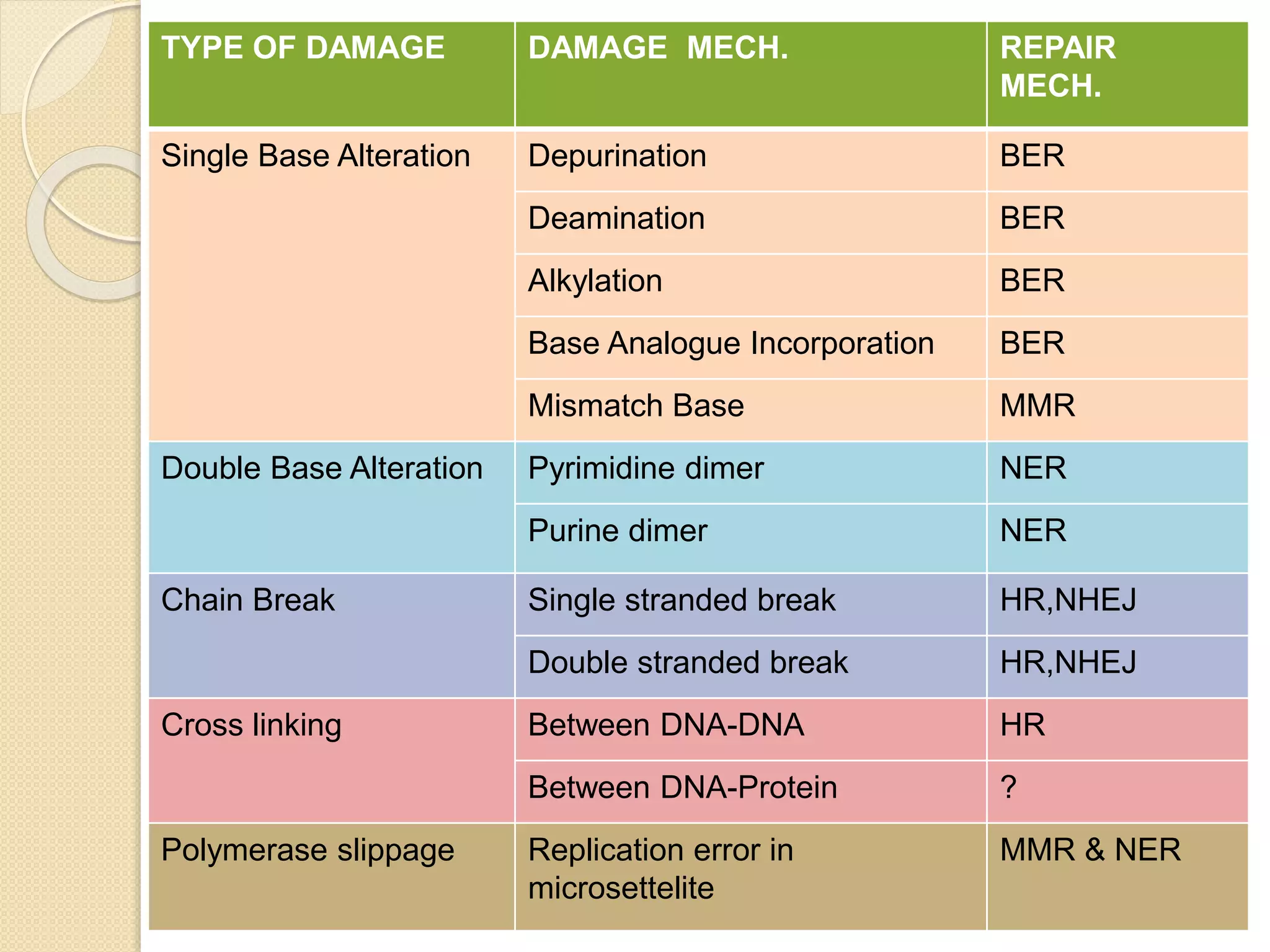
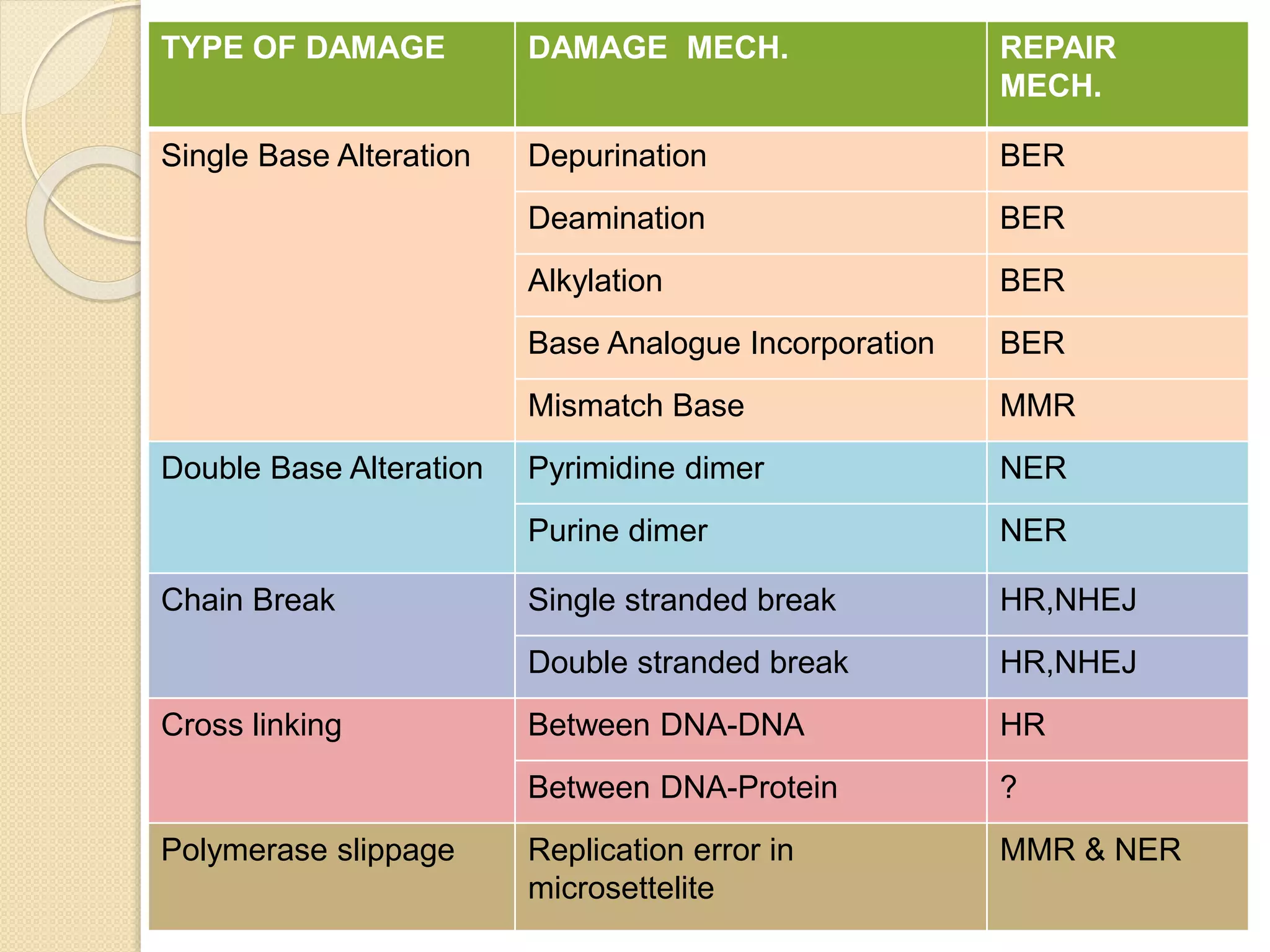
TYPE OF DAMAGE DAMAGE MECH. REPAIR
MECH.
Single Base Alteration Depurination BER
Deamination BER
Alkylation BER
Base Analogue Incorporation BER
Mismatch Base MMR
Double Base Alteration Pyrimidine dimer NER
Purine dimer NER
Chain Break Single stranded break HR,NHEJ
Double stranded break HR,NHEJ
Cross linking Between DNA-DNA HR
Between DNA-Protein ?
Polymerase slippage Replication error in
microsettelite
MMR & NER
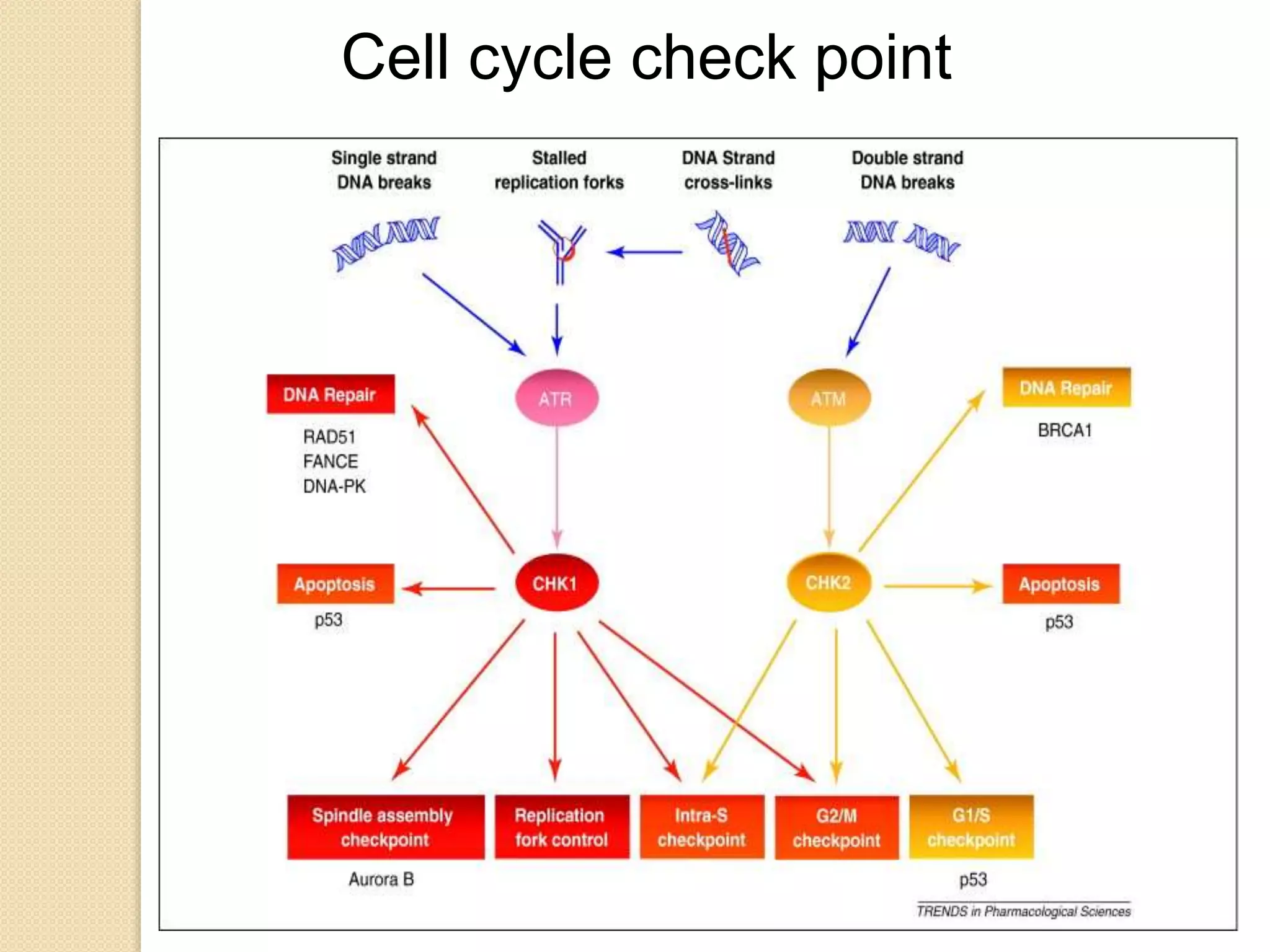
Cell cycle check point
DNA
damage
Activation of cell cycle check
points
DNA repair
SOS
Response (synthesis of repair enzymes
Trans lesion synthesis/ bypas-Photoreactivation
-Demethylation
MMR BER NER HR NHEJ
FAILURE
Senescence
Apoptosis Mutation
If excess damage
If excess damage
No effect
Cancer
Death
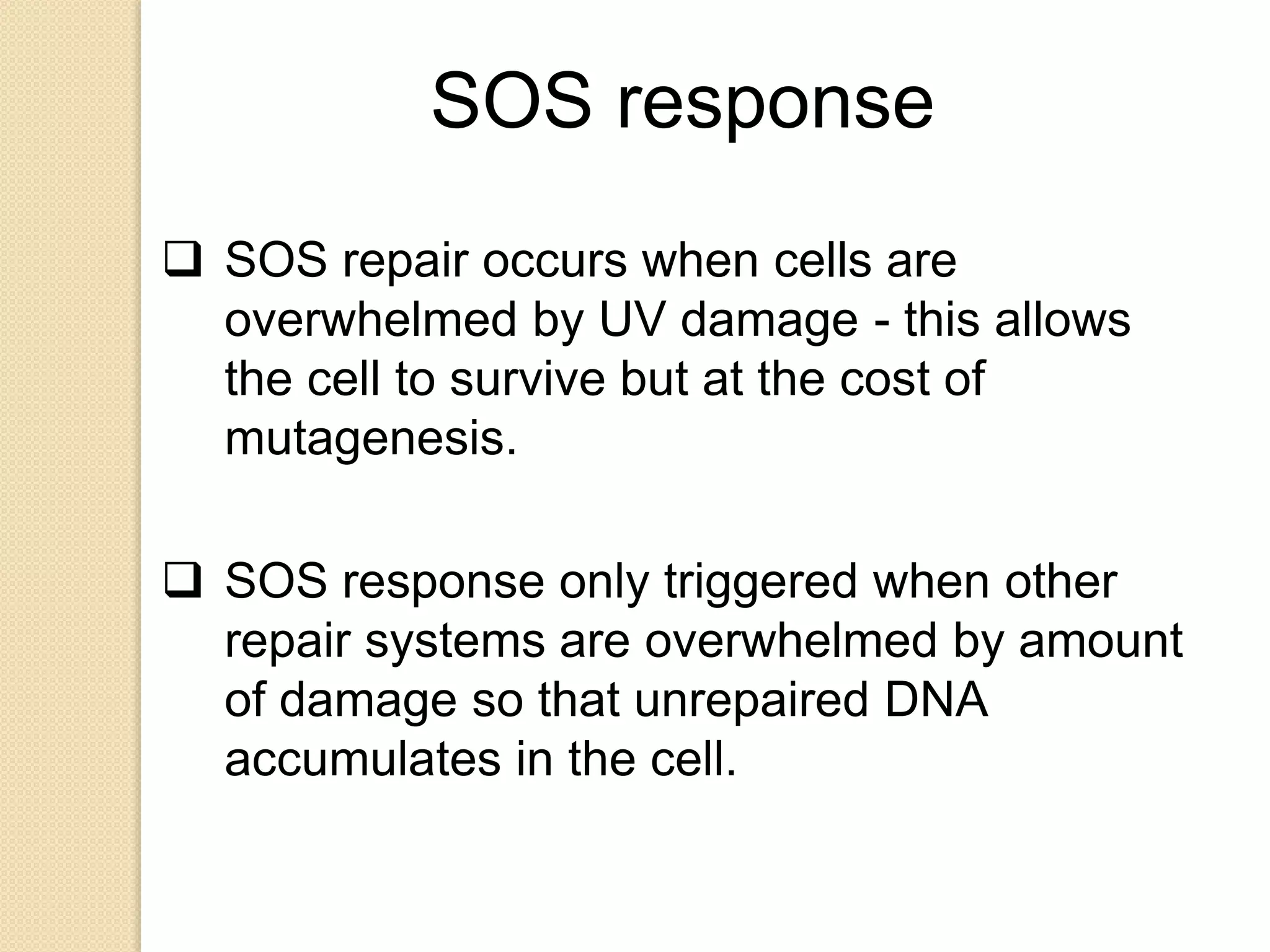
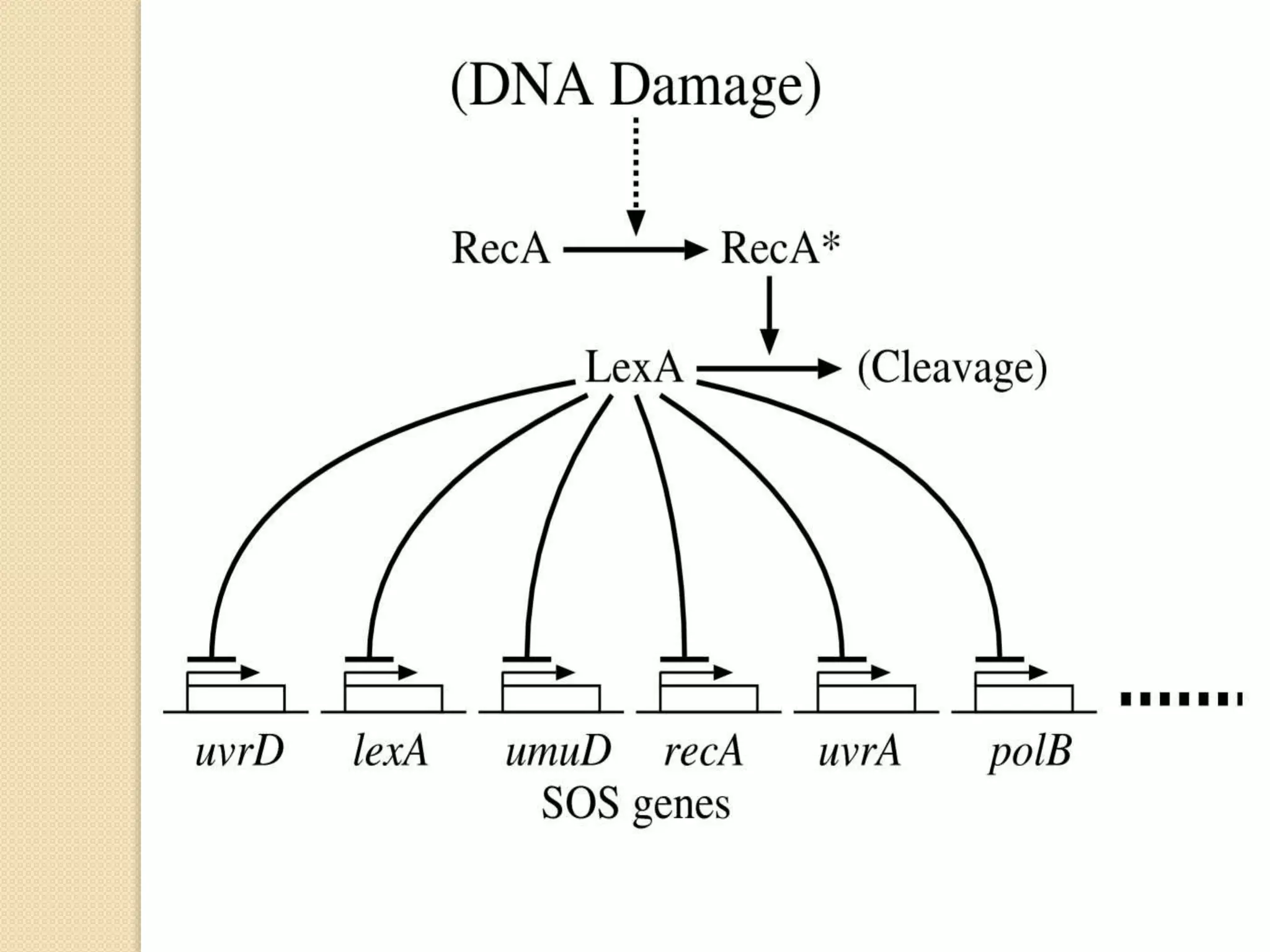
SOS response
 SOS repair occurs when cells are
overwhelmed by UV damage - this allows
the cell to survive but at the cost of
mutagenesis.
 SOS response only triggered when other
repair systems are overwhelmed by amount
of damage so that unrepaired DNA
accumulates in the cell.
DNA
damage
Activation of cell cycle check
points
DNA repair
SOS
Response (synthesis of repair enzymes
Trans lesion synthesis/ bypas-Photoreactivation
-Demethylation
MMR BER NER HR NHEJ
FAILURE
Senescence
Apoptosis Mutation
If excess damage
If excess damage
No effect
Cancer
Death
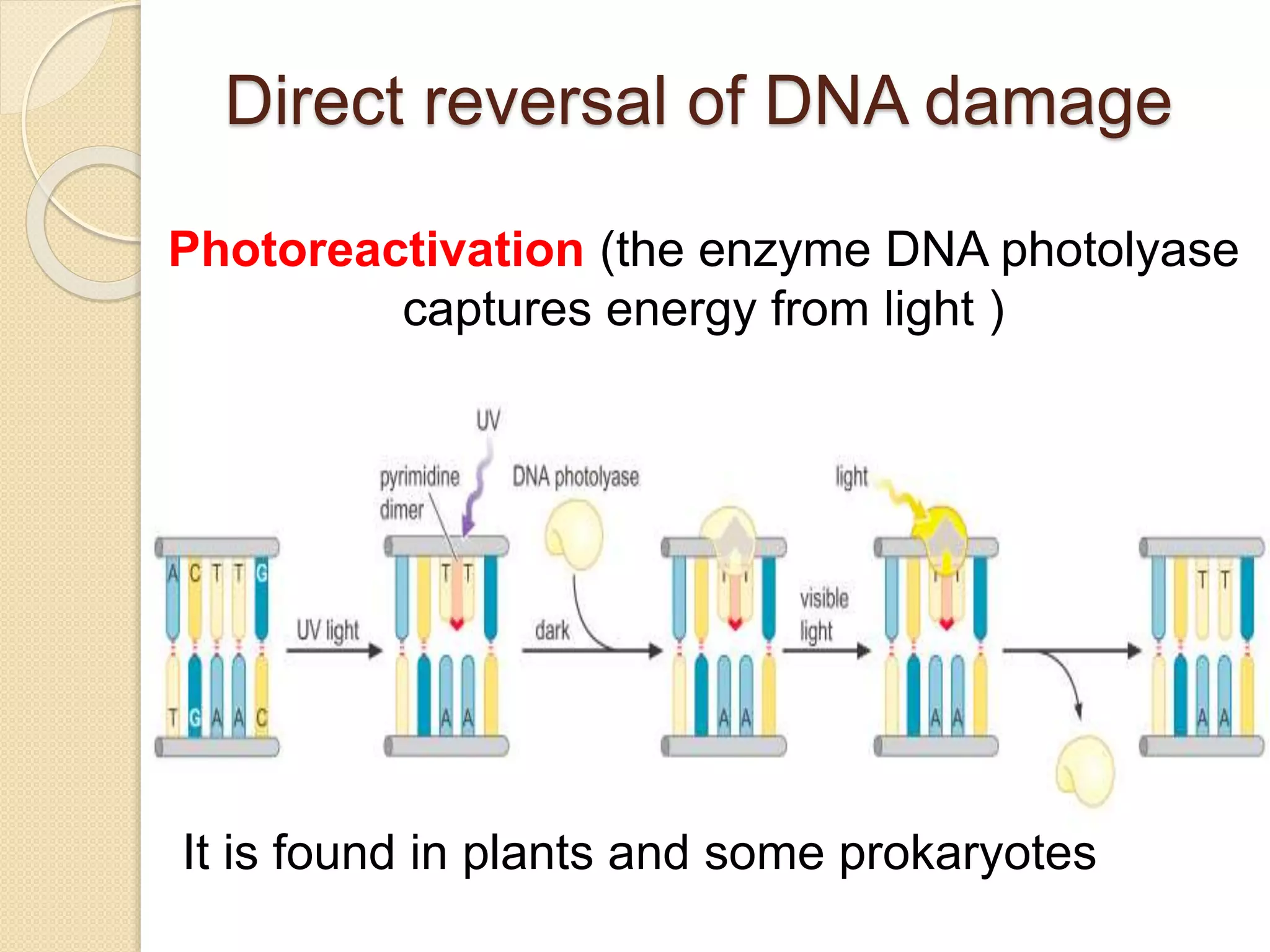
Direct reversal of DNA damage
Photoreactivation (the enzyme DNA photolyase
captures energy from light )
It is found in plants and some prokaryotes
Methylation of DNA by alkylating agents
Direct Repair: Reversal of O6 methyl G to G by
methyltransferase
DNA
damage
Activation of cell cycle check
points
DNA repair
SOS
Response (synthesis of repair enzymes
Trans lesion synthesis/ bypas-Photoreactivation
-Demethylation
MMR BER NER HR NHEJ
FAILURE
Senescence
Apoptosis Mutation
If excess damage
If excess damage
No effect
Cancer
Death
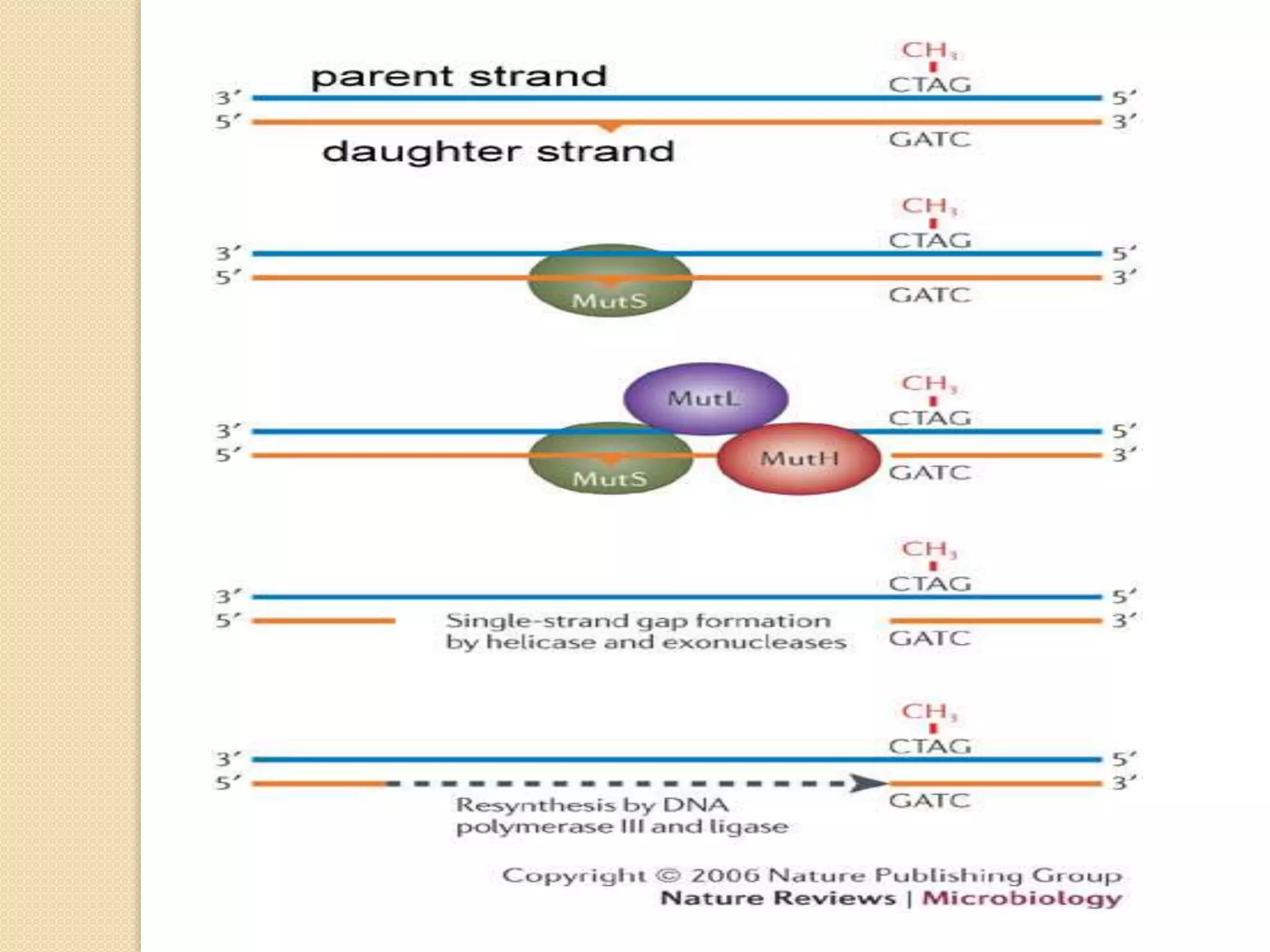
Mismatch repair(MMR)
• MMR system is an excision/resynthesis system that
can be divided into 4 phases:
• (i) recognition of a mismatch by MutS proteins
• (ii) recruitment of repair enzymes
• (iii) excision of the incorrect sequence,
• (iv) resynthesis by DNA polymerase using the
parental strand as a template.
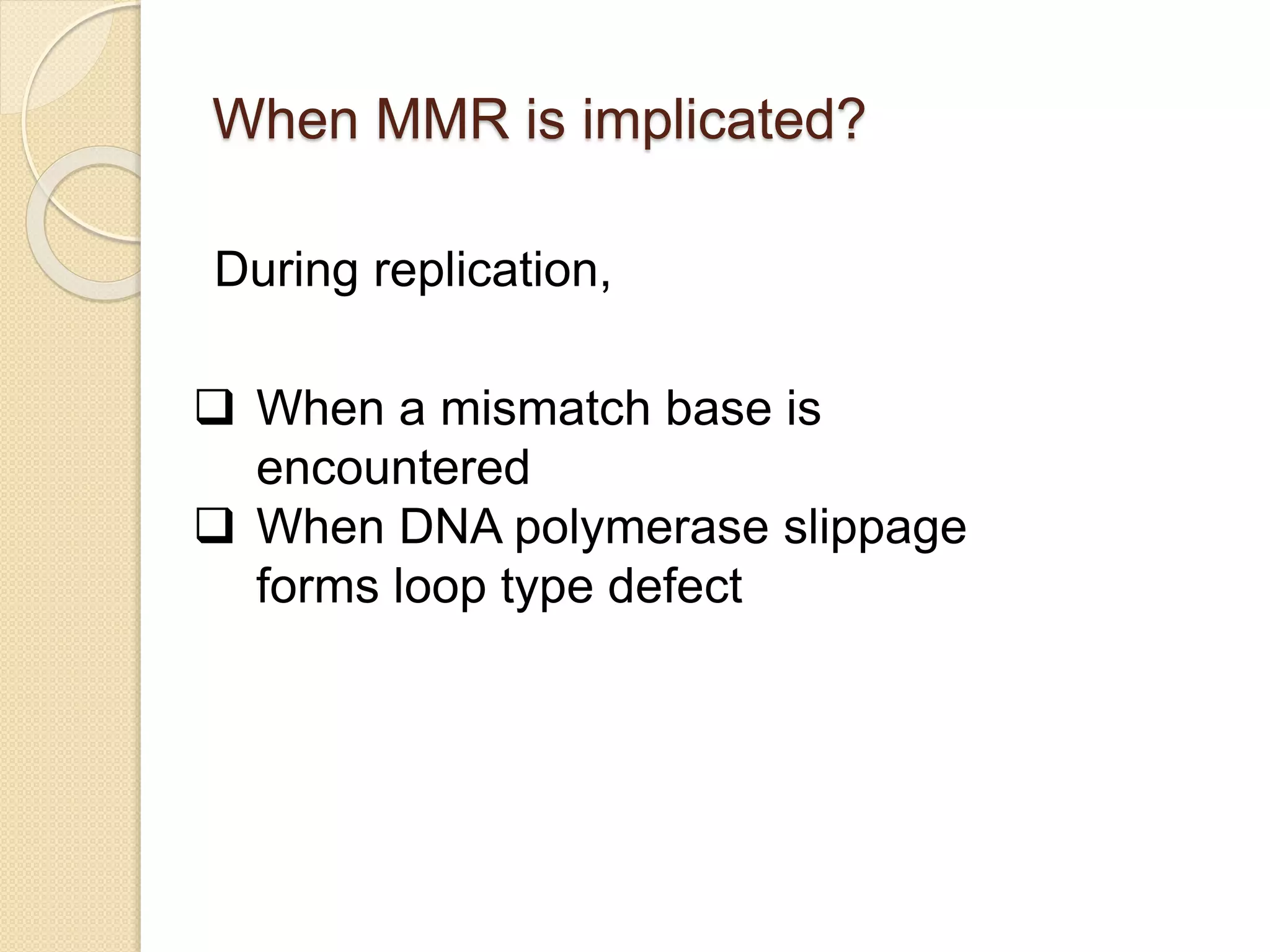
When MMR is implicated?
 When a mismatch base is
encountered
 When DNA polymerase slippage
forms loop type defect
During replication,
In prokaryotes like E.coli…
Mut proteins
Mut S Mut L Mut H
Scans DNA and
recognize the
mismatch base
on daughter strand
-Links Mut S and Mut H
-Activates Mut H
-Binds the complex to
hemi methylated GATC
sequence
-Helicase activity
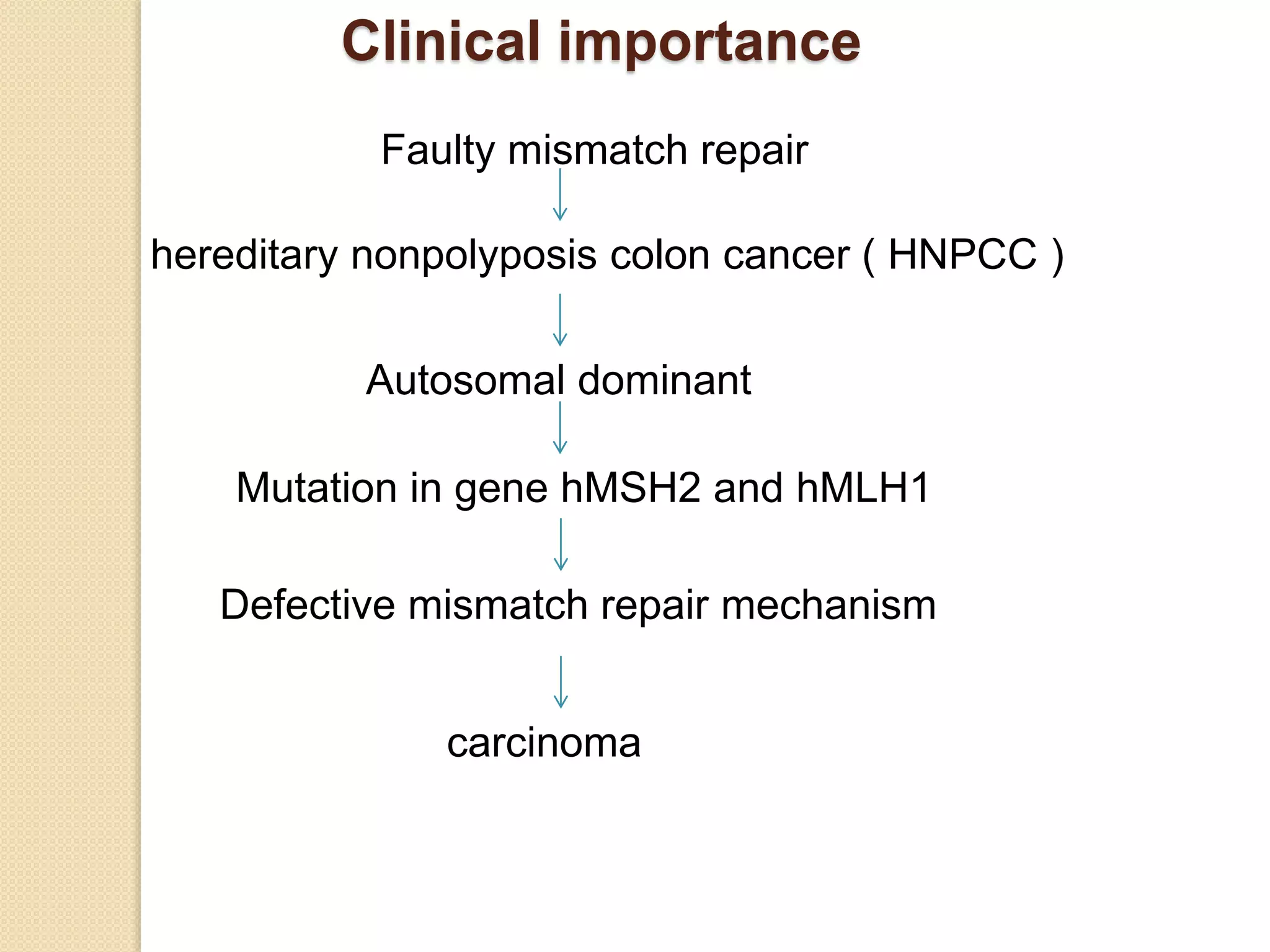
Clinical importance
hereditary nonpolyposis colon cancer ( HNPCC )
Faulty mismatch repair
Mutation in gene hMSH2 and hMLH1
Defective mismatch repair mechanism
Autosomal dominant
carcinoma
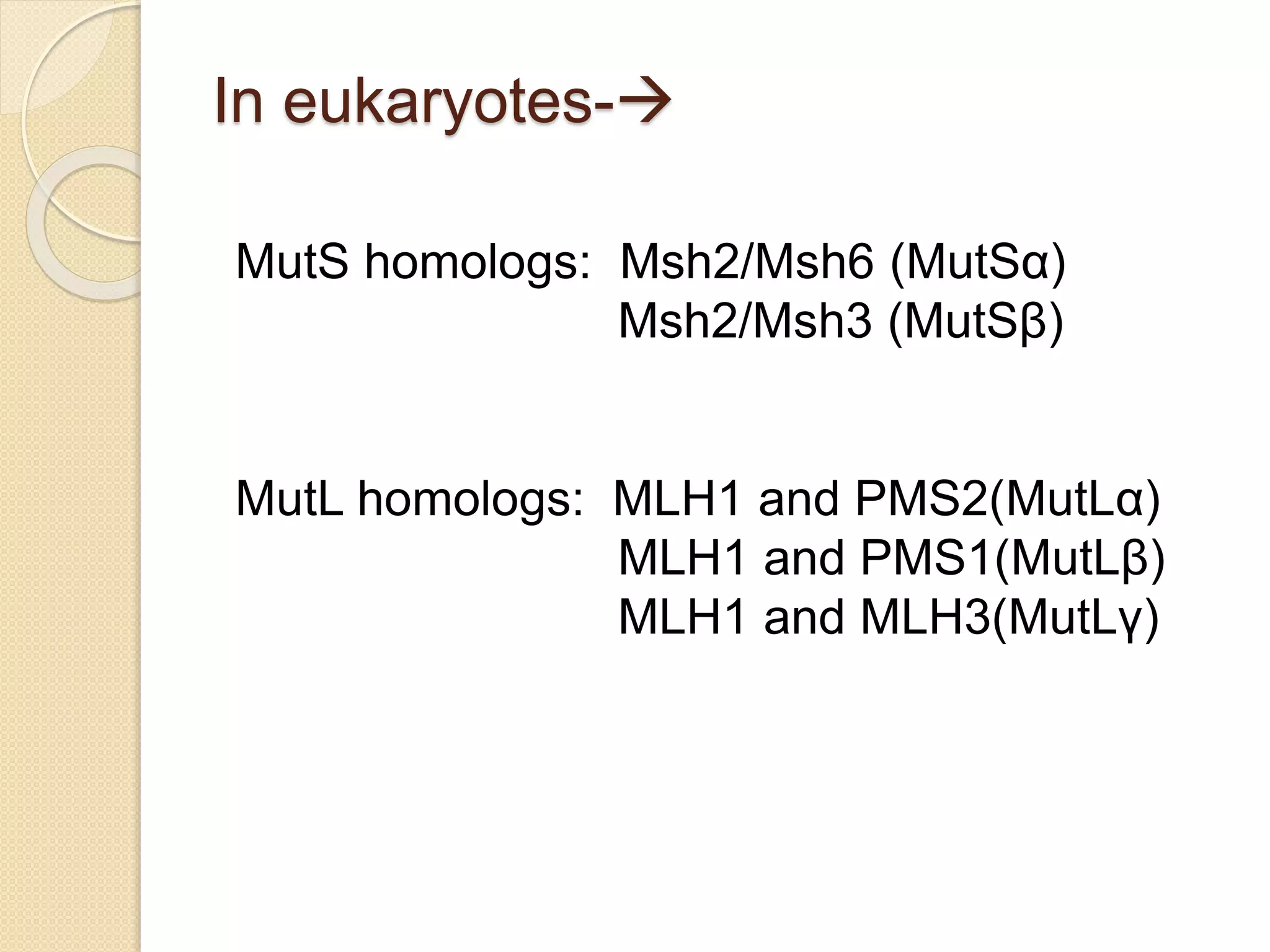
In eukaryotes-
MutS homologs: Msh2/Msh6 (MutSα)
Msh2/Msh3 (MutSβ)
MutL homologs: MLH1 and PMS2(MutLα)
MLH1 and PMS1(MutLβ)
MLH1 and MLH3(MutLγ)
TYPE OF DAMAGE DAMAGE MECH. REPAIR
MECH.
Single Base Alteration Depurination BER
Deamination BER
Alkylation BER
Base Analogue Incorporation BER
Mismatch Base MMR
Double Base Alteration Pyrimidine dimer NER
Purine dimer NER
Chain Break Single stranded break HR,NHEJ
Double stranded break HR,NHEJ
Cross linking Between DNA-DNA HR
Between DNA-Protein ?
Polymerase slippage Replication error in
microsettelite
MMR & NER
Microsatellite instability (MSI)
It is a condition manifested by damaged DNA due to
defects in the normal DNA repair process.
Microsatellites are repeated sequences of DNA
A dinucleotide repeat of CA, is most common
DNA polymerase slips out from these sequences
while replication and forms loop
This is corrected by MMR and NER mechanism
Defect in MMR will result in increase or decrease length
Microsatellites
It will cause DNA mutation
TYPE OF DAMAGE DAMAGE MECH. REPAIR
MECH.
Single Base Alteration Depurination BER
Deamination BER
Alkylation BER
Base Analogue Incorporation BER
Mismatch Base MMR
Double Base Alteration Pyrimidine dimer NER
Purine dimer NER
Chain Break Single stranded break HR,NHEJ
Double stranded break HR,NHEJ
Cross linking Between DNA-DNA HR
Between DNA-Protein ?
Polymerase slippage Replication error in
microsettelite
MMR & NER
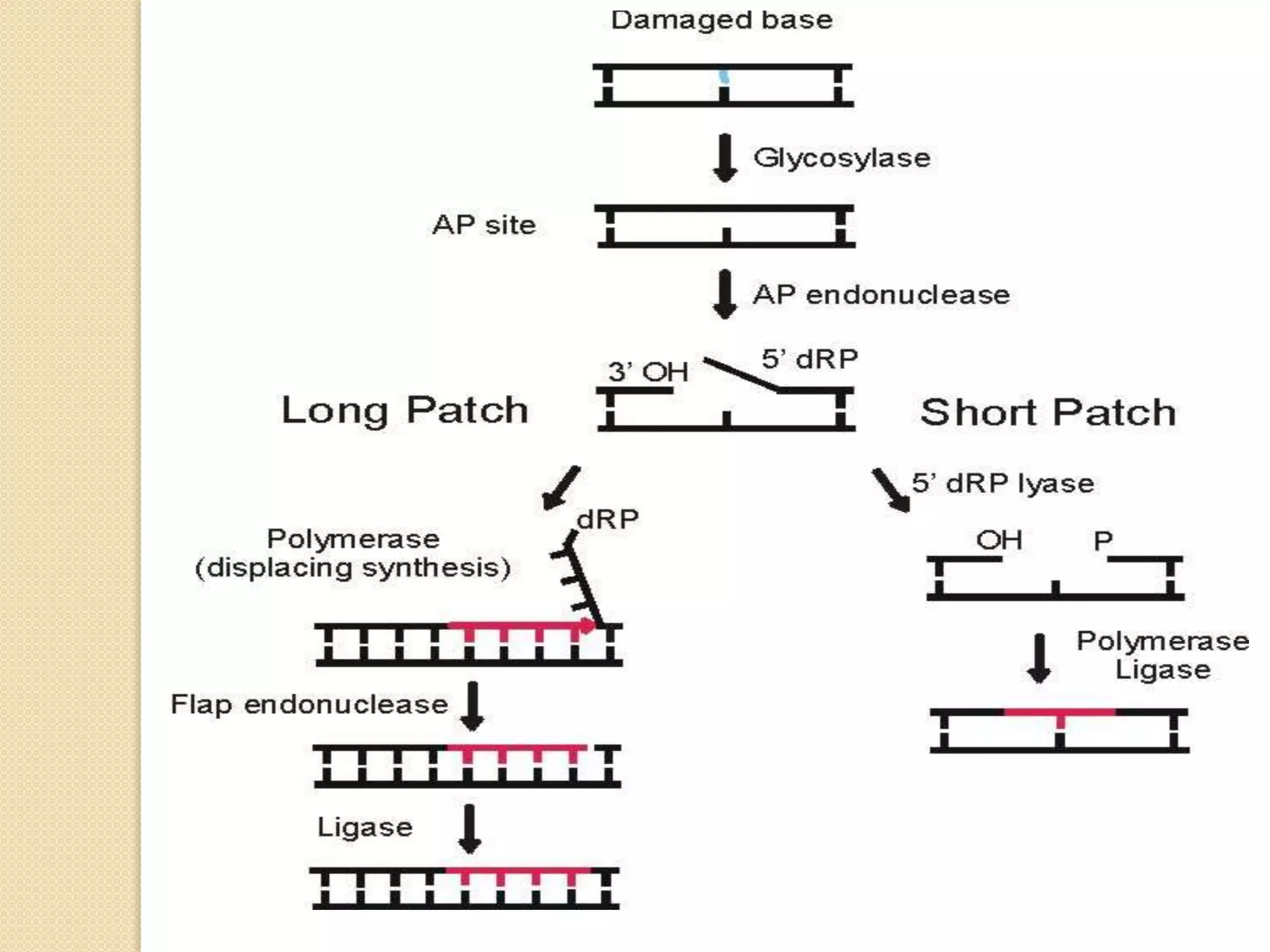
Base excision repair
 Variety of DNA glycosylases, for different types of
damaged bases.
 They scan the genome and flips out the wrong base
 AP endonuclease recognizes sites with a missing
base; cleaves sugar-phosphate backbone.
 (Deoxyribose phosphate lyase) removes the sugar-
phosphate lacking the base.
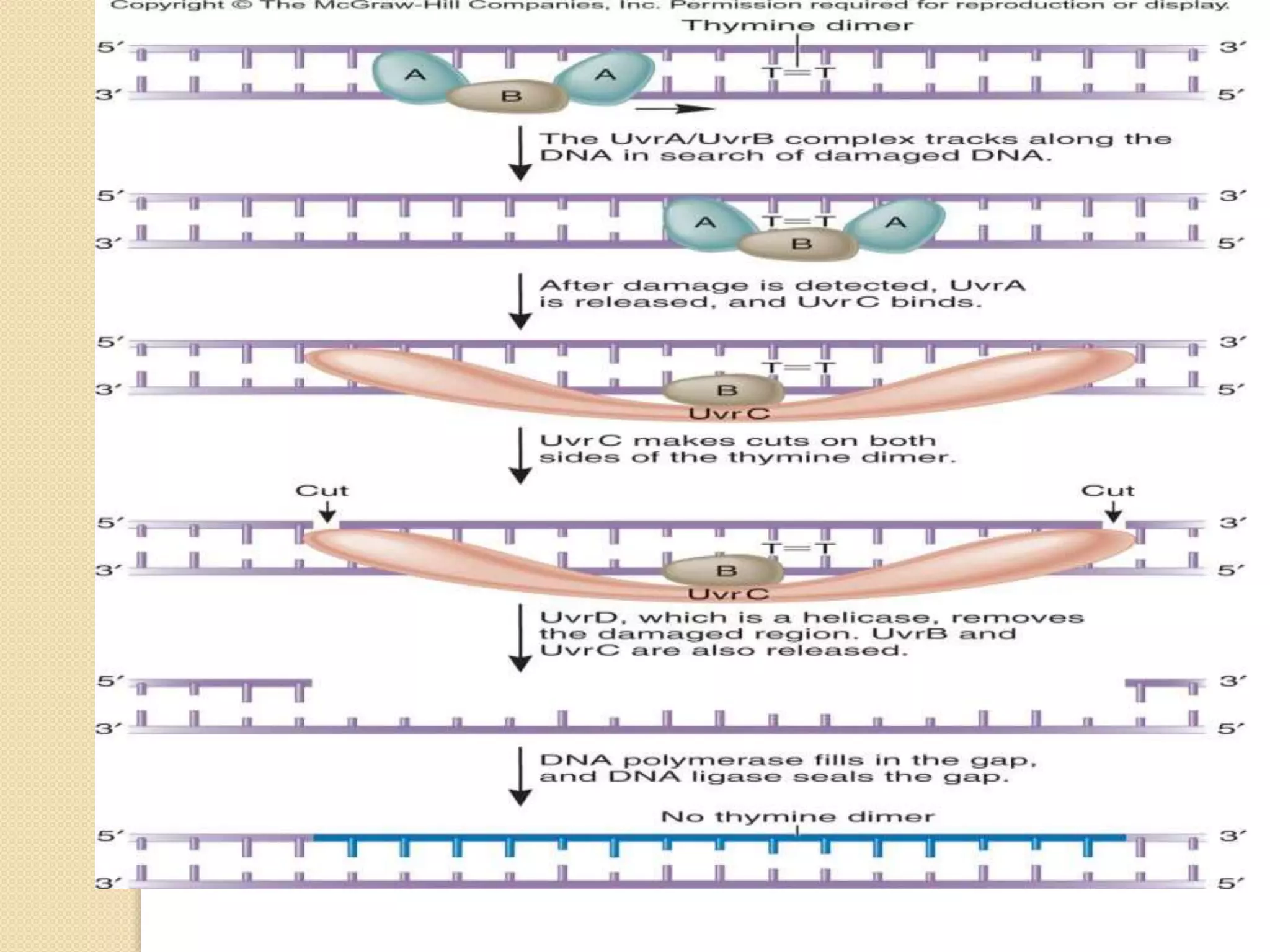
Nucleotide Excision Repair
Used for repair of DNA adducts
EXAMPLES: thymine-thymine dimers
Produced by chemical and UV radiation damage
Nucleotide Excision repair in E.coli
1.UvrA and UvrB scan DNA to identify a distortion
2. UvrA leaves the complex ,and UvrB melts DNA
locally around the distortion
3. UvrC forms a complex with UvrB and creates nicks
to the 5’ side of the lesion
4. DNA helicase UvrD releases the single stranded
fragment from the duplex, and DNA Pol I and ligase
repair and seal the gap
Nucleotide excision repair in eukaryotes
Two major pathways
Global genome repair Transcription coupled repair
Type of protein Function
DDB1 ,DDB2(XPE)
XPC
Recognize damage
XPG -- Stabilizes TFIIH
-- Endonuclease activity
XPD
(subunit of TFIIH)
Act as helicase
XPB
(subunit of TFIIH)
Act as ATPase
XPA Involved in damage
verification
XPF endonuclease
Clinical Importance
 Xeroderma pigmentosum is an autosomal recessive
genetic disease .
 The clinical syndrome include marked sensitivity to
sunlight ( UV rays ) with subsequent formation of
multiple skin cancers & premature death .
 The risk of developing skin cancer is increased 1000
to 2000 fold.
 Cells cultured from patients with xeroderma
pigmentosum exhibit low activity for the nucleotide
excision repair process
TYPE OF DAMAGE DAMAGE MECH. REPAIR
MECH.
Single Base Alteration Depurination BER
Deamination BER
Alkylation BER
Base Analogue Incorporation BER
Mismatch Base MMR
Double Base Alteration Pyrimidine dimer NER
Purine dimer NER
Chain Break Single stranded break HR,NHEJ
Double stranded break HR,NHEJ
Cross linking Between DNA-DNA HR
Between DNA-Protein ?
Polymerase slippage Replication error in
microsettelite
MMR & NER
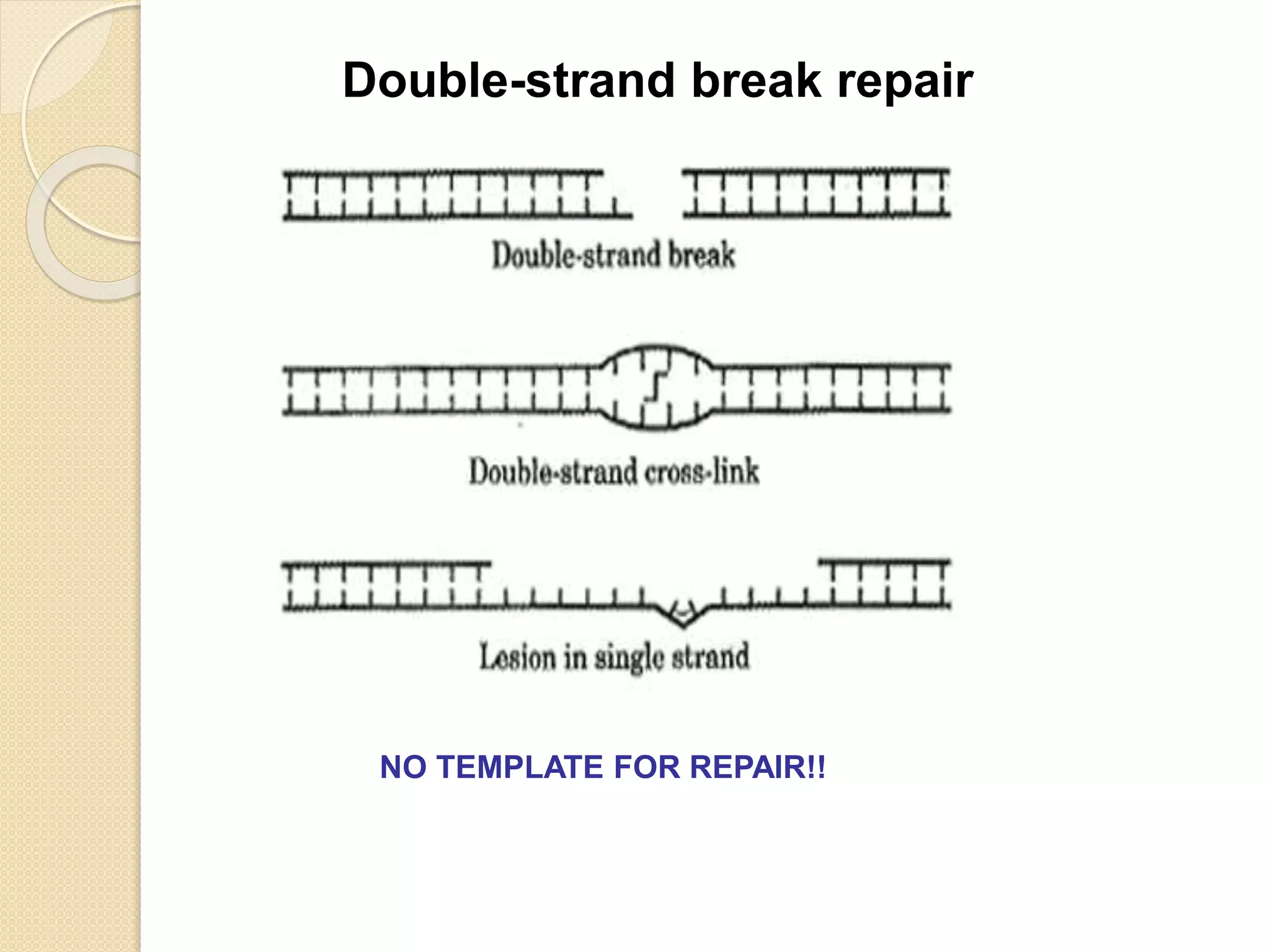
Double-strand break repair
NO TEMPLATE FOR REPAIR!!
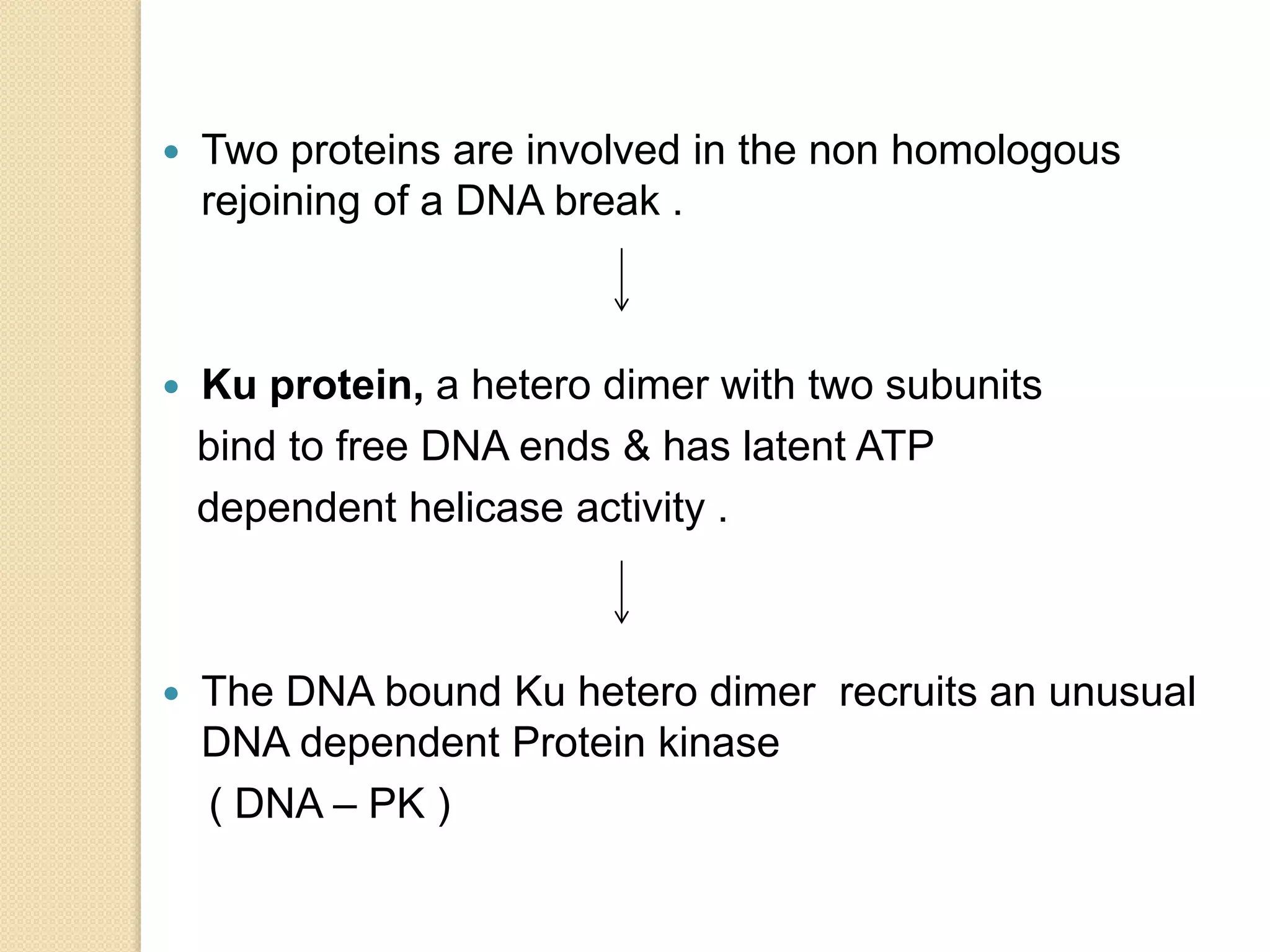
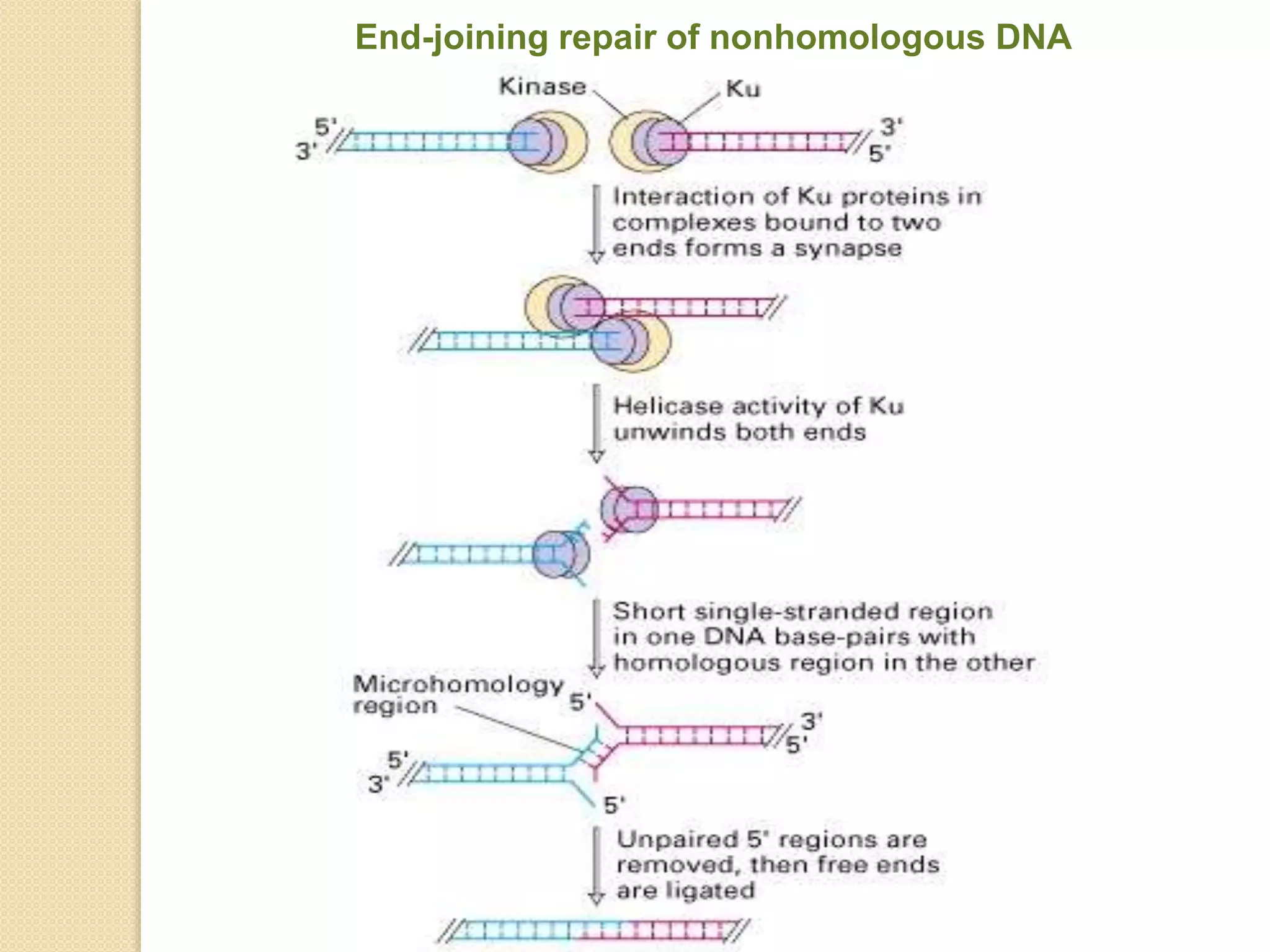
End-joining repair of nonhomologous DNA
 Two proteins are involved in the non homologous
rejoining of a DNA break .
 Ku protein, a hetero dimer with two subunits
bind to free DNA ends & has latent ATP
dependent helicase activity .
 The DNA bound Ku hetero dimer recruits an unusual
DNA dependent Protein kinase
( DNA – PK )
 DNA – PK has a binding site for DNA free ends
 It allows the approximation of the 2 separated ends .
 The free end DNA/Ku/DNA – PK complex activates the
kinase activity in the later.
 DNA – PK reciprocally phosphorylates Ku .
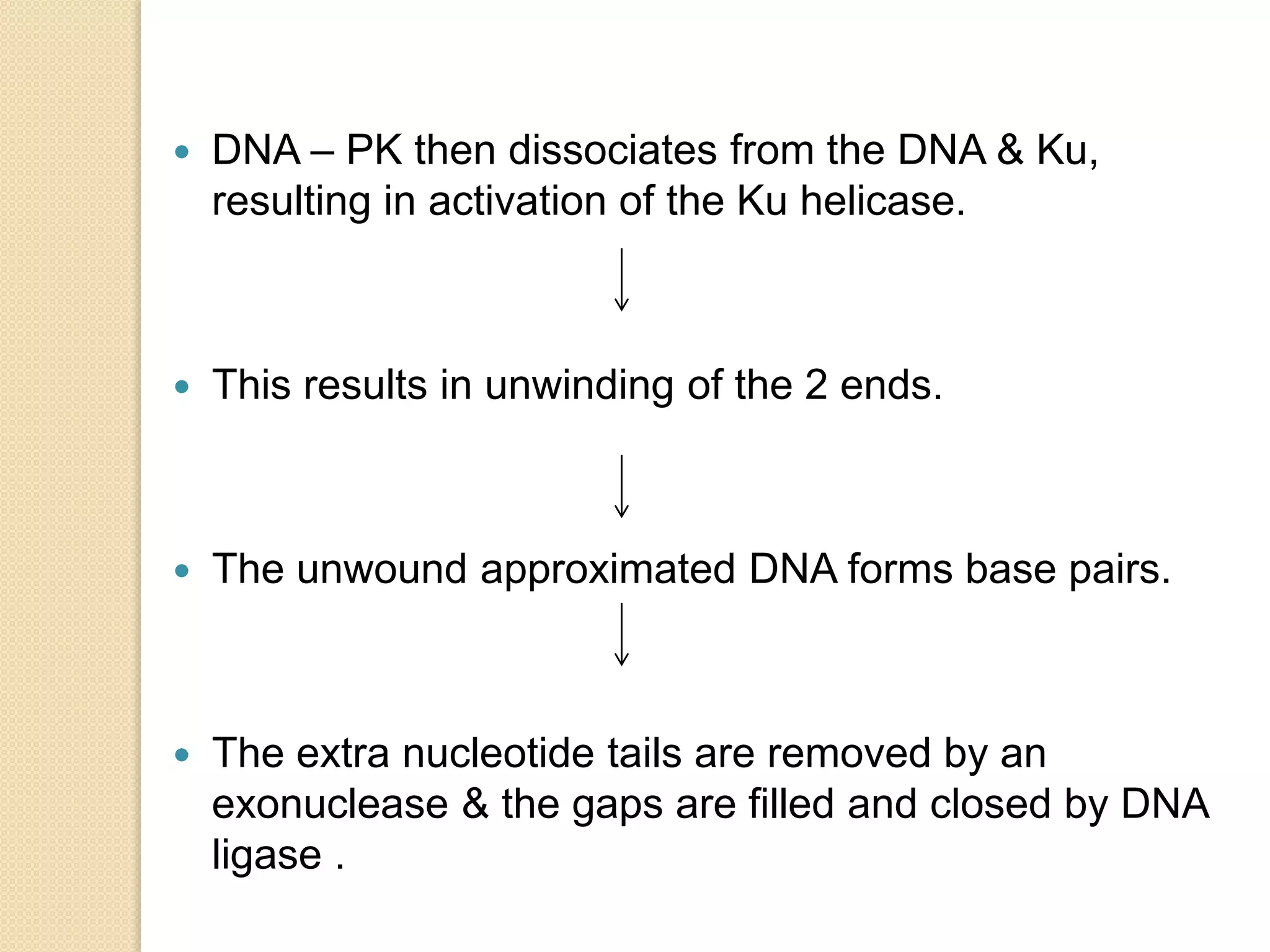
 DNA – PK then dissociates from the DNA & Ku,
resulting in activation of the Ku helicase.
 This results in unwinding of the 2 ends.
 The unwound approximated DNA forms base pairs.
 The extra nucleotide tails are removed by an
exonuclease & the gaps are filled and closed by DNA
ligase .
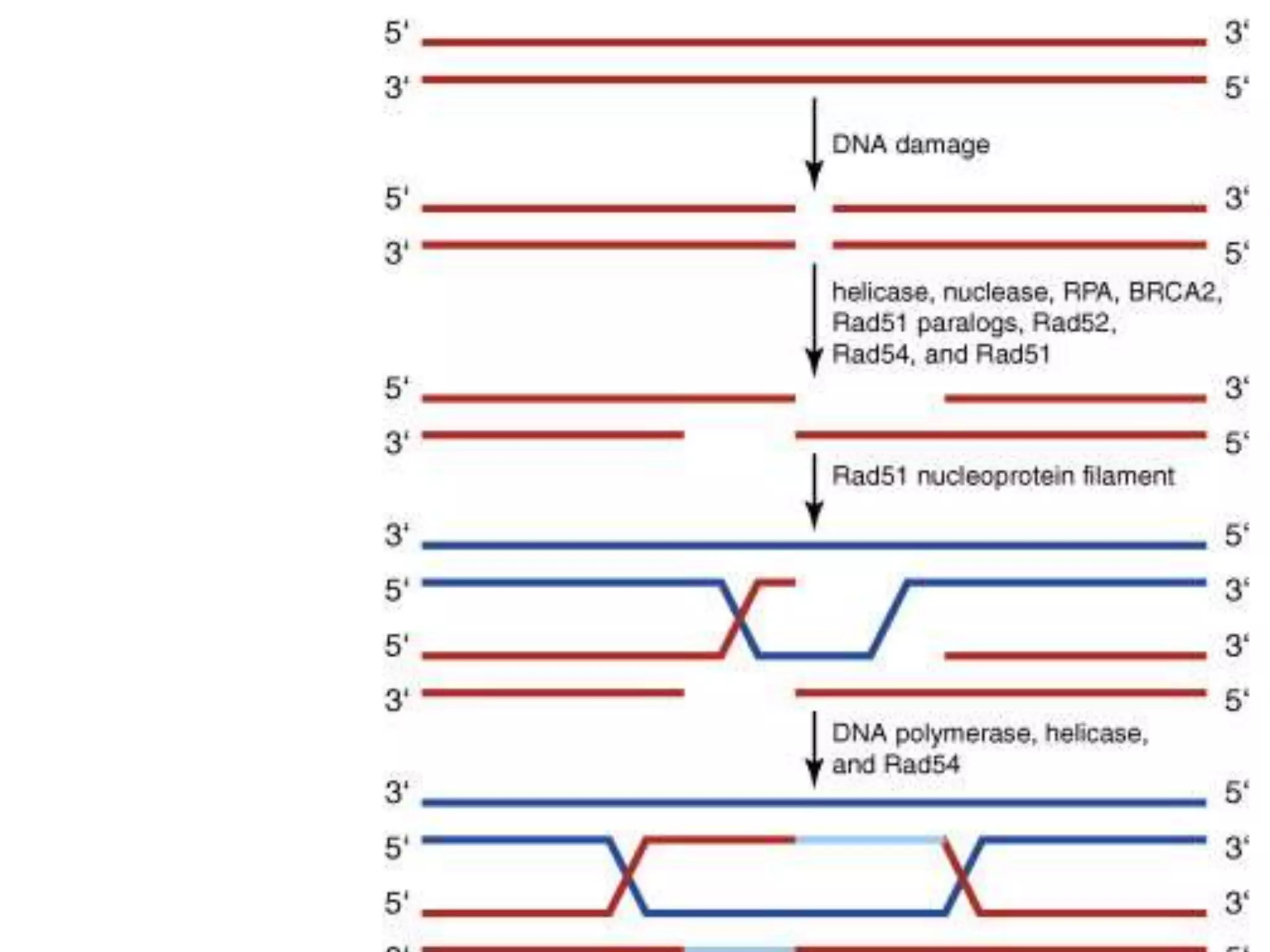
Homologous recombination
Double strand break
MRN complex binds to DNA on either side of the break
Various proteins will trim back 5’ ends
Production of 3’ overhangs on ssDNA
RPA will cover ssDNA & prevents its own winding
Rad 51 produce nucleoprotein on ss DNA
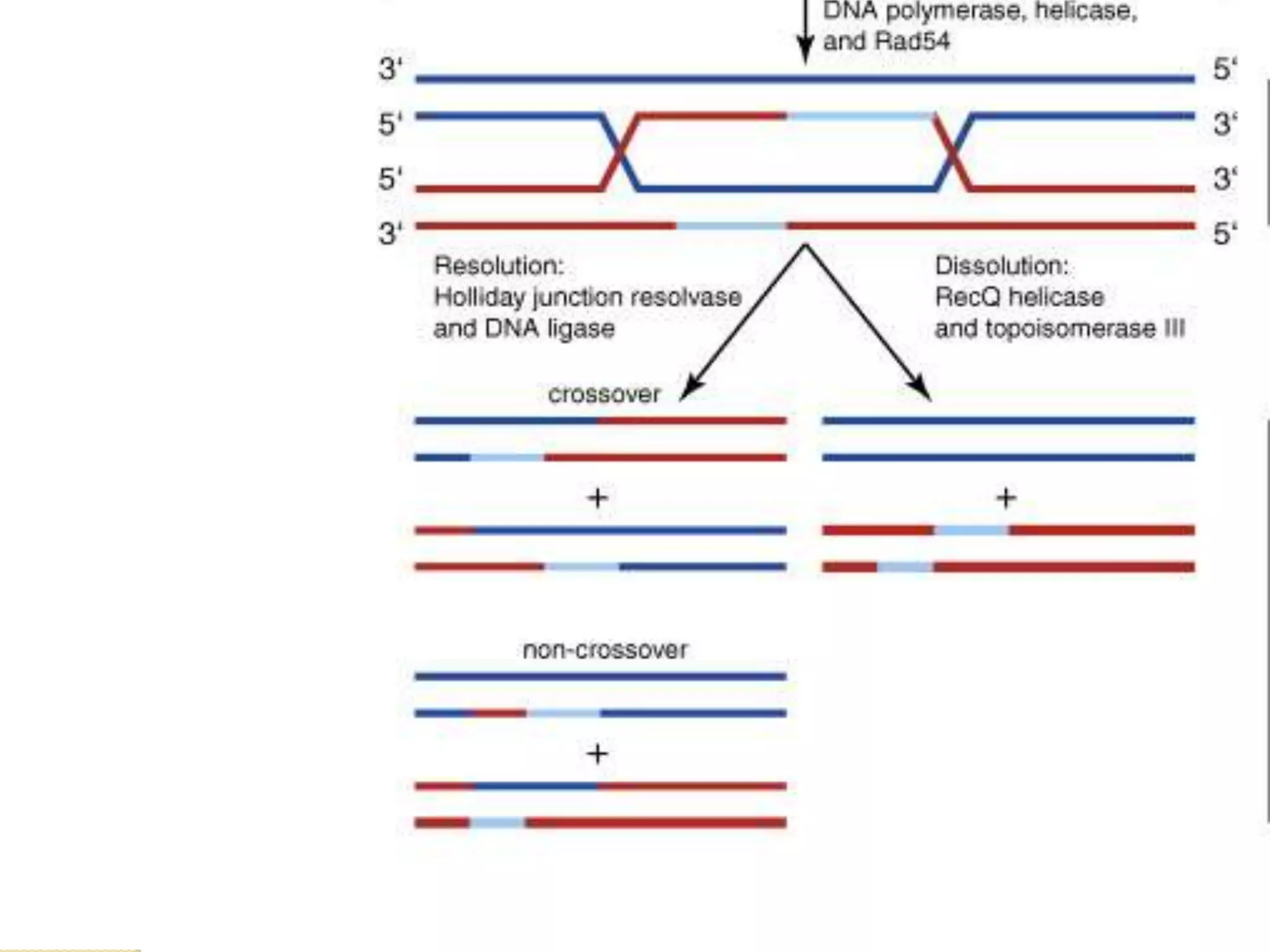
Strand invasion in identical duplex
D-loop formation between 3’ overhang and
homologous chromosome
DNA polymerase will extend it
Holiday junction formation
DSBR pathway SDSA pathway
Cross over product Non cross over product
DNA
damage
Activation of cell cycle check
points
DNA repair
SOS
Response (synthesis of repair enzymes
Trans lesion synthesis/ bypas-Photoreactivation
-Demethylation
MMR BER NER HR NHEJ
FAILURE
Senescence
Apoptosis Mutation
If excess damage
If excess damage
No effect
Cancer
Death
Trans lesion DNA synthesis
 Occurs when the above repairs are not
efficient enough
 Prevents cell from having un-replicated
chromosome at the cost of some point
mutation
 enables replication to proceed across
DNA damage
Dna repair
Dna repair

Dna repair

  • 1.
    DNA REPAIR Dr.Khushbu Soni 3rdYear Resident Dept. of Biochemistry
  • 2.
     DNA damage,if not repaired, may affect replication and transcription, leading to mutation or cell death  DNA repair is a collection of processes by which a cell identifies and corrects damage to the DNA molecules that encode its genome. What is DNA repair?
  • 3.
    Efficient DNA replication DNAreplication is highly efficient process Replication error rate is only 1 defect in 10 8 nucleotides DNA repair rate is 99% Unrepaired error rate is only 1 in 10 10 nucleotides Human genome=6.4x10 9 base pairs
  • 4.
    DNA damage Activation of cellcycle check points DNA repair SOS Response (synthesis of repair enzymes Trans lesion synthesis/ bypas-Photoreactivation -Demethylation MMR BER NER HR NHEJ FAILURE Senescence Apoptosis Mutation If excess damage If excess damage No effect Cancer Death
  • 5.
    TYPE OF DAMAGEDAMAGE MECH. REPAIR MECH. Single Base Alteration Depurination BER Deamination BER Alkylation BER Base Analogue Incorporation BER Mismatch Base MMR Double Base Alteration Pyrimidine dimer NER Purine dimer NER Chain Break Single stranded break HR,NHEJ Double stranded break HR,NHEJ Cross linking Between DNA-DNA HR Between DNA-Protein ? Polymerase slippage Replication error in microsettelite MMR & NER
  • 6.
  • 7.
    DNA damage Activation of cellcycle check points DNA repair SOS Response (synthesis of repair enzymes Trans lesion synthesis/ bypas-Photoreactivation -Demethylation MMR BER NER HR NHEJ FAILURE Senescence Apoptosis Mutation If excess damage If excess damage No effect Cancer Death
  • 8.
    SOS response  SOSrepair occurs when cells are overwhelmed by UV damage - this allows the cell to survive but at the cost of mutagenesis.  SOS response only triggered when other repair systems are overwhelmed by amount of damage so that unrepaired DNA accumulates in the cell.
  • 11.
    DNA damage Activation of cellcycle check points DNA repair SOS Response (synthesis of repair enzymes Trans lesion synthesis/ bypas-Photoreactivation -Demethylation MMR BER NER HR NHEJ FAILURE Senescence Apoptosis Mutation If excess damage If excess damage No effect Cancer Death
  • 12.
    Direct reversal ofDNA damage Photoreactivation (the enzyme DNA photolyase captures energy from light ) It is found in plants and some prokaryotes
  • 13.
    Methylation of DNAby alkylating agents
  • 14.
    Direct Repair: Reversalof O6 methyl G to G by methyltransferase
  • 15.
    DNA damage Activation of cellcycle check points DNA repair SOS Response (synthesis of repair enzymes Trans lesion synthesis/ bypas-Photoreactivation -Demethylation MMR BER NER HR NHEJ FAILURE Senescence Apoptosis Mutation If excess damage If excess damage No effect Cancer Death
  • 16.
    Mismatch repair(MMR) • MMRsystem is an excision/resynthesis system that can be divided into 4 phases: • (i) recognition of a mismatch by MutS proteins • (ii) recruitment of repair enzymes • (iii) excision of the incorrect sequence, • (iv) resynthesis by DNA polymerase using the parental strand as a template.
  • 17.
    When MMR isimplicated?  When a mismatch base is encountered  When DNA polymerase slippage forms loop type defect During replication,
  • 18.
    In prokaryotes likeE.coli… Mut proteins Mut S Mut L Mut H Scans DNA and recognize the mismatch base on daughter strand -Links Mut S and Mut H -Activates Mut H -Binds the complex to hemi methylated GATC sequence -Helicase activity
  • 20.
    Clinical importance hereditary nonpolyposiscolon cancer ( HNPCC ) Faulty mismatch repair Mutation in gene hMSH2 and hMLH1 Defective mismatch repair mechanism Autosomal dominant carcinoma
  • 22.
    In eukaryotes- MutS homologs:Msh2/Msh6 (MutSα) Msh2/Msh3 (MutSβ) MutL homologs: MLH1 and PMS2(MutLα) MLH1 and PMS1(MutLβ) MLH1 and MLH3(MutLγ)
  • 23.
    TYPE OF DAMAGEDAMAGE MECH. REPAIR MECH. Single Base Alteration Depurination BER Deamination BER Alkylation BER Base Analogue Incorporation BER Mismatch Base MMR Double Base Alteration Pyrimidine dimer NER Purine dimer NER Chain Break Single stranded break HR,NHEJ Double stranded break HR,NHEJ Cross linking Between DNA-DNA HR Between DNA-Protein ? Polymerase slippage Replication error in microsettelite MMR & NER
  • 24.
    Microsatellite instability (MSI) Itis a condition manifested by damaged DNA due to defects in the normal DNA repair process. Microsatellites are repeated sequences of DNA A dinucleotide repeat of CA, is most common DNA polymerase slips out from these sequences while replication and forms loop This is corrected by MMR and NER mechanism
  • 25.
    Defect in MMRwill result in increase or decrease length Microsatellites It will cause DNA mutation
  • 27.
    TYPE OF DAMAGEDAMAGE MECH. REPAIR MECH. Single Base Alteration Depurination BER Deamination BER Alkylation BER Base Analogue Incorporation BER Mismatch Base MMR Double Base Alteration Pyrimidine dimer NER Purine dimer NER Chain Break Single stranded break HR,NHEJ Double stranded break HR,NHEJ Cross linking Between DNA-DNA HR Between DNA-Protein ? Polymerase slippage Replication error in microsettelite MMR & NER
  • 28.
    Base excision repair Variety of DNA glycosylases, for different types of damaged bases.  They scan the genome and flips out the wrong base  AP endonuclease recognizes sites with a missing base; cleaves sugar-phosphate backbone.  (Deoxyribose phosphate lyase) removes the sugar- phosphate lacking the base.
  • 30.
    Nucleotide Excision Repair Usedfor repair of DNA adducts EXAMPLES: thymine-thymine dimers Produced by chemical and UV radiation damage
  • 31.
    Nucleotide Excision repairin E.coli 1.UvrA and UvrB scan DNA to identify a distortion 2. UvrA leaves the complex ,and UvrB melts DNA locally around the distortion 3. UvrC forms a complex with UvrB and creates nicks to the 5’ side of the lesion 4. DNA helicase UvrD releases the single stranded fragment from the duplex, and DNA Pol I and ligase repair and seal the gap
  • 33.
    Nucleotide excision repairin eukaryotes Two major pathways Global genome repair Transcription coupled repair
  • 34.
    Type of proteinFunction DDB1 ,DDB2(XPE) XPC Recognize damage XPG -- Stabilizes TFIIH -- Endonuclease activity XPD (subunit of TFIIH) Act as helicase XPB (subunit of TFIIH) Act as ATPase XPA Involved in damage verification XPF endonuclease
  • 36.
    Clinical Importance  Xerodermapigmentosum is an autosomal recessive genetic disease .  The clinical syndrome include marked sensitivity to sunlight ( UV rays ) with subsequent formation of multiple skin cancers & premature death .  The risk of developing skin cancer is increased 1000 to 2000 fold.  Cells cultured from patients with xeroderma pigmentosum exhibit low activity for the nucleotide excision repair process
  • 37.
    TYPE OF DAMAGEDAMAGE MECH. REPAIR MECH. Single Base Alteration Depurination BER Deamination BER Alkylation BER Base Analogue Incorporation BER Mismatch Base MMR Double Base Alteration Pyrimidine dimer NER Purine dimer NER Chain Break Single stranded break HR,NHEJ Double stranded break HR,NHEJ Cross linking Between DNA-DNA HR Between DNA-Protein ? Polymerase slippage Replication error in microsettelite MMR & NER
  • 38.
    Double-strand break repair NOTEMPLATE FOR REPAIR!!
  • 39.
    End-joining repair ofnonhomologous DNA
  • 40.
     Two proteinsare involved in the non homologous rejoining of a DNA break .  Ku protein, a hetero dimer with two subunits bind to free DNA ends & has latent ATP dependent helicase activity .  The DNA bound Ku hetero dimer recruits an unusual DNA dependent Protein kinase ( DNA – PK )
  • 41.
     DNA –PK has a binding site for DNA free ends  It allows the approximation of the 2 separated ends .  The free end DNA/Ku/DNA – PK complex activates the kinase activity in the later.  DNA – PK reciprocally phosphorylates Ku .
  • 42.
     DNA –PK then dissociates from the DNA & Ku, resulting in activation of the Ku helicase.  This results in unwinding of the 2 ends.  The unwound approximated DNA forms base pairs.  The extra nucleotide tails are removed by an exonuclease & the gaps are filled and closed by DNA ligase .
  • 43.
    Homologous recombination Double strandbreak MRN complex binds to DNA on either side of the break Various proteins will trim back 5’ ends Production of 3’ overhangs on ssDNA RPA will cover ssDNA & prevents its own winding Rad 51 produce nucleoprotein on ss DNA
  • 44.
    Strand invasion inidentical duplex D-loop formation between 3’ overhang and homologous chromosome DNA polymerase will extend it Holiday junction formation DSBR pathway SDSA pathway Cross over product Non cross over product
  • 48.
    DNA damage Activation of cellcycle check points DNA repair SOS Response (synthesis of repair enzymes Trans lesion synthesis/ bypas-Photoreactivation -Demethylation MMR BER NER HR NHEJ FAILURE Senescence Apoptosis Mutation If excess damage If excess damage No effect Cancer Death
  • 49.
    Trans lesion DNAsynthesis  Occurs when the above repairs are not efficient enough  Prevents cell from having un-replicated chromosome at the cost of some point mutation  enables replication to proceed across DNA damage