NON – CODING DNA
CHAITRALI .V. JADHAV
ROLL NO:- 07
PAPER - 4
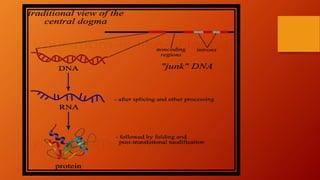
Noncoding DNA in Eukaryotes : Introduction
Each cell in our bodies has about 6 feet of DNA stuffed into it.
-However, less than one inch is devoted to genes!
 Non-coding DNA describes components of an organism’s DNA sequences
that do not encode for protein sequences.
 In many eukaryotes, a large % of an organism’s total genome size is non-
coding DNA.
 Amount of non-coding DNA & the proportion of coding versus non-coding
DNA varies greatly between species.
 Much of this DNA has no known biological function & was referred to as
“Junk DNA”.
Utricularia Gibba has 3% of non-coding DNA,
which is low for flowering plants.
Types of non- coding DNA sequences
 Non- coding functional RNA
 Cis- and Trans- regulatory elements
 Introns
 Pseudogenes
 Repeat sequences, transposons and viral elements
 Telomeres
1.Non- coding Functional RNA
The RNA molecules which are not translated into
proteins.
 For eg:- Ribosomal RNA, Transfer RNA & Micro
RNA
2.Cis- and Trans- Regulatory Elements
 Those are sequences that control the transcription
of a nearby gene.
 Located within 5’ or 3’ untranslated regions or
within introns.
 trans-regulatory element control the transcription
of a distant gene.
3. Introns
 They are non-coding sections of a gene.
 Transcribed in the precursor m-RNA sequence
but is ultimately removed by RNA splicing.
 Most of the introns appear to be mobile genetic
elements.
4. Pseudogenes
 They are related to known genes, that have lost their
protein-coding ability or are otherwise no longer expressed
in the cell.
 Arise from retrotransposition or genomic duplication of
functional genes.
 Therefore become “Genomic Fossils” : non-functional.
5.Repeat Sequences, Transposons & Viral Elements
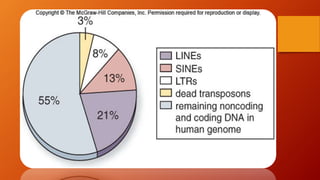
 Transposons & Retrotransposons are mobile genetic element.
 Retrotransposons : LINEs, SINEs – account for large proportion of the genomic
sequences in many species.
 Over 8% of the human genome is made up of endogenous retrovirus
sequences as a part of over 42% fraction that is recognizably derived of
retrotransposons.
 Remaining 3% can be identified to be the remains of DNA transposons.
6. Telomeres
 Telomeres are regions of repetitive DNA.
 Located at the end of a chromosome.
 They provide protection from chromosomal
deterioration during DNA replication.
FUNCTIONS OF NON-CODING DNA
They have strong biological functions : some regions that are highly conserved are
under evolutionary pressure & positive selection.
 Some specific sequences of non-coding DNA are essential for chromosome
structure, centromere function & homolog recognition in meiosis.
 From study over 300 prokaryotic & 30 eukaryotic genomes, eukaryotes appear to
require less amount of non-coding DNA.
 Apart from this : 1. protection of the genome 6. Enhancers
2. Genetic switches 7. Silencers
3. Regulation of gene expression 8. Promoters
4. Transcription factor sites 9. Insulators
5. Operators
USES OF NON-CODING GENE
 Non-coding DNA evolution
 Long range Correlations
 Foreinsic anthropology
REFERENCES
 www.Wikipedia.org
 www.google.com
 www.Princeton.edu
 T. A. Brown
Non – coding dna presentation

Non – coding dna presentation

  • 1.
    NON – CODINGDNA CHAITRALI .V. JADHAV ROLL NO:- 07 PAPER - 4
  • 2.
    Noncoding DNA inEukaryotes : Introduction Each cell in our bodies has about 6 feet of DNA stuffed into it. -However, less than one inch is devoted to genes!  Non-coding DNA describes components of an organism’s DNA sequences that do not encode for protein sequences.  In many eukaryotes, a large % of an organism’s total genome size is non- coding DNA.  Amount of non-coding DNA & the proportion of coding versus non-coding DNA varies greatly between species.  Much of this DNA has no known biological function & was referred to as “Junk DNA”.
  • 4.
    Utricularia Gibba has3% of non-coding DNA, which is low for flowering plants.
  • 5.
    Types of non-coding DNA sequences  Non- coding functional RNA  Cis- and Trans- regulatory elements  Introns  Pseudogenes  Repeat sequences, transposons and viral elements  Telomeres
  • 6.
    1.Non- coding FunctionalRNA The RNA molecules which are not translated into proteins.  For eg:- Ribosomal RNA, Transfer RNA & Micro RNA
  • 7.
    2.Cis- and Trans-Regulatory Elements  Those are sequences that control the transcription of a nearby gene.  Located within 5’ or 3’ untranslated regions or within introns.  trans-regulatory element control the transcription of a distant gene.
  • 8.
    3. Introns  Theyare non-coding sections of a gene.  Transcribed in the precursor m-RNA sequence but is ultimately removed by RNA splicing.  Most of the introns appear to be mobile genetic elements.
  • 9.
    4. Pseudogenes  Theyare related to known genes, that have lost their protein-coding ability or are otherwise no longer expressed in the cell.  Arise from retrotransposition or genomic duplication of functional genes.  Therefore become “Genomic Fossils” : non-functional.
  • 10.
    5.Repeat Sequences, Transposons& Viral Elements  Transposons & Retrotransposons are mobile genetic element.  Retrotransposons : LINEs, SINEs – account for large proportion of the genomic sequences in many species.  Over 8% of the human genome is made up of endogenous retrovirus sequences as a part of over 42% fraction that is recognizably derived of retrotransposons.  Remaining 3% can be identified to be the remains of DNA transposons.
  • 12.
    6. Telomeres  Telomeresare regions of repetitive DNA.  Located at the end of a chromosome.  They provide protection from chromosomal deterioration during DNA replication.
  • 14.
    FUNCTIONS OF NON-CODINGDNA They have strong biological functions : some regions that are highly conserved are under evolutionary pressure & positive selection.  Some specific sequences of non-coding DNA are essential for chromosome structure, centromere function & homolog recognition in meiosis.  From study over 300 prokaryotic & 30 eukaryotic genomes, eukaryotes appear to require less amount of non-coding DNA.  Apart from this : 1. protection of the genome 6. Enhancers 2. Genetic switches 7. Silencers 3. Regulation of gene expression 8. Promoters 4. Transcription factor sites 9. Insulators 5. Operators
  • 15.
    USES OF NON-CODINGGENE  Non-coding DNA evolution  Long range Correlations  Foreinsic anthropology
  • 16.