JIWAJI UNIVERSITY,GWALIOR
1
TOPIC-DNA damage and repair mechanism
NAME –MANISHA SINGHAI
M.Sc. 3rd SEM
Contents
 INTRODUCTION
 SOURCES OF DNA DAMAGE
 TYPES OF DNA DAMAGE
 DNA REPAIR
 TYPES OF DNA REPAIR
 REFERENCE
2
Introduction
 DNA damage is an alteration in the chemical structure of DNA,such as break in a strand
of DNA,a base missing from the backbone of DNA.
 DNA damage can occur naturally or via environmental factors.
 A DNA damage causes changes in the structure of genetic material and prevents the
replication mechanism from functioning and performing properly.
3
Sources of DNA damage
 Sources of DNA damage are of two types-
1. Endogenous damage
2. Exogenous damage
 Endogenous damages-1.by reactive oxygen speices.
2.by natural metabolic byproducts.
3.hydrolysis of nucleotide bases.
4.replication error
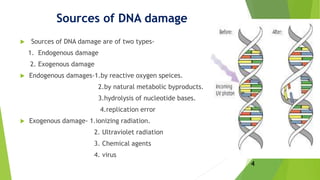
 Exogenous damage- 1.ionizing radiation.
2. Ultraviolet radiation
3. Chemical agents
4. virus
4
Types of DNA damage
 Single base alteration-1. depurination
2. deamination
3. alkylation
 Double base alteration- 1.pyrimidine dimer
2. purine dimer
 Chain breaks –1.single strand break
2. double strand break
 Cross linkage-1. between DNA-DNA molecule
2. DNA-protein molecule
5
SINGLE BASE ALTERATION
1.Depurination-hydrolytic cleavage of N glycosidic bond of purine nucleotide ( A and
G)
 Loss of purine bases from the DNA.
 It forms apurinic site.
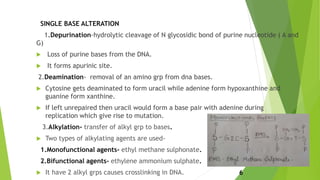
2.Deamination- removal of an amino grp from dna bases.
 Cytosine gets deaminated to form uracil while adenine form hypoxanthine and
guanine form xanthine.
 If left unrepaired then uracil would form a base pair with adenine during
replication which give rise to mutation.
3.Alkylation- transfer of alkyl grp to bases.
 Two types of alkylating agents are used-
1.Monofunctional agents- ethyl methane sulphonate.
2.Bifunctional agents- ethylene ammonium sulphate.
 It have 2 alkyl grps causes crosslinking in DNA. 6
DOUBLE BASE ALTERATION
 It consist of two types-purine dimer and pyrimidine dimer.
1.Pyrimidine dimer-(thymine and cytosine) DNA absorbs uv radiation in the range of (280-
315)nm.
2.Purine dimer- (adenine and guanine) after the exposure of uv radiation the adjacent purine
base forms dimer.
CHAIN BREAK
 Break in phosphodiester bond.
 It is of two type- single strand break and double strand break.
1.Single strand break- causes by radiation and free radical(peroxidase).
2.Double strand break- causes by radiation,repair of single strand break,free radical injury.
 CROSS LINKING
 Cross linking is caused by uv radiation,ionizing radiation like x rays, gamma rays,free radicals
like Peroxide.
 Cross linking is between DNA-DNA molecule and DNA- protein molecule. 7
DNA repair
 It refers to the process by which a cell identifies and correct the damage of DNA
molecule that encodes its genome.
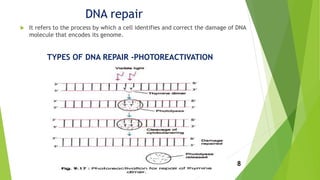
TYPES OF DNA REPAIR -PHOTOREACTIVATION
8
1.photoreactivation
 Uv rays shows lethal effect when the normal DNA comes into the contact of uv rays
then it causes damage.
 In nucleotide the adjacent pyramidine bases forms the covalent bond and it forms t-t
dimer
 visible light is used for the repair.
 Then photolyase enzyme attached to the damaged part it cleaves the dimer which
formed between two same pyramidine.
 Then the hydrogen bond reformation takes place and the damaged DNA is repair.
 Then photolyase enzyme will be separated from the DNA.
 Photolyase enzyme is present in bacterial cell and mammal placenta.
9
Base excision repair
10
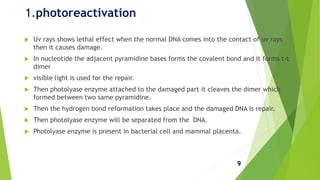
2.Base excision repair
 Deamination of cytosine takes place and uracil comes in place of cytosine.
 Uracil glycosylase enzyme is active and it is used to remove the uracil from DNA
backbone but it has to hydrolyse the glycosidic bond from which uracil and guanine
joined.
 So that uracil will removed and the place of uracil will remain empty.
 Ap endonuclease means apurine site or apyramidine site.
 Ap endonuclease cuts the whole strand of the damage site so that all the nucleotide
present in the damaged DNA will be removed.
 DNA polymerase enzyme is used for the synthesize of nucleotide base pair and DNA
ligase enzyme is used to sealed the newly synthesized strand.
11
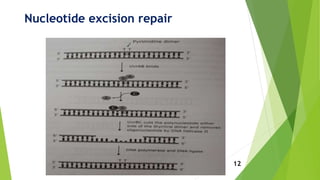
Nucleotide excision repair
12
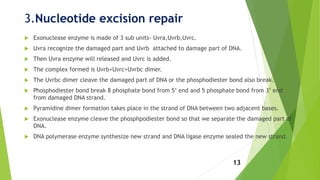
3.Nucleotide excision repair
 Exonuclease enzyme is made of 3 sub units- Uvra,Uvrb,Uvrc.
 Uvra recognize the damaged part and Uvrb attached to damage part of DNA.
 Then Uvra enzyme will released and Uvrc is added.
 The complex formed is Uvrb+Uvrc=Uvrbc dimer.
 The Uvrbc dimer cleave the damaged part of DNA or the phosphodiester bond also break.
 Phosphodiester bond break 8 phosphate bond from 5’ end and 5 phosphate bond from 3’ end
from damaged DNA strand.
 Pyramidine dimer formation takes place in the strand of DNA between two adjacent bases.
 Exonuclease enzyme cleave the phosphpodiester bond so that we separate the damaged part of
DNA.
 DNA polymerase enzyme synthesize new strand and DNA ligase enzyme sealed the new strand.
13
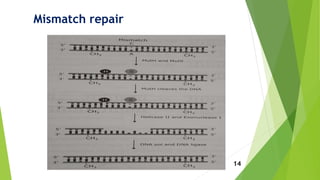
Mismatch repair
14
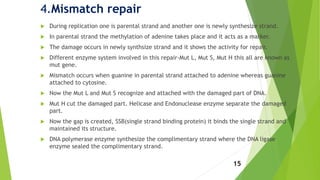
4.Mismatch repair
 During replication one is parental strand and another one is newly synthesize strand.
 In parental strand the methylation of adenine takes place and it acts as a marker.
 The damage occurs in newly synthsize strand and it shows the activity for repair.
 Different enzyme system involved in this repair-Mut L, Mut S, Mut H this all are known as
mut gene.
 Mismatch occurs when guanine in parental strand attached to adenine whereas guanine
attached to cytosine.
 Now the Mut L and Mut S recognize and attached with the damaged part of DNA.
 Mut H cut the damaged part. Helicase and Endonuclease enzyme separate the damaged
part.
 Now the gap is created, SSB(single strand binding protein) it binds the single strand and
maintained its structure.
 DNA polymerase enzyme synthesize the complimentary strand where the DNA ligase
enzyme sealed the complimentary strand.
15
Reference
 AUTHOR;- U.SATYANARAYANA; 2016PUBLISHED; THIRD EDITION;
BIOTECHNOLOGY; PAGE NO-34-37.
 AUTHOR; ALEXANDER MCLENNAN, PHIL TURNER; 2015 PUBLISHED; FOURTH
EDITION; MOLECULAR BIOLOGY; PAGE NO-86-89.
16
Thank you
17

Manisha 4th ppt

  • 1.
    JIWAJI UNIVERSITY,GWALIOR 1 TOPIC-DNA damageand repair mechanism NAME –MANISHA SINGHAI M.Sc. 3rd SEM
  • 2.
    Contents  INTRODUCTION  SOURCESOF DNA DAMAGE  TYPES OF DNA DAMAGE  DNA REPAIR  TYPES OF DNA REPAIR  REFERENCE 2
  • 3.
    Introduction  DNA damageis an alteration in the chemical structure of DNA,such as break in a strand of DNA,a base missing from the backbone of DNA.  DNA damage can occur naturally or via environmental factors.  A DNA damage causes changes in the structure of genetic material and prevents the replication mechanism from functioning and performing properly. 3
  • 4.
    Sources of DNAdamage  Sources of DNA damage are of two types- 1. Endogenous damage 2. Exogenous damage  Endogenous damages-1.by reactive oxygen speices. 2.by natural metabolic byproducts. 3.hydrolysis of nucleotide bases. 4.replication error  Exogenous damage- 1.ionizing radiation. 2. Ultraviolet radiation 3. Chemical agents 4. virus 4
  • 5.
    Types of DNAdamage  Single base alteration-1. depurination 2. deamination 3. alkylation  Double base alteration- 1.pyrimidine dimer 2. purine dimer  Chain breaks –1.single strand break 2. double strand break  Cross linkage-1. between DNA-DNA molecule 2. DNA-protein molecule 5
  • 6.
    SINGLE BASE ALTERATION 1.Depurination-hydrolyticcleavage of N glycosidic bond of purine nucleotide ( A and G)  Loss of purine bases from the DNA.  It forms apurinic site. 2.Deamination- removal of an amino grp from dna bases.  Cytosine gets deaminated to form uracil while adenine form hypoxanthine and guanine form xanthine.  If left unrepaired then uracil would form a base pair with adenine during replication which give rise to mutation. 3.Alkylation- transfer of alkyl grp to bases.  Two types of alkylating agents are used- 1.Monofunctional agents- ethyl methane sulphonate. 2.Bifunctional agents- ethylene ammonium sulphate.  It have 2 alkyl grps causes crosslinking in DNA. 6
  • 7.
    DOUBLE BASE ALTERATION It consist of two types-purine dimer and pyrimidine dimer. 1.Pyrimidine dimer-(thymine and cytosine) DNA absorbs uv radiation in the range of (280- 315)nm. 2.Purine dimer- (adenine and guanine) after the exposure of uv radiation the adjacent purine base forms dimer. CHAIN BREAK  Break in phosphodiester bond.  It is of two type- single strand break and double strand break. 1.Single strand break- causes by radiation and free radical(peroxidase). 2.Double strand break- causes by radiation,repair of single strand break,free radical injury.  CROSS LINKING  Cross linking is caused by uv radiation,ionizing radiation like x rays, gamma rays,free radicals like Peroxide.  Cross linking is between DNA-DNA molecule and DNA- protein molecule. 7
  • 8.
    DNA repair  Itrefers to the process by which a cell identifies and correct the damage of DNA molecule that encodes its genome. TYPES OF DNA REPAIR -PHOTOREACTIVATION 8
  • 9.
    1.photoreactivation  Uv raysshows lethal effect when the normal DNA comes into the contact of uv rays then it causes damage.  In nucleotide the adjacent pyramidine bases forms the covalent bond and it forms t-t dimer  visible light is used for the repair.  Then photolyase enzyme attached to the damaged part it cleaves the dimer which formed between two same pyramidine.  Then the hydrogen bond reformation takes place and the damaged DNA is repair.  Then photolyase enzyme will be separated from the DNA.  Photolyase enzyme is present in bacterial cell and mammal placenta. 9
  • 10.
  • 11.
    2.Base excision repair Deamination of cytosine takes place and uracil comes in place of cytosine.  Uracil glycosylase enzyme is active and it is used to remove the uracil from DNA backbone but it has to hydrolyse the glycosidic bond from which uracil and guanine joined.  So that uracil will removed and the place of uracil will remain empty.  Ap endonuclease means apurine site or apyramidine site.  Ap endonuclease cuts the whole strand of the damage site so that all the nucleotide present in the damaged DNA will be removed.  DNA polymerase enzyme is used for the synthesize of nucleotide base pair and DNA ligase enzyme is used to sealed the newly synthesized strand. 11
  • 12.
  • 13.
    3.Nucleotide excision repair Exonuclease enzyme is made of 3 sub units- Uvra,Uvrb,Uvrc.  Uvra recognize the damaged part and Uvrb attached to damage part of DNA.  Then Uvra enzyme will released and Uvrc is added.  The complex formed is Uvrb+Uvrc=Uvrbc dimer.  The Uvrbc dimer cleave the damaged part of DNA or the phosphodiester bond also break.  Phosphodiester bond break 8 phosphate bond from 5’ end and 5 phosphate bond from 3’ end from damaged DNA strand.  Pyramidine dimer formation takes place in the strand of DNA between two adjacent bases.  Exonuclease enzyme cleave the phosphpodiester bond so that we separate the damaged part of DNA.  DNA polymerase enzyme synthesize new strand and DNA ligase enzyme sealed the new strand. 13
  • 14.
  • 15.
    4.Mismatch repair  Duringreplication one is parental strand and another one is newly synthesize strand.  In parental strand the methylation of adenine takes place and it acts as a marker.  The damage occurs in newly synthsize strand and it shows the activity for repair.  Different enzyme system involved in this repair-Mut L, Mut S, Mut H this all are known as mut gene.  Mismatch occurs when guanine in parental strand attached to adenine whereas guanine attached to cytosine.  Now the Mut L and Mut S recognize and attached with the damaged part of DNA.  Mut H cut the damaged part. Helicase and Endonuclease enzyme separate the damaged part.  Now the gap is created, SSB(single strand binding protein) it binds the single strand and maintained its structure.  DNA polymerase enzyme synthesize the complimentary strand where the DNA ligase enzyme sealed the complimentary strand. 15
  • 16.
    Reference  AUTHOR;- U.SATYANARAYANA;2016PUBLISHED; THIRD EDITION; BIOTECHNOLOGY; PAGE NO-34-37.  AUTHOR; ALEXANDER MCLENNAN, PHIL TURNER; 2015 PUBLISHED; FOURTH EDITION; MOLECULAR BIOLOGY; PAGE NO-86-89. 16
  • 17.