DNA Damage and
DNA Repair Mechanism
DNA (Deoxy Ribonucleic Acid)

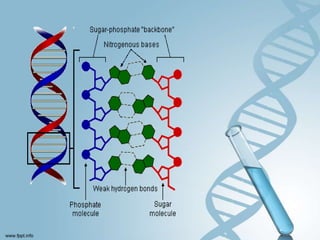
• DNA stores and passes on genetic
  information from one generation to another.
• The DNA structure is shaped like a spiral
  staircase, or twisted ladder.
• The outer part of the ladder are made o
  sugars.
• The steps of the ladder are made of
  nitrogenous bases.
DNA Damage

1. DNA damage due to mutation:

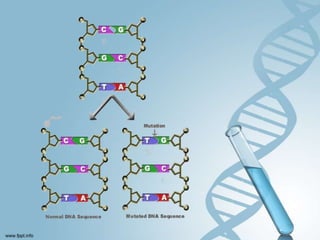
• A permanent change in the DNA is known as
  DNA mutation.
• A mutation affecting just a single nucleotide
  pair can destroy an organism if the change
  occur in a vital position in the DNA
  sequence.
DNA Damage
For example:
      Humans use the protein hemoglobin to
  transport oxygen in the blood, the sequence of
  nucleotides that encodes the amino acid
  sequence of one of two protein chains (the
  Beta-globin chain) gets a permanent change in
  a single nucleotide causes to make a beta-
  globin chain with an incorrect sequence of
  amino acid.
DNA Damage
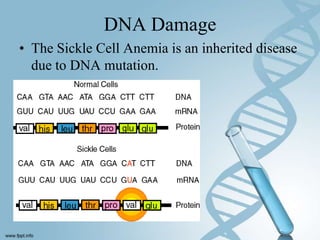
• The Sickle Cell Anemia is an inherited disease
  due to DNA mutation.
DNA Damage

2. Spontaneous Reaction:

   There are also other ways in which the
  DNA can be damage, DNA is continually
  undergoing thermal collision with other
  molecules. These often result in major
  chemical changes in the DNA.
DNA Damage
For example:
       during the time it takes to read this
  sentence, a total of about a trillion purine bases
  (A and G) will be lost from the DNA of our
  cells by a spontaneous reaction.
DNA Damage
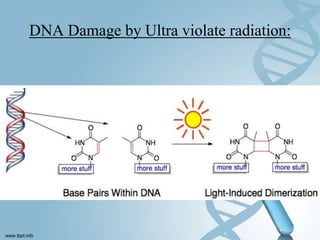
3. DNA Damage by Ultra violate radiation:

      Two adjacent thymine bases have become
 covalently attached to one another to form a
 thymine dimer. Skin cells that are exposed to
 sunlight are especially susceptible to this type
 of DNA damage.
DNA Damage by Ultra violate radiation:
DNA Damage
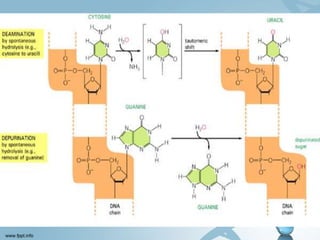
4. Depurination and Deamination:

    These are the most frequent
 spontaneous chemical reaction
 known to create serious DNA
 damage in cells.
DNA Repair
  The process of immediately
correction of temporary damaged
DNA is known as DNA repair.

  DNA Repair Mechanism:
 There are three basic steps of
DNA repair
DNA Repair Mechanism

1.            The damaged DNA is recognized and
     removed by one of a variety of different
     nucleases, which cleave the covalent bonds that
     join the damaged nucleotides to the rest of DNA
     molecule, leaving a small gap on one strand of
     DNA double helix in this region.
DNA Repair Mechanism

2.             A repair DNA polymerase binds to the
     3’-hydroxyl end of the cut DNA strand. It then
     fills in the gap by making a complete copy of
     the information stored in the undamaged
     strand. Although a different enzyme from the
     DNA polymerase that replicates DNA, a repair
     DNA polymerase synthesize DNA strands in
     the same way.
DNA Repair Mechanism

3.                When the repair DNA polymerase
     has filled in the gap, a break remains in the
     sugar-phosphate backbone of he repaired
     strand. It is in the helix is sealed by DNA
     ligase, the same enzyme that joins the lagging
     strand DNA fragments during replication.
Dna repair
Dna repair

Dna repair

  • 1.
    DNA Damage and DNARepair Mechanism
  • 2.
    DNA (Deoxy RibonucleicAcid) • DNA stores and passes on genetic information from one generation to another. • The DNA structure is shaped like a spiral staircase, or twisted ladder. • The outer part of the ladder are made o sugars. • The steps of the ladder are made of nitrogenous bases.
  • 4.
    DNA Damage 1. DNAdamage due to mutation: • A permanent change in the DNA is known as DNA mutation. • A mutation affecting just a single nucleotide pair can destroy an organism if the change occur in a vital position in the DNA sequence.
  • 5.
    DNA Damage For example: Humans use the protein hemoglobin to transport oxygen in the blood, the sequence of nucleotides that encodes the amino acid sequence of one of two protein chains (the Beta-globin chain) gets a permanent change in a single nucleotide causes to make a beta- globin chain with an incorrect sequence of amino acid.
  • 7.
    DNA Damage • TheSickle Cell Anemia is an inherited disease due to DNA mutation.
  • 8.
    DNA Damage 2. SpontaneousReaction: There are also other ways in which the DNA can be damage, DNA is continually undergoing thermal collision with other molecules. These often result in major chemical changes in the DNA.
  • 9.
    DNA Damage For example: during the time it takes to read this sentence, a total of about a trillion purine bases (A and G) will be lost from the DNA of our cells by a spontaneous reaction.
  • 10.
    DNA Damage 3. DNADamage by Ultra violate radiation: Two adjacent thymine bases have become covalently attached to one another to form a thymine dimer. Skin cells that are exposed to sunlight are especially susceptible to this type of DNA damage.
  • 11.
    DNA Damage byUltra violate radiation:
  • 12.
    DNA Damage 4. Depurinationand Deamination: These are the most frequent spontaneous chemical reaction known to create serious DNA damage in cells.
  • 14.
    DNA Repair The process of immediately correction of temporary damaged DNA is known as DNA repair. DNA Repair Mechanism: There are three basic steps of DNA repair
  • 15.
    DNA Repair Mechanism 1. The damaged DNA is recognized and removed by one of a variety of different nucleases, which cleave the covalent bonds that join the damaged nucleotides to the rest of DNA molecule, leaving a small gap on one strand of DNA double helix in this region.
  • 16.
    DNA Repair Mechanism 2. A repair DNA polymerase binds to the 3’-hydroxyl end of the cut DNA strand. It then fills in the gap by making a complete copy of the information stored in the undamaged strand. Although a different enzyme from the DNA polymerase that replicates DNA, a repair DNA polymerase synthesize DNA strands in the same way.
  • 17.
    DNA Repair Mechanism 3. When the repair DNA polymerase has filled in the gap, a break remains in the sugar-phosphate backbone of he repaired strand. It is in the helix is sealed by DNA ligase, the same enzyme that joins the lagging strand DNA fragments during replication.