DNA Mutation

     Presented by
Mona Othman AlBureikan
What are mutations?
What are mutations?
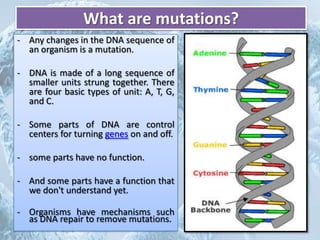
- Any changes in the DNA sequence of
  an organism is a mutation.

- DNA is made of a long sequence of
  smaller units strung together. There
  are four basic types of unit: A, T, G,
  and C.

- Some parts of DNA are control
  centers for turning genes on and off.

- some parts have no function.

- And some parts have a function that
  we don't understand yet.

- Organisms have mechanisms such
  as DNA repair to remove mutations.
What are mutations?
- Other parts of DNA are genes
  that carry the instructions for
  making proteins .

- Proteins are long chains of
  amino acids.

- These proteins help build an
  organism.

- Protein-coding DNA can be
  divided into codons — sets of
  three bases that specify an
  amino acid or signal the end of
  the protein.
Classifications of mutations

            OR

    Types of Mutation
A- Good or bad or neutral.
- A harmful mutation
  Is a mutation that decreases the fitness of the organism.


- A beneficial mutation
   Is a mutation that increases fitness of the organism, or which promotes
  traits that are desirable.


- A neutral mutation
  Has no harmful or beneficial effect on the organism. Such mutations occur
  at a steady rate, forming the basis for the molecular clock.
B- Somatic or germline
C- Spontaneous or Induced Mutations
 - Most mutations are spontaneous, rather than being induced
   by a mutagen.
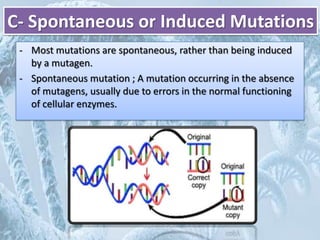
 - Spontaneous mutation ; A mutation occurring in the absence
   of mutagens, usually due to errors in the normal functioning
   of cellular enzymes.
Spontaneous Mutations
These mutations can be caused by:

• Tautomerism – A base is changed by
   the repositioning of a hydrogen atom,
   altering the hydrogen bonding pattern
   of that base resulting in incorrect base
   pairing during replication.

• The ability of a molecule to exist in
   more than one chemical form is called
   tautomerism .

• All the four common bases of DNA (A,
   G, C and T) have unusual tautomeric
   forms, which are rare.
Spontaneous Mutations
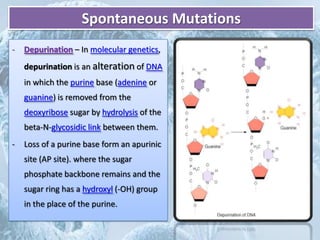
-   Depurination – In molecular genetics,
    depurination is an alteration of DNA
    in which the purine base (adenine or
    guanine) is removed from the
    deoxyribose sugar by hydrolysis of the
    beta-N-glycosidic link between them.
-   Loss of a purine base form an apurinic
    site (AP site). where the sugar
    phosphate backbone remains and the
    sugar ring has a hydroxyl (-OH) group
    in the place of the purine.
Spontaneous Mutations
• Deamination – Hydrolysis changes a normal base to an atypical
  base containing a keto group in place of the original amine group.
Spontaneous Mutations
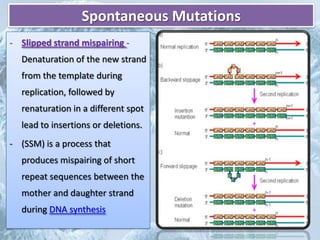
- Slipped strand mispairing -
  Denaturation of the new strand
  from the template during
  replication, followed by
  renaturation in a different spot
  lead to insertions or deletions.
- (SSM) is a process that
  produces mispairing of short
  repeat sequences between the
  mother and daughter strand
  during DNA synthesis
Induced Mutations
• Ingredients that cause mutations
   are called mutagens. Mutagen is
   divided into three, namely:

1- Mutagenic chemicals like;

• Hydroxylamine NH2OH

• Base analogs (e.g. BrdU)

• Alkylating agents

• Agents that form DNA adducts

• DNA intercalating agents

• DNA crosslinkers

• Oxidative damage
Induced Mutations


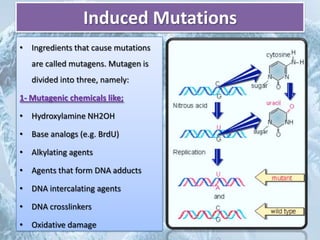
 Nitrous acid converts amine groups on A and C to diazo

 groups, altering their hydrogen bonding patterns which

    leads to incorrect base pairing during replication.
Induced Mutations

2- Mutagen materials physics

    like;

- Ultraviolet rays. (can cause

    skin cancer).

-   Radioactive rays.

- Gamma rays.
Induced Mutations
- Ultraviolet light is absorbed

  by the nucleic acid bases,

  and the resulting influx of

  energy can induce chemical

  changes.
Induced Mutations
-   The most frequent photoproducts
    are the consequences of bond
    formation between adjacent
    pyrimidines within one strand,
    and, of these, the most frequent
    are cyclobutane pyrimidine dimers
    (CPDs).

-   T CPDs are formed most readily,
    followed by T-C or C-T; C-C dimers
    are least abundant.
Induced Mutations
3- Mutagen biological substances.

suspected viruses and bakeries can
  cause mutations. Of the virus that
  can cause mutations is DNA.
D- Forward or Reverse Mutations
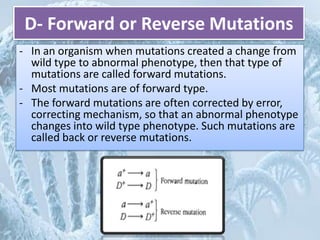
- In an organism when mutations created a change from
  wild type to abnormal phenotype, then that type of
  mutations are called forward mutations.
- Most mutations are of forward type.
- The forward mutations are often corrected by error,
  correcting mechanism, so that an abnormal phenotype
  changes into wild type phenotype. Such mutations are
  called back or reverse mutations.
E- Point or frameshift mutations
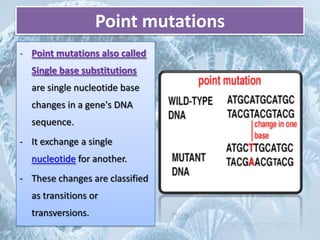
Point mutations
- Point mutations also called
  Single base substitutions
  are single nucleotide base
  changes in a gene's DNA
  sequence.
- It exchange a single
  nucleotide for another.
- These changes are classified
  as transitions or
  transversions.
Point mutations
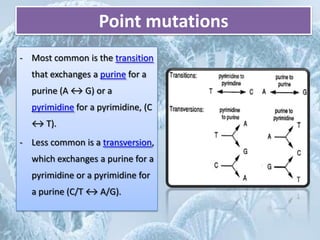
- Most common is the transition
  that exchanges a purine for a
  purine (A ↔ G) or a
  pyrimidine for a pyrimidine, (C
  ↔ T).
- Less common is a transversion,
  which exchanges a purine for a
  pyrimidine or a pyrimidine for
  a purine (C/T ↔ A/G).
Point mutations
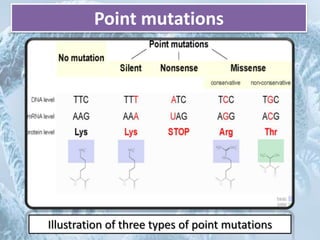
- Point mutations that
  occur within the protein
  coding region of a gene
  may be classified into
  three kinds, depending
  upon what the
  erroneous codon codes
  for:
   • Silent mutations: which
     code for the same amino
     acid.
   • Missense mutations:
     which code for a different
     amino acid.
   • Nonsense mutations:
     which code for a stop and
     can truncate the protein.
Point mutations


Illustration of three types of point mutations
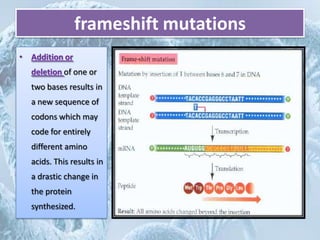
frameshift mutations
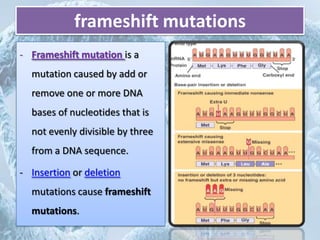
- Frameshift mutation is a
  mutation caused by add or
  remove one or more DNA
  bases of nucleotides that is
  not evenly divisible by three
  from a DNA sequence.

- Insertion or deletion
  mutations cause frameshift
  mutations.
frameshift mutations
• Addition or
  deletion of one or
  two bases results in
  a new sequence of
  codons which may
  code for entirely
  different amino
  acids. This results in
  a drastic change in
  the protein
  synthesized.
DNA Repair
• Cells have developed a number
  of systems designed to repair
  DNA damage and correct
  mutations.

1- Photoreactivation

- For Repair Thymine Dimers by A
  brief exposure to blue light
  following UV exposure can
  reverse the effects of the UV
  radiation.
DNA Repair
• An enzyme called
  photolyase or
  photoreactivation
  enzyme (PRE), which
  cleaves the covalent
  bonds linking the
  thymine dimers using
  the energy from a
                          DNA Repair Pathway. This flow chart shows one way that damaged
  photon of blue light.                  DNA is repaired in E. coli bacteria.
DNA Repair
•     2- Base excision repair
      The damaged or inappropriate base
      is removed from its sugar linkage and
      replaced. These are glycosylase
      enzymes which cut the base-sugar
      bond.

•      3- Nucleotide excision repair
    - This system works on DNA damage
       which is "bulky" and creates a block
       to DNA replication and transcription.
    - (UV-induced dimers and some kinds
       of chemical adducts).
    - It probably recognizes not a specific
       structure but a distortion in the
       double helix.
DNA Repair
4- Recombinational (daughter-strand
gap) repair
- This is a repair mechanism which
promotes recombination to fix the
daughter-strand gap--not the dimer--and
is a way to cope with the problems of a
non-coding lesion persisting in DNA.
- Double Strand Break (DSB) Repair.
Shown is an overview of the main steps
and factor requirements for DNA DSB
repair by homologous recombination (left)
and non-homologous end-joining (right).
DNA Repair
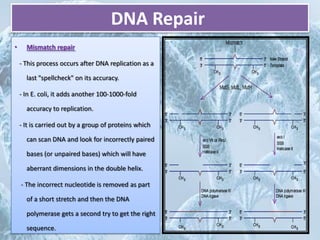
•     Mismatch repair

    - This process occurs after DNA replication as a

      last "spellcheck" on its accuracy.

    - In E. coli, it adds another 100-1000-fold

      accuracy to replication.

    - It is carried out by a group of proteins which

      can scan DNA and look for incorrectly paired

      bases (or unpaired bases) which will have

      aberrant dimensions in the double helix.

    - The incorrect nucleotide is removed as part

      of a short stretch and then the DNA

      polymerase gets a second try to get the right

      sequence.
Nucleotide excision
DNA Repair
References;
http://academic.brooklyn.cuny.edu/biology/bio4fv/page/molecular%20biology/mutations-type.html

http://www.web-books.com/MoBio/Free/Ch7G.htm

http://www.emunix.emich.edu/~rwinning/genetics/mutat.htm

http://www.prism.gatech.edu/~gh19/b1510/7mut4.jpg

http://www.ncbi.nlm.nih.gov/books/NBK21240/

http://chemistry.gravitywaves.com/CHEMXL153/DNAMutationRepair.htm

http://www.brooklyn.cuny.edu/bc/ahp/BioInfo/MUT/Mut.Definition.html

http://evolution.berkeley.edu/evolibrary/article/mutations_01

http://learn.genetics.utah.edu/archive/mutations/mutatedna.html

http://www-personal.ksu.edu/~bethmont/mutdes.html

http://en.wikipedia.org/wiki/Mutation#Causes

http://ocw.openhighschool.org/mod/book/view.php?id=8447&chapterid=2327

http://www.microbiologyprocedure.com/genetics/mutation/classification-of-mutation.htm

http://en.wikipedia.org/wiki/Mutation#Causes
THE END
THANK YOU

Mutation

  • 1.
    DNA Mutation Presented by Mona Othman AlBureikan
  • 2.
  • 3.
    What are mutations? -Any changes in the DNA sequence of an organism is a mutation. - DNA is made of a long sequence of smaller units strung together. There are four basic types of unit: A, T, G, and C. - Some parts of DNA are control centers for turning genes on and off. - some parts have no function. - And some parts have a function that we don't understand yet. - Organisms have mechanisms such as DNA repair to remove mutations.
  • 4.
    What are mutations? -Other parts of DNA are genes that carry the instructions for making proteins . - Proteins are long chains of amino acids. - These proteins help build an organism. - Protein-coding DNA can be divided into codons — sets of three bases that specify an amino acid or signal the end of the protein.
  • 5.
    Classifications of mutations OR Types of Mutation
  • 6.
    A- Good orbad or neutral. - A harmful mutation Is a mutation that decreases the fitness of the organism. - A beneficial mutation Is a mutation that increases fitness of the organism, or which promotes traits that are desirable. - A neutral mutation Has no harmful or beneficial effect on the organism. Such mutations occur at a steady rate, forming the basis for the molecular clock.
  • 7.
    B- Somatic orgermline
  • 8.
    C- Spontaneous orInduced Mutations - Most mutations are spontaneous, rather than being induced by a mutagen. - Spontaneous mutation ; A mutation occurring in the absence of mutagens, usually due to errors in the normal functioning of cellular enzymes.
  • 9.
    Spontaneous Mutations These mutationscan be caused by: • Tautomerism – A base is changed by the repositioning of a hydrogen atom, altering the hydrogen bonding pattern of that base resulting in incorrect base pairing during replication. • The ability of a molecule to exist in more than one chemical form is called tautomerism . • All the four common bases of DNA (A, G, C and T) have unusual tautomeric forms, which are rare.
  • 10.
    Spontaneous Mutations - Depurination – In molecular genetics, depurination is an alteration of DNA in which the purine base (adenine or guanine) is removed from the deoxyribose sugar by hydrolysis of the beta-N-glycosidic link between them. - Loss of a purine base form an apurinic site (AP site). where the sugar phosphate backbone remains and the sugar ring has a hydroxyl (-OH) group in the place of the purine.
  • 11.
    Spontaneous Mutations • Deamination– Hydrolysis changes a normal base to an atypical base containing a keto group in place of the original amine group.
  • 12.
    Spontaneous Mutations - Slippedstrand mispairing - Denaturation of the new strand from the template during replication, followed by renaturation in a different spot lead to insertions or deletions. - (SSM) is a process that produces mispairing of short repeat sequences between the mother and daughter strand during DNA synthesis
  • 13.
    Induced Mutations • Ingredientsthat cause mutations are called mutagens. Mutagen is divided into three, namely: 1- Mutagenic chemicals like; • Hydroxylamine NH2OH • Base analogs (e.g. BrdU) • Alkylating agents • Agents that form DNA adducts • DNA intercalating agents • DNA crosslinkers • Oxidative damage
  • 14.
    Induced Mutations Nitrousacid converts amine groups on A and C to diazo groups, altering their hydrogen bonding patterns which leads to incorrect base pairing during replication.
  • 15.
    Induced Mutations 2- Mutagenmaterials physics like; - Ultraviolet rays. (can cause skin cancer). - Radioactive rays. - Gamma rays.
  • 16.
    Induced Mutations - Ultravioletlight is absorbed by the nucleic acid bases, and the resulting influx of energy can induce chemical changes.
  • 17.
    Induced Mutations - The most frequent photoproducts are the consequences of bond formation between adjacent pyrimidines within one strand, and, of these, the most frequent are cyclobutane pyrimidine dimers (CPDs). - T CPDs are formed most readily, followed by T-C or C-T; C-C dimers are least abundant.
  • 18.
    Induced Mutations 3- Mutagenbiological substances. suspected viruses and bakeries can cause mutations. Of the virus that can cause mutations is DNA.
  • 19.
    D- Forward orReverse Mutations - In an organism when mutations created a change from wild type to abnormal phenotype, then that type of mutations are called forward mutations. - Most mutations are of forward type. - The forward mutations are often corrected by error, correcting mechanism, so that an abnormal phenotype changes into wild type phenotype. Such mutations are called back or reverse mutations.
  • 20.
    E- Point orframeshift mutations
  • 21.
    Point mutations - Pointmutations also called Single base substitutions are single nucleotide base changes in a gene's DNA sequence. - It exchange a single nucleotide for another. - These changes are classified as transitions or transversions.
  • 22.
    Point mutations - Mostcommon is the transition that exchanges a purine for a purine (A ↔ G) or a pyrimidine for a pyrimidine, (C ↔ T). - Less common is a transversion, which exchanges a purine for a pyrimidine or a pyrimidine for a purine (C/T ↔ A/G).
  • 23.
    Point mutations - Pointmutations that occur within the protein coding region of a gene may be classified into three kinds, depending upon what the erroneous codon codes for: • Silent mutations: which code for the same amino acid. • Missense mutations: which code for a different amino acid. • Nonsense mutations: which code for a stop and can truncate the protein.
  • 24.
    Point mutations Illustration ofthree types of point mutations
  • 25.
    frameshift mutations - Frameshiftmutation is a mutation caused by add or remove one or more DNA bases of nucleotides that is not evenly divisible by three from a DNA sequence. - Insertion or deletion mutations cause frameshift mutations.
  • 26.
    frameshift mutations • Additionor deletion of one or two bases results in a new sequence of codons which may code for entirely different amino acids. This results in a drastic change in the protein synthesized.
  • 27.
    DNA Repair • Cellshave developed a number of systems designed to repair DNA damage and correct mutations. 1- Photoreactivation - For Repair Thymine Dimers by A brief exposure to blue light following UV exposure can reverse the effects of the UV radiation.
  • 28.
    DNA Repair • Anenzyme called photolyase or photoreactivation enzyme (PRE), which cleaves the covalent bonds linking the thymine dimers using the energy from a DNA Repair Pathway. This flow chart shows one way that damaged photon of blue light. DNA is repaired in E. coli bacteria.
  • 29.
    DNA Repair • 2- Base excision repair The damaged or inappropriate base is removed from its sugar linkage and replaced. These are glycosylase enzymes which cut the base-sugar bond. • 3- Nucleotide excision repair - This system works on DNA damage which is "bulky" and creates a block to DNA replication and transcription. - (UV-induced dimers and some kinds of chemical adducts). - It probably recognizes not a specific structure but a distortion in the double helix.
  • 30.
    DNA Repair 4- Recombinational(daughter-strand gap) repair - This is a repair mechanism which promotes recombination to fix the daughter-strand gap--not the dimer--and is a way to cope with the problems of a non-coding lesion persisting in DNA. - Double Strand Break (DSB) Repair. Shown is an overview of the main steps and factor requirements for DNA DSB repair by homologous recombination (left) and non-homologous end-joining (right).
  • 31.
    DNA Repair • Mismatch repair - This process occurs after DNA replication as a last "spellcheck" on its accuracy. - In E. coli, it adds another 100-1000-fold accuracy to replication. - It is carried out by a group of proteins which can scan DNA and look for incorrectly paired bases (or unpaired bases) which will have aberrant dimensions in the double helix. - The incorrect nucleotide is removed as part of a short stretch and then the DNA polymerase gets a second try to get the right sequence.
  • 32.
  • 33.
  • 34.
    References; http://academic.brooklyn.cuny.edu/biology/bio4fv/page/molecular%20biology/mutations-type.html http://www.web-books.com/MoBio/Free/Ch7G.htm http://www.emunix.emich.edu/~rwinning/genetics/mutat.htm http://www.prism.gatech.edu/~gh19/b1510/7mut4.jpg http://www.ncbi.nlm.nih.gov/books/NBK21240/ http://chemistry.gravitywaves.com/CHEMXL153/DNAMutationRepair.htm http://www.brooklyn.cuny.edu/bc/ahp/BioInfo/MUT/Mut.Definition.html http://evolution.berkeley.edu/evolibrary/article/mutations_01 http://learn.genetics.utah.edu/archive/mutations/mutatedna.html http://www-personal.ksu.edu/~bethmont/mutdes.html http://en.wikipedia.org/wiki/Mutation#Causes http://ocw.openhighschool.org/mod/book/view.php?id=8447&chapterid=2327 http://www.microbiologyprocedure.com/genetics/mutation/classification-of-mutation.htm http://en.wikipedia.org/wiki/Mutation#Causes
  • 35.

Editor's Notes

  • #30 example: uracilglycosylase--enzyme which removes uracil from DNA.Several proteins are involvedin this process (in prokaryotes these are the products of the 'uvr' genes, for 'UV repair').