Mechanisms
Ms. M. Arthi
Assistant Professor
DNA Repair
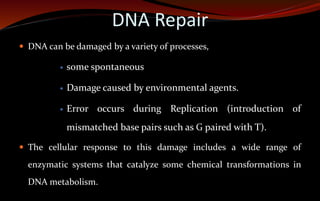
 DNA can be damaged by a variety of processes,
 some spontaneous
 Damage caused by environmental agents.
 Error occurs during Replication (introduction of
mismatched base pairs such as G paired with T).
 The cellular response to this damage includes a wide range of
enzymatic systems that catalyze some chemical transformations in
DNA metabolism.
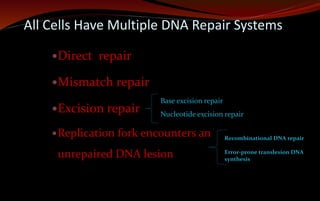
All Cells Have Multiple DNA Repair Systems
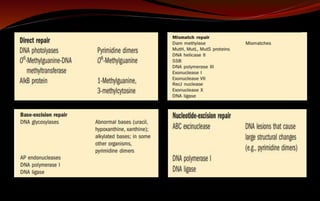
Direct repair
Mismatch repair
Excision repair
Replication fork encounters an
unrepaired DNA lesion
Base excision repair
Nucleotide excision repair
Recombinational DNA repair
Error-prone translesion DNA
synthesis
1. Direct repair
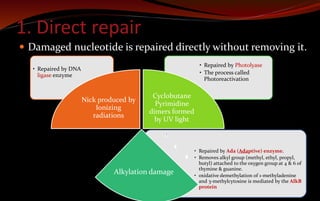
 Damaged nucleotide is repaired directly without removing it.
• Repaired by Ada (Adaptive) enzyme.
• Removes alkyl group (methyl, ethyl, propyl,
butyl) attached to the oxygen group at 4 & 6 of
thymine & guanine.
• oxidative demethylation of 1-methyladenine
and 3-methylcytosine is mediated by the AlkB
protein
• Repaired by Photolyase
• The process called
Photoreactivation
• Repaired by DNA
ligase enzyme
Nick produced by
Ionizing
radiations
Cyclobutane
Pyrimidine
dimers formed
by UV light
Alkylation damage
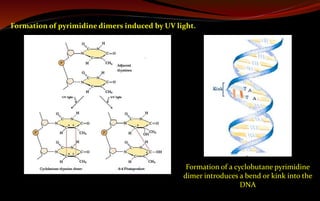
Formation of pyrimidine dimers induced by UV light.
Formation of a cyclobutane pyrimidine
dimer introduces a bend or kink into the
DNA
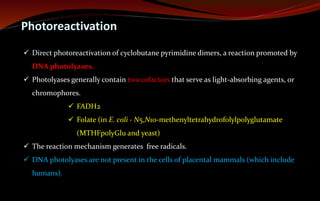
Photoreactivation
 Direct photoreactivation of cyclobutane pyrimidine dimers, a reaction promoted by
DNA photolyases.
 Photolyases generally contain two cofactors that serve as light-absorbing agents, or
chromophores.
 FADH2
 Folate (in E. coli - N5,N10-methenyltetrahydrofolylpolyglutamate
(MTHFpolyGlu and yeast)
 The reaction mechanism generates free radicals.
 DNA photolyases are not present in the cells of placental mammals (which include
humans).
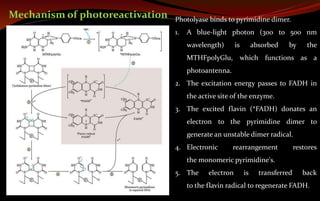
Photolyase binds to pyrimidine dimer.
1. A blue-light photon (300 to 500 nm
wavelength) is absorbed by the
MTHFpolyGlu, which functions as a
photoantenna.
2. The excitation energy passes to FADH in
the active site of the enzyme.
3. The excited flavin (*FADH) donates an
electron to the pyrimidine dimer to
generate an unstable dimer radical.
4. Electronic rearrangement restores
the monomeric pyrimidine's.
5. The electron is transferred back
to the flavin radical to regenerate FADH.
Mechanism of photoreactivation
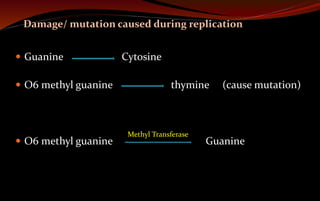
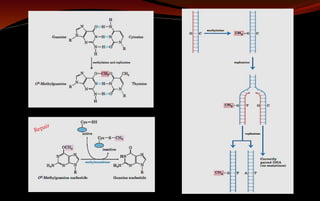
 Guanine Cytosine
 O6 methyl guanine thymine (cause mutation)
 O6 methyl guanine Guanine
Methyl Transferase
Damage/ mutation caused during replication
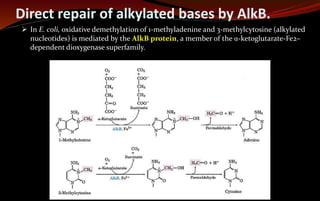
Direct repair of alkylated bases by AlkB.
 In E. coli, oxidative demethylation of 1-methyladenine and 3-methylcytosine (alkylated
nucleotides) is mediated by the AlkB protein, a member of the α-ketoglutarate-Fe2–
dependent dioxygenase superfamily.
2. Mismatch Repair
 Correction of the rare mismatches left after replication in E. coli
improves the overall fidelity of replication.
 The repair system must discriminate between the template and the
newly synthesized strand.
 The cell accomplishes this by tagging the template DNA with
methyl groups.
 The mismatch repair system of E. coli includes at least 12 protein
components that function either in strand discrimination or in the
repair process.
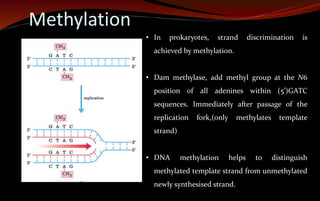
Methylation
• In prokaryotes, strand discrimination is
achieved by methylation.
• Dam methylase, add methyl group at the N6
position of all adenines within (5’)GATC
sequences. Immediately after passage of the
replication fork,(only methylates template
strand)
• DNA methylation helps to distinguish
methylated template strand from unmethylated
newly synthesised strand.
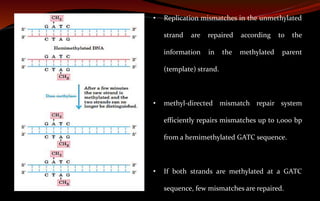
• Replication mismatches in the unmethylated
strand are repaired according to the
information in the methylated parent
(template) strand.
• methyl-directed mismatch repair system
efficiently repairs mismatches up to 1,000 bp
from a hemimethylated GATC sequence.
• If both strands are methylated at a GATC
sequence, few mismatches are repaired.
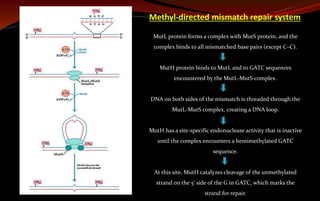
Methyl-directed mismatch repair system
MutL protein forms a complex with MutS protein, and the
complex binds to all mismatched base pairs (except C–C).
MutH protein binds to MutL and to GATC sequences
encountered by the MutL-MutS complex.
DNA on both sides of the mismatch is threaded through the
MutL-MutS complex, creating a DNA loop.
MutH has a site-specific endonuclease activity that is inactive
until the complex encounters a hemimethylated GATC
sequence.
At this site, MutH catalyzes cleavage of the unmethylated
strand on the 5’ side of the G in GATC, which marks the
strand for repair.
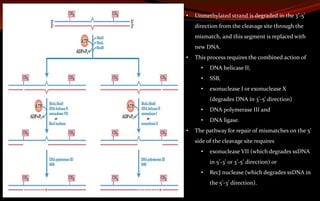
• Unmethylated strand is degraded in the 3’-5’
direction from the cleavage site through the
mismatch, and this segment is replaced with
new DNA.
• This process requires the combined action of
• DNA helicase II,
• SSB,
• exonuclease I or exonuclease X
(degrades DNA in 3’-5’ direction)
• DNA polymerase III and
• DNA ligase.
• The pathway for repair of mismatches on the 5’
side of the cleavage site requires
• exonuclease VII (which degrades ssDNA
in 5’-3’ or 3’-5’ direction) or
• RecJ nuclease (which degrades ssDNA in
the 5’-3’ direction).
3. a) Base-Excision Repair
 Every cell has a class of enzymes called DNA glycosylases.
 It recognize a common DNA lesions (such as the products of
cytosine and adenine deamination) and remove the affected
base by cleaving the N-glycosyl bond.
 This cleavage creates an apurinic or apyrimidinic site in the
DNA, commonly referred to as an AP site or abasic site.
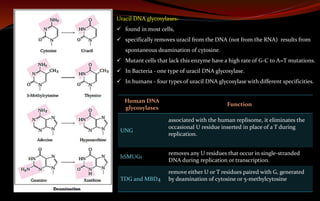
Uracil DNA glycosylases-
 found in most cells,
 specifically removes uracil from the DNA (not from the RNA) results from
spontaneous deamination of cytosine.
 Mutant cells that lack this enzyme have a high rate of G-C to A=T mutations.
 In Bacteria - one type of uracil DNA glycosylase.
 In humans - four types of uracil DNA glycosylase with different specificities.
Human DNA
glycosylases
Function
UNG
associated with the human replisome, it eliminates the
occasional U residue inserted in place of a T during
replication.
hSMUG1
removes any U residues that occur in single-stranded
DNA during replication or transcription.
TDG and MBD4
remove either U or T residues paired with G, generated
by deamination of cytosine or 5-methylcytosine
Other DNA glycosylases
 Recognize and remove a variety of damaged bases, including
 Formamidopyrimidine and 8-hydroxyguanine (both arising from
purine oxidation),
 hypoxanthine (arising from adenine deamination), and alkylated
bases such as 3-methyladenine and 7-methylguanine.
 pyrimidine dimers in some classes of organisms.
 AP sites also arise from the slow, spontaneous hydrolysis of
N-glycosyl bonds in DNA .
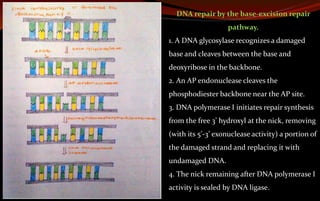
DNA repair by the base-excision repair
pathway.
1. A DNA glycosylase recognizes a damaged
base and cleaves between the base and
deoxyribose in the backbone.
2. An AP endonuclease cleaves the
phosphodiester backbone near the AP site.
3. DNA polymerase I initiates repair synthesis
from the free 3’ hydroxyl at the nick, removing
(with its 5’-3’ exonuclease activity) a portion of
the damaged strand and replacing it with
undamaged DNA.
4. The nick remaining after DNA polymerase I
activity is sealed by DNA ligase.
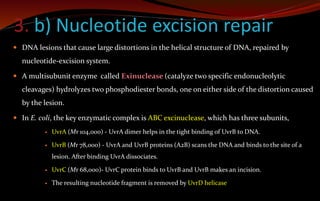
3. b) Nucleotide excision repair
 DNA lesions that cause large distortions in the helical structure of DNA, repaired by
nucleotide-excision system.
 A multisubunit enzyme called Exinuclease (catalyze two specific endonucleolytic
cleavages) hydrolyzes two phosphodiester bonds, one on either side of the distortion caused
by the lesion.
 In E. coli, the key enzymatic complex is ABC excinuclease, which has three subunits,
 UvrA (Mr 104,000) - UvrA dimer helps in the tight binding of UvrB to DNA.
 UvrB (Mr 78,000) - UvrA and UvrB proteins (A2B) scans the DNA and binds to the site of a
lesion. After binding UvrA dissociates.
 UvrC (Mr 68,000)- UvrC protein binds to UvrB and UvrB makes an incision.
 The resulting nucleotide fragment is removed by UvrD helicase
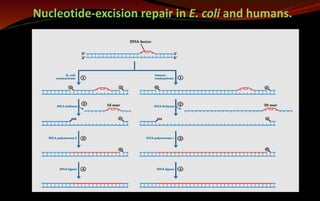
 In E. coli and other prokaryotes – it generates 12 to 13 nucleotides fragment.
 In humans and other eukaryotes - produce 27 to 29 nucleotides fragment.
 The excised oligonucleotides are released from the duplex and the resulting gap is
filled—by DNA polymerase I in E. coli and DNA polymerase ε in humans. DNA ligase
seals the nick.
 This pathway is a primary repair route for many types of lesions, including
 cyclobutane pyrimidine dimers, 6-4 photoproducts
 other types of base adducts including benzo[a]pyrene-guanine, which is formed in
DNA by exposure to cigarette smoke.
 Nucleotide-excision repair and base-excision repair in eukaryotes is closely tied to
transcription.
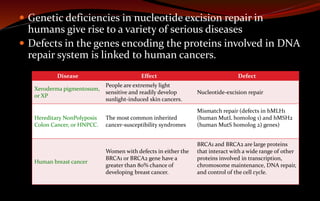
 Genetic deficiencies in nucleotide excision repair in
humans give rise to a variety of serious diseases
 Defects in the genes encoding the proteins involved in DNA
repair system is linked to human cancers.
Disease Effect Defect
Xeroderma pigmentosum,
or XP
People are extremely light
sensitive and readily develop
sunlight-induced skin cancers.
Nucleotide-excision repair
Hereditary NonPolyposis
Colon Cancer, or HNPCC.
The most common inherited
cancer-susceptibility syndromes
Mismatch repair (defects in hMLH1
(human MutL homolog 1) and hMSH2
(human MutS homolog 2) genes)
Human breast cancer
Women with defects in either the
BRCA1 or BRCA2 gene have a
greater than 80% chance of
developing breast cancer.
BRCA1 and BRCA2 are large proteins
that interact with a wide range of other
proteins involved in transcription,
chromosome maintenance, DNA repair,
and control of the cell cycle.
Nucleotide-excision repair in E. coli and humans.
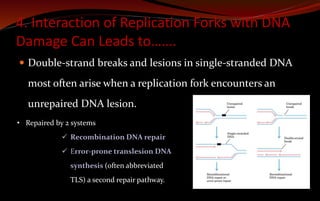
4. Interaction of Replication Forks with DNA
Damage Can Leads to…….
 Double-strand breaks and lesions in single-stranded DNA
most often arise when a replication fork encounters an
unrepaired DNA lesion.
• Repaired by 2 systems
 Recombination DNA repair
 Error-prone translesion DNA
synthesis (often abbreviated
TLS) a second repair pathway.
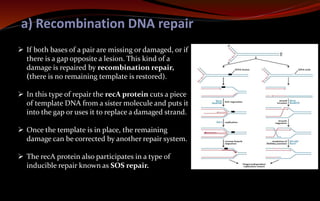
a) Recombination DNA repair
 If both bases of a pair are missing or damaged, or if
there is a gap opposite a lesion. This kind of a
damage is repaired by recombination repair,
(there is no remaining template is restored).
 In this type of repair the recA protein cuts a piece
of template DNA from a sister molecule and puts it
into the gap or uses it to replace a damaged strand.
 Once the template is in place, the remaining
damage can be corrected by another repair system.
 The recA protein also participates in a type of
inducible repair known as SOS repair.
b) Error-prone translesion DNA synthesis (TLS)
 When this pathway is active, DNA repair becomes significantly less accurate and a
high mutation rate can result.
 In bacteria, error-prone translesion DNA synthesis is part of a cellular stress
response to extensive DNA damage known as SOS response.
 In this instance the DNA damage is so great that synthesis stops completely, leaving
many large gaps.
 RecA will bind to the gaps and initiate strand exchange. Simultaneously it takes on
a proteolytic function that destroys the lexA repressor protein, which regulates the
function of many genes involved in DNA repair and synthesis .
 The system can quickly repair extensive damage caused by agents such as UV
radiation, but it is error prone and does produce mutations. However, it is certainly
better to have a few mutations than no DNA replication at all.
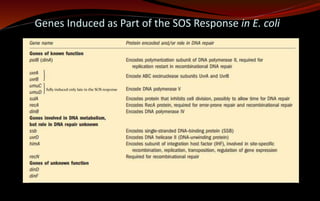
Genes Induced as Part of the SOS Response in E. coli
fully induced only late in the SOS response
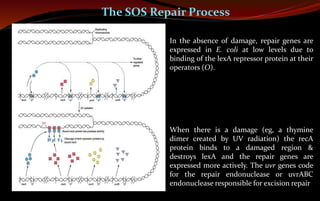
In the absence of damage, repair genes are
expressed in E. coli at low levels due to
binding of the lexA repressor protein at their
operators (O).
When there is a damage (eg, a thymine
dimer created by UV radiation) the recA
protein binds to a damaged region &
destroys lexA and the repair genes are
expressed more actively. The uvr genes code
for the repair endonuclease or uvrABC
endonuclease responsible for excision repair
The SOS Repair Process
Family of TLS polymerases
 Enzyme lack a proofreading exonuclease activity, and the fidelity of replicative
base selection.
 DNA polymerase V - Can replicate past many of the DNA lesions that would
normally block replication. Proper base pairing is often impossible at the site
of such a lesion, so this translesion replication is error-prone.
 DNA pol V mediated replication kill some cells and create deleterious
mutations in others.
 DNA polymerase IV, product of dinB gene, is also highly error-prone.
Mammalian TLS polymerase
 These enzymes does not cause unacceptable mutational burden becoz they
have specialized functions in DNA repair
 DNA polymerase η (eta) -. It promotes translesion synthesis primarily across
cyclobutane T–T dimers.
 Results in Few mutations, because the enzyme preferentially inserts two A
residues across from the linked T residues.
 DNA polymerases β, ι(iota), γ - have specialized roles in eukaryotic base-
excision repair. Each of these enzymes has a 5-deoxyribose phosphate lyase
activity in addition to its polymerase activity
.             DNA Repair Mechanisms.pptx

. DNA Repair Mechanisms.pptx

  • 1.
  • 2.
    DNA Repair  DNAcan be damaged by a variety of processes,  some spontaneous  Damage caused by environmental agents.  Error occurs during Replication (introduction of mismatched base pairs such as G paired with T).  The cellular response to this damage includes a wide range of enzymatic systems that catalyze some chemical transformations in DNA metabolism.
  • 3.
    All Cells HaveMultiple DNA Repair Systems Direct repair Mismatch repair Excision repair Replication fork encounters an unrepaired DNA lesion Base excision repair Nucleotide excision repair Recombinational DNA repair Error-prone translesion DNA synthesis
  • 5.
    1. Direct repair Damaged nucleotide is repaired directly without removing it. • Repaired by Ada (Adaptive) enzyme. • Removes alkyl group (methyl, ethyl, propyl, butyl) attached to the oxygen group at 4 & 6 of thymine & guanine. • oxidative demethylation of 1-methyladenine and 3-methylcytosine is mediated by the AlkB protein • Repaired by Photolyase • The process called Photoreactivation • Repaired by DNA ligase enzyme Nick produced by Ionizing radiations Cyclobutane Pyrimidine dimers formed by UV light Alkylation damage
  • 6.
    Formation of pyrimidinedimers induced by UV light. Formation of a cyclobutane pyrimidine dimer introduces a bend or kink into the DNA
  • 7.
    Photoreactivation  Direct photoreactivationof cyclobutane pyrimidine dimers, a reaction promoted by DNA photolyases.  Photolyases generally contain two cofactors that serve as light-absorbing agents, or chromophores.  FADH2  Folate (in E. coli - N5,N10-methenyltetrahydrofolylpolyglutamate (MTHFpolyGlu and yeast)  The reaction mechanism generates free radicals.  DNA photolyases are not present in the cells of placental mammals (which include humans).
  • 8.
    Photolyase binds topyrimidine dimer. 1. A blue-light photon (300 to 500 nm wavelength) is absorbed by the MTHFpolyGlu, which functions as a photoantenna. 2. The excitation energy passes to FADH in the active site of the enzyme. 3. The excited flavin (*FADH) donates an electron to the pyrimidine dimer to generate an unstable dimer radical. 4. Electronic rearrangement restores the monomeric pyrimidine's. 5. The electron is transferred back to the flavin radical to regenerate FADH. Mechanism of photoreactivation
  • 9.
     Guanine Cytosine O6 methyl guanine thymine (cause mutation)  O6 methyl guanine Guanine Methyl Transferase Damage/ mutation caused during replication
  • 11.
    Direct repair ofalkylated bases by AlkB.  In E. coli, oxidative demethylation of 1-methyladenine and 3-methylcytosine (alkylated nucleotides) is mediated by the AlkB protein, a member of the α-ketoglutarate-Fe2– dependent dioxygenase superfamily.
  • 12.
    2. Mismatch Repair Correction of the rare mismatches left after replication in E. coli improves the overall fidelity of replication.  The repair system must discriminate between the template and the newly synthesized strand.  The cell accomplishes this by tagging the template DNA with methyl groups.  The mismatch repair system of E. coli includes at least 12 protein components that function either in strand discrimination or in the repair process.
  • 13.
    Methylation • In prokaryotes,strand discrimination is achieved by methylation. • Dam methylase, add methyl group at the N6 position of all adenines within (5’)GATC sequences. Immediately after passage of the replication fork,(only methylates template strand) • DNA methylation helps to distinguish methylated template strand from unmethylated newly synthesised strand.
  • 14.
    • Replication mismatchesin the unmethylated strand are repaired according to the information in the methylated parent (template) strand. • methyl-directed mismatch repair system efficiently repairs mismatches up to 1,000 bp from a hemimethylated GATC sequence. • If both strands are methylated at a GATC sequence, few mismatches are repaired.
  • 15.
    Methyl-directed mismatch repairsystem MutL protein forms a complex with MutS protein, and the complex binds to all mismatched base pairs (except C–C). MutH protein binds to MutL and to GATC sequences encountered by the MutL-MutS complex. DNA on both sides of the mismatch is threaded through the MutL-MutS complex, creating a DNA loop. MutH has a site-specific endonuclease activity that is inactive until the complex encounters a hemimethylated GATC sequence. At this site, MutH catalyzes cleavage of the unmethylated strand on the 5’ side of the G in GATC, which marks the strand for repair.
  • 16.
    • Unmethylated strandis degraded in the 3’-5’ direction from the cleavage site through the mismatch, and this segment is replaced with new DNA. • This process requires the combined action of • DNA helicase II, • SSB, • exonuclease I or exonuclease X (degrades DNA in 3’-5’ direction) • DNA polymerase III and • DNA ligase. • The pathway for repair of mismatches on the 5’ side of the cleavage site requires • exonuclease VII (which degrades ssDNA in 5’-3’ or 3’-5’ direction) or • RecJ nuclease (which degrades ssDNA in the 5’-3’ direction).
  • 17.
    3. a) Base-ExcisionRepair  Every cell has a class of enzymes called DNA glycosylases.  It recognize a common DNA lesions (such as the products of cytosine and adenine deamination) and remove the affected base by cleaving the N-glycosyl bond.  This cleavage creates an apurinic or apyrimidinic site in the DNA, commonly referred to as an AP site or abasic site.
  • 18.
    Uracil DNA glycosylases- found in most cells,  specifically removes uracil from the DNA (not from the RNA) results from spontaneous deamination of cytosine.  Mutant cells that lack this enzyme have a high rate of G-C to A=T mutations.  In Bacteria - one type of uracil DNA glycosylase.  In humans - four types of uracil DNA glycosylase with different specificities. Human DNA glycosylases Function UNG associated with the human replisome, it eliminates the occasional U residue inserted in place of a T during replication. hSMUG1 removes any U residues that occur in single-stranded DNA during replication or transcription. TDG and MBD4 remove either U or T residues paired with G, generated by deamination of cytosine or 5-methylcytosine
  • 19.
    Other DNA glycosylases Recognize and remove a variety of damaged bases, including  Formamidopyrimidine and 8-hydroxyguanine (both arising from purine oxidation),  hypoxanthine (arising from adenine deamination), and alkylated bases such as 3-methyladenine and 7-methylguanine.  pyrimidine dimers in some classes of organisms.  AP sites also arise from the slow, spontaneous hydrolysis of N-glycosyl bonds in DNA .
  • 20.
    DNA repair bythe base-excision repair pathway. 1. A DNA glycosylase recognizes a damaged base and cleaves between the base and deoxyribose in the backbone. 2. An AP endonuclease cleaves the phosphodiester backbone near the AP site. 3. DNA polymerase I initiates repair synthesis from the free 3’ hydroxyl at the nick, removing (with its 5’-3’ exonuclease activity) a portion of the damaged strand and replacing it with undamaged DNA. 4. The nick remaining after DNA polymerase I activity is sealed by DNA ligase.
  • 21.
    3. b) Nucleotideexcision repair  DNA lesions that cause large distortions in the helical structure of DNA, repaired by nucleotide-excision system.  A multisubunit enzyme called Exinuclease (catalyze two specific endonucleolytic cleavages) hydrolyzes two phosphodiester bonds, one on either side of the distortion caused by the lesion.  In E. coli, the key enzymatic complex is ABC excinuclease, which has three subunits,  UvrA (Mr 104,000) - UvrA dimer helps in the tight binding of UvrB to DNA.  UvrB (Mr 78,000) - UvrA and UvrB proteins (A2B) scans the DNA and binds to the site of a lesion. After binding UvrA dissociates.  UvrC (Mr 68,000)- UvrC protein binds to UvrB and UvrB makes an incision.  The resulting nucleotide fragment is removed by UvrD helicase
  • 22.
     In E.coli and other prokaryotes – it generates 12 to 13 nucleotides fragment.  In humans and other eukaryotes - produce 27 to 29 nucleotides fragment.  The excised oligonucleotides are released from the duplex and the resulting gap is filled—by DNA polymerase I in E. coli and DNA polymerase ε in humans. DNA ligase seals the nick.  This pathway is a primary repair route for many types of lesions, including  cyclobutane pyrimidine dimers, 6-4 photoproducts  other types of base adducts including benzo[a]pyrene-guanine, which is formed in DNA by exposure to cigarette smoke.  Nucleotide-excision repair and base-excision repair in eukaryotes is closely tied to transcription.
  • 23.
     Genetic deficienciesin nucleotide excision repair in humans give rise to a variety of serious diseases  Defects in the genes encoding the proteins involved in DNA repair system is linked to human cancers. Disease Effect Defect Xeroderma pigmentosum, or XP People are extremely light sensitive and readily develop sunlight-induced skin cancers. Nucleotide-excision repair Hereditary NonPolyposis Colon Cancer, or HNPCC. The most common inherited cancer-susceptibility syndromes Mismatch repair (defects in hMLH1 (human MutL homolog 1) and hMSH2 (human MutS homolog 2) genes) Human breast cancer Women with defects in either the BRCA1 or BRCA2 gene have a greater than 80% chance of developing breast cancer. BRCA1 and BRCA2 are large proteins that interact with a wide range of other proteins involved in transcription, chromosome maintenance, DNA repair, and control of the cell cycle.
  • 24.
    Nucleotide-excision repair inE. coli and humans.
  • 25.
    4. Interaction ofReplication Forks with DNA Damage Can Leads to…….  Double-strand breaks and lesions in single-stranded DNA most often arise when a replication fork encounters an unrepaired DNA lesion. • Repaired by 2 systems  Recombination DNA repair  Error-prone translesion DNA synthesis (often abbreviated TLS) a second repair pathway.
  • 26.
    a) Recombination DNArepair  If both bases of a pair are missing or damaged, or if there is a gap opposite a lesion. This kind of a damage is repaired by recombination repair, (there is no remaining template is restored).  In this type of repair the recA protein cuts a piece of template DNA from a sister molecule and puts it into the gap or uses it to replace a damaged strand.  Once the template is in place, the remaining damage can be corrected by another repair system.  The recA protein also participates in a type of inducible repair known as SOS repair.
  • 27.
    b) Error-prone translesionDNA synthesis (TLS)  When this pathway is active, DNA repair becomes significantly less accurate and a high mutation rate can result.  In bacteria, error-prone translesion DNA synthesis is part of a cellular stress response to extensive DNA damage known as SOS response.  In this instance the DNA damage is so great that synthesis stops completely, leaving many large gaps.  RecA will bind to the gaps and initiate strand exchange. Simultaneously it takes on a proteolytic function that destroys the lexA repressor protein, which regulates the function of many genes involved in DNA repair and synthesis .  The system can quickly repair extensive damage caused by agents such as UV radiation, but it is error prone and does produce mutations. However, it is certainly better to have a few mutations than no DNA replication at all.
  • 28.
    Genes Induced asPart of the SOS Response in E. coli fully induced only late in the SOS response
  • 29.
    In the absenceof damage, repair genes are expressed in E. coli at low levels due to binding of the lexA repressor protein at their operators (O). When there is a damage (eg, a thymine dimer created by UV radiation) the recA protein binds to a damaged region & destroys lexA and the repair genes are expressed more actively. The uvr genes code for the repair endonuclease or uvrABC endonuclease responsible for excision repair The SOS Repair Process
  • 30.
    Family of TLSpolymerases  Enzyme lack a proofreading exonuclease activity, and the fidelity of replicative base selection.  DNA polymerase V - Can replicate past many of the DNA lesions that would normally block replication. Proper base pairing is often impossible at the site of such a lesion, so this translesion replication is error-prone.  DNA pol V mediated replication kill some cells and create deleterious mutations in others.  DNA polymerase IV, product of dinB gene, is also highly error-prone.
  • 31.
    Mammalian TLS polymerase These enzymes does not cause unacceptable mutational burden becoz they have specialized functions in DNA repair  DNA polymerase η (eta) -. It promotes translesion synthesis primarily across cyclobutane T–T dimers.  Results in Few mutations, because the enzyme preferentially inserts two A residues across from the linked T residues.  DNA polymerases β, ι(iota), γ - have specialized roles in eukaryotic base- excision repair. Each of these enzymes has a 5-deoxyribose phosphate lyase activity in addition to its polymerase activity